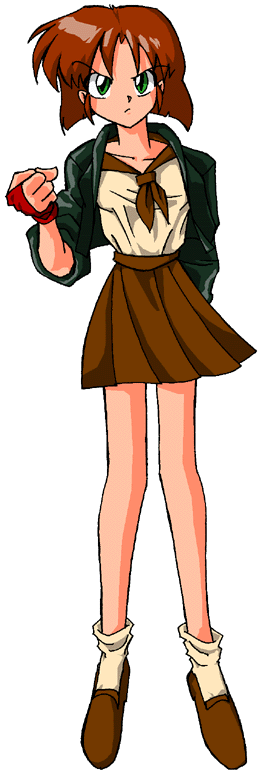
Scott Pilgrimage

I have never read Scott Pilgrim.

I’ve definitely heard about it, and I plan on reading it eventually, but as of this point I have never done more than glimpse a few pages. Regardless however, I know that Bryan Lee O’Malley has become a household name among geeks, and with the final volume of Scott Pilgrim out, he’s going to be well-remembered.

Imagine my surprise then when I discovered that the covers of Scott Pilgrim are not the first place I had seen Mr. O’Malley’s name.

Years ago I enjoyed reading the stories over at Improfanfic, a site dedicated to both fanfics and original stories with an anime flair. Each chapter of a story was written by a different person, providing the “improvisation” in the site’s name. Of these improfanfics, my favorite was probably Furniture Warriors, a parody  of shounen fighting tournaments and the like where all of the characters wielded chairs and tables with deadly precision. Feeling nostalgic, I decided to look at the page for Furniture Warriors at Improfanfic, where in the middle of the fanart section one name in particular caught my eye.

Could it be the same person? Could the “Bryan O’Malley” who drew these images and wrote various chapters of Improfanfic be the same Canadian whose work has had the honor of being adapted into a feature-length film?

All signs point to “yes.”

Bryan has mentioned at conventions that he is inspired by anime. Not only that, but if you look at the fanart there and compare it to the artwork in Scott Pilgrim, even though there is a markable difference in style, skill, and experience, I think you can definitely see small inklings of what the man would become.

Not only that, but going to the archive.org record of the website listed with his name and e-mail address on the FW page, it says:

In real life, incidentally, they call him Bryan L. O’Malley. And the L, of course, stands for Lunacy. He happens to be the only Canadian member of Maison Otaku.

So there you have it.

Keep in mind that my reason behind this post was not to show off my internet detective skills or anything, but to simply be amazed that the person whose artwork I saw way back would become responsible for such a phenomenon. It makes the world feel so much smaller, and yet also so much grander.

Now, time to get reading.

Heartcatch Precure Gettin’ All Self-Referential

Over the past few episodes, big things have happened in Heartcatch Precure. During this time, the show has made some references to past Pretty Cure series, and here’s a couple I’ve spotted.

Again, this is towards the end of the first half of the series, so there are spoiler-worthy things happening. I’d highly recommend you go watch the show before you read any further.

In episode 21, new fairy mascot creature Potpourri asks a number of characters if they could be the third Cure to go alongside Blossom and Marine, with one of the candidates being female soccer player Sayaka. When Sayaka mentions that her only skill is soccer, Potpourri assures her that in the past there have been Precure who were also good at soccer.

This refers to Natsuki Rin, aka Cure Rouge, the third in a line of Cures who are good at Sports (Cure Black = Lacrosse, Cure Bloom = Softball).

The bigger event of course is when Myoudouin Itsuki transforms into Cure Sunshine. Unlike Blossom and Marine who use “Heart Perfumes,” Sunshine uses a “Shiny Perfume.”

This is in reference to the character Kujou Hikari, aka Shiny Luminous, who was first introduced in Futari wa Pretty Cure Max Heart.

Further supporting this is the fact that the powers of Cure Sunshine are mainly defensive in nature, which was also the role Shiny Luminous provided to the original Pretty Cure girls.

However, the big difference here is that while Luminous never shed her protective role on the team, Itsuki comes into the team as the only trained martial artist to become a Cure, which means she balances her barriers with actual physical combat experience.

So that was just a small observation. If you’ve made it this far, congratulations on watching an excellent show and may I hope to see you once the series is over.

Enter Animefan

A couple of days ago I made a post discussing the way in which the purchase of anime-related goods often transcends the purchase of anime itself. I didn’t concentrate much on the act of buying anime, and was planning a follow-up post, but Omo over at Omonomono beat me to the punch. He brings up some good points that I want to touch upon while also elaborating on this whole idea of what it means to “buy anime.”

First, a story.

I once told someone that I pretty much only buy DVDs of things with which I’m already familiar, to which he simply responded, “Why would you buy something you’ve already seen?”

Whereas I saw my ownership of DVDs as a testament of sorts to the shows I felt were good and enjoyable enough for me to have them in my collection, the other person saw DVDs simply as a way to try new things out. In the end, we agreed to disagree.

While this person was not what you’d call a hardcore fan of any kind of media, I think his philosophy applies to a lot of how anime fandom sees anime: Why spend money to see something that isn’t new to you?

Omo hit upon a simple, yet profound idea: the act of purchasing DVDs is “meta.” Anime fans generally love anime because it presents a world to them with a story and characters to whom they can relate or from which they can derive some kind of enjoyment or escapism. They become fans of the anime, but not necessarily fans of the anime as a creative work. If most anime fans find some way of watching their favorite anime for free, and they subscribe to the idea of not paying for shows already viewed, then it is difficult to see why they would purchase a DVD of it, as that would require them seeing their favorite show not necessarily as a window into another world, but as an endeavor born out of the thoughts and efforts of its creators. In other words, on some level, they would have to appreciate their favorite anime as a work of art, which I have to ask, how often does that happen with entertainment in general, let alone anime?

Are anime fans actually less likely to appreciate their favorite shows as works of art? I believe so, and I use anime conventions as an example. When it comes to anime convention guests, the people who get by far the biggest crowds are the voice actors. On the one hand this tells us that a lot of fans can at least see past the character the actor portrays to the individual performer, but on the other hand the voice of a character is directly a part of the show itself. The influence a producer or a director or even a writer has upon a work is less readily noticeable by someone viewing a show, and as such these guests tend to get fewer sheer numbers. Is this any more or less than the audiences who see actors over directors for live-action movies? I don’t think so, but I wanted to show that as far as anime is concerned, this is the kind of thing that happens.

My words bring up another potential conflict: is there something bad about being one of those fans who sees anime purely as a window into another world? My answer is that I do not find anything necessarily wrong with not engaging one’s favorite shows on that “meta” level. Nor is seeing the strings necessarily a good thing; it’s pretty much all subjective in the end. Actually, if you want to see a good example of a fandom which balances the meta with the immersive, then look no further than professional wrestling.

In pro wrestling, there traditionally have been two terms used to describe people who enjoy it: marks and smarts. Marks are people who believe wrestling is 100% real, that the Hulk Hogan in the ring is actually who he’s supposed to be. They see pro wrestling as a venue for good to defeat evil, or at least for bad-good to defeat namby-pamby-evil. Smarts on the other hand are fans who know that wrestling is all staged. They know that there are writers and scripts and politics behind the facade of Nothern Light Suplexes and Shining Wizards, and having a keen understanding of the backstage actions is where they derive their enjoyment.

But those are the two extremes, and in this age where the cat is completely out of the bag about wrestling being “sports entertainment,” there arises a new category of fan: the “smart mark,” otherwise known as the “smark.” Like smarts, they seek the truth of what goes on with the wrestlers as actors, but are also eager to suspend their disbelief just long enough for them to cheer for the good guys and boo the bad guys.

So who is the “better” fan? Is it the mark for his genuine immersion, or is it the smart who appreciates the performance?  Or is it the smark who tries to combine both worlds, arguably at the expense of either side?

And how do you get all of them to buy your stuff to keep you afloat?

Otakumonogatari

Today it occurred to me that there is more to Bakemonogatari than what’s on the surface. No, I’m not talking about the occult subject matter or the Nisio Isin writing which can give even Japanese people pause, or even that Shinbo touch that the director puts into most of his works. Instead, what I’m referring to is the way Bakemonogatari treats otaku, or more broadly, anime and manga fans.

Now I want to ask, who in Bakemonogatari is an anime fan? The answer is no one and everyone. In this story, everyone is able to just mention obscure manga titles and make equally esoteric references with the assumption that somebody else out there will get them, almost like how everyone in Beyblade knows about tops.

Within the confines of its own story, Bakemonogatari normalizes the otaku, something that is exceedingly rare. In titles about otaku such as Genshiken and Mousou Shoujo Otakukei, the otaku is still seen as something special or at least different. Other works take aspects of reality and soften them through layers of otaku filters. Bakemonogatari on the other hand assumes otaku to be the starting point and moves the story forward from there, adding in all of those supernatural elements.

It’s kind of like how superhero comics are traditionally a power fantasy, taking the real world and making it a little more fantastic, but titles like Watchmen take the fantasy and inject reality back in. Not that I’m comparing Alan Moore to Nisio Isin, mind you.

The Hidamari Sketches

While looking through my recently-acquired volumes of Hidamari Sketch, I found myself enjoying the comic well enough, but gravitating more towards the interstitial drawings that populate the pages in between the 4-panel comics.

“Wow,” I thought to myself upon first noticing them, “These drawings are really nice and and have excellent line quality to them. I kind of wish the whole comic was drawn this way.”

But then I wondered about how that would actually affect Hidamari Sketch. Part of why I like a looser, heavier brush style is that it gives off a good sense of vibrancy and energy; it’s really visceral in a way but also can be extremely elegant. However, all of that has to do with the drawing itself and connecting to the artist, as opposed to the art style being a way to connect with the characters. Given that Hidamari Sketch is a pleasant slice-of-life story, soothing like a spoonful of honey, drawing that much attention to the hand behind the art might not be the best thing for it.

I can still hope though.

How Diabolical!

I think there’s more to the manga and anime series Zettai Karen Children than meets the eye, possibly some kind of elaborate conspiracy taking place over a period of years.

The series is about 3 young psychic girls defending the world alongside their adult caretaker (not pictured) Looking at the character designs, I think it’s undeniable that there is at least some lolicon appeal to these characters and that the creators are well aware of this element.

However, Zettai Karen Children does not run in some otaku-pandering magazine. It’s not like it’s from Comic High or Champion Red Ichigo or even Dengeki Daioh. ZKC runs in Shounen Sunday, the home of Detective Conan, Kekkaishi, Touch!, and Inuyasha. It’s meant to appeal to young boys first and foremost, though in a way different from Shounen Jump‘s more well-known approach of commercialized battling and the like.

Shounen Sunday has a well-established track record of introducing female characters who are on equal footing with their male counterparts with the goal of introducing the concept of males and females being equal to one another to children at an early age. There’s Ran in Detective Conan, Tokine in Kekkaishi, Minami in Touch!, and Kagome in Inuyasha. Having the main characters be the girls in ZKC means that the strength of females is readily apparent.

I have trouble thinking that Shounen Sunday would just let a series with lolicon elements run in its pages without some kind of ulterior motive to change or influence people, to just let it run to attract that older otaku audience.

As Zettai Karen Children has continued, the titular girls have aged. As of now, they are junior high age and their bodies have clearly matured. First, this implies that the progression of time is desired in the series, and second, that the girls are gradually moving away from being designed to have that very, very youthful appeal.

What I think they’re actually doing is an attempt to slowly create an  attraction to adult women in a group that might normally reject it otherwise. It’s using the power of the 2D complex to seize the hearts of otaku early on and then gradually wean them off of lolicon.

That’s Shounen Sunday, thinking long-term.

Yelling Till It’s Blu in the Face

HD video is currently the next step in increasing the visual quality of moving images, and it is certainly more detailed than anything in the past, but it just makes me think about how in terms of visual clarity, video is forever doomed to lag behind still images and photographs.

Here is a fiction re-enactment of the interaction between video and photography.

Video: I’m bigger and sharper and better than ever! Maybe I’ll finally win!
Photography: Well that’s great! By the way, have you seen my new ultra mega resolution that lets me get in 100 times as much detail?
Video: DAMN YOUUUUUUUU

Or something to that effect.

Of course video is more realistic in its own way, but through time we’ve seen that increasing desire for more realism in it, but just by the fact that for every step in visual clarity that video takes, photography and the like are able to be at least twice or three times better just by virtue of being static images.

This might make for a good shounen manga, actually. Personally I can’t wait for the heroic team-up to vanquish a common enemy.

And by common enemy, I mean REALITY ITSELF.

Ike! Pin Panels!

As Otakon draws nearer I’ve been steadily working on my panels, and I’ve come to realize that this time around I’m really concerned with giving good presentations.

That’s not to say though that I didn’t care about previous panels, nor that I haven’t ever presented in front of a crowd. I have plenty of experience for example defending my art portfolio for various thesis classes. But what feels different about this perhaps is that I really want to convey information in a way that really helps people grow as thinking fans. I want to make sure I do as much as I can with the time that I have so that everyone who attends can come away satisfied and feeling like they want more and want to do more.

I don’t have too many doubts though, as I think not only me but my co-panelists all have passions for the subjects we’ll be presenting, and so I think that once we’re in the spotlight we’ll do well. No pressure!

Otakon’s 21 days away, which seems like a lot but kind of isn’t. And then there’s that other thing looming on the horizon…

Believe in the Evangelion 2.22: You Can (Not) Advance that Believes in You

I watched Evangelion 2.22: You Can (Not) Advance over the weekend and I have a whole smattering of thoughts to put down on the subject. It’ll be part-review, part-editorial, and it will contain a ton of spoilers, so watch out.

Evangelion 2.22: You Can (Not) Advance is the second of four movies whose purpose is to retell the story of Studio Gainax’s Neon Genesis Evangelion, one of the most influential works ever in anime history. Fueled by hindsight and merchandise profits, Rebuild brings it all back while taking into account changes that have occurred in the world and in anime since the original series ended back in the 90s.

The basic premise of Evangelion is that a cataclysm in the early 21st century has left most of the world unpopulated. Ikari Shinji, a quiet, passive teenager, is tasked  with defeating otherworldly monsters known as “Angels” through the use of unusually organic-looking robots called “Evangelions.” However, his nature and personality make him perhaps the least qualified person in the world to be engaging in battle, let alone defending the Earth. He is supported by the organization NERV, which houses the Evangelions as well as his fellow pilots, the mysterious, stoic Ayanami Rei and the aggressive and competitive Sohryu Asuka Langley.

The idea seems fairly simple, but Evangelion would eventually become a whirling dervish of emotional trauma and introspection that sucks you into the characters’ thoughts and fears, and that characteristic of the series is by far its main strength, and according to some, also its main weakness.

Shinji especially is a pile of neuroses and doubts, which can make him an aggravating main character but also establishes him as quite a bit of an “anti-protagonist.” In watching the first Rebuild of Evangelion movie I found myself unable to engage Shinji, as they tried to build him up to have just an ounce more confidence and determination, but failed to spend enough time on his inner thoughts. His change of heart at the end of the movie comes so suddenly that it rings false to some extent as a result. Luckily, You Can (Not) Advance solves this problem with grace and artistry, which is to say, I liked this second movie. Now on to why.

While the movie opens with a fight between brand new character Makinami Mari Illustrious and an equally brand new Angel, I feel like the movie truly “begins” with the scene immediately after. Here, Shinji and his father Gendou, who is also the head of NERV, are at the grave of Shinji’s mother. Prior to the first movie, father and son had not seen each other in years, and so their relationship is justifiably awkward. Walls have been erected towards each other. However, here at the grave of Ikari Yui, both show that the walls are not absolute, that they are willing to express their feelings towards each other, if only briefly.

While Evangelion has always been about humans relating to one another, this idea of taking just that one tiny step towards trying to connect with others is what really sets apart the Rebuild of Evangelion from the original TV series. The characters aren’t significantly different from who they were in previous incarnations, but by attempting to reach out to others they encourage others to do the same as well, which keeps everyone from retreating into the comforting shell of personal insecurity. Ayanami Rei is seemingly without personality in the first film, and could have very well remained that way, but Shinji is able to reach out to her. In turn, in this film when Asuka (now sporting the surname “Shikinami”) confronts Rei and accuses her of being a “doll,” Rei is able to reply that she is not, but more importantly tries to help Asuka, who she sees as being much more human than herself and thus able to foster relationships outside of their “work.”

I really became aware of this element when Rei invites Shinji and Gendou to dinner to try and have them grow closer (or perhaps less distant). Amidst all of the talk of Angels and Human Instrumentality, I began to care a little more about this dinner, as I felt it skirted closer to the heart of the movie than anything else. The film follows a minor variation of the motto for success from another Gainax work, Gurren-Lagann, “Believe in me who believes in you.” Everyone is portrayed as a thinking and feeling being, even the Angels, who are not one-trick ponies but instead contain backup plans which are augmented by contingencies, hinting at the idea that they have brains underneath those monstrous facades.

The dinner ends up being canceled, as a disaster leads to Asuka and her new experimental Evangelion being possessed by an Angel. Shinji is sent out to fight the compromised EVA, but cannot act out of fear of hurting Asuka. Despite Shinji’s protests however, Gendou is able to override his controls, causing Shinji’s unit to go on auto-pilot and crush the Angel, with Asuka still inside. Shinji is justifiably upset at the whole ordeal, but what he curses most is that he ended up doing nothing. When Shinji is faced with a similar situation again, this time with Rei being the one at risk, Shinji is determined to not repeat the same mistake. Even if something terrible happens as a result, it’s better than having stayed on the sidelines.

The final scene of the movie mirrors one of the most famous scenes in Evangelion, that of Shinji falling unconscious and the EVA rampaging out of control, ultimately leading to it consuming the Angel in an orgy of violence and “evolving.” In this instance however, Shinji does not fall by the wayside and instead is fully in control. His desire to do something and make a difference where he once could not causes the EVA to transcend into a god-like state, visually captured by the movement and posture of the EVA. Neither hunched like normal, nor craven like when berserk, this divine manifestation stands with shoulders apart and head raised, as if to say that it has transcended into another level of existence. Its movements are steady and deliberate, with a clearly conscious mind behind them. In the end, Shinji is able to succeed because he has grown as a person with the help of those around them, who were themselves made better by knowing Shinji.

Whether or not I like this more than the original TV series is still up in the air, but seeing as there is so much to this film, so much to discuss and address, I am quite surprised that so much of the discussion going on about You Can (Not) Advance tends to be rather lacking. Instead of exploring the characters in-depth or talking about themes and story, the conversation revolves around talking about whether or not Asuka is tsundere, the levels of fanservice in the film, and how much merchandise the whole thing generates, as if to say that the movies do not contain any merit beyond being cash grabs. Why is that? I understand that Evangelion, being the classic it is, has been discussed to high heaven by anime fans the world over, but I don’t think any of us are too cool for school that we cannot bring about that fervor again.

Actually, a better way to put it would be to say that people seemingly do not allow the discussion to move beyond the idea that Rebuild of Evangelion is tapping into that pool of devoted fans. It is doing that of course, but no one ever said that they cannot still put heart and effort into the whole project.

So let’s talk!

(And if you’ve talked already, kudos to you.)

Box vs Sphere: What is a Well-Developed Character?

What is a one-dimensional character? What is a well-developed character? And how is it that two people viewing the same exact anime can reach entirely different judgments on whether or not its characters feel “real” or not? Those are the questions that have most recently been on my mind.

It makes me ponder the differences in the way people perceive the world and the people around them, as well as how those perceptions are then translated into the world of fiction. What do some people prioritize in their concept and understanding of a “three-dimensional personality” that runs so counter to the opinions and values of others?

Personally speaking, I find characters to be particularly well-developed in personality when I can sense that there is something more to them than what they are saying. It’s not like I want characters who are saying one thing and thinking another, however. It’s more about showing or at least hinting at a thought process behind those words. Genshiken, Eureka Seven, and Toradora! for example are particularly good at this, in that you can see the transmission from personal desire to choice of words getting filtered through the characters’ own personalities and values. But then I know there are plenty of people out there who dislike these series while accusing the shows of the very opposite of why I praise them. So again, what causes this conflict?

Many times when a character is seen as “artificially deep,” the accusation leveled at them is that they are simply there to fulfill a checklist. This isn’t necessarily wrong or unwarranted, and even I’ve used the “checklist” criticism before and have no real regrets doing so, but the question then becomes, how did these checklists form and who is responsible for them? To what extent are those negative checklists generated by one’s own standards of realism and authenticity?

What is more important for a well-developed character, that they start off with an almost palpable personality that reveals a heart and mind in them, or that they grow their hearts and minds over the long term?

What is more important, what you let the audience see, or what you let the audience infer for themselves? If you keep on revealing more and more angles, is the purpose to imply a sphere, or simply a many-sided polygon?

And how much of it is tapping into the familiar vs the unfamiliar?

It’s food for thought I haven’t really digested myself yet.