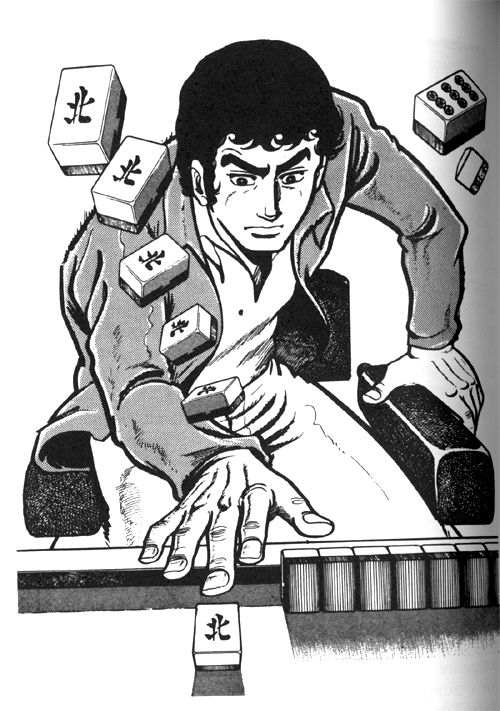
What to Buy, Man? Why, a Mahjong Set of Course!

The March gathering of the US Professional Mahjong League was possibly the most exciting yet.

For those who don’t know the USPML is devoted to playing Japanese-style mahjong, which is probably best known for the ability to declare a hand as “ready” or “riichi” in order to score extra points and to clearly reveal yourself as the aggressor. While I was without my usual accomplice on this occasion, I was joined by thedigitalbug, who I believe had heard of these mahjong sessions from my previous posts on the subject.

We played two games total, one east + south game and a quick east-only game after that. The first game was quite intense, with people declaring ron and tsumo all over the place, and not a single round ending due to all the tiles being drawn. I was the first to lose points in the match, getting hit for a decent amount, but my fortune was reversed as I managed to win using a high scoring hand which turned the tables of the match and put me in the lead. Actually, at first I thought my hand was worth less than it actually was, misreading my “junchan” (All sets have at least a 1 or 9 in them) hand as the similar and less valuable “chanta” (All sets have at least a 1, 9, or “honor” kanji on them). On top of that, by declaring riichi and winning instantly off of it, my hand’s score increased further. In total, I netted 12,000 points. To give an idea of scale, for these sessions we start with 29,000 points each and games typically use 25,000.

By the final round I was about 17,000 points in the lead, and the other players were scrambling for second place. With such a comfortable lead, I could have very well ended the game by intentionally dealing into another player’s hand, but thanks to a mix of luck, greed, good reading of the game, and even a fortunate accident, I managed to end the game on a very high note.

For this round, I started my hand with two 8-su (bamboo), which was the bonus “dora” tile. If you have seen Akagi, the “dora” tile was the centerpiece in the final battle between young Akagi and the blind player Ichikawa (in that instance it was the pure white “haku” tile). Seeing another 8-su discarded, I called for it, which, while improving my potential score, also limited its freedom by removing the only pair I had in my hand. Having a pair in your hand is a vital part of winning at mahjong, and I could have very well thrown my only opportunity away.

Things were looking good however, especially because I had two of the “south” wind tiles which in sets of three are worth extra, provided you are playing in the south round, or alternately if you’re sitting in the south position. Both of these criteria applied to me at the time so I would score off of both of these if I won. However, when I looked down, I realized my opponent had already discarded a south tile and I had simply failed to notice it. Silently cursing, I waited for the next opportunity, hoping that the last south tile (there are four total in a set) would fly out of someone’s hand. As luck turns out, the same player who had discarded it previously believed it to be a safe tile and decided to toss it out again. Seizing the opportunity, I called for it, and was one step closer to completing my hand. Now the open parts of my hand looked truly threatening, and the other players were surely aware of it.

In the end though, they were unable to stop me, and with a shout of “Ron!” I won off of a player’s discard. My hand ended up being the following:

Toitoiho (All triplets)
Honitsu (Psuedo-flush)
Bakaze (Round wind)
Jikaze (Seat wind)
Dora 3 (3 bonus tiles)

Which all together looks like this:

A demigodly hand

In total, this hand was worth a “Baiman,” or 18,000 points. Winning like this was a rare and wonderful feeling, like I was actually in a mahjong anime and lightning and thunder had come crashing down as I revealed my hand. Actually, I once again did not initially notice just how much the hand was worth, and had to have someone tell me its true value.

What’s funny about this win was that had I paid more attention in the match, I would have probably called on the first discarded south wind tile, which would have then changed the flow of the match considerably. It was possibly my brief lack of concentration which let me win so gloriously.

After some mutual handshakes and a quick break, we started the next game. Here, I did not do so well, scoring dead last, but I did manage to get one good hand in, and I had better concentration than last time. Previously, I had made the mistake of drinking too much soda, which dehydrated me and wore me down and hampered my ability to focus, but this time I went with a non-caffeinated root beer as well as a bottle of water. I still lost, but at least felt alert the whole way through.

I had a great time, as I do every time, and I don’t mean that simply because I won so hard that I accidentally impregnated a woman half-way around the world. It just reminded me that while online mahjong is certainly fun, the direct human element is irreplaceable.

As for the Pringles, they were available once again, but this time I ate them with a pair of chopsticks. Yes, it was rad.

You Get Off to… THOSE Drawings?

Occasionally I’ve run into people who have trouble understanding the concept of being sexually attracted to drawn images. In terms of anime fandom, this often comes in two forms, either disagreeing with a certain character design style or disagreeing with the very notion that anime characters look human enough to even warrant attraction. The latter appears to happen with people unfamiliar with anime and its depictions of sexuality, while the former, which I want to focus on, seems to occur when people from different areas of fandom encounter each other. “I don’t know how you could find Sayla Mass hot,” the Evangelion fan might say to the Gundam enthusiast, who will then fire off that Ayanami Rei is too anorexic and not like a “real woman” at all.

Some of the contention comes from the changes in prevailing trends in anime and manga art styles. For example, younger fans might not understand why other older fans think a certain character is “hot,” while the older fan may see newer characters and accuse them of looking freakish. And neither side is “wrong” in this case, their preferences are just different. Who’s to say which is closer to “human attractiveness?”

And so all of this recently got me thinking about the very concept of depicting humans sexually, and just how subjective it can be. Particularly, it reminded me of classic Japanese erotic woodblock prints known as “shunga.”


Artist: Miyagawa Isshou

Though they clearly do not look like anime or manga characters from the past fifty years, the women in shunga do share something in common with modern erotic stories such as Bible Black in that they all have faces which could not possibly exist in reality, but are still rendered depictions of a beautiful face concurrent with the trends of the time.

The other thing shunga has in common with erotic manga is that both are clearly designed for masturbatory purposes. I’ve intentionally chosen an image that’s relatively tame, but a trip to the NSFW wiki entry on the subject will make the “utility” of shunga that much more obvious. While you’re on the page , you might also notice that it’s not only the faces that are “unrealistic;” over-sized genitalia for both men and women and torsos contorted at angles physically impossible are common. While photographs did not exist in that period, they could have very well drawn people in more realistic poses, and yet they chose not to.

If you’re attracted to anime characters but at the end of the day look at shunga and think, “Man, I have no idea how anyone could find this hot,” then I think that can be a very good thing. On some level, it means that you can relate to those who have trouble with the idea of finding certain character designs sexy (or even the idea that drawn images of humans can be sexy at all without being photo-realistic) and so at the very least promotes a degree of understanding.

Postignorism

I like the postmodernist idea that when given a work of art,  fiction or anything with any degree of abstraction, everyone interprets it and enjoys it their own way. The artists have power but so does the audience. That said however, I do feel that there is a distinct danger in becoming too wrapped up in your own interpretation, particularly at the expense of what is actually there.

In the case of anime fandom, this often takes the form of watching something through the lens of esoteric criteria such as a set of rules for enjoying (or not enjoying) a series established by a fan community for a fan community. It’s okay to watch Inuyasha because you really like Sango, but it’s another matter entirely to judge a given episode’s merit almost entirely on percentage of Sango content or that the series would be objectively improved by more Sango screen time. Shipping can often become a similar beast. Having a favorite pairing is very reasonable even in series without a hint of romance, but the game changes when a series’ ability to provide ammo for that specific coupling is considered the most vital criteria of success.

There is a delicate balance in terms of arguing for the sake of the creator vs the sake of the audience. It may sound like I’m faulting the viewers for not going along with what the creators have laid out, but I understand that creators are not infallible gods even when it comes to their own works, and what they think happens in their own story can play out very differently on the page and screen. I encourage people to really understand their own tastes and to not treat their personal criteria as frivolous, but at the same time if your rubric for enjoyment is too narrow, then it starts to reach a point where what you’re demanding from a work of fiction is that it caters to you, even at the expense of the work itself. On some level it’s not even about like or dislike, good or bad, but rather making an opinion on what’s there rather than what doesn’t exist.

I want to emphasize that I’m not trying to tell people they need to enjoy their shows a certain way, as I don’t believe in that. However, what I do believe in is having some sense of how you approach fiction and to acknowledge the whole of the work when thinking about it, and then taking steps from there to express your mode of enjoyment. Indulging your fantasy is okay as long as you don’t confuse it for the “reality” of the story. If you’re going to be ignoring an aspect of a work, at least be somewhat aware that you’re ignoring it.

There Are Two Kinds of People in This World: Winners and Trolleys

In Anime World Order’s look back at the previous decade of anime, guest Matt Alt talks about how the true successor to giant robot anime isn’t current giant robot anime, instead bestowing that title to those shows which spawn trading cards and games revolving around collecting. Essentially, the true spirit of super robots lies not in the continuation of the aesthetics of giant robot anime, but rather in their ability to push merchandise.

Considering this point, I can only think about how much more today’s anime for boys fosters a sense of competition, with trading card games and the like being at the center of children’s entertainment. The kids don’t have to be competitive “high-level” players, and they don’t even have to necessarily know the rules, and I still think these games, even if their shows talk about friendship and honor, still push the theme of competition more than anything else. Just the fact that there are  specific rules and stats and points means that, in a given activity, there will be winners and losers, even if it’s just cheap plastic being spun in an enclosed space. In contrast, that’s not really possible when you just have toy robots and the like. You can perhaps beat your friends by collecting more toys than them, or even create arbitrary rules of competition or even create fake competitions between your toys as Cobra Commander attacks with his vicious horde of My Little Ponies, but at the end of the day there’s no definitive way to become King of Make-Believe.


Well, almost no way.

This in turn got me thinking about the anime fandom and how we have figured out ways to compete via anime. The act of watching cartoons is not really an area in which you can determine winners and losers (unless you say that we’re all losers), so the community instead focuses their competitive spirits towards anime-related activities such as making music videos and cosplaying. These competitions are far more subjective in their criteria and human judgment is paramount in determining winners, but all the same we have taken a relatively passive activity and found ways to test our abilities against others.

I don’t really have a grand point I’m trying to reach, as I’m just laying down some thoughts. But be it through subjective judging or concrete goals, I don’t think an increase in competitive spirit is really a bad thing. That said, it can be taken too far.

I Thought We Liked Mahjong Series!

While Akagi and Saki were probably a lot of people’s introduction to the notion of manga based on the game mahjong, I don’t think I’m alone when I say that my first introduction to “mahjong manga” was from Frederik L. Schodt’s seminal book Manga! Manga! The World of Japanese Comics.

In it, Schodt explores the burgeoning genre and talks about popular titles such as Mahjong Houroki (“Tales of a Wandering Mahjong Player”) and Jigoku Mahjong (“Mahjong Hell”), even citing the author of Mahjong Houroki, Kitano Eimei, as the sort of “father” of mahjong manga, who showed that a comic about dealing tiles could look and feel exciting.

Truth be told, while I was fascinated by the idea of mahjong manga back when I first read Manga! Manga! ten years ago, I am not so different than the people who discovered it through Akagi, as that was the first mahjong series which I actually had the privilege to see. And while I don’t expect mahjong manga to become a runaway success in even the scanlation community, it’s clear that it has its devoted followers.

Here’s the odd thing though: Where are the scans of Mahjong Hourouki? If Akagi and Saki have resulted in people from all over the fandom getting into mahjong even at a periphery level, why hasn’t anyone bothered to look into these significant works which established the genre that so many are enjoying now? And it can’t really be the case where fans of these newer series might not like the older series due to the artwork. After all, we’re talking about Akagi fans here, and I’ve never seen anyone proclaim, “If the characters don’t have ultra pointy faces and noses and everyone looks shocked all the time, then I refuse to read it!” And I see you considering making a comment where you reiterate what I just said. I’m watching you.

Oh, and of course the reason I’m talking about it in the realm of scanlations and such is that no sane company would license a mahjong series in the United States. The closest you’d get to one that could conceivably do well is Saki which is streamed on Crunchyroll, and even that is a bit of a stretch when you consider the not-internet.

The most likely culprit is probably scarcity. It’s no doubt difficult to find these old series in the first place, especially with a niche genre like mahjong. And I’m as guilty of not contributing to the pursuit as any other. This is the first post I’ve made about it, and it’s only because I was re-reading Schodt’s book today. But still, I’m making the call out. We have to find these old works, titles like Mahjong Fuunroku (“Mahjong Crises”) and Gambler no Uta (“The Son of the Gambler”), and bring them to the forefront of consciousness.

First there’s a Du, and Then I Couldn’t Hear the Rest

When it comes to uniting fans, Nico Nico Douga and episodic blogging have quite a bit in common.

Nico Nico Douga is a popular Japanese streaming video site which helped push popular Japanese memes such as the fusion of voice synthesis and moe, Hatsune Miku, and creating a small revival in the career of gay porn actor Billy Herrington by making clips from his videos running jokes among the community. Its most notable feature however is its unique comments system, where user comments are scrolled from right to left as the video plays. For some it’s an annoying feature which gets in the way of watching the video, but for others it’s the very lifeblood of Nico. Despite most of its content not being live, the comment system allows site users to experience a sense of “community” within the comments, by seeing what people had to say about a particular video at exactly the right moment.

Episodic blogging, or the act of reviewing and discussing individual episodes on a blog, usually as they are released, is even more removed from the concept of “real time,” but just like Nico Nico Douga it has the ability to unite fans by actively engaging in the very zeitgeist of internet fandom itself, by experiencing a series almost as it is airing, and having the format feel a little more permanent and a little more focused than simply sharing talk on an internet forum.

However, the ideal of episodic blogging is not often met, and in some cases this has to do with the shows being blogged about not being particularly good for the concept of episodic blogging. These are the kinds of shows where the blogger might simply go, “Eh some stuff happened this episode. It was all right, I guess.” While knowing that an episode of some show might be average is still something possibly worth knowing, after a while it bogs down episodic blogs as a whole.

Now if there is one current show that I think is very well-deserving of episodic blogging, it is Durarara!

Here you have a show where every episode is so packed with information that the normal custom of summarizing the episode extensively can become a great boon, especially when it comes to recalling the events of a previous episode. It’s also an ideal show for episodic blogging because the theme of the show itself is related to “living in the present,” and practically reflects upon the online anime fandom itself (which is no doubt helped by having a couple of characters who are otaku). Most importantly however is that while the show is an on-going story, its structure is such that each individual episode stands as something to be scrutinized and discussed, with the next one building on top of that.

So for those bloggers out there who have been tackling Durarara! episode by episode, keep it up. It’ll be particularly interesting to see just how your opinions and predictions change over time if at all.

True Honorable Spirit in 30 Minutes or Less

Over the years, I’ve probably gotten too much exposure to kids’ entertainment from both Japan and America. Because of that, as well as an idle comment made by someone I was talking, to I was recently thinking about portrayals of Japanese/American relations in each respective country’s cartoons and comics, and how interestingly they mirror each other.

In anime and manga, when an American character meets the primarily Japanese main characters, what almost inevitably ends up happening, especially if the American ends up being a friend or ally, is that he is able to understand the “true Japanese spirit” after his fateful encounter. Usually it’ll have to do with the determination and willpower of the Japanese, as well as just how much they can overcome in the face of superior forces.

But in American cartoons and comics, when a Japanese character appears, he almost always emphasizes honor. Honor is the most important quality in a Japanese character in an American cartoon, and there is always a point in the show, typically towards the end, where one or more American characters prove that they are truly honorable in the eyes of the Japanese character.

To some extent I think the American cartoon’s portrayal has to do with the mystifying image of the orient that has been a part of western fiction for centuries, while the Japanese cartoon’s portrayal supports the reassuring idea that, although Japanese people might not be the biggest or strongest, they can make up for that with intangible qualities. In either case however, this idea of winning over the foreigner and showing that, when you get down to it, respectable qualities remain very similar around the world, even if it’s portrayed through the lens of stereotypes and simple stories.

What do you think of this? Am I on the mark? Do you think things have changed significantly over the years so that this is no longer the case?

Guys We’re Gonna Make America Skinny Again One Poke at a Time


Hi, it’s Machamp with Cross Chop!

The Pokewalker is diabolical.

So the latest Pokemon game, Heart Gold/Soul Silver comes with a pedometer onto which you can transfer Pokemon and take them for walks. As you take steps, you get points in order to do things like get rare items and catch Pokemon. It’s partially designed to curb piracy, as not only is the Pokewalker something that you can’t really pirate, but the cartridge for the game itself has infrared sensors on it, so just having the rom isn’t enough.

But that’s not why it’s so fiendishly clever. The real and more sinister reason is that it’s going to get kids addicted to walking.

Consider the mentality that brought us “gotta catch ’em all,” the mentality that puts small children on the same wavelength as hardcore World of Warcraft players grinding up to max to open up the real game. Now apply it to light exercise. You could very well have kids just going out for long walks practically every day!

To some extent, it feels like saying, “Hey kids, if you get an A on your test, you can get a LEGENDARY POKEMON,” or, “Hey adults, the only way to defeat this super hidden boss is to FILE YOUR TAXES.”

Really, Wii Fit was a nice try, but it’s no Pokewalker.

Nonexistent Rationality

In light of the Handley case’s conclusion and the recent measure in Tokyo to outlaw sexually provocative imagery of characters 18 and under to protect “nonexistent youths,” as well as the subsequent opposition by manga creators from all over Japan, I’ve felt an increasing desire to state my thoughts on the whole situation. I’m not really anybody who can affect a change, particularly when it comes to the Japanese government, but I still want to say my piece.

Before I begin, I want to explain my stance on objectionable art so that you can understand where I’m coming from. Ask two different people from similar upbringings to list their sexual kinks, and you would likely see differences in their answers. People’s sexualities are very personal things, and often times people cannot help what they are sexually attracted to. They can ignore it, they can actively avoid situations in which they are exposed to it, and being confused about their own sexuality can lead a person to think they’re into something they’re really not, but sexual attraction, to whatever it may be, will be there.

And so you’ll find situations where something one person finds sexually attractive will be absolutely repulsive and morally reprehensible to another. It is not absolutely not wrong for a person to feel disgusted with something that makes them highly uncomfortable, and it is their very right to think less of anyone who finds such a thing arousing. However, it is my belief that laws should not be passed based simply on the fact that something is seen as creepy or disgusting. Laws should not be carried by emotion alone. In order for it to be a crime, there should be a real risk of harm, be it physical, psychological, monetary, or some other form to another individual, something that makes it more than just a “bad feeling.”

With that in mind, I want to get into the main thrust of why this bill to protect “nonexistent youths” is so dangerous should it pass. Simply put, it is too broad in its scope and so vague in its language that it can encompass pretty much anything. It is based too much on vague “feelings” and is inherently flawed.

Pornography is one thing, but the proposal extends to all potentially sexually provocative portrayals of characters 18 and under. That covers a lot of ground. Let’s take a classic example of something easily sexualized which is also a part of everyday life: the short skirt. How short does it have to be in order to be considered sexually provocative? What is the threshold? Is it the standard length for a Japanese school uniform’s skirt? In that case, I don’t think I have to tell you that there is a sizable population that would disagree with that. In that case, let’s just get rid of all short skirts on minors in manga and anime. But even long dresses can be deemed sexually attractive, possibly more than short skirts, depending on the individual. The same thing applies to getting rid of dresses and skirts entirely and replacing them with pants. Forbid sexually provocative imagery? I can only believe that the people who drafted this proposal have no idea how powerful the human imagination can be, especially that of a horny teenager.

The teenager is also an important individual to consider with this proposal. The idea of removing fictional portrayals of people 18 and under that could be deemed sexually provocative feels like a myopic decision created in the world of adults. The proposal is there to prevent adults from looking at underage characters in a sexual manner, but not everybody reading manga is an adult. And while I know that it is difficult to determine age based on a drawing given the sheer unlimited possibilities that can occur when pen is put to paper and an image is created, let’s just assume for the sake of argument that we discovered a way to 100% accurately portray the age of a drawn character, that the 16-year old on the page is 16 years old. If you consider the reader to also be a 16-year old, then it would only make sense that they would be sexually attracted to that character, that a 16-year old can be sexually attractive at all. Yes, there is a risk involved with attracting people who are much older than teenagers, but if we were to apply that logic to the real world, to “existent youths,”  it would be as if teenagers were being told that they weren’t allowed to look attractive because there’s a risk people outside their age group might find them attractive as well, or saying that people 18 and under cannot look attractive at all. Again, when taken from a purely adult perspective, it’s easy to see why this would make sense, but not everyone in Japan is an adult, and not everyone reading manga is over the age of 18.

Taking a broad view of censorship, artists and creators will push the limits of censorship as far as they possibly can, no matter how strict or severe the censorship may be. Genitals are censored in Japanese pornography, but their porn industry has found a number of ways around the “mosaic.” Some companies push the limits of pixel size in the mosaic, boasting that their mosaics are extra small, while the very concept of bukkake possibly stems from the goal of showing evidence of the male genitals without actually displaying them. If a limit on skirt length really were to be decided and skirts were deemed “okay”  if they were less than 4 centimeters above the knees at most, then some manga creator or artist out there would make sure to point out that a girl’s skirt is 4.000001 cm above. It’s one thing to set a limit and say, “this is the point you must not cross,” but to try and prevent anything sexual from being portrayed in visual fiction is a losing battle forever thwarted by the endless creativity of artists.

Crayola Couldn’t Come Up With These: Pokemon Heart Gold and Soul Silver Tomorrow

So I don’t know about you, but I am pretty psyched about tomorrow’s release of Pokemon Heart Gold/Soul Silver. A remake of the second generation of Pokemon games, playing through my copies of Gold and Silver in high school was a memorable experience which I’m eager to revisit all these years later.

You might be asking, “Why would you play a game that’s just a retread of a game you’ve played previously?” And the answer to that is: Pokemon.

I’m serious, there’s something about the games which has people coming back to it over and over, whether it’s the cute/awesome critters, the nice character designs, the fun of battling, or even peer pressure, there’s a ton of reasons Pokemon has endured, though probably the most prominent one is that it is easy for anyone to pick up and play, and yet also deep enough that those of us who want to get into it with a more competitive mindset can do so.

I do wonder what my team will be like this time around. I’ve always had a fondness for Furret, and it is Gold and Silver, so there’s a good chance I’ll be taking one on and then bringing it into battle against my peers.

I don’t know what big changes HGSS brings to the table in terms of changing the metagame of multiplayer Pokemon, and in fact I’m not even sure I’ll be jumping back into that world. Still, I get the feeling that I’ll start to gravitate towards it anyway. It’s practically in my bones which hit twice and are good for attacking through Substitutes.