Ogiuevolution: Thoughts on Genshiken II

As the premiere Ogiue-themed blogger, I’ve had quite a few people asking me about my feelings on the all-new manga sequel to Genshiken, or as I like to call it, the “best surprise ever.” I have a lot of thoughts to lay down, so put on your hats and let’s go for a ride.

I recently picked up the second and final volume of Genshiken author Kio Shimoku’s child-raising manga Jigopuri (the first volume of which I reviewed), where I kind of expected to see the one-chapter continuation of Genshiken that fans generally refer to as “Chapter 56.” After all, the Kujibiki Unbalance manga featured additional Genshiken chapters, so I figured this was no different. As it turns out however, there was no Chapter 56 at the end of Jigopuri Volume 2, which left me kind of curious as to where the continued adventures of Chairman Ogiue would end up. Upon hearing the news of Genshiken II (alternately “Genshiken Nidaime” or “Genshiken the Second” to differentiate it from the second anime TV series, Genshiken 2), I realized that Chapter 56 would probably simply end up as the first chapter of the new series; all Kio has to do is change the chapter number from 56 to 1. It’s not the first time the chapter numbers have been modified in Genshiken, either. Volume 8 of Genshiken featured chapters which weren’t published for the initial run in Afternoon, and so the numbers were changed accordingly.

Whether or not Genshiken II is a response to Jigopuri‘s lack of success (as far as seinen manga goes, infants are a particularly unorthodox subject, and the way Kio handled it even less so) or an attempt to regain popularity, I think it’s clear that Kio doesn’t simply want to rehash the original formula even if it is a sequel. Just at the outset, there are two major differences between the new Genshiken club and the old. First, whereas the club back in Volume 1 of Genshiken was populated primarily by guys, five years of time have transformed it into one filled with mostly women, which is something probably no one expected from the club for years and years since its original founding. Second, Ogiue is at the helm, but her importance in this role isn’t simply that she’s their new fearless leader. She’s carrying the increased momentum set by Sasahara when he first became chairman and decided that the club should participate at the doujinshi event Comic Festival, and is taking it further by leading the charge with her own artistic skills and experience. These two aspects alone will provide plenty of differentiation from the previous series, and even if it is a bit of a cash grab, I think Kio will likely try to make it more than just that.

But then I hear people asking, “What if it’s too different?” In the original 2channel thread which revealed the news to the internet, a number of commenters voiced such concerns, talking about the different gender balance of characters, how the series appears to have become populated with moe harem character types, and simply that they could no longer relate to the series with its relative lack of “typical” otaku.  While I don’t agree with everything said, I can definitely see where they’re coming from. When you compare Chapter 1 with Chapter 56, it can feel like night and day even when you ignore the drastic art difference. It almost makes you feel like saying, “What happened to Genshiken?”

The answer is, chapters 2 through 55 “happened.”

While the themes of growth and change are much more prominent in the second half of the series, Genshiken has always featured them to some extent, right when Sasahara decides to check out the clubroom. Along the way, each new club member influenced the old ones and vice versa, with the final result being characters who are different from when they started, more confident about themselves and a little less worried about distinctions betwen otaku and non-otaku. So yes, the Modern Culture Society is no longer filled with anime fans who can’t talk with girls to save their lives, but it didn’t happen out of the blue, it isn’t unrealistic, and Genshiken isn’t a series with static characterization.

The more negative responses about Genshiken II seem to imply that success is less realitic than failure, that pain more of a truth than pleasure. While I simply cannot agree with that, it kind of puts things into perspective. Perhaps some of the fans feel that as the characters and the story of Genshiken progressed, they ended up outgrowing the fans themselves to the point that the series no longer felt like it spoke to them. But even then, I think that fans can still relate to the new cast of characters, regardless of gender differences, and it can feel just as close to home, if not closer. After all, I relate to Ogiue, and this is where it’s taken me.

Additional thoughts:

Of course, I recognize that at least three of these characters are entirely new, so they don’t have the same emotional attachment as the previous club members, but I say give them a chance. At the very least, I received a good impression from Yajima, Hato, and Yoshitake in Chapter 56, and remember that the old characters were once unfamiliar too.

If I were responsible for Kio Shimoku creating a new Genshiken spinoff, it would have to be Angela Burton’s American Anime Club.

As for the “harem” complaint, I think that’s just an exaggerated complaint about the mostly female cast.

Manga Artists and Their Stylistic Progression: A Video Demonstration

A while ago, I found a series of videos on Nico Nico Douga wherein manga characters from the first volume of their respective titles are compared to their later incarnations in the same series. In most instances, this is done to show some kind of great contrast, either by a marked improvement in drawing ability or an unusually large shift in style. I think it’d be to everyone’s benefit to take a look, and because I understand that not everyone has a Nico account or wants to fumble with the Japanese language registration, I’ve taken the liberty of uploading all three videos to Youtube. You can find them at the bottom of this post.

Regardless of how exactly the change comes about, the shift or transformation in art style seems to most often come from increasing familiarity. Speaking somewhat from personal experience, when you first start to draw a character, even if you’ve planned them out extensively, there’s still a period of struggle where the character’s design and by extension their personality and physical language are not yet ingrained in your psyche. The more you draw the characters, the more natural they feel to you, possibly eventually reaching a point where you’re so comfortable with them that your aesthetic sense and personality start to shine through the characters, almost subconsciously. It’s like your body and mind start to prioritize what’s really important to you, and I think you will definitely see this happening for at least a good number of your favorite artists.

So take a look, be amazed, and lay down your own thoughts and feelings about art in manga. If you’d all prefer, I can even compile a list of all of the artists and titles mentioned here.

He’s So Through, You Know

Parkour is an activity French in origin where practitioners try to get from point A to point B in the most efficient way possible, usually navigating through obstacles rather than around them to save time.

I can think of at least two anime characters who already have the right mindset for this non-competitive physical activity.

Kageyama Torako (Hyakko)

Her obsession with moving in a straight line towards her intended goal no matter the circumstance means that Torako has a bright future in Parkour, though she perhaps has to work on the fact that she actually ends up taking longer to get to her destination.

Raoh (Fist of the North Star)

Physical roadblocks actually mean nothing to him, as the man is actually unwilling to walk around a building if he can simply walk straight through it. Some might say that he’s too lacking in acrobatics for Parkour, but I think his spirit is in the right place.

Can you think of any other potential Parkour specialists out there in anime and manga?

On Powerful Female Characters

Seeing the comments I received on my post about strong female characters two days ago, I noticed that much of the difficulty in the discussion comes from people disagreeing on the very definition of the term (as is the case with so many anime arguments). Re-reading the examples given there and elsewhere, I’ve come to realize that the issue stems from the fact that when many people use the term “strong female character,” they actually mean “powerful female character.”

It’s a simple yet profound difference. Think about how you’d use the two words to describe a real person.

“That woman is strong.”

“That woman is powerful.”

It rings differently, doesn’t it? Power can refer to a number of things. Physical ability, political influence, knowledge, specialized skills, it all comes down something which gives a character the tools to do things better than others. But when you say someone is strong, you’re generally talking about something deeper inside, such as an iron resolve or strong convictions.

That’s not to say that just because a character is powerful can’t meant they’re strong or vice versa, of course. And many times a series can potentially undermine a strong character by intentionally or unintentionally placing emphasis on “power.” Even so, I think this is where most of the misunderstandings occur.

So I guess the real solution is to ask both questions.

What do you think of the status of strong female characters in anime and manga?

What do you think of the status of powerful female characters in anime and manga?

On Strong Female Characters, Again

Occasionally people say that anime and manga have a dearth of strong female characters, that they are relegated to supporting roles where they must step aside for the male leads. But while such characters do exist, to think that they are the majority of female characters in anime and manga betrays a myopic view of anime and manga fueled primarily by titles designed for guys looking for some kind of power fantasy.

I recently began reading Attack No. 1, a 60s shoujo manga about volleyball and one of the most famous sports manga series ever. Being a 60s title and well before the advent of the Showa 24 Group, I somewhat expected the main heroine Kozue to be demure and dainty and in need of a strong man, but I was proven completely wrong. That part in the anime’s opening where Kozue goes, “But I shed tears. I’m a girl, after all?” That is a complete diversion from what she really is.

In the first few chapters, Kozue is a transfer student who antagonizes the teacher by sleeping through classes, then goes up to the girls’ volleyball team and accuses them of not truly understanding volleyball. She then makes a bet that she can beat their trained team using just a ragtag bunch of complete beginners, and then in order to achieve her goal trains her erstwhile teammates so hard that they collapse from exhaustion repeatedly.

Everyone talks about how Hagio Moto and her comrades revolutionized shoujo manga, and they surely did, but going back even to the prior decade we can see a heroine who shows strength, both inner and outer. And as you continue along throughout the decades, you can see more and more examples. Don’t let the popularity of certain titles and genres blind you.

But I also realize that it’s very easy to call just about any female character a “strong one,” particularly when they are designed to be badass action heroes. These fall into two dangerous categories, the first being the “action damsel,” where a girl is a strong and capable fighter up until the point that she gets kidnapped and needs a man, and the second being the “man in a woman suit,” as Hisui from the Speakeasy Podcast so put it. The issue with the former is that it tends to undercut all of the development a female character might have, while the problem with the latter is that it pushes a very specific idea of what it means to be “strong.”

In the same podcast, Hisui also says that his problem with the “man in a woman suit” is that it is essentially a shortcut to actual well-developed character portrayal, and that it is pretty much shallow. I pretty much agree with Hisui on this matter, but I also want to address another great danger that comes from associating the idea of “strong female characters” with “tough action hero,” and that is that it implies that the only way for a female character to be strong is to be “like a guy,” or to put it more broadly, that the only way is through physical strength and hardened grit and determination.

Think about that for a moment. It’s bad enough that we define male strength through physical prowess, but to also try to group women in there as well is a grave mistake. Putting characters and fiction aside for a moment, true strength comes from within, it is not something measured simply through muscles and athletic ability. While a person who is physically strong, male or female, can also be strong inside, the former without the latter is an empty shell. Though I know that Hokuto no Ken isn’t the best example of strong female characters, as most of them are there to just stand aside at let men fight men, I think of the little girl whom Kenshiro rescues early on, Rin.

In one chapter, Rin is kidnapped by a gang of misshapen thugs who have terrorized an entire village. In order to oppress the villagers, the gang ruthlessly forces them to walk on a pit of fire, with many casualties naturally resulting. The villagers are gripped with fear, but when it’s Rin’s turn to walk the coals, she remembers Kenshiro’s words, that she cannot give in to fear, that she cannot let them win. Rin willingly walks towards the flames, head held high, and in doing so shames the villagers. If such a little girl has the spirit to fight back, what does that say about all of the full-grown men who cowered in the shadows?

Then Rin eventually becomes some kind of damsel-in-distress and there’s a whole marrying Rin arc when she gets older, but I chalk that up more to the second part of Hokuto no Ken being terrible overall than anything else. But there it is, even in Shounen Jump you can find a display of great inner strength in a female character, albeit temporarily.

One more time, I want to state that strong female characters in anime and manga definitely do exist and in large numbers. If asked, I can even start listing them off, but the important thing to take away here is that you simply have to look in the right places with the right mindset.

Otakon 2010: I Don’t Believe It. That’s Unbelievable.

At this point, having gone to Otakon for the past four years, I feel it safe to call myself an Otakon veteran to some degree. In terms of what to expect, this year didn’t feel that different from all the previous times I went, but a lot of things have happened to me over the past year or so, makes me think I’ll reflect back on Otakon 2010 particularly fondly.

Ogiue Maniax’s Panelist Debut

Otakon 2010, from July 30th to August 1st, was the first time that I came to the convention as a panelist. And I had two to boot!  It may have been obvious from all the posts I made about panel preparations, but I really wanted to do a good job and I really wanted people to come to the panels, so up until I finished both of them, I had been very nervous.

The mahjong panel, titled “Riichi: Japanese Mahjong, Anime, and You” was a collaboration between me and Sub over at Subatomic Brainfreeze. With a 9:30am Friday timeslot when a good portion of the con hadn’t even been registered, and a fairly obscure topic like mahjong, we were both worried that our panel attendance would amount to our friends and acquaintances, and while we would have been glad to teach them about mahjong, our real goal was to reach those people who were only barely familiar with mahjong anime. Fortunately, the turnout was better than we had ever expected, and while I am to understand that our panel room was the smallest of the bunch, we still managed to pretty much fill the whole room, getting approximately 160 people to listen to us talk about an old Chinese tile game and the way it works in Japanese cartoons.

The Riichi panel itself also went far better than we expected. Knowing how much information there was to convey despite the fact that we had already decided to cut large amounts of information, we had practiced the panel on multiple occasions, barely finishing on time. But while our practice sessions felt kind of strange and awkward, the actual panel itself had an amazing energy to it. Both Sub and I were playing to our strengths, playing off of each other, and we managed to give all of the information we wanted to while also keeping the audience entertained. We even finished early and had a good amount of time for questions! From this experience, I have learned that Sub and I make a good paneling team and I look forward to the next opportunity we have to do a panel together.

By the way, for those of you who were at the mahjong panel but were unable to copy down the URL for the additional mahjong resources, here it is.

My second panel was also on Friday, but at the opposite end of the day at 11pm. Entitled “Portrait of a Fujoshi: The Psychology of Ogiue Chika,” this joint effort between myself and Viga the Otagal was in many ways a culmination of what I had been doing on this blog. Last year, Viga challenged me to do a panel all about Ogiue, and that’s how we ended up on stage.

I understoood well that even if a good portion of the convention was into yaoi and Hetalia and the like that they would not be interested in deep character analysis, so while the panel attendance wasn’t as high as it was for the mahjong panel, it was still quite impressive, and once again we managed to play off the energy of the audience and each other and give a good presentation, with me giving a more subdued approach. Also, once again, where practice netted us a panel that had about 10 minutes worth of Q&A, the actual thing gave us three times the amount. While I wish we had prepared more, I think we did a good job of expressing what makes Ogiue such a great character and why we connect so well to her (and why you should too!).

When I think about it, doing a panel on a single character is unusually rare at an anime con. You have panels about Evangelion, but never is it a panel specifically about Ayanami Rei. I hope we can start a trend at anime cons, as I think it’s a worthwhile way of running things.

I don’t know if any video recordings are available so I apologize for those of you who were unable to attend but wanted to see them. I also want to say thank you, thank you from the bottom of my heart, to all of you who attended my panels. I hope you enjoyed them.

Now having panels at both extremes of the day has its drawbacks, but it also had the great benefit of avoiding conflict with the majority of events, thus freeing up the rest of the con for me. As is the case with every year, my primary mode of entertainment at Otakon is the panels, both industry and fan. Fortunately or unfortunately however, I found that there was still too many entertaining things crammed into a single weekend and I still had to sacrifice one panel for another.

Industry Panels

In terms of guests, I was not looking forward particularly to any of them this year, but I’m glad I attended the Q&A’s that I did as all of them provided incredible insight into the industry, with Mitsuya Yuji’s panel perhaps being the most informative of all. Attending his Friday panel, the voice acting veteran told us how voice acting became a “profession” rather than a side job for dramatic actors and how voice acting should come from the entire body and not just the voice. He also talked about how in the old days, if you flubbed a line, rewinding the film reel and readjusting everything was a huge pain, so mistakes were a big deal.

Throughout the panel, Mitsuya showed us what it was to truly be a voice actor, from passionate yells (he delivered a passionate “CHOUDENJI SPIIIIIIN” on more than one occasion) to voice changes to even the change in jobs given to you as you age and can no longer be the handsome male lead. Also, seeing as his debut voice acting role was as Hyouma, the main character of Combattler V, I asked him the question I had asked of Macross director Ishiguro and Gundam creator Tomino: What were your experiences with legendary anime director Nagahama Tadao?

Mitsuya gave us the impression that Nagahama was an incredibly passionate man. Gentle and understanding, he took his role as director very seriously and pushed Mitsuya to improve his performance. Mitsuya had originally tried out for both the lead Hyouma and the rival Garuda, and Nagahama made him redo his Garuda takes ten times. When asked if this was typical of a mere audition, everyone said that this was highly unusual. Mitsuya would later find out that all of this, from the audition to the strict voice sessions, were all signs of the fact that Nagahama had seen the amazing potential Mitsuya had and wished to nurture it into something greater.

Maruyama Masao was back again this year. The head producer over at Studio Madhouse, in my opinion the best anime studio there is, Maruyama is a staple of Otakon, but despite the fact that he comes pretty much every year, I look forward to it every time. This year we finally learned that Redline, the series he had been working on for six years which he also mentioned at numerous past Otakons, is finally getting a theatrical release in October, though its director also passed away before it could debut. Redline is  high-intensity anime, resembling the most elaborate portrayal of F-Zero ever, and Maruyama claims it will be the last truly hand-drawn anime ever.

Otakon was also the American debut of Welcome to THE SPACE SHOW, a feature-length film from the animation team which brought us Read or Die and Kamichu. As such, the creators were also there at Otakon, and managed to have an informative Q&A session. I gave a question targeting mainly Ishihama, the character designer, asking if he felt there is a trend in anime films to move towards simpler character designs which lend themselves towards looser and more whimsical animation. Ishihama responded that he believed there is indeed such a trend, but that there is also a counter-trend present, where more detailed, less fluid animations are also becoming popular.

As for Welcome to THE SPACE SHOW itself, the movie is quite fun but is too unfocused. The story of kids who travel into outer space in a way reminiscent of Galaxy Express 999, the film had opened up many good directions the story could have gone but ended not taking very many of them and losing a good deal of its potential. The film also dragged on after a while in a way where even the expertly animated sequences and wonderful set of aliens felt less exciting overall. At the Q&A session, we learned that this was the team’s first feature-length work, and in hindsight it really showed.

The only American industry panel I ended up attending was the Vertical Inc. panel with Ed Chavez and Peepo Choo author Felipe Smith. Ed, responsible for all of those Vertical Vednesdays I keep talking about on the blog, is about the most personable marketing guy in manga. While giving hints at interesting new titles coming in the future (including another Tezuka title), he also showed that he has some strong opinions on manga, stating that Vertical would not license Yokohama Kaidashi Kikou because “I don’t like it.”

Fan Panels

I had a lot of fun with the fan panels I attended, which mainly focused on exploring elements of anime and manga but I also attended some fun ones too. In the “elements” category there were three panels:  “You Don’t Like Moe and Here’s Why,” “The Changing Faces of Anime,” and “The Life and Times of Akiyuki Shinbo.” In the “fun” category, there was Anime World Order‘s “10 11 Anime You’ve Never Heard of But Must See,” the “Mecha Fan Panel,” and Megaman in Anime and Manga.”

The moe panel focused on the concept as a phenomenon and the meanings it gains as it has become a part of the industry itelf. It took a while to get off the ground but eventually found its footing, and the best advice I can give to the panelists is that more can be done to bridge the gap between what they are talking about and what the audience understands.

The Changing Faces of Anime panel, run by Evan Minto of Ani-Gamers, was a literal look at faces in anime, discussing changes in character designs over the years. It was a good panel which generated even better discussion, and it’s a difficult topic to tackle in only an hour.

The Shinbo panel, presented by wildarmsheero, showed that he had clearly done his research on the eccentric director and took a look at all the stylistic elements Shinbo loves to employ in his works. It ran a big long, forcing the Q&A session to be cut.

The “Must-See Anime” panel was very entertaining, though it was focused less on recommending good shows to anime fans and more about showing amazingly obscure anime that were difficult to obtain and had a lot of excitement value (but could still be good shows). I know that I’m going to track down Natsuki Crisis and other titles. Also, while obviously the clips themselves say a lot, it also doesn’t always convey some of the more overarching positives of a title, so more talking might be a good idea.

The Mecha Fan and Megaman panels meanwhile were fairly similar, giving the history of mecha and Megaman in Japanese graphic fiction. I won an old issue of Nintendo Power at the Megaman panel, and enjoyed the liveliness of the mecha panel, but I think that both could benefit greatly from delving even more into their topics. The Megaman panel also suffered from everyone reading from their scripts too much. It was very obvious that everyone at the panel was an expert in the field of Megamen, and I think removing the script would have made it more personable. On the other hand, it also showed the best Rockman.exe opening, so it’s all good.

Entertainment

While neither was truly the start or the end of the convention, I find that the opening ceremony and the Home Made Kazoku concert act as nice bookends to the con proper, mainly because of the positive impression Home Made Kazoku made on the audience at the former, which led to great anticipation about their performance for the latter. A hip hop-oriented Japanese group, their music and live performance was really infectious, and I think that music-wise it was a great success for Otakon this year, especially when I found out that the shamisen-playing Yoshida brothers managed to fill the concert area so tightly as to nearly be a fire hazard.

Speaking of fire hazards, the talk of the town was clearly the fire alarm Saturday Afternoon which forced all of the nearly 30,000 attendees to evacuate the Baltimore Convention Center. Given the general immaturity of the con crowd (including whoever actually pulled the fire alarm), I was pleasantly surprised to see people doing the right thing in the even of the fire: leave in a calm and orderly manner. Even the most rambunctious anime teen knows not to mess with this sort of thing, which brings a smile to my face.

Food and Friends

But going to a con isn’t just about the anime or the guests, it’s about meeting people and having a great time doing so. The con begins on Friday, but the con experience truly begins the Thursday before, from the point the bus arrives, and only really ends when we get back home. This year’s Otakon featured the return of glorious Brazilian Buffet, being amazed at the evergreen awfulness of G-Saviour while watching it in the hotel room, large gatherings with people relaxing and joking about, and amazingly deep discussions about everything anime and manga.

As I rode the bus home with my travel companions, we discussed for about four hours straight the very nature of enjoying anime and manga, as well as their qualities as creative forms of expression, and it made me realize just how much better conventions are when you add the human element to it.

I love it, and love makes Otakon better, I can guarantee you that.

Sho Nuff Himself Would Be Scared

When I think of western anime fanart, the first thing that pops into my mind is something I call the “Deviantart style.” Characters are usually drawn fairly realistically, their bodies becoming canvases for a psuedo-airbrushed look, every shadow and every highlight blended so softly that characters can probably be best described as “glowing.”


Artist: Yanimator

Artist: Ramy


Artist: REIQ (NSFW)

Now I am fully aware that Deviantart is home to an incredible variety of artists, and that even among the anime-style artists this is not anywhere close to the sole artistic style present. Nor am I even saying that this style is bad. However, as far as I can tell, this glowing style tends to be the most popular and ubiquitous, especially at anime conventions.

So my questions are: Why is this style so popular, and how did people learn it?

When I look at the most popular manga artists, none of them actually color their images in this manner, not Kishimoto (Naruto) nor Kubo (Bleach), and especially not Oda (One Piece). Branching out, I can only think of a handful of artists who get anywhere close to that Deviantart style, and most of them cut their teeth in the world of adult doujinshi, such as Satou (High School of the Dead), so their styles end up being closer to visual novel CG than anything else.


Artist: Satou Shouji (aka Inazuma)

One major difference is that the aforementioned Shounen Jump artists all color using real tools, and when I think about it, the Deviantart style seems born out of an almost purely digital environment, where textures can be finely tuned to almost microscopic levels, and stroke lines can be edited down with the utmost precision. It is, perhaps, a style resulting from the ability to hit ctrl-z in Photoshop and Illustrator. Of course, I’m not saying that it’s an impossible thing to overcome, but that perhaps artists who have experience with traditional media may be better at transcending limitations and making that style their own.

When it comes to anime artwork among western fans, I feel like there is an obsession with “realism.” In OEL manga for instance, a great amount of attention is put on screentones for smooth shading and for perspective in building backgrounds. With fan artists, perhaps this manifests itself into a hyper-realism where vibrant gradients rule the land. Not to pick on him again or anything, but it feels like the “five-tone shading” concept taken to the extreme, where the number of tones approaches infinity and the whole thing turns into a calculus metaphor. In a way, it reminds me of superhero comics, where musculature is emphasized greatly because they similarly harken to reality through exaggeration.

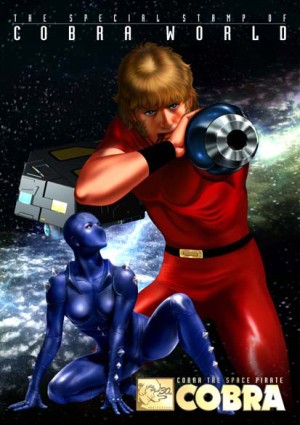
The closest artist I can think of which combines all of these elements is probably Terasawa (Space Adventure Cobra), but I get the impression that not very many artists on Deviantart take their inspiration from Terasawa.

Artist: Terasawa Buichi

But this is all speculation on my part. What do you think of the Deviantart style? Like it? Hate it? Do you use it? If so, what are you influences?

I just want to figure out how it came to be.

The Soul of Doujinshi: Why I Like the Comic Party Anime

As more and more dating sims and visual novels have gotten adapted into anime, the question of what makes a good adaptation frequently comes up. When I’m asked this, the title I most often mention is Comic Party.

I’m going to get into specific story details to express the strengths of Comic Party, so I’m going to be spoiling a good deal. Also, I have never played the original game, so while I am aware that a number of differences between the source and the adaptation exist, I do not know to what extent, aside from the very fact that the main characters seem to have been de-aged from college to high school.

Based on the dating sim by To Heart creators Leaf/Aqua Plus, the first Comic Party anime is not that different from a number of similar titles. A single guy finds himself surrounded by a variety of girls, including one childhood friend, one bespectacled jokester, one quiet girl, and so on, only this time the guy is a fledgling doujin creator and the girls are fellow doujin artists, cosplayers, and otaku. But what sets apart Comic Party from other dating sim adaptations is its approach to that single guy, that protagonist around whom the story revolves.

Kazuki, amateur artist, is introduced to the world of doujinshi by his enthusiastic otaku friend, Taichi. Although a rocky start, Kazuki ends up being inspired by a number of other doujin artists and eventually creates his very first doujinshi. A square-jawed violent tale of gangs and guns called “Not Hundred,” Kazuki’s isn’t exactly a crowd pleaser, but still manages to sell a few.

The joy of having his own artistic work purchased and read by others gives Kazuki a new determination. For his second attempt, he would do some serious research, learning what people wanted in doujinshi and how he could best incorporate all of it into a single work. Full color, twice the size (and price) of his first doujinshi, and featuring a big-breasted giant robot pilot as its main character, Kazuki was confident that his follow-up would be a smash hit, but failed to realize that in his attempt to make a big seller, his work lost its soul in a way that was recognizable to anyone who picked it up.

Feeling dejected, Kazuki abandons the world of doujinshi. However, with the help of the friends he made along the way, Kazuki is able to regain inspiration and draw again. Though his third work is rougher than the last two, even being made by xeroxing copies at the local convenience store, it is clear that his enthusiasm and spirit are stronger than ever. Kazuki learns what it means to be an artist of doujinshi.

Kazuki’s character is remarkable, particularly when you compare him to other dating sim heroes, where most protagonists of these adaptations are primarily viewer surrogates who act as guardian angels of sorts to help solve the problems of the girls around them. While this exists to some extent in Kazuki, what’s more important is that Kazuki has a significant character arc. He finds a goal, grows, falters, and recovers, and comes out of it a better person. I know that dating sim anime are not exactly where people look for anything more than wish fulfillment, but I was glad to have gotten an actual story and a much more active main character. This is also exactly the reason why I dislike Comic Party Revolution, as the anime went from being a tale of artists to just a nudge and a wink to the existing fans and an excuse to see all of the characters together.

Comic Party was also the first anime which introduced me to the concept of doujinshi (incidentally, also the concept of moe). It told me that doujinshi were comics created by fans for fans to celebrate the joy and love that comes with being a creator who sees himself not above his readers but as a peer. It wasn’t about money, it was about loving anime. And while I know that there are many doujin artists out there who do manage to work for profit, that doesn’t tarnish the ideal Comic Party presents.

Left-Handed Basis for Purchase of Anime Goods

For many anime companies in the US, the million dollar question is, “Why are so many fans willing to spend so much money on anime-related merchandise but not anime itself?”

One avenue of thought says that because a lot of people download these shows or obtain them for free and do so for so long, a lot of them simply take having free shows for granted. Figures and posters and such, however, cannot be obtained for no money. But I think this is looking at things on too narrow a level. I believe there’s something that manifests itself in different ways according to different types of fans, from moe fans to Naruto devotees to mech heads.

I think there’s a strong desire to get closer to the characters and the world of the anime, beyond what an anime shows. Even if it’s not real, we want to get as close to real as possible. By buying that left-handed bass, a person can feel like they have a bond with Akiyama Mio. By buying that Temari fanart at a convention, a person can affirm their fondness for the sand kunoichi, and in a much more direct and efficient way than simply buying the Naruto anime (which as a whole has like, 2% Temari content tops). By buying that Master Grade Qubeley MK II, a person can bring the fantastic realism of a mobile suit into the actual reality of their home, with the tactile nature of model kit building also contributing.

For the most part, anime fans definitely enjoy the anime they watch, but the anime itself remains in its own world behind the TV screen or computer monitor. Fans want to pull that world past the 4th wall and engage it more directly. But it’s impossible to make the world of anime our own, so the best we can do is buy tangible products that let us get as close as possible.

Believe in the Evangelion 2.22: You Can (Not) Advance that Believes in You

I watched Evangelion 2.22: You Can (Not) Advance over the weekend and I have a whole smattering of thoughts to put down on the subject. It’ll be part-review, part-editorial, and it will contain a ton of spoilers, so watch out.

Evangelion 2.22: You Can (Not) Advance is the second of four movies whose purpose is to retell the story of Studio Gainax’s Neon Genesis Evangelion, one of the most influential works ever in anime history. Fueled by hindsight and merchandise profits, Rebuild brings it all back while taking into account changes that have occurred in the world and in anime since the original series ended back in the 90s.

The basic premise of Evangelion is that a cataclysm in the early 21st century has left most of the world unpopulated. Ikari Shinji, a quiet, passive teenager, is tasked  with defeating otherworldly monsters known as “Angels” through the use of unusually organic-looking robots called “Evangelions.” However, his nature and personality make him perhaps the least qualified person in the world to be engaging in battle, let alone defending the Earth. He is supported by the organization NERV, which houses the Evangelions as well as his fellow pilots, the mysterious, stoic Ayanami Rei and the aggressive and competitive Sohryu Asuka Langley.

The idea seems fairly simple, but Evangelion would eventually become a whirling dervish of emotional trauma and introspection that sucks you into the characters’ thoughts and fears, and that characteristic of the series is by far its main strength, and according to some, also its main weakness.

Shinji especially is a pile of neuroses and doubts, which can make him an aggravating main character but also establishes him as quite a bit of an “anti-protagonist.” In watching the first Rebuild of Evangelion movie I found myself unable to engage Shinji, as they tried to build him up to have just an ounce more confidence and determination, but failed to spend enough time on his inner thoughts. His change of heart at the end of the movie comes so suddenly that it rings false to some extent as a result. Luckily, You Can (Not) Advance solves this problem with grace and artistry, which is to say, I liked this second movie. Now on to why.

While the movie opens with a fight between brand new character Makinami Mari Illustrious and an equally brand new Angel, I feel like the movie truly “begins” with the scene immediately after. Here, Shinji and his father Gendou, who is also the head of NERV, are at the grave of Shinji’s mother. Prior to the first movie, father and son had not seen each other in years, and so their relationship is justifiably awkward. Walls have been erected towards each other. However, here at the grave of Ikari Yui, both show that the walls are not absolute, that they are willing to express their feelings towards each other, if only briefly.

While Evangelion has always been about humans relating to one another, this idea of taking just that one tiny step towards trying to connect with others is what really sets apart the Rebuild of Evangelion from the original TV series. The characters aren’t significantly different from who they were in previous incarnations, but by attempting to reach out to others they encourage others to do the same as well, which keeps everyone from retreating into the comforting shell of personal insecurity. Ayanami Rei is seemingly without personality in the first film, and could have very well remained that way, but Shinji is able to reach out to her. In turn, in this film when Asuka (now sporting the surname “Shikinami”) confronts Rei and accuses her of being a “doll,” Rei is able to reply that she is not, but more importantly tries to help Asuka, who she sees as being much more human than herself and thus able to foster relationships outside of their “work.”

I really became aware of this element when Rei invites Shinji and Gendou to dinner to try and have them grow closer (or perhaps less distant). Amidst all of the talk of Angels and Human Instrumentality, I began to care a little more about this dinner, as I felt it skirted closer to the heart of the movie than anything else. The film follows a minor variation of the motto for success from another Gainax work, Gurren-Lagann, “Believe in me who believes in you.” Everyone is portrayed as a thinking and feeling being, even the Angels, who are not one-trick ponies but instead contain backup plans which are augmented by contingencies, hinting at the idea that they have brains underneath those monstrous facades.

The dinner ends up being canceled, as a disaster leads to Asuka and her new experimental Evangelion being possessed by an Angel. Shinji is sent out to fight the compromised EVA, but cannot act out of fear of hurting Asuka. Despite Shinji’s protests however, Gendou is able to override his controls, causing Shinji’s unit to go on auto-pilot and crush the Angel, with Asuka still inside. Shinji is justifiably upset at the whole ordeal, but what he curses most is that he ended up doing nothing. When Shinji is faced with a similar situation again, this time with Rei being the one at risk, Shinji is determined to not repeat the same mistake. Even if something terrible happens as a result, it’s better than having stayed on the sidelines.

The final scene of the movie mirrors one of the most famous scenes in Evangelion, that of Shinji falling unconscious and the EVA rampaging out of control, ultimately leading to it consuming the Angel in an orgy of violence and “evolving.” In this instance however, Shinji does not fall by the wayside and instead is fully in control. His desire to do something and make a difference where he once could not causes the EVA to transcend into a god-like state, visually captured by the movement and posture of the EVA. Neither hunched like normal, nor craven like when berserk, this divine manifestation stands with shoulders apart and head raised, as if to say that it has transcended into another level of existence. Its movements are steady and deliberate, with a clearly conscious mind behind them. In the end, Shinji is able to succeed because he has grown as a person with the help of those around them, who were themselves made better by knowing Shinji.

Whether or not I like this more than the original TV series is still up in the air, but seeing as there is so much to this film, so much to discuss and address, I am quite surprised that so much of the discussion going on about You Can (Not) Advance tends to be rather lacking. Instead of exploring the characters in-depth or talking about themes and story, the conversation revolves around talking about whether or not Asuka is tsundere, the levels of fanservice in the film, and how much merchandise the whole thing generates, as if to say that the movies do not contain any merit beyond being cash grabs. Why is that? I understand that Evangelion, being the classic it is, has been discussed to high heaven by anime fans the world over, but I don’t think any of us are too cool for school that we cannot bring about that fervor again.

Actually, a better way to put it would be to say that people seemingly do not allow the discussion to move beyond the idea that Rebuild of Evangelion is tapping into that pool of devoted fans. It is doing that of course, but no one ever said that they cannot still put heart and effort into the whole project.

So let’s talk!

(And if you’ve talked already, kudos to you.)