Translator’s Introduction: This is a translation of a post by Tamagomago aka Makaroni-san for his blog, Tamagomagogohan. It’s a post talking about his feelings in regards to the moe-fication of female otaku by their male counterparts. Because it’s written in a somewhat casual style, I’ve altered the language in small parts to be a little less stiff. The paragraph formatting is different from the original, as I’ve tried to make it more friendly for English readers. Also, Tamagomago has a tendency to put key phrases into quotes, a property I’ve kept, though admittedly something gets lost in the translation.
There’s also the occasional meme or internet humor used by Tamagomago, and whenever that happens I’ve tried to find an English equivalent. Translation notes are at the bottom of this post.
In any case, please enjoy Tamagomago’s essay.
‾‾‾‾‾‾‾‾‾‾‾‾‾‾‾‾‾‾‾‾‾‾‾‾‾‾‾‾‾‾‾‾‾‾‾‾‾‾‾‾‾‾‾‾‾‾‾‾‾‾‾‾‾‾‾‾‾‾‾‾
It’s Okay to Propagate the Idea that “Otaku Girls” are Moe, But…: The Aggression and Difficulty Inherent in Moe
I previously participated in the magazine Gendai Shikaku Bunka Kenkyuu 3 (The Study of Modern Visual Culture Volume 3) with an interesting project titled “This is the Kind of Otaku Girlfriend I Want!”
Let me introduce it briefly.
In short, it’s a feature which in order to promote the concept of “Otaku Girl Moe” says things like, “Girls who are otaku are cute, aren’t they?” For instance, something like this.

“A girlfriend who will make a manga out of my embarrassing fantasies.”
…Does not exist! That’s what I think, but I’ve got to admit that when a situation like that is turned into a drawing, the result is dangerously cute. While there are a variety of complications inherent, there is definitely a strong emotion involved when a guy thinks, “Wow, she’s willing to go this far just for me?!”
But there’s no such thing. At all.

A girlfriend delivering a fervent speech about Sega.
Now this is possible. In fact, I’d like to have conversations this nice.
This is what I would call a good girlfriend. There’s no such thing as a bad person who likes Sega.
These sorts of anything-goes fantasies are the kinds of feelings I’m utilizing when drawing the “Portrait of an Otaku Girlfriend.” It’s not an artistic design, but rather one completely steeped in the kind of subculture that surrounds Gendai Shikaku Bunka Kenkyuu, and I do feel it’s the right decision to make.
I consider it to be the right decision because its topic is difficult to really take “seriously” as it were. It would probably receive snickering comments along the lines of, “Whoa, I get it! It’s definitely a fantasy… but that’s okay, isn’t it?” That sort of thing.
That said, in truth I do like the “Otaku Girl” character.
I’m an otaku myself, and so I have no trouble speaking about this stuff, but that’s not what’s most important here. Instead, having someone who’s capable of completely immersing themselves in something, that is the real appeal of Otaku Girl characters.
Lucky Star‘s Konata, Kagami, and Hiyori. Doroko (Thundering High)’s Rin and Chouko. Rakkyou no Kawa (Shallot’s Skin)‘s Maki, Tsukiko, and Ms. Shiogama. Every character in Comic Party. And others still.
Seeing that Otaku Girl characters do actually exist, it then might be possible to have Otaku Girl characters that are “moe,” and can thus be looked upon with adoration. But with this “Otaku Girl Moe” concept you have a mountain of problems piled high up, acting as an obstacle. The “Otaku Girl Moe” genre is one where you just can’t quite get a proper foothold.
The reason is that there’s actually a kind of violent aspect connected with moe.
Hold on, I’m about to do some serious thinking.
From the Very Beginning, Some Went Down the Wrong Path
How female otaku became a topic of conversation is itself a conversation from long ago with no clear origin. However, one particularly important point at which the discourse changed was with the arrival of Genshiken.
With the introduction of Ohno and Ogiue, the topic of conversation became “Girls Who Like ‘BL.'”
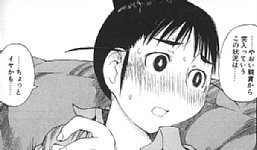
The blunt and honest Ogiue is very cute.
The reason why we have someone like Ogiue, who has such a disagreeable and problematic personality, is of course to create in the story a character with whom the reader can easily relate and empathize. The core of Ogiue is that she’s a girl who with honesty and seriousness approaches life with everything she has.
Then there’s Ohno, who claims, “There’s no such thing as a girl who hates homos!”
Oh, of course it’s useless to actually accept them as real. THAT’S THE JOKE.
In one sense, I feel that the idea that “Female otaku go through life giving all they’ve got despite their suffering” has really picked up, and it’s something that’s being drawn quite often now as a result. Genshiken is a splendid work. But we must never forget that, in the end, we’re talking about “manga” here.
No matter how realistic it gets, it’s still a fantasy.
I don’t really think there’s many people who will tell me, “Hey that goes without saying,” but I want to point out that it does not, in fact. As proof, three years ago there was a misunderstanding by the media, and from then onwards a strange and unusual searchlight was placed on the “fujoshi.”
A character who really likes BL is fine when that character is in a 4-panel gag strip. However, when that becomes a sought-after quality in real life, well there’s a big problem. To start with, when actual girls are called fujoshi, I believe they are being done quite a disservice. When you get down to it, doesn’t it sound like a masochistic joke? Even if there were people who called themselves “disgusting otaku,” to be called a disgusting otaku by people I don’t know would elicit the same negative reaction from me.
Certainly, within the context of a manga, Girl Otaku are lovely. But to have written articles for the purpose of riding this wave, with statements such as “Right now, fujoshi are in!” and “How to get fujoshi to fall for you!” and then to have those statements be given in all seriousness, to actually see these things written for people, why it made me dizzy.
C’mon now, it’s just their hobby, you know? Just treat it as a hobby, and then leave it alone.
And then there’s the problem where female otaku in general are now being bunched in with those whom we would call “fujoshi,” and men’s magazines are marginalizing female otaku as a whole. That’s the worst part of it to me.
Then again, men’s magazines already give tips on how to hit on women. Considering the condescending nature of these magazines towards women, you really can’t expect much else.
For the sake of completely removing themselves from the path of sensibility, some have come to accept a great and terrible and very 2D idea: “Otaku girls sure are cute!” Well that’s obvious. But when it comes to actual girls, those same guys will just be all, “Hey, leave me alone, okay?”
It is never a good idea to confuse the two-dimensional world with reality. Ever.
If this strange fad had never caught on, if these guys and girls could simply realize the charm of being people who live for their hobbies and interests and then use it to attract others, that would have been just fine. However, it seems we’ve gone and removed ourselves from that path.
The Foundation of “Moe” is Violent
To see someone actually say, “This is so moe,” and actually mean it is quite mystifying. That’s because declaring something to be “moe” is an extremely violent act in the first place.
In cases where someone is moe for a two-dimensional tsundere character, it’s really just a matter of holding a commanding view of the character, or, perhaps, it’s a matter of cherry-picking what’s convenient. There are no alternatives. If that girl character suddenly strays from the supposedly correct path and gets closer to another guy, it’s often the case that some people will just abandon her. It’s not impossible at all. Because when it comes to “moe,” all you’re looking at is just one aspect of a girl. It’s not impossible, that is, because it isn’t “love.”
However, when it comes to two-dimensional characters, I think this is fine. Those who are capable of loving a character to the very end are wonderful and all, but there are those characters who can only be loved so much. That too is nature’s providence.
They are containers to hold and store the desires of aggressive humans.
But what happens when you take that idea and apply it to reality?
“This person is different from what I expected!”
“This person’s changed compared to what I thought they were!”
The only outcome then, is denial of the other.
These are individuals we’re dealing with here. You’re free to say, “I fell for you,” or, “I love you,” but don’t ever say to someone, “I’m moe for you.” It’s a violent act in which you try to deny them their individuality.*¹
The reason tsundere and maids have been so successful is that they are two-dimensional characters clearly separate from the real world. And sure, there are actually things like tsundere cafes based on these memes, but no one in reality would actually want or desire a tsundere. Even if you unexpectedly fall in love with someone who gives off a tsundere vibe, given enough time that fictional character-type image you created of her will go away.
But of course “female otaku” are not uncommon. Nevertheless, unlike “Shrine Maiden Moe,” “Nurse Moe,” and other similar types of moe, female otaku are to some degree in possession of a “guilty conscience,” a conscience which causes these girls to exclaim, “Leave us alone!” Particularly, those who like BL live their lives burdened with hardships, as they’re confronted with tons of people saying either, “Moe!” or “Give me a break!” in response to them.
“Female Otaku Moe” is a Fantasy
Based on what I’ve read and considered, the true identities of these two-dimensional “Otaku Girls who get the guys feeling moe,” so to speak, are “girls who act like guys.” Of course, I think the easiest example to understand is Lucky Star’s Konata. While she has some feminine qualities, her nature and her desire to collect are extremely similar to that of male otaku.
She immerses herself in her hobbies, and while she’s a little rough around the edges she gives it her all. Occasionally her eccentricities show. Rather, she doesn’t really bother to try and be more “feminine.”

Even if this girl was a boy, she wouldn’t feel uncomfortable at all.
‘s why she’s cute.
If we were to turn this around, it’s like otaku are saying, “A girl whose tastes are like mine, a girl who I can speak to honestly without pretense, isn’t that just a dream?” and so the manner in which they’ve developed their taste in girls is exceedingly, and I mean EXCEEDINGLY shaky.
If I were to rephrase the above paragraph, I would say that I think of it as a matter of wanting someone who understands you and enjoys being with you.
Whenever someone says, “Girl otaku characters are cute,” I want you to understand that by no means are they saying that they harbor an excessive amount of sexual desire for real actual female otaku, or that they want to sleep with those female otaku.
For the guys, this is considered “fantasy” and is viewed as a line that will not be crossed. Thought of in that manner, girls then are just a source for “memes.”
If that’s the case, this seems like a good time to talk just a little more about the moe that I myself haven’t been able to exclaim, the “Girls who are otaku are cute!” moe.
It would be strange of me to say, “Don’t moe them!” so I think it would be nice if we could find some kind of balance or harmony.
On one final note, people who with all earnestness engage in otaku activities are in a sense guys and girls filled with enthusiasm, which gives them a certain charm, no doubt. …Right?
———————————————————–
Addendum.
There have been a lot of otaku marriages recently. How nice…
But these aren’t people saying, “I married someone because they’re an otaku,” so much as, “I married an otaku I fell in love with,” and nothing beyond that. These are normal marriages, no more and no less.
Hmm. In comparing “Female Otaku Moe” to other types of moe, there’s too great a sense of reality with the former, and because of that it’s also become a rather harsh subject to approach. Nevertheless, if we accept the logic that “a girl who’s engrossed in something is cute,” it’s inevitable then that we would see girls who are “into” the “otaku culture” so close to us as being cute, and that the level of demand stemming from this preference would rise greatly. However, there’s pretty much no such thing as “Otaku Boy Moe.” At all.

Gendai Shikaku Bunka Kenkyuukai 3 (Sansai Mook Vol. 3)
(The Society for the Study of Modern Visual Culture 3)
Sansai Books

Rakkyou no Kawa—Moero! Morinomiya Koukou Manga Kenkyuubu (6) (Gum Comics)
(Shallot’s Skin!—Get Moe! Morinomiya High School Manga Club Volume 6)
By Abekawa Kineko
Wani Books

Kyoumeiseyo! Shiritsu Todoroki Koukou Toshoiinkai 3 (ID Comics and Zero-Sum Comics)
(Resound! The Thundering Private High School’s Book Committee! Volume 3)
By D. Kissan
Ichijinsha

Mousou Shoujo Otakukei (5) (Action Comics)
(Fujoshi Rumi Volume 5)
By Konjou Natsumi
Futabasha
If there’s any title that has a relative balance of the realistic and the cute, it would be Mousou Shoujo Otakukei. It doesn’t bother to hide its sharp edge and instead thrusts at you using bitter words like “disgusting.” It’s not just a series which remains closed to outsiders while shouting, “LONG LIVE OTAKU!” But as we all know, lively girls are adorable.
‾‾‾‾‾‾‾‾‾‾‾‾‾‾‾‾‾‾‾‾‾‾‾‾‾‾‾‾‾‾‾‾‾‾‾‾‾‾‾‾‾‾‾‾‾‾‾‾‾‾‾‾‾‾‾‾‾‾‾‾
*¹ Idols, maid cafe maids, and others involved in constructed roleplays excepted.
‾‾‾‾‾‾‾‾‾‾‾‾‾‾‾‾‾‾‾‾‾‾‾‾‾‾‾‾‾‾‾‾‾‾‾‾‾‾‾‾‾‾‾‾‾‾‾‾‾‾‾‾‾‾‾‾‾‾‾‾
Translator’s Notes:
Moe: This is a very difficult word to translate, not because the word can have multiple meanings but because the meaning can change drastically depending on who you’re talking to. It means something along the lines of “passion” or “infatuation,” particularly for fictional characters, and often for characters who are somehow weak or deeply flawed.
Otaku Girl, Girl Otaku, Female Otaku, etc.: Tamagomago uses a variety of phrases to say the same basic concept of an otaku who is a girl, and so I’ve tried to vary it accordingly, but it’s still not 1:1 because I didn’t want to use crazy phrases like “Otaku Lass.”
BL: Stands for Boys’ Love, refers to the genre of guy-on-guy action targeted primarily at female readers. I know most of you know this, but I’m being safe.
Fujoshi: A slang phrase used to refer to girls who are obsessed with Boys’ Love. A pun on the Japanese word for a lady, the kanji used with this Fujoshi (腐女子) literally means “rotten girl.” A frequent topic on this blog.
Disgusting Otaku: In Japanese, “キモオタ” and pronounced kimo ota, an abbreviation of kimoi otaku.
THAT’S THE JOKE: The actual phrase used here in the Japanese is “ネタをネタだと(略” which is an incomplete way of referring to someone who doesn’t realize a joke is a joke or that a meme is a meme. I used the popular quote from Simpsons character Rainier Wolfcastle’s movie, McBain: Let’s Get Silly.
Genshiken: A manga by Kio Shimoku about the lives of otaku in college. Published by Kodansha in Japan and Del Rey in the US and made into an anime by Palm Studio and Studio ARMS. If you aren’t familiar with Genshiken, I suggest you read it, seeing as this entire blog is devoted to one of its characters.
Gendai Shikaku Bunka Kenkyuu: Despite being similar to what “Genshiken” stands for, this is not the above-mentioned manga but rather an otaku-oriented magazine, or more specifically, a mook.
Mook: Magazine + Book. Used to refer to publications which focus on a single topic, thick but bound together like a magazine. The Gundam series tends to get a lot of mooks.
Lucky Star: A 4-panel manga by Yoshimizu Kagami about an unabashed otaku named Konata and her three friends in high school. Published by Kadokawa Shoten, it was turned into a very popular anime by Kyoto Animation.
Doroko: Short for Kyoumeiseyo! Shiritsu Todoroki Koukou Tosho Iinkai, a 4-koma high school comedy which occasionally switches to a more normal panel format, kind of like Azumanga Daioh.
Rakkyou no Kawa: Short for Rakkyou no Kawa-Moero! Morinomiya Koukou Manga Kenkyuubu. A manga about a “former” otaku in high school.
Comic Party: Originally an erotic game by Leaf/Aqua Plus about doujinshi artists, it has been converted into a variety of media.
Mousou Shoujo Otakukei: Released in America as Fujoshi Rumi. The manga is about a high school girl who loves BL and yaoi. Published by Futabasha in Japan and by Media Blasters in the US.


 OGIUE MANIAX