And Then Takuto Will Catch a Bullet with His Teeth

A Star Driver-themed video uploaded to Tumblr, I expect it to get glowing reviews.

Spoilers for those who haven’t seen Star Driver.

Inspired by this tweet.

Hope They’re Okay

I do not have any relatives in Japan, and I’m grateful for that. No need to worry in that regard.

But I do have friends living in Japan, people I’ve met both in real life and online. I’m not sure if this qualifies as irony, but whereas the folks I know primarily through the internet I can more easily find through those channels (or at least try to), the people I met in real life first are the people I have less chance of contacting. Whether it’s through changing e-mail addresses or just lack of contact over time, I have people whom I would call friends who are probably in Japan right now and I have no idea if they’re okay or not, and I have no way of ever finding out. Part of me regrets my own lack of initiative to try and keep up with them in the first place.

It reminds me of the first time I ever ate udon and onigiri, at a small Japanese restaurant in the World Trade Center, back in about 1999 or so. The udon was amazing as far as I could tell with my limited experience, and the onigiri were $2 per ball and absolutely gigantic. I never really got to know the owners or anything, so when 9/11 hit I found myself wondering whether or not the people working there made it out okay. Of course, I have no way of ever knowing.

I do not have any amazingly close ties to Japan. I’m not going to lose much sleep over it. But I do hope my friends are okay.

Creamy Mami, All Alone

I’m a little less than halfway through 80s magical girl anime Mahou no Tenshi Creamy Mami, and though it’s fairly entertaining I haven’t really been feeling it. I’ll watch a couple episodes and then have no motivation to keep watching, unlike when I watch, say, Ojamajo Doremi where I almost have to stop myself from watching more. It’s not particularly boring or offensive or anything like that, so for a while I just wasn’t sure why Creamy Mami wasn’t quite gelling for me, but I’ve finally figured it out.

Morisawa Yuu, the girl who transforms into Creamy Mami, has no female friends around her own age.

Instead, you mostly see her interact with adults (some of whom she primarily talks to as Creamy Mami), a couple of male friends, and only rarely do you get a one-off female character the same age as Yuu. This isn’t a problem in and of itself, especially given that it is very possible for a girl to be friends with guys her own age, but in the show Yuu likes one of them, the other one likes her, and that one is the comic-relief fat kid. We never get to see Yuu interact with someone who can truly be considered her peer and equal, and I think it can be a problem, even if the show was intentionally designed that way. (Cardcaptor) Sakura has Tomoyo, Nagisa (Cure Black) has Honoka (Cure White) and her lacrosse team, and even Mitsuki (Full Moon o Sagashite), who also transforms into an older girl, can be seen interacting with her female classmates. All of them are better characters for it.

Without a female friend of the same age, Yuu kind of feels that she’s only there to transform into Creamy Mami, which she very well might be, but I think that she would have been fleshed out much better in a way that doesn’t run contrary to the overall feel of the anime if she had such a friend. I could possibly say that the show works as a somewhat minimalist anime, where only the bare essentials are needed to drive it forward, but even that could have benefited from a female friend for Yuu.

Quality of the Moe

Moe discussion in anime fandom seems to ebb and flow, and whenever it turns into an argument, both sides tend to overreact greatly. Bikasuishin over at tsurupeta.info recently pointed out a trend among moe detractors who try to argue from a position of intellectual superiority, where they attempt to give a sense of scale, history, and purpose to their examination of moe but get a little too ambitious and fail in the process, an overreaction in the sense that they are overeager to show how moe hurts anime. I want to address what is in a sense the other side of this, the tendency for moe supporters to be overly defensive in protecting their cherished genre. I will not be using as amusingly sarcastic a tone as Bikasuishin, but will instead be offering what I think is a better solution for people who tend to take the defensive position, one of understanding and civility, rather than exacerbating an “Us” vs. “Them” mentality.

Before I get into the meat of things, I want to just clear the ground for the kind of “moe” I’m talking about. Now, I am of the strong belief that feelings of moe are a very personal thing and that you can get them in works that are not specifically designed to be moe. For the sake of simplicity and convenience though, I’m mainly going to focus on titles that are usually considered “moe” either by the desires of creators, marketers, and what have you, or by the fans themselves. In other words, “moe anime” as opposed to “anime that can be moe.”

Imagine a somewhat extreme and simplified argument against moe, such as “moe anime are terrible and devoid of any real value and is a sign of stunted emotional growth.” In such a situation, I often times see a defensive, albeit well-meaning response from moe fans, something along the lines of, “Leave us moe fans alone! We’re just enjoying ourselves.” That’s fair enough, but the problem here lies in the way the accusation was brought up. Nested inside that negative statement on moe is the following statement: “Prove me wrong.” There’s a discrepancy between the attack and the response, as if the two are on completely different wavelengths.

But even though defense is not the best defense, offense is an even worse option. If the counterargument essentially boils down to “No, you’re the man-children and your anime sucks compared to glorious moe,” that accomplishes nothing. This is because hidden inside the nested statement of “Prove me wrong” is another idea: “Moe fans have no standards.” So whether the moe fan has gone completely defensive and tries to trivialize the concept of “quality” or has instead decided to counterattack by showing how moe is “just as good as” or “even better than” other anime out there, to the detractor it seems as if the moe fan could not handle the implicit debate set forth.

Rather than turtling up or fighting fire with fire, my advice is to show that you do have standards… about moe. Show that you can point to one of two moe shows and say, “I think this is a better moe anime,” and be able to state your reasons why. They don’t have to be reasons based purely on logic and rationality and a devotion to a well-crafted story, nor do they have to be overly exacting standards where only .1% of moe is really okay. You can even include your feelings towards the titles in question in your explanation. In fact, I encourage it. The key here is to be able to say, “I find this moe anime personally valuable and here’s why,” perhaps even, “This what I feel moe positively brings to anime.” By doing so, you can show that you are discerning towards the very genre of which you’re a fan, and that the moe genre itself is not simply what happens when you take anime and make it inherently worse, as some might see it.

The goal is not to convert people to moe. Some people simply cannot be convinced, and even if you show your own value system towards the anime you like (or don’t), not all reasons are going to work for everybody. If you tell me you like Show A over Show B because Show A has ten girls and Show B only has nine, while you’re free to say that, I’m just as free to find that to be a terrible reason. But by showing that you have personal standards when it comes to moe, and can perhaps even point out a moe anime that a person who is not a fan of moe can enjoy, you can make your opinion known in a respectful manner, and if they decide they can’t agree, then there’s nothing more to do. You made your case, after all. The key to this “defense” is to not defend at all, but to let people know that moe is a genre that can be utilized effectively, one that can succeed or fail on its own terms, however you want to define the terms of success.

It’s pretty much impossible to defend every single title that falls under the banner of “moe anime,” just as it’s impossible to defend every single giant robot anime or every romantic comedy film, because not only is it highly unlikely that every single one will succeed in what they’ve set out to do, but it’s even more unlikely that a single person will enjoy every approach taken no matter what. However, defending all of moe is not the same as defending moe as a genre. One is defense in absence of personal discernment and the other is defense of the potential of a genre, with hopefully some real examples to support.

If you want to see a more concrete sample of what I’m talking about, take a look at my review of Toradora! It’s not the best thing I’ve ever written, and looking back I think I’m a little too hard on the Kugimiya Rie-voiced tsundere character type, but I think it does a pretty good job of showing why I find Toradora! to be a remarkable moe show, and I don’t expect impeccable writing from every single person writing about what they like about moe. You can also see me defending the show after someone left a negative comment. I have to admit that I got a little too spirited in defending Toradora!, but that’s exactly the kind of experience which has me writing this very post.

I’m a Dreamer, Moeru Power: Genshiken II, Chapter 61

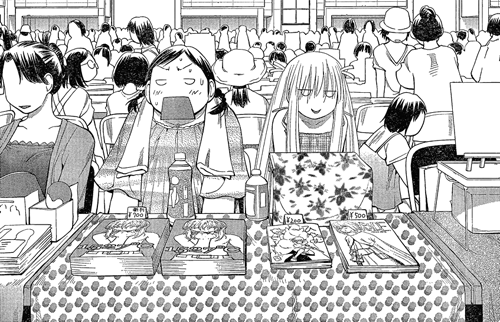
The newest chapter of Genshiken II hints at the most glorious team-up in otaku manga history. However, the antics of Battlehopkins and Double Asada are only for a few panels, and the real focus is split this time around between Ogiue’s precarious deadline juggling and Hato engaging in a Hato x Mada-themed thought exercise. This month’s theme is friendship!

Before we jump into the chapter though, I want to point out the next-chapter anime references that are at the end of each chapter. We’ve seen Occult Academy, K-ON!, and Heartcatch Precure, among others. This time it’s Jewelpet Tinkle. I didn’t even know that series had an otaku following.

Ogiue discusses her professional debut with Yabusaki, who is equal parts jealous and proud of her former enemy and current doujinshi collaborator. Ogiue’s challenge, as established a few chapters back, is to finish both the manuscript for her first published manga and the doujinshi she’s planning for Comic Festival (which we now know is Fullmetal Alchemist-themed), and though she has an insanely prolific work-rate (see her previous 80-page draft which she drew in about one night), it can be a double-edged sword; as we can see at the very end of the chapter, Ogiue can get so engrossed in her imagination that it can be difficult to put her professional responsibilities above her passions. I get the feeling Sasahara knows this better than anyone, which is why their unofficial editor-artist relationship can be so volatile.

During their discussion, Ogiue and Yabusaki speak in their respective Tohoku and Kansai dialects, which is nothing short of amazing. While Yabusaki does this all of the time, it is an incredibly rare case that we get to see Ogiue use Tohoku-ben out loud instead of just thinking in it, and I believe that this is the very first instance of Ogiue speaking in her native dialect for an extended conversation outside of flashbacks. I think this is a very important indication of not only how much more comfortable Ogiue has become with herself, but the extent to which Ogiue and Yabusaki get along now, even if their faces don’t show it. Ogiue doesn’t even use her Tohoku dialect in private with Sasahara! Her Tohoku talk, combined with her newer hairstyle, in a way reminds me of Heartcatch Precure, where we get to see girls change while discovering their true selves.

At the same time as Ogiue, Sue, Yabusaki, and Asada are talking art, Hato is taking respite from the heat in Madarame’s empty and air-conditioned apartment. Here, we get to see Hato’s gender-divided fantasy in action, as Hato the guy’s thoughts run practically parallel with Hato’s thoughts as a “fujoshi,” represented by an imaginary(?), naked, and decidedly feminine Hato floating nearby. Alternately called a Stand and an 801-chan among other things, Hato’s mind inhabits this unusual territory where he scrutinizes his own natural actions and provides a field day for psychologists of fictional characters. Hato turns out to be so tired that he ends up dozing off, and by the time he wakes up Madarame is already home. A potentially awkward situation to say the least, especially given Hato’s out-of-body musings.

Just as we were able to see a current Ogiue talking in her own dialect for an extended period for the first time in Genshiken, this is also the first time that Madarame gets to see Hato sans drag, but rather than making things more uncomfortable, Madarame just treats him as one of the guys. While sharing dinner, Hato brings up the fact that he does not consider himself to be homosexual, even though he likes BL as much as he does. Anticipating Madarame to react somehow, Madarame still doesn’t seem particularly fazed by this “revelation.”

Speculating as to why Madarame is able to take such a declaration in stride, I can only think that it’s because Madarame, as an otaku, knows the significant disparity that can exist between 2-D and 3-D. Ogiue is into yaoi, but she doesn’t expect Sasahara to be into other guys even when she uses him as “inspiration” for her own doujinshi. An even better example might be Madarame himself, whose taste in the erotic can skew a little young, and yet he finds himself in love with the very mature Kasukabe Saki. For that matter, Sasahara and Ogiue sometimes skew young in their preferences as well (young Ritsuko Kubel Kettengrad and Edward Elric, respectively), so I think the whole of Genshiken understands the divide well. Still, gender and sexuality is not the easiest of topics to talk about, and you might be surprised at how the complex lines of tolerance and understanding can fall within people’s own values.

Seeing how relaxed Madarame is being around Hato despite the possibility that an outsider observer (i.e. “herself”) could interpret all of this as fertile soil for romance, Hato can’t help but see Madarame as a weak bottom because of how open he leaves himself to “attack.” For some reason though, I feel like Hato’s logic behind the “hetare uke” Madarame “character” is different from Ogiue’s. I think Ogiue’s variant has more to do with how passive he is despite his passionate otaku outbursts and the like.

Speaking of Saki, Hato accidentally becomes aware of Madarame’s unrequited love, though Madarame himself is unaware that Hato knows. Maybe Hellsing creator Hirano Kouta is right after all and Madarame really is the most moe character in the series.

It’s Only Greater

Recently I was thinking about how great it is that I have friends and people with whom I can share my love of anime and manga, with whom I can discuss my feelings on specific works, trends among fans, and much more. Nowadays I think that it’s really, really wonderful to be an otaku.

It makes me consider the concept of anime fan gatherings that aren’t conventions or anything tied to specific activities or venues, but just something where everyone can sit back and enjoy themselves, like a relaxed discussion on the internet but in real life, so not everything has to be in words. Preferably this is all done over a big pot of chili (with vegetarian/vegan alternatives for whoever needs them), or I guess donburi if we want to stick to the whole Japan thing.

Surely there are disagreements among otaku all the time, and heated arguments about minutiae that seem many times larger, but just the fact that we can be so engrossed in something is itself a glorious thing.

If you want to know what makes the “geek” special, it’s not brains or looks (or lack thereof) or anything like that, it’s simply passion. I have a lot of it, and as it continues to grow I know I have you to thank.

The Ogiue Maniax Tumblr

For those who missed it, last week I started my very own Tumblr. Its purpose is for housing things that cannot go anywhere else, and this blog is home to a huge variety of posts, so its existence is a matter of necessity. As of now, there’s only one post on it, but I think it’ll make you feel like you can live forever.

THAT Anime Blog, Home of Utopian Philosophy

This past Valentine’s Day, ExecutiveOtaku over at THAT Anime Blog offered a service for all of the single ladies and gentlemen who found themselves alone on February 14th, a “Harem Finder” that would allow you to enter into a Love Hina-esque setting, custom-tailored to your specific wants and passions. Though obviously a joke, the Harem Finder is not without historical precedent, at least in literary terms. In particular, the concept resembles the writings of utopian philosopher Charles Fourier.

Fourier (1772-1837) believed that the denial of passion was the most major problem with the world, and in his utopian writings he proposed a society where everybody would be able to indulge in their passions in a way that would benefit their society. For instance, a man predisposed to death and slaughter would find a job as a butcher. Fourier (somehow) calculated that there are 810 character and personality types to be satisfied. This of course includes sexual passions, so a sadist would be able to meet a masochist, same-sex relationships would be condoned, and so forth.

Priests and priestesses would gather everyone together and initiate extensive tests involving multiple meetings between potential partners, keeping in mind that “love at first sight” does not always happen. And for those dorks who worry about their physical attractiveness, Fourier has them covered too.

In Harmony sheer physical attractiveness will not have the colossal influence that it has in civilization where everyone is transfixed by the sight of a beautiful woman. Of course the Harmonians will not fail to appreciate physical beauty; in fact their judgment will be considerably more discerning than ours. But when it comes to the selection of sympathetic patners their choices will not be determined by physical charm. For their desire for sensual gratification will be satisfied in several different ways.

In a way, the concept of the “harem” in anime and manga is a form of utopia, acting as a very localized, almost self-functioning society where happiness is being surrounded by women (or men) and everything that happens in the world comes from that harem setting. The same idea could be extended to the most slicey slice-of-life shows, especially when you factor in their utility as a form of cathartic escape. These are, after all, “better worlds.”

In a different era, I think Charles Fourier could have very well been an otaku. He would spend every day after work focused on writing about his utopia, and his devotion to passion is well-represented in anime and manga. He also had a thing for lesbians, making it very possible that he’d be a big yuri advocate, and his obsession with precise calculations seemingly pulled out of nowhere (he determined that there are 26,400 men in the world who also enjoy lesbians) would not be that far off with numbers-obsessed mecha or idol fans.

He was also a life-long virgin, but I’ll leave those jokes to you.

We Still Fight

Mazinkaiser SKL and Madoka Magica embody the spirit of 1990s anime and anime fandom.

That I included Mazinkaiser SKL in that statement is not much of a surprise, I imagine. It’s the robot whose name stands for “Skull” because it’s covered in skulls, and its plot, characters, and levels of ultra-violence are taken straight of the worst best OVAs of the era. Mazinkaiser SKL has what thrilled anime fans of the 90s, and it would not have looked out of place next to the likes of MD Geist and Bubblegum Crisis.

My choice of Madoka Magica might be more puzzling, but I insist that in some ways it houses the 90s anime (and anime fan) spirit even more than Mazinkaiser SKL. When you look at how the series has been captivating fans, you see recurring comments in regards to how dark it is, or how it subverts the genre. Even if people don’t necessarily have a good understanding of the original genre being addressed, when it comes down to it Madoka Magica is attracting fans because it feels “different” and worth discussing and thinking about at length. The way people talk about it reminds more of the way people discuss Akira, Ghost in the Shell, or Evangelion than the way conversations about Suzumiya Haruhi or Code Geass go. Madoka Magica has that certain something that thrills people into dividing anime into Madoka Magica and everything else. While the difference is that Akira drew in non-fans and Madoka Magica isn’t really going beyond the existing fandom, it seems to be hitting fans with the same shock that Goku’s death gave to me as I realized cartoon character’s could die after all.

So while Mazinkaiser SKL is aesthetically an anime ripped straight out of the 90s, a time traveler from a different era whose ways may seem at odds with the current day, Madoka Magica takes the effect anime had on anime fans in the 90s and translates that emotional impact across time onto the current fandom. Whether or not these shows will be remembered in another ten years is unknown, but at the very least in the here and now they connect the decades together.

Vistas: Streaming for Profit – Crunchyroll vs. GOMtv.net

I’ve got a new post over at the Vistas blog, this time about the differences in paid services provided by two different streaming sites with two different ideas of what its users should pay for, Crunchyroll and GOMtv.net. Feel free to comment either there or right here on Ogiue Maniax.