Home Made Kazoku Rap-Sings Their Way to Otakon

Otakon 2010 fires its first major volley with “Home Made Kazoku” as their Sunday musical guest.

Realistically speaking, this is pretty much the kind of musical guest I want at conventions more often. While I know that they’re not a J-ROCK BAND and thus won’t have quite as much clout among those who go to anime conventions mainly for the concerts, Home Made Kazoku’s a legitimate act that’s actually done music for popular anime. I mean, you couldn’t exactly call Naruto or Bleach small-fry cartoons (aside from literally being for children), and they also did “Shounen Heart,” the love-it-or-hate-it second opening of Eureka Seven.

I still consider it a crime that JAM Project got only a fraction of the audience of other musical guests at Otakon 2008, especially when they had Kageyama “Chala Head Chala” Hironobu, a guy whose songs almost every person at an anime con knows at least one of. While I get the appeal of the J-Rock band, I wouldn’t mind them nearly as much if more of them had actually sung something related to anime, or if they weren’t being sold mainly on image. Hell, a COVER of an anime song would be acceptable.

So, Home Made Kazoku. I can’t wait to see everyone at the concert try (and fail) to sing along to the rap portions.

That includes myself.

It’s hard!

Now It’s Partially for Consistency’s Sake

Back in 2007 when I first posted about  Mousou Shoujo Otakukei (aka Fujoshi Rumi), I complained about how the price difference between buying the Japanese language version from a Japanese bookstore was nearly at the point where it wasn’t actually worth it. At that point, it was about $8 or $9, very close to the typical $10 price of an English-translated manga.

Now it’s 2010 and six volumes in the problem is bigger than ever. Stopping by Kinokuniya the other day, the price for the current volume is about $10.50, compared to the English releases’ $12 per volume. What makes this sting extra hard is that the death of Asahiya last year means Kinokuniya basically has no competition and can sell its Japanese-language manga whatever price it wishes. Granted there’s Bookoff for low-price manga, but that consists entirely of used books, and I have this strange feeling I’m the only person in New York City buying Mousou Shoujo.

At this point you may be wondering why I’ve stuck with the series even after I said “meh” to its Volume 1, aside from keeping up with the Fujoshi Files. Well, after having read further, I realized that it’s not until Volume 2 that the series and its characters really begin to find their voices. It’s a fun series with nice developments, and I’m eager to see what happens next. Though out of all the fujoshi-themed manga I’ve read so far, I think I like Fujoshissu! best.

There Are Two Kinds of People in This World: Winners and Trolleys

In Anime World Order’s look back at the previous decade of anime, guest Matt Alt talks about how the true successor to giant robot anime isn’t current giant robot anime, instead bestowing that title to those shows which spawn trading cards and games revolving around collecting. Essentially, the true spirit of super robots lies not in the continuation of the aesthetics of giant robot anime, but rather in their ability to push merchandise.

Considering this point, I can only think about how much more today’s anime for boys fosters a sense of competition, with trading card games and the like being at the center of children’s entertainment. The kids don’t have to be competitive “high-level” players, and they don’t even have to necessarily know the rules, and I still think these games, even if their shows talk about friendship and honor, still push the theme of competition more than anything else. Just the fact that there are  specific rules and stats and points means that, in a given activity, there will be winners and losers, even if it’s just cheap plastic being spun in an enclosed space. In contrast, that’s not really possible when you just have toy robots and the like. You can perhaps beat your friends by collecting more toys than them, or even create arbitrary rules of competition or even create fake competitions between your toys as Cobra Commander attacks with his vicious horde of My Little Ponies, but at the end of the day there’s no definitive way to become King of Make-Believe.


Well, almost no way.

This in turn got me thinking about the anime fandom and how we have figured out ways to compete via anime. The act of watching cartoons is not really an area in which you can determine winners and losers (unless you say that we’re all losers), so the community instead focuses their competitive spirits towards anime-related activities such as making music videos and cosplaying. These competitions are far more subjective in their criteria and human judgment is paramount in determining winners, but all the same we have taken a relatively passive activity and found ways to test our abilities against others.

I don’t really have a grand point I’m trying to reach, as I’m just laying down some thoughts. But be it through subjective judging or concrete goals, I don’t think an increase in competitive spirit is really a bad thing. That said, it can be taken too far.

I Thought We Liked Mahjong Series!

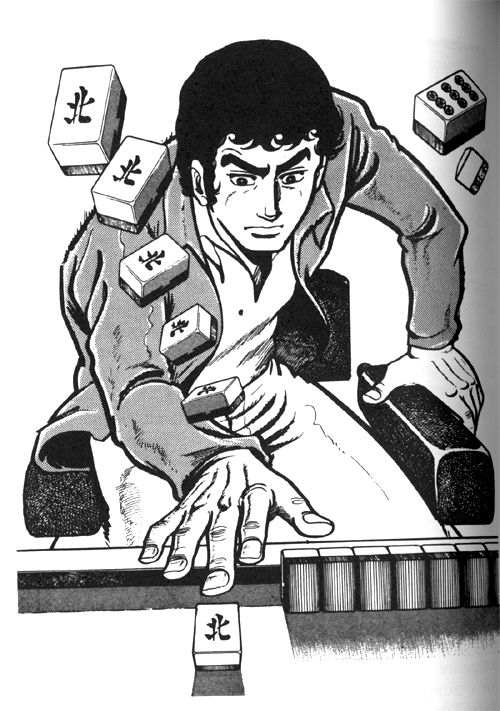
While Akagi and Saki were probably a lot of people’s introduction to the notion of manga based on the game mahjong, I don’t think I’m alone when I say that my first introduction to “mahjong manga” was from Frederik L. Schodt’s seminal book Manga! Manga! The World of Japanese Comics.

In it, Schodt explores the burgeoning genre and talks about popular titles such as Mahjong Houroki (“Tales of a Wandering Mahjong Player”) and Jigoku Mahjong (“Mahjong Hell”), even citing the author of Mahjong Houroki, Kitano Eimei, as the sort of “father” of mahjong manga, who showed that a comic about dealing tiles could look and feel exciting.

Truth be told, while I was fascinated by the idea of mahjong manga back when I first read Manga! Manga! ten years ago, I am not so different than the people who discovered it through Akagi, as that was the first mahjong series which I actually had the privilege to see. And while I don’t expect mahjong manga to become a runaway success in even the scanlation community, it’s clear that it has its devoted followers.

Here’s the odd thing though: Where are the scans of Mahjong Hourouki? If Akagi and Saki have resulted in people from all over the fandom getting into mahjong even at a periphery level, why hasn’t anyone bothered to look into these significant works which established the genre that so many are enjoying now? And it can’t really be the case where fans of these newer series might not like the older series due to the artwork. After all, we’re talking about Akagi fans here, and I’ve never seen anyone proclaim, “If the characters don’t have ultra pointy faces and noses and everyone looks shocked all the time, then I refuse to read it!” And I see you considering making a comment where you reiterate what I just said. I’m watching you.

Oh, and of course the reason I’m talking about it in the realm of scanlations and such is that no sane company would license a mahjong series in the United States. The closest you’d get to one that could conceivably do well is Saki which is streamed on Crunchyroll, and even that is a bit of a stretch when you consider the not-internet.

The most likely culprit is probably scarcity. It’s no doubt difficult to find these old series in the first place, especially with a niche genre like mahjong. And I’m as guilty of not contributing to the pursuit as any other. This is the first post I’ve made about it, and it’s only because I was re-reading Schodt’s book today. But still, I’m making the call out. We have to find these old works, titles like Mahjong Fuunroku (“Mahjong Crises”) and Gambler no Uta (“The Son of the Gambler”), and bring them to the forefront of consciousness.

First there’s a Du, and Then I Couldn’t Hear the Rest

When it comes to uniting fans, Nico Nico Douga and episodic blogging have quite a bit in common.

Nico Nico Douga is a popular Japanese streaming video site which helped push popular Japanese memes such as the fusion of voice synthesis and moe, Hatsune Miku, and creating a small revival in the career of gay porn actor Billy Herrington by making clips from his videos running jokes among the community. Its most notable feature however is its unique comments system, where user comments are scrolled from right to left as the video plays. For some it’s an annoying feature which gets in the way of watching the video, but for others it’s the very lifeblood of Nico. Despite most of its content not being live, the comment system allows site users to experience a sense of “community” within the comments, by seeing what people had to say about a particular video at exactly the right moment.

Episodic blogging, or the act of reviewing and discussing individual episodes on a blog, usually as they are released, is even more removed from the concept of “real time,” but just like Nico Nico Douga it has the ability to unite fans by actively engaging in the very zeitgeist of internet fandom itself, by experiencing a series almost as it is airing, and having the format feel a little more permanent and a little more focused than simply sharing talk on an internet forum.

However, the ideal of episodic blogging is not often met, and in some cases this has to do with the shows being blogged about not being particularly good for the concept of episodic blogging. These are the kinds of shows where the blogger might simply go, “Eh some stuff happened this episode. It was all right, I guess.” While knowing that an episode of some show might be average is still something possibly worth knowing, after a while it bogs down episodic blogs as a whole.

Now if there is one current show that I think is very well-deserving of episodic blogging, it is Durarara!

Here you have a show where every episode is so packed with information that the normal custom of summarizing the episode extensively can become a great boon, especially when it comes to recalling the events of a previous episode. It’s also an ideal show for episodic blogging because the theme of the show itself is related to “living in the present,” and practically reflects upon the online anime fandom itself (which is no doubt helped by having a couple of characters who are otaku). Most importantly however is that while the show is an on-going story, its structure is such that each individual episode stands as something to be scrutinized and discussed, with the next one building on top of that.

So for those bloggers out there who have been tackling Durarara! episode by episode, keep it up. It’ll be particularly interesting to see just how your opinions and predictions change over time if at all.

True Honorable Spirit in 30 Minutes or Less

Over the years, I’ve probably gotten too much exposure to kids’ entertainment from both Japan and America. Because of that, as well as an idle comment made by someone I was talking, to I was recently thinking about portrayals of Japanese/American relations in each respective country’s cartoons and comics, and how interestingly they mirror each other.

In anime and manga, when an American character meets the primarily Japanese main characters, what almost inevitably ends up happening, especially if the American ends up being a friend or ally, is that he is able to understand the “true Japanese spirit” after his fateful encounter. Usually it’ll have to do with the determination and willpower of the Japanese, as well as just how much they can overcome in the face of superior forces.

But in American cartoons and comics, when a Japanese character appears, he almost always emphasizes honor. Honor is the most important quality in a Japanese character in an American cartoon, and there is always a point in the show, typically towards the end, where one or more American characters prove that they are truly honorable in the eyes of the Japanese character.

To some extent I think the American cartoon’s portrayal has to do with the mystifying image of the orient that has been a part of western fiction for centuries, while the Japanese cartoon’s portrayal supports the reassuring idea that, although Japanese people might not be the biggest or strongest, they can make up for that with intangible qualities. In either case however, this idea of winning over the foreigner and showing that, when you get down to it, respectable qualities remain very similar around the world, even if it’s portrayed through the lens of stereotypes and simple stories.

What do you think of this? Am I on the mark? Do you think things have changed significantly over the years so that this is no longer the case?

Guys We’re Gonna Make America Skinny Again One Poke at a Time


Hi, it’s Machamp with Cross Chop!

The Pokewalker is diabolical.

So the latest Pokemon game, Heart Gold/Soul Silver comes with a pedometer onto which you can transfer Pokemon and take them for walks. As you take steps, you get points in order to do things like get rare items and catch Pokemon. It’s partially designed to curb piracy, as not only is the Pokewalker something that you can’t really pirate, but the cartridge for the game itself has infrared sensors on it, so just having the rom isn’t enough.

But that’s not why it’s so fiendishly clever. The real and more sinister reason is that it’s going to get kids addicted to walking.

Consider the mentality that brought us “gotta catch ’em all,” the mentality that puts small children on the same wavelength as hardcore World of Warcraft players grinding up to max to open up the real game. Now apply it to light exercise. You could very well have kids just going out for long walks practically every day!

To some extent, it feels like saying, “Hey kids, if you get an A on your test, you can get a LEGENDARY POKEMON,” or, “Hey adults, the only way to defeat this super hidden boss is to FILE YOUR TAXES.”

Really, Wii Fit was a nice try, but it’s no Pokewalker.

Female Characters in Shounen Fighting Series and the Meaning of “Strength”

Sometimes when discussing shounen fighting series, there are disagreements among fans as to what female characters are considered “strong” and which are considered “weak.” Someone will accuse one female character of being “useless,” while another will point out all that she’s done to help the good guys, and that she’s strong in her own way. While opinions may be opinions, I think that the nature of shounen fighting series makes it difficult for those types of characters.

Hokuto no Ken is a classic example of a series with female characters who are “strong-but-not-really.” Mamiya is a skilled fighter and trains hard to keep up in a world of mutant thugs armed with only a crossbow and some yo-yo’s, but she’s still a few tiers below Kenshiro and Friends. Yuria has great will and even greater compassion, but she’s not a fighter at all, and in this series, as strong as Kenshiro’s own compassion is, fist to face action is at the forefront.

And as much as I like Hyuuga Hinata from Naruto, and as much as I think she is an excellent character, I know that she is not meant to be one of those female characters who is actually able to keep up with the guys when the chips are down. And in fact, as far as I can tell, despite the fact that Naruto is full of skilled kunoichi, there are only two or three female characters in that series who can actually fight on an even keel with the guys: Tsunade, Temari, and maybe Kurenai. Sakura definitely had the potential, and was supposed to end up as being super strong and super determined, but she too has fallen victim to the Shounen Side Heroine Syndrome.

But being physically weaker or lacking in skills compared to the main hero and the guys doesn’t mean a female character will necessarily be “weak.” Nami and Nico Robin from One Piece are both excellent examples of characters who carry their own weight. And even before Nami gets the Clima-Tact and starts participating in battles, her skills are shown to be indispensable to the team. Another good example of a female character who uses the skills that she has and contributes immensely to the overall cause is Tokine from Kekkaishi. Tokine, while not capable of as much sheer “brute strength” as her male counterpart Yoshimori, is able to use her finesse to not only match him but often outperform him.

“But wait, weren’t you the one who talked about how great it is when characters accomplish things at their own pace? Isn’t that one of the great appeals of moe? And aren’t you a supporter of moe?” And you would be right on that, but again I must say that it has to do with the fact that shounen fighting series inevitably revolve around fighting or at the very least getting characters to a point at which they can fight. Basically, the moe series will define strength within the context of their series as overcoming a small adversity which is difficult for them in particular, while a shounen fighting series is all about displays of strength, even if they are fueled by friendship and honor.

The big, essential difference between the Sakura/Mamiya group and the Nami/Tokine group is “results.” Both groups of female characters might not have as much raw skill or ability or training or whatever as the guys do, but one of those groups gets things done. Nami and Tokine don’t just contribute to the overall goal by doing something like blocking the villain’s attack just that one vital moment so that the hero can get in the final shot, but instead actually accomplish significant goals, things that can move the story along. It’s not even that they simply defeat opponents that the others cannot, but that they will do what it takes to win.

This doesn’t even necessarily apply to female characters. All you need to to do is take a look at Usopp from One Piece as a good example of a character who fights with what he has. It’s just that this is often the situation in which female characters find themselves, and often it’s done so that the guys can come in and go, “Stand aside, ladies. It’s MAN TIME.”

…Which is not necessarily a bad thing either, as having the men be strongest in a series for boys makes all sorts of sense. It’s just that if someone’s looking for female characters who really pull their weight to accomplish an overall goal, they may end up disappointed as a result. Though not a shounen fighting series, Legend of the Galactic Heroes can often seem like a sausage fest despite a plethora of genuinely well-written, strong, and clever female characters because of the fact that none of them are out there commanding ships and fleets, i.e. the very activity that is at the absolute forefront of LoGH.

Again, I like a lot of female characters who might not be the best or the strongest but try their best to do what they can even if they can’t keep up with the boys, characters who do things their own way at their own pace. However, even if a series actually says explicity, “This girl is truly strong because she really tried and her help, however small, was essential for victory,” within the context of shounen fighting “strength” is more defined by the overall setup and themes of the story, and rarely is any amount of lip-service enough to make the readers truly think otherwise.

If You’re Looking For an Additional Reason to Wear Green Today…

Incidentally, the other vital component of the day appears to have a similar effect on people.

Now It’s YOUR Turn to Survive a Deadly Game of Chicken

For those of you who were regaled by my tales of exciting mahjong (as well as the tales of others) but were saddened by the fact that you yourself were not able to participate, fear not! There is a new opportunity for you (yes you!) to participate in a live session of Japanese-style “riichi” mahjong! Well, provided you live in the New York area.

This month’s “US Professional Mahjong League” meeting is Sunday, March 28, 2010 from 3-7pm. Address and further information are here. If you’re going, make sure to RSVP on the forums.

I’ll most likely be there, ready to lose.