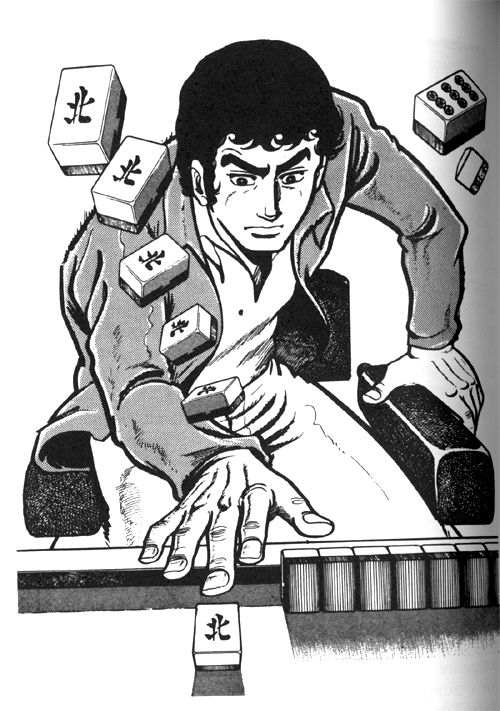
Attack-Style

A drawing inspired by the art from Attack No.1. Hanekawa’s hair is cool.

I Can’t Believe It’s Not

A few days ago I was watching that old mainstay from my college days, the Food Network when something caught my eye. I don’t remember what show it was exactly, maybe Iron Chef America, but I took notice when the chef mentioned one ingredient in particular: margarine.

Now this was not one of those shows that was looking out for the well-being of your waist line, and so there was no way that the chef’s decision to use margarine in the dish was out of some desire to cut down on fat calories, but instead to use it because it has properties that butter simply does not. Looking at it, it was as if margarine had broken free of its shackles and stepped out of the shadow of butter. Margarine was no longer merely a substitute, but could be treated as a unique ingredient all its own.

Thinking about the identity of margarine, it reminded me somewhat of limited animation, particularly in regards to anime. While limited animation was born out of necessary budget constraints, over time as the children who watched early anime grew into adults, they embraced the “limited” style and created a sort of style and grammar all their own.

As for the unique properties of margarine, I’m not really sure what they are. I suspect it has to do with flavor and the way it transforms under heat. I’m no cooking expert, I just like food and anime (like most otaku).

RIGHT AND WRONG? PAH, SUCH TRIVIALITIES

Lately I’ve been watching Kekkaishi on Hulu, courtesy of VIZ. Every week they release two new episodes and it’s been fun to keep up with Yoshimori and Tokine and all their wacky adventures. The show is fun and clever with remarkably good characterization for a shounen fighting series. And when an episode ends on a cliffhanger, there I am eagerly waiting for the next episode to appear the following Monday.

Here’s the thing, though. I am in no way against fansubs, and I am well aware that Kekkaishi has been fansubbed in its entirety. With a few clicks I could easily be watching the next episode and the next one after that, all the way until I finish the entire series. But still I refrain from grabbing those fansubs, and it’s not out of some sense of right and wrong or loyalty to the fine companies that license anime. And so I begin to wonder what the hell is up with me.

In his Macross 7 podcast, Andrew talks about how important he believes not marathoning Macross 7 is to enjoying the show more, and this may be affecting my thinking. Part of it may also be that I want to enjoy the experience of watching a series a little bit at a time and in a way where I can plan my schedule around it instead of squeezing it into every moment that I can. Monday is Kekkaishi day; it’s a nice way of approaching watching anime, and leans a little closer to the “passive” side of anime fandom.

But the more I think about it, the more I believe that this conscious self-restraint is just out of sheer stubbornness, like I’m daring myself to see just how long I can keep this up. I’m not only watching only an episode or two a week, but doing it on purpose when I could quite easily do otherwise. I’ve subconsciously thrown down the gauntlet at myself.

One thing I realized about myself is that I enjoy having “streaks.” When I exercise, it’s only partially to keep healthy, and much of it has to do with stubbornly seeing just how long I can do it. I also basically dared myself into making at least one post every day here on Ogiue Maniax, and the result is that, short or long, drawing or writing, I’ve posted 7 days a week for over two years. Granted, I no longer have that early blogger desire to make multiple posts in a day just because I can, but I think that’s more a matter of pacing myself.

So let’s see if I can finish Kekkaishi this way. Even if I fail, I think the experience will have been well worth it either way.

Impatience and Experience and Competitive Gaming Sequels

I am, perhaps by nature, not the most competitive person around. I like to win for sure, and I like to improve my chances of winning when in competition, but I have never had that win-at-all-costs attitude which defines the most successful players in any game or activity. Still, I have spent time in and observing many communities, particularly in the area of video games, and I’ve come to notice a number of trends which all seem to stem from the same fountain of human behavior and irrationality.

When it comes to “professional gaming,” there is no example more prominent than the Korean Starcraft scene. It is by far the most refined and successful example of video game as competition. Finally however, Starcraft 2 is right on the horizon, with a beta version out. I have not had the fortune of playing this game, and in fact I have not played the original Starcraft in well over six years. But as much as I am inexperienced in the scene itself, I am still fascinated by its growth. To that end, I have been listening to podcasts about the SC2 beta, particularly the “Team Liquid Beta Podcast,” recorded by Sean “Day[9]” Plott and his friend Tristan. Sean Plott is a very famous American player who is known not only for his skills behind a keyboard, but his incredibly analytical mind. In episode 3 of the podcast, he addresses an idea which has been floating around, the idea that Starcraft 2 is less suited for competition than its predecessor, and makes too many concessions to neophytes. And it very well might, but as Sean points out, it’s rather curious that people would be so quick to jump to conclusions on a game which isn’t even officially out yet, a prototype which can very well experience drastic changes. Herein lies the logical irrationality I spoke of.

Through the hours of effort put into it by players in Korea as well as in every other country which houses competitive spirit for Starcraft, many discoveries have been made over a decade that have pushed the game to points that would seem unbelievable to fans of the past. It took time and effort and I think everybody who likes this game is likely grateful for a number of these progressions, if not all of them. But the mistake that the players of the beta make here, and it’s a mistake I can point out despite never having played the game, is sheer impatience. The error of reasoning in this situation is the idea that just because the community is so experienced with its predecessor and the process of discovering concepts and techniques to foster and push competition, that the same progress not only could happen in the sequel at an accelerated rate, but that it should happen.

This is not the only time I have seen this impatience in action. For years I was and still am a big fan of the Super Smash Bros. series, and have played every incarnation of the game. I pride myself on being fairly good at Smash, albeit not at the highest levels of competition, but I have a keen understanding of the whole deal.

While the original Nintendo 64 Super Smash Bros. did well enough, it was with its Gamecube sequel, Super Smash Bros. Melee, that a competitive community truly began to form. Like Starcraft, the players, full of desire to win, created and discovered new techniques which pushed the game to unforeseeable levels. And just like Starcraft, when a sequel in the form of Super Smash Bros. Brawl appeared, people were quick to compare it to its predecessor (as one could only expect), and just as quickly pass judgment on it, decrying it as lacking the “advanced techniques” and overall suitability for a competitive game, and making big and bold declarations after the game had only been out mere weeks. Again, the same flawed reasoning appeared. “With all of our experience in Melee, advanced techniques should be getting discovered at a fraction of the time it took originally! We have more people and we don’t have that period where people were just messing around!” In addition, players were quick to establish a set of “tournament rules” at blinding speed, stifling the idea of discovery for discovery’s sake with the desire to simply win at “legitimate” competitive venues.

Why is there such impatience when it comes to competitive sequels? I understand well the idea that a follow-up to a popular competitive game will be compared to the original. It’s all but inevitable. And I also understand that people want to make sure their skills translate from one game to the next. But still, I can’t help but feel that this impatience can only hurt a competitive scene. Discovery happens not only when you cut away the fat, but also when you expand and explore, and such things take time, even if you have years and years of experience.

There is actually a game in which I have devoted myself to competition before, and that is Pokemon. I have played Pokemon more than perhaps any other game series, participating in tournaments and discussions and spending days and nights thinking of possible teams and avenues of victory. And though my main focus is on exploration and discovery and trying to find holes in the “metagame,” I have seen the state of competition as it applies to the Pokemon series, from the early days of Red and Blue all the way up to the recent generation starting with Diamond and Pearl, and two things are always clearly inevitable as the scene transitions from one version of the game to the next. First, we bring with us all of our old ideas about what makes a team strong, and what we predict will be the vanguards of victory and competition. Second, those theories are smashed and obliterated as we realize that, as similar as the games are to each other, subtle differences can have wide-reaching effects in the most unpredictable of ways. And it’s going to happen again and again and again.

There is no specific point at which you can officially decide if a game is worthwhile for competition or not, and it is very possible that initial reactions will be validated. Still, impatience brought on by the “pride of experience” is an incredibly dangerous thing to any competitive scene, and the sooner people realize this, the better.

Easy Doesn’t Mean Boring

After having beaten and reviewed Megaman 10 on its Normal difficulty, today I revisited the game on Easy Mode, playing alongside someone who doesn’t have quite as much experience with the series and so doesn’t quite have the same tolerance for abuse built in. What I discovered was that even for someone who had already finished the game on a more difficult setting, Megaman 10 is still a very fun game and having my mind somewhat at ease (though not entirely of course!) let me more fully appreciate the finer aspects of the gameplay, particularly the controls. It just really reminded me how Megaman is known for good controls despite the titular character’s sub-par leaping abilities.

I think it’s very easy to make the mistake of thinking that the fun of Megaman games is in its challenge when the NES-hard style only plays a partial role in the overall experience. It might be the one you remember the most, but it’s the rest of the game which keeps you coming back.

The fact that easy mode is fun to play with multiple people has gotten me to thinking about other games which have tried to encourage people of varying skill levels to play together without fear of reprisal, be it from those same friends or from the computer. A recent popular example is New Super Mario Bros. Wii, which allows for 4-player simultaneous action and a unique system which allows players to “skip” sections while other players handle a particularly troublesome area should they choose to do so. It’s not perfect, but it keeps things moving along, and you can tell that they put a lot of consideration into this mechanic. A more classic example is introducing luck into a game. With just the right amount, it can make things exciting, and cries of “unfair!” can sometimes just entice those same complainers to play even more. I should know, mahjong can have that effect.

One really good example of a game that fosters play between beginners and experts is the Smash Bros. series. With its 4-player simultaneous action, you can get a lot of people in on it at once. More importantly though, its “Time” setting, which has everyone fight until a preset time limit, allows everyone, win or lose, to play the same amount per match. Contrast this with “Stock,” where once you lose all of your lives you are unable to play anymore. For a new player, this can be very boring as you watch the better players continue to have fun while you just sit there unable to participate in any manner except verbally (or blocking the TV and knocking away controllers if you want your ass kicked).

What’s kind of funny though is that a good deal of people, particularly overly competitive individuals, seem to have trouble understanding this idea of having games and game modes which allow everyone to derive enjoyment in roughly equal portions, as if they don’t comprehend enjoying the game as anything but a bloody battle to the top. While there are games which take the balancing factor too far (recent Mario Kart games are kind of notorious for this), I think overall games can benefit from just having things everyone can enjoy, even if it’s having both COMPETITIVE PRO KOREA MAPS and BIG GAME HUNTERS for Starcraft.

Speaking of competitive gamers and such, it seems like almost every community makes the same mistakes, but I’ll leave that topic for another time.

Manga Criticism Translation: “At First, I Wanted to be a Manga-ka”: Analyzing the Nausicaa Manga by Kumi Kaoru, pt 2

Blogger/Translator’s Note: This is the long-past-due followup to the translation posted by kransom over at his blog, welcome datacomp.

As stated by kransom, the translation is based on a lecture by freelance writer Kaoru Kumi and included in a book he has written about Miyazaki. More information can be found in the introduction of part 1. For the sake of consistency and other things, all names in the essay are first name first, unlike my usual style.

Incidentally, just as we have translated his writings from Japanese into English, Kumi has translated an English book into Japanese, “Astro Boy and Anime Come to the Americas” by Fredd Ladd and Harvey Deneroff. More information about the Japanese translation can be found here, and you can purchase the original version from Amazon.

So without further ado, Part 2.

___________________________________________________________

Actually, the Nausicaa manga also frequently uses these techniques to create a sense of smoothness between panels, the difference with Yotsuba&! being that the sequence from Nausicaa relies on speech, while the one in Yotsuba&! relies on sound in order to keep the flow continuous. In short, this sequence utilizes a spoken word to smooth the sensory incongruity between the two panels.

Volume 7 p.83

This is the impressive scene where Master Yupa steps in to stop the conflict between the citizens of Dorok and the remnants of the Tolmekian Army at the cost of his own life. Panel 1 and 2 show the boy witnessing the death of Yupa while being carried on monk’s back, while Panel 3 shows him rushing over to Yupa. Here, the cut between Panel 2 and Panel 3 is B’. With a B’ cut however, there should fundamentally be a continuation of the overall action, as is the case with the prior example of Shirley, which is covered by the action where the young maid quickly makes a cup of tea for her master. However, in this example, with panel 2 you have the boy sitting on the man’s shoulders without moving, and then with panel 3 he’s running. Technically, his overall action has been interrupted between these two panels.

However, you can see a line of dialogue in panel 2 where the boy says, “Put me down. I can walk.” Thanks to this line, the overall action is continued. Let’s try covering up the line, if you like (Here, the lecturer puts is hand over the projector to cover the words “Put me down. I can walk.”). Even with this, there’s nothing hindering the transition between Panels 2 and 3, but now don’t you sense something amiss? It’s like a baby stroller being pushed along and then suddenly hitting a bump in the road. But when you add in the line, “Put me down. I can walk,” (moves hand away) now it becomes smooth. The overall action of “rushing over to Yupa” continues in panels 2 and 3. In other words, B’ is established here. I think it subtly proves that Miyazaki cares a lot about having his readers enjoy Nausicaa and has a good sense of what will improve that enjoyment.

Nausicaa also has a clever use of Pattern B”. Let’s see the beginning of the old edition of New Treasure Island once more. If you compare the two, you will find that the two use the same Pattern B”. Here, Nausicaa and Chikuku are returning to a Dorok airship via air. In New Treasure Island the vehicle runs along hastily, while in this scene from Nausicaa, Nausicaa, Chikuku, and the monk are in a rush. That’s right, they both fall into Pattern B”.

Volume 5 p.62

“You’ve come back, too!?” “Chikuku won’t run away!” “A map! I’ve traced the movement of the mold.” “This way!” [CL1] These three panels look perfectly continuous since their dialogue goes on, in spite of the discontinuity in physical action in these panels. It’s the same technique as the one in the three-legged race I referred to earlier.[1]

Speaking of Pattern B”, I know there is another example in Nausicaa.


Volume 5 p. 87

The world of humans is on the verge of destruction, and with Teto in tow Nausicaa goes on a solitary flight. She lands on high ground and decides to wait for the army of Ohmu, who know the key to the situation at hand. The action in these six panels is not continuous, and so one might determine these panels to be an A” sequence[2]. And yet, you can follow these panels smoothly, as if you were watching a movie, in spite of the lack of speech or sound to give you a sense of continuity. Actually, while these panels do not follow Nausicaa’s actions continuously, including how she lands on the ground and how she shoulders her kite, you can still follow those actions smoothly because the overall action of ‘her swooping down from the sky and landing near some high ground and then walking towards it’ remains continuous, or is uninterrupted. And so you sense that they are still continuous. This is Pattern B”.

Let’s look at another example of B”.

Emma Volume 5 (Mori Kaoru/Enterbrain) p.76-77

This is Emma. I’m impressed with this author, who takes a total of four pages just to draw Emma changing into her maid uniform. However, when you look at it, the omissions in the actions that happen from panel to panel are assuredly there. If the sequence were to be drawn in its entirety, a mere four pages would not have sufficed. When you read it, however, it looks perfectly continuous. The overall action of “changing from plain clothes into maid clothes” is done consistently, and the small actions which are not drawn instead take place in your head and complement the action. This is a typical example of Pattern B”[3].

By the way, recall that earlier I explained how the Pattern B you see in movies theoretically cannot be replicated in manga, and that in order to do so you would need some way of falsely approximating the process. Actually, it is not impossible. Here, the monk points his gun at the sky and fires. Then, the subordinates up in the sky make their presence known.

Volume 4 p.124

The sequence from Panel 2 to Panel 3 is key here. If you were to put this into a movie, in panel 2 the bullet would appear to be flying OUT of the screen, and then a cut would happen. Then, in panel 3 you would suddenly see the bullet flying, or, to put it differently, you would see the bullet flying IN when the officers in the sky riding the flying turtle are startled by it. That’s the exemplary editing it would need if it were put into cinema. Simply put, this is a Pattern B sequence. Pattern B may be theoretically not replicable in manga, but take a good look at Panel 3. The trajectory of the bullet is shown by the smoke trail. “Wha… What kind of bullet was that?!” [CL2] exclaims the astonished monk. Indeed, it’s a little more like a rocket. Thanks to this however, you can now tell with just one look that Panel 3 is an IN shot. Wow, this is definitely like a B sequence from a movie!

Incidentally, this kind of smoke is associated with the “action lines” which you might remember from Zipang, where it is used in aerial battles. Contrasting with the physically impossible and fanciful assemblage of lines, the smoke in Nausicaa has a physical existence. It does not feel insubstantial, but rather actually quite real and natural. If we analyze the transitions in those five panels, they are A’ B’ D’ A’; in other words, they are all single-dash (‘) sequences and not double-dash (”) ones.

Miyazaki’s composition of these panels is so awfully sophisticated that I’m terrified, but the examples I’ve drawn upon so far have been from when Miyazaki’s manga had been serialized for a while and he was establishing his own form of manga syntax, and not at the point when he first began serialization, back when his refinement was still lacking. Take a look here at the first page from Volume 1.

Volume 1 p. 9

I touched on it just before, but the second image here is unusual for Nausicaa in that the rectangular panel does not have a border. Actually, when it was published in Animage originally, the title logo for Nausicaa of the Valley of the Wind was inserted here. When it was being collected together for the tankobon, Nausicaa flying with the glider was drawn in, and so the edit from panel 1 to panel 2[4] is not B” so much as it is B”-. It’s the same as the beginning of the revised edition of “New Treasure Island.”

Now what’s a good way to explain the transition from Panel 2 to the giant skull in Panel 3? In a movie it would be a B. You’d think then that it would be a B’ sequence, but when you compare it to the way the bullet was handled in the panel I mentioned earlier, I must say it looks less sophisticated than a typical B’ scene.

And then, doesn’t the edit from Panel 3 to Panel 4 feel abrupt? First, some of her actions seem omitted. 1) The glider lands -> 2) Nausicaa pulls the gun from the glider -> 3) Nausicaa carries it on her shoulder -> 4) Nausicaa faces the Sea of Corruption and walks (Here, the lecturer demonstrates the way in which Nausicaa walks). That is how Nausicaa is supposed to act in this sequence, but three out of four of her actions have been removed. Moreover, while in Panel 3 she was gliding very close to the skull, in Panel 4 the scene is set at ground level, and so they cannot be A, B, or D. So, is it supposed to be C? No, because Pattern C is a scene change, which usually does not have the continuous presence of the same subject.

So then, what exactly is the sequence in these panels? If I had to explain it, I might venture to say that it’s like the old version of “New Treasure Island.” That is to say, it can be categorized as B”. However, there we have the consistent action of a moving vehicle. In this page of Nausicaa, the glider vehicle’s action is interrupted. Perhaps, if Panel 4 illustrated the glider flying towards the Sea of Corruption, it would be a smoother sequence, although Nausicaa would crash right into the tree trunks! (laughter) …even if it would be a smoother sequence.

Here’s the same scene from the movie version. Here, it is incredibly smooth.

1

2, 2’, 2’’

3, 3’

4

5

6

Nausicaa sweeps over the giant skull (1) -> Nausicaa prepares to land very close to the Sea of Corruption (2)~(2)” -> Nausicaa makes a soft landing below onto the sandy surface (3)~(3)’ -> Nausicaa pulls the gun from the glider (4) -> Nausicaa hangs it over her shoulder (5) -> Nausicaa walks towards the Sea of Corruption (6). They are edited in quite a normal fashion. But when you see this and then look at the same scene from the manga, you find that the sequence from the manga has less elegance to it in comparison. It suggests that Miyazaki was unsure of how to transfer and convert movie syntax onto paper when he began drawing the first chapter[6]. Also, the first chapter was 18 pages. With only so many pages, the complicated sequences where Nausicaa appears, wanders through the Sea of Corruption, reunites with Yupa, and then flies to the Valley of the Wind—a sequence which in the movie takes 15 minutes—has to be drawn, then the panel sequences would inevitably feel crammed and rushed.

If you were to again look over this first serialized chapter, you’d wonder why, despite the fact that the drawings are made to be dense, does the comic look so stark-white? Really, why? After thinking about it, I realized the answer: there are no screen tones being used. Do you understand? I brought some with me today. Can those sitting in the back see this? It’s a somewhat thin, net-like sheet. There are dozens of varieties of these, and they’re used by nearly every manga artist, cutting and pasting them onto their manga in order to create effects such as shadows and clothing patterns[7]. But in the first chapter of Nausicaa, all shadows are hand-drawn.

Volume 1, p.19 (with close-up)

With that, it’s pretty white. But actually, in the comic a bit of screen tone does get used.

Volume 1 p.26 (with close-up)

This is a close-up of Yupa’s face. Notice the shaded area. On top of the thin lines drawn here, a layer of screen tone is pasted onto it. This is the last page in the serialized chapter 1.

There are other instances of Miyazaki’s process of trial and error showing up in his drawings.

Volume 1 p.23

Nausicaa here is running with a big smile on her face. This same scene is also in the movie, but in the manga the scene has more of a slow-motion feel to it, and gives the impression of being a slowed-down moment. This is the weakness of B”-. Here, Nausicaa is sticking out of the panel, and is quite possibly Miyazaki’s deliberate attempt to reduce the slow feeling here. This technique, called “off the panel,” is incredibly common in Japanese manga, but this is the only instance[8] of its use in Nausicaa. “How should I draw a manga?” Miyazaki probably asked himself as he was holding a variety of manga magazines in his hand, and tried his hand at making something “off the panel.” Miyazaki had most likely not yet developed his own methodology as of chapter one.

Such is also the case with this panel, where if you look at it after you’ve come to know Nausicaa it seems unpolished.

Volume 1, p.24

First, the use of the “hyuu” sound effect and the streamline seem rather forced. Second, the scene composition gives the impression of unsophistication. For a genius layout man like Miyazaki, the scene is too loose and incomplete. Why is that the case? Well, it’s because too many words, or should I say “speech balloons,” have been crammed into the scene. Later on, Miyazaki would use a multitude of panels to handle such a scene, but I think here Miyazaki decided to depict their conversation only for one panel because Nausicaa and Yupa are holding still. There are many speech bubbles in the panel, so the scene feels relaxed.

And so on and so forth. In chapter 1, examples of Miyazaki’s trial and error are everywhere. “There’s a lot I want to talk about, a lot I want to convey, but I am not trained enough to put what I really want to tell into manga. This is so frustrating!” thought Miyazaki, I suppose. However, the second chapter is much more stable. And listen, ladies and gentlemen, he finished the second chapter not in pen, but in pencil! When the first manuscript for Nausicaa was handed over, the Sherlock Holmes (aka Sherlock Hound) project was given the go-ahead, and so Miyazaki no longer had any time to draw manga. However, Animage persuaded him to continue the series, with Miyazaki finally agreeing to do so, on the condition that he could draw the Nausicaa manga in pencil because it enabled him to finish it more quickly. Nausicaa, as a result, became the first commercial manga ever drawn in pencil.

Volume 1, p.35 (with close-up)

One of the unique characteristics of the manga version of Nausicaa is how the shadows are rendered by drawing a series of thin lines. This is influenced by the French comic artist Moebius[9]. Look at the right image. You can see that these shadow lines are chipped subtly. That’s because it’s drawn in pencil (laughter). For your information, Miyazaki seems to have used a variety of pencil types, including a B and an H.

But then around the second half of the second volume, the comic goes back to being in pen. Now I might have this wrong, but I get the feeling that even after that it occasionally goes back to being in pencil. Here, for example.

Volume 3, p.41 (left) Volume 3, p.42 (right)

For the sake of the Nausicaa movie, the manga’s serialization was put on hiatus. The image on the left is a panel from the final page before Nausicaa was put on hiatus, and the image on the right is from the page right after serialization resumed. In the collected volume (tankobon), they’re printed on the same piece of paper, one on the front and the other on the back, but in reality there was a 13-month gap. Now if we were to magnify the dangling ends of the gas mask…

Do you see? The lines in the image on the right are more chipped. This means it’s a pencil drawing. You might know that in animation key frames are drawn in pencil, and so while making the Nausicaa movie, Miyazaki became more attuned to using pencil. I guess after the manga resumed, he was unable to draw with a pen the way he wanted to, and so after the manga started up again, the first new chapter was done in pencil. But then in the next chapter, the comic goes back to being in pen. Incidentally, when he resumed the Nausicaa manga after having completed the movie Kiki’s Delivery Service, the lines look a little chipped. I think that it was also drawn in pencil. Then, it returned to pen.

Now we’re going back to analyzing what it means to be “cinematic.” Having the background be out of focus is a technique frequently used in live action film, or should I say, photography. Suppose there were many little flowers blossoming and you attempted to use your camera to shoot one of them very closely. However hard you tried, the shot would get crowded by the other flowers. For that reason, you have the camera focus on just the one flower and leave all of the other flowers out of focus (Lecturer projects it on the screen). This is a terrible example though, granted (laughter).

The “out of focus” method is also in Nausicaa.

Volume 2, p.116

This scene is the duel between Yupa and Asbel. It’s an action scene, and yet it’s more akin to stopped motion. In my opinion though, I wouldn’t call it stopped motion so much as the removal of sound.

Look at this scene from the Nausicaa movie (DVD playback). A giant transport vehicle crashes into the Valley of the Wind. By the window is a girl who looks the same age as Nausicaa. The sound disappears in this cut. Movement in this scene hasn’t stopped, and yet doesn’t it seem like time has stopped for an instant? The panel in question, the one with Yupa and Asbel, achieves the same result on paper, although this scene was drawn before Nausicaa was ever turned into a movie. It is said that Takahata, who joined the production of Nausicaa the movie as a studio manager, worked as the sound supervisor as well and removed all the sound in this cut. His sound removal method must have impressed Miyazaki, as Miyazaki applied it to the Nausicaa manga in a more refined way later.

Volume 3, p.139

Here, Nausicaa is fleeing from a Dorok cavalry. Of the guards who are desperately covering Nausicaa with their bodies, one of them gets hit and falls over. It’s quite exciting. At the same time, the lack of a rendered background emphasizes her psychological shock and as a result gives off a sense of stillness, a sense of stopped motion [10].

The overlap technique seen in films is also used. It’s not used that often, but if you take a look here:

Volume 5 p.75

For some reason, the monk has a worried look on his face, and Nausicaa appears behind him flying. Drawing an image like this on paper is a little too bold, but in actuality the image does not feel out of place. In other words, it reminds us just how heavily we have adapted ourselves to the scene dissolves that occur in movies and television.

Speaking of which, this is a manga which faithfully uses rectangular panels. There are, however, exceptions, like here.

Volume 3 p.13

This image brings back some memories from when I was in elementary school, especially the illustrated encyclopedias that would be available in the school library. Boys who are into science or technology like illustrated encyclopedias, and a young Miyazaki would be included among them. (laughter). Now have a look.

Volume 7 p.105

Oh! Here we have Nausicaa relaxing with a silly look on her face (laughter). She’s forgotten her usual self-denial and self-restraint, feeling quite relaxed and refreshed, with the image of the garden bleeding past the edges of the page as if to reflect the calm in her mind[11]. The author wanted Nausicaa to relax for a short while. After this, she would be sacrificed to a journey filled with despair…

…Which is my own humble analysis of Nausicaa. Seeing this manga, I’m impressed that almost all of the panels are rectangular, something quite unusual for modern manga, while each of those panels is packed with the passion and energy of such an extraordinarily talented creator. This gives off the impression that Miyazaki was holding back. As he was most likely extremely conscious of how the movie’s sequences and transitions would be edited, the activity in the actions from panel to panel, in other words A”, are united with the context of words and dialogue. In short, Nausicaa is the manga which blends cinematic methods exquisitely into classical manga syntax.

Miyazaki learned Disney-style full animation at Toei Animation, and then left the studio where he and his comrades ended up falling in labor union activities. He and Takahata joined the TV cartoon industry, trying to achieve maximum “cinematic” efforts using lower budgets and fewer animated drawings. In his autobiography, veteran animator enthusiastically writes about how Miyazaki had been living his vision.

This is Miyazaki’s storyboard from the 1971 Lupin III[12]. Otsuka compares Miyazaki’s storyboard with one done by a different animator. If we look at this other storyboard done by someone we’ll call “Mr. X…”

The Animator Clawing His Way (Sakuga Ase-Mamire),
Revised and Expanded Edition by Yasuo Otsuka,
published by Tokuma Shoten Publishing, p.149

…there’s an A cut. However, with Pattern A, the action must be continuous, which makes drawing the images for it labor-intensive. Miyazaki’s storyboard on the other hand is entirely D edits. If the action isn’t continuous, then the drawings become easier to do, all the while Miyazaki remains perfectly faithful to the principles of film editing.

Looking at the Nausicaa manga more closely, not only can you see that the D’ sequences are well-done, but that there are a lot of A’ sequences (with actual A sequences being impossible). When A sequences appear in TV anime, a character’s actions must be singular, and it must be a simple action—like an arm extending—to shorten the amount of labor put into the drawing. Manga, however, is by nature a series of still images, so with Pattern A’ or even Pattern A”, the readers will conceive the movements in their heads. Showcasing clever uses of this mental mechanism is the air battle scene I showed you earlier. In Panel 8, the gunship is depicted flipping like a springboard diver jumping backwards into water. If you were to actually try to animate it, the process would have been laborious and would have required many frames of animation to be drawn. However, because it is manga, the complementary actions are envisioned mentally by the reader, where less labor is needed than in drawing animation frames, and so it becomes an easier task.

Thus, what you have here are the patient efforts of Japanese animators over dozens of years to make TV cartoon shows as fully cinematic as possible in spite of difficult circumstances in production, as well as the brilliant efforts of Japanese manga artists over dozens of years to achieve cinematic style on-paper in spite of the fact that manga is just composed of still images. One of the most brilliant fruits of their labor is the subtle and bold fusion of the two sides that is Nausicaa of the Valley of the Wind. That is my conclusion. (Applause) What? Why are you all clapping here? (Big laughter, huge applause) I’m grateful! Oh, don’t you think NHK will have to invite me as a guest commentator whenever they have their “Manga Night Talks” show about Tezuka’s New Treasure Island? (laughter).” Not that Tezuka Productions would ever give the OK on it, even though this is the 80th anniversary of Osamu Tezuka’s birth[13] (laughter).

Next week, we’ll continue to discuss Nausicaa. This time we discussed technique in depth, but next time we’ll be analyzing and getting at the core of its story and themes. I hope to see you all in this classroom next week. Class dismissed.

Footnotes:

[1] It goes without saying that the three-legged race I mentioned earlier is A”. However, the two girls’ swing of conversation fills cinematic gaps among the three panels.

[2] Notice how in panels 1~5 there are no speech balloons, sounds, or entire figures. On the other hand, you have Footnote 9, or “Osaka splitting her chopsticks apart,” where sound and figures make it easier to follow the panels smoothly, as if it were cinematic.

[3] In an interview, Mori mentions liking this sort of panel sequence.

[4] For the sake of convenience I called this “panel 2,” despite it having no actual borders.

[5] Actually there’s another solution here. If one were to insert a panel of Nausicaa preparing to land in between panels 3 and 4, it would become B”.

[6] I also referenced Yukihiro Abeno, who said, “Miyazaki is the ultimate and most fortunate amateur manga author.” (Seidosha Publishing, Eureka Special “World of Hayao Miyazaki” Issue)

[7] The first time this was used in a manga was by Miyomaru Nagata. Around 1955 or so.

[8] An omission.

[9] Moebius, born on May 8th, 1938. He is famous for having influenced the styles of Katsuhiro Otomo and Hayao Miyazaki, and apparently Moebius style had an influence on Tezuka’s Hidamari no Ki, the samurai drama featuring Tezuka’s ancestors. As an aside, Moebius named his own daughter “Nausicaa.

[10] In Nausicaa, when an action scene occurs the closing line in the panel becomes diagonal.

[11] I believe this technique of piling fragment-like panels on a larger, non-bordered image was first used in Japan by Shotaro Ishinomori (January 25, 1938 – January 28, 1998).

[12] At first Satoshi Dezaki drew the storyboard for the sequence, but Miyazaki rejected it and drew this afterwards. Though keep in mind that Dezaki was not “Mr. X.” In fact, the second storyboard on this page was drawn by a younger animator whom Otsuka got to draw it years after the production of the first Lupin.

[13] The old New Treasure Island was finally re-released on February, 2009.

The Otaku Diaries Look at the FUTURE OF ANIME!!!

In what is going to be (at least for now) the last major article of the Otaku Diaries, the Reverse Thieves reveal how at least some fans view the future of Japanese Animation.

When it comes to understanding the path anime will take, I think it’s important to look back at its past, though without being confined by it. But then I’ve already addressed that to a large extent through my 2000-2009 series, where I first looked at the past decade and then gave some ideas of where I think anime will go and where I want it to go.

Instead, what really fascinated me about this Otaku Diaries post was the fundamental idea of how your current mindset about anime goes a long way in determining how you regard its future well-being. Do you think anime is “dying?” If so, are you still optimistic about its future? The sample size, as they’re quick to admit, is not a particularly huge one, but it still provides an interesting variety, and it doesn’t make the fact that every single person said that they’d still be watching anime in 10 years, or at least hoped they’d be able to.

Another area of interest that comes out of all of this is the idea that a lot of relatively newer fans don’t mature their anime fandom but simply grow out of it. I have no idea how prevalent this actually is, but the idea is that once they leave high school or college, they leave behind all the shows they watched and move onto other media. I’ve seen it happen on occasion; the person who once loved anime has moved onto live action shows a la House and Heroes, as they offer something “more” than what anime has, or at least what they perceive anime as having.

Anime and especially manga have a fantastic range of stories to tell and decades of history. They can be mature, they can be childish, they can be sexually offensive, they can be enlightening, and sometimes they can be all of those things at once. If you’re a regular reader of Ogiue Maniax, then I hope that I’ve been able to convey that idea to you. But apparently this idea doesn’t reach everyone. Sure, it’s obvious why it doesn’t reach the people who see anime as nothing but tits and/or toons and who don’t understand why we take our hobby seriously, but it does seem somewhat odd that the people who get into anime are able to shed it just as easily.

Or maybe it isn’t odd at all. Maybe, as anime has become more well-known to people and as kids have grown up on the stuff, it just becomes yet another thing they feel they have to shed as they grow older and more “mature,” the process we all go through when we’re trying to reach that realm we call adulthood. In that respect, it is us nerds who are the real anomalies, those of us who can loyally stick to our beloved medium and have enough passion to defend it or decry its flaws.

10 Will Get You 10: Megaman 10

Highly anticipating its arrival, I was quick to nab the newly-released Megaman 10 off of WiiWare. After some hard-fought battles, I have emerged victorious and I am now here to tell my tale and give what the fleshnoids call “impressions.”

Just like its immediate predecessor, the 10th game in the classic series is a retro remake, resembling the 8-bit, pixelated style that was once necessitated by technology limitations of the NES era but now exists as a stylistic choice. The wait between games wasn’t nearly as long as the period between games 8 and 9 (which is even longer if you’re counting from the last NES release, 6), so its arrival isn’t quite as impactful, but a welcome addition nonetheless.

What can be said about Megaman 10? Well it’s frustrating, for one, but you already knew that. So did Capcom. That’s why they put in an Easy Mode. But my foolish pride would not let me play Easy Mode, though it was still weak enough to make me succumb to purchasing Energy Tanks to make the trip through the game less aggravating at certain points.

One interesting feature of 10 is the range of playable characters available. Megaman of course is there, and this time Protoman is available from the start instead of being a $2 download. Megaman can’t slide or charge his shots, but has more health than Protoman who can use those techniques, who also sports a new, larger shield than in the previous game. Not content to let the whole “paid downloadable content” thing go, they’re providing a third character in the form of Megaman’s Dr. Wily-created rival, Bass. The angry, villainous Megaman counterpart apparently has the ability to rapid-fire in seven directions, and will be available for purchase on April 5th, 2010. It should be noted that this is the first time that Bass has made a full appearance in 8-bit form, and I must say that his design doesn’t exactly translate well to the NES graphics, especially because he was designed in the SNES era, possibly to take advantage of the technology of the time.

Speaking of which, Bass isn’t the only character to get a retro “downgrade,” but I won’t say anymore.

Megaman 10 bears a lot of resemblance to Megaman 9 in terms of the way stages are laid out, which I think is both a good and a bad thing when compared to the original NES games. In the original games, stages were a series of hazards that came one after the other, getting more difficult along the way overall, but still providing the occasional run-and-gun moments. The recent remakes however, but especially 10, treat the level as almost a puzzle of sorts, where it introduces a basic gameplay concept earlier in the stage and then has you use it later. This is a welcome sophistication which would be all good except that the game is poor at giving moments of respite to you the player.

Let’s look back at (almost) everyone’s favorite, Megaman 2, particularly the Crashman level. The stage is well-designed, but it has no real “gimmicks” to it, and there’s not much danger of falling down a deadly pit. It’s mostly an empty stage but it’s still fun. Compare that to any of the levels in 10, which will consist of tons of enemies attacking, crazy traps, and other such obstacles, and 10 stands as a more exhausting game overall. Again, still fun though.

If you’re really masochistic, there’s a Hard Mode once you beat the game on Normal. I’d personally avoid it, but I hear that the bosses get new attacks in Hard Mode, so I’m highly tempted to work my way through it.

Speaking of the bosses, all of whom can be seen here, I consider them successes on both a gameplay and design level. The bosses are difficult opponents, some significantly moreso than others, but none of them seem outright unfair. Each of them has an effective strategy that can be broken down (or at least worn out via attrition, i.e. Energy Tanks), but it takes time to learn their patterns and tendencies. Some Robot Masters, such as Blademan, primarily fight by reacting to Megaman’s movements, while others such as Pumpman kind of do their own thing. What’s also a nice touch is that having the Robot Master’s weakness isn’t always enough; you have to know how to use it as well. For example, the boss weak to Commandoman’s Commando Bomb is not weak to the projectile itself, but the shockwaves it generates on impact, and in defeating Nitroman with the proper weapon you have to exploit his motorcycle form. It’s a really nice touch, I think. Better yet, once you engage each boss in battle, you get the ability to face them over and over again in the new “Challenge Mode.” As someone who loves bosses in video games but especially Megaman, this is a dream come true.

As for the visual design of the Robot Masters, I think they make perfect sense when you realize that they’re not designed to be Dr. Wily’s minions but rather just random robots that went berserk because of a virus. They’re mostly non-threatening because they’re supposed to seem harmless. Even the most dangerous-looking ones, Blademan and Commandoman, are a museum robot and a minesweeper, respectively.

9 has catchier tunes and better aesthetics overall I think, but Megaman 10 is overall a very fun game and no slouch in those categories either. It’s less difficult than its prequel in certain respects but also much more difficult than others. Again, it’s not quite as big a deal as 9, but it’s got that classic crisp Blue Bomber action, and the ability to fight just the bosses is a very welcome addition, in my opinion making Megaman 10 very much worth the $10, even if it makes you want to punch someone every-so-often.

Tonguebo

Everything That is: Summer Wars

In a time where an interactive online community known as “OZ” has become so popular that even the governments of the world participate in it and treat it as a second reality of sorts, a young high schooler named Kenji is roped into attending his classmate Natsuki’s family reunion. When a mishap sends OZ into disarray, its consequences ripple outward into reality, affecting people of all ages and showing that, while everyone has different priorities in life, they can all come together for the common good.

I gave the above description to convey just a little of what Hosoda Mamoru’s Summer Wars is about, but it is hopelessly insufficient on its own, as Summer Wars defies categorization. But to get some idea of what kind of movie it is, perhaps we should first look at the title of the movie itself.  Summer Wars is designed in nearly every way to be a “summer movie,” and I mean that in the absolutely best way possible. When people talk about “summer blockbusters” that “the whole family can enjoy,” Summer Wars is it.

It’s all-encompassing, it’s down-to-Earth, it’s subtle and personal and yet also powerful and grand, simultaneously appealing to audiences young and old and of different values. There’s romance, there’s epic battles, and yet through all this the whole film never feels manufactured. Within the context of the movie, even simple actions take on incredible meaning as you relate to Kenji and Natsuki’s family. The characters are treated with the utmost care, and its story is solid and natural, even if it stems from a digital world.

Often times when a movie or a cartoon portrays any sort of “advanced technology,” it is very clear that the people responsible for these portrayals have no real or direct experience with that technology, but such is not the case with Summer Wars. Whether it’s an old countryside in Japan or the elaborate world of OZ, the animation is gorgeous and sensible and goes a long way in helping to make the movie as strong as it is. Clever art direction in both realms makes both OZ and the real world seem like separate entities, and yet I was never jarred out of the movie when it transitioned between the two. Its integration of various incongruous elements into a cohesive whole is so organic that everything just feels right, just like the entirety of Summer Wars.

In all truth, I almost don’t want to review Summer Wars, as there is so much to the movie that if I were to talk any longer I would give away too much or would risk spoiling the experience of watching it yourself. In fact, if you’ve read this far, there’s a chance I may have ruined the experience for you forever. And I know that Summer Wars isn’t just the kind of movie you can go and see easily, as I saw it as part of the New York International Children’s Film Festival, but if you can get to a theatrical showing or something at a con, I highly recommend you do so.

Speaking of the NYICFF, I had the fortune of being at a showing where Hosoda Mamoru himself was in attendance. After the movie was over, Hosoda went up to the stage for Q&A. I managed to ask him a question about the strong theme of closing generation gaps and his message to people of all ages, to which he responded that it was basically “to get along with one another.” But the real stars of this session weren’t me or Hosoda, but the kids. The children’s questions blew the adults’ questions out of the water, mine included. Many were surprisingly insightful and intelligent, and to me it showed me just how well-made Summer Wars is at communicating to both adults and children.

When I went to watch The Girl Who Leapt Through Time at NYICFF three years ago, I could hear the kids in the theater asking their parents, “What’s going on?” as the themes and topics were perhaps a little too mature for them. But such things did not happen with Summer Wars. Here, you have a movie which allows both adults and children to enjoy it without patronizing or insulting the intelligence of either. To me, that is the clearest sign that no matter your age or origin, Summer Wars is a movie which can keep you riveted through even the simplest of moments.