Battle Ready

News from the Japanese Internet Without Needless Complexity

kransom from welcome datacomp has started a new service, the welcome datacomp linkblog. Its purpose is to introduce to English-speaking anime fans some of the more interesting aspects of the Japanese fandom without having relevant news trapped in between images of tits and ass and WACKY JAPAN that it takes for other anime and manga culture news sites to attract readers.

It annoys me when there are sites which resort to the old-fashioned WOW ISN’T JAPAN CRAAAAAAAZY gimmick to get viewers, which is partly why I’m promoting this alternative as I think it’s much more tasteful, though keep in mind that taste is a relative thing.

Really though, you should go check it out, and see some of the more intriguing threads from 2channel, among other places.

Like ROBOTECH? Then You’ll Love THE OMEGA SKIES

It’s the exciting new series that has the animation critics calling it even better than Voltron and Macron-1…combined!

The Omega Skies centers around a boy destined for greatness. This boy, Renton Thurston, is a fan of the latest craze on the planet, SKY SURFING! Sky surfing is so popular that not only do people do it, but robots as well! However, what he couldn’t predict was that his love of Sky Surfing would lead him to meet a mysterious girl named Eureka!

Not only that, but she’s friends with the most out-there rebel and Sky Surfing pro, Holland!

Joining Holland and Eureka on their custom-made radical airship, the “Gecko,” Renton’s life is transformed as he too realizes he has the potential for greatness, especially when the alien menace, the Coraelians arrive! Action-packed fights explode everywhere the Sky Surfers go!

But just when you think the story’s over, there’s more! Don’t look below this line if you don’t want to ruin the big events in The Omega Skies!

Continue reading

Understanding the Girls of K-On!, Instantly!

Now this is an interesting shot from episode 6 of K-On!

All four characters are in the same place, and just from this one still you can get a basic idea of their personalities. On the flipside, if you already know the characters then you can definitely see that this is instantly accurate.

In general, K-On! pays a good amount of attention to these sort of things, and I think it’s characteristic of Kyoto Animation in general. Some wonder why others are so fond of Kyoto Animation’s various works, from Haruhi to Lucky Star to various Key adaptations, and the answer is care. These are not just moe blob shows with no real content, they’re visually rich with a good sense of timing and comedy (or tragedy as the case may be). K-On! is no exception.

Capturing the “Spirit” of a Work

When I first saw the trailers for the new Star Trek movie, a movie designed to be a continuity reboot of sorts with a young Kirk and young Spock, I was worried. On the movie theater’s screen was a whole lot of action and explosions and intense moments all while the trailer implies what a big coming-of-age story the whole thing will be. I felt that while it could still be a sgood movie, there was a risk that it would not be faithful to the spirit of Star Trek. Having seen the movie, I can say that I was thankfully wrong about it. It’s still full of action and is basically a coming-of-age story, but the core of Star Trek felt intact.

Now, this might be hard to believe based on everything I said in the above paragraph, but I am really not that much of a Star Trek fan. I may have caught a few episodes on tv here or there, particularly The Next Generation, sat through parts of the Star Trek original series marathons that would crop up on tv now and then, watched Duane Johnson Rock Bottom Seven of Nine, and know what the hell a Jem’Hadar is, but it’s not something that has consumed my attention like say, Gundam has. I am not speaking from the perspective of a diehard Star Trek fanatic. That said, the core of Star Trek, I feel, lies in its “How far could we go, if only we got along?” message. To extend it further, I feel that Star Trek is an “intelligent” series, not in the sense that you need to be smart to watch it, but that the focus is mainly on the exchange of ideas, be it between friends of the same race or enemies from different planets, and it’s something I think the new Star Trek film accomplished successfully.

I said something similar about Dragonball Evolution about the need for an adapatation to really capture the “spirit” of its source material, something that, for example, I felt the recent Iron Man film also was able to do. However, what I found in speaking about my concerns regarding Star Trek and any other movie where I feel that an adaptation of an existing work may not be adapting “properly,” is that I had a hard time describing what I consider the “spirit” of a work to be, what an adaptation must successfully bring over from the source material to make it truly an adaptation. After some thinking, the answer I’ve arrived at is something like this.

I believe that the necessary ingredient for an an adaptation is respect for the source material. Incidentally, it’s also something which I consider to be essential to the study of anime as well. It’s not about liking or disliking a work, or perhaps even the production quality, but the people doing adaptations must be able to see what at the core of these works made them special, what made them successful, what is it that gives these works their uniqueness, and using that as a foundation to build upon. It’s okay if you want to make it look less “cheesy” or update some outmoded concepts, but don’t completely throw out what made this idea good or effective in the first place.

Bad Writing vs Bad Translation

The Eureka Seven manga was released by Bandai Entertainment alongside their anime release. For those of you who haven’t read the manga but have seen the anime, it’s a different take on things with I think less solid storytelling but still has its good points. However, the dialogue in the English language version was often very awkward-sounding. It didn’t sound like people actually talking. Lines which were supposed to be “cool” or “dramatic” ended up landing with wet thuds. I had read a bit of the manga in Japanese prior, but as I finished it up with the English release, the flow of language in it continued to bother me. I had to wonder then, was it the translation, or was the original writing simply that stilted and it was my lack of complete Japanese fluency that didn’t notice it originally?

Whenever I read a translated manga where the dialogue seems off or unusually poor, I have to wonder where the blame lies, seeing as how there are so many people and factors involved. You have the original writer, writing in their native language, coming from their own culture, and then you have the translator, adapting to their own native language, keeping their own culture and readership in mind for just how much they change or allow to remain “as is.”

Is it that the translation is bad? Or is it that the writing wasn’t so great in the first place? And if the writing is bad, do you massage it until it becomes fine and readable English prose? It sort of goes beyond the literal accuracy vs spiritual accuracy argument when you have to factor in a source which may not be regarded as the pinnacle of literary talent. And it’s something that without proper research can be difficult to detect, aside from a few obvious examples where you can just tell the translator was struggling with a very Japanese-sounding sentence. “The burning passionately me now challenges you to a duel!” That sort of thing.

And then you throw money into the mix.

Let’s say that you’re a translator (and who knows, maybe you are!), and you’re giving the script to some work with achingly bad dialogue, like say, Government Crime Investigation Agent Zaizen Jotaro, and as much as you think there are definitely better works out there, you’ve been handed this and your company’s supposed to make a profit off of it. Do you try your best to salvage the bad writing and make it presentable? Or do you show it for what it is? And if so, are you prepared for idiots like me to accuse you of doing a poor translation?

The Geek Logical Fallacy

Not to be confused with Geek Social Fallacies.

The Geek Logical Fallacy is basically when a person (generally a geek) says, “I have an opinion. I’m an intelligent person who uses logic and reasoning. Therefore, my opinion is objectively correct because it’s backed by my superior logic and reasoning abilities.”

Like many flaws in arguments or understanding, the Geek Logical Fallacy is derived from positive sources. Intelligence is great and so is the confidence to acknowledge one’s own intelligence. Logic and reasoning? Both important facets of life and especially debate. However, there are many situations where these good qualities can all fall apart and lead to the Geek Logical Fallacy. Here are the big ones.

1) When Emotions are Involved

Whether it’s because the topic involves emotions, e.g. love or religion, or because the person is somehow emotionally involved with the topic at hand, the result can often be a mess when one tries to use their heightened logic abilities to tackle a subject that involves more than simply the rational mind. At best, the person misreads a situation or argument. At worst, the person confuses their own feelings for logic and reasoning, and simply assumes that through this odd Emotional Scientific Method they have arrived at the only right answer.

2) When the Arguer Cannot See Beyond Their Own Experiences

This is the situation where it becomes hard for the Fallacious Logic Geek to fathom and acknowledge opinions other than his own, even if they too have been derived through the power of intelligence and reasoning. This often stems from being unable to see beyond their own experiences in life or to realize that people may have lived a life different from them or even worse, that their limited experience and circumstances in life has somehow imbued upon them a unique, i.e. more correct perspective upon the world. Working on their own past experience, and again believing themselves to be logical beings of reason, they remove the possibility of anyone thinking otherwise.

I’m sure you’ve seen this in action before, and there’s even a very good chance someone else has mentioned this before under a different name. It’s probably even a mixture of existing logical fallacies though I haven’t looked at which ones they are specifically.

The obvious advice of course is “DON’T DO THIS,” but it might not be so easy to correct if you feel you have this tendency. So what to do about it?

I feel like the main ways to prevent the Geek Logical Fallacy are somewhat simple. First, you must be able to empathize with others. Second, is that you have to realize that intelligence and logic do not run the whole world and thus there are situations where they do not quite work out, or at least not alone.

Vertical Vednesday Vhen and Vhere

Ed Chavez from the MangaCast is now the marketing director for the New York City-based Vertical Press, home of titles such as Black Jack and To Terra. As such, he is holding the first of what looks to be a series of “Vertical Vednesdays,” the contents of which I have no clue about. However, seeing as I’m in New York, I’ll be joining the crowd so that we may bathe in chocolate and deliver manga to orphans.

Everyone will be meeting TODAY at 6:30pm in front of Kinokuniya on 6th ave and 41st street in Manhattan. If I see you there, and I know who you are, I’ll say hi. Maybe I’ll give a firm handshake. Really, I’ll play it by ear.

“Vogiue.”

The Thing Which Makes You Think, “Ah Yes, This is an American Comic”

In the comments section for kransom’s translation of Takekuma Kentaro’s lecture on Miyazaki, a lot of talk is brought up regarding styles and trends according to where the artist is from or where the artist draws their inspiration from. Specifically, the comments center around Miyazaki’s style being similar to that of European artists. Commenter JBR states, “Nausicaa is very similar, in many ways, to the European avant-guard [sic] comics of the 1970’s/80’s, which also emphasize densely-constructed panels and attention to background detail.”

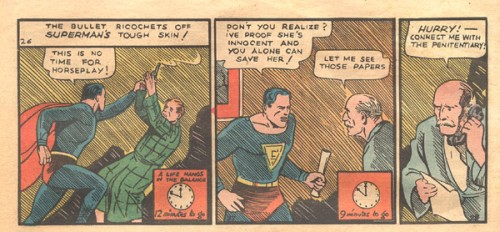
So if the emphasis on European comics is on these “densely-constructed panels and attention to background detail” (something that rings true even for comics that aren’t avantgarde), and the priorities for Japanese story comics is in having the panels be “easy to read” with respect to how panels flow into each other and other aspects, I had to ask myself, “What is the primary feature of American comics, specifically comic books, that makes it stand out?” What, in other words, is the aspect that artists and fans can draw from to make a comic feel very American?

Thinking it over, I’d have to say that I believe that traditionally, the primary feature of American comics is the desire to convey a complete amount of information in a single panel, to really inform the reader that, yes, this is going on right now exactly as you see it. Characters’ poses and actions in relation to text and background all work together to provide a sort of storytelling clarity that some might even regard as overly busy. You know where that foot is going. You know exactly what the characters are doing. You know what is going on in a given scene, as if every panel were an incident in and of itself. Some might say this is the problem with American comics, but I think that wanting to present information in your comic in complete chunks has its merits, in the way radio dramas of yesterday and cd dramas of today do. Of course, I say “traditional” because as comics artists from all over the world interact with each other these differences start to recede, but I think you can still see them in today’s comics.

I’m well aware that there are comics that do not do this, and that even in the comics that do there are plenty of panels which are more for conveying a mood or some other function. I’m also aware that all the visual examples are from superhero comics, and that there’s an entire indie comics scene out there, and famous artists such as Dave Sim, Robert Crumb, Chris Ware, Art Spiegelman, and even Brian Lee O’Malley who do not abide to this “rule” if you can call it one. However, I do feel that this is the aspect of American comics which people remember the most, whether they’re long-time fans or new readers, these panels designed to exist on their own if they have to, but also function as part of a whole.

Pokemon Reflects the Changing Times

The Pokemon anime is making the transition to digital broadcast in the coming months in Japan, and I think it more than anything else marks the beginning of the end for standard television.

The Pokemon anime is older than some of the kids who are fans of the show in the first place. It’s seen some of the most significant changes in animation and entertainment in our time. The anime started in 1998 with cel animation and a somewhat limited budget resulting in somewhat limited animation. As Pokemon reached international success, the show clearly improved, and by the time the 2000s rolled around it was starting to go into digital animation, eventually converting over completely. Along the way there’s been multiple movies done in both cel and digital, and now we have a new era upon us of widescreen, high-definition, digitally animated, digitally broadcasted Pokemon. And that’s not even talking about the basic changes in episode styles and themes that are the result of starting with a primarily Japanese audience and moving into an international one.

It’s amazing, isn’t it? Very few anime can say they’ve seen the world change around them as it has with Pokemon.