I Wish Virtual Youtubers Became a Thing Much Sooner

One of the biggest transformations that occurred from the internet of my younger days to that we have now is the integration of the web into our flesh-and-blood lives. Whereas once you could reasonably maintain some kind of distinction between “online” and “IRL,” the latter term isn’t even really used anymore because it’s kind of pointless. Every major platform wants you to integrate because it helps them make money.

I’m under no false assumptions that Virtual Youtubers are some defiant rebellion against the greed that makes companies share information, but what they do represent is a purposeful separation of selves between who you are among close friends and who you are to an audience—while also making it obvious that there is a distinction in the first place. Of course, there are plenty of famous cases of performers being very different in public and private (see Freddie Mercury for one famous example), but the use of stylized moving avatars reduces the chances of the two sides being conflated.

The way VTubers have reintroduced and even kind of re-normalized an element of pseudonymous presentation makes me wish that they arrived sooner. Perhaps the internet would look different if VTubers were more quickly embraced before Facebook, et al could make everyone think that putting photos of yourself everywhere for all to see should be the default.

Very broadly speaking, that’s what online icons and avatars were for. And when it comes to hiding your face but wanting to communicate, things like chat rooms and voice chat have and still fulfill that function. But where VTubing is able to go a step further is in its ability to convey facial expressions that add an additional layer of interpersonal connection while also keeping that active and outright facade in place. How much more comfortable might people be talking “face to face” if the faces are virtual? 

In the video above, Apex Legends player discusses his favorite Virtual Youtubers, but also brings up all the points I’ve made above. Namely, he likes the fact that it gives viewers something to look at while still maintaining some semblance of privacy for the streamer, even if it’s for someone who shows their face normally.

I understand the programs used by VTubers can be expensive and time-intensive, especially if you want something professional-looking like your favorites. Still, I imagine a world where this sort of thing becomes accessible to a great many more people, and they can maybe engage with their online communities more comfortably.
Making and Sharing Lemonade: Princess Connect! Re:Dive Season 2

The first season of Princess Connect! Re:Dive was a surprise hit for me. In a seemingly endless field of mobile game adaptations, this one manages to achieve a nice balance between plenty of irreverent hijinks among its core characters with a bit of intrigue surrounding its greater plot and world. Season 2 flips the ratio, leaning more heavily into the overarching narrative, but I find it still enjoyable in its own right. In a certain sense, having the former take a more episodic approach gives more dramatic weight to the latter.

One thing I find particularly fascinating about Re:Dive is the way it connects to the original Princess Connect (sans Re:Dive) by giving the “player character,” Yuuki, more dimensions through turning his story into a redemption arc. It’s established throughout the anime that the world portrayed in the anime is something of a “redo” after a final battle against a great villain went horribly wrong, which renders Yuuki initially amnesiac. “Having things happen to you” is not the same thing as having a personality, but in giving this origin story to Yuuki, it lets him feel like a character all his own instead of an automatic audience stand-in. Takasaki Yu from Love Live! Nijigasaki High School Idol Club shares a similar circumstance, and like Yuuki, is there in part to show how great everyone else is.

Making the vanilla Princess Connect the backstory for a bigger and better sequel turns out to be a solid idea, and it actually reminds me of another game franchise: Street Fighter. The very first game is widely regarded as the worst one just by virtue of awkwardly imprecise controls and the lack of a large playable character roster, but the roots were there. And like Princess Connect, it’s the sequel that would become more of a gold standard—and the sprinkling of story from Street Fighter would become the exciting backdrop for Street Fighter II. After all, how much more awesome is the rivalry between Ryu and Sagat when the canon says Ryu scarred Sagat with a Shoryuken and drove the former champion to develop his own leaping uppercut? 

For that matter, the way that various characters in Season 2 of the Re:Dive anime show up to reward their fans without overshadowing the Big Plot feels like how a fighting game anime would ideally work if adapted into a TV series. I never finished Street Fighter II V, so I can’t say how that one goes.

Princess Connect! Re:Dive Season 2 gets around to more or less wrapping up the big threads established from Season 1, but given that it’s a mobile game, there’s inevitably going to be some more story. I hope it can keep up the general joy and excitement that made me a fan in the first place. 

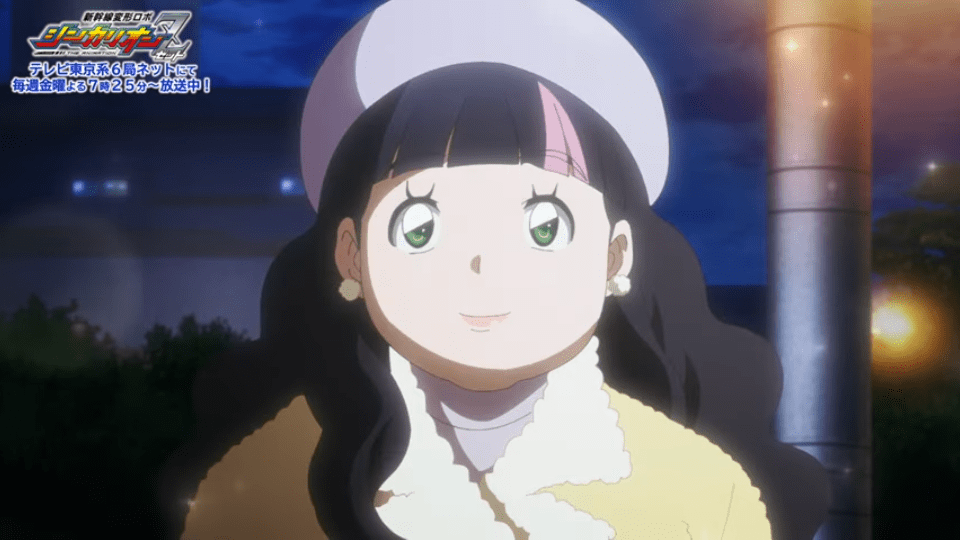
Shinkalion Z, Ooishi Misaki, and Fat Positivity

Attractive portrayals of fat girls are a real rarity in anime and manga, and when they do exist, they tend to have something of a fetish quality (see: Real Drive or Pochamani). It’s less common to see a character with a less conventional appearance featured in a romantic way that doesn’t draw specific attention to her size. But we have one in, of all series, Shinkansen Henkei Robo Shinkalion Z.

Ooishi Misaki is an operator for the Shinkansen Ultra Evolution Institute Yokokawa Branch, and is one of a handful of characters who fulfill the role of moving levers and hitting triggers to provide upgrades to the Shinkalion robots. In other words, she fulfills a role akin to Mikoto in Gaogaigar, and receives similar cool moments while working in the command center.

Partway into the series, a female character reveals that she’s actually a member of the enemy forces, and a guy in love with her named Hosokawa Atsuto feels betrayed and upset. Just as he tosses a souvenir he received from the spy into the water, Misaki happens to show up, and the Atsuto sees her in a dazzling new light, and finds himself smitten by her beauty in that moment.

Misaki does not exhibit negative fat stereotypes. She’s not comically eating all the time. She’s not constantly trying to diet. No one draws attention to her size versus other characters in the series. She’s different without any particular focus on that difference, and even Atsuto’s attraction looks like any other in anime and manga. That unremarkable quality is itself noteworthy, and I feel like it goes a step in the right direction.

Redefining Traditions and Expectations: Turning Red

Turning Red is Disney Pixar’s latest theatrical animation, and its focus on life as an Asian middle schooler hits close to home. Like many Asians from North America, I was a kid who took overachieving to heart due to my upbringing. I wasn’t dedicated as some of my peers, mind, but it was enough that getting a B+ used to summon deep and gut-wrenching dread. But when I looked at TV and movies, it was clear that characters who were like me were few and far between, and the ones who did appear were often relegated to support characters even when factoring out physical appearance. 

This has changed over time, with the mainstream rise of the “nerd” and protagonists like Twilight Sparkle from My Little Pony: Friendship is Magic carrying a similar energy, but that particular cocktail of emotions shared by so many of Asian descent remained a rarity. That’s why I was so taken by the heroine of Turning Red, Meilin Lee. A 13-year-old Chinese-Canadian from Toronto, her story is the latest in a line of works addressing generational trauma—and one of those symptoms is the way that Asian kids are expected to get those straight A’s, learn piano and violin, get into a good college, have a successful career, have a family and kids, and on and on. 

Yet, the key is that the pressure placed upon us does not come from malice, neglect, or simple fear of ruining family reputation, but rather from what is practically the opposite. For our elders who had to endure unbelievable hardship, they do not want us to suffer as they did, yet the context in which many of us are raised is so fundamentally different that it creates inherent tensions.

The way Turning Red pursues this complex relationship through Meilin is nothing short of brilliant and powerfully relatable. Within her is a turbulent embrace of both 2002 North American pop culture (boy bands!) and the traditional culture of her parents, and the way they merge and split and get thrown into the blender feels so much like what I experienced as a kid and still do today. It’s a film where I instantly saw myself—not simply because it’s about Asians but because it tells a personally familiar story in a way that assumes that such experiences are natural and common.  

Dang, Spring Anime Is Really Good: Ogiue Maniax Status Update for May 2022

I know I’m probably not the first person to say this, but the Spring 2022 anime season has been rock-solid. I can’t watch every show, but the sheer amount of quality made for quite an enjoyable April, even as the world continues to teeter between hope and despair. Spy x Family, Ya Boy Kongming, Love Live! Nijigasaki High School Idol Club, Birdie Wing, and a whole host of other series are just knocking it out of the park.

Thanks again to all my followers on Patreon!

General:

Ko Ransom

Diogo Prado

Alex

Dsy

Sue Hopkins fans:

Serxeid

Hato Kenjirou fans:

Elizabeth

Yajima Mirei fans:

Machi-Kurada

Blog highlights from April:

Navigating Your Cultures: Himawari House

My review of a comic about living in Japan as an Asian expat and searching for identity.

Super Robot Wars 30, Gaogaigar, and J-Decker: The Compromises of a Composite Narrative

Thoughts on the combining of two different Brave anime in SRW30.

The Art of Love: Words Bubble Up Like Soda Pop

A great little movie that went under the radar.

Kio Shimoku

Kio Shimoku’s Twitter was full of design drawings for Hashkko Ensemble. There’s a lot of insight into his early decisions for the manga!

Closing

One other piece of big news from April was the announcement and release of the final DLC for Super Robot Wars 30. I still can’t believe Shinkalion made it in! It makes me want to draw giant robot fanart…

Kio Shimoku Twitter Highlights April 2022

Kio’s tweets this month feature lots of his preliminary sketches for Hashikko Ensemble! It’s worth a look if you want to see how the characters began.

All the drawings used for the cover of Hashikko Ensemble, Volume 8!

Kio comments on the passing of Fujiko Fujio (A), remembering a Ninja Hattori-kun story he loved where Hattori moved next door and turned the house into a ninja mansion.

The pet tortoise at an active time.

Kio recommends that B the Jin fan go see Oedo Coraliers, a chorus/gee club Kio previously worked with.

The artist Shigisawa Kaya is feeling conflicted about waiting for things to calm down but that never being the case. Kio comments that he’s finally gotten around to checking things off his bucket list, but it’s after 28 years as a manga artist.

Kio has always felt that preparing salads is a pain even though it’s good to eat more vegetables, but then realizes that he basically makes salads for his tortoise every day.

Kio went to the library for the first time in a long while. The drawing of Kozue talks about the feeling of getting an author’s new work, only to realize that it’s already five volumes long and also finished. He then recalls borrowing tons of books from the library as a kid and reading through all of them before going back for more, but looking back wonders how in the world he managed to make the time to do that.

Kio comments that it’s the season for haramaki (stomach bands), and jokingly states that this year’s Fanta vintage is good.

A drawing for Afternoon that didn’t end up in any of the collected volumes of Hashikko Ensemble.

Kio began sharing some preliminary character design drawings for Hashikko Ensemble. Akira is described as having a contrast between his timid personality and his newly acquired bass voice. 

Jin’s initial background had him singing since he was five years old, and that he can even sing soprano. 

Kousei the baritone was always intended to have a heavy backstory. 

Shion was a more serious character, though had the quality of being made to learn piano by her mother, as well as having poor grades.

It’s interesting that some of the character designs changed significantly. Also, a few of these drawings were actually used in the teaser for Kio’s “new manga” back before the series began.

The student work uniforms.

Mimi-sensei, mostly unchanged. A capable person despite how she might appear, though lacking in experience.

Probably the biggest departure of all: A male character named Koizumi Yuusuke who would eventually morph into Akira’s neighbor and childhood friend, Himari. Described as an idiot who thinks he’s smart.

Kio mentions that people might ask “That’s it?!” when seeing how few planning drawings he does, but that’s just how he works. He mentions that he did have to design all the students in Class 1-5 afterwards, and that’s where Kanon, Kozue, and Shinji came from.

Kio elaborates on the point above that he tries to get a solid idea of how the characters will be in the roughs, and by the time he’s inking, he more or less knows how they’ll be. Someone asks if this was the same process he used for Genshiken characters, and he says yes. Kio also says that he feels the drawings feel the best in that rough stage and he wants to keep that feel, but that the designs inevitably change over the course of serialization.

An even earlier Shion sketch. Apparently “not owning a smartphone” was in there from the start.

A Chinese-speaking individual thanks Kio for all his work, to which Kio thanks them. Also, the person is clearly an Ogiue fan, and therefore a superior human being.

The rough versions of those early Hashikko Ensemble designs. Kio is asked how he came up with the names for Akira and Jin, to which he replies, “Intuition.”

To come up with various students and teachers, Kio gathered image references online and then started doing sketches based on them.

More sketches to better solidify the designs.

Why Did I Ever Stop Reading Fanfiction?

I don’t really read fanfiction these days, but that hasn’t always been the case. My very first internet community was a video game fanfic site, and I spent quite a few years indulging in the hobby. At some point, though, I simply fell out of it—and I haven’t returned since. When I see people I know who are well into the realm of adulthood like me who still read and write fanfics, and when I see something like Archive of Our Own spring up around two decades after I quit, I can’t help but wonder where the differences lie. Why did I stop whereas others have kept going?

While reflecting on all this, I came to a conclusion: I stopped reading fanfiction because I no longer need it to fulfill the reason I began in the first place. The root desire that led me to fanfics no longer applies to me today.

What Fanfiction Gave to Me

When I first discovered fanfiction, it came at a time when many of the things I enjoyed felt confined in certain narrative ways. Video games like NiGHTS into dreams… had plots and characters, but they were very sparse and minimal—more vehicles to get people playing than elaborately unfolding stories. Many cartoons I grew up with, like King Arthur and the Knights of Justice, never reached proper conclusions. This was also the era of anime OVAs at the video store, and those were often just little samplers not meant to be complete stories. 

What fanfiction gave me was the opportunity to explore these limited settings. It often felt like the canon product only gave us a thin slice of the worlds they were presenting. I wanted to see how other people imagined what was beyond the visible parts of those universes, both external (other physical areas and aspects) and internal (the internal worlds of characters beyond what is shown to us). Of course, fan sequels were a huge part of this, continuing the stories where they might have ended (in my opinion) too soon.

Why I Stopped Reading, Maybe

However, more and more of the stories I experience now feel more complete and more satisfying. The worlds they portray are endlessly complex and intricate, sometimes even overly so. Rather than wanting more and more, I find myself often wanting less and less. And if there is some unresolved element, I’d rather use my energy to move on to another piece of entertainment. My current mindset is, why read fanfic of one manga when I can read two manga instead? Not only that, series like Naruto literally have gotten sequels, and while there’s plenty to potentially disagree with when it comes to the direction Boruto has taken, I don’t feel strongly enough about it to check out fan versions. Heck, I’m not even that interested in reading the multiple endings of We Never Learn, where the author drew out a happy ending for each girl.

This isn’t to say that everyone should do what I do or be where I’m at. Fanfiction is great, and it holds so much energy for joy and discovery. I also look at what seem to be the common directions that fanfics go these days—alternate-universe settings for characters, shipping, etc.—and those aren’t really my jam either. In my younger days, I searched for Gundam Wing fanfiction because I wanted to see people come up with their own mobile suits. What I got instead was decidedly not that. Fair game, but not what I was seeking.

Maybe I’ll Be Back Someday

It would be silly of me to say “never.” What the past couple years has taught me is that the future is indeed unpredictable, and I may find myself in a place where I need the comfort of fanfiction. See you in another decade maybe.

Write Like an Eagle: Cobra Kai

I’m one of those people who wrote off Cobra Kai back when it was first announced. I’ve always liked the movies well enough, and the premise of a series focused on original antagonist Johnny Lawrence seemed interesting, but I wasn’t sure there was much to explore in the Karate Kid universe. Years later, I’ve taken the plunge and binged all four seasons currently out—and I have to express just how impressed I am with how much love, care, and respect the show’s staff and cast clearly put into this.

Cobra Kai continues the story of The Karate Kid series. True to its name, however, this new series focuses on the rival from the first film, Johnny Lawrence. Ever since getting crane kicked in the face by Daniel LaRusso and losing the 1984 Under-18 All Valley Karate Tournament, Johnny’s life has been stuck in the past and on a downward spiral. The fact that he’s living paycheck to paycheck while Daniel has gained (minor) fame and fortune only rubs salt in the wound. But when a selfish Johnny inadvertently rescues his new next door neighbor’s teenage son, Miguel Diaz, from a group of bullies, he finds himself in the role of “Mr. Miyagi”-type mentor to this boy. Only, instead of dispensing wise proverbs, Johnny’s approach is more School of Hard Knocks and 80s metal references, albeit while attempting to remove the cruelest elements from the Cobra Kai karate he was taught.

The premise of Daniel’s old tormentor becoming a sensei who doesn’t want to repeat the mistakes of how he was taught is intriguing in itself, but Cobra Kai does a remarkably solid job of taking the bits of depth present in Johnny in the original film (like how he had some sense of honor and limits to his antagonism) and expanding upon them. Essentially, what was once a largely two-dimensional character is fleshed out into a three-dimensional one.

The cast is split between adults and teens, with a roughly even focus on each group, giving a kind of inter-generational appeal to the series. Cobra Kai does a good job of outlying the contours of both the parents’ and kids’ respective concerns in their lives. Characters like Johnny and Daniel are able to use their experience to give valuable advice to the new generation, but there’s a limit to what they understand about what life is like for teens in an age of social media and greater social awareness.

Each season builds on the previous, adding twists and turns that highlight how the path to improvement is rarely problem-free. Sometimes the developments feel overly dramatic, as if they’re creating conflict for the sake of conflict—though that’s not surprising, given that Cobra Kai is an American-made drama about karate. Even if that element feels a little forced at times, though, the characters end up with interesting arcs where they learn and grow but also falter she stumble. 

The themes of Cobra Kai are poignant and valuable, though they are anything but subtle. When Miguel needs to learn to take initiative in life beyond karate, he’s told by Johnny to remember the Cobra Kai mantra of “strike first.” When the inherent aggressiveness of Cobra Kai’s style starts to create as many problems as it solves, the show contrasts it with Daniel’s defensive Miyagi-Do karate. And when the show wants to explore the need for balance in both life and karate, the show talks at length about that too. 

Ultimately, there are two important messages. First, it’s never too late to change for the better, but people need to change at their own pace. Second, there’s no one-size-fits-all solution to finding confidence and balance. Some need to learn a Cobra Kai mindset, while others need the Miyagi-Do philosophy, and everyone eventually has to pick up at least a piece of each.

To say I’ve become a fan of Cobra Kai is a bit of an understatement. It’s far exceeded my expectations, and I genuinely look forward to each new chapter in the story of past and future generations of karate practitioners evolving physically, mentally, and emotionally.

Not a Circle, but a Sphere of ’Em: The Orbital Children

I’m not the kind of anime fan who thinks having specific names on a project is the be-all, end-all. That said, as soon as I saw that there was a new anime by the director of Dennou Coil, Iso Mitsuo—with character designs by Yoshida Ken’ichi (Eureka Seven, Gundam Reconguista in G), no less—I knew I had to watch it. The Orbital Children (also known as Extraterrestrial Boys & Girls) is in many ways a spiritual successor to Dennou Coil, but rather than elementary school kids’ experiences in a world where augmented reality is commonplace, it’s about young teens in a world where humanity has to grapple with the consequences of “rogue” artificial intelligence and failed space colonization.

Orbital Children is set in 2045 aboard a space station and follows five kids ages 12–14. Three of them are from Earth, having won a promotional trip to the station, while the other two are the last surviving members of an attempt to bear and raise children on the moon. When an asteroid hits, the emergency forces them into a fight for their lives, but also into a confrontation with how they view the world, humanity, and themselves. Underlying all of this is the fact that the failure to create and sustain life in space is the result of a defunct artificial intelligence known as “Seven,” which was the most powerful ever before being shut down for going out of control.

Advertisements for The Orbital Children do not shy away from making associations with Dennou Coil. In comparing the two, I prefer Dennou Coil, but this has largely to do with format differences. Whereas the latter is a 26-episode TV series given time to both meander and slow-build its narrative, The Orbital Children is only six episodes and originally released in Japanese theaters as two 3-episode “movies” before becoming available on Netflix. I also am a bigger fan of the character conflicts and the eerie quality of AR as experienced by kids, but I also really appreciate the earnest confrontation with science and technology through the lens that The Orbital Children provides. In many ways, it feels like a spiritual successor to Dennou Coil precisely because it better conveys the concerns of children who are older but while still grounding it in this science fictional setting. 

Ultimately, the series asks the audience whether we’re too afraid of how things might turn out to be that we shield the young and try to keep them from learning more about the world in the ways that make sense to them. Rather than forcing them to go one direction while trying to hide all the bad stuff out there, isn’t readier access to more information and faith in their intelligence and reasoning the better way to go? When I think about this, I can feel my own fear influencing my beliefs, but there’s an element of realization that has hit every generation: Try as you might, you can’t truly control how kids think, so it’s better to foster learning.

Super Robot Wars 30, Shinkalion, and Pioneering DLC

The developers of Super Robot Wars 30 have announced a final expansion pack that brings many surprises, the biggest of which are new DLC units.

  • Scopedog, Scopedog TC LRS (Armored Trooper Votoms)
  • Ultimate Dancouga (Super Beast Machine God Dancouga)
  • Red 5+ (Majestic Prince: Genetic Awakening)
  • Getter 1, Getter 2, Getter 3 (Getter Robo Devolution: The Last 3 Minutes of the Universe)
  • Shinkalion E5 Hayabusa Mk. II, Shinkalion E5 Mk. II Over Cross ALFA-X (Shinkansen Henkei Robo Shinkalion the Movie)
  • Dygenguar with Aussenseiter (Super Robot Wars Alpha 3)

Gan Gan Zudandan

The big news on this list in my opinion is Shinkalion, not because it’s one of my long-desired franchises for SRW or anything, but because it has ties to a major company like Japan Railway. In hindsight, however, it was ridiculous to think that could be a barrier: Shinkalion did already appear in the mobile game Super Robot Wars X-Ω, and the series itself is crossover central. Seeing the series debut is nice, and I enjoy how the originally-3DCG units in this game have a different look and feel to them (see also ULTRAMAN). I’ll also be hoping for DLC missions where train otaku Hayato gets to geek out with all other mega nerds in the cast. Too bad Evangelion isn’t in SRW30 for some truly fun references.

I’m Seeing Double: Four Ryomas!

The other new main-series debut is Getter Robo Devolution, and I’m surprised at its inclusion. While other SRW have taken references from multiple Getter Robo series at the same time (mostly in terms of how Shin Getter Robo presents itself), this is the first time we’re seeing variations of the same characters crossing over—and no, I’m not counting Sanger and evil Sanger in Alpha Garden. Interestingly, they announced voice actors for these characters (and big ones too!), which makes the decision to omit a lot of the Gaogaigar vs. Betterman mecha all the more mysterious.

Incidentally, the manga is actually out in English from Seven Seas, so I plan on picking it up to see what this one’s all about. It’s also from the creators of Linebarrels of Iron.

30th Anniversary Versions

The Scopedog TC LRS and Ultimate Dancouga stand out because the idea of making special versions of robots specifically for SRW is very rare, with Mazinkaiser being the #1 example. Sometimes there are units taken from unused production materials (like Final Dancouga), but this is a step beyond. Moreover, both anniversary robots are from their original mechanical designers—Ookawara Kunio and Obari Masami, respectively—contributing to the epic feel of this collaboration. I’ll be curious to see what animations the Scopedog has, as I do miss Chirico’s amazing final attack from the SRWZ games.

When Will I Use Them?

I’m in a strange position where I’m pretty much at the final stages of SRW30, and I’m trying to figure out if I should just get all the DLC units before proceeding or if I should focus on them in a possible New Game+. Either way, I can’t wait to try them out.