One pleasant surprise from Anime Central 2025 was the presence of the new Anne of Green Gablesadaptation, Anne Shirley. The convention had two staff members as guests of honor: Producer Nakayama Yoshiko, as well as the voice of Anne, Inoue Honoka. Inoue is actually the daughter of veteran voice actor Inoue Kikuko (Belldandy, Aina Sahalin, various mom characters throughout the years).
Both guests did commentary over a screening of the first episode, providing a lot of insight into the production process. These are my notes from their Anne Shirley panel, but I will also be posting my interview with Nakayama and Inoue in the next few days as well!
They actually had the full animation done for the recording, a rarity. Inoue couldn’t stop being absorbed by the beauty of the animation.
She did the fish-eye lens scenes over and over.
Marilla’s voice actor has pretty much no anime experience before this, and is actually primarily a stage actor. Inoue once worked on dubbing a film with her and felt at ease.
Nakayama wanted to convey just how talkative Anne is to both people who are familiar and unfamiliar with her character.
They went to a great big lake the day before just like in the show. Specifically, Lake Michigan.
When Anne first spots the Cuthberts’ house, the yellow color of it is meant to show how Anne sees the house in her head.
For Nakayama, Anne walking into the house while crying is a really funny contrast. For Inoue, Anne going from crying to not crying all of a sudden left an impression.
Nakayama feels bad that Honoka has to keep up with a character like Anne who flips moods all the time.
Nakayama: Marilla is kind of tsundere. Matthew is strong and silent but has to go along with what Marilla says.
Honoka was told she could do Anne’s gestures while she was recording (like covering her face), which is unusual.
Nakayama: Anne’s personality and maturity for her age means she doesn’t try to make fun of anyone even if they are being hard on her.
Honoka: “I couldn’t do that.”
Nakayama: “Same.”
The screening was followed by a Q&A, which continued the look into their process.
The biggest challenge was finding a studio to actually do the show; the trends right now are isekai, action, and otaku-oriented works. The 1979 version also looms large and studios thought it would be difficult.
Inoue watched the old anime as a kid, and in middle school she learned about Lucy Maud Montgomery. That made her really want to land the role. She thought it was as unlikely as winning the lottery.
While Nakayama and the staff had to cut a few scenes due to time and money, the basic story remains unchanged. There is one thing she technically changed: adding a stoat.
Inoue prepared for the role by rewatching the 1979 anime. She also read the Japanese translation of the original books by Muraoka Hanako (apparently a very famous and beloved translation), and even reread it again after landing the role.
For Anne, Matthew, and Marilla (but not Gilbert), Nakayama had a clear idea of how she wanted them to sound, and Inoue was in top 3 for Anne.
At the audition, Nakayama pushed for Inoue. There was someone else who was in the top running but she can’t remember who it was, and another who would have been too busy.
A lot of the cast members are similar in age, and they go out for food after recordings, to get Korean food and such.
In June 2023, they all went to Prince Edward Island (where Anne takes place). The art director’s suitcase got a large crack, but nothing was stolen.
As a kid, Honoka didn’t name everything like Anne does, but she could feel the life force from nature, and thinks Anne is similar.
Some Japanese fans took issue with the color of Anne’s clothing and such, but they have experts who look at this stuff, and they hope the fans understand that not everything can be as they want.
One of the hardest things for Inoue was having to match the lip flaps, but it was fun actually getting to see Anne’s expressions. It’s like she really is in Green Gables.
Afterwards, everyone attending the panel got a piece of promotional art autographed by both Nakayama and Inoue. I noticed how above and beyond Inoue seemed to go to appeal to her fans, and I think she’s going to be a very beloved performer in the years to come.
The last time we saw a figure skating anime hit big, it was the sensation known as Yuri!!! On Ice. Medalist takes a different approach, telling a story of both an older coach and a younger skater trying to make up for lost time.
Medalist follows Akeuraji Tsukasa, a former competitive ice dancer who retired after failing to podium in his final event. As a high schooler, he dreamed of competing, but went into ice dancing after being told he was too old to start in traditional figure skating. When he meets a meek yet oddly daring 10-year-old girl named Iori, he discovers in her a girl who so desperately wants to be a skater that the local rink’s security guard shows pity on her by letting Iori sneak in in exchange for worms. Witnessing Iori’s passion for the sport, Tsukasa volunteers to become her coach, but 10 is already considered a late start in a field where beginning at five years old is typical, and Iori’s own mother is dead-set against it because another daughter of hers was injured competing.
Medalist is originally a manga by Tsurumaikada, and it currently still runs in the magazine Monthly Afternoon: a seinen magazine with more of an otaku appeal aimed more at an older male audience, though it tends to be fairly experimental as well. I imagine this is why Medalist has the structure it does, with a grown man and a young girl sharing the spotlight. As the competitor, Iori has more of the classic sports manga thrust of improving and aiming to overcome rivals, but it’s told more often from Tsukasa’s perspective as a guiding hand. These dual threads are interesting in that sports series tend to place the vast majority of the emphasis on one side or the other. With Tsukasa and Iori, however, you get to see things two ways most of the time: from the point of view of an older person who knows what it’s like to fall short of a dream, and that of a younger person anxious to compete but who dwells on the here-and-now. They’re also both passionate and timid in different ways, creating a fun and frantic dynamic between coach and player.
One of the basic questions of the series is “Where do you find your inner strength?” Is it built up as you stack blocks of experience bit by bit? Does it come from desperation to do all you can with what you have? Is it about “believing in me who believes in you?” One of Tsukasa’s greatest strengths is his ability to recognize what others do well and give them the encouragement to keep at it, such as when he lights a fire under Iori. At the same time, Tsukasa has no confidence in himself, which seems to consign him to a fate of being a great coach and a mediocre act were he to ever compete again.
Yet, when another ex-skater sees Tsukasa, he points out that it’s a flaw for one to assume they’re the underdog even when they’re not. As the series progresses, we get to see conundrums not just Tsukasa and Iori but also an ever-expanding cast of friends and rivals have their own takes on such challenges. They show the complex feelings that come with competition, and knowing that the people you’re facing bring their own strong convictions and desires to make it to the top.
Medalist is a great work, and it’s worth checking out in anime or manga form. As for which is preferable, it really depends on what you’re looking for. The anime has the advantage of being able to portray figure skating in full motion with sound, replicating the feeling of watching and experiencing competitions. The manga is further along in its story, and the intensity of the art makes it feel as if the characters are radiating energy when they compete. Certain characters can give a very different impression as a result of the stylistic differences: Kamisaki Hikaru, the #1 skate in Iori’s age group, looks aloof in the anime but sometimes seems to border on sociopath in the manga. But no matter the medium, Tsukasa and Iori are a wonderful and endearing duo who work together to tell a story about striving for a dream while also trying to give hope to the next generation.
I can’t believe the summer anime season has arrived! I’m already behind on the spring shows, so I may be stuck in a perpetual state of being behind on everything.
I’m looking forward to the return of Panty & Stocking, as well as a chance to finally see what Hell Teacher Nube is all about.
If you want to see Kio’s rough manuscripts, this is a good month.
Closing
We got a new fish in town! I feel like we might see big moves from her soon—including with many other big names, like Dooby3D, Nimi Nightmare, Mint Fantôme, and Dokibird.
Kio watched the movie Eiyuuden, and was impressed by the fight scenes. The movie consulted with an actual martial artist for them. The organization that provided the consultation thanked Kio.
Kio feels that he should be starting to think up a new idea for serialization (that is not porn). This is easier said than done, because he often starts having ideas for new ero manga instead. When one fan asks if he’ll do fantasy, Kio responds that all he can say is that he won’t say anything.
Kio knows what he’d like to work on, which is more Sister Wars. Last time he was working on a proper draft, he stopped one page short of introducing Anakin. However, he also feels that instead of doing a full draft, he should be working on the rough manuscript for Episode II.
Chapter 2 and on of Sister Wars: Episode I. The first few pages are fully drawn and inked, while everything that follows comes from the rough manuscript. Note: This is around 150 pages of work.
Anime Central 2025 was home to the United States premiere of the final Thunderbolt Fantasy movie. I reviewed the film, but because there was so much other stuff, I didn’t want to cram it all into one post. So here we are with Part 2, which covers things that happened both before and after the screening. Note that much of what’s written below contains SPOILERS for the finale.
Red Carpet Gala
Before the screening, ACen actually set up a red carpet of sorts and allowed photographs of the puppets. Some cosplayers were also there—one who later turned out to be PILI puppeteer Osmond Pi Ting, and a couple who were just really dedicated fans.
Live Demonstrations
After the screening, the staff also put on demonstrations of the puppets as they went around the room. Music and sound of different characters played, and the puppeteers moved the puppets with grace and beauty.
Osmond (cosplaying as the Enigmatic Gale) also participated, and at one point even “fought” the Demon Lord.
Panel Q&A Notes
PILI also provided lots of fascinating information about their process in a Q&A section.
Audio is recorded first, and then the puppeteers at according to the voices and sounds
The giants and monsters (such as the gorilla mecha and the emperor made of magical swords) are played by live actors in suits
They actually only use one camera to film for the most part. Two cameras are utilized for explosions and such, though.
The sage who created the swords is actually based on a famous character from PILI’s shows. One of his appearances is in the 2000 film Legend of the Sacred Stone, where he was voiced by Koyasu Takehito in the Japanese dub. Koyasu reprised the role for Thunderbolt Fantasy.
Some puppets are heavier and can be harder to puppet. In some action scenes, three people might be needed to puppet
Traditionally, PILI lets the sculptors do the creating and go straight into making the puppets. Thunderbolt Fantasy was different because they got the designs from Japan. Simple puppets like Shāng might need two weeks, while more complex ones like the yandere princess might need two months because of all the 3D printing for her accessories.
There were two puppeteers among the guests. One was Osmond (the aforementioned cosplayer and puppeteer), who is one of their newest recruits. He likes to handle the female characters because he’s adept at conveying softer movements. The other was Yu-Che Hsieh, a 30-year veteran. He likes to puppet action scenes.
Who decides the signature gestures of characters? They’re designed by the puppeteers based on the script, and then go about trying to get their personality down.
TM Revolution definitely liked working on the series. In one of his music videos, he had Làng come out to interact with him. Làng allowed him to play a character who actually survived [as opposed to dying quickly like his Gundam SEED characters], which he was happy about.
PILI staff sometimes had to come out covered in fake blood when making trips to the convenience store. Bystanders wondered whether they should call the cops.
That’s it for this post! Stay tuned for Part 3: An Interview with the staff of PILI and Thunderbolt Fantasy!
I’ve never played League of Legends, but I decided to watch Arcane after seeing it consistently praised by all sorts. Now, having finished the first season, I understand why it is beloved in a way far different from the also-popular game it calls its source material: two-dimensional personalities given depth through a story about family and class differences, combined with an attractive aesthetic that marries cool action with a colorful, yet gritty environment. Playable characters are seen in a new light, such as fan favorite Jinx, who goes from a Harley Quinn–esque goth punk to, well, basically the same thing but with a method to her madness and a tinge of tragedy.
It’s not the first instance of taking rougher materials and bringing them all together to make a creative work with more cohesion. Alternate stories with familiar characters, be they done by professionals or fan amateurs, are a way to tell stories that might not happen otherwise. That’s why I was surprised to find out that Riot Games has decided to make Arcane the official League of Legends canon and retcon everything else to fit it. That indicates just how successful Arcane has been, because reshaping your lore in your 15-year-old series is no simple task.
One article I read about the retcon mentioned that League of Legends has plenty of established backstory, though players were not necessarily engaging with it in-game. I think the difference with Arcane is that the previous stuff apparently felt like either scraps of lore dumps, whereas actual stories told through a narrative just hit differently. They create a sense of connection to the characters as creatures of thought and emotion whose lives have stakes.
The closest thing I can compare to Arcane is the Generation 1 Transformers cartoon. In its case, the franchise began by bringing together action figures from multiple Japanese toy lines under one banner and giving these toys basic names and designations of good and evil (Autobot or Deception). But the 1980s cartoon went such a long way in establishing those toys as characters that it became the benchmark for how all Transformers works, and to some extent all similar multimedia properties are perceived. Optimus Prime was vaguely a heroic truck in toy form, but with his battles against Megatron animated, he became the strong and gentle leader with an unparalleled moral core that we still think of today.
I don’t know if the Arcane retcon is working, but I’d love to know if people have indeed been convinced to play League of Legends because of it, and whether the refocus has been welcome or not. (Though I still will probably never play the game.)
At Anime Central, I attended the panel for Kobayashi Hiroyasu, CGI Director at Studio Khara, and I learned a lot.
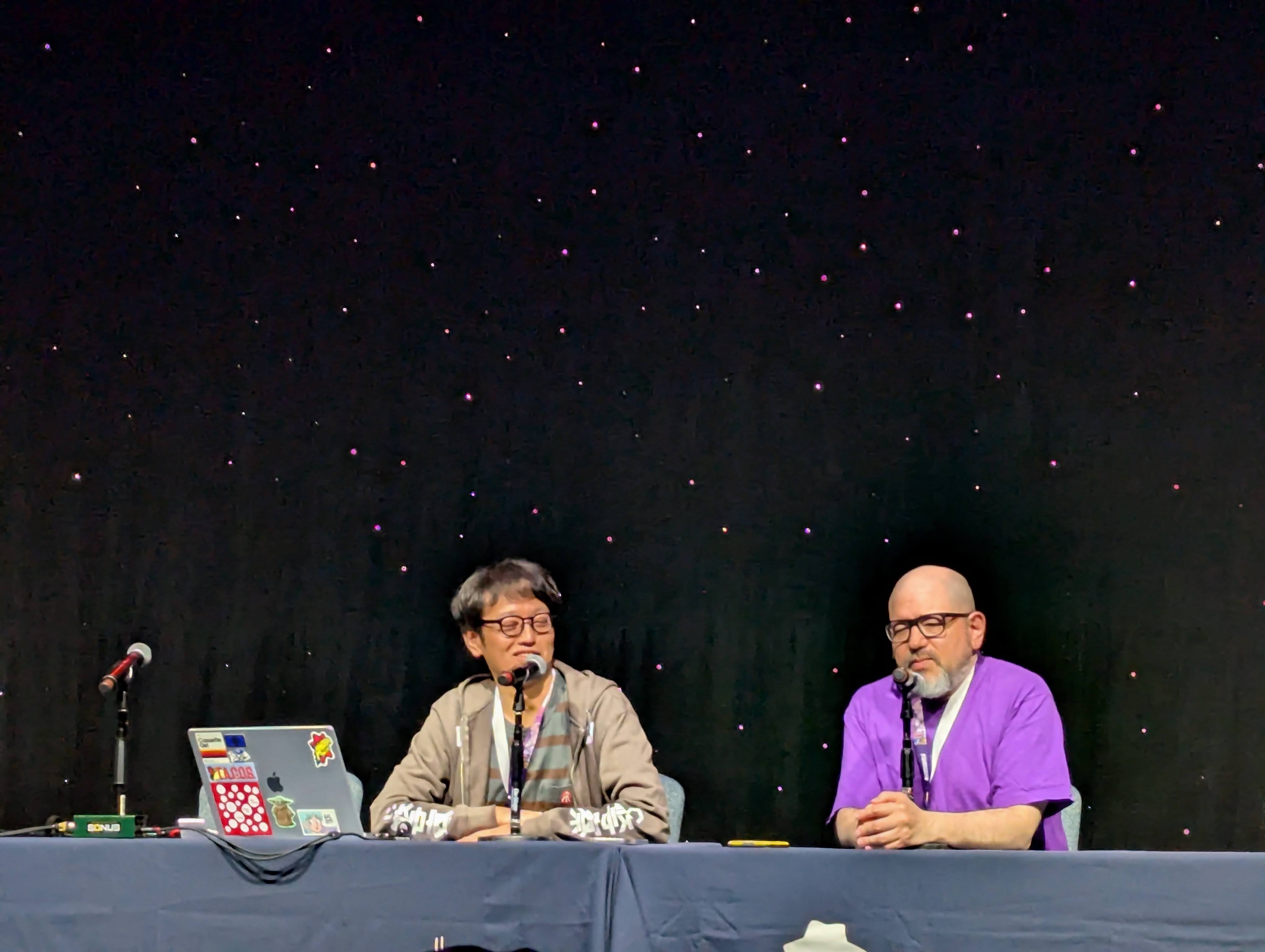
Kobayashi has worked on titles such as the Rebuild of Evangelion filmsand Gundam GQuuuuuuX, but until I came to this panel, I didn’t have a good sense of what his job was. While one might imagine a CGI Director as a person in charge of 3D animation or models, his job along with the rest of the digital production team is to create assets and enhance scenes by adding details and intricacies so that the final product has the right character and feel. Along with translator Dan Kanemitsu (who is on the right in the photo above, and who also works for Khara), they described how one thing that sets Khara as a studio apart is the accumulation of small details.
Some examples of his work include the following.
Superimposed staff credits and lightning effects in the GquuuuuuX opening.
Monitors, logos, etc in Rebuild of Evangelion.
Superimposed textures like decals on model kits.
Making a scene better by adding a mesh walkway onto the floor.
Making things look dingier.
Dan Kanemitsu also mentioned that he’s charged with finding English assets to avoid “Engrish” issues.
Kobayashi also mentioned that sometimes, they’ll put in a bunch of work into a really nice and detailed background, and then it’ll be almost entirely obscured by extra graphics in the final product.
They also provided a lot of information about what it’s like working for Director Anno Hideaki.
Anno Hideaki used to add details in sharpie to cels, but now that’s Kobayashi’s job to do it digitally.
That attention to little details is characteristic of Anno.
Kobayashi and Kanemitsu told a story about how Anno sent them a post-it note with a message about adding locking holes to a scene similar to the ones used on aircraft carriers to anchor the planes. Anno thought it would be an easy copy/paste job but they actually had to create a locking hole model in CG to get the perspective right.
Anno generally wanted all monitor graphics to convey what is going on, which made their job harder. For example, in a scene depicting massive needles injecting EVA-02, they changed it so that the monitors showed the injected liquids going through the EVA’s entire body.
The glittery, shimmering water one used to often see in anime back in the cel animation days is called backlighting cel, and it was something Anno was especially good at. They wanted to recreate that feel for digital animation.
They also talked about working with Director Tsurumaki Kazuya on GQuuuuuuX.
Tsurumaki wants everyday life in GQuuuuuuX to resemble modern real life, which is reflected in the choice of cell phones and other details.
Spattering is an art technique used in the original Gundam, and the’re incorporating it into GQuuuuuuX as well.
The colony Side 6 is a facsimile of current Japan mixed with other cultures
In the world of GquuuuuuX, Anaheim Electronics is a glorified appliance maker.
Trains are primarily Tokyo style, but the station names take from different cultures.
On the subway maps, the stations have very different names. There’s a lot of British station names, and this might be because Tsurumaki is a big fan of British soccer.
A particular green subway line is a representation of Tsurumaki’s old defunct train route from his home.
The police wear uniforms that say “Military Police” in Japanese, but just “Police” in English because the director wanted signage to be readable at a glance.
There’s a travel book that purposely replicates a series of guides called How to Walk the Earth.
Stickers on a particular laptop are from drag racing in current day Tokyo.
A box of tangerines alludes to a tangerine box that Tem Ray was using in the original Gundam.
The activation key common to mobile suits resembles the Tem Ray circuit, which was a piece of junk in the old series.
Kanemitsu was asked to come up with elements to make Pomeranians trading card more MLB-ey
Saturn Doughnuts: “I told you I don’t like sour stuff” is a reference to FLCL.
Overall, I came away with an appreciation for another aspect of working in animation, and I hope I can convey that feeling to everyone reading this.
I follow the VTuber La+ Darknesss, who reads a lot of manga on a regular basis. Every so often, she throws out a recommendation, and one such title that caught my attention was Oshi ga Yameta, or My Fav Idol Quit.
Miyabi is a 25-year-old woman who is obsessed with a male idol, the 22-year-old Miku. She devotes her entire life to supporting him, even going as far as doing sex work to fund her fandom. Miyabi also meets up with a group of like-minded women, each of whom have their own favorite idols, and each of whom have their own secrets about their personal lives. But when Miku announces that he’s quitting the business, Miyabi ends up like a boat adrift in the ocean. What she doesn’t realize is that Miku’s retirement is the catalyst for drama, turmoil and discovery—not only for Miyabi and Miku, but also the people around them.
The world of Japanese idols is a great subject for stories because the clash of fantasy and reality is inherent to it. Oshi ga Yameta focuses on the drive of fans to keep living in an illusory world, but not solely in a negative manner or judgmental manner. Individual and societal circumstances, like the pressure put on Japanese women to marry young, undergird the seemingly foolish decisions being made by idol fans. At the same time, the manga also portrays the idols themselves as being of all stripes, from those who genuinely buy into the idol image to those who enter the industry with ulterior motives. The lives depicted feel both ugly and beautiful, and it’s not always clear which aspects are which. Is Miyabi’s main sex client any better or worse than Miyabi herself in terms of how passion, love, and lust intertwine?
Comparing it to the biggest idol drama work of the day in Oshi no Ko, Oshi ga Yameta entirely lacks the supernatural elements as a plot hook. The latter also maintains its heroine’s perspective as a fan and nothing more (as opposed to having her enter the industry), and puts greater emphasis on the torrent of complicated emotions arising from a lifestyle that is both self-affirming and self-sabotaging. The art in Oshi ga Yameta is also very different, showing a messier style with less distinct differences in character designs, but which emphasizes its characters’ own dysfunctions and roiling emotions. The two series do resemble each other more in certain ways, but it’s not immediately obvious how.
I originally planned to read all of Oshi ga Yameta a lot sooner, so it’s funny that I would finish after the news about the Fuji TV scandal involving the former leader of the idol mega group SMAP. Juxtaposing this real scandal with that of the manga’s, it becomes clear that there’s still an element of fantasy even as stories feel “too real.” But the ability to approach sensitive topics while cloaked in fiction helps to provide plenty of food for thought, and this particular manga provides a hell of a buffet.
In 2016, I was looking at a preview of the new anime season with friends, as was our custom. We talked about the shows we thought had potential, the ones we were more skeptical about, and anything else of note. But there was one series that seemed to come completely out of left field. A Taiwan-Japan co-production that wasn’t animated but rather performed using puppets, and it was written by Urobuchi Gen of Madoka Magica fame?! Even if we potentially did not end up liking it, we had to at least give this Thunderbolt Fantasy a chance.
Nine years later, and this series has become one of my absolute favorite works of fiction ever. The novelty of its puppetry never actually wears off, and it’s backed by solid writing and charismatic voice actors giving some of their best performances, as well as a sense of tension and excitement that had me coming back for more. So when I found out that they would be doing the North American premiere of the feature-length Thunderbolt Fantasy: The Final Chapter, I made it my mission to attend the convention.
This is my review of the movie, but since then, the movie has come out on Crunchyroll under the name Thunderbolt Fantasy -The Finale-. I recommend you just get straight into watching it, but feel free to proceed if you want my thoughts. Note that there will be a MAJOR SPOILERS section at the bottom.
The Basics
Thunderbolt Fantasy is set in a world once ravaged by a war against demonkind, which humanity barely won thanks to the help of a series of divine weapons. In the long years since this War of Fading Dusk, the weapons have been sought after by the righteous and the evil alike.
When we first see the two main characters of our story—no-nonsense vagrant swordsman Shāng Bú Huàn and white-haired pain-in-the-ass illusionist Lǐn Xuě Ya—they have just met each other for the first time, and both are holding their own respective secrets. At the end of the first season, we learn that Shāng is not only a ridiculously powerful swordsman who can wield a wooden stick like it was real steel, but that he’s also in possession of the Sorcerous Sword Index: a special scroll designed to house all sorts of supernaturally powerful weapons. Shāng carries it to prevent the weapons from falling into the wrong hands, notably the Order of the Divine Swarm, a clandestine organization seeking to conquer the world.
But Lǐn the “Enigmatic Gale” has been far more, well, enigmatic. Throughout the prior seasons, he appears to just be an elusive trickster who finds joy in aggravating the powerful. But in the penultimate chapter, we finally learn a truth even he didn’t know: Lǐn is actually a kind of “offshoot” of the Demon Lord who rules the Demon Realm, cast away and abandoned to remove any of the leader’s weakness. Lǐn thus has a revelation that the greatest target to torment would be essentially none other than himself.
Three other major plot points help create the backdrop for the end. First, the leader of the Divine Swarm, Huò Shì Míng Huáng, turns out to be the Emperor of Xī Yōu, the land which Shāng was trying to leave. This means the emperor was playing both sides of the law the entire time. Second, one of Shāng’s old allies, a bard named Làng Wū Yáo (voiced by rock star TM Revolution!) is actually half demon and is being forcibly transformed into an infernal god by his long-lost father. Third, the armies of Dōng Lí and Xī Yōu (the East and the West) are on the verge of coming together to fight a new war against the demons, though the former doesn’t know a thing about the latter’s true identity.
The Final Chapter
I’ll admit that I don’t have the most rigorous grasp on the full story of Thunderbolt Fantasy. There’s a lot I’ve forgotten over the years among all the different plot threads, and I suspect many coming into this movie would be in a similar situation. However, I actually don’t think you need to have an encyclopedic knowledge of all that has transpired to enjoy the film. In addition to just being incredibly entertaining, the characters all have such bombastic designs and larger-than-life personalities that it’s easy to identify what roles they each serve in the overall narrative, even if the details are a little fuzzy.
That said, the movie is (as expected) not meant to be watched without any prior exposure to the show, and it does little in the way of actively filling in the blanks for the uninformed. It feels very much like the conclusion of a long-running TV series than a work meant to stand entirely on its own legs. Things happen fast and furious, not only in terms of the pace of the storytelling but also the action. The fights are more complex and relentless compared to what is typically seen in Thunderbolt Fantasy, and rivals even the greatest martial arts fight scenes in history.
In a certain sense, this is PILI taking off its weighted clothes and unleashing its full potential. The studio has a four-decade history of creating action-oriented puppet TV shows in Taiwan, and if you compare Thunderbolt Fantasy to their other works, the latter often turn into such never-ending frenzies of stylized violence that the notion of “breathing room” is a suggestion at best. But action in Thunderbolt Fantasy is slower and more deliberate, emphasizing the drama over a fight choreography built on countless details. In The Final Chapter, we get the best of both worlds.
Battles truly feel like the characters are fighting with everything they have, while the narrative and the characters’ individual motivations provide context to give their movements meaning and weight. Lǐn fights his doppelganger, the Demon Lord, and they naturally match each other move for move. Làng’s travel companion, a sentient pipa, has turned human and fights with strings befitting a former instrument. When he runs into a yandere princess puppeting two magical corpses at the expense of her own life force in order to take on Làng’s demonic father, the three-way back-and-forth is nonstop but also relatively easy to follow. And when Shāng finally gets the chance to wield a non-wooden sword after nine years of avoiding it, his assault is all the more special.
The plot twists and dramatic turns are all really satisfying in a way that screams “epic finale,” and the respective fates of all the big villains provide perfect bookends to all their stories. The film even touches on the origins of Shāng himself, and it was the last thing I could have ever predicted. That being said, I want to discuss some of the details of the ending.
SPOILERS SECTION
There are three major spoilers I wanted to write about in greater detail.
The first thing is Shāng being in the same company as Marty McFly (Back to the Future), John Connor (Terminator), and Philip J. Fry (Futurama). Essentially, he turns out to be the son of Lāng and the blind harpist Mù Tiān Mìng, both with whom he fought side by side before the start of Thunderbolt Fantasy. They realize their baby is somehow the Shāng they know, and the couple gives him up to the sentient pipa-turned-human, who apparently comes to raise him in another realm so that he will be ready to fulfill his destiny.
I definitely did not expect that, and based on the audience reaction, I don’t think anyone did. I also genuinely thought he had romantic feelings for Mù, but I guess it turned out to be more filial. They hinted at Shāng being a time traveler of sorts in Season 4, and possibly before that as well, but it implies the source of Shāng’s unparalleled swordsmanship: the fact that the man has trained across time and space and dimensions since he was a child. So he was the child who saved everyone, and also got his own parents together, to an extent. At least he did not sleep with his own grandmother.
The second thing is the way the leader of the Divine Swam is defeated, and the aftermath of his loss. There’s something a little hokey but absolutely wonderful about him using all the divine weapons of the Sorcerous Sword Index to transform into a gigantic armored demigod. A part of me wishes he was vanquished in a more conventional manner, but I think what happens fits the story incredibly well.
Shāng uses the one remaining blade, and while it seems to have no effect on Huò, it seems to be opening up a rift in the sky. Realizing the true nature of the weapon in his hand, Shāng proceeds oto summon Bái Lián, the sage who originally created the weapons (and whom he met in Season 3). Bái Lián proceeds to forcibly bring the emperor into the void beyond and back home to his own world where the weapons came from, and where they are now rusted and lifeless. The emperor tries to use his dark magic to threaten Bái Lián but finds that he can’t form spells. Bái Lián tells him that had he arrived in this realm as himself, he would have retained his powers, but by tying his very being to the weapons, he is now as inert as they are, and the only thing he can do is live like any other average person. His precipitous fall from world conqueror to commoner breaks him.
I love this so much. Not only is it rather cathartic given the state of the actual world right now, but I really find pleasure in seeing someone who believed they were untouchable be laid low and made to feel vulnerable. The villain really thought he was inherently superior and deserving of ruling over his entire world, and the fact that he can’t handle the idea of fending for himself the way everyone else does is the justest of deserts. (See also JoJo’s Bizarre Adventure Part 5: Golden Wind). Bái Lián is also based on a popular recurring character in PILI’s Taiwanese puppet shows, so his presence at the climax is also a way to pay homage to the studio that made all this possible.
The third thing is Lǐn taking over as Demon Lord. Hilarious. We get that silly moment where Shāng sees through his disguise and refuses to duel to the death with the Enigmatic Gale (“Of course it’s you. I’ve never even met the Demon Lord, so why would he want to fight me?). We also get to think about just how a Demon Realm ruled by the most egregious troll in all of existence would turn out.
SPOILERS OVER
Concluding Thoughts…and More
What a fantastic ride. I’ve been told that this movie was originally supposed to be a full season, and it does show to a degree, but I still think this was a wonderful way to close the book on Thunderbolt Fantasy. It was the essence of this whole international creative endeavor boiled down to a clean 90-ish minutes, and had me coming away grateful to have learned about it nearly a decade ago.
So those are my thoughts on the movie, but this is actually just the first part of my Thunderbolt Fantasy coverage from ACen 2025. There was a “red carpet gala” to show off the puppets before the screening, as well as a Q&A afterwards with some live puppet demonstrations. Even more exciting, I got the chance to interview the PILI staff and even try out one of the puppets!
Of all the decades-long science fiction mega franchises in the world, Doctor Who is definitely one where I’ve long had little, if any exposure.
In my head, it was always this series where people got mad if I called the main character “Doctor Who.” It also had the image of being a relatively low-budget serial adventure that suddenly became big again around 2006 or so, had been going on since television was black and white, and somehow had still kept going. It was (somehow) a still-ongoing story whose various hiccups and plot inconsistencies can be hand-waved away with suspension of disbelief and time travel shenanigans—not unlike a mix of soap opera, pro wrestling, and Star Trek, with shades of the legacy of Buffy the Vampire Slayer in more modern times.
Oh, and I enjoyed seeing that one scene of Daleks vs. Cybermen. It works even without knowing a single bit of actual Doctor Who context.
But until recently, I don’t think I quite appreciated the lasting impact Doctor Who has made on culture and entertainment—not just in the UK, but around the world too.
I think there were two things that prompted me to start looking at the series more in-depth. First, I kept seeing people (including VTubers like Gawr Gura) make reference to the Doctor Who monsters known as Weeping Angels. Second, I read that the Doctor Who theme song is iconic, identifiable, and still very unique even after 60 years…and I couldn’t recognize it even if you played it in full for me. Knowing that this was a missing piece of television and pop culture education in my brain was my motivation to learn. And with a lot of help from a very well-maintained official Doctor Who Youtube channel, I started to just watch clips of iconic scenes from throughout its run going all the way back to the First Doctor. I read discussions about “who’s the best Doctor,” knowing that this debate has been going on for literal decades and across generations and waves of nostalgia. I learned that the aforementioned theme song is one of the two most continuously used theme songs ever (the other being James Bond), and even influenced Pink Floyd.
But one thing I held back on was watching actual full episodes of Doctor Who. Where do you even start? It’s a challenging question, even when compared to similarly old franchises like Gundam or Star Wars don’t have to face. In those cases, “go with some version of the original” does the trick, but with Doctor Who, there are literal episodes of the early era that were never archived, and by most estimations, Doctor Who didn’t hit its stride until at least a few years in.
I ultimately went with “Genesis of the Daleks,” a story from the Fourth Doctor era, because I read that it’s a widely beloved episode featuring one of the most popular Doctors of all time. I understood that it risked color my perception of Doctor Who to an extent, and that it would give me perhaps a different impression from the 21st-century “New Who” era that helped drive Tumblr discourse for over a decade alongside Supernatural and Sherlock (the so-called SuperWhoLock fandom). If this was the “peak” of Doctor Who, I tried to remember that the series is a range and not a single mountain.
I was impressed. Within the caveat of it still being fairly hokey, the basic plot is surprisingly serious and fraught with profound ethical dilemmas. The Doctor being forced to go back in time to try and stop the creation of the cruel, genocidal war machines that would become his greatest nemesis. He finds himself in a “would you shoot Baby Hitler?” scenario and a chance to convince the father of this army of Baby Hitlers to change his mind, only to realize that this creator is beyond all help. (And if the Nazi analogy wasn’t clear enough, all the soldiers fighting this forever war are all very SS-coded.) For a show aware of and expecting young viewers among its audience, these are heavy topics.
(I also can’t help but think about the fact that Nazis were still fresh in the general memory of humanity at this point. It’s perhaps appropriate that I’m watching this at a time when we are realizing once again that Nazism and fascism are clear and present threats that must be confronted.)
But even putting aside the weightiness of the topics, what truly makes “Genesis of the Daleks” work are the performances of the actors themselves. Tom Baker as the Doctor is so very convincing, both in terms of his portrayal of this eccentric protagonist around whom the series revolves, but also with the way he seems to really grapple morally and philosophically with the potential impacts of his decisions. Baker isn’t alone, either, as other actors (notably Elizabeth Sladen as Sarah Jane Smith) also bring a sense of sincerity to their performances.
The ability to make you believe that the characters believe their own words reminds me a lot of tokusatsu from Japan: The shows might look cheap, but the actors and presentation make the stakes feel real, and that’s something that can ring true on some level even if the writing, the visuals, or storytelling styles change. It’s also the case that, like Doctor Who, franchises such as Ultraman and Kamen Rider have themselves been ongoing for decades—with new protagonists coming in on a regular basis, and with continuous growing pains as they try to adapt to the changing times. Because of all this, I came to the conclusion that Doctor Who is basically British tokusatsu.
It’s actually more coincidence than anything else that I started watching Doctor Who during a time that I’ve heard about some wild things going on. I don’t pretend to have an opinion on all that because, well, I’ve just dipped my toes in. But it is funny and amazing to me that this work of fiction is somehow both massive and small, and that it has existed long enough to have made a mark on both the history of prog rock and Tumblr. I don’t know how much more I’ll end up watching, but never say never.
And did I write all that just to talk about watching a single Doctor Who story? Yes. Yes I did.




 OGIUE MANIAX