VTubing and the Dancer’s Conundrum

With the 3D debut of hololive’s ReGLOSS, we have the arrival of another fantastic VTuber dancer. Todoroki Hajime might very well be the best yet, her experience as a professional backup dancer coming through loud and clear. She’s mentioned her love of dance since day one, and other talents have praised her abilities along the way, so there was a good deal of anticipation for Hajime in 3D.

It was well worth the wait, but I have to think about the fact that the wait happens in the first place. Being a VTuber known for dancing comes at an inherent disadvantage.

Almost all VTubers these days begin with 2D models; it’s the faster and more economical option compared to 3D. The drawback to this approach is that movement is much more limited. Certain skills are not really affected by this—singing, chatting, and gaming all work similarly to what non-virtual streamers do. 

However, dancers cannot show their strength at the start. They require a 3D model plus more advanced motion tracking, as well as literal space they can move comfortably in. For indie VTubers, this can be a very tall order, with the technology being very expensive. Even in a more established company, talents rarely get them any time soon. hololive, arguably the best place for virtual dancing, still has a typical lead time of around 7–12 months, with Hakos Baelz especially delayed (18 months!) due to restricted travel to Japan resulting from the COVID-19 pandemic. Brave Corporation—owners of VSPO, V4Mirai, and more recently IDOL Corp—often have the shortest lag time, but even that is measured in months. The early period starting from debut is a vital time to make an impact and establish one’s image, and a reputation for dance is harder to include when the audience can’t see it.

After these dancers (or any other very physical performers) show the world what they’re capable of, they still face hurdles. Namely, they often simply cannot dance as frequently as others engage in other methods of performances. For hololive, proximity to their studio in Japan is a major factor—those living overseas have to invest a lot to even be there, and if anyone wants to dance more often, they basically have to stay in Japan. I have to suspect that this has been a factor in both Bae’s, hololive English’s Koseki Bijou, and hololive Indonesia’s Vestia Zeta’s decisions to move to Japan. And even after that, they have to deal with well-known scheduling issues when it comes to booking studio time. Other companies have to rent out dedicated spaces that specialize in 3D motion capture.

Even in a stream to stream comparison, dancers have it tough. A karaoke session can go for hours, bringing attention and even money through viewer donations. Dancing, in contrast, is much more physically demanding while also having to deal with cumbersome and costly equipment.

The upside of being a dancer is that one does finally get the chance, it makes a hell of an impact. There is probably nothing that shows off better the concept of a VTuber as a bridge between the real and the virtual. Hajime’s debut performance of “Bandage” has done incredibly well, with her clipped VOD (see above) already close to 2 million views. I have zero doubt that she’ll get some of the loudest cheers when she appears at the annual holo fes concerts.

There’s definitely value to building up hype over many months for a 3D debut, and wowing viewers with an incredible choreography and sheer ability. At the same time, though, it does give those who shine brightest through their footwork and movement something of a slow start. While I know it isn’t realistic, I do wonder how things would be if VTubers could stream dancing on a whim, or at least as easily as they could do anything else. 

The La+ Darknesss Solo Live, the hololive EN “Mind Craft” Cover, and Other Recent Music Events

A lot of cool music-related things have happened in hololive land over the past few months, so I just wanted to give some brief, unorganized thoughts about them.

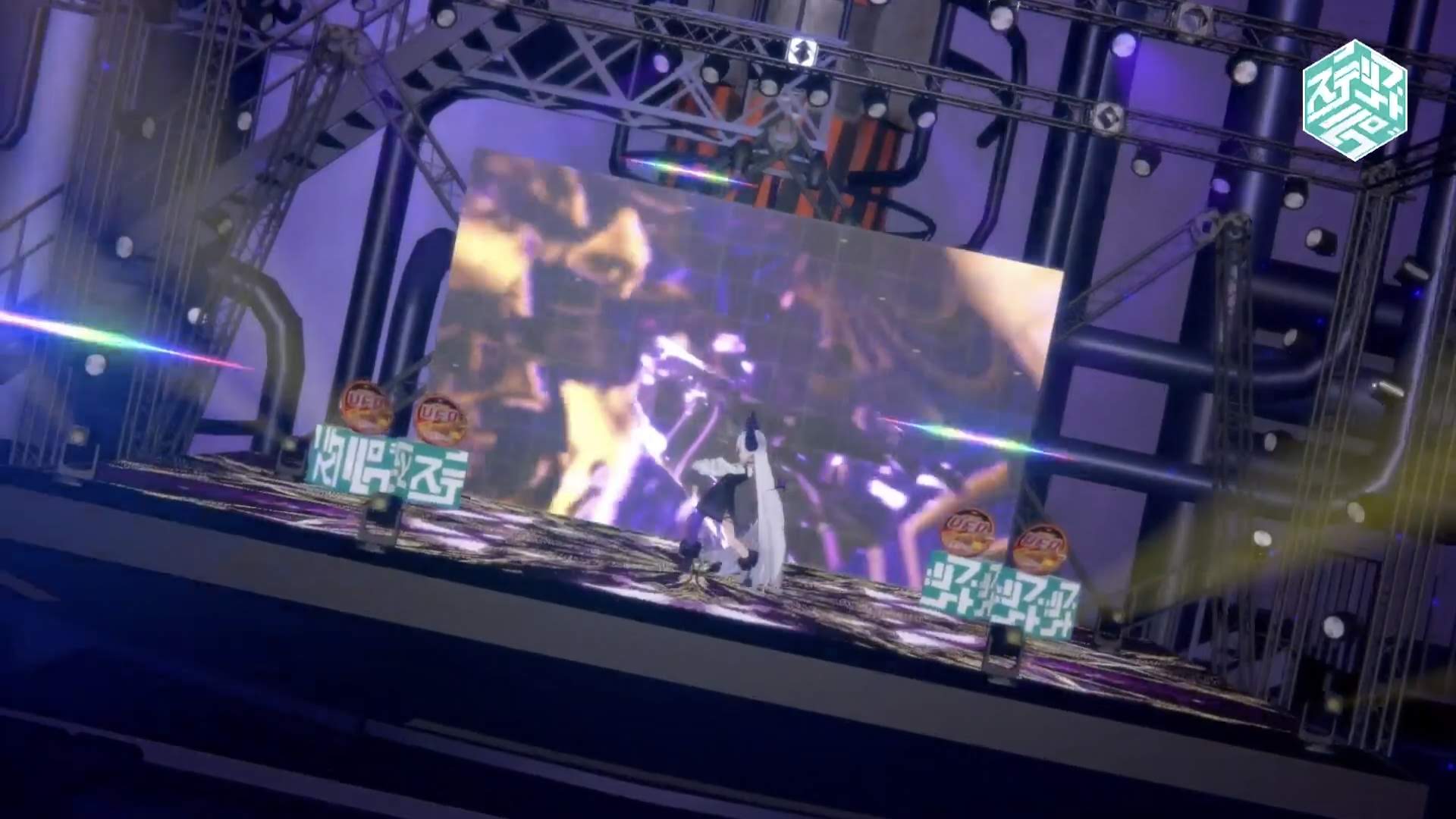
La+ Darknesss Solo Live: Waku Waku Nightmare

La+ had her first solo concert a few days ago, and the paid VOD (3300 yen)  is still available until March 1, JST. The event was sponsored by Nissin, the original instant noodle company, and La+ recently became a spokesperson for their U.F.O. brand of yakisoba. Note that the site is Japanese-only, and that when registering, you can put all 0s as your phone number. (Also, there’s a Koyori solo live on April 7, JST.)

As a La+ fan, I’d been hoping for something like this for a while now. While I could talk endlessly about this event (check out her final song, “Kurai”), I just want to highlight a couple things that stood out to me.

La+ actually started off with “Kamippoi Na,” which was her very first cover song back when she debuted, and she decided to sing with a deeper voice in contrast to the the whispiness of her recorded version. The choreography was also completely different from the time she covered it with Murasaki Shion. What’s really fascinating, though, is comparing her dance to that of Hakos Baelz. Both are among the very best dancers in hololive, and you can see how their respective styles come through on the same song: La+ is smooth, while Bae is dynamic.

Towards the end, La+ performed “Aien Jihen,” her first original song, and something she hadn’t pulled out since her original 3D debut. Back then, she had decided to perform the dance against a pre-recorded vocal track because of the challenging choreography. This time, however, La+ did both the song and dance, showing the progress she’s made, but also how she’s worked through a collarbone fracture from her COVID cough, a hiatus for her mental health, and throat issues, among other setbacks.

One thing I noticed during this performance of “Aien Jihen” is that the choreography has changed in some ways since she last showed it. These might be adjustments designed to make it easier to perform while singing, but I also suspect that she actually modifies her dances depending on whether or not she’s wearing her massive coat. Note in the above images (during the line “Nothing bad happened”) how La+ is leaning forward in her 3D debut but is leaning back during her solo live. I feel like the silhouette in the first image wouldn’t be quite as strong without the coat.

Ray (covered by Generation 0)

Recently, I was trying to decide which generation is the strongest musically…and then the Japan Generation 0 cover of “Ray” came out. Suisei, Sora, and AZKi are in the top echelon of Holo singers. Roboco’s sound has this haunting quality, and Miko pulls off “cute idol” while maintaining her signature voice. The closest second is probably Indonesia Gen 1.

Mind Craft (covered by hololive English)

Hakos Baelz organized a cover of “Mind Craft” with the entirety of hololive EN, and everything about it is amazing. The balance between giving the fans familiar combinations of individuals and unexpected ones really makes it a journey of a song. My highlights are IRyS + Nerissa, and how Bae herself is presented as a modest “leader” of the whole thing, both in how she has only a few solo parts but at pivotal moments, and her literal outfit looking like a ringmaster’s. Speaking of which, the character art is some of my favorite ever for hololive, and I hope there’s a way to own it someday.

Bae also did a stream where she talked in detail about getting the song and music video produced, and I think it’s worth a listen.

2023 to 2024 Countdown 

The New Year’s countdown was fun just like last year, and I’m glad to have seen new girls get in on the Shuffle Medley fun. Naturally, La+ as Kiara performing “Do U” stole the show for me.

But I wanted to look more at the fact that the hololive and holostars streams had different performances of the same songs, with distinct choreographies. Specifically, it was “Idol” from [Oshi no Ko] and “Dai Zero Kan” from The First Slam Dunk

The guy versions are more “masculine” in approach (like the basketball-themed dance moves in “Dai Zero Kan”), and it makes me think of something I read in the dance manga Wandance: It tends to be the case that guys don’t learn “girly” moves. Issues of heteronormativity aside, it’s still fun to see different interpretations of the same songs.

hololive KDA

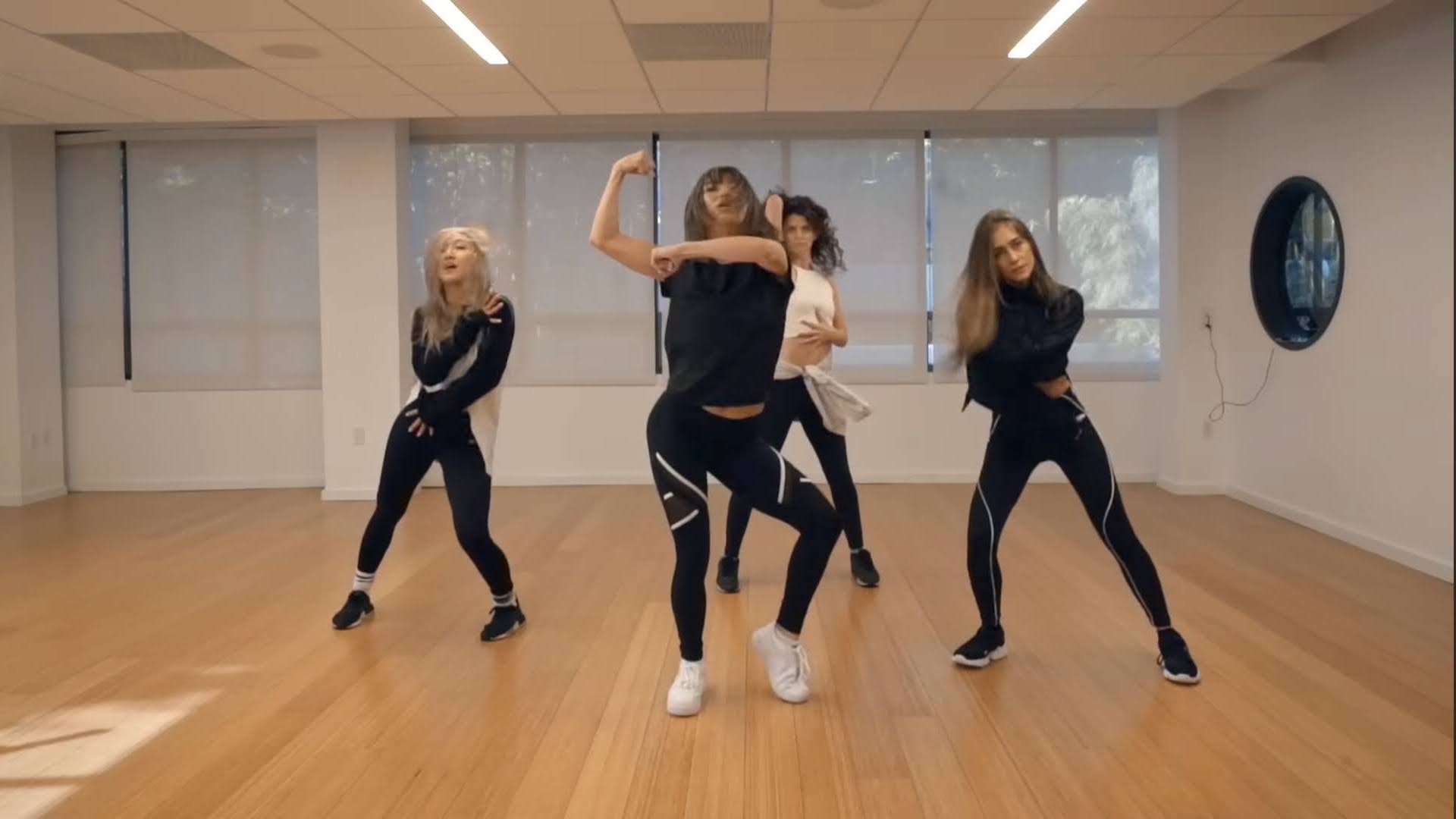
I wrote about the Riot Games One 2023 KDA cover performances previously, but I’m bringing it up again because I’ve been thinking about something in particular: The hololive version shows some of the limits of the 3D technology, and where it has room to improve. 

Putting aside the skill difference between the hololive girls and full-on professional dancers, there are definitely moments where the 3D can’t quite capture certain subtleties, or where certain moves don’t quite read correctly. For example, during “POP/STARS,” one of the performers is supposed to be a bicep flex, but this just doesn’t get conveyed when La+ does it.

That’s it for now! Who knows if I’ll do one of these again?

Hololive and the Year of Amazing Dancers

I once described La+ Darknesss as having a level of skill and confidence in dancing nearly unmatched all of Hololive. That was back in March, shortly before 4th fes (the latest of the annual live concert events), and at the time, I left a caveat that there were actually a number of members who had yet to debut in 3D, and things might change.

Well, things have changed.

At this point, every girl in Hololive outside of the most recent debuts have gotten full 3D models, and many have shown themselves to be noticeably amazing physical performers. Among these talents, there are three that stand out to me in particular.

Hakos Baelz of Hololive Promise.

Vestia Zeta of Indonesia Gen 3.

And Vestia’s genmate Kobo Kanaeru. 

I have zero technical or artistic knowledge of dancing (outside of reading Wandance!), so my praise of them is mostly based on vibes. From that limited perspective, I get the sense that they move better than the vast majority of their fellow Holomembers. On top of that, they all seem to approach dance in different ways compared to one another, to the extent that I start to feel like their personalities and quirks come through in their respective performances. 

To me, Bae moves as if her entire body from head to toe is equally super-charged, Zeta from the ground up (with her legs being a big focus), and Kobo like she’s acting just as much as she’s dancing. La+, in comparison, seems to dance from the core and then have her energy radiates outwards into the rest of her body. I don’t know if this is even accurate or makes sense, but I start to wonder if I might be able to recognize each of them through their dancing even if they shared the same 3D model. Either that, or I’m just overestimating myself.

We might be entering a new Renaissance period of VTuber dancing. The recently announced 5th fes, Hololive Island, is likely to feature all of them and be an incredible showcase. On top of that, an upcoming Riot Games event in Japan is going to have a performance by Murasaki Shion and three of the names I’ve mentioned above: La+, Bae, and Kobo. And with ReGLOSS’s Todoroki Hajime making dance a major part of her character, I can see things only getting more exciting in the near future.

Hip Hop Manga: “Change!” and “Wondance”

Whether by chance or perhaps some broad editorial intent, it’s a curious thing that hip hop culture would be a prominent theme in two currently serialized Kodansha manga in Japan. Change!, running in Monthly Shounen Magazine, is the story of a Japanese poetry-loving girl named Shiori who ends up being drawn into the world of rap battling. Wondance, from Monthly Afternoon, focuses on an athletic boy with a stutter who discovers hip hop dance as a way to express himself. Each series, almost by necessity, takes a very different approach to their respective subjects, and juxtaposing the two highlights the power each work possesses.

Change! naturally places great emphasis on verbal dexterity as a series about Japanese rapping, and there are certain aspects to the language that make it differ from English rapping. Japanese has fewer vowel sounds, which means that many more things in the language can technically rhyme, which in turn means that the rhymes that do occur can be even more varied yet precise aurally. The heavy emphasis on syllables also gives Japanese a certain sense of rhythm, especially because extending those sounds can change the meaning of a word entirely.

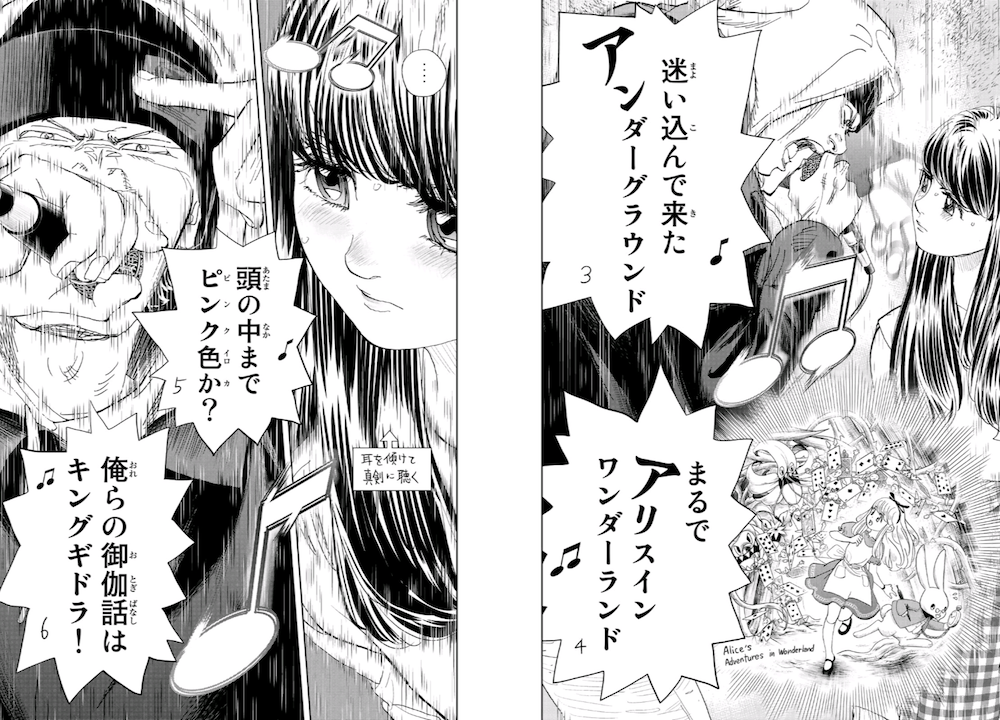
All of this needs to be effectively conveyed in the manga, and the approach Change! takes is to place more emphasis on word balloons than most manga. Words and syllables can appear larger or more erratic in order to highlight what key words in one line are being correlated with in the next line. The classic staple of many manga, furigana to aid in the reading of difficult kanji, take on added importance due to both the sheer number of homonyms that exist in Japanese and to make sure the reader keeps track of what’s being said syllable by syllable.

In the images above, the male rapper connects the word “underground” with “Alice in Wonderland,” working off the fact that andaaguraundo and Arisu in Wandaaraando both start with an “a” and have the similar raundo vs. rando. He then follows up on the next page with Atama no naka made pinku iroka? / Orera no otogibanashi wa Kingu Gidora!, or, “Is even the inside of your head the color pink? / Our fairytale is King Ghidorah!” Pinku iroka lines up perfectly vowel-wise with Kingu Gidora, and the talk of fairy tales follows up to his comparison of Shiori as being as out of her depth as Alice is in her story. While the passionate expressions and the metaphorical imagery shown contribute to the atmosphere and to hammer home the meanings behind the words, the actual word balloons do a great deal of heavy lifting.

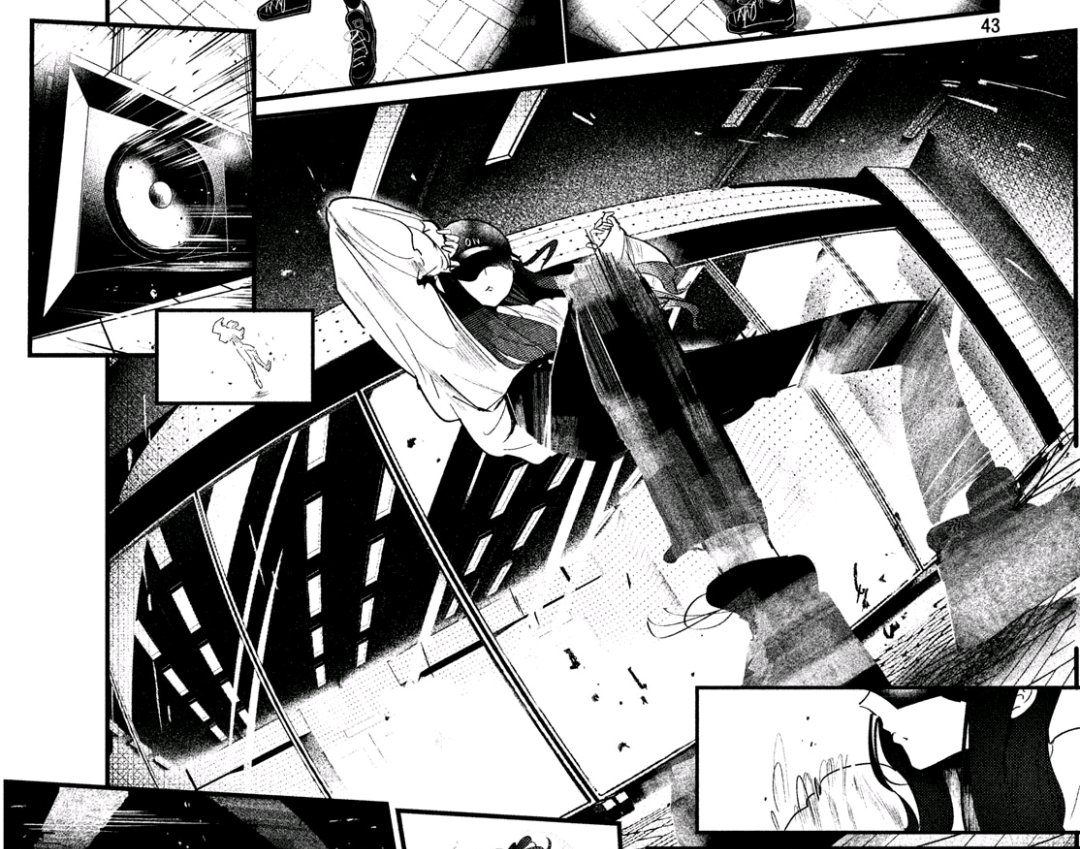
In contrast, although Wondance can be fairly wordy at times, when it comes to dancing, the manga is very much in the “show, don’t tell” category. Characters move with grace and intensity, and panels highlighting their steps litter the pages, turning them into virtual collages that practically crackle with energy. Text is sparse, and primarily brief glimpses into how the characters are thinking in the heat of the moment.

In the pages above, the main character and Hikaru—the girl who brings him into the world of dancing—are dancing together in a class. The paneling supports the character artwork, emphasizing a sense of the two as a duo in sync with each other on some deeper level. This visual approach calls to mind the elaborate paneling of 1970s shoujo manga such as Swan, where panels cascade and climax in beautiful ways. The drawings capture not just the dance but the emotions of the dancers as well, making their moves the central vehicle for storytelling. In a sense, one doesn’t even need to know Japanese (or have a translation handy) to get the essence of Wondance.

Thus, on the one hand, you have a series where the words are of the utmost importance and another where images hold the power. However, they both draw upon the visual language of comics and especially manga in fundamental ways through their particular emphases. Change! and Wondance capture some of the magic of hip hop culture itself as a multi-medium, multi-angle fusion of various ingredients.

Tomino’s Daughter (NSFW)

Wl3MssK

One of the talking points of the new anime Gundam: Reconguista in G, related to the fact that it’s the return of Gundam creator Tomino Yoshiyuki in a directorial role, is that the dances performed by the characters in the eyecatches were choreographed by, of all people, Tomino’s youngest daughter Yukio. According to Japanese Wikipedia, Tomino Yukio is a modern dance choreographer living in the Netherlands, and as it turns out, some of her performances are available on YouTube.

Be warned, these videos contain some nudity.

I’m not really into dance, so I can’t comment in depth on the performances or the choreography, but I find it interesting that both of his children went into the performing arts (his oldest daughter Akari is a theater director in Japan). Obviously I have no idea about their family but I do feel that Tomino’s own work in anime reflects a kind of performative spirit in itself (his dialogue often sounds like it comes from a musical or play), and I wonder if this has influenced his children in any way.