I, Too, Think Highly of the 2025 Superman Movie

Since 2021, I’ve had superhero movie fatigue. I was tired of Disney’s constant attempt to force us to watch nothing but Marvel, and the way DC films trafficked in the edgy. There were definitely some gems during this time, but I could find myself losing interest. Even long after the height of the COVID-19 pandemic, I hadn’t seen a superhero movie in the theaters in a long time.

That changed with James Gunn’s Superman. As a fan of Gunn’s Guardians of the Galaxy movies, I had a degree of faith that he would make something at least entertaining. But much like another recent box office and critical success, Sinners, I started seeing comments online from happy viewers. The buzz (both positive and negative) convinced me to watch it right away rather than wait for streaming.

From jump, the 2025 Superman stands out for not being an origin story despite acting as a franchise reboot. A quick and basic text exposition catches the audience up to an established Superman in the middle of his latest peril, and the story assumes that even if you don’t already know who the Last Son of Krypton is, you’ll soon understand what he’s all about: a man of godlike power who nevertheless pushes his own limits out of compassion for his fellow living beings.

Gunn’s Superman stands in pleasant contrast to Zack Snyder’s Man of Steel, and I say that as someone who thought well of the latter. While I understand the complaints about Clark killing or allowing innocent people to be harmed when that goes against his whole ethos, I think both Gunn and Snyder emphasize a similar point: Despite what people assume, it’s actually not easy to be Superman. The difference is that Snyder’s version experiences more tragedy, has less experience, and fights by himself against a superior opponent. Gunn’s iteration benefits from having a community, and I think there’s a powerful message there about how even Superman can’t go it alone when it comes to making the world a better place for all.

This Superman also bucks the trends of trying to make superhero films more palatable to a presumed audience skeptical of comics. Instead, it embraces the more absurd elements that have emerged over many decades, whether it’s Silver Age shenanigans or the irony of the 1980s and 1990s. Along with the message about how doing good doesn’t necessarily come easily but you do it anyway, everything and it communicates the idea that superheroes (and human beings) have room to be both silly and earnest. 

At the same time, this film does anything but play it safe. One of the major antagonistic forces in the story is a country supported by the US government that aims to take over a neighboring country through military force and conspiracy, and the parallels to that Palestine situation (and to a degree Ukraine) are hard to avoid. Superman’s simple refrain when told to stay out of it is simple yet profound: “People are dying!!” Whatever complexities undergird this situation, the reality of starving and shooting at defenseless civilians, especially children, is hard to ignore.

The 2025 Superman dares to be a ray of hope in a bleak world, breathing new life into one of the US’s most well known fictional characters. It shows that a movie doesn’t have to be all serious business to have a serious message, and that valuing life and humanity is anything but corny. 
Back to Basics: The Blue Beetle Film

On a whim, I decided to watch the recent superhero movie, Blue Beetle. I’ve been feeling a little burned out by the Marvel Cinematic Universe, so I figured I’d try something from DC. It also stars Xolo Maridueña (who I’ve enjoyed in Cobra Kai) as the main hero, Jaime Reyes.

The basic structure of the movie is standard hero-origin fare, but at the very least, it ends up being better than a lot of the recent Marvel stuff. I think where Blue Beetle succeeds (and where the MCU increasingly fails) is that it feels very human and doesn’t get lost in the weeds of a “superhero universe” or its tropes. In the case of Blue Beetle, the emphasis on Jaime’s Latin American background is what holds the entire film together. 

Jaime’s family is Mexican, and they are shaped by both the struggles and triumphs they’ve had to face making a life in the US, ranging from some members being undocumented immigrants, to enduring years of backbreaking labor, to a rather surprising detail about his doting old grandma. Blue Beetle asks how a person like Jaime, the very first member of his family to graduate from college, gains a lot of his strength from his upbringing and the values of his culture. The generational and cultural gap felt by Jaime as a first-generation American feels very authentic. And all through this, the story of the Reyes family delivers a complex message about what it’s like to aim for the American dream in an America that doesn’t see you as equal.

Blue Beetle isn’t spectacular, but it’s still a pretty entertaining feature with some solid legs. It frames the superhero aspects of its story through an exploration of a multigenerational immigrant experience, and manages to cross a finish line that many of its peers have been unable to reach.

The Kids Are All Right—Batman and Superman: Battle of the Super Sons

Recently, I did something I haven’t done in a long time: I watched an in-flight movie. I used to love using my time traveling to check out the new and unfamiliar, and it was refreshing to experience that again. Given a short flight time, there was only so much I could fit in, and the movie I landed on was Batman and Superman: Battle of the Super Sons

Somewhat reflecting developments in DC Comics over the past few years, it’s an animated feature film about Superman’s son, Jon Kent, teaming up with Batman’s son, Damian Wayne. How this compares and contrasts with the comics is convoluted in ways I don’t fully understand myself, so I’m treating this mostly as a standalone thing. In that regard, it’s probably fine to watch on its own as long as you’re familiar with Superman and Batman in a general sense. Maybe the fact Robin (Damian) is a pint-sized assassin who calls Batman “father” might throw some people off.

The story: Jon thinks he’s a regular kid with boring parents who are both journalists. Soon, though, he discovers the truth about his dad, and his entire perspective changes. When the starfish-like alien conqueror Starro begins to take over the adult superheroes, it’s up to him and Damian, whom he befriends (?) after meeting Batman, to save the world.

There’s something about the past decade of fiction that has brought to the forefront the challenge of heroes having to raise their own children. While plenty of comparisons can be made between Jon and Son Gohan from Dragon Ball, I think it’s more apt to look at other works, like Boruto, the Star Wars sequel trilogy, and even Avatar: The Legend of Korra to some extent. The gap between the stories focused on the parents and those focused on the children can vary from a few years to many decades, but they all land in the same space, wherein the legacies of the old heroes still persist in the hearts of the fans. 

Because of this, portraying these adults as loving but flawed parents can be a tricky balancing act, and a common source of conflict in these stories is the struggle between maintaining one’s duty and being there for their kids. What’s more, these works are often meant to have the old good guys step out of the limelight and allow their kids to take center stage, which can create complicated feelings among fans.

In that regard, it’s actually kind of comforting to see the literal most perfect superhero, Superman, have trouble with this. If even the Last Son of Krypton has days where it’s hard to be a dad, then who wouldn’t? Sure, he’s ultimately the Best Dad Ever (and Lois an equally amazing mom in her own right), but Battle of the Super Sons successfully conveys the idea that we can have faith in the next generation to do things their way if we communicate to them the importance of love and justice. 

Kiryuin Satsuki and the Curse of Power Girl

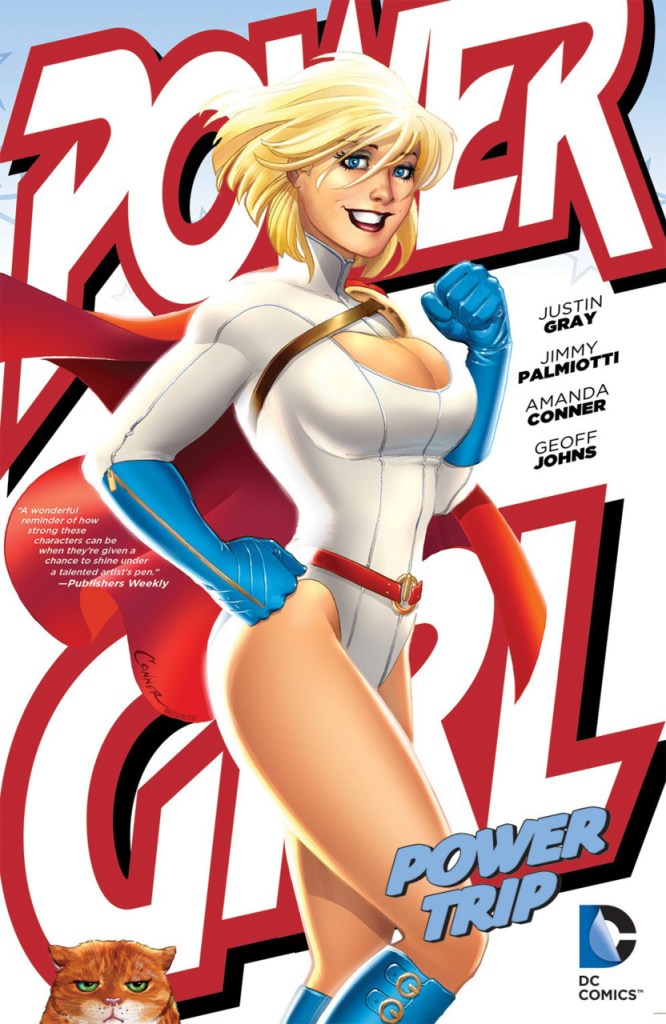
I view the DC superhero Power Girl as being almost doomed by her appearance. If you ask anyone with even a passing familiarity with Power Girl about what defines her character, you’re very likely to get the response “boob window.” This is despite numerous attempts to revamp her character, emphasize her personality, and make her more than just eye candy first, superhero second.

This is not to say that Power Girl is an inherently bad or sexist character, whether she’s supposed to be an adult Supergirl (her original origin) or something else entirely. I don’t even think the boob window necessarily has to go. But what fascinates me about Power Girl’s situation is that, for whatever reason, it seems especially difficult for her to escape being seen almost as a character attached to a pair of breasts.

In contrast, when it comes to characters who have overcome a highly sexualized appearance, one need look no further than Kiryuin Satsuki from the anime Kill la Kill. In spite of the fact that her battle uniform looks like a sling bikini on steroids, her personality overwhelms even the sheer and unbridled sexuality of her clothing. Despite her breasts and buttocks often being in full display in numerous scenes what first comes to mind are her other attributes: scowl (with enormously imposing eyebrows), her ambition, and the fact that she literally radiates an aura of light that symbolizes her power.

I find myself wondering, what is the difference between Satsuki and Power Girl, or indeed Power Girl and other female superheroes who have been successfully redefined as more than just their eroticism (note that I did not say more than just their looks—appearance is just an essential part of superheroes, male and female)?

There are two major context points that separate Satsuki and Power Girl. First, unlike Power Girl, Satsuki is introduced in Kill la Kill in her full-body school uniform rather than in her skimpier attire. Second, whereas Satsuki’s existence is defined solely by one television series, Power Girl has been a part of comics for decades. While the circumstances of 2010s Japan and 1970s United States are substantially different, I suspect that Power Girl would be remembered very differently if she arrived on the scene the way Satsuki does in Kill la Kill: as someone grandiose and powerful. Perhaps it would even be possible for her to keep the boob window and still be thought of primarily for her superheroics and feats of strength.

Or perhaps my view of Satsuki is too charitable. Maybe the imprint she’s left on anime and its fandom, especially those who know Kill la Kill only from images, is just her near-naked body in a battle bikini.

Power Girl appears to be a victim of historical inertia. No matter what is done with her character to turn her away from a primary emphasis on her breasts, focus always returns to her iconic cleavage cut. Whether it’s possible to overturn this might require not just an amazing creative team where artist and writer are working towards this goal, but a comics fandom willing to accept this change.


So Then Maybe Sesshoumaru is Darkseid?

Warning: Inuyasha Spoilers

Despite the fact that Inuyasha: The Final Chapter ended recently, I have not seen very many people talking about it. I know that can’t possibly be the trend across anime fandom as a whole, though. It’s Inuyasha after all, the show so popular it all but defined Adult Swim anime alongside Cowboy Bebop.

I already know about the ending from having read the manga, but remembering just how long and encompassing Inuyasha is, and how much detail that is ideal for a fan-made Wikipedia about the subject exists, I took a look over at the Inuyasha Wiki, reading up on what swords Sesshoumaru uses, what the heck people’s attacks are, as well as the character who deservedly has one of the longest and most complicated entries on the Wiki, Naraku.

As I read Naraku’s entry, his description started to remind me of another famous villain. He’s powered by negativity. His power is seemingly infinite. He increases his power and transforms thoughout the series. He has a vast army of demons under his control which he can absorb in order to regenerate and heal (which the heroes manage to turn against him). At the very end, in a desperate situation, he switches to a strategy of pure revenge and destruction, abandoning his tendency towards elaborate scheming.

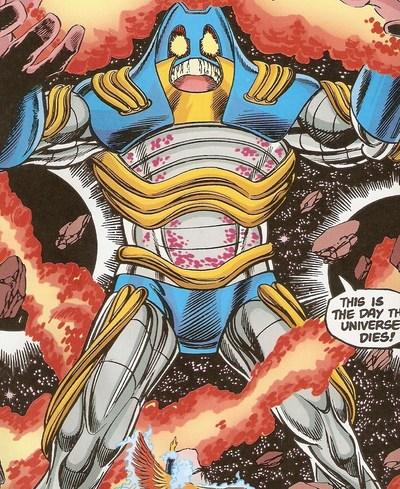
Naraku is like the manga equivalent of DC Comics’ Anti-Monitor.

“She’s So Developed!”

There’s something about a lot of anime and manga that I think lends them much of the praise and criticism they receive from people, fans or otherwise. I wouldn’t call it a unique or exclusive property of anime, but it’s something that I believe recurs more often when compared to other mediums. What I am talking about is the ability for a character to both be sexualized and objectified by its audience while still being able to move the audience with a well-developed personality.

Sheryl Nome. Arika Yumemiya. Kawashima Ami. Practically the entire female cast of Gundam 00. Every girl in Godannar. All these and more are designed on some level to explicitly titillate, but I would not call any of their characters excessively shallow or designed purely with fanservice in mind. Nor would I say that pure fanservice characters do not exist at all, but I feel like more often than not in anime and manga, blatant, in-your-face sexual attractiveness does not come at the expense of strong characterization or at the very least attempts at strong characterization. Much of the eroge and visual novel industry is built on this premise.

I do not see this happening as often in other mediums. Of course sex appeal still exists in them, but very rarely do they try to turn both dials up to max, rarely do they say, “Hey we want to basically tell the audience outright to fantasize indecently about this character while still showing the strength of their personality.” Hayden Panettiere (Claire Bennet) on Heroes is clearly meant to invoke a reaction from male viewers with her attractiveness, official assignment as “cheerleader,” her clothes, and pretty much everything about her, but there’s some attempt at keeping the character Claire’s “fanservice” somewhat implicit. The DC Comics character Power Girl, known for her super strength and her enormous chest, seems to go through constant subtle shifts in characterization as writers and artists seem unsure how to balance the development of her character with a design clearly meant to get guys’ mojos going. Fans of DC Comics run into a similar problem. In other cases, a character who is obviously sexually attractive while possessing good characterization will have their sexuality incorporated into their personality and character.

Meanwhile, many anime fans embrace this double threat. Others do not of course, and I think this causes some of the conflict as to whether or not a character is “good” or not. Does being explicitly sexual in design and presentation work with characterization, or against it? Or do they perhaps run parallel to each other? Wherever you fall, if you meet someone who thinks otherwise, there’s a chance that, because your approach to characters is so different, arguments will arise. This is probably where arguments about moe find most of their ammo, no matter which side fans are on.

As a final note, keep in mind I used female examples because that’s what gets me. Feel free to replace all examples with male equivalents if that’s your thing.