I’m happy and grateful that the full Hi Score Girl manga series by Otoi Rekomaru is out in English. It’s one of those manga where, once upon a time, a US release would have been a pipe dream. A nostalgic nerd love story premised around Street Fighter II and the 90s Japan arcade scene? As significant as that era was in Japanese gaming history, it’s a niche among niches. And yet, here we are.
I first discovered the series eight years ago, and was immediately won over by two things. First, there was the eccentric nature of its main duo: the obnoxiously loud gamer kid Haruo and his friend/rival/love interest, the reticent and rampaging Akira. They initially meet at an arcade and feud over a Guile vs. Zangief matchup, and though they never stop butting heads, it’s silly and sweet how they essentially communicate through gaming. That’s not metaphorical either; Akira pretty much never talks. Second, the portrayal of the 90s games and the way Haruo based his very outlook on life on them could have only come from a genuine place. Otherwise, jokes like “messing up the secret select code for Akuma” and “Akira having sympathy for big grappler characters because she feels bad about how little they get chosen” wouldn’t land so well.
The characters age over the course of the 11 volumes, going from elementary to high school and growing alongside the rapid developments in gaming technology. Their transition into adulthood is concurrent with continuous upgrades to Street Fighter II, the advent of 3D fighting games like Virtua Fighter, and so on. A nice narrative device to be sure, but it’s actually surprising seeing how much Haruo actually matures as he comes to understand responsibility in his own way. He’s not the sharpest tool in the shed, but his convictions are real.
Hi Score Girl reminds me a lot of one of my all-time favorites, 81 Diver. The art is similarly rough, and the core relationship is as much a rivalry as it is a love story (if not moreso). That’s actually pretty rare in manga focused on het romance, and is usually the domain of fujoshi-adjacent works. But it’s convincing here because of how Otoi portrays the genuine desire for connection, and the way that gap is bridged through gaming. Sure, the premise of a boy meeting an ultra rich mega gamer girl is unrealistic in many ways, but the portrayal makes me want to believe in their love.
In addition to the authenticity of the passion for fighting games, I think what ultimately makes Hi Score Girl work is that while Haruo kind of exists primarily in his gaming-obsessed mental space, the life lessons he draws from games are ultimately his own. He’s a guy with an imaginary friend who gives him pep talks and acts as his conscience, and that friend is often just Guile. Haruo and Akira imbue greater meaning into games, and the games reciprocate by providing them the thrill of victory, the agony of defeat, the comfort of friendship, and the joy of love.
Street Fighter 6 has succeeded in its goal of bringing in new players through a simplified control scheme labeled “Modern.” The signature special inputs that Street Fighter pioneered are basically replaced by one-button inputs and cardinal directions, with the caveat that damage dealt is reduced by 1/5. The Modern control scheme has also spiced up discussion in the community as competitive players try to figure out if having your most powerful moves be instantaneous is a worthwhile tradeoff for having fewer options overall. But this is not the first time fighting games have included easier inputs, and I think it’s interesting to see how past games have tried to incorporate more accessible control schemes.
In the GameCube Capcom vs. SNKEO and the 3DS Street Fighter IV, the advantages their shortcuts provide is tremendous. The only thing that kept them at bay is that they were not the “main” tournament versions; if they were, high-level play would be fundamentally worse because the characters were simply not balanced with instant specials and such in mind.
Another approach comes from Granblue Fantasy Versus. In that game, players have simultaneous access to both traditional specials and simplified ones (on a cooldown timer), with the expectation that stronger players will use the former and newbies the latter. In actuality, competitive players use both, recognizing that faster inputs are more reliable in certain situations.
Then there’s Super Smash Bros., a game franchise built around more simplified controls. When traditional 2D fighter characters became playable, the big question was how they would be incorporated into the Smash system. The answer, it turns out, was to allow everything—you can use Smash-style special inputs and classic fighting game motions, the latter rewarding the player with greater damage and KO power. However, no Ryu, Ken, or Terry Bogard players worth their salt play a primarily “Modern”-esque style. And unlike Granblue, the simplified versions are only ever used when recovering offstage.
This is because the aforementioned distinction between damage and KO power is an important part of Smash. In SF6, your Shoryuken taking a bit less off might just mean you need to land one additional hit. In Smash Ultimate, it might mean not being able to finish off the opponent at all. The fighting-game characters are balanced around their ability to take stocks relatively early through their “true” specials, as they’re called by the community.
The saving grace of SF6’s Modern controls is probably the fact that they’re part of the game from the very beginning, and they make players feel powerful without going overboard. Unlike some games, you cannot have your cake and eat it too with respect to accessing both modes, and Modern comes with drawbacks that feel neither ineffectual nor overly harsh. Efficacy seems to vary from character to character, and players have to be cognizant of what they give up to obtain instant specials and supers—advantages the opponent can know about and play around. I expect them to be a staple of Street Fighter going forward, and are one big step in helping to chase the elusive specter of accessibility all while maintaining competitive integrity.
There’s a 50/50 chance that saying “the Japanese beverage company Suntory has their own official Virtual Youtuber” would come as a surprise. But the blue-haired “Suntory Nomu” is real (in a sense), and I actually like her design quite a bit. What really stands out about Nomu’s appearance, relative to other VTubers, is how simple and subdued it is. A white dress with blue highlights stands in sharp contrast to the vast majority of Hololive and Nijisanji, who seem to be created with a maximalist philosophy. This latter approach brings to mind broader discussions about character design in media.
(Side note: I’m not sure I need to mention this, but in case it matters, I am not endorsing Suntory products in any way. I generally like their drinks well enough, but that’s about it.)
When looking at Nomu relative to the Hololive members she’s streamed with, the difference is clear. While both have attractive designs, Takane Lui and Aki Rosenthal have all these details, adornments, and colors, resulting in rather complex/complicated appearances. There are practical reasons to make them this way, of course: They need to be immediately distinct and visually appealing to prospective viewers. Rigging/modeling them for animation is a one-time thing, as opposed to needing to draw them anew every time in the vein of anime or manga. And the expectation is that people will stare at them for extended periods. VTubers need to communicate a good portion of who they are immediately, as viewers can’t be expected to dive into an extensive backstory—and often VTuber backstories are helpful suggestions, at best.
The decision to go maximalist reminds me of fan discussion surrounding fighting game characters. Fighting games, especially ones not based on an existing property, share a number of similarities with VTubing. There’s no prior context for people to get attached to (as they might with an animation or comic), so having characters catch the eye right away while also communicating how they play is important. There’s still quite a bit of range—Compare Ryu or Chun-li from Street Fighter to Sol Badguy or Dizzy from Guilty Gear (especially pre-STRIVE)—but criticizing a fighting game character for being “boring” is typically more about looks and presentation of attacks. That’s actually a big difference with Virtual Youtubers: It does ultimately come down to personality.
But it makes me wonder if significantly simplified designs like Suntory Nomu couldn’t thrive despite the general trends against them. Maybe it’s because so many designs take an “everything but the kitchen sink” approach that Nomu’s aesthetics stand out more. Could there be a trend back down to relatively more minimalist designs in VTubing, fighting games, and other similar areas? It’s something I’d like to see, if only because I’m curious how it would all play out among the fans themselves.
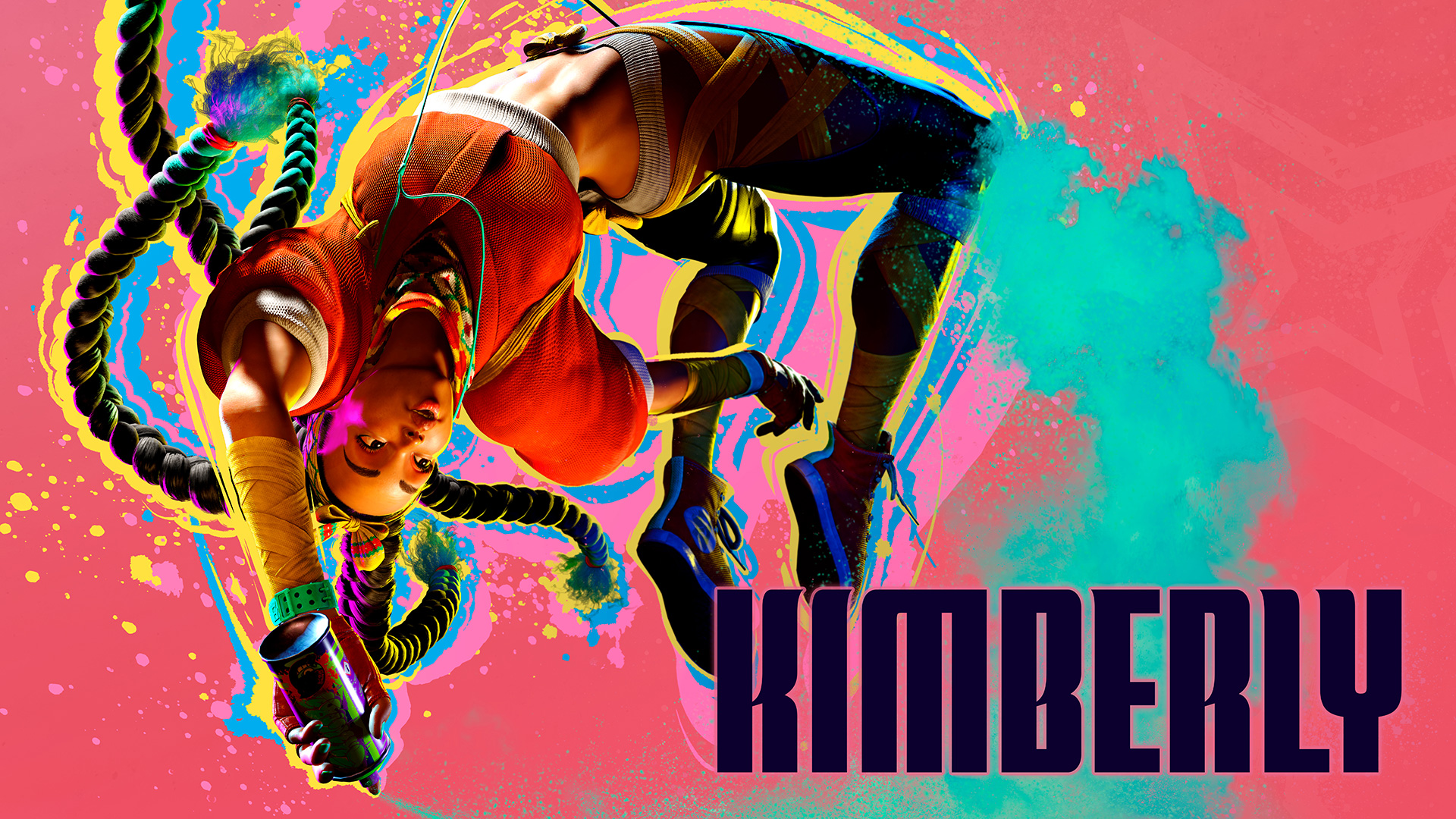
Street Fighter 6 draws ever closer, and standing at the poster child of this new game is the American MMA fighter Luke. He was even originally introduced in Street Fighter V as the bridge to the anticipated sequel. But as prominent as Luke is, I actually think another new character might be the true protagonist of Street Fighter VI: the black female ninja, Kimberly.
The new Street Fighter leans heavily into an urban street aesthetic, most notably in the use of spray paint/graffiti as reflective of hip hop culture. While this motif been around to certain degrees since the very first Street Fighter (like on the title screen), here it’s a defining part of the look and feel of SF6. And if you look at all the new characters, only Kimberly incorporates spray paint in her moveset. She combines it with her ninjutsu training under Guy from Final Fight, taking the old and giving it a fresh coat.
I’m entertaining this possibility because I see it as a way for the Street Fighter franchise to stealthily push a forward-looking diversity that celebrates its international fandom while simultaneously shielding itself from the pitchforks of overly sensitive cultural conservatives who are afraid of having their games not be represented by a conventionally muscular manly man. Luke almost feels like a Trojan horse: “Look over here at this blond American tough guy! Isn’t he what you want?” Meanwhile, Kimberly thoroughly embodies the spirit of SF6.
And that’s on top of having Ryu, Ken, and Chun-li still around. I could be completely wrong in the end, but even if I am, I think Kimberly is already a breakout character among a crowded roster of excellent new designs. She’ll at least wind up being the Chun-Li of Street Fighter 6.
I’m no stranger to Guilty Gear or the yo-yo wielding Bridget: I cut my teeth on the character’s debut game, Guilty Gear XX, and I’ve seen both the unorthodox zoning and the particular internet notoriety garnered by Bridget’s feminine appearance and association with a certain term that implies an element of deception. I’m also one of the many surprised by Bridget’s return in the current Guilty Gear STRIVE—doubly so at the reveal that Bridget has gone from identifying as a boy (albeit one raised as a girl for superstitious reasons) to being a trans girl. Honestly, I never thought the games would make this decision, even accounting for the fact that another fighter, Testament, is nonbinary in STRIVE.
However, the biggest shock of all to me was seeing some of the more negative reactions to Bridget’s loudly declaring herself to be a girl, specifically coming from a 4chan-derived crowd who worshiped Bridget as a “femboy” while simultaneously engaging in transphobic behavior. To them, Bridget being trans is a deep betrayal, or as one person summarized it, “their 9/11.”
As someone who knew nothing about the character until yesterday it's amazing seeing how Bridget being trans is like 9/11 but for white guys from the rust belt who larp as Japanese ethnonationalists on Twitter
I’ll be upfront in saying that I don’t really have an “interest” in Bridget, so this is not that type of personal matter to me. However, having seen the “Bridget worship” from all the way back in the day, I had always chalked up the caustic behavior of certain fans as a bit of self-deprecation mixed with slowly discovering their sexuality in a way that was psychically acceptable. While I never thought that being into Bridget automatically made you gay (attraction and sexuality are far more complex than that), I had assumed these people would like to see Bridget happy no matter what decision she made—and even then, the art of her wouldn’t have to substantially change. What I failed to take into account was the fact that bigoted fetishism is a thing, and that by extension, some use “femboy attraction” as a form of identity politics to rally against “wokeness.”
That was an oversight on my part. I know full well how fetishizing a group can risk dehumanizing them (though that’s not to say fetishes are inherently wrong). It also needs to be acknowledged that Bridget is a purely fictional character, which changes the dynamic compared to a real person. It does make me wonder, however, if affirming Bridget’s trans identity is somehow a breach of that plausible deniability that some had used to keep their contradictory beliefs afloat.
One thing I do worry about is how the politics of grievance seem to turn everything into a culture war, and that Bridget is going to be another front for harassment to occur, if it hasn’t happened already. Kudos to Arc System Works for being willing to take this risk, though. When it comes to updating their characters—be they straight, gay, cis, or trans, or anything else—Guilty Gear is unmatched.
What are the most common salty complaints in fighting games? “I swear I pressed the right button!” “Why did your move hit?!” “It’s not fair that I practiced this combo and you have to do less!” “Combos are cheap! Why should I have to put down my controller whenever I get hit?” Scrub gripes are often contradictory and based in whatever is convenient for the player, so if you were to truly cater to the scrub, the solution would be to wipe that all away and let them do whatever they want, whenever they want. So here’s my idea: give every character permanent super armor.
For those unfamiliar with “super armor” in fighting games, think of most classic Mega Man games. In boss fights, Mega Man recoils whenever he takes a hit, but the enemy robot masters never flinch, and will continue to execute their attacks even as you damage them. I believe the ideal scrub fighter would be such that all playable characters would be like Mega Man bosses, and hitstun as a concept wouldn’t even exist. The character Mech-Zangief already exists in some older games with this ability, but it would be roster-wide.
No blocking. No throws. Plenty of combos, but none of the combos would actually prevent the other player from continuing to hit buttons. There would be literally zero ways for an opponent to interrupt a player’s actions, and it would only become a matter of who could land more of their attacks against an opponent who’s moving around and trying to land theirs.
Would scrubbery still happen? Of course. You can’t truly defeat it any more than you can defeat anger itself. But maybe by being absolutely uninterruptible, the scrub can panic mash to their heart’s content, and thus derive joy.
As a long-time fan of Super Smash Bros., I’ve been curious about the recent expansion of the “platform fighter” subgenre, especially in indie gaming. Over the past six years or so, more and more titles have been developed that follow the basic Smash formula. I’ve mostly watched tournament matches to try and get a sense of what each game is about, but more recently I’ve been able to try some out. Playing them made me aware of an odd trend: a lot of these games do not have shielding or anything akin to blocking as a sustained stationary defensive option.
The five indie platform fightersI’vepaid attention to are Rivals of Aether, Brawlout, Brawlhalla, Slap City, and Icons Combat Arena (which is being succeeded by Vortex Rising). Of these titles, only the last two have Smash shielding. The first three have, at most, workarounds. Rivals of Aether has parrying, Brawlout has a spot dodge and a Guilty Gear-esque burst system, and Brawlhalla has a spot dodge.
There’s nothing necessarily wrong with removing shields from a game, but the decision stands out because of how fundamental blocking is to fighting games as a whole. It’s one thing to have weak shields like in Smash Bros. Melee or Smash Bros. Ultimate, but it’s another to eschew the mechanic wholesale—doing so removes the classic rock-paper-scissors balance of blocks > attacks > throws > blocks. Indeed, while Brawlout technically has grabs, they don’t really function all that differently from striking attacks. The fact that the posterboy for Brawlout, Paco, is a wrestler becomes largely a matter of aesthetics.
The big question is simply, why remove the most basic defensive technique there is? After all, while there are clear similarities between these Smash-inspired games, they’re also not necessarily going for the same exact gameplay. Moreover, as different as the actual Smash titles are, they all have shields.
The answer, it seems, is to try and capture that ineffable quality called “hype” while keeping players from being overwhelmed by complexity.
In the case of Rivals of Aether, its creator describes the lack of shield as a product of both practical limitation and creative decision-making:
Grabs and Shields were removed from Rivals to decrease defensive options and to reduce animation scope by removing throws.
The aggressive focus on Rival’s engine reflects my style as a player. I gravitate toward rushdown and so does RoA’s middleground.
The RoA fans themselves seem to love this, arguing that it emphasizes aggressive gameplay, making things more thrilling overall. Meanwhile, the official Brawlout website has this to say:
Rather than slow-paced defensive battles, Brawlout goes all-out with the lightning-fast aerobatics which platform fighters are famous for.
By focusing on aggressive mechanics, new players will be able to easily nail impressive combos while not feeling overwhelmed by friends who’ve had a bit more practice.
Brawlhalla doesn’t have any specific mission statements, but its free-to-play nature and its overall mechanics also hew in this direction.
Generally speaking, strong defenses frustrate those eager to be rewarded for offense, and that goes double for less experienced players and viewers. Even titles with crazy combos and pressure like Dragonball FighterZ have people getting salty about players who “spam block.” But there’s also the specific context of when many of these platform fighters began development: during the rise and fall of Smash 4. A frequent criticism of the Wii U entry was that shields were too strong, and discouraged the kind of high-pace aggression Melee is known for. Ultimate itself responded to this feedback by weakening shields in certain ways. The shield-less indie games essentially took it one step further.
It’s also notable that these games, as much as they want to emphasize an almost Melee-esque speed, also try to make competitive-level play more accessible than Melee—a desire to, as the old saying goes, be easy to learn and difficult to master. Brawlout, RoA, and Brawlhalla all try to streamline Smash and especially Melee mechanics to remove some of the execution barrier, whether that’s removing the need for “smash attacks” (Brawlhalla) or simplifying wavedashing (RoA).
However, it’s impossible to fully solve the “problem” of strong defense, blocking mechanic or no. Turtlers always seem to find a way, especially when their opponents want to attack without much forethought. Even Brawlhalla, with its flimsy spot dodge, has seen players frustrated by defensive styles. For example, one asked how to fight passive/defensive players, while another understood how to beat spot dodge (bait it out and punish), but hated playing passively.
There’s another aspect to consider. Smash Bros. shield is a signature aspect of the franchise, and for a long time, it was unique among fighting games. A barrier that successfully guards against nearly everything at first, it shrinks over time, leaving the user more exposed and more prone to getting stunned into a dizzy state (shield breaking) . It’s one way to introduce weaknesses into blocking, which traditional fighting games usually go about through the concept of high/low mix-ups. But perhaps, because the Smash shield is so iconic, the games that do incorporate it seem even more like “clones.” An alternative form of blocking that’s simple and reasonably effective could be the answer to set future platform fighters further apart. In this respect, some games have been trying their own renditions of shielding. Vortex Rising is implementing one-way shields that are inherently vulnerable to cross-up attacks (i.e. attacks that can land behind your opponent where they aren’t protected), while a newcomer to the platform fighter genre, Slayers for Hire, is going for something more akin to a Street Fighter IV-style “focus attack” (for Smash players, that would be Ryu and Ken’s down special).
The shield-less platform fighters have thus far sought to discourage stationary defense and encourage more active movement, and the players who have gravitated towards these games have found them to be enjoyable. But I have to wonder if aggression can truly be considered as such if there isn’t enough to oppose it. In other words, is rushdown truly rushdown if there isn’t an equally strong defense it needs to crack? Whatever the answer may be, having games that remove blocking entirely may bring about interesting results.
The concept of “privilege” is a tricky one, because it’s extremely apparent to those who lack it, and yet often unnoticeable to those who possessed it. And given the dominance of the white male in gamer culture, others have attempted to make video game-based analogies to help the unaware comprehend “privilege.” But the most prominent comparison, the idea that being privileged is like playing a game on easy mode, is ineffective for multiple reasons. While its simplicity gets the point across easily, it’s also pretty antagonistic and liable to make people defensive. “How dare you say my life is easy, just because I’m a man?”
So I propose a different analogy: being privileged is like starting each round of a fighting game with a full super meter.
Not everyone is familiar with fighting games, so this bears some explanation. Typically, when you start a match, both characters have full health, maybe somewhere between zero to 50% super meter, and placed at a neutral distance where neither has an automatic leg up on the other. Super meter is a gauge that, when sufficiently full, gives access to powerful moves that can aid players in various situations.
A full super meter at the start of a round does not guarantee a win. It does not replace or remove the need for skill, hard work, or experience. It can be squandered to the point of being useless. Some players might end up perpetually unable to truly take advantage of it. However, even if it never gets explicitly utilized, the presence of that full super meter at the start of each round influences player and character interactions from top to bottom. Just by its existence, that meter affects how your opponent perceives you.
If all you ever do is fight other people who also start with a full meter, you might never notice that there’s an issue. But as soon as you fight someone who doesn’t have this perk, the dynamics change. Imagine two players with the exact same talent and skill, playing the same character, but only one of them has that meter. The two should be able to do the same things, but one starting with more resources makes it so that what should be even exchanges are always potentially lopsided. The player with the super meter has access to additional options. That means not only does it let that player get out of tight spots they wouldn’t otherwise, and press advantages that they already have, but when only one person has that starting meter, a “neutral start” isn’t actually neutral.
That’s the thing about privilege: it subtly affects how you are perceived in the world and what you are thought to be able to get away with. It doesn’t automatically mean those who are privileged have a leg up in every situation compared to those who aren’t, but its influence permeates aspects of life big and small without anyone even having to try. It’s why assuming that everyone is on a level playing field is the classic sign of someone who is privileged and unaware of it, but also why it can be so hard to grasp for those ignorant of its existence.
The question of whether or not to stratify different groups of competitors occurs in any competitive setting, but it tends to be ground zero for debate in gaming even more than in traditional sports or fields such as Chess. For this reason, a recent tweet by veteran League of Legends and Overwatch commentator MonteCristo lamenting the lack of “pros-only” tournaments for fighting games garnered a significant backlash.
It’s such a bummer. If teams had more guarantees that top players would get stream time, like at E League, instead of worried that they could get knocked out by a fluke in open brackets, the pros could make more money.
Not that I disagree with eLeague but this statements whack. The player accepts his losses no matter what and improves upon them 'fluke' or not his/her branding should expand past player performance. Most sponsors here are late on the pulse and don't know how to push correctly.
There’s one core reason for the negative response to MonteCristo: those who consider themselves part of the fighting game community tend to consider the ability for “gods” and “mortals” to meet in open competition—and for god slayers to emerge at any moment—as one of the strengths of fighting games. In particular, people latched onto the use of the word “flukes” as evidence of the esports works being afraid of “true competition.” If esports could be compared to tennis, then to the FGC a world of invitationals (and nothing else) would be akin to the pre-open era of tennis—when pros and amateurs were not allowed to compete against each other at major tournaments.
However, having followed esports for over ten years now, I’ve noticed that this seeming incongruity in values stems from a difference in what aspects of competitive gaming are prioritized. Is it about competition and camaraderie, or competition and sustainability? While the two are not wholly incompatible, the esports side has long expressed a desire for recognition, expansion into the mainstream, and eventually a reverence similar (but not necessarily identical) to traditional sports. With respect to this, figures in esports have emphasized the importance of “narratives,” and seeing how big a deal they are is very telling as to how esports tends to try and achieve sustainability.
In 2010, StarCraft II ushered in a new era in esports, and tournament circuits such as GOM Starcraft League in Korea and the US-based Major League Gaming were established to give players a chance at competition. While there were many differences in their formats—GSL participants played only a handful of matches per day over the course of weeks and months, while MLG pitted hundreds of players against each over a single weekend—both came to the table early on with a certain goal in mind: to create stars.
GSL created a distinction between the cream of the crop (Code S) and the almost-greats (Code A), where players from the latter could earn the right to be promoted to the former. However, in the first few incarnations of the GSL, it was purposely made difficult for players to fall out of Code S. Essentially, the players who performed the worst in Code S had to compete against the best of Code A in a potential changing of the guard. The number of players who dropped down to these “Up and Down Matches” was restricted, and the Code S players could still end up defeating the hopefuls from Code A and send them back down. The reason? To make sure that recognizable faces remained on camera so they could establish fanbases, and by extension garner a sense of celebrity—to be people that fans and players could remember and look up to.
This was also the reasoning behind MLG‘s seeding system for its multi-tournament season, which saw players who did well at earlier tournaments get byes into much, much later stages of later league tournaments. Going on a tear in your first tournament could pay off down the line. If a player earned a top-32 spot in one tournament, they could keep getting place into a high spot for the next, and then play just well enough to not tank out, it meant a stable spot for increased visibility.
Eventually, both GSL and MLG revised their formats to encourage less ossification of brackets and more chances for rising stars to make a name, but that still doesn’t erase the fact that their initial versions tried to create a delineation between the “Pros” and the “Joes.” Central to all of this was the idea that “good narratives draw viewers in.” What better way to encourage a good narrative than to have a consistent cast of “characters” for the audience to know and root for?
Examples of the benefits that heroes and heroic narratives provide to competition are numerous, but one that stands out in particular is the story of basketball legend Larry Bird. At the time, basketball was seen in the US as largely a “black sport,” and thus had a relatively small white audience. Larry Bird helped to change that, as could be seen from one nickname of his: the Great White Hope. Was this racist? Yes, to a degree. Did it also help pull basketball into the mainstream? Yes it did.
(Is there a comparison to be made between this example and the fact that esports vs. FGC exists along something of a similar divide in terms of racial demographics? Also yes, but that discussion will be for another time.)
Narratives do not have to be manufactured whole-cloth. Seeing an underdog defeat a champion, or watching a winner cement his place with an undefeated streak happens just from competition existing. However, in a world where visual presentation can often be confusing to those unfamiliar, presenting these bouts as being between humans with wants and desires and emotions (especially simple ones like anger) can bridge that gap. So it’s no wonder why esports organizations frequently try to control it through player perception, delineations between pros and amateurs, and so on. But one question that arises is, does setting things up so conveniently end up compromising the integrity of competition? The answer is that it can, but it largely depends on severity.
Take professional wrestling, which has been predetermined for many decades precisely because the promoters understood that most audience members cared more when the wrestlers had charisma. Famously, when a bland 1940s wrestler named George Wagner dyed his hair blond and became the arrogant and effete “Gorgeous George,” his antagonistic demeanor drew audiences in droves to see him in the hopes that they’d get to witness George getting destroyed. Pro wrestling isn’t a true athletic competition precisely because it becomes easier to control the narrative and get viewers invested.
But even in a legitimate sport like mixed martial arts, the desire for narrative can influence decisions. While the results of matches aren’t fixed, the media and advertising machine surrounding MMA are there to try and produce the best narratives they can, either by using what’s there or cooking up some controversy. That’s because they know that narratives make people care. Athletes will be brought out to drum up a sense of animosity between the two. Is it real? Is it fake? Does it matter if it sells tickets? A guy like Conor McGregor, who’s naturally antagonistic but also an amazing fighter, puts butts in seats. People are eager to see him be on either the giving or receiving end of an ass-kicking.
At the same time, leaving things to chance can be scary for those who have substantial amounts of money riding on the success of their investment. Conor McGregor is in some ways the ideal, but he also has a tendency to get himself in trouble and make the UFC look bad in the process. One can even compare those blunders to the number of players caught blurting out racial slurs onstream. Just because someone’s a winner doesn’t mean they’re a good spokesperson, especially if they have no media training and are just kids plucked out of online lobbies and given an environment to train in. When there are so many variables at play where something can go wrong—quality of the game itself, image of competitive gaming to the outside world, the perception of “nerds”—it’s understandable (though not immune to criticism) why teams, tournaments, and organizations would want to control what they can.
The divide between FGC and esports, or the perception of it, has largely to do with community vs. respectability. The former looks inwards, and believes that having a solid core, a group of passionate players who can weather any storm together through a love of competition, is paramount. The latter looks outwards, and aims to establish itself as a permanent fixture in the world, something that cannot die because it has the size and backing to keep it going forever. The two are not irreconcilable, but finding a balance (if a balance is desired at all) requires parties that can trust each other to not abandon the other side’s principles.
The purest image of the competitive gamer is the person who “plays to win.” Whereas other players might decry a particular move or strategy as “unfair” or “overpowered,” the true competitor uses every tool available. But while this is the ideal in a certain sense for how a competitive gamer should behave, I find that it’s not actually a reflection of reality. If it is, it’s a reality that has long since passed.
Since the proliferation of the internet in the 90s and into the 2000s, the image of what it means to be competitive in the world of games (particularly fighting games) has been defined by two different resources. One is David Sirlin’s “Playing to Win,” which discusses what it means to not be held back by concepts such as “honor” or “aesthetic.” The other is Seth Killian’s “Domination 101,” which positions opposite the true competitor the figure known as the “scrub”—the player who constantly makes excuses, refers to things they lose to as “cheap,” and chooses to complain rather than learn. Within reason (so no foul play), both are based around the idea that what matters most in competition are the words “YOU WIN.”
Both Sirlin and Killian have changed over the years. Sirlin became a game designer who has to take a greater range of players into account. Killian is now a community veteran, old and wizened and less fiery. However, at the time these series of articles were written, both were most certainly what the Magic: The Gathering developers call “Spikes.” According to the developers of Magic: The Gathering, players of their card game can be roughly divided into three different archetypes. In contrast to the “Timmy,” who loves to make big plays using the highest-damage tools, and the “Johnny,” who loves to innovate new strategies and employ unorthodox tactics, the Spike is defined by the tendency to simply do what is most effective and efficient to beat the opponent.
Because of those articles, I believe that the stereotypical image of the competitive player, in fighting games especially, became the “Spike.” However, what’s curious is that, when you look at even the highest levels of play, that undiluted competitive mentality does not seem as dominant as one might assume. The greatest fighting game player of all time is Umehara Daigo, but in his book The Will to Keep Winning, he writes:
Tournaments are a playground for people who practice for growth. It’s where they show off their achievements. Once I made that realization, I finally started making continued growth my goal, rather than winning. Games enrich my life by allowing me to grow as an individual, and that’s what motivates me to keep on going.
Going from a different angle, Super Smash Bros. Melee player Mang0 has discussed how he’s had to balance changing his playing style to suit more recent developments in his scene with staying true to himself:
What’s clear is that even the best players in the world aren’t necessarily subscribe “pure Spikes.” While anyone who goes to a tournament to get as far as possible is a Spike on some level, hybrids such as “Johnny-Spikes” or “Timmy-Spikes” exist. This is even acknowledged by the Magic: The Gathering developers. However, what I believe is that, not only are “Timmy-Spikes” present among competitive gaming communities such as the FGC, but they are about as prevalent as pure Spikes, and in some communities are the greatest population.
Where once even the biggest competitive gaming communities might have been incredibly niche and might have indeed been comprised of mostly Spikes, I think that world has changed immensely, due to online play, greater publicity, streaming video such as Twitch, the concept of eSports, and so on. Going from the strongest champions in the paragraph above to the lower levels of aspiring competitors and eSports spectators, it is often the case that many people care just as much (if not more) about how victory is achieved than whether it happens at all.
While few people, be they watching or playing, can say they have no investment in wins or losses, what competitive games provide for a great number of players is a feeling of power. This might come from the look of the game itself, or from how it plays. A pure Timmy, at their most extreme, wouldn’t mind a loss, provided he managed to land a breathtaking combo that squeezes the life out of the opponent. They fight for the highlight reel, to be turned into a 30-second Twitch clip or gfycat. Keep in mind that this is not necessarily a “scrub” attitude. Timmy-Spikes, while they most certainly want to win, would prefer to win with style.
There are certain games, I believe, that even encourage Timmy-Spike mindsets more than others. These include the Guilty Gear series, the Marvel vs. Capcom series, and Super Smash Bros. Melee. What they all have in common is that the flashiest, most impressive-looking techniques tend to also be extremely effective in high-level play. Techniques that make you feel like unbridled energy is coursing through your veins, things that the common gamer might never achieve reliably, become yours to control and command, and they just so happen to carry a lot of visual oomph.
None of what I’ve mentioned in this article is fully an “eSports” or “video game”-exclusive phenomenon. People want to see and experience glory, and that image of grand triumph as a dramatic moment is etched into the human experience. It might just be that, because video games are a relatively new form of competition in an age where media and personal interaction become increasingly blurred, we’ve seen eSports grow much more rapidly and visibly than other forms of competition, even if it’s still small potatoes compared to soccer or boxing.





 OGIUE MANIAX