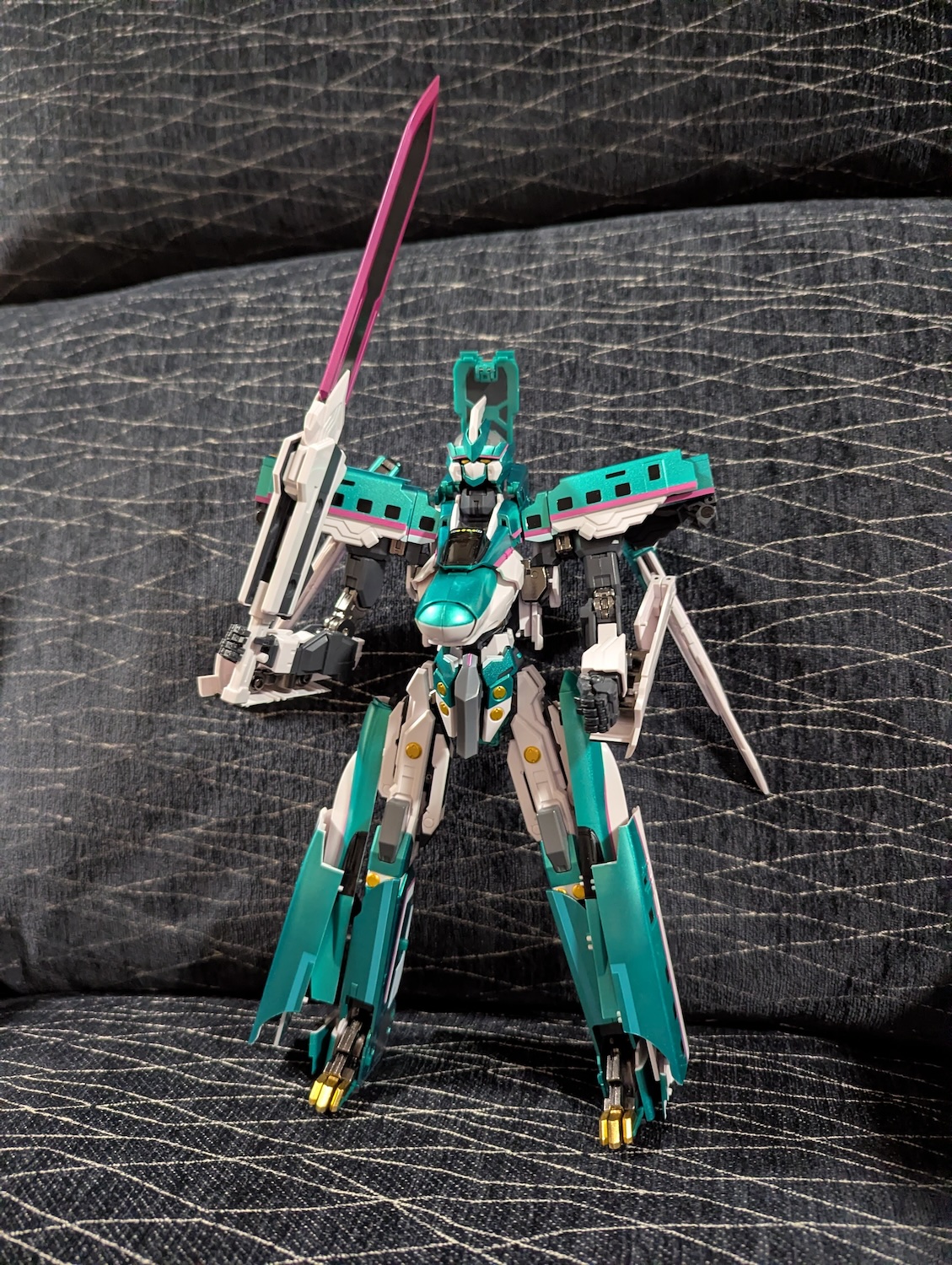
I have a hard time believing that Shinkalion is over a decade old. It feels like just yesterday that I first saw a live suit actor performing as a train robot at an event as a precursor to the anime. But last year, the Soul of Chogokin toyline released its version of the Shinkalion E5 Hayabusa to commemorate the franchise’s 10th anniversary, so there’s indeed proof. And now I have this physical manifestation of train marketing for myself.
Only 10 years to get a Soul of Chogokin rendition is remarkably fast for any mecha series; some have needed 40 or 50, if not more. While Shinkansen Henkei Robo Shinkalion isn’t the most amazing anime ever, it’s fun and tries to bring together viewers young and old. Also, the design is pretty cool overall, and I’m glad they tackled a relatively modern mecha. That said, one of my criticisms of Shinkalion has always been that nearly all the robots across multiple series transform in much the same way and look largely similar, so it can get a bit repetitive. Just one SoC is enough, I believe.
The figure comes in shinkansen mode as two separate trains, which are then bent and contorted to become the upper and lower halves of the Shinkalion’s body. The end product makes quite a striking impression, though I need to mention that transforming it is both a figurative and somewhat) literal pain.
Upon looking at the instructions, one thing stands out: the amount of warnings about notches, pegs, and slots that can easily break off or get worn down if you’re not careful. There are also many areas that have to join together in just the right way, or else things just start falling off or risk snapping. And because the design of the Shinkalion is so spindly, there are pointy edges everywhere, and I could feel them stabbing into my thighs when I was trying to get two pieces to connect. Now that I have it as a complete robot, I probably won’t ever change it back to train mode.
I don’t own and have never touched the higher-quality figures from the original Shinkalion toyline, so I can’t make a firsthand comparison, but based on the videos I’ve watched, the SoC figure sacrifices a good deal of the playability in terms of transforming it back and forth in favor of getting closer to how the E5 Hayabusa looks in the anime. For example, the double-layered pauldrons recreate how the shoulders come together in the show’s transformation sequence, but this also means the arms have to be attached to the body in a more finicky way. Even posing it can be tricky, as pushing too hard in one direction or another can easily make a limb fall off. A delicate touch seems necessary.
However, I can’t deny that the end result looks both really sleek in a way that should be familiar to Shinkalion fans. It’s just an aesthetically pleasing robot, at least from the front. The rear view shows a lot less detail, but that’s just part of the mecha itself from its source material. I find that goofy and charming in its own way.
I also enjoy how the lower half is mostly just one hefty piece filled with diecast metal, especially in the hip joints, as it makes for a stable and poseable figure overall. The large pieces that attach to the legs help give the figure a more pleasing silhouette.
I do have one other small criticism, which is that the instruction manual is unusually sparse. All of its space is dedicated to teaching how to transform the Shinkalion, whereas other SoC figures’ booklets will have things like a history of the original show, early drafts of the mecha design, older toys, etc. While Shinkalion is a relatively young franchise, there should still be some kind of material worth including. I’m left to wonder if this has anything to do with either the length of the instructions provided, or perhaps some kind of copyright issue.
When I look at the SoC Shinkalion E5 Hayabusa, one thing I think about is the fact that there were kids who grew up with Shinkalion, who came to it because of a love of trains or even learned to love trains because of Shinkalion. Perhaps this figure is a test of their maturity 10 years down the road—can they handle this figure now that they’re teenagers and adults? Well, provided that they have the money to buy it, of course. This thing is still a premium figure at the end of the day, and we might need another few years for those kids to have the disposable income to make a purchase like this.