April was a hell of a month for VTuber fans. Between the departures from various major companies, a few surprise returns, and even a boatload of legitimate drama on the indie side, it felt like a nonstop rollercoaster. It has been (and perhaps will continue to be) such a frenzy of a time that I devoted more posts to the topic of VTubers than I usually would—a combination of things I had been wanting to write about, plus other things becoming more time-sensitive. Additionally, I want to write something encapsulating the tumult, because I think it deserves to be gathered together and contextualized.
The result is that many of the posts I had been working on that are more directly related to anime and manga have been pushed back. Hopefully, I can get some out for May.
Last month, I mentioned thinking about allowing tips directly through WordPress. I don’t really see Ogiue Maniax as my primary source of income, so I’m not desperate for more ways to make money, but it might be a way for readers to show support without having to use Patreon. I do technically have a ko-fi gathering dust as well, but maybe folks would prefer less hoops to jump through.
Hololive’s Gawr Gura, the world’s most subscribed VTuber, recently released one last project before her departure from her agency: a music video for an original song titled “Ash Again.” It’s a powerful work that Gura described as essentially baring a piece of her soul to the world.
Since then, I’ve found myself playing it over and over again. I dwell on its haunting tone and lyrics, to the extent that I even woke up one morning with its words in my head. “And they all say, tear it down, burn it down.” And as I’ve listened, I’ve also come to a conclusion: “Ash Again” is art in the truest sense.
I generally have a very lenient definition of “art,” and don’t need things to be deep or abstract or be worthy of a museum or even a refrigerator door; expression creates art. That said, I think VTuber music exists in a space where lots of elements mingle. There’s the influence from Japan’s idol culture. There’s the clear overlap with Vocaloid culture, including the fact that many VTubers (including Gura) often cover Vocaloid songs or have Vocaloid producers make new songs for them. There’s the fact that VTubing is a space where one person might perform as a way of emulating the glitz and glamour of a professional or as a present to their fans, while another person releases critical hits on a regular basis. Deeply personal and melancholy songs can come from a dedicated musician or even someone who is much less musically inclined.
It’s therefore not fair to judge all VTuber music by one standard, but it also means that a lot of VTuber music isn’t aiming to communicate complicated emotions like the ones found in “Ash Again.” The song conveys a pain so specific to Gura that, while likely relatable to many people on some level, could not have been made by anyone else.
For me, what is made crystal clear by this song is that Gura has often been in a dark place these past five years, and that she has both gained and lost a great deal. The opening lyrics talk about how she’s always being told that the memory of her is fading, and that she’s heard it all before. The music video shows her trapped in an enclosed, barren room as she struggles and lashes out while trying to create. It seems to say that there has been a crushing mixture of internal and external pressure on Gura, yet the fact that the outside forces are never explicitly identified makes me wonder what she has witnessed and experienced.
I’ve seen the negative comments towards Gura: the ones filled with venom from trolls who acted like her absences were grave sins against their very existence, the ones that accuse her of being lazy and ungrateful, and the ones that try to argue that her success was all a matter of lucky timing due to the COVID-19 pandemic. However, the line “Don’t tell me everyone around is waiting” might also imply that the fans who were trying to be supportive with the best of intentions inadvertently added to her anxiety. The words could even be interpreted as coming from hololive itself, as many talents from the company have said that there’s a lot more to working for them than just jumping in front of a screen and streaming. This ambiguity opens it up to a lot of readings, but it also gives this sense of an amorphous demon of the mind.
The music video features two versions of Gura fighting each other. One of them wears what I see as an Atlantean outfit, while the other is in her familiar and iconic hoodie. The former looks beaten down and fed up, while the latter is concerned but still possessing light in her eyes. I see the former as not just representative of her negative emotions, but also her past self before she became “Gawr Gura”—the person who was once blessed and cursed with a different form of success, and who she might return to being when she leaves hololive. I think the fear expressed by the hooded Gura is the notion that this figure we’ve all seen these past five years is fleeting and that her “true” and troubled self is what will remain.
But then, as she sinks deep into the ocean naked, the lyrics give a sense of a girl who’s slowly realizing that what she’s accomplished is as much a reflection of herself, and that her accolades are anything but empty. “No more hands upon my words, they only speak for me” seems to imply that she’s felt the need to keep quiet about some things until now. Then comes my favorite lines of the entire song: “For all the ones who try to silence thunder, I’m the wave that pulls you down and under.” It’s as if this is the moment that she realizes how strong she really is, and that she’s bigger than the voices trying to hold her back or drag her down.
This is followed by silhouettes of all her genmates in hololive English’s Myth supporting her and bringing her back to the surface, and crucially, this includes Gura helping Gura herself. When the hoodie Gura re-emerges from the sea, she’s able to overwhelm and defeat her other self, who is shown to be more frightened and tired than bitter and angry. In contrast to her violent rejection at the beginning of the video, Atlantean Gura then moves to embrace hololive Gura, and the two seemingly become one. Now solely in her Atlantean form, she makes her way to a door and opens it to leave. I interpret this as Gura finally accepting that who she’s been in hololive is as much her true self as anything that came before, and that she realized this with help from her friends in hololive.
It’s very possible that all of what I wrote is me projecting onto Gura what I want to see, and that it’s just another example of parasocial behavior. At the same time, it’s undeniable that what “Ash Again” conveys is not the same as the other final songs from graduated talents. While it does express sadness and gratitude, the primary feeling is not one of nostalgia, but one of fighting inner demons—or as Gura would put it, brain worms.
I ultimately was compelled to write about “Ash Again” for a couple of reasons, despite having just posted my tribute to Gura days earlier. First, the song simply struck a chord with me on a very deep and resonant level, and I didn’t want to leave these feelings undefined. Second, amidst all the negativity that can persist in a space like VTubing, I’ve been wanting to more concretely praise the people who have decided to challenge this vast frontier, and who have inspired me in their own ways. After seeing all these graduation, hiatuses, and even sometimes tragedies, I want the people behind these VTubers to know that they’re appreciated.
Gawr Gura of hololive, the most subscribed VTuber in the world, has announced her graduation, set for May 1 Japan Time. As one of the biggest gateways to VTubing, her influence is almost impossible to overestimate. And while Gura’s infrequent streams made people wonder for years whether her departure was impending, to see it actually happen hits like a shockwave nevertheless.
Debuting in September 2020 during the height of the COVID-19 pandemic as part of Myth—hololive’s first English generation—Gura brought comfort and humor to many while shattering virtually every record under the sun. Whether it was her simple-yet-effective character design, her sense of humor, or her remarkably soulful singing, the shark girl from Atlantis helped propel hololive into an international success story.
Gura is often cited as a major inspiration for others to become VTubers themselves, but there really is no one like her. She has that undeniable “it” factor perhaps more than anyone else in this sphere, and while I don’t know if I can fully explain the magic, I do think there is at least one important factor that makes it all click: To this day, even as she’s improved in so many ways, Gura still feels like an amateur.
As creators and personalities gain fame and influence, they often change in ways that reflect their greater status. This is not necessarily a bad thing, nor is it inherently a sign of selling out or inauthenticity, and this transformation often shows up as a greater image of confidence and a more polished presentation. But whether deliberate or unintentional, Gura always comes across as the same goofy and nervous, yet charming and witty girl who’s still fumbling her way through. The way she banters with her chat, the rough edges and scuff that still show up on stream, and even her singing are as if she’s performing for a small audience in a humble little room. Gura somehow manages to work as both an effective source of background noise while you’re doing other things, and as a primary thing to focus on and get lost in her ramblings. It’s like she draws you into her world, but leaves it up to you how far you want to fall in.
I still remember the handful of times she’s actually responded to me in chat despite the sheer size of her audience and despite me often not being a paid member of her channel. I have to admit that it made me feel a little more special.
(I’m the Shrimp in that clip asking what’s the best thing she ate.)
During Gura’s graduation announcement, she mentioned how the thought of having so many eyes on her would often make her so nervous that she had trouble eating. And in one of her final streams with her friend and genmate Amelia Watson, Gura also revealed that she would ask Ame for advice, all while Gura was seen as the more successful of the two overall. I don’t know if that’s anxiety, humility, imposter syndrome, or simply an open mind and heart, but I can’t help but wonder if this is what gives Gura that “professional amateur” energy.
I’m going to end this by simply linking two of my favorite things she’s ever done. The first is her 2024 birthday concert, titled “Shark City.” She begins with a surprise cover of the first Legend of the Galactic Heroes opening, sings multiple City Pop and City Pop–inspired hits, and even collabs with the soon-to-be-graduating Murasaki Shion along with one of my favorites in La+ Darknesss.
The second is the final Myth song with all five members, “The Show Goes On.” I still think it’s their best full-gen number.
Thank you, Gura. You’ve literally changed lives, and I hope you find the peace and balance you need to thrive, no matter where you end up.
I’ve watched the recent anniversary streams of holoX, and in light of the announcement of the Hololive 4th Fes, I’ve been thinking about how holding 3D concerts can carry different types of significance depending on the individual member and what their fans are looking for. Hololive seems to celebrate their stars in a manner inclusive to every Hololive member’s diverse fanbase, and I’m all for it.
It’s no secret that Hololive members can vary tremendously in terms of where their talents lie. Some clearly establish themselves as great performers as soon as they have the chance, like Hoshimachi Suisei. Others don’t necessarily have the background but have worked hard and come into their own, such as Oozora Subaru. And then there are those who don’t reach the level of their fellow VTubers in terms of singing and dancing, but they might have engaging personalities that just make for a special experience.
However, when there are 3D concerts or other major events that bring Hololive members together, they potentially become places where all respective fans can come together and appreciate their favorites for their own particular reasons. Take the Hololive 3rd Fes concert, which was the 3D debut of Hololive English’s first generation. Gawr Gura showcased the singing talent that brought so many fans to her, along with a cute dance. Takanashi Kiara brought a more polished idol flair. Ina came with a soothing voice in a subdued performance. Amelia Watson is definitely not a strong singer, but her choice of music (a weird fictitious anime opening from the show Welcome to the NHK!) put her personality on full display. And Calliope Mori put her well-established rap skills (that have since led to a contract with Universal Music Group) to good use. Hololive Indonesia’s first generation also made their 3D concert appearances, with Moona’s diva-like poise, Iofi’s adorableness, and Risu’s ridiculous vocal range all on full display.
With holoX, there is a similar range of strengths and quirks on display in their anniversary concerts. La+ Darknesss (see above) is a ridiculous total package whose impressive vocals and unmatched dance skills both support and defy her “bratty alien demon lord” concept. Takane Lui doesn’t fit the typical image of an idol, but she’s very good at singing while also staying “in-character,” and her choice of songs conveys a sense of maturity. Hakui Koyori is a jack of all trades who also leans into her character the most by adding in puzzles and brain teasers to her concert. Sakamata Chloe is arguably the best singer in the group, with a voice that can seem unreal; she was also the only one to do exclusively solo performances, as if to prove a point. Kazama Iroha’s cuteness shines through in her energetic performances, and it’s clear that she put in a lot of effort to improve her dancing.
It all reminds me of an essay I once read about the differences in presentation between Japanese idols and Korean pop stars: part of the appeal of J-idols is seeing them grow into the role, whereas K-pop stars appear before fans already fully formed. In the context of Hololive, it’s like there’s a purposeful and perhaps even inevitable contrast. While you might have your “J-idol fan” types who want to see their favorites grow and your “K-pop fan” types who love to see perfection in action, a single banner like Hololive allows these groups (and many more) to all thrive in the same general space.
The power that comes from the variety Hololive has to offer is the way it encourages respect for diversity of talent. People can be fans of different members for different reasons. There are certainly talents whose appeal lies in their sheer skill, and the fans want to see their favorites put their abilities and/or progress on full display. However, there are also Hololive members who aren’t necessarily the greatest performers in one way or another, but their presence on stage makes for a kind of “we made it” moment for their fans. No matter the reason, it emphasizes the idea that there’s no one “right” way for a performance to be, and it encourages the different fanbases to coexist.
As the days go by, I increasingly find myself looking into the world of Virtual Youtubers. I watch the clips and highlights that go around, and I sometimes tune into the live streams of my favorites. I wouldn’t consider myself a devotee of the whole concept, but I’m entertained. I know I’m not alone, as the increasing success of VTubers is a sight to behold—Gawr Gura, one of the first members of the Hololive agency’s push into English-language streaming, hit one million subscribers in just a little over a month and has since surpassed two million.
The more I think about it, however, the more I realize that the success of Virtual Youtubers shouldn’t come as a surprise. They’re in many ways a perfect storm of things that appeal to people on the internet, bringing together different groups who tend towards obsession and converging them onto this amalgam of elements.
The first group is weebs. I generally avoid the term, preferring things like “anime and manga fans,” but I feel that its usage is accurate here—it’s not just about being into the media but being into that strain of Japanese pop culture. With few exceptions, Virtual Youtubers go for that anime aesthetic, recruiting famous artists and character designers to create these avatars. In a sense, they’re anime characters come to life, and that gives them a certain charm and universality that comes with being less realistic in terms of appearance. And while VTubers now exist across the world, they’re firmly rooted in that anime/manga/light novel realm, and expectations derive from the tropes found there.
The second group is gamers. While streaming has had some presence on the internet for decades now, gaming has become one of its absolute pillars. Between the transformation of Justin.tv into Twitch, the prevalence of esports, the enduring popularity of Youtube channels like Game Grumps, and the rise of speedrunning as a spectator activity, there’s no denying the draw. Live streaming your play session is just an easy and reliable way to connect with potential fans, and while streamers usually need some kind of physical or personal charisma to get things going, the sleek designs of VTubers help bridge that gap.
The third group is idol fans. While it’s like every one of them eventually gets their own original songs, what attracts people to idols is that they feel somehow distant yet accessible, and Virtual Youtubers greatly exaggerate both sides of the fantasy by their very nature. The use of character avatars means there’s no mistaking their visual appearances for being the “real” individuals, but that also means being able to project onto them an idealized version. At the same time, unlike Hatsune Miku, they’re real people interacting from behind the curtain. Depending on what level of performativity vs. seeming authenticity a viewer wants, or popularity vs. obscurity (what’s more exciting than seeing your favorite personality grow from small-time to wild success?) there’s probably a VTuber for them. What’s more, the concept of superchats on YouTube allows fans to get instant gratification by giving money to have their messages read and acknowledged.
The fourth group, and there’s plenty of overlap with the other three, is those who are into celebrities. This is a more vague and generalized group, but it’s the same energy that fuels people to follow the goings-on of their favorite movie stars and singers.
A weeb might love all things anime-adjacent but dismiss Western-style game aesthetics. A fan of first-person shooters might love watching anything and everything related to their favorite games but think anime stuff looks weird as hell. But then a Virtual Youtuber who looks like an anime character come-to-life might play Apex Legends, and so now the weebs get their real-life anime girl and the Western-focused gamers get to connect to her through their favorite game. At the same time, even if she isn’t particularly good at what she’s playing, that gives her a kind of element of relatability that an idol fan might be drawn to. And even if someone isn’t an idol fan, seeing someone suffer through a game has an established history of bringing in eyeballs. The crossover appeal is hard to deny.
Thus, when the VTubers branch into areas other than gaming, they can bring all those different groups together. It’s why they can karaoke Japanese, English, and even German songs, all to praise and fanfare. When they do something completely out of the realm of entertainment, like cook, it doesn’t seem out of the ordinary even if the results can range from bizarre to horrifying. The fact that their fans don’t just come from one place also gives the VTubers the flexibility to try new things and see what sticks. Non-virtual streamers who get popular because of one game can sometimes have a hard time playing others because they might not get the viewer counts they normally would, but what makes people want to see Virtual Youtubers goes beyond specific games or titles.
I think the concept of the VTuber allows it a certain degree of freedom that flesh-and-blood streamers do not. By virtue of their virtual natures (pun intended), they invite viewers into a kind of alternate reality. From there, the ability to take that anime character identity and apply it to various domains or interests means that even activities that normally might not appeal to a person can suddenly seem interesting. It’s a lot like how manga can make certain topics more appealing to those who are unfamiliar, but with Virtual Youtubers you get both the slice-of-life hobbyism and the gutsy competition at the same time. And unlike in manga, the wins and losses are real—even if everything is ultimately made up and the points don’t matter.
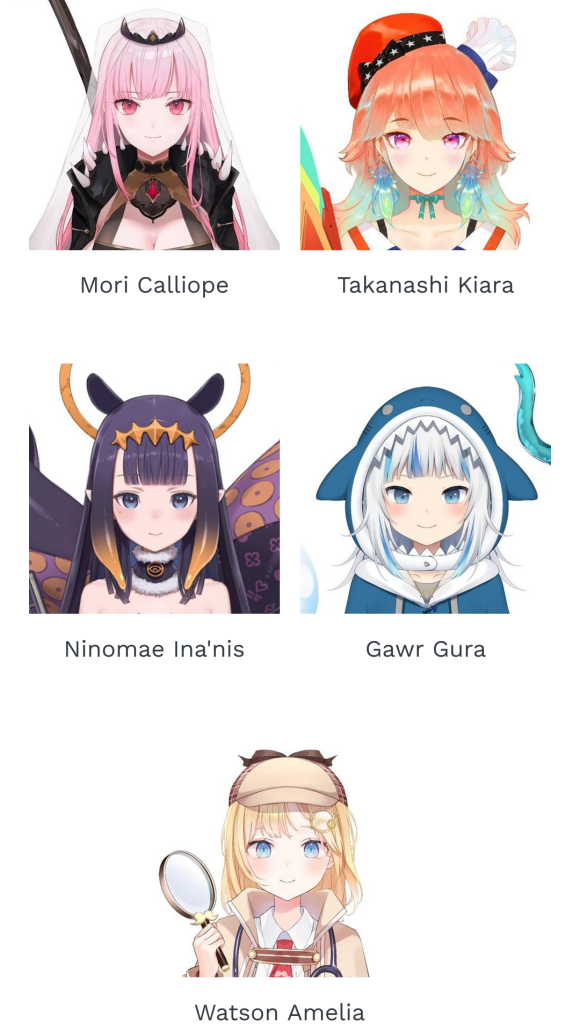
Virtual Youtubers continue to be a tour de force, reaching beyond Japan to worldwide recognition. Given this success, as well as the crossover appeal of certain English-fluent VTubers (such as Fujima Sakura, Pikamee, and Kiryu Coco), it was only a matter of time before one of the big VTubers agencies would try to make an active effort to court an English-speaking audience. Thus is born Hololive EN, and with it five new streamers.
The tricky thing with something like Hololive English is striking the right balance in terms of audience desire and accessibility. Speaking in the target demographic’s native tongue does wonders for directly engaging with viewers, and offers an experience closer to what the Japanese viewers typically enjoy. Rather than Inugami Korone’s amusing struggles with English, little gets lost in translation. However, it’s also possible that part of the appeal is the existence of a culture gap—that there’s an element of exoticism found in both the language barrier and the moe idol aesthetic. Veering too far in one direction might alienate certain fans.
The route that Hololive English appears to have taken is to feature VTubers with decent degrees of spoken Japanese fluency—enough to interact with the Japanese fans as well. Their true identities remain unknown (as is standard), so it’s unclear if they’re natively multilingual or if they achieved it through study, but the result either way is that there isn’t a complete disconnect with the Japanese origins of Hololive. The style of English seems to differ from one to the next, whether it’s the cutesy affectations of Gawr Gura or the more natural-sounding speech of Mori Calliope. I think this probably a good way to hedge their bets in terms of figuring out what will garner the most fans, though I don’t know how intentional that is.
While all of them are able to speak Japanese fairly well, written fluency varies significantly between the Hololive English members (unless it’s somehow all an act). Case in point, Takanashi Kiara’s language skills are very strong to the extent that she self-translates, Ninomae Ina’nis appears to have a solid handle, and Amelia Watson can struggle with the basics. Kiara’s advantage is obvious, but I think the ones who are less fluent actually have a certain appeal themselves. Not only do they resonate with those of us who grew up speaking our parents’ languages but never became properly literate, but they’re also relatable to those currently learning Japanese or who want to learn Japanese—no doubt a common occurrence among Virtual Youtuber fans.
For now, I don’t really have a favorite, but I wish all of them the best of luck. If they find success, I wonder if other Vtuber groups will push harder to have an active international presence.
This post is sponsored by Ogiue Maniax patron Johnny Trovato. You can request topics through the Patreon or by tipping $30 via ko-fi.


 OGIUE MANIAX