Calliope Mori, Beyond the “Rapping Reaper”

When Calliope Mori debuted as the first member of hololive English, she helped transform people’s perceptions of VTubing by showing that the music and personalities didn’t have to be limited to assumptions about idol culture and kawaii aesthetic. Over time, however, she has changed her approach to music, going from primarily rap to rock with occasional rap elements, and she even does some of the idol stuff. In fact, she now finds some of her earlier songs to be somewhat embarrassing, and it’s a transition that I find intriguing. 

It’s perfectly normal to cringe over one’s past artistic work, and genre changes also aren’t unfathomable. But I think in Calli’s case, the rapper + reaper combo has been a tricky thing to pull off because it requires two different and at times contradictory forms of kayfabe. That is to say, she has two create and maintain her act convincingly enough that the audience can suspend disbelief, and she has to do it twice over.

Before I dive in, I want to preface that neither music or rap (and its culture) are subjects I am an expert on. Everything I learn I basically pick up primarily from others, so if I come across as a tourist, then well, guilty as charged.

On an episode of Holomelo Radio with fellow hololive member Nerissa Ravencroft and musician Lotus Juice of Persona fame, Calli mentioned that she eased up on the rapping because she can’t bring the confidence expected of a dedicated rapper, especially in English. While her inspiration for getting into the genre was always Japanese rap (notably FAKE TYPE.) as opposed to American, the fact that her primary language is English means that any claims to be an amazing rapper puts her in contention with some real heavy hitters and a culture + fandom that isn’t afraid to let their criticisms be heard. Being a white Texan also complicates matters.

Black video essayist FD Signifier describes rap as having a form of kayfabe akin to pro wrestling. A lot of performers will talk about how dangerous they are, how much money they have, why they’re the greatest on the mic, etc., but in every case, it’s a persona with some truth blended into the fiction at best. The crucial part of this performative presentation is that the rapper has to make you believe that they believe they’re the best in the world. Calli appears to have trouble buying into her own hype, perhaps because rap is such a heavily scrutinized and competitive art form. Even an actual commercial and critical success like the subject of FD’s video above, J Cole, has gotten a lot of flack from some commenters. His apology and withdrawal from beefing with Kendrick Lamar was often seen not as a welcome example of humility but instead a marker of weakness and cowardice.

While most would have only one level of kayfabe, Calli has a second: her identity and lore as a VTuber, specifically her persona as an immortal grim reaper. While VTubers don’t necessarily have to go all in on the assumed persona, it becomes a point of connection for viewers and potential fans, and it makes a difference in presentation compared to other streamers and creators. However, trying to keep up a complete alter ego based on a single aspect becomes an increasingly difficult task over time, let alone two aspects.

It’d be like if Eminem had to be “Slim Shady” in most songs and public appearances, and also Slim Shady was a vampire for some reason. Or imagine if the Undertaker in pro wrestling was not just some kind of undead wizard (and occasional biker) but also a rap star. One of the reasons rapping worked for a young John Cena was because “Doctor of Thuganomics” was his primary gimmick at that point in his career was that he was supposed to be a normal-ish guy (albeit with freakish strength) otherwise. VTubing is also similar to wrestling in the way minor past accomplishments can become the entire basis of a performer’s identity, because of how they allow a performer to stand out in their respective spaces, and this can be both an asset and a limitation in both worlds.

What I think undergirds her stylistic switch is that Calli wants to be vulnerable in her music. I don’t think it’s a coincidence that one of her most beloved early songs is “End of a Life,” which is about guilt over becoming a massive success as a VTuber and leapfrogging over friends and mentors to whom she felt deep gratitude. In fact, Calli originally applied to hololive on a whim after her friends barely convinced her to try it out, and she beat them out despite taking it less seriously. While some of the most acclaimed rap songs express profound pain, rap is often about having that air of strength and swagger, and it feels like she increasingly gets away from that bravado with every album (such as in “Memento.”)

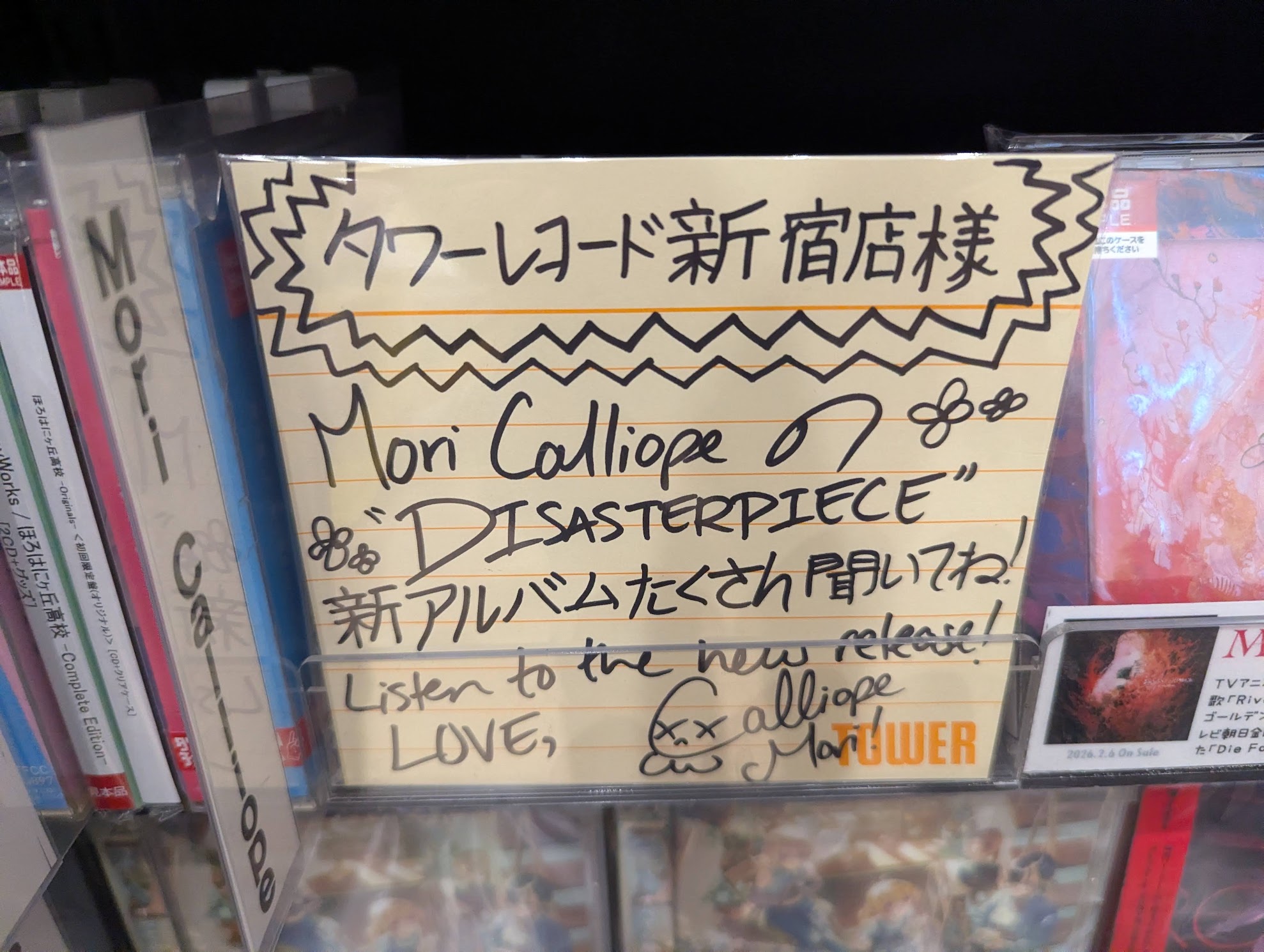
The current Mori is currently making what I find to be the best music of her career, like the opening she did for Patlabor EZY, “Reimei Compass.” She’s still honing her rap skills too, like on her cover of Gurren-Lagann’s “Libera Me from Hell” alongside Elizabeth Rose Bloodflame. Seeing the way she has morphed her identity as a performer is encouraging. It’s as if she’s saying that the image you’re given, or even the one created by your own hands, should not be a prison that keeps you from further discovering your potential or your passion. 
Happy 6th Anniversary to hololive Myth

Calliope Mori and the Courage to Step Outside Your Comfort Zone

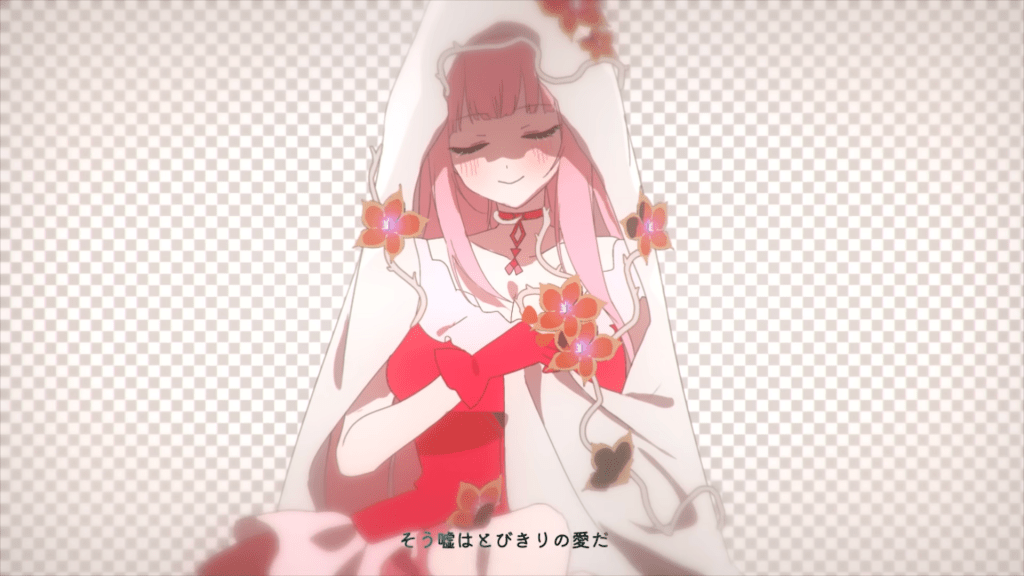
A pink-haired girl in a white dress with a hood, covered with flowers. The background is a gray and white checkerboard pattern referencing transparent backgrounds in computer images.

How much should we do what we’re good at vs. to what extent should we try to work on our weaker areas? And to what end? I’ve been contemplating these questions because of the Virtual Youtuber Calliope Mori.

There used to be an ad campaign in the 2000s for the beer Dos Equis featuring a charismatic older gentleman described as “The Most Interesting Man in the World.” The commercials would boast about his accomplishments, and even occasionally have him wittily comment on various topics. In one case, his advice on careers was “Find out what it is in life that you don’t do well, and don’t do that thing.” It‘s a statement that can be taken as “know your strengths and play to them,” but this and similar sentiments have me contemplating the ways in which we as people navigate the notion of self-improvement. 

That’s where Calliope Mori comes in. One of the most popular VTubers in the world, the central theme of her persona is that she is a “rapping reaper”—a death god who has bars for days while also presenting a very anime aesthetic. A lot of her early success was built on her rap skills, and it’s given her both fame and fortune, including a major deal with Universal Music Japan. Yet, rather than stick to the image of the “hip-hop anime girl,” Calli has more recently delved into two areas she feels less experienced in: cuteness and singing.

Among VTubers, being adorable and singing well are certainly not uncommon traits. Her genmate Gawr Gura (featured in the above collaboration, “Q”) is a prime example, and Calli going this route means being compared to the Guras of the world. But while Calli’s qualities (especially her rap skills) are much rarer and help her to stand out among the crowd, she’s also mentioned a desire to work on both cuteness and singing ability. For example, she originally asked if she could have a character model that was short and flat-chested, closer to her ideal image of cuteness. Calli has also been doing covers of cute songs like  “Kawaikute Gomen” and “Idol,” the opening for Oshi no Ko. It’s a move that has gotten both positive and negative feedback, some of which has been on the extreme side.

The worst comments seem to stem from the idea that one shouldn’t be putting content like this out unless they match a very high and often gatekeeping standard, and I find it sad and awfully pathetic to attack someone who is trying to do what they want while aware that they’re not the best at it, rather than just be mature and ignore what you don’t like.

Certainly, Calli could only try to operate outside her wheelhouse because she’s had financial success through Hololive and the support of a fanbase that wants to see her do well. It’s a far cry from telling someone barely scraping by to just “do what you feel like, even if you’re not necessarily going to be great at it.” But while Calli has a fairly privileged position, the fact that she’s willing to learn and experiment in the public eye, all while doing things that don’t come as easily to her, is admirable. It would be a terrible thing if people are discouraged from trying unusual things because of the backlash Calli receives. My hope is that everyone, Calli included, does not lose heart.

Hololive 3D Concerts and Bringing Different Fans Together

Laplus Darknesss and Amane Kanata from Hololive singing and dancing on stage

I’ve watched the recent anniversary streams of holoX, and in light of the announcement of the Hololive 4th Fes, I’ve been thinking about how holding 3D concerts can carry different types of significance depending on the individual member and what their fans are looking for. Hololive seems to celebrate their stars in a manner inclusive to every Hololive member’s diverse fanbase, and I’m all for it.

It’s no secret that Hololive members can vary tremendously in terms of where their talents lie. Some clearly establish themselves as great performers as soon as they have the chance, like Hoshimachi Suisei. Others don’t necessarily have the background but have worked hard and come into their own, such as Oozora Subaru. And then there are those who don’t reach the level of their fellow VTubers in terms of singing and dancing, but they might have engaging personalities that just make for a special experience.

However, when there are 3D concerts or other major events that bring Hololive members together, they potentially become places where all respective fans can come together and appreciate their favorites for their own particular reasons. Take the Hololive 3rd Fes concert, which was the 3D debut of Hololive English’s first generation. Gawr Gura showcased the singing talent that brought so many fans to her, along with a cute dance. Takanashi Kiara brought a more polished idol flair. Ina came with a soothing voice in a subdued performance. Amelia Watson is definitely not a strong singer, but her choice of music (a weird fictitious anime opening from the show Welcome to the NHK!) put her personality on full display. And Calliope Mori put her well-established rap skills (that have since led to a contract with Universal Music Group) to good use. Hololive Indonesia’s first generation also made their 3D concert appearances, with Moona’s diva-like poise, Iofi’s adorableness, and Risu’s ridiculous vocal range all on full display.

With holoX, there is a similar range of strengths and quirks on display in their anniversary concerts. La+ Darknesss (see above) is a ridiculous total package whose impressive vocals and unmatched dance skills both support and defy her “bratty alien demon lord” concept. Takane Lui doesn’t fit the typical image of an idol, but she’s very good at singing while also staying “in-character,” and her choice of songs conveys a sense of maturity. Hakui Koyori is a jack of all trades who also leans into her character the most by adding in puzzles and brain teasers to her concert. Sakamata Chloe is arguably the best singer in the group, with a voice that can seem unreal; she was also the only one to do exclusively solo performances, as if to prove a point. Kazama Iroha’s cuteness shines through in her energetic performances, and it’s clear that she put in a lot of effort to improve her dancing.

It all reminds me of an essay I once read about the differences in presentation between Japanese idols and Korean pop stars: part of the appeal of J-idols is seeing them grow into the role, whereas K-pop stars appear before fans already fully formed. In the context of Hololive, it’s like there’s a purposeful and perhaps even inevitable contrast. While you might have your “J-idol fan” types who want to see their favorites grow and your “K-pop fan” types who love to see perfection in action, a single banner like Hololive allows these groups (and many more) to all thrive in the same general space. 

The power that comes from the variety Hololive has to offer is the way it encourages respect for diversity of talent. People can be fans of different members for different reasons. There are certainly talents whose appeal lies in their sheer skill, and the fans want to see their favorites put their abilities and/or progress on full display. However, there are also Hololive members who aren’t necessarily the greatest performers in one way or another, but their presence on stage makes for a kind of “we made it” moment for their fans. No matter the reason, it emphasizes the idea that there’s no one “right” way for a performance to be, and it encourages the different fanbases to coexist.

Hololive Alternative, TakaMori, and the Speed of Memes

Hololive Alternative is a 2d animation project depicting the Virtual Youtubers of Hololive as active characters within a world. Two “teasers” are out currently, and they’re a treat for fans and newcomers alike. But while watching the second, the depicted interaction between Takanashi Kiara and Mori Calliope made me hyper-aware of how internet culture and its memes evolve at lightning speeds.

Kiara the Phoenix and Calliope the grim reaper are both part of HoloMyth, the Hololive brand’s first foray into the English-speaking market. Early on in their careers, they were known for having a rather flirtatious and tsundere-esque relationship, which in turn spawned the ship known as TakaMori. It was a prominent part of both character identities—even making it into Can You Do the Hololive?, a song based on all the members’ signature greetings. In it, Kiara states, “Of course the two of us come together,” and Calli responds, “Shut your mouth, Kusotori [Stupid Chicken].” 

Similarly, the second Hololive Alternative teaser shows the two eating together. Kiara eagerly takes photos of everything (Calli included), and the reaper responds by grabbing her scythe and taking swipes at Kiara. The whole interaction describes the original basis for TakaMori to a tee. 

The only problem: the nature of the pairing has changed over time. It still has fans, of course, and the two even recently had an in-person stream together that was made all the more impressive by the fact that one had to travel from Japan to Austria. However, both Kiara and Calli have talked about the fact that they decided to emphasize their solo identities more. The fans in the Youtube comments for that collaboration have remarked even on how the duo’s dynamic has changed (and arguably for the better).

Granted, this isn’t quite the same as a meme naturally morphing into something unrecognizable. The fact is, one can point to a conscious decision as the reason TakaMori isn’t quite the same as it used to be: a purposeful shift in direction. Nevertheless, it feel indicative of the rapid pace at which VTuber in-jokes are formed feels indicative of the general speed of the current internet. In contrast, elaborate animations—even short ones like the teasers for Hololive Alternative—take time to be made. In that gap, the ground shifted underneath TakaMori, and its depiction in animated form can feel like a relic of the past. In reality, it’s only been a little over a year, but the fact that a year sounds like forever in VTuber time makes that difference all the more stark. Online empires rise and fall in less time, and I have to wonder what else might end up coming across as a “yesteryear meme” by the time the next teaser is done.

Hololive EN and Multilingual Fluency Among Virtual Youtubers

Virtual Youtubers continue to be a tour de force, reaching beyond Japan to worldwide recognition. Given this success, as well as the crossover appeal of certain English-fluent VTubers (such as Fujima Sakura, Pikamee, and Kiryu Coco), it was only a matter of time before one of the big VTubers agencies would try to make an active effort to court an English-speaking audience. Thus is born Hololive EN, and with it five new streamers.

The tricky thing with something like Hololive English is striking the right balance in terms of audience desire and accessibility. Speaking in the target demographic’s native tongue does wonders for directly engaging with viewers, and offers an experience closer to what the Japanese viewers typically enjoy. Rather than Inugami Korone’s amusing struggles with English, little gets lost in translation. However, it’s also possible that part of the appeal is the existence of a culture gap—that there’s an element of exoticism found in both the language barrier and the moe idol aesthetic. Veering too far in one direction might alienate certain fans.

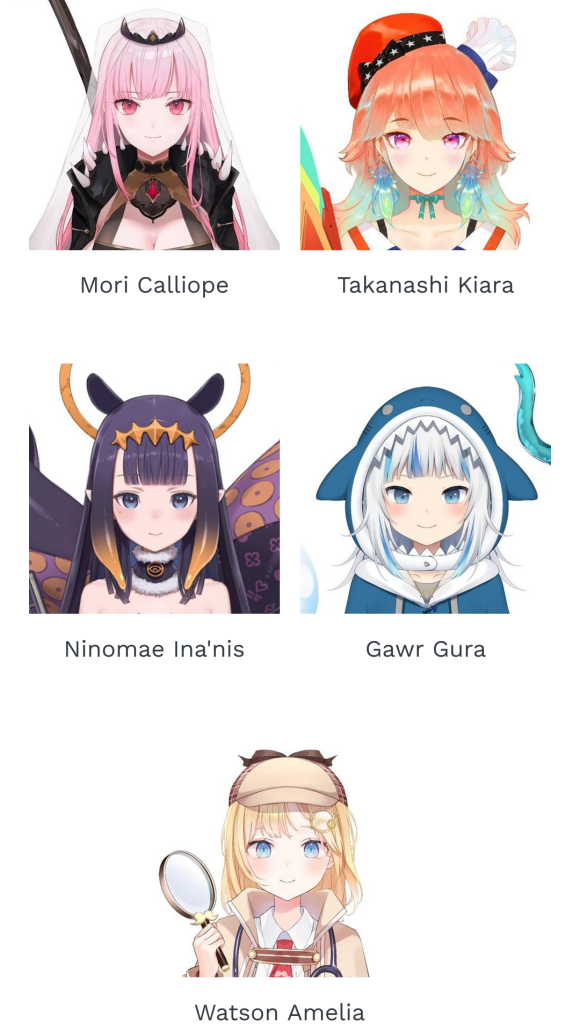
The route that Hololive English appears to have taken is to feature VTubers with decent degrees of spoken Japanese fluency—enough to interact with the Japanese fans as well. Their true identities remain unknown (as is standard), so it’s unclear if they’re natively multilingual or if they achieved it through study, but the result either way is that there isn’t a complete disconnect with the Japanese origins of Hololive. The style of English seems to differ from one to the next, whether it’s the cutesy affectations of Gawr Gura or the more natural-sounding speech of Mori Calliope. I think this probably a good way to hedge their bets in terms of figuring out what will garner the most fans, though I don’t know how intentional that is.

While all of them are able to speak Japanese fairly well, written fluency varies significantly between the Hololive English members (unless it’s somehow all an act). Case in point, Takanashi Kiara’s language skills are very strong to the extent that she self-translates, Ninomae Ina’nis appears to have a solid handle, and Amelia Watson can struggle with the basics. Kiara’s advantage is obvious, but I think the ones who are less fluent actually have a certain appeal themselves. Not only do they resonate with those of us who grew up speaking our parents’ languages but never became properly literate, but they’re also relatable to those currently learning Japanese or who want to learn Japanese—no doubt a common occurrence among Virtual Youtuber fans. 

For now, I don’t really have a favorite, but I wish all of them the best of luck. If they find success, I wonder if other Vtuber groups will push harder to have an active international presence.

This post is sponsored by Ogiue Maniax patron Johnny Trovato. You can request topics through the Patreon or by tipping $30 via ko-fi.