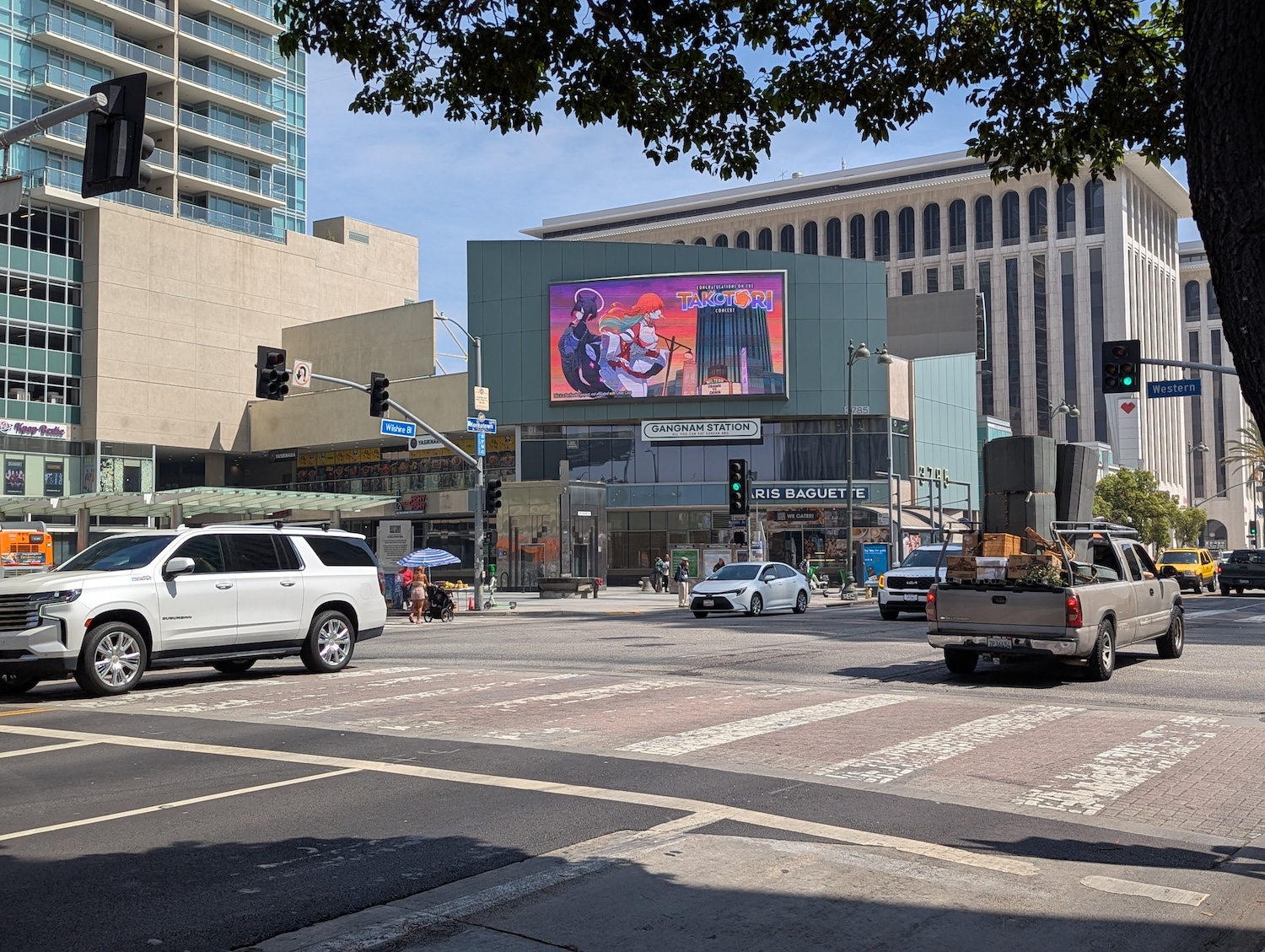
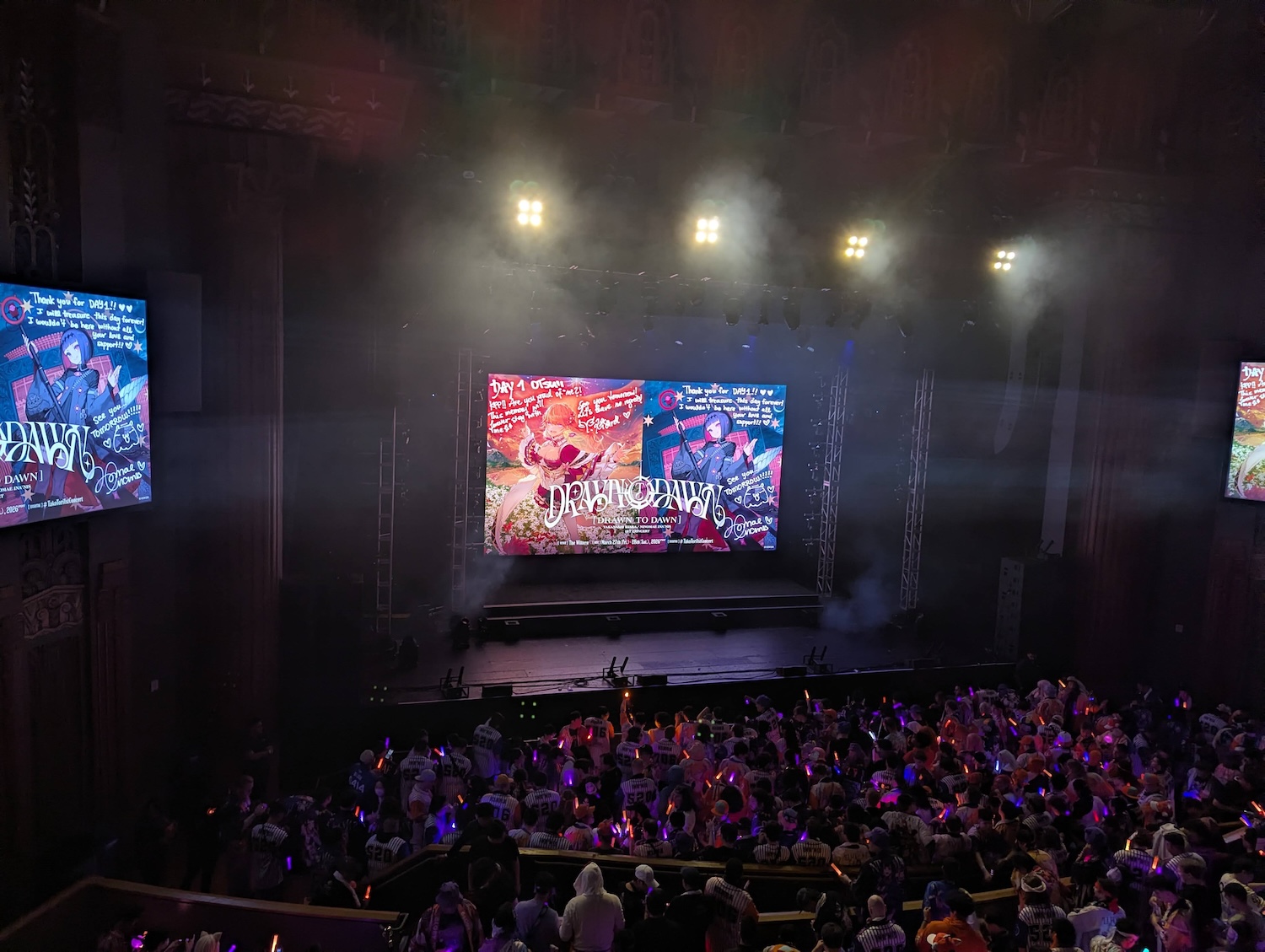
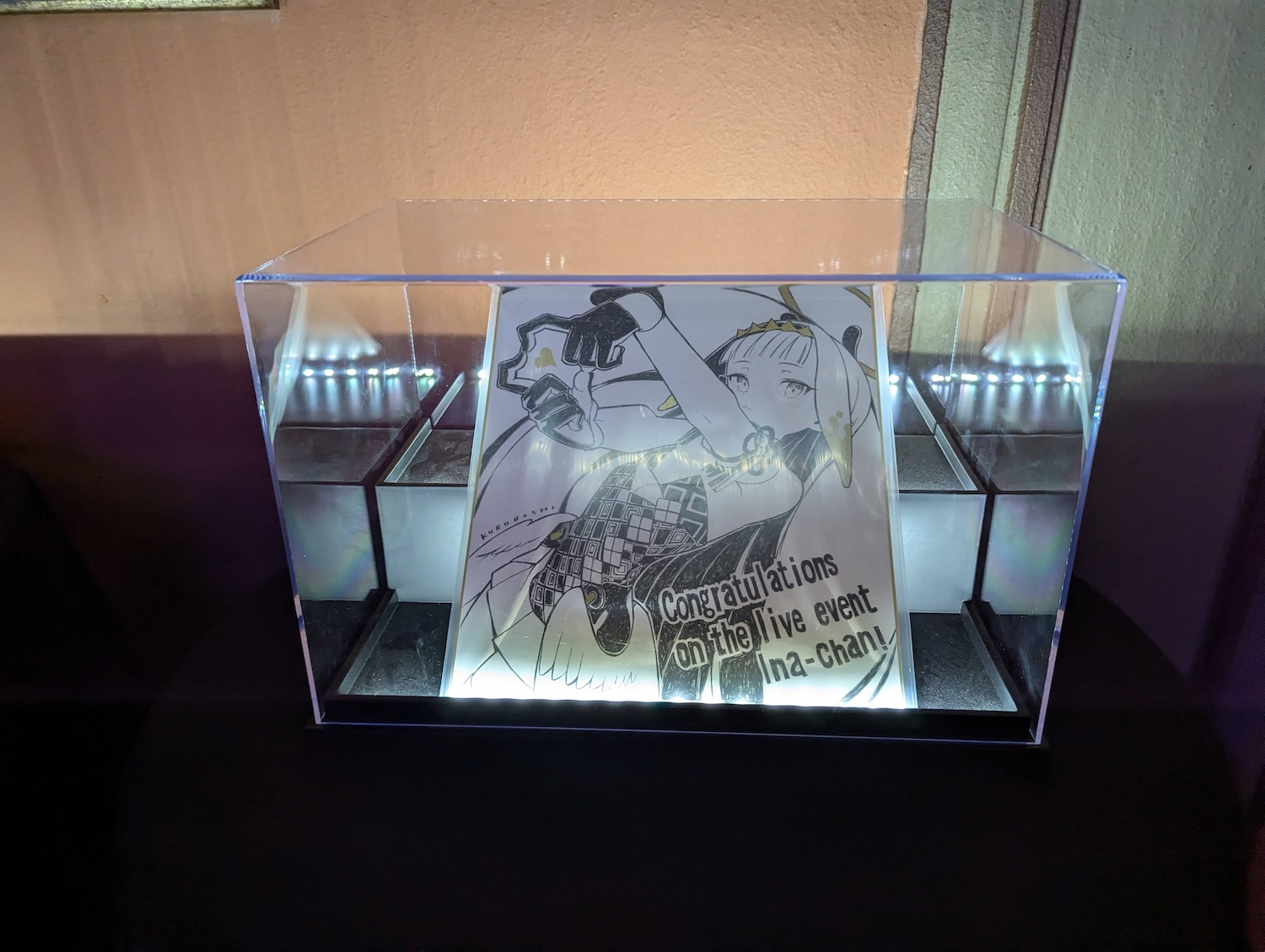
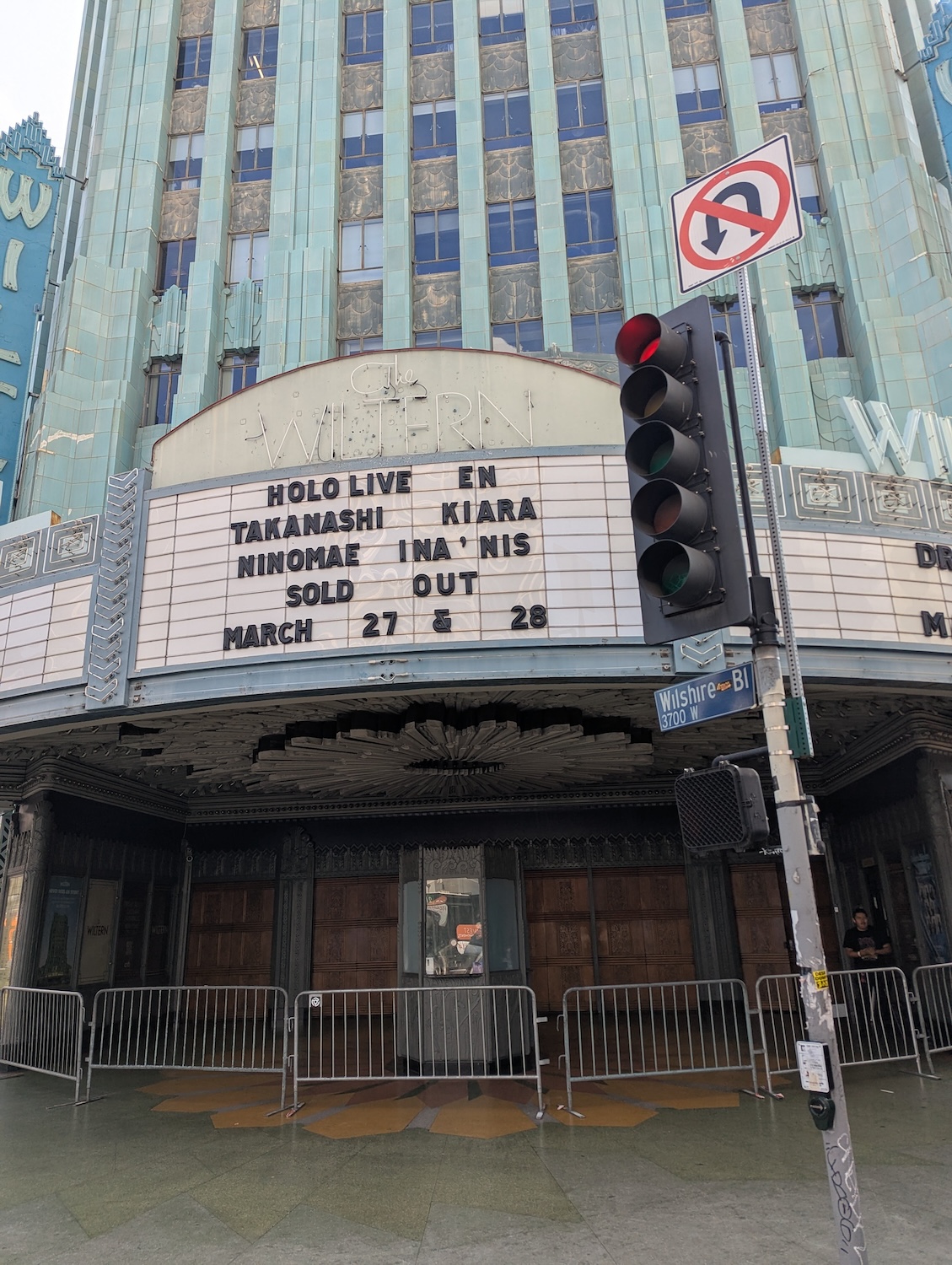
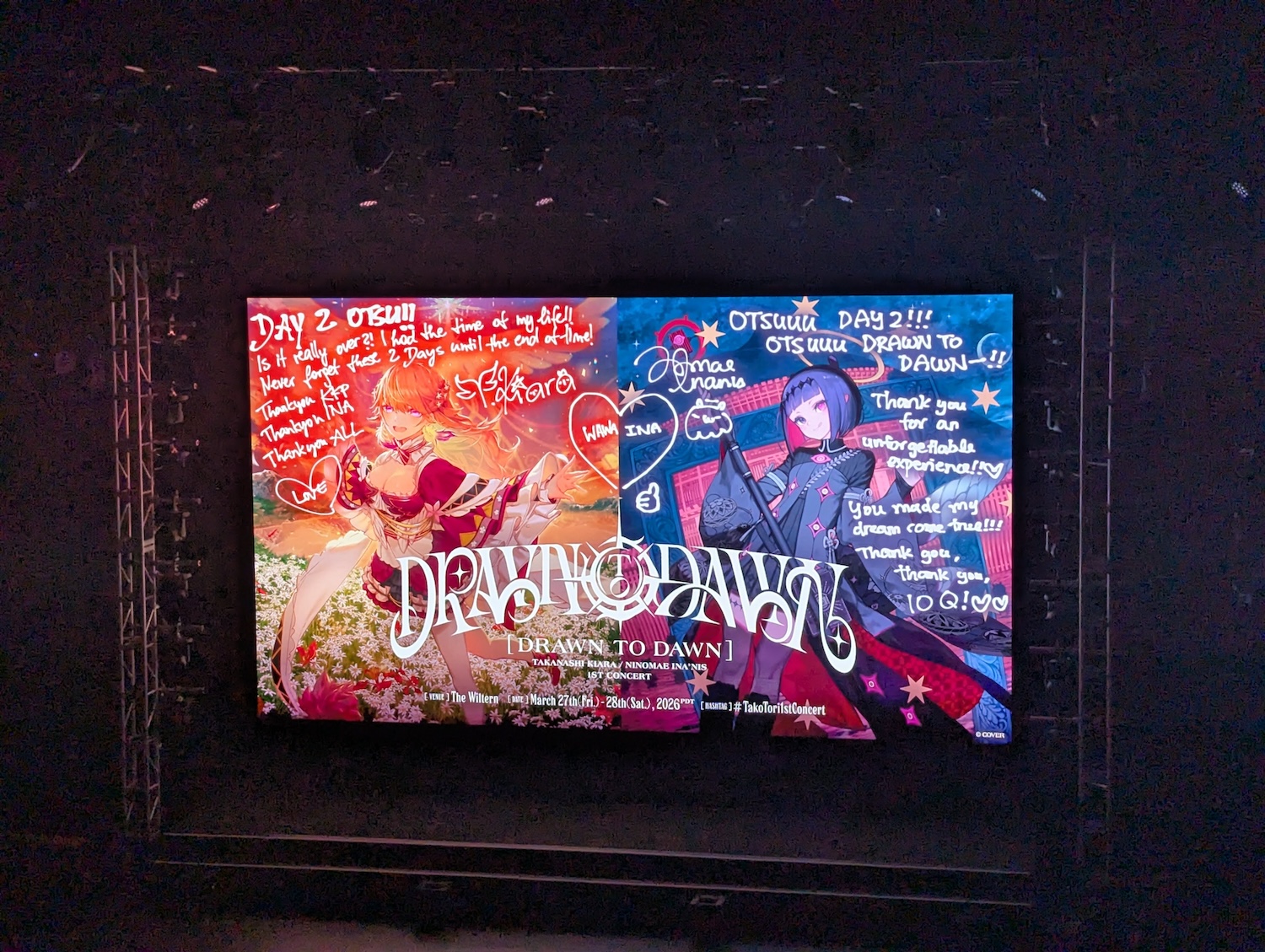
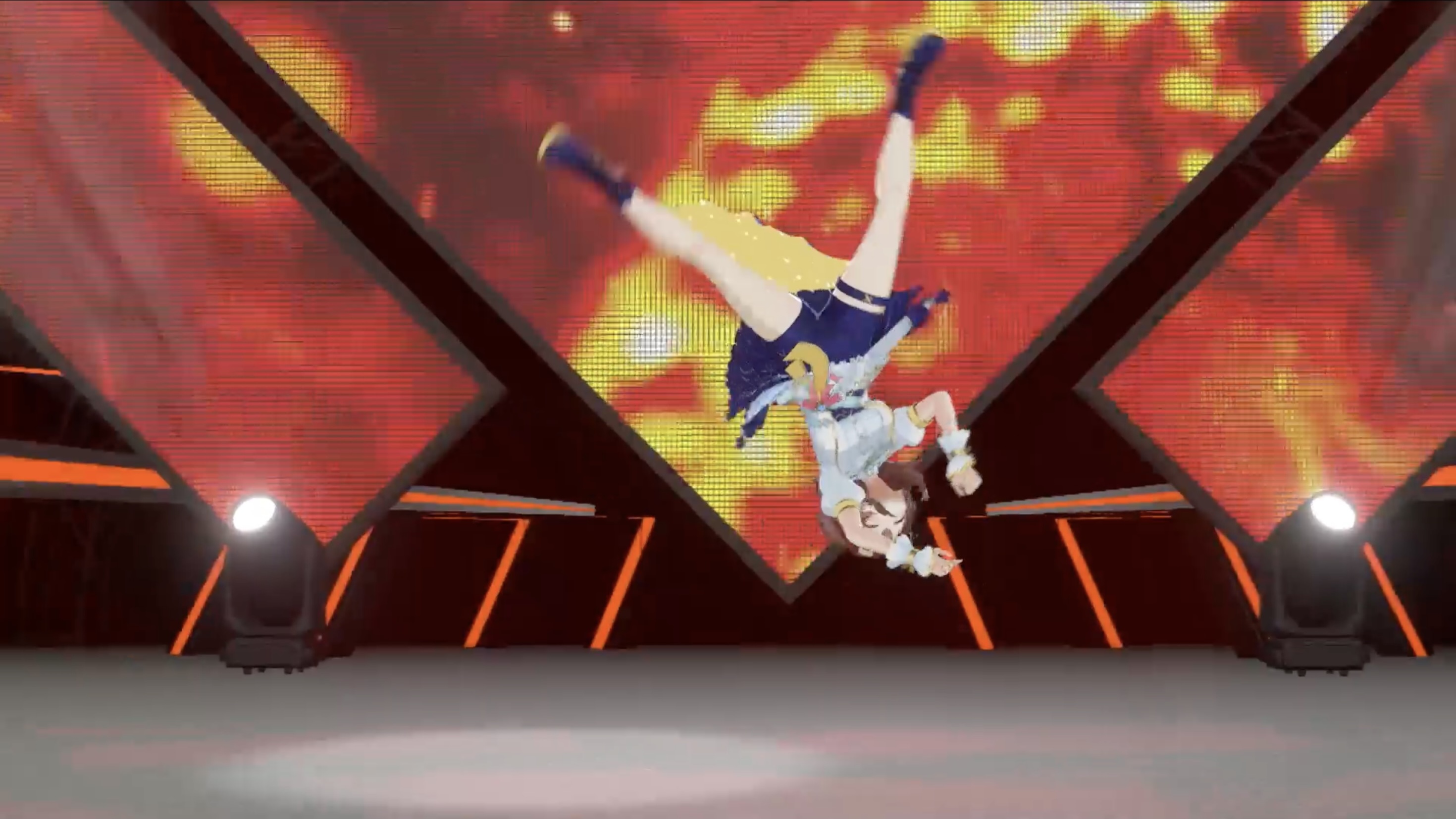
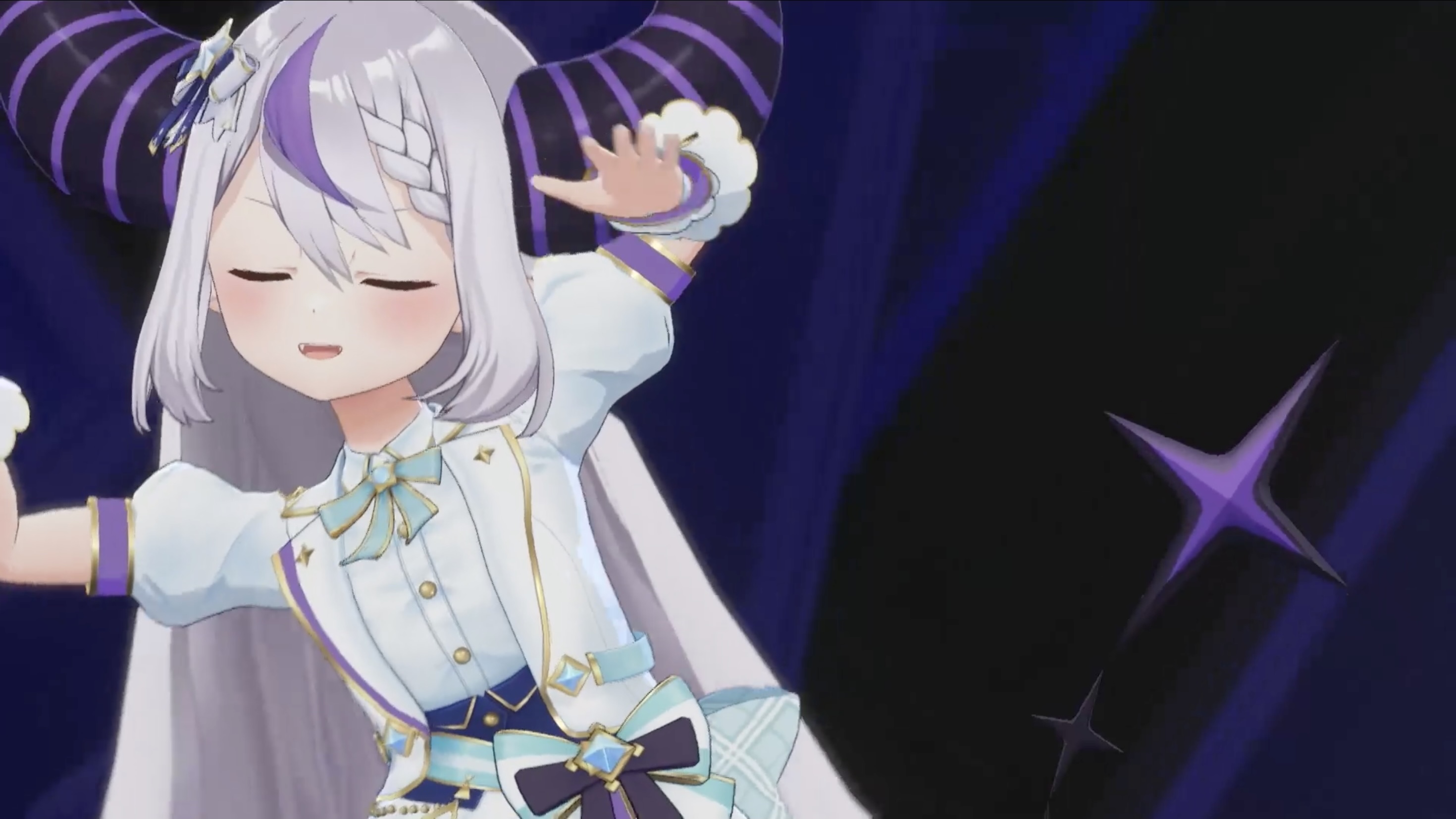
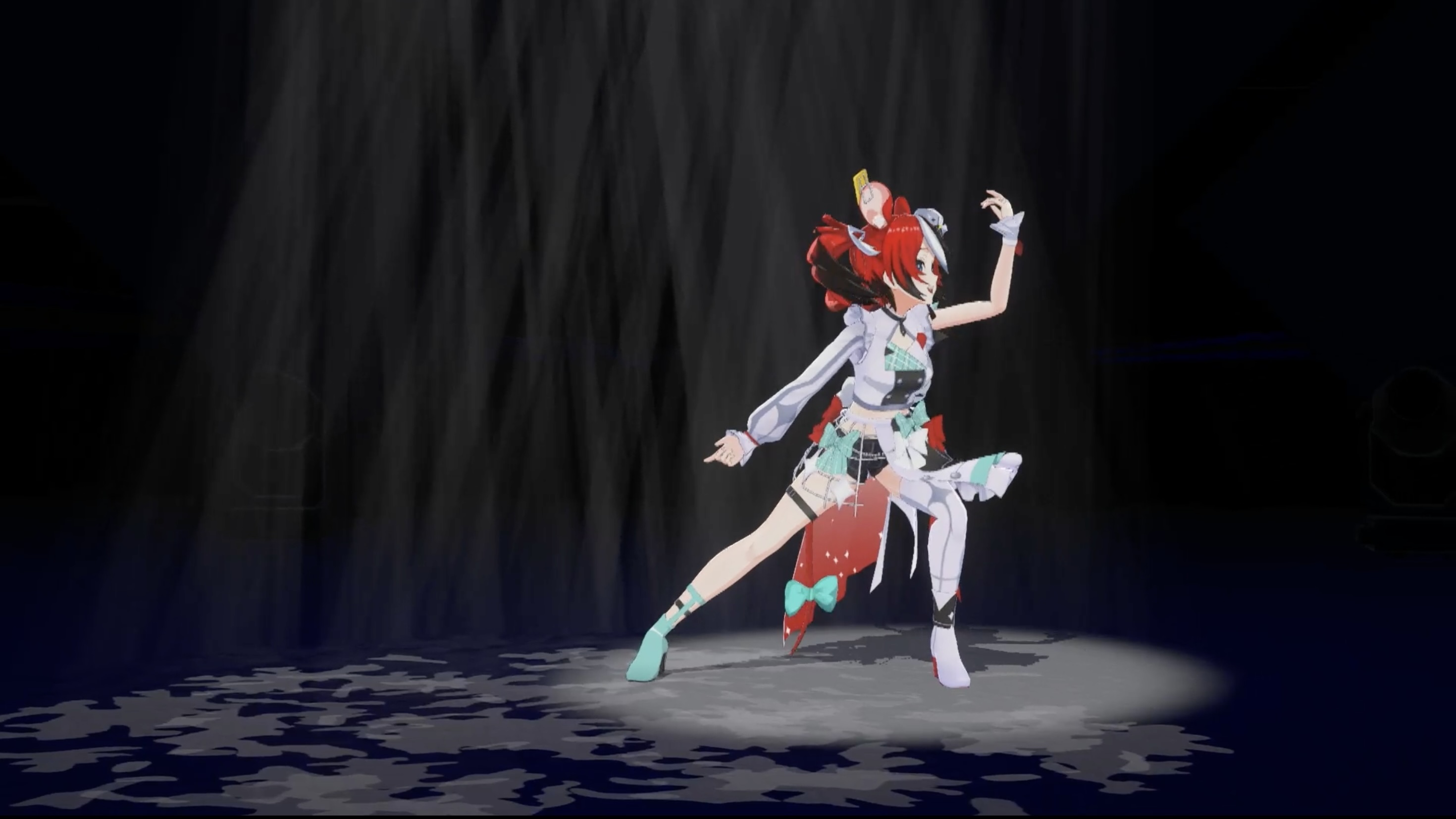
“Solo live.” “Duo live.” Whatever you call it, Drawn to Dawn was something special. An in-person VTuber concert at the Wiltern in Los Angeles held on March 27 and 28, the event featured two of the founding members of hololive English: the spirited phoenix diva Takanashi Kiara and the low-key eldritch priestess Ninomae Ina’nis. While both have years of experience performing in front of a live audience, they also have never had the spotlight dedicated to just them. They join their gen mate Calliope Mori in being among the few EN talents to star in concerts of this kind.
And in the months leading up to the event, I kept waffling between excitement and buyer’s remorse.
While I greatly admire and support both Kiara and Ina, I’m also nowhere near being the most diehard fan of either. Was I denying a bigger KFP or Takodachi the opportunity of their life? Was I spending my money wisely, given the cost of tickets and overall travel expenses? Was I really going all the way to LA just to do this? The doubts lingered, but one thing I told myself was that if ever there was a time to show my appreciation for these Myth girls, this was it.
I’ve seen my fair share of VTuber concerts, and multiple talents typically means alternating between the performers from song to song. To my surprise, however, they instead each had their own dedicated sections before crossing over for a big finale. Kiara started for Day 1 (and thus appeared in the free preview online), while Ina opened on Day 2. The approach differed significantly from the generation-focused concerts (e.g. NePoLaBo’s and holoFantasy’s) by emphasizing them as individuals more than their identity as a group, which ended up very effectively showcasing their differences, allowing each to shine in their own unique ways and at their own paces.
Takanashi Kiara
As the owner of one of the largest discographies on the English side, Kiara has always made clear that a concert like this had been one of her dreams. However, it has been an uphill battle for her, having started in hololive at the height of the COVID-19 pandemic, and having spent the great majority of her tenure living outside of Japan. As later generations have debuted with even more stage experience than her, it felt like her star might not shine quite as brightly among the multitude. Despite these challenges, she persevered and honed her craft, and her resulting performance truly felt like she was pouring all of that passion and determination onto the stage. I have never seen Kiara move better or sound better than she did for Drawn to Dawn.
Kiara has always had the most “pop star” energy of her generation, and her setlist embodied that. Every single one of her 20 numbers had its own unique choreography, with only a few slow enough to even arguably be considered “restful.” She even included more complex formations with back-up dancers, who themselves had newly revealed designs that took them from shadow silhouettes to full-fledged characters. And in a first for hololive, the dancers actually have two unique designs instead of just one.
Not to be outdone by her own back-up, Kiara debuted a new 3D outfit herself. It was exactly what she was wearing on the official promotional art for the concert, and also happened to be one of the best VTuber outfits I’d ever seen, both from Kiara and in general—and that’s factoring in the fact that I adore her other outfits too. (I may have a dirndl bias, though.)
It was also quite remarkable to hear her bring her current singing ability and some of the flair she uses in “Do U” and “Mirage” (one of my favorites), to her older songs, such as “Hinotori” and “Fever Night” (another favorite). And when she slowed down the tempo for “Blue and Gold,” a song dedicated to her former genmates Gawr Gura and Amelia Watson, the weight of the history they (and we) share felt palpable.
During one of her MCs, Kiara read a letter she wrote to her past self. She recalled the time she performed in front of an audience of just one person (who wasn’t even there for her), and wanted to congratulate the younger “Kiara” on not giving up. She also brought up the development of her music style—which she cheekily called “K-pop” (short for Kiara-pop)—and the way she has shifted from a more cheerful J-idol sound to a more mature K-pop presentation. She was honest in stating that she personally prefers the former, but understood that the latter was getting her more notice, and that mix of passion, pragmatism, and bluntness is what I think draws fans to Kiara.
I have to wonder if the rise of “Kiara-pop” simply comes from her fan base being younger than her now (whereas it would have been older than her in the past), and whether Kiara will find a way to unite the two sides of her music into something greater.
Ninomae Ina’nis
In many ways, Ina is the opposite of Kiara. With her more subdued personality, she’s known for things like her professional-level art skills, her comfy chatting style, and her love of puns. To Ina, music and stage performances have not been life-long pursuits, but rather something she has come to learn and appreciate as part of hololive. The size of her discography is only a fraction of Kiara’s, but Ina’s artistic sense comes through every time in her choice of music style and the aesthetics of each music video, and she brought that same creative unity to Drawn to Dawn.
Whereas Kiara’s staging drew most of the attention to herself and the dancers, Ina’s was almost like a series of paintings in motion. Each of her original song performances was unified by a single thematic color that reflected the contents of the song, and often its implications in both the official lore of Ninomae Ina’nis and the identity she has created with her fans. As she sang and moved about the stage, it was as if she was integrating herself into each art piece.
Ina also revealed her own new 3D outfit matching the official promotional art, which resembles something like occult priest robes but with some extra pizzazz. It was sharp and elegant, but there was an additional surprise: the robes could be removed to reveal a more casual long-sleeve and short skirt ensemble. Social media was abuzz with the comments about how her lack of high heels and somewhat larger thighs gave a different (yet welcome) impression to Ina’s appearance. Incidentally, Kiara’s thighs also seem to have been made larger, and attractiveness aside, I can’t help but wonder if this is some kind of trend. (Then again, even the original and official character designs of hololive members often don’t end up perfectly matching their VTuber models in proportions, be they 2D or 3D.)
While Ina doesn’t have a ton of range to her voice, she used it well across all her songs, especially when taking into account that all her originals are quite different from one another. “Violet” is quiet and gentle, “Meconopsis” has a heartrending and forlorn quality that I particularly love, “ “Tako Takover” is silly and hypnotic, and so on. Because she doesn’t have nearly as many songs as Kiara, she filled out some of her setlist with covers of other hololive members’.
As Ina explained in an MC section, she had no experience singing and dancing in this way prior to hololive. However, that has made her journey to Drawn to Dawn special in its own way. Rather than it being the culmination of a continuously striving performer, Ina’s path is one of new discovery and the realization of another facet of herself. Together with Kiara, they exemplify two types of idol journeys, and this juxtaposition strengthened both women’s respective approaches.
Miscellaneous
There were a few technical issues that occurred during the event. The line on Day 2 took so long that some people did not even get the chance to see the first few songs. I managed to get in on time, but only because I went around asking employees about the early entry line, and that was only because a friend reminded me that there was supposed to be early entry in the first place. Apparently some of the Wiltern workers didn’t realize that, and put everyone on the same massive line, which wrapped around the venue.
This isn’t the first hololive concert that had issues of this kind, and I think it might come down to unfamiliarity with attendees who want to carry their entire fan collection with them. Each venue exists on its own, so we have to repeat history over and over. Day 2 was better in the sense that they just delayed the start.
I also realized something myself. I’m actually not a huge fan of penlight stuff, especially when it’s supposed to be a detailed and coordinated choreography. When I have to make a conscious effort to do it, I end up having a harder time concentrating on the actual performers, who are my main focus. There was more than one occasion at Drawn to Dawn where I found myself fumbling to do the “right” thing and missed a dance move or accidentally zoned out. I appreciate penlight formations and all that, but I end up distracting myself. At the most, I just want to vibe along with it at my own pace.
Speaking of penlights, one bizarre thing happened to me (and apparently a few others) during “Blue and Gold.” As per Kiara’s instructions, we were supposed to set our Penlights to Myth colors during the final chorus, and I had mine set to Gura blue and Ame yellow. Venue security actually came up to me during the song and asked me to turn off the yellow, mistaking it for an Ultra Orange glowstick. This is despite multiple Ultra Oranges being deployed by other people during the concert with seemingly no consequence. I was a little annoyed to have the moment tarnished by this interaction, but I understand that security was just trying to do its job and didn’t understand the difference—hell, I only recently learned about it in greater detail.
Final Thoughts
While I was initially unsure about whether attending Drawn to Dawn was the right decision, I don’t regret it one bit now that I’m on the other side. I enjoyed the hell out of it, and was happy to be part of something so unique. I ended up making a lasting memory and growing my appreciation for both Kiara and Ina.
At the end of each day, both girls asked the audience to quiet down so that they could shout out with their voices unmic’d. Despite some audio mishaps and audience confusion, getting to hear the fact that two of them were really and truly present with us in that concert hall is a treat I’ll cherish forever.
hololive VTuber Takanashi Kiara revealed a new outfit last month: a 1980s aerobics ensemble that ties into one of her songs, the vaporwave retro–themed “Fever Night.” The look has proven to be a very popular design with fans, and I’m no exception. But putting aside personal taste, one thing I find intriguing is that while the costume successfully evokes the 80s, Kiara’s hips and thighs reflect a much more contemporary beauty standard.
For better or worse, the Western standard for how women (especially white women) were “supposed” to look in the 80s was big breasts, tiny waist, narrow hips, thin legs, and small butt. There’s a reason “Baby Got Back” is written as a rebuttal to a dominant cultural sentiment.
This is even more the case when it comes to the iconic aerobics wear of the period. There’s a famous YouTube upload of an aerobics championship, and it’s a never-ending parade of fit and smiling folks in spandex showing off their slim lower bodies.
These days, however, wide hips and big butts are in. People online use words like “thicc” and “gyatt” with positive connotations, Instagram models swing in this direction, and Kiara to some degree aligns with these current values. Her default design has more prominent hips, and she even got the backside of her 3D model changed to be more shapely and closer to her non-virtual self—an upgrade that has received extra attention in her “Chimera” music video.
The Fever Night outfit, as form-fitting as it is, emphasizes this aspect of Kiara even more. And rather than seeing it as unfaithful to the 1980s, artists have embraced it, often exaggerating her proportions further still. In a way, it makes all the current fanart depict a kind of (not unwelcome) anachronism.
The way that fans have shown their love for Fever Night aerobics Kiara just has me thinking about how beauty standards can change—not only over time, but also across cultures. The 80s “ideal figure” might not be fashionable in 2024, but it could be seen in a different hololive campaign earlier this year: the hololive Production x Cheer Up collab in Taiwan. The promotional art was created by local artist Yanni, and it’s very clear that the girls’ proportions are different from their respective official designs.
In a way, the combination 80s aerobics outfit with current beauty standards—manifested in the form of Takanashi Kiara—really hits home the way nostalgia for an older time doesn’t necessarily mean every aspect of that bygone era is revived at equal levels. We’re seeing a snapshot of a time that is itself looking backwards, and if that is most readily depicted in the form of large thighs in hot pink, so be it.
PS: Today is Kiara’s birthday—stream “Fever Night!”
Over the past few years, hololive Super Expo & hololive fes (a combination convention and live music event) have cemented themselves as the premiere event of not just hololive, but all of VTubing. This year, “hololive 5th fes. Capture the Moment” bookended an incredible 365 days that saw the debut of two new generations, a swathe of 3D debuts, and other milestones all culminate in a whopping four-concert series.
The big visual change this year was a new triple-stage setup for the live audience. By having three stages (one in front and two on the sides), it gave the chance for different sections of the crowd to have a better view of the action at different times. This didn’t matter much to anyone like myself who was watching via the live stream, but I appreciated the effort on behalf of those attending in person.
In anticipation for 5th fes, I watched the Blu-rays of the previous years’, as well as videos of other concerts. While this year’s event was indeed bigger than ever before, it also really felt like the latest point in each VTuber’s journey. Seeing the progress of your favorites is a part of the idol experience, but what I find notable in this situation is how hololive encourages the fans to meet the talents “where they are.” Improvement is relative to oneself rather than absolute, and can consist of circuitous and unpredictable paths.
Because there were dozens and dozens of hololive talents involved, I will only be writing about a handful. That said, even if I did not include your favorite, you might be able to find them fitting into one of the categories below.
Debuting on the Big Stage
For the 3rd generation of hololive Indonesia, this was their very first hololive fes, marking a major milestone in their VTubing careers.
Kobo Kanaeru showcased her versatile singing voice and her boundless energy. Vestia Zeta displayed her sleek dancing but decided to go a cuter route compared to the hip-swaying routines of her 3D debut. Kaela Kovalskia went a simpler and more subdued route that fit her “gamer grind” persona. The range in their personalities was on full display, especially when performing the ID gen 3 group song “Save Our Hearts.”
Making Strides
Some talents, often by their own admission, are not the best singers or dancers. However, it was clear from their performances at 5th fes that they’ve taken steps to get better.
Himemori Luna has been known for her nonexistent stamina, once even needing to literally sit down in the middle of a performance while everyone else continued. At 5th fes, though, Luna was like a new person, showing no signs of severe fatigue. On top of that, her song choice—“Kamippoi na”—was a far cry from the cute and bubbly tunes she typically prefers. The contrast between her famous baby voice and the eerie feel of the number was a pleasant surprise.
Amelia Watson was originally so down on her own singing that one of her YouTube stickers is a bleeding ear. But many karaoke sessions and one original song later, things have changed. At 5th fes, she covered “Sugar Song and Bitter Step” (the ending theme to Blood Blockade Battlefront), and went full-on idol for it, not only showing better vocals but also including dancing a more complex routine compared to previous concerts. Amelia’s karaoke streams are among her most popular because they feel like going out to sing with a friend, and she maintains that feel on the big stage even as she develops.
Pushing the Limits
Progress didn’t just come from those who were lacking ability, but also those who were already highly skilled and took things to the next level. For example, Inugami Korone has gone from a front walkover flip two years ago, to back-to-back cartwheels last year, and now a fully unsupported side flip.
I’ve devoted many words to the mesmerizing performances of La+ Darknesss, and I think 5th fes is her best ever. Her song of choice was her first original, “Aien Jihen,” and its inclusion has a special importance. La+’s first performed it during her 3D debut, and it was when fans realized what a phenomenal dancer she is. However, she used a pre-recorded track due to the difficulty of the choreography (which she came up with herself!). At Waku Waku Dark Nightmare (her Nissin- sponsored solo live), she managed to both sing and dance at the same time, but the audience was all online. This time, La+ was there in front of a crowd of 11,000+—and she killed it.
Additional adjustments to the choreography made her look even more crisp, her voice remained mostly strong throughout, and her overall movement felt more intricate and daring than at 4th fes. In her own words, La+ thought the 5th fes “Aien Jihen” was stronger compared to at Waku Waku Dark Nightmare, and I’m inclined to agree. I’m happy to have seen my favorite hololive song performed so beautifully.
Takanashi Kiara is a similar case. When Myth, the first generation of hololive English, first appeared in official 3D at 3rd fes in 2022, Kiara made a big impression. There was no doubt that she was one of the best dancers in hololive, as she displayed a level of grace and confidence few could match. Then, at 4th fes the following year, an amazing debut performance by Hakos Baelz actually prompted Kiara to declare Bae the best dancer in EN. Over time, other strong dancers have also joined hololive, and it felt like Kiara was getting “powercrept,” so to speak.
Then Kiara went on stage in 5th fes and blew away all prior notions. While singing a brand new song, “Chimera,” she moved in a way I’d never seen from her before. Most (all?) of her prior choreographies have been arranged by an expert dancer named kianna, and Kiara’s “Chimera” looked closer than ever to matching that professional level. It really felt like Kiara was out there to show the world that you can never write her off, and that she was willing to put in the time and effort to prove this point. Watching in the moment, I wondered if Kiara might shine brighter than everyone else this year.
Changing the Conversation
Then Hakos Baelz came in and showed how pointless comparisons could be. By that, I don’t mean that she was inherently or objectively better than Kiara or anyone else, but that she decided to flip the script in a way that rendered such discussions moot.
Ever since her first 3D appearance at 4th fes, Bae has brought a very high level of quality and energy to every performance. Because she has been so consistently great, however, it became a question of how she’d be able to outdance herself this time around. Add in the fact that Bae herself commented on how her plans could potentially result in a flop, and fan speculation was all but inevitable. What feats of dance would she show this time?
To my (and it seems everyone else’s) surprise, Bae went in another direction entirely. Eschewing the high-octane routines she was known for, Bae went for a slow and passionate interpretive dance set to “Uta yo” (aka “Gales of Song”) from the Hosoda Mamoru film Belle. Watching her, I could feel my emotions welling up in response to her sublime choreography, the shock of seeing something so unexpected, and the boldness of Bae’s decision. Moreover, her voice was haunting in a way we rarely hear from her.
The next day, when she performed again for the hololive x Honeyworks stage, Bae did something more typical for her, and the contrast between those performances makes her sheer ability all the more impressive. Later, Bae also said that 1) she’d never done interpretive dance before this and 2) it takes her only about 2 hours to fully learn a choreography. It all goes to show how ridiculous she really is.
Returning in Style
In a few cases, certain performances were like reunions. Some of the hololive members have spent time not using YouTube and social media, and their circumstances meant that their presence at 5th fes ended up being reunions of sorts with their fans.
Murasaki Shion has been on hiatus for the past few months, and this was her first public appearance since she went on break. The roar of the crowd felt like a big “welcome back,” and seemed to communicate the idea that her supporters are there for her through thick and thin.
But while it was already known that Shion would be there, there was actually one talent whose performance came completely out of left field. Last year, Haachama ended up in the hospital not long after 4th fes, and she had to take eight months away from streaming. Because so much time had passed and because there wasn’t much time for her to practice after she did return, Haachama was not scheduled to be at 5th fes.
Then, without any anticipatory fanfare, Haachama blinked onto the stage. Watching the stream, I could hear the slight delay as general confusion in the crowd transitioned into pure excitement. Haachama sang “Idol,” the opening to Oshi no Ko—a song whose content fits an unpredictable girl who declares herself to be the “Worldwide Strongest Idol.” At the very end, she transformed one of the lyrics into a shout of “I love you!” as if to show her gratitude to everyone watching.
There was one other reunion of sorts, though it was more like a story going full circle. One of the last songs of the event was “Last Frontier,” performed by Hoshimachi Suisei and AZKi. The two are among the very best singers in the entire company and naturally sounded amazing, but the song also has a special significance: It was originally written by AZKi for Suisei when Suisei was transitioning from hololive’s INNK music label to the main branch, and AZKi was considering retirement. However, both have stayed with hololive, and Suisei even secretly rewrote some of the lyrics to go from being about sending someone off to achieving new goals together. When Suisei then read out a letter to AZKi about their time together, AZKi couldn’t hold back her tears.
Final Thoughts
It’s funny seeing just how massive hololive has gotten. In those earliest blu-rays, it’s clear that this whole project was a much more humble affair. The concerts were just decently large (but not gigantic) crowds of people in front of screens displaying their favorite VTubers, and actively buying into the illusion presented. Now, everything is so slick that it feels like another world. A bit of the intimacy has been lost in the process, but despite that one drawback, I think this change has been good for hololive and VTubing as a whole.
All the different journeys detailed above, combined with the variety of performances, made for an emotional rollercoaster. There were even plenty of fantastic showings that I didn’t touch on, where the stories weren’t as dramatic but were still wonderful to see play out—even ones as simple as “They put on a great show that the audience adored.”
My only worry is that 6th fes in 2025 looks like it’ll have at least 10 new talents to account for, and I can see my free time (and my sleep schedule) slipping away.
Official VODs are currently available until April 17.
I’ve watched the recent anniversary streams of holoX, and in light of the announcement of the Hololive 4th Fes, I’ve been thinking about how holding 3D concerts can carry different types of significance depending on the individual member and what their fans are looking for. Hololive seems to celebrate their stars in a manner inclusive to every Hololive member’s diverse fanbase, and I’m all for it.
It’s no secret that Hololive members can vary tremendously in terms of where their talents lie. Some clearly establish themselves as great performers as soon as they have the chance, like Hoshimachi Suisei. Others don’t necessarily have the background but have worked hard and come into their own, such as Oozora Subaru. And then there are those who don’t reach the level of their fellow VTubers in terms of singing and dancing, but they might have engaging personalities that just make for a special experience.
However, when there are 3D concerts or other major events that bring Hololive members together, they potentially become places where all respective fans can come together and appreciate their favorites for their own particular reasons. Take the Hololive 3rd Fes concert, which was the 3D debut of Hololive English’s first generation. Gawr Gura showcased the singing talent that brought so many fans to her, along with a cute dance. Takanashi Kiara brought a more polished idol flair. Ina came with a soothing voice in a subdued performance. Amelia Watson is definitely not a strong singer, but her choice of music (a weird fictitious anime opening from the show Welcome to the NHK!) put her personality on full display. And Calliope Mori put her well-established rap skills (that have since led to a contract with Universal Music Group) to good use. Hololive Indonesia’s first generation also made their 3D concert appearances, with Moona’s diva-like poise, Iofi’s adorableness, and Risu’s ridiculous vocal range all on full display.
With holoX, there is a similar range of strengths and quirks on display in their anniversary concerts. La+ Darknesss (see above) is a ridiculous total package whose impressive vocals and unmatched dance skills both support and defy her “bratty alien demon lord” concept. Takane Lui doesn’t fit the typical image of an idol, but she’s very good at singing while also staying “in-character,” and her choice of songs conveys a sense of maturity. Hakui Koyori is a jack of all trades who also leans into her character the most by adding in puzzles and brain teasers to her concert. Sakamata Chloe is arguably the best singer in the group, with a voice that can seem unreal; she was also the only one to do exclusively solo performances, as if to prove a point. Kazama Iroha’s cuteness shines through in her energetic performances, and it’s clear that she put in a lot of effort to improve her dancing.
It all reminds me of an essay I once read about the differences in presentation between Japanese idols and Korean pop stars: part of the appeal of J-idols is seeing them grow into the role, whereas K-pop stars appear before fans already fully formed. In the context of Hololive, it’s like there’s a purposeful and perhaps even inevitable contrast. While you might have your “J-idol fan” types who want to see their favorites grow and your “K-pop fan” types who love to see perfection in action, a single banner like Hololive allows these groups (and many more) to all thrive in the same general space.
The power that comes from the variety Hololive has to offer is the way it encourages respect for diversity of talent. People can be fans of different members for different reasons. There are certainly talents whose appeal lies in their sheer skill, and the fans want to see their favorites put their abilities and/or progress on full display. However, there are also Hololive members who aren’t necessarily the greatest performers in one way or another, but their presence on stage makes for a kind of “we made it” moment for their fans. No matter the reason, it emphasizes the idea that there’s no one “right” way for a performance to be, and it encourages the different fanbases to coexist.
Hololive Alternative is a 2d animation project depicting the Virtual Youtubers of Hololive as active characters within a world. Two “teasers” are out currently, and they’re a treat for fans and newcomers alike. But while watching the second, the depicted interaction between Takanashi Kiara and Mori Calliope made me hyper-aware of how internet culture and its memes evolve at lightning speeds.
Kiara the Phoenix and Calliope the grim reaper are both part of HoloMyth, the Hololive brand’s first foray into the English-speaking market. Early on in their careers, they were known for having a rather flirtatious and tsundere-esque relationship, which in turn spawned the ship known as TakaMori. It was a prominent part of both character identities—even making it into Can You Do the Hololive?, a song based on all the members’ signature greetings. In it, Kiara states, “Of course the two of us come together,” and Calli responds, “Shut your mouth, Kusotori [Stupid Chicken].”
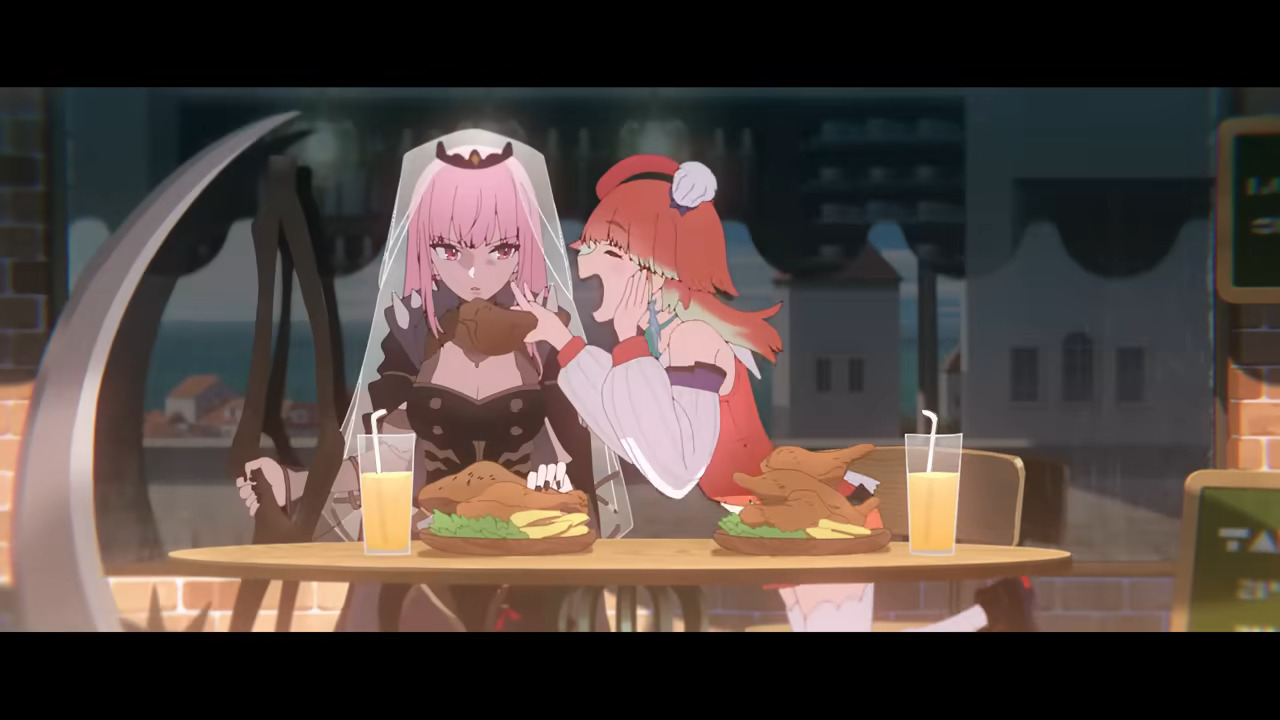
Similarly, the second Hololive Alternative teaser shows the two eating together. Kiara eagerly takes photos of everything (Calli included), and the reaper responds by grabbing her scythe and taking swipes at Kiara. The whole interaction describes the original basis for TakaMori to a tee.
The only problem: the nature of the pairing has changed over time. It still has fans, of course, and the two even recently had an in-person stream together that was made all the more impressive by the fact that one had to travel from Japan to Austria. However, both Kiara and Calli have talked about the fact that they decided to emphasize their solo identities more. The fans in the Youtube comments for that collaboration have remarked even on how the duo’s dynamic has changed (and arguably for the better).
Granted, this isn’t quite the same as a meme naturally morphing into something unrecognizable. The fact is, one can point to a conscious decision as the reason TakaMori isn’t quite the same as it used to be: a purposeful shift in direction. Nevertheless, it feel indicative of the rapid pace at which VTuber in-jokes are formed feels indicative of the general speed of the current internet. In contrast, elaborate animations—even short ones like the teasers for Hololive Alternative—take time to be made. In that gap, the ground shifted underneath TakaMori, and its depiction in animated form can feel like a relic of the past. In reality, it’s only been a little over a year, but the fact that a year sounds like forever in VTuber time makes that difference all the more stark. Online empires rise and fall in less time, and I have to wonder what else might end up coming across as a “yesteryear meme” by the time the next teaser is done.
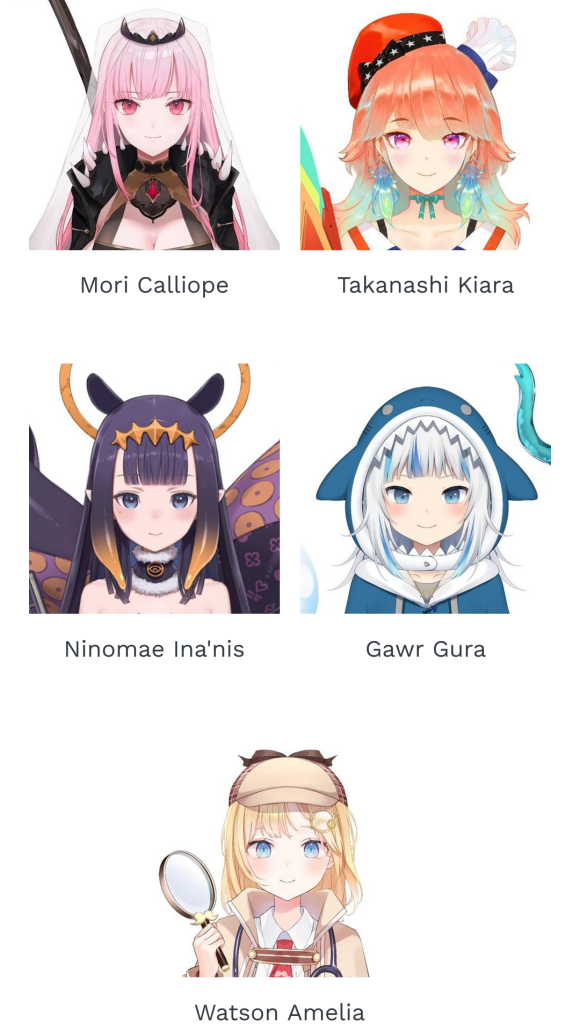
Virtual Youtubers continue to be a tour de force, reaching beyond Japan to worldwide recognition. Given this success, as well as the crossover appeal of certain English-fluent VTubers (such as Fujima Sakura, Pikamee, and Kiryu Coco), it was only a matter of time before one of the big VTubers agencies would try to make an active effort to court an English-speaking audience. Thus is born Hololive EN, and with it five new streamers.
The tricky thing with something like Hololive English is striking the right balance in terms of audience desire and accessibility. Speaking in the target demographic’s native tongue does wonders for directly engaging with viewers, and offers an experience closer to what the Japanese viewers typically enjoy. Rather than Inugami Korone’s amusing struggles with English, little gets lost in translation. However, it’s also possible that part of the appeal is the existence of a culture gap—that there’s an element of exoticism found in both the language barrier and the moe idol aesthetic. Veering too far in one direction might alienate certain fans.
The route that Hololive English appears to have taken is to feature VTubers with decent degrees of spoken Japanese fluency—enough to interact with the Japanese fans as well. Their true identities remain unknown (as is standard), so it’s unclear if they’re natively multilingual or if they achieved it through study, but the result either way is that there isn’t a complete disconnect with the Japanese origins of Hololive. The style of English seems to differ from one to the next, whether it’s the cutesy affectations of Gawr Gura or the more natural-sounding speech of Mori Calliope. I think this probably a good way to hedge their bets in terms of figuring out what will garner the most fans, though I don’t know how intentional that is.
While all of them are able to speak Japanese fairly well, written fluency varies significantly between the Hololive English members (unless it’s somehow all an act). Case in point, Takanashi Kiara’s language skills are very strong to the extent that she self-translates, Ninomae Ina’nis appears to have a solid handle, and Amelia Watson can struggle with the basics. Kiara’s advantage is obvious, but I think the ones who are less fluent actually have a certain appeal themselves. Not only do they resonate with those of us who grew up speaking our parents’ languages but never became properly literate, but they’re also relatable to those currently learning Japanese or who want to learn Japanese—no doubt a common occurrence among Virtual Youtuber fans.
For now, I don’t really have a favorite, but I wish all of them the best of luck. If they find success, I wonder if other Vtuber groups will push harder to have an active international presence.
This post is sponsored by Ogiue Maniax patron Johnny Trovato. You can request topics through the Patreon or by tipping $30 via ko-fi.