The Time of Retribution, Battle 2: Genshiken II, Chapter 63

Chapter 63 of Genshiken II is day 1 of Comic Festival, and some of the very best Genshiken chapters have been in that venue. This time around is no exception, and in fact it’s one of the most densely packed chapters ever in the manga. There’s a lot to go through, so let’s do a quick run-down first.

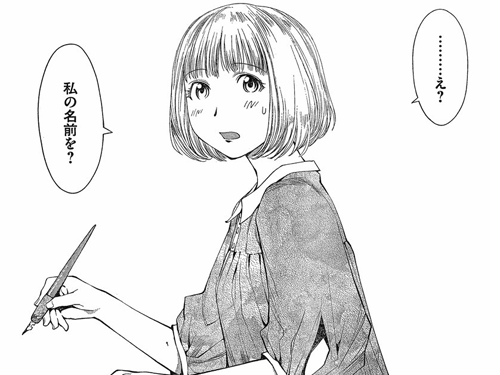
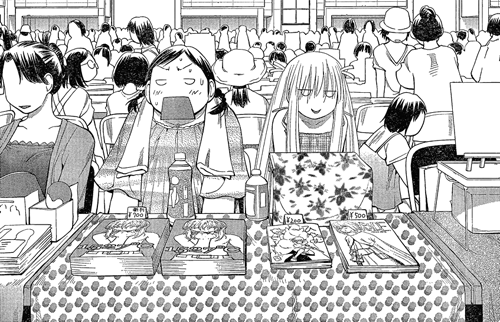
After finishing the second half of her debut professional work, Ogiue pulls an all-nighter to crank out an additional cheaper-quality doujinshi to complement her collaborative effort with Yabusaki. Unable to make it to Comic Festival before the afternoon, she sends Sue in her place, who naturally torments Yabusaki and gets along well with Asada the cat-faced girl, whose first name we discover is “Naoko” (We also get verification on pronunciation of at least the first half of Ogiue’s pen name: Ogino). As Comic Festival begins, a line begins to form at their table due to the popularity of Ogiue’s published manga, which leaves Yabusaki flustered.

I’m not sure if this is Yabusaki’s ComiFest debut or not, but it is Hato’s first time attending. This being Day 1 (the girl-oriented day), he crossplays as Yamada from Kujibiki Unbalance in order to make it less awkward for him to purchase his desired yaoi doujinshi, and in doing so continues the club tradition of Kujian cosplay. Managing to fool men and women alike, Hato ends up facing a dilemma when he’s confronted with having to hold up a large sign for the men’s bathroom, a situation he tries to avoid but is naturally inevitable. While Sue attacks from a fortified position through her signature obscure references (Kyuukyoku Choujin R), Angela brings the gaijin assault head on; when she’s not teaming up for a startlingly apt Panty & Stocking cosplay with Ohno, she’s grabbing Hato’s chest to verify his gender.

Ogiue meanwhile finally leaves her apartment, but at the same time over at Tokyo Big Sight, Nakajima, Ogiue’s old “friend” from her traumatic junior high days, visits Yabusaki’s table expecting Ogiue to be there, wherein the chapter ends on this cliffhanger.

Phew! And again, there’s still two more days of ComiFest left.

The last time Nakajima visited, it conjured up bad memories for Ogiue, who was already dealing with the inner turmoil of shame over her attraction to Sasahara and her fear of hurting him as she did her old boyfriend Makita back in junior high. Since then, Ogiue has learned to accept herself, start dating again, and has even turned her passion for drawing into a career, but when you think about it, she has still never directly confronted Nakajima. Prior to Genshiken II, we could only speculate as to whether or not this would ever happen. Now, short of meeting Makita again, this might very well be the true bookend to Ogiue’s growth over the course of the series, a way to decide her destiny, if you will. All of this has me giddy with anticipation, because while Genshiken II has been delivering so far, all of the fun and games make it easy to forget that this series also handles the dramatic incredibly well.

That’s not to say that the comedy of Genshiken needs to take a hike, as the chapter was hilarious and informative all-around. Hato’s plight is not one I can say I’ve experienced, but I can really feel for the poor guy. It’s interesting to remember that Hato drew a distinction in his mind between cosplay and crossdressing, and also to kind of compare it with Ohno’s own views on cosplaying, particularly that it’s wholly different from dressing sexily. There’s quite a bit of commonality between the two in this respect. And speaking of cosplay, I can’t help but to compare Ohno’s taste in older men to Stocking’s overall poor taste in men, as some would argue that the former is a case of the latter. I’ve also always seen Angela as being more sexually active than the other characters in Genshiken, though obviously not to the extent that Panty does. And if that weren’t enough, Ohno once remarked that her chest is bigger than Angela’s, a situation mirrored somewhat with the Anarchy sisters they’re cosplaying.

The chapter also reveals quite a bit about Sue’s development, specifically in regards to her growing language skills. When Sue first appears, she speaks purely in anime and manga quotes. When she makes her second visit to Japan, she shows that her listening comprehension has grown dramatically. By the time she began studying abroad at Shiiou University, her vocabulary had expanded to the point that she could communicate without the use of otaku references. Now, Sue takes the next step.

It’s not evident in English versions of the Genshiken manga (or at all in any of the anime), but one of the features of Sue’s Japanese is that it’s written primarily in katakana to represent her foreign accent. In this chapter though, some of that katakana has begun turning into hiragana, the script used primarily for non-loan words, indicating that her Japanese is reaching an even greater point of fluency. Personally speaking, I made my greatest strides in my Japanese language skills while studying in Japan, and to see the same happening with Sue brings a smile to my face.

And you wouldn’t believe how glad I am that Kio’s finally told us how to pronounce at least some of Ogiue’s pen name. I’ve even made the appropriate correction to her Fujoshi File.

In any case, I’m probably more stoked for the next chapter of Genshiken II than I’ve ever been. Comic Festival, it always delivers.

Cross Fight, Cross Fight: Genshiken II, Chapter 62

What was once fated to shine brightly for a few moments in the grand scheme of the universe now has been given new life, as Genshiken II has shed its limited-time status and has revived itself as a fully serialized title. That’s right, Genshiken is back in full force and I can only be pleased by the news. Almost as if to symbolize this new beginning for Genshiken, Chapter 62 feels almost like another introduction to the series and the madness contained therein. Let’s take a look.

As Angela returns for her third trip to Japan and Yabusaki puts the finishing touches on her Fullmetal Alchemist doujinshi, Ogiue is working frantically to complete the second half of her debut as a legit manga artist. Luckily she has the help of the current Genshiken freshman as well as Sue, but the whole situation begins to derail when Hato becomes self-conscious of the fact that his facial hair is growing in. Yajima suggests that Hato wouldn’t have this problem if he dressed like a guy, given that guys aren’t embarrassed by facial hair, but Hato has no men’s clothing with him. Fortunately(?), Ohno left everyone some cosplay outfits, but things get quickly out of hand and everyone ends up working on Ogiue’s manga while cosplaying.  Even Ogiue decides to join the “party” in an effort to take responsibility. The chapter ends with Yabusaki coming in to help Ogiue, only to lecture them for goofing off. Naturally, Ohno deeply regrets not being around for this rare occasion of cosplay goodwill.

So, this heavy chapter obviously has a ton of references, and it’s not exactly big on character development, so I think it’s a good idea to find out just who they all are. Some of them I got, some of them I needed to do some internet detective work. Here’s a list of the costumes worn by each Genshiken member.

Yajima: Yagyuu Juubee Mitsuyoshi, the rather large and voluptuous heroine of Sekiganjuu Mitsuyoshi.

Hato: Ashikaga Yuuki, the cross-dressing main character of the School Days sequel, Cross Days.

Yoshitake: Kurashita Tsukimi, the Jellyfish-obsessed protagonist of Kuragehime.

Sue: The titular character of Comic Master J, a super manga assistant.

Ogiue: Nakano Azusa, underclassman guitarist from K-ON!

The entirety of Ohno’s selection for Hato consists of crossdressing characters. Though I can’t recognize all of them, at least one of them is Maria from Mariaholic. Yajima’s outfit is arguably the most embarrassing, coming from a manga series by the character designer of badonkadonk resource Real Drive, but given Yajima’s personality that must have been the most conservative outfit of the bunch. It’s interesting that Ohno would see “overweight girl” and interpret that as “cosplay as thick ladies,” though it makes sense in retrospect. Yajima’s outfit this chapter shows that she’s actually quite busty, and much like when Ogiue first cosplayed way back when though, it kind of makes you aware of the fact that Yajima’s baggy clothes are partially the result of shame. How appropriate it is then that Yoshitake is dressed as a character with a similar dilemma.

Ogiue as Azusa of course makes it own kind of sense, especially when you factor in the fact that the girls of the light music club pushed Azusa towards the Azunyan cat motif somewhat resembles Ohno’s own constant persuasion of Ogiue into cosplay. In fact, Ohno can draw a number of parallels to K-ON!‘s Yamanaka Sawako.

Interestingly, everyone except Ogiue is dressed as a main character, despite the fact that Ogiue was pretty much the central focus of the second half of the original Genshiken. If I were to be somewhat liberal with my interpretation, I’d say that this is symbolic of the direction of Genshiken II, where the new girls are starting to establish themselves as the main stars of the new series. As I’ve said before though, I’m quite okay with this, despite my fondness for Ogiue, as it feeds into one of the themes of Genshiken, that of the continuous renewal of the club.

Looking forward, with Angela around, the chances of a Sue-centric chapter rise greatly. And in the spirit of Sue, we’ll end with a fourth-wall-breaking image.

I’m a Dreamer, Moeru Power: Genshiken II, Chapter 61

The newest chapter of Genshiken II hints at the most glorious team-up in otaku manga history. However, the antics of Battlehopkins and Double Asada are only for a few panels, and the real focus is split this time around between Ogiue’s precarious deadline juggling and Hato engaging in a Hato x Mada-themed thought exercise. This month’s theme is friendship!

Before we jump into the chapter though, I want to point out the next-chapter anime references that are at the end of each chapter. We’ve seen Occult Academy, K-ON!, and Heartcatch Precure, among others. This time it’s Jewelpet Tinkle. I didn’t even know that series had an otaku following.

Ogiue discusses her professional debut with Yabusaki, who is equal parts jealous and proud of her former enemy and current doujinshi collaborator. Ogiue’s challenge, as established a few chapters back, is to finish both the manuscript for her first published manga and the doujinshi she’s planning for Comic Festival (which we now know is Fullmetal Alchemist-themed), and though she has an insanely prolific work-rate (see her previous 80-page draft which she drew in about one night), it can be a double-edged sword; as we can see at the very end of the chapter, Ogiue can get so engrossed in her imagination that it can be difficult to put her professional responsibilities above her passions. I get the feeling Sasahara knows this better than anyone, which is why their unofficial editor-artist relationship can be so volatile.

During their discussion, Ogiue and Yabusaki speak in their respective Tohoku and Kansai dialects, which is nothing short of amazing. While Yabusaki does this all of the time, it is an incredibly rare case that we get to see Ogiue use Tohoku-ben out loud instead of just thinking in it, and I believe that this is the very first instance of Ogiue speaking in her native dialect for an extended conversation outside of flashbacks. I think this is a very important indication of not only how much more comfortable Ogiue has become with herself, but the extent to which Ogiue and Yabusaki get along now, even if their faces don’t show it. Ogiue doesn’t even use her Tohoku dialect in private with Sasahara! Her Tohoku talk, combined with her newer hairstyle, in a way reminds me of Heartcatch Precure, where we get to see girls change while discovering their true selves.

At the same time as Ogiue, Sue, Yabusaki, and Asada are talking art, Hato is taking respite from the heat in Madarame’s empty and air-conditioned apartment. Here, we get to see Hato’s gender-divided fantasy in action, as Hato the guy’s thoughts run practically parallel with Hato’s thoughts as a “fujoshi,” represented by an imaginary(?), naked, and decidedly feminine Hato floating nearby. Alternately called a Stand and an 801-chan among other things, Hato’s mind inhabits this unusual territory where he scrutinizes his own natural actions and provides a field day for psychologists of fictional characters. Hato turns out to be so tired that he ends up dozing off, and by the time he wakes up Madarame is already home. A potentially awkward situation to say the least, especially given Hato’s out-of-body musings.

Just as we were able to see a current Ogiue talking in her own dialect for an extended period for the first time in Genshiken, this is also the first time that Madarame gets to see Hato sans drag, but rather than making things more uncomfortable, Madarame just treats him as one of the guys. While sharing dinner, Hato brings up the fact that he does not consider himself to be homosexual, even though he likes BL as much as he does. Anticipating Madarame to react somehow, Madarame still doesn’t seem particularly fazed by this “revelation.”

Speculating as to why Madarame is able to take such a declaration in stride, I can only think that it’s because Madarame, as an otaku, knows the significant disparity that can exist between 2-D and 3-D. Ogiue is into yaoi, but she doesn’t expect Sasahara to be into other guys even when she uses him as “inspiration” for her own doujinshi. An even better example might be Madarame himself, whose taste in the erotic can skew a little young, and yet he finds himself in love with the very mature Kasukabe Saki. For that matter, Sasahara and Ogiue sometimes skew young in their preferences as well (young Ritsuko Kubel Kettengrad and Edward Elric, respectively), so I think the whole of Genshiken understands the divide well. Still, gender and sexuality is not the easiest of topics to talk about, and you might be surprised at how the complex lines of tolerance and understanding can fall within people’s own values.

Seeing how relaxed Madarame is being around Hato despite the possibility that an outsider observer (i.e. “herself”) could interpret all of this as fertile soil for romance, Hato can’t help but see Madarame as a weak bottom because of how open he leaves himself to “attack.” For some reason though, I feel like Hato’s logic behind the “hetare uke” Madarame “character” is different from Ogiue’s. I think Ogiue’s variant has more to do with how passive he is despite his passionate otaku outbursts and the like.

Speaking of Saki, Hato accidentally becomes aware of Madarame’s unrequited love, though Madarame himself is unaware that Hato knows. Maybe Hellsing creator Hirano Kouta is right after all and Madarame really is the most moe character in the series.

Wig Party: Genshiken II, Chapter 60

In my last chapter review, I predicted an Ogiue-centric chapter while also pointing out how Hato hasn’t gotten a chapter focused on himself yet but rather seemed to get a bit of focus and characterization every chapter.  Contrary to my expectations however, this latest chapter, despite taking place mainly in Ogiue’s apartment, is actually centered around Hato. Specifically, it reveals the truth as to why he cross-dresses, peeling away some of the enigma that is Hato Kenjirou.

Ogiue has a professional manga debut coming up and in order to meet her deadline she’s recruited Yajima, Yoshitake, and Hato. Yajima, who we know likes to draw, finds herself paling in comparison to Hato not just in looks but also in artistic talent. It also turns out that Hato has been gaining a reputation outside of the club as a mysterious brown-haired knockout who only seems to show up in the afternoon, and given the potential trouble that would-be suitors of Hato could bring, Yajima has to ask Hato once more: why the dresses?

Hato explains that he had kept his fondness for yaoi a secret all through high school, because if and when he revealed his status as a fudanshi, the “rotten boy” opposite the “fujoshi,” he surely would’ve been was persecuted by his peers. So upon entering college, he began cross-dressing mainly so that he could enter a club much like Genshiken and finally be able to talk with people who share his interests.

“Persecution.” The word lingers in Yajima’s head, and it makes her feel absolutely terrible for confronting Hato. While she can’t relate to Hato in terms of choice of attire, as an otaku it’s very likely that she knows the pain of being ridiculed or tormented by one’s peers all too well. Yajima decides to not press the issue at first, but then realizes that Hato’s response was only half an answer. Everyone there now knows why Hato started to cross-dress, but given that everyone in Genshiken knows his secret and his okay with the fact that he’s a fudanshi, it’s no longer necessary. So why does Hato continue to cross-dress?

He enjoys it.

He knows he looks good in it, and it helps to fuel his own fantasies, not necessarily in the sense that the cross-dressing itself is the kink, but that donning women’s clothing can give him the right frame of mind. Through it, Hato can see the possibilities, including pairing himself with Madarame, which also puts the last scene of the previous chapter in a whole new light: were Hato’s signals real or imagined by Madarame?

One significant reveal for me in this chapter is the fact that Hato self-identifies as a man. In planning future entries for the Fujoshi Files, Hato presented a bit of a problem, namely, how much of gender is biological and how much of it is social? Gender studies is not my specialty, and even among the Genshiken characters, you could see that different characters take different approaches: Yajima talks of Hato as if he were a man, while Ohno mainly refers to Hato in the feminine. As you can see as well, I’ve mainly gone with male pronouns when referring to Hato, but I ultimately decided that it would be based on his own personal preference.

So Hato’s crossdressing isn’t entirely the product of a tormented gender identity conflict, but it’s important to avoid thinking that Hato’s crossdressing is somehow less legitimate or even wrong just because it’s a little self-indulgent. Hato has a perfectly good reason to crossdress, and the way in which Genshiken presents his situation, with both serious and more lighthearted aspects, does not and should not lessen either side. Nor should Hato and Genshiken in turn make gender portrayals that are focused more in one direction (such as Wandering Son) necessarily less poignant or entertaining.

We also learn a little bit more about another character whose life rarely gets explored, as we discover that Kuchiki is that guy in more ways than one. He’s not only the guy so lacking in social skills that they became actively antagonistic, but that he’s also able to coast by in life because of nepotism. I wonder what his parents think of him?

I think that Genshiken II has been getting better and better at establishing the New Class as characters in their own right, and I don’t really mind seeing the club veterans step aside so that they can take center stage. It takes a theme already present in the original manga, that of people entering the club and leaving when they graduate to make room for new blood, and realizes it in a much bigger way. It makes me wonder how they would fare if this was the first Genshiken series ever, and we only knew the previous characters somewhat in passing.

Next chapter looks to be again about Hato, but I’ve been deceived in the past, so I’ll hold off making any big predictions until then. Sue didn’t talk too much in this chapter, so I wonder if Kio’s saving her up for something big. The last thing I want to talk about though is Ogiue (of course), and the way that Kio Shimoku has been inserting some some nostalgic references to Ogiue past. Ogiue’s inner thoughts entertain the proposal of Hato x Mada in Ogiue’s native Tohoku dialect, and when Ohno tries to start a cosplay party at Ogiue’s place we’re greeted with a familiar sight. Perhaps we could call this “Ogiue Abridged?”

Mysterious Madarame X: Genshiken II, Chapter 59

This month’s Genshiken II focuses on club alumnus Madarame. If you’re the kind of person who likes to pair anime characters up, then this chapter has a lot for you to chew on. Romance! Sort of.

Madarame has always been a fan-favorite, due in part to the fact that he seems the “Truest Nerd 4 Life” and thus the one closest to us. This is especially evident in his unrequited love for Kasukabe; sinking back into the recesses for fear of not ruining your friendship is the hallmark of the nerd with heartache, that “noble nerd” mindset with which many deceive themselves. I don’t know about you, but I’ve definitely felt that before, even if it wasn’t directed at any girl in particular.  So when Sasahara’s sister Keiko confronts Madarame about his feelings towards Saki in the tactless way that only Keiko can (as opposed to the tactless way only Sue can), Madarame gets taken for a psychological ride and we’re taken along with them.

Keiko, who has herself shown affections for the other half of the Kohsaka-Kasukabe Combination, makes it very clear that not only is she well aware of Madarame’s crush on Kasukabe, but that just about everyone else is too, possibly even including Saki herself. Of course, this comes as a complete shock to Madarame, who failed to realize that in his concerted efforts to minimize his longing gazes at Saki actually made his feelings completely obvious. Though this has very much to do with the fact that Madarame is such a huge dork, believing you’re subtle when you’re really not is a problem many guys have, and I can really empathize with him. Madarame has a track record of doing this, too. I mean, let’s not forget the “nose hair” incident.

By the way, I’m unsure of how popular it is among English-speaking fandom, but I know there’s a decent amount of Japanese Genshiken fans who are way into Madarame x Keiko (or Keiko x Madarame). I wonder if Kio Shimoku is aware of that?

Madarame and Keiko’s conversation never quite resolves. Sue walks in at an (in-) opportune moment, suggesting that not only do Sasahara and Keiko have more in common than expected, but that perhaps Sue is actually a cosmic being who takes strength from the meta-fabric of Genshiken itself, particularly in channeling Ogiue references. I hope that Sue gets her own dedicated chapter at some point in this run. Shifting character focus from chapter to chapter seems to be the direction of Genshiken II, so I think there’s a fair chance of it happening. Maybe Angela will make a brief return.

In any case, despite Sue’s interruption, Keiko leaves Madarame with a profound message: the only reason he can continue to spin in place is because he’s never had his heart broken. And again, if we look at Genshiken history, right there on-panel in the beach chapter was Keiko confronting an old boyfriend. Whether that bad outcome was the result of “heartbreak” or not is unclear, as is whether Keiko has truly given up on Kohsaka, but the comparison between then and now shows the kind of maturity that Keiko’s developed since we first saw her trying to wrangle money from her brother, incomplete as that maturity may be.

So while the chapter was Madarame-centric, Keiko also got a lot of development, or at least we see that she’s developed some since her last appearance.

Book-ending the chapter is Madarame’s interactions with Hato, who has been using Madarame’s apartment to change in and out of his feminine clothing. The impossibly attractive Hato is messing up Madarame’s wiring a bit, and even he can’t tell whether his friendliness with Hato is more of the male companionship he clearly misses from his club days or if it’s something else entirely (or possibly both). Again, for you shippers out there, I’m sure this chapter pleases Caesar. Interestingly, Hato himself seems to be getting the most consistent amounts of page time. I wonder if it just has to do with the fact that he is the biggest mystery of Genshiken.

Ogiue meanwhile is poised to make her published manga debut, and I am continually fascinated by her relationship with Sasahara, notably in the way they butt heads due to their respective professions of artist and editor, and how it ultimately results in better work. Ogiue’s experience with Sashara-as-editor, which we’ve seen ever since the last volume of Genshiken, is itself likely influenced by Kio Shimoku’s own time at Kodansha’s Monthly Afternoon, and seems to confirm Peepo Choo artist Felipe Smith’s own account of creating manga for sister Kodansha publication Morning Two. I’m also curious as to whether or not Sue stays over at Ogiue’s place often and interferes with Sasahara and Ogiue’s alone time, as the chapter seems to imply.

But the real story is that Ogiue’s manga schedule is conflicting with her Comic Festival schedule, and that seems to be the focus for the next chapter.  As you might expect, I’m looking forward to it quite a bit.

Ogiuevolution: Thoughts on Genshiken II

As the premiere Ogiue-themed blogger, I’ve had quite a few people asking me about my feelings on the all-new manga sequel to Genshiken, or as I like to call it, the “best surprise ever.” I have a lot of thoughts to lay down, so put on your hats and let’s go for a ride.

I recently picked up the second and final volume of Genshiken author Kio Shimoku’s child-raising manga Jigopuri (the first volume of which I reviewed), where I kind of expected to see the one-chapter continuation of Genshiken that fans generally refer to as “Chapter 56.” After all, the Kujibiki Unbalance manga featured additional Genshiken chapters, so I figured this was no different. As it turns out however, there was no Chapter 56 at the end of Jigopuri Volume 2, which left me kind of curious as to where the continued adventures of Chairman Ogiue would end up. Upon hearing the news of Genshiken II (alternately “Genshiken Nidaime” or “Genshiken the Second” to differentiate it from the second anime TV series, Genshiken 2), I realized that Chapter 56 would probably simply end up as the first chapter of the new series; all Kio has to do is change the chapter number from 56 to 1. It’s not the first time the chapter numbers have been modified in Genshiken, either. Volume 8 of Genshiken featured chapters which weren’t published for the initial run in Afternoon, and so the numbers were changed accordingly.

Whether or not Genshiken II is a response to Jigopuri‘s lack of success (as far as seinen manga goes, infants are a particularly unorthodox subject, and the way Kio handled it even less so) or an attempt to regain popularity, I think it’s clear that Kio doesn’t simply want to rehash the original formula even if it is a sequel. Just at the outset, there are two major differences between the new Genshiken club and the old. First, whereas the club back in Volume 1 of Genshiken was populated primarily by guys, five years of time have transformed it into one filled with mostly women, which is something probably no one expected from the club for years and years since its original founding. Second, Ogiue is at the helm, but her importance in this role isn’t simply that she’s their new fearless leader. She’s carrying the increased momentum set by Sasahara when he first became chairman and decided that the club should participate at the doujinshi event Comic Festival, and is taking it further by leading the charge with her own artistic skills and experience. These two aspects alone will provide plenty of differentiation from the previous series, and even if it is a bit of a cash grab, I think Kio will likely try to make it more than just that.

But then I hear people asking, “What if it’s too different?” In the original 2channel thread which revealed the news to the internet, a number of commenters voiced such concerns, talking about the different gender balance of characters, how the series appears to have become populated with moe harem character types, and simply that they could no longer relate to the series with its relative lack of “typical” otaku.  While I don’t agree with everything said, I can definitely see where they’re coming from. When you compare Chapter 1 with Chapter 56, it can feel like night and day even when you ignore the drastic art difference. It almost makes you feel like saying, “What happened to Genshiken?”

The answer is, chapters 2 through 55 “happened.”

While the themes of growth and change are much more prominent in the second half of the series, Genshiken has always featured them to some extent, right when Sasahara decides to check out the clubroom. Along the way, each new club member influenced the old ones and vice versa, with the final result being characters who are different from when they started, more confident about themselves and a little less worried about distinctions betwen otaku and non-otaku. So yes, the Modern Culture Society is no longer filled with anime fans who can’t talk with girls to save their lives, but it didn’t happen out of the blue, it isn’t unrealistic, and Genshiken isn’t a series with static characterization.

The more negative responses about Genshiken II seem to imply that success is less realitic than failure, that pain more of a truth than pleasure. While I simply cannot agree with that, it kind of puts things into perspective. Perhaps some of the fans feel that as the characters and the story of Genshiken progressed, they ended up outgrowing the fans themselves to the point that the series no longer felt like it spoke to them. But even then, I think that fans can still relate to the new cast of characters, regardless of gender differences, and it can feel just as close to home, if not closer. After all, I relate to Ogiue, and this is where it’s taken me.

Additional thoughts:

Of course, I recognize that at least three of these characters are entirely new, so they don’t have the same emotional attachment as the previous club members, but I say give them a chance. At the very least, I received a good impression from Yajima, Hato, and Yoshitake in Chapter 56, and remember that the old characters were once unfamiliar too.

If I were responsible for Kio Shimoku creating a new Genshiken spinoff, it would have to be Angela Burton’s American Anime Club.

As for the “harem” complaint, I think that’s just an exaggerated complaint about the mostly female cast.