The Fujoshi Files 107: Y

Name: Y
Aliases: Silver-chan (銀髪ちゃん), Camphorwood Editor (楠の編集者)
Relationship Status: Single
Origin: Humanity Has Declined

Information:
Y is responsible for helping to put together a monument to mankind, a task which never seems to move forward. While working, Y discovers the ancient technology of a printer+copier, working computers, and hard data of old manga and revives the notion of self-publishing among mankind when the original material runs out. Referring to these works as “douruishi,” Y becomes the leading producer of douruishi, particularly BL-themed material, through her circle “Camphorwood.”

Y is friends with the mediator between the human race and the current dominant species on Earth, the advanced-yet-naive fairies. Having met back in high school, Y correctly assessed the mediator as the only other sane person around, and even harbors some romantic feelings for her. It was also during that time that Y discovered her interest in BL, amassing a hidden collection of BL prose novels pilfered from the school library.

Fujoshi Level:
In addition to designing a complex method for hiding her collection back in high school and jump-starting the yaoi craze for a new generation, Y’s fujocity can also be seen in the way she tries to pair a chess pawn with a knight.

The Fujoshi Files 102: Student from Warm Watch Group

Name: N/A
Alias:
Student from Warm Watch Group (見守る会の生徒)
Relationship Status: 
N/A
Origin:
Mayo Chiki

Information:
This girl is a student of Roran Academy and a member of the “Subaru-sama Warm Watch Group,” a fan club for the butler of the Suzutsuki household and Roran student Konoe Subaru. Their group, comprised mostly of fujoshi, are in favor of Subaru’s friendship with a male classmate named Sakamichi Kinjirou, which puts them constantly and secretly at war with a rival group opposed to that relationship, “Shooting Star Subaru Sama,” aka S4. This member is one of the few in the Warm Watch Group other than their leader Narumi Nakuru to interact directly with Kinjirou.

Fujoshi Level:
After rescuing Kinjirou from an S4 member’s attack, she asks him if he is the “seme” (top) or the “uke” (bottom).

The Fujoshi Files 101: Narumi Nakuru

Name: Narumi, Nakuru (鳴海ナクル)
Alias:
Narunaru
Relationship Status:
Single
Origin:
Mayo Chiki

Information:
The cat-eared high school student at Roran Academy with an extreme fondness for glasses, Narumi will go as far as to dive out windows to save a pair. She, like many of the girl at her school, is a big fan of fellow student and butler Konoe Subaru, and is even the president of the “Subaru-sama Warm Watch Group,” one of two major Subaru fan factions in her school. The Warm Watch Group is constantly at odds with their rival group, S4 (Shooting Star Subaru Sama), though neither is aware that Subaru is actually a girl.

Narumi and the rest of the Warm Watch Group are mostly fujoshi, and thus support the friendship between Subaru and “his” male friend, Sakamachi Kinjirou. Narumi herself goes as far as to write BL novels starring thinly-veiled analogues of the two which are so lengthy that they require someone with superhuman strength to staple the pages together, and then acts out the scripts. Owing to the popularity of her doujinshi, she has a loyal fan club of her own.

Fujoshi Level:
Narumi once turned down a boy who had confessed to her, for the reason that she has dedicated her entire high school life to creating BL.

The Fujoshi Files 99: Shiina Mafuyu

Name: Shiina, Mafuyu (椎名 真冬)
Alias: N/A
Relationship Status: Single
Origin: Seitokai no Ichizon

Information:
Shiina Mafuyu is a shy and demure girl who often has her face buried in a video game. So addicted to video games is Mafuyu that she will bring multiple home consoles and portable systems with her on long trips. Though open to diverse genres, Mafuyu mainly plays visual novels, for which she creates internet guides.

Along with her older sister Minatsu, Mafuyu is a member of the Hekiyou Academy student council, voted in by her fellow students. There, Mafuyu participates in the idle discussions which characterize the student council, and has a tendency to pair the only male council member, Sugisaki Ken, with another male student named Nakameguro. She is also somewhat antagonistic towards Ken’s younger sister as the two have “overlapping characters.”

Fujoshi Level:
Mafuyu describes herself as “half-games, half-Boys Love.” She believes being able to fantasize about a pen and a pencil together is a fundamental skill.

The Fujoshi Files 95: Kondou Mayuka

Name: Kondou, Mayuka (近藤繭佳)
Alias:
Mr. X (ミスターX)
Relationship Status:
Single
Origin:
Onii-chan no Koto nanka Zenzen Suki Janain Dakarane!

Information:
Kondou Mayuka is a model high school student and class president who in contrast to her pristine reputation secretly goes out at night to buy BL magazines. When she accidentally bumps into her classmate Takanashi Shuusuke one evening while the two are on their respective porn runs, she winds up making Takanashi into her “pet,” an errand boy who has to buy BL for her in exchange for food and pats on the head. While she at first she keeps him around by way of threats, the two eventually develop an actual friendship.

Kondou is adept at cooking and studying. Her most noticeable feature is her black pantyhose, to the extent that she singlehandedly induces a black pantyhose fetish in Takanashi. Mayuka has feelings for Takanashi, though they appear to be tied to her fondness for yaoi and wish to see him in equally dire situations. Her alter ego, Mr. X, is her personal name for when she wishes to disguise herself and her fujoshi side.

Fujoshi Level:
The reason Mayuka turns Shuusuke into her errand boy is that while she desires more extreme yaoi titles she is too embarrassed to buy them on her own, showing that while her imagination is vast she has limits based in reality.

The Fujoshi Files 87: Akai Ringo

Name: Akai, Ringo (赤井林檎)
Alias: N/A
Relationship Status: Single
Origin: Okami-san & Her Seven Companions

Information:
Akai Ringo is a high school student at Otogi Academy in Otogibana City, where she works for the “Otogi Bank,” a school organization which helps with student requests in exchange for future favors. Patterned after Little Red Riding Hood and ending all of her sentences with the syllable “no,” Ringo exudes an image of youth and innocence. In reality, Ringo is a “rotten apple” with a cunning and manipulative personality, albeit loyal to her friends.

Ringo is best friends with her fellow Otogi Bank member, the wolf-like Ookami Ryouko, while supporting Ryouko’s burgeoning relationship with the timid Morino Ryoushi. Her feelings towards Ryouko are somewhat complex in that she would be very comfortable with a romantic relationship, but does not desire her normally otherwise. Ringo is also the half-sister of Shirayuki Himeno, a poor but beautiful fellow student who cares for seven younger siblings.

Fujoshi Level:
Akai once created a fictionalized movie where Ookami, Morino, and she fight the three terrorist Tonda brothers. The story called for the pig-like brothers to do possibly indescribable things to each other as the result of a penalty game.

The Aggressively Passive Protagonist

There’s a general trend I’ve been seeing with male anime protagonists from light novels, or more specifically anime adaptations of light novels. In many of these titles, the main characters tend towards having passivity as a defining trait, sometimes to the point of “aggressive passivity.” Not to be confused with someone who’s passive-aggressive, or even someone who’s mostly passive and occasionally active (like Shinji in the Evangelion TV series), the aggressively passive protagonist is someone whose passivity is almost a badge of honor, either in the form of a passive special ability, a self-image in which passivity practically defines them, or a reputation for passivity.

Let’s look at a brief list.

  • My Teen Romantic Comedy SNAFU: Hikigaya Hachiman persistently mentiones how the real world is harsh and unforgiving and how it’s best to kind of just coast through it with little ambition.
  • Mayo Chiki: Sakamichi Kintarou has the nickname of “Chicken Tarou,” indicating what a pushover he is, which he tries to fight.
  • A Certain Magical Index: Kamijou Touma, though not truly passive, operates on an extremely loose philosophy of “do the right thing, I guess.” In addition, his ability is a defensive one which neutralizes other superpowers.
  • Monogatari Series: Araragi Koyomi helps others out, but his abilities as a vampire mainly manifest in his ability to endure pain and injury, and even his method of active help comes across as essentially philosophically passive.
  • Ookami-san: Morino Ryoushi, Ookami’s partner, is someone who can only help fight from the shadows, as he fears direct confrontation.
  • Suzumiya Haruhi: Kyon, though he eventually enjoys it, starts off talking about how much he’d rather not be having strange and crazy adventures.

If you look, you’ll also find such characters in non-light novel anime. This is somewhat different from the classic milquetoast harem lead, whose averageness is taken as a way to make him the everyman and the avatar of the reader, because often-times with these aggressively passive characters a lot of time is spent talking about just how average they are and how being average/passive is the way to be.

I’m not sure why this is the case, but I suspect it may have something to do with the “herbivore men” concept that has taken hold in Japan. Herbivore men are defined as guys who shun the life of wealth, success, sex, and family, the classic symbols of masculinity, and embrace a more passive lifestyle which shirks society’s expectations. This trend gets tied to a number of things by those curious as to why it’s occurring, such as the poor Japanese economy driving down ambition towards employment, and it’s possible that the protagonists described above are a product of this environment, that the people reading (and perhaps even writing) these light novels and watching their anime adaptations also see the traditional path of Japanese men to be fraught with lies and deception.

Of course, in many of these cases, it’s not like the characters sit back and do nothing, but that passivity on some level becomes a part of their characters, either as something to be celebrated or something to be worked on. If anything, even the sampling of titles above speak towards a broad range of viewpoints as to what passivity is and whether or not it’s something to be embraced or to be worked on.

This trend is actually why I think Kirito in Sword Art Online has become such a popular hero for anime fans both male and female. It’s not that the aggressively passive hero is inherently bad, but that in this environment an aggressive protagonist stands out that much more. In SAO, Kirito is an extremely skilled fighter who helps the downtrodden, attracts women left and right, and has a powerful reputation among those inhabiting the world, while also being gentle, considerate, and devoted to those he loves. He becomes the exemplary light novel hero for those who’d rather not have a passive protagonist.

The Title is a Lie (Or Is it?): My Teen Romantic Comedy SNAFU

One of the most visibly obvious trends in anime in recent years is the extremely long and descriptive title. My Little Sister Can’t Be This Cute. Baka and Test: Summon the Beasts. More accurately, it’s the product of a tendency in the current light novel industry from which many anime are adapted, and with that verboseness comes a blessing of sorts. For those who want what a particular title has to offer, they need only look at the name, and for those who want to avoid specific shows at all costs it becomes equally useful. You can indeed judge these books by their covers to a certain extent, which is why I initially set aside My Teen Romantic Comedy SNAFU, considering it a low priority.

I have nothing against teen romantic comedies or SNAFUs, but the original Japanese title, Yahari Ore no Seishun Love Come ga Machigatteiru (translated also as, “My Youth Romantic Comedy is Wrong as I Expected”) seems to imply a lot of things which don’t exactly excite me. First, it seemed to hint at this strange cooler-than-school cynicism which you find in a lot of light novel protagonists that I find unappealing, a sort of counter-elitism of the same variety as “the geeks will inherit the Earth.” Second, even though it says the romantic comedy is “wrong,” it still implied some combination of harem/love triangle. When I finally got around to watching SNAFU, I realized I’d been wrong all along. While it contains some degree of the two elements I’ve described, it’s also a clever series which has at its core not so much a good ol’ harem comedy but a closer look at the combination of social and sef-perceptive tensions which can make life as a teenager mentally and emotionally taxing, especially for those who don’t quite fit in, and the help that can come from those who simply understand.

SNAFU centers around Hikigaya Hachiman, a cynical guy who quickly acknowledges how low on the social totem pole he is and how much he prefers to be there. Hikigaya is forced to join a club whose purpose is vaguely to help people out, acting as a last-ditch student-run guidance counseling of sorts. In the club, Hikigaya is joined by two girls with equally Stan Lee-esque names, Yukinoshita Yukino and Yuigahama Yui. Yukinoshita is extremely observant but a little too sharp-tongued for her own good, and Yuigahama is energetic and a little ditzy with a greater desire to try and fit in with her peers compared to the other two.

Just from my basic plot summary I think it’s easy to see why I was a bit wary (and potentially weary) of the show, but there are a number of things which give this anime some solid legs.

First, although Hikigaya is indeed quite the pessimist, and he does have the “screw the popular kids” attitude to an extent, he also shows that he’s aware of what he lacks. He knows that if you have the right attitude you can accomplish many things and reach out to a lot of people, but he doesn’t have that attitude and probaby never will. What his perspective does for him, however, is that it allows him to find people who are similar to him, and to figure out solutions that wouldn’t work for the “average” teenager, but are perfect for those who are below the bar. Similarly, Yukinoshita’s astute assessments make her able to understand a given social situation quickly, while Yuigahama’s propensity for tact and cheer becomes the grease to move the wheel where Hikigaya and Yukinoshita’s personalities would otherwise stifle it. SNAFU really does focus on the theme of helping people who feel ground down by the pressures of their social groups, and at places goes to some fairly dark (though not morbidly or horrifyingly dark) places.
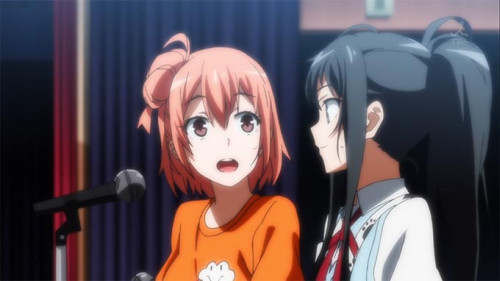
Second, even though there is a love triangle element to the main cast, with Yuigahama clearly having feelings for Hikigaya due to a small event in the past, and Yukinoshita can be seen as gradually developing feelings for him as well, the friendship between the two girls is just as if not more important than the romance. Yukinoshita has no friends, while Yuigahama would traditionally try to ingratiate herself with other girls just to not be caught outside the circle, and so their growing bond becomes an important factor in developing them. It’s to the extent that, even if the series ends with one “winning” over the other by dating Hikigaya, it is highly doubtful that it would destroy the friendship they’ve built up.

Third, when it come to determining who might indeed end up with Hikigaya, the show gives a fair case for both of them. It doesn’t come across as woefully lopsided like in, say, Love Hina. And actually, when you look at the hormonal responses Hikigaya has to those he finds attractive, the strongest reactions seeem to come not from any girl, but from the incredibly effeminate male tennis club member Totsuka Saika. I’m pretty sure this is just another case of a Hideyoshi from Baka Test, a character so feminine in appearance that we’re supposed to take it as a gag, though in this case I suspect he also functions as a way to show how much deeper the connection Hikigaya makes with either girl will be.

I honestly think that this series ended up with a name as excessively long as Yahari Ore no Seishun Love Come wa Machigatteiru because someone told the author that everybody’s doing it. As a title, it’s actually quite deceptive, and somewhat ironically doesn’t help a person looking at it to understand what’s beneath the cover. I don’t think it’ll start any trends of intentionally obtuse light novel names, but at the very least it gives hope that if you’re willing to squeeze that lump of coal hard enough that it might turn into a diamond after all.

No guarantees with any other shows though.

Comparing Manga with the Otaku Guy + Popular Girl Theme: Otaku Riajuu vs. 3D Kanojo

Recently I read two manga with very similar conceptions, I’ll Make You into an Otaku, So Make Me into a Riajuu and 3D Kanojo (also known as “Real Girl.”) Both are based on the concept of an otaku guy and a fashionable girl forming a friendship (or something more), but the messages they convey, at least from what little I’ve read, are significantly different. In particular, the way Otaku Riajuu handles its female lead is pretty embarrassing, and highlights a lot of things wrong with whatever mindset produced the story, and for which 3D Kanojo provides a better alternative.

First things first, there are some differences in the setup of each. Unlike 3D Kanojo, which is about the budding romance between the otaku guy and the fashionable girl, Otaku Riajuu is similar to Toradora! in that the two leads are at least initially trying to help each other to get together with someone else. Other similarities include the fact that the girl is tiny and feisty, much like Taiga. Toradora! is pretty great, so that’s not so bad in and of itself, but there’s more to it.

In Otaku Riajuu, the girl, Momo, has a reputation for sleeping around a lot. The guy, Naoki, upon becoming aware of this, basically wants nothing to do with her. He thinks of her as a “bitch” (in Japanese context, the term veers closer to “slut,” see Panty in Panty & Stocking with Garterbelt for a prime example), and therefore wants nothing to do with her. A pretty messed up opinion to be sure, but then when he find out she’s actually uncomfortable around guys and clearly can’t be the bed crusader the rumors make her out to be, then he gets along with her a lot better.

Think about it: Naoki doesn’t like her when he thinks she’s a slut, but when he finds out otherwise everything’s “okay.” I’m not one to throw out the term “slut-shaming” liberally, and in fact this is the first time in the history of the blog that I’ve even used it, but it is literally the main character looking at a girl with disdain for being sexually active. The fact that we’re supposed to think Naoki the poor closet otaku is a Good Guy for changing his opinion of her after he learns the truth makes it even worse.

3D Kanojo on the other hand establishes that its female lead, Iroha, actually does sleep with a lot of guys, but doesn’t make the concept itself an inherent minus other than the fact that she has to deal with a lot of angry former lovers. Here, although the male character Hikari, being an awkward otaku virgin, is uncomfortable with the way Iroha is, the series seems to be more about their budding romance both in spite of and because of their differences. Hikari is also a nice guy in that he tries to save Iroha from a couple of angry suitors and gets so nervous when she invites him to have sex that he ends up avoiding it, but it’s clear he sees her as a person neither in spite of or because she’s sexually active.

I think a lot of the reason for this difference is just the intended demographic. Otaku Riajuu is based on a light novel, and aims for that male otaku market. Although not always the case (and not something exclusively otaku or Japanese), a valuing of virginity and purity by way of moe aesthetic is very clear and obvious here, and the strange idea the manga has about what it means for a guy to be “nice” likely stems from this. 3D Kanojo however is a shoujo manga, and this can be seen in the male lead who has a smattering of “gentle, ideal boyfriend” in him. He’s awkward around girls, but that’s what makes his attempts at heroics all the more charming. It also goes a long way in explaining why Iroha is written in a more well-rounded manner.

I’ve only read a bit of each, so I can’t say for sure if my opinions of either title would change down the road, but for now I’d have to say that 3D Kanojo is clearly the better title. The differing approaches to the popular girl character used by it and Otaku Riajuu do not form the entirety of my reasoning for recommending one over the other, but I think they give a good indication anyway.

The Fujoshi Files 70: Shiguma Rika

Name: Shiguma, Rika (志熊理科)
Alias:
N/A
Relationship Status:
Single
Origin:
Boku wa Tomodachi ga Sukunai!

Information:
Ostensibly a high school student at St. Chronica Academy, Shiguma Rika is a technological genius who performs her own independent research as her “curriculum” away from other classmates. Possessing poor social skills and an eccentric personality, Rika is a member of the “Neighbors Club,” a club secretly devoted to helping people become better at making friends.

Rika possesses a dirty mind, and is eager to turn almost anything anyone says into a sexual innuendo, specially when it comes to her fellow club member, Hasegawa Kodaka. In spite of a massive yaoi collection, Shiguma has never actually been to a Comic Market, owing to a sense of fear and discomfort towards large crowds. Rika once spoke of never having “kissed a mammal” before, and owns a video collection of invertebrate mating.

Fujoshi Level:
Rather than being a simple fujoshi, Shiguma Rika is more of an overall pervert. Her favorite titles are not simply yaoi-themed, but ones where giant robots engage in intercourse, described through creative visual metaphors.