
NOTE: This is the second of my paid posts, where I have been asked to discuss the use of anime character mascots to promote a certain service, company, or idea. As stated in my previous entry, I have not used the products in question, and can neither endorse or turn people away from them. Rather, I am writing to go in depth on the use of anime mascots, and to help spotlight the idea of their usage in general.
—
11 years ago, I made my first trip to Japan to study abroad. As I walked through the downtown area of my city for the first time, I noticed a branch of Mizuho Bank, the oldest bank in Japan. However, it wasn’t anything lofty like history that made Mizuho Bank stand out to me. Rather, it was the simple fact that it shared a name with Kazami Mizuho, the teacher from Onegai Teacher.
Because I was merely an exchange student, I didn’t open up a Japanese bank account, but I know I would have entertained the notion of going with Mizuho Bank just because of that tenuous anime connection. As an aside, it’s that sort of thinking that made me realize that I was most certainly an “otaku” by even the strictest of definitions.

Are enough people of a similar mind? Would they base their financial choices on a love of anime and its characters beyond simply spending money on merchandise? The creation of Card Loan Girls, a site dedicated to introducing different types of credit card loans in the form of anime girls, contends that this is more than a mere possibility.
While Hikkoshi More goes with a simpler and less flashy design for its mascots, Card Loan Girls is straight up “anime as hell.” The girls emphasize cute elements with character designs that wouldn’t be out of place in a light novel or visual novel, and are knee-deep in their emphasis on kyara: a focus on character design that tries to convey a sense of liveliness purely through visual presentation.
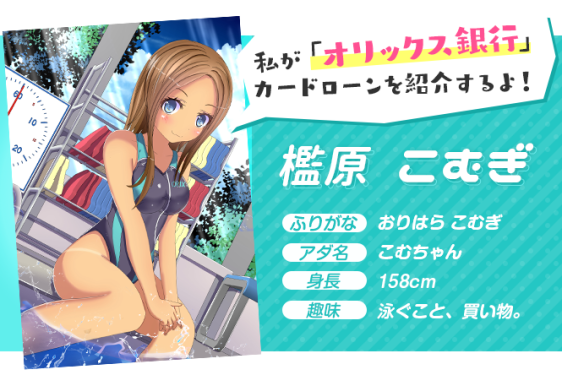
Orix Bank’s Orihara Komugi
What’s notable about the Card Loan Girls is that they all represent real banks. From Orix (sponsor of the Orix Buffaloes baseball team) to Mobit, actual companies are behind this. Sure enough, Mizuho Bank is there too. Despite my expectations, its mascot is not an attractive teacher but instead a petite student named Kingami Eira who looks something like a cat girl or fox spirit.
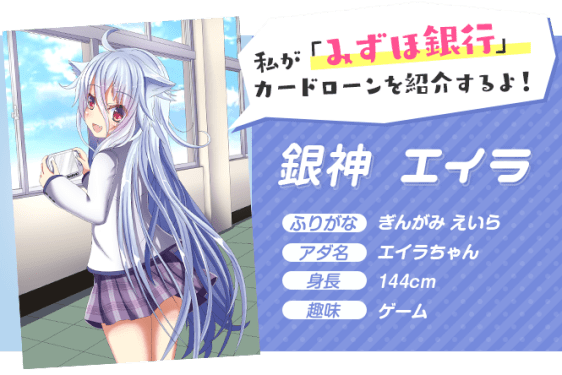
Mizuho Bank’s Kingami Eira
I believe that Eira’s design is supposed to invoke some kind of old spirit to go in line with the fact that Mizuho Bank is Japan’s oldest bank, and in that respect it certainly got my attention. I mean, I didn’t even know that factoid about Mizuho until I clicked on Eira’s profile page. There are many other bits of trivia throughout the site, and it potentially inspires people to learn about these banks in a manner similar to how Hetalia fans really delve deep into history. In many cases, these sorts of cute girls-as-things media franchises/campaigns try to incorporate and interpret as much actual detail into the characters’ designs (like larger guns equaling larger chests in Kantai Collection), but I simply don’t know enough about Japanese banks to actually figure that out.
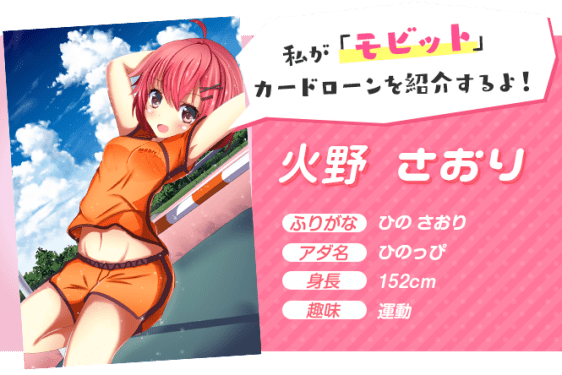
Mobit’s Hino Saori
As for the credit card loan information itself, Card Loan Girls doesn’t appear to be pushing any one bank over the others. Each girl is accompanied with a long list of important information, such as who can borrow and what the interest rates are. While Mobit’s Hino Saori is the most popular according to the site, I can’t say for sure why that’s the case. Are people voting for her because they think Mobit offers the best loans, or are they attracted to her tomboy design? Given the strength of anime mascot marketing in Japan, I think it’s probably more the latter, but the fact that Saori represents an online-only loan company that seems perfect for today’s modern otaku might mean it’s actually a mix of the two worlds.
I’d like to end with a couple of questions. For those living in Japan, would you pick your credit card loan based on Card Loan Girls? For those living elsewhere, what do you think of the idea of having something as far from entertainment as possible as a loan being anthropomorphized into cute young girls? Is it the kind of marketing you can get behind, or is it perhaps a step too far?


 OGIUE MANIAX