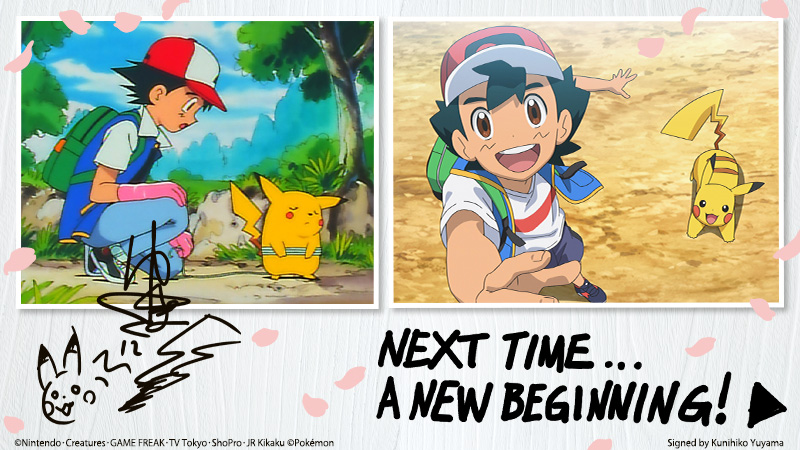
Pallet Cleanser: The End of Ash Ketchum as Pokemon Protagonist

This past week marked one of anime’s biggest departures ever, as Ash Ketchum—aka Satoshi—has ended his 26-year tenure as the main hero of Pokemon. It’s amazing to think about how the character has been such an enduring presence in the lives of millions of people for over two decades, all without being wholly remade and revised. Other heroes in other franchises might arguably have greater legacies, but the fact that it was consistently the same Ash week in and week out makes for one fascinating and continuous chain of history.

It’s been many, many years since I was actively part of the Pokemon fandom. I naturally didn’t know about it when it first came out in Japan, but for all practical purposes I was there from the beginning. I remember getting a little pamphlet about Pokemon in an issue of Nintendo Power, and as I anticipated its arrival, I managed to even catch the sneak peek “Battle Aboard the St. Anne” episode that aired the week before the first episode aired in the US. For maybe five or more years, I would record every episode on VHS, and the times I had to program the VCR, I tried to time breaks in the recording to preserve space so I could fit more on each tape. I’ve long since stopped doing that, or watch Pokemon on a regular basis, but I can never forget those early days.

Ash was never my favorite Pokemon character, and for the fellow fans I interacted with online, it was largely the same. The reason: a lot of the people I talked to I met either through the competitive scene (years before the founding of Smogon) or via a Team Rocket messageboard. In the former case, people were not fans of Ash’s nonsensical battles or inability to understand the type chart despite his successes. In the latter, it’s because a site dedicated to Team Rocket would naturally run ever-so-slightly edgy and prefer older characters. For me, it’s just because he was a pretty decent but generic kids’ anime protagonist—a plain rice ball (or donut, as it were) in a world of more compelling stories. 

But there‘s something special about being that hero for so many people for so long. And while many of his accomplishments were often tied to meta events (e.g. Gary Oak/Shigeru’s Japanese voice actor leaving the show is why they ended up having their big 6v6 clash in the Johto Pokemon League), the sheer amount of things Ash managed to achieve is impressive. A character who could have gone on forever unchanging still leaves behind one hell of a CV. 

A big factor in why there was a sense of progress with Ash was because of the way he would go from one region to the next in accordance with game sequels. While the basic formula of “meet new friends, have adventures, get gym badges” was always present, he never stayed in the same area for long, and he always met new people. And while fans would often remark on the way his skill and knowledge would seemingly go backwards every time he started a new path to a Pokemon League, it’s clear that his inability to retain knowledge is not necessarily a matter of poor character writing or insufficient lore consistency and more a way to keep him level with the new fans who still come to the series even now. Ash is as much a vessel as he is a protagonist, and he could never be a vessel for everyone at the same time.

One thing I always found funny is the fact that some of Ash’s greatest wins and titles came about in “filler arcs,” the seasons that took place between main-game storylines. This is why he’s the Orange League champion, the Frontier Champion, and most recently the winner of the Masters Eight tournament (solidifying him as the strongest trainer in the world). He also won the Galar Pokemon League, but in hindsight, it’s clearly because they knew they were about to start winding down Ash’s story and they wanted to show much he had grown. I remember thinking, all the way back in the late 90s, about how a main-line gold medal would likely someday be the sign that Pokemon was going to conclude. While the anime will continue with new leads, it really is the end of an era. 

Now the perennial 10-year-old gets to go off and do things unseen, and it makes me wonder if we’ll ever see him again. Might Ash make cameo appearances down the road, and will he look different or even possibly…older? It’s a new and unknown world.

Ash Ketchum and the Case of Filler Arc Character Growth

Ash Ketchum (Satoshi in Japan) is an ageless character. Whether it’s 1998 or 2017, Ash will always be 10 years old, will always be traveling with Pikachu, and will always be just not quite good enough to win a major championship. When he’s fighting through Kanto or Kalos, he won’t dominate the competition with his massively powerful Pikachu, and he’s perpetually more of a learner than a master in spite of his experience. It makes sense, because that’s how his character’s supposed to be. When he points his Pokedex at the same Pokemon for the 10th time in 10 years, it’s not because he’s supposed to be dumb but rather for the sake of a young audience who might be watching Pokemon for the first time.

Ash doesn’t always act as the impetuous rookie, and at times he’s allowed to shine as the battle-hardened veteran. Curiously, however, these mainly come when the Pokemon anime is not trying to go through its main narrative. During the filler arc that was the Orange Islands (taking place between the first and second generations of games), Ash was allowed to have a 6 on 6 battle and even defeat the Orange Islands champion. When Ash was participating in the Battle Frontier, post-game content within the context of the games, he would call upon his entire previous roster. The opening video during that arc reflected the full range of Ash’s experience by showing every Pokemon at his disposal (and even cameos by ones since released such as Butterfree). Ash eventually won the Battle Frontier, again showing how strong he was, but only within the between-games storylines.

Perhaps the biggest exception to this rule was when Ash finally got to face Gary in a full on 6-on-6 battle in the Johto League finals. The context behind this was that Gary’s Japanese actor was taking on less of a role in the series so they wanted him to go out with a bang and they succeeded. Just like his eventual Battle Frontier victory, Ash was allowed to show just how much he had learned over the years, at least for one climactic confrontation. It reminds me of how the Archie Sonic the Hedgehog comics kept running even during the years-long lull of no new Sonic games, and it was during those times that they dared to go as far as killing Dr. Robotnik. To a lesser extent, it makes me think of how during the infamous Naruto year-long filler arc, characters such as Hinata were allowed to get new techniques and grow more powerful.

I find Ash’s situation this interesting because it reflects both the realities of making an anime based on an wildly popular game and a desire to provide continuity or growth when the opportunity arises. Ash has to be eternally youthful, yet his viewers grow up and remember all of his adventures. The anime’s creators likely also have to mindful of the source material, especially as the series has grown to such international success (the earliest seasons played rather fast and loose with the rules).

What do you think of this balance? Do you wish Ash could be 20 years old by now, training atop a mountain like Red in Pokemon Gold, Silver, & Crystal?

Why Are They Making Ash Ketchum’s Eyes So Huge? I’ll Tell You!

In anticipation of the latest Pokemon Black & White games, the anime of Pokemon is undergoing a revamp, and with this newest iteration comes a great amount of aesthetic change for a series which has up to this point remained fairly static in that regard (or at the very least has experienced change so gradual as to be unnoticeable). Many long-time characters are undergoing design changes, but perhaps the most prominent is that of main character Satoshi, possibly better known as Ash Ketchum, whose irises appear to have doubled in size.

Around the internet, people have been wondering what could possibly be the catalyst for this change. The truth lies with the character designer for the Pokemon games, Sugimori Ken.

Sugimori was the original Pokemon artist, drawing up all 151 of the originals as well as all of the character artwork. Even now he remains in that position, with his works being the official depictions of all humans and Pokemon in the franchise. Essentially, this means that Sugimori has been drawing for Pokemon for 15 years now, and his artistic sense and style have grown accordingly. Whereas the designs for the anime originally drew inspiration largely from Sugimori’s original designs for the first generation of Pokemon games and have remained fairly constant since, Sugimori’s own artwork has gone through a one and a half decade process of refinement.

Left: 1995-1998, Right: 2010

When you look at the anime’s new character designs, you can see that they are simply re-aligning themselves with Sugimori’s work.

So in a way, the artwork for the Pokemon anime is pretty much ending up where it should be.

Nanto Ho-oh Ken