
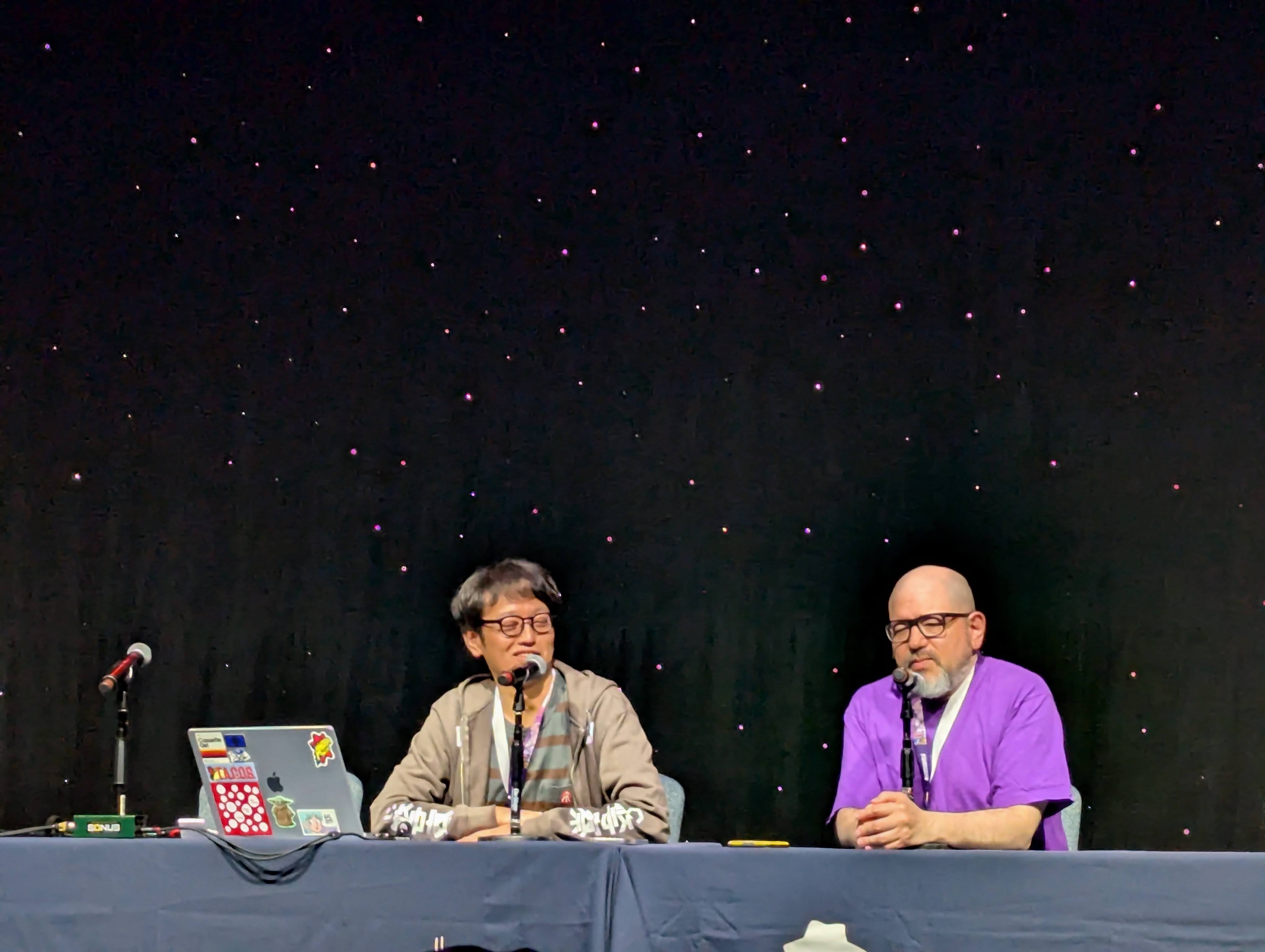
At Anime Central, I attended the panel for Kobayashi Hiroyasu, CGI Director at Studio Khara, and I learned a lot.
Kobayashi has worked on titles such as the Rebuild of Evangelion films and Gundam GQuuuuuuX, but until I came to this panel, I didn’t have a good sense of what his job was. While one might imagine a CGI Director as a person in charge of 3D animation or models, his job along with the rest of the digital production team is to create assets and enhance scenes by adding details and intricacies so that the final product has the right character and feel. Along with translator Dan Kanemitsu (who is on the right in the photo above, and who also works for Khara), they described how one thing that sets Khara as a studio apart is the accumulation of small details.
Some examples of his work include the following.
- Superimposed staff credits and lightning effects in the GquuuuuuX opening.
- Monitors, logos, etc in Rebuild of Evangelion.
- Superimposed textures like decals on model kits.
- Making a scene better by adding a mesh walkway onto the floor.
- Making things look dingier.
- Dan Kanemitsu also mentioned that he’s charged with finding English assets to avoid “Engrish” issues.
Kobayashi also mentioned that sometimes, they’ll put in a bunch of work into a really nice and detailed background, and then it’ll be almost entirely obscured by extra graphics in the final product.
They also provided a lot of information about what it’s like working for Director Anno Hideaki.
- Anno Hideaki used to add details in sharpie to cels, but now that’s Kobayashi’s job to do it digitally.
- That attention to little details is characteristic of Anno.
- Kobayashi and Kanemitsu told a story about how Anno sent them a post-it note with a message about adding locking holes to a scene similar to the ones used on aircraft carriers to anchor the planes. Anno thought it would be an easy copy/paste job but they actually had to create a locking hole model in CG to get the perspective right.
- Anno generally wanted all monitor graphics to convey what is going on, which made their job harder. For example, in a scene depicting massive needles injecting EVA-02, they changed it so that the monitors showed the injected liquids going through the EVA’s entire body.
- The glittery, shimmering water one used to often see in anime back in the cel animation days is called backlighting cel, and it was something Anno was especially good at. They wanted to recreate that feel for digital animation.
They also talked about working with Director Tsurumaki Kazuya on GQuuuuuuX.
- Tsurumaki wants everyday life in GQuuuuuuX to resemble modern real life, which is reflected in the choice of cell phones and other details.
- Spattering is an art technique used in the original Gundam, and the’re incorporating it into GQuuuuuuX as well.
- The colony Side 6 is a facsimile of current Japan mixed with other cultures
- In the world of GquuuuuuX, Anaheim Electronics is a glorified appliance maker.
- Trains are primarily Tokyo style, but the station names take from different cultures.
- On the subway maps, the stations have very different names. There’s a lot of British station names, and this might be because Tsurumaki is a big fan of British soccer.
- A particular green subway line is a representation of Tsurumaki’s old defunct train route from his home.
- The police wear uniforms that say “Military Police” in Japanese, but just “Police” in English because the director wanted signage to be readable at a glance.
- There’s a travel book that purposely replicates a series of guides called How to Walk the Earth.
- Stickers on a particular laptop are from drag racing in current day Tokyo.
- A box of tangerines alludes to a tangerine box that Tem Ray was using in the original Gundam.
- The activation key common to mobile suits resembles the Tem Ray circuit, which was a piece of junk in the old series.
- Kanemitsu was asked to come up with elements to make Pomeranians trading card more MLB-ey
- Saturn Doughnuts: “I told you I don’t like sour stuff” is a reference to FLCL.
Overall, I came away with an appreciation for another aspect of working in animation, and I hope I can convey that feeling to everyone reading this.


 OGIUE MANIAX