Kio is going to have an artbook! (I wonder if this is why he’s been posting high-quality images of his old art over the past year or so.) More details here.
He wondered when would be the right time to release the book, and reflects on the fact that it’s been 30 years since he started his manga career.
Kio has a color illustration job deadline coming up, so he’s been plugging away at it little by little. He thinks he can finish in time. That said, he has a lot of other work due the week after. It also means he can’t work on his ero manga.
Terry and Mai from Fatal Fury will be in Street Fighter 6. Kio is surprised at the news. One commenter says they’re looking forward to seeing Sue in SF in 15 years, to which Kio says maybe in 30.
It turns out this drawing from last month is for the cover to the artbook! It’s one of his characters from an older work (I think the Yonensei/Gonensei series?).
Kio bought all of the original Oblivion Battery manga out, only to find out that it doesn’t progress as quickly as the anime. Now, he wishes he stuck with just the anime.
There’s a Yasuhiko Yoshikazu and Koizumi Yuu exhibit titled “Modern Japan and Russia/Soviet.” Kio couldn’t go the previous day but has decided to check it out.
While waiting for a Pre-DLC Elden Ring update to download, Kio works on his ero manga and gets a page done. He’s also wondering how the hell he’s listening to an audio book of Buddha’s Teachings while working on said 18+ comic,
Otomo Katushiro is releasing an album called Akira Remix. The Otomo recent cel exhibition was playing music from it, and Kio remembers going to the exhibition and hearing the music the whole time.
Street Fighter 6 has succeeded in its goal of bringing in new players through a simplified control scheme labeled “Modern.” The signature special inputs that Street Fighter pioneered are basically replaced by one-button inputs and cardinal directions, with the caveat that damage dealt is reduced by 1/5. The Modern control scheme has also spiced up discussion in the community as competitive players try to figure out if having your most powerful moves be instantaneous is a worthwhile tradeoff for having fewer options overall. But this is not the first time fighting games have included easier inputs, and I think it’s interesting to see how past games have tried to incorporate more accessible control schemes.
In the GameCube Capcom vs. SNKEO and the 3DS Street Fighter IV, the advantages their shortcuts provide is tremendous. The only thing that kept them at bay is that they were not the “main” tournament versions; if they were, high-level play would be fundamentally worse because the characters were simply not balanced with instant specials and such in mind.
Another approach comes from Granblue Fantasy Versus. In that game, players have simultaneous access to both traditional specials and simplified ones (on a cooldown timer), with the expectation that stronger players will use the former and newbies the latter. In actuality, competitive players use both, recognizing that faster inputs are more reliable in certain situations.
Then there’s Super Smash Bros., a game franchise built around more simplified controls. When traditional 2D fighter characters became playable, the big question was how they would be incorporated into the Smash system. The answer, it turns out, was to allow everything—you can use Smash-style special inputs and classic fighting game motions, the latter rewarding the player with greater damage and KO power. However, no Ryu, Ken, or Terry Bogard players worth their salt play a primarily “Modern”-esque style. And unlike Granblue, the simplified versions are only ever used when recovering offstage.
This is because the aforementioned distinction between damage and KO power is an important part of Smash. In SF6, your Shoryuken taking a bit less off might just mean you need to land one additional hit. In Smash Ultimate, it might mean not being able to finish off the opponent at all. The fighting-game characters are balanced around their ability to take stocks relatively early through their “true” specials, as they’re called by the community.
The saving grace of SF6’s Modern controls is probably the fact that they’re part of the game from the very beginning, and they make players feel powerful without going overboard. Unlike some games, you cannot have your cake and eat it too with respect to accessing both modes, and Modern comes with drawbacks that feel neither ineffectual nor overly harsh. Efficacy seems to vary from character to character, and players have to be cognizant of what they give up to obtain instant specials and supers—advantages the opponent can know about and play around. I expect them to be a staple of Street Fighter going forward, and are one big step in helping to chase the elusive specter of accessibility all while maintaining competitive integrity.
When I was playing Splatoon 3, I would do something that I barely attempted in previous games: try out as many weapons as I could to get a feel for them. Because upping a weapon’s “Freshness Rating” is how you get tickets to obtain other weapons, it’s both a welcome system and an opportunity to experiment. Combined with the forgiving leniency of Open Anarchy Battles, and I could even do so without worrying that it’d tank my rating.
This relates to a topic I always find fascinating: How people figure out what “feels right” for them and why. It extends to just about any game where players have the freedom to choose their tools. The considerations one makes about skill level, comfort, satisfaction, community consensus on what’s strong and weak, etc. all factor in.
And then there are all the attempts to help people figure out where they are. The famous Magic: The Gathering psychographic profiles, i.e. Timmy, Johnny, and Spike, are meant to be broad categories to designate how different cards appeal to different players. YouTubers create videos to help anyone who’s unsure of what weapons work for them in various shooters. Fighting games like Guilty Gear STRIVEand Street Fighter 6 now include in-game basic descriptions of how characters play so that newcomers can more quickly pick the archetype that appeals to them.
I think what fascinates me in particular about the whole “trying to find what fits you” aspect of multiplayer video games is that just because something is the “best” doesn’t mean it’s right for you. The example that immediately comes to my mind is the Smash Ultimate player, MKLeo. Despite Pyra and Mythra being widely considered a top tier character, they don’t quite click with MKLeo’s play style for some reason, and he’s actually gotten better results with the theoretically weaker Byleth. Even a player who had been undisputed #1 for years, can’t automatically go with the “superior” choice.
I love to watch videos discussing choice of weapon or character. I love discussions about it, salt and all, even in games I don’t actually play! I think it’s the way these choices are conduits for personal expression, and it’s what makes games beautiful.
WARNING: SPOILERS FOR SPIDER-MAN: ACROSS THE SPIDER-VERSE (and I guess Street Fighter 6?)
I’ve had the pleasure lately of experiencing two of the finest works of media this year: Street Fighter 6 and Spider-Man: Across the Spider-Verse. Both are at the pinnacle of their respective genres (fighting games and superhero movies) and seem to draw all the right lessons from the past. But one thing both titles really have in common—and which I think is so indicative of their approach—is strong character designs that are profoundly respectful of their casts’ diversity in terms of culture, background, and circumstances.
The idea of an international roster far predates both works and even their respective origin points, i.e. Street Fighter the arcade game and the Spider-Man comics. Often, these past portrayals end up being flawed, if well-intentioned. Be it a manga like Kinnikuman featuring heroic wrestlers built entirely on stereotypes or having the brilliant detective Charlie Chan played by an actor in yellowface, it’s historically a mixed bag. These instances frequently betray a lack of exposure to other cultures by ones that consider themselves the default.
SF6 and AtSV know that their audiences aren’t limited mainly to one ethnic group anymore, and either have people from more diverse cultures on staff, or at least people eager to listen to people from other groups. Both SF6 and AtSV had to meet the challenge of revamping many existing designs—the former because many returning characters are supposed to be older, and the latter because it draws from so many different portrayals of Spider-Man. In this regard, both succeed in spades.
Here are a few examples:
In SF6, Chun-Li’s update conveys through her mannerisms and outfit that she has matured while still being undoubtedly recognizable as the queen of fighting games. Her clothes draw directly from Chinese culture without bordering on parody, and some of her animations have been changed to draw from actual Chinese kung fu styles. Her new standing medium kick, for example, is actually the Separation Kick from tai chi.
Zangief still looks like a hulking wrestler, but they actually changed his body type. In previous games, Zangief has more of a body builder’s physique—extremely chiseled all around—but in SF6, he exchanges that appearance for one with a bit more fat around his massive muscles. In other words, he looks more like he trains for practical strength, and the fact that the developers did this actually goes a decent way in diversifying the bodies in the game while remaining true to Zangief’s character.
Similarly, AtSV had Pavitr Prabhakar, an Indian Spider-Man whose costume feel less like symbols of India added to Spider-Man and more like what a Spider-themed superhero might look like if they grew organically out of Indian culture. Moreover, the writers of AtSV actually consulted with Indian and Indian American writers as well as Pavitr’s voice actor, Karan Soni, because they wanted greater cultural specificity and authenticity.
And even with all of this consideration for ethnicity, gender, sexuality, etc., all these characters are attractive in their own right. People like to see good-looking characters, but there’s no one standard of beauty. Both creative teams seem to understand that.
A major factor in both works’ success is starting from the understanding that not just one group of people are going to enjoy it. Kimberly Jackson in SF6 is black and one of the three most prominent heroes, and the only one with a story that ties directly to the main antagonist. The protagonist of the Spider-Verse movies, Miles Morales, is Black and Puerto Rican—and he reflects many of the aspirations and anxieties of those who grow up in non-White households in the US.
It can be easy to forget that the first Miles Morales film, Into the Spider-Verse, came out in 2018—before the murder of George Floyd and the increased mainstream awareness of the deeply rooted problems with police in the US. In 2023, however, I couldn’t help but notice the views expressed on that topic in AtSV. Both Miles and another character, the Spider-Woman Gwen Stacy, have dads who are on the force. They’re officers of the law who honor and respect the people, and having them be positive role models is part of the Spider-Man lore, but making the police and unalloyed good would never be compatible with the lived experience of so many black and brown people, not to mention other groups.
At one point, Stacy (a white girl) outright states that the reason her dad took on the role of captain is because he would inevitably be replaced by someone worse than him. In other words, contrary to the idea that cops like the one who murdered George Floyd are simply “bad apples,” it is the tree itself that is rotten, and the occasional good apple is the exception rather than the rule. While perhaps the film could have stated it more directly, it goes to show just how much AtSV is trying to express perspectives beyond what is comfortable.
The greatest strength of Street Fighter 6 and Across the Spider-Verse is that both works come across as genuinely wanting to engage with as many cultures as possible from all sides. They’re not just paying lip service to the notion of diversity but actually making it happen in a satisfying way. I hope that both Capcom and Marvel continue to draw inspiration from the world in all its glory and shame, and in turn, encourage others to do the same.
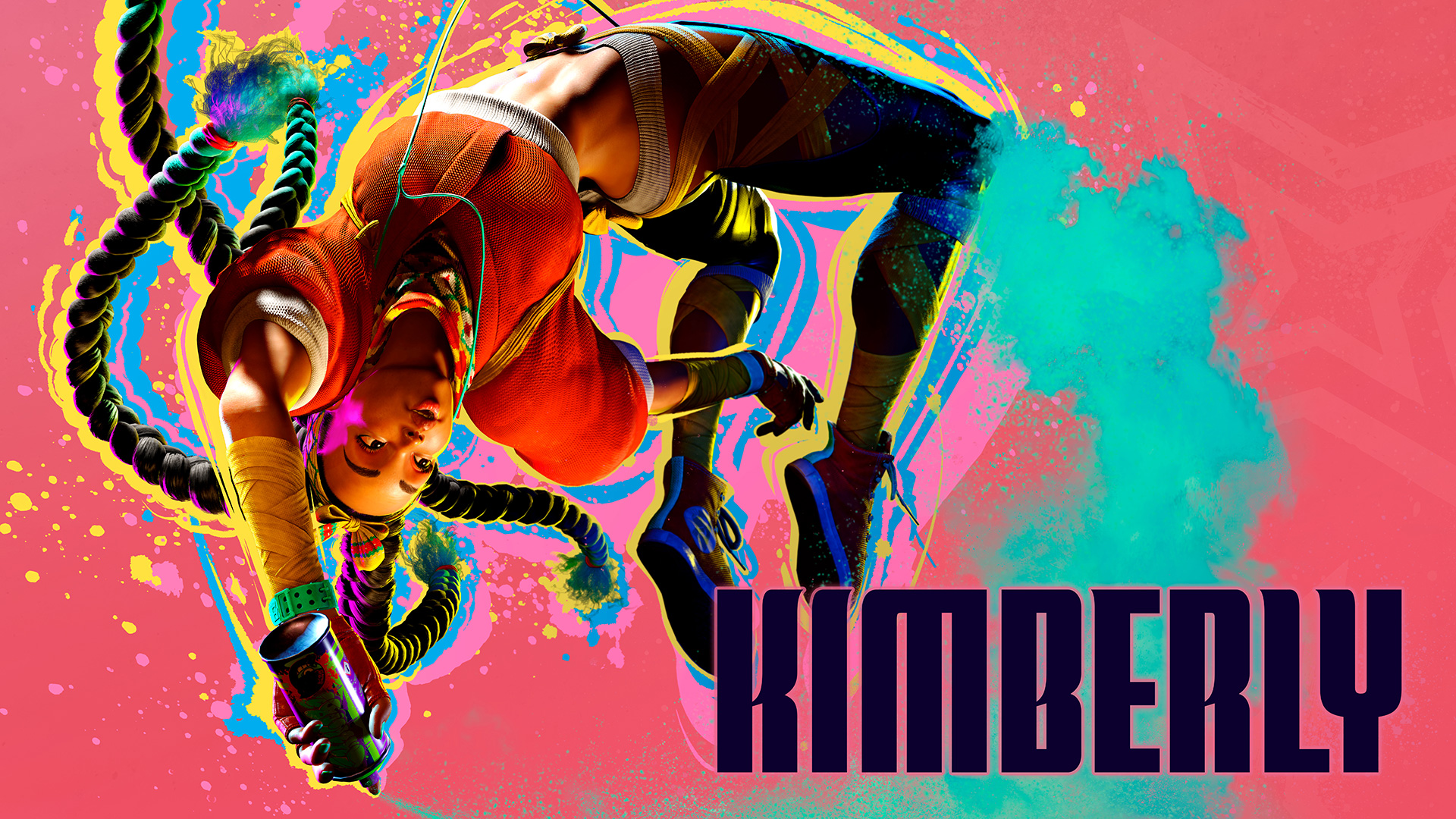
Street Fighter 6 draws ever closer, and standing at the poster child of this new game is the American MMA fighter Luke. He was even originally introduced in Street Fighter V as the bridge to the anticipated sequel. But as prominent as Luke is, I actually think another new character might be the true protagonist of Street Fighter VI: the black female ninja, Kimberly.
The new Street Fighter leans heavily into an urban street aesthetic, most notably in the use of spray paint/graffiti as reflective of hip hop culture. While this motif been around to certain degrees since the very first Street Fighter (like on the title screen), here it’s a defining part of the look and feel of SF6. And if you look at all the new characters, only Kimberly incorporates spray paint in her moveset. She combines it with her ninjutsu training under Guy from Final Fight, taking the old and giving it a fresh coat.
I’m entertaining this possibility because I see it as a way for the Street Fighter franchise to stealthily push a forward-looking diversity that celebrates its international fandom while simultaneously shielding itself from the pitchforks of overly sensitive cultural conservatives who are afraid of having their games not be represented by a conventionally muscular manly man. Luke almost feels like a Trojan horse: “Look over here at this blond American tough guy! Isn’t he what you want?” Meanwhile, Kimberly thoroughly embodies the spirit of SF6.
And that’s on top of having Ryu, Ken, and Chun-li still around. I could be completely wrong in the end, but even if I am, I think Kimberly is already a breakout character among a crowded roster of excellent new designs. She’ll at least wind up being the Chun-Li of Street Fighter 6.


 OGIUE MANIAX