Muteki na Fujoshi: 801-chan’s Small Anime Revival

Months ago I reported on the fact that the popular Japanese webcomic turned franchise Tonari no 801-chan, about a hardcore fujoshi and her otaku boyfriend, was getting an anime and later that the anime was getting scrapped. Well now it is back in the form of a 90-second opening-only anime titled Tonari no 801-chan R to be released with volume 4 of the published manga, a follow-up to the Drama CD released previously.

This opening special will be directed by Yamamoto Yutaka, the director of Kannagi who had also previously worked on Haruhi and Lucky Star (before getting fired), and is the modern father of the Dance Op/Ed. It will also have an opening composition by A-bee, who worked on songs for Lucky Star and Keroro Gunsou. As for the singer, why that will be for Nico Nico Douga to decide, because they are holding an online audition to be the singer OF the 801-chan opening.

The test song is the third Yawara Opening, “Makeruna Onna no Ko,” and you can download the song here and then upload them here, provided you have a Nico Nico Douga account. They are looking for female singers, though if you’re a guy with a feminine voice then you also have a chance. The audition schedule is available but in Japanese, so I’ve provided a translation.

All times are in Japan time. Check to see how it translates to your own time zone.

6/19 13:00 – Open for Auditions
7/6 00:00 – Closed for Auditions
7/9  21:00 – Preliminary Results, as Chosen by Nico Users!
7/16 21:00 – Decision-Making Process LIVE

After that, the vocalist will be decided and recording will begin on 7/20.

Who knows? Maybe someone outside of Japan could land the role. I’d look forward to that.

If you’re curious to check out the 801-chan comic, keep in mind that it is still a free webcomic and that provided you understand Japanese you can read it on the official website.

This takes me back to the time when they announced the first Genshiken drama CD with Mizuhashi Kaori as Ogiue, followed by the release of the OVAs and then Genshiken 2. While I’m not quite as excited for 801-chan as I am for Ogiue (this is not 801-chan Maniax after all), I still really hope this does well.

Oh Me Oh My, Tomino to Be in NY

The New York Anime Festival announced its first major guest today, and it is none other than the creator of Gundam and one of the most famous anime directors ever, Tomino Yoshiyuki.

Having grown up in New York City, I was a bit upset that I was not able to meet him at Big Apple Anime Fest around 2000 or so, and thought I’d never have the chance again, especially because he’s not exactly a big name among today’s anime con crowd. But here he is again, and I’m going to make sure I bring my Zambot 3 box set for him to sign. Definitely.

I’ve spoken before about Gundam and how it’s not only influential to not only the anime industry as a whole but for me personally, and to have the opportunity to pick Tomino’s brain is something I can’t pass up. Like or hate his work you know he’s different from most others, particularly in the sense of his tumultuous career as hate turned to love.

Anime News Network has an interview with Tomino to go along with their announcement, and it’s worth a read if only for the following line”

Until I was middle-aged, I liked to cram my frustrations into my works. However, my mindset changed when I realized that anime is an entertainment medium, and it has to be something people look forward to. That line of thinking is plain to see in the Z Gundam movies.

In other words, the films were an expression of the fact that by nature, all people have both a positive side and a negative side.

Wow. I am looking forward to this.

Analyzing the X-Men Manga and What It Says About Manga and American Comics

This is a follow-up to the images from the X-Men manga I posted yesterday. Now that I’ve given people time to ruminate over those pages, pages which I selected partly to show how various characters are portrayed but mostly to show how the artists took a very “manga” approach to the material, I’d like to go into further discussion about them.

I’d also recommend checking out my post about what I think is a recurring defining trait of American comics.

There’s two things we can say about this comic. First, is that it’s based off of the 90s X-Men cartoon, which was actually shown in Japan with new openings specific to the Japanese broadcast.

Second, is that this isn’t a terribly good comic. It’s an interesting piece of cross-cultural collaboration and all but of course isn’t nearly as high-profile in America as, say, Nihei Tsutomu’s Wolverine comic “Snikt.” It is, to put it simply, okay but not great, and there are many, many runs of the original American X-Men comic which are better and more influential. But of course that doesn’t mean we can’t learn from it.

While this page doesn’t really show any X-Men and in fact just has Mystique in disguise, I think it tells us a lot about some of the fundamental differences between manga and american comics, and it has largely to do with the fact that it is such a low-profile throw-away comic. It is not the pinnacle of manga achievement, but that’s what makes it so useful.

After all, if you only try to learn from the very best you’ll only end up seeing a fraction of the whole image.

Here we have Mystique disguising herself as per her shape-shifting powers. Clearly the goal of the artist here was to portray an attractive female so that when the thug accosts her she can turn her head into a grotesque abomination for contrast. The result is an almost Matsumoto-esque female figure, particularly in the face. She’s disguised as a mysterious, alluring sort of woman, and it’s one far more in line with the Japanese version of such a concept as opposed to the more American va-va-va-voom type, despite this being an adaptation of an American property.

Now what I find to be even more interesting than the character designs is the panel arrangement of this X-Men manga. Again, it is not the best example of panel flow in a manga, but it is a very good example of what is considered “standard” for panel progression.

Panels are arranged as if they do not all exist on the same plane. Intra-panel depth cues are not nearly as important as seeing the panels placed one on top of the other to achieve a smooth progression throughout the page. A lot of emphasis is placed on shifting facial expressions, and those faces help to carry the reader’s eyes through the page.

Of course, this is only in a page with no action and how could I make a proper comparison without some fighting going on?

Below is an example of a fight scene from this manga, and an example of a fight scene from popular X-Men artist Jim Lee’s run, which was going on at around the same time.

Now it’s not exactly a fair comparison as Jim Lee is considered among the best artists who have ever worked on X-Men and there simply aren’t a lot of X-Men manga to go by, but what’s important here are the small differences.

Notice the degree to which the characters separate from the backgrounds. In the case of the manga, the separation is much more stark despite the Jim Lee panels having color on their side, color generally allowing an artist to much more easily separate foreground and background compared to black and white.

Then there’s the vertical progression vs the horizontal one, which admittedly this is not a good example for. This is perhaps my own pet theory, but I believe that a comic in a language which is generally written vertically will tend to have a vertical progression, while comics in a horizontal language will put an emphasis on the horizontal just short of having books actually being wider than they are tall. The most prominent example is the Japanese 4-Koma vs the American 3-panel strip, but that’s a discussion for another day.

Basically what the X-Men manga here has shown us is what features are so naturally a part of manga and people’s and artist’s perceptions of manga that they crop up in a comic based on American superheroes.  Because this is a comic based off of the X-Men with obvious attempts to match the look of the cartoon and comics, the Japanese and manga influences in the drawing style come out even more.

CRY FOR THE MOON

X-Men by Yasue Kooji and Higuchi Hiroshi, published 1994.

By the way, this is NOT a doujinshi.

Note: The Japanese Word for “Snikt” is “Jakin.”

Somerset Somersault: AnimeNEXT 2009

This past weekend I attended AnimeNEXT in New Jersey. While held this year in Somerset at the Garden State Exhibit Center and conjoined Somerset Doubletree Hotel, in years prior the convention was held at the Meadowlands Arena in Secaucus. However, seeing as this was my first ever AnimeNEXT this did not have much of an effect on me beyond the fact that I was basically required to stay at a hotel, an experience which turned it from a commuter convention to a hotel convention, and perhaps turned out better because of it.

AnimeNEXT is a fairly small con whose guest list is comprised mostly of locals. There are no big name Japanese guests at AnimeNEXT but the convention doesn’t really pretend to be an Anime Expo or an Otakon. It’s in this environment that I was able to do my first two official con panels ever (I was a last-minute panelist on the Comic Market panel at Otakon 2006), and I managed to learn a lot despite attending relatively few panels myself. At a convention like this, fan-run panels really are the order of the day so that was the majority of my activity at AnimeNEXT.

Friday, June 12

Friday I arrived in Somerset accompanied by kransom from welcome datacomp and the Reverse Thieves. After finding out that my site was apparenty called “Ugiue Maniax” I went to the panels. Getting there too late to see the mecha panel or others that might have been of interest to me, I ended up going to the “Anime Through the Generations” panel, curious as to who would be giving such a panel with such a name. It turned out to be a group of girls who were fairly young but also fairly diverse in their approach to the fandom, and with the help of Rob Fenelon and other (seriously) old school fans it turned into an interesting discussion about how otaku relate to each other across age gaps.

Next was a panel about Anime Pirates, whose name was fairly confusing because I was unsure of whether or not it was a panel about Pirates in Anime or about Anime Piracy. It turned out to be the former…sort of. Apparently Gurren-Lagann totally counts as pirate anime because it makes Captain Harlock references.

Probably the highlight panel of Friday was Anime Princesses, or as the full title goes, “Anime Princesses Rule, Disney Princesses Drool,” run by the aforementioned Old Guard Anime Fans, which talked about female royalty in recent anime and how their portrayals as figures essential to the governance of their respective kingdoms contrasts heavily with the traditional portrayal of the damsel-in-distress Disney Princess. I noticed a lot of girls leaving once they realized that the panel was essentially about politics in anime rather than talking about princesses per se, but for those who stayed it was an informative hour. My only complaint with the panel really was that too much time was spent on too few princesses and there was a glut of video clips. Points that could have been illustrated with one or two videos were expanded to four or five.  Still, a fun panel.

At this point I’d like to talk about the game rooms set up for AnimeNEXT and how pleasant it turned out to be. They had six separate rooms dedicated to different genres with the most popular ones getting their own rooms out of consideration for said popularity. Most importantly, they never really smelled too badly. It was a well-run game room overall.

Saturday, June 13

Saturday began with the panel run by the Reverse Thieves and I, titled “I Can’t Believe You Haven’t Seen This!” Though it was among the first panels of the day, running from 9am-10am, we still managed to get a fairly large crowd and for that I am thankful to you our panel attendees, whoever and wherever you are. It’s our hope that we could expand your selection of possible anime to watch and to go beyond what you know already, and people came away ready to look at the titles we recommended, among them being Kaiba, Rose of Versailles, and Kekkaishi. Again, thank you to everyone there.

Vertical Press also had their panel Saturday, led by Marketing Director Ed Chavez. In it, he tried to clear up misconceptions about Vertical Press, which is often touted as a provider of manga classics but should more accurately be seen as a provider of the widest range of material indicative of Japanese popular culture. Ranging from cook books to light novels to non-fiction memoirs and of course manga, no topic is taboo for Vertical Press. Having spoken to Ed on multiple occasions now, I have to recommend anyone who has an interest in manga or Japanese pop culture who has the opportunity to listen to Ed speak should take that opportunity. While a Marketing Director, he does not speak like a stereotypical spin doctor, and will fast convince you that Vertical Press is trying to sell you something worth your time. I know I felt that way at least.

The panel immediately following the Vertical Press one was a dub voice actor panel featuring Michele Knotz and Bill Rogers. The crowd was significantly larger than the Vertical Panel, which came as no surprise once it was revealed that both Knotz and Rogers are voice actors for Pokemon. Both are talented individuals, though the main reason I was there is because Knotz is the English voice actor for Ogiue. So naturally I had to ask Knotz for her opinion on Ogiue. Michele called Ogiue a “very interesting” character, and a type whom she had never played prior to landing the role of Ogiue. Recalling difficulty in achieving the right voice for Ogiue, Michele mentioned that the voice director told her to do a voice akin to “Wednesday Addams.” While I don’t think Ogiue is quite like Wednesday Addams (a more accurate description would be to imitate a girl imitating Wednesday Addams), it was interesting to see how she approached this most important and defining of roles in anime. Both of them also talked about how much they’re looking forward to Genshiken 2’s US release. There were other questions but as far as Ogiue-related topics were concerned this was it.

One of the panels that caught my eye on the programming schedule was “Restricted Rock Paper Scissors.” Anyone who’s seen Kaiji should be familiar with this concept, though interestingly only half of the people at the panel had even seen Kaiji. After a few hiccups and the panelists warning the half who didn’t see Kaiji to say away from the half who did, the game was afoot. I managed to be a finalist in both of the games I played, remembering that there’s no such thing as Honor in the ultimate gamble and to avoid the mental trap of “balance.” My prizes were candy and a tiny deck of Uno cards. Truly I was at the very least a Penultimate Survivor.

The highlight of Saturday by far was dinner, as I and other bloggers converged on the local Ruby Tuesday and chatted it up. Many of the bloggers were ones I met for the first time at AnimeNEXT and it’s always enjoyable to see new faces. Among them were the Reverse Thieves and kransom, my fellow Sunday panelists Omo, Super Rats, and Moy, as well as Anime Almanac’s Scott and Japanator’s Brad. I got the dry-rub Memphis ribs with mashed potatos and steamed broccoli, and followed it up with a decked-out baked potato.

After dinner I arrived just in time for the “Bad Anime, Bad!” panel, where we watched select clips from an old Toei animation called “Dracula: Sovereign of the Damned,” an entertaining movie which plays fast and loose with the story of Vlad Tepes and whose plot involves Dracula pretending to be Satan so he can trick Satan’s bride into marrying him. The movie managed to continually top itself in ways that few could imagine. It was also apparently based on a comic by Marv Wolfman, writer of the most famous Teen Titans run as well as many other comics.

Hisui from Reverse Thieves joined us halfway through Dracula, the other half having been spent at the “As the Otaku Grows” panel, which he informed us was a very misleading title as it turned out just to be a guy with a serious hard-on for 90s anime. He would declare that everything made before and after the 90s was worse by comparison, and would apparently give inane evidence to support his claims. I guess if we have so many people calling the 80s the greatest anime decade it’s inevitable we’d get one for the following decade. I look forward in 15 years when someone declares this decade of Zaizen Jotaro and Slap-Up Party Arad Senki to be the greatest period of anime ever.

Sunday, June 14

Due to rearrangements in the AnimeNEXT schedule, I essentially had my entire Sunday convention experience in the same room. Starting off with the History of Manga in the US panel, I learned a lot about not only manga translations in the US, but also the many attempts to either take existing manga properties and get American artists to draw comics based on them, or to draw a comic in a deliberately “manga-esque” style. It’s a side of the manga industry that isn’t really explored much and I learned a good deal, particularly in regards to how the companies constantly try to adapt to the shifting environment. My only regret was that I had to leave the panel a little early so I was unable to ask him about anything he knew in regards to Marvel’s Shogun Warriors comics. For those who don’t know, Shogun Warriors was a toy and comic line where popular Japanese super robots were brought to America with their stories entirely changed so they could fit in the same universe, somewhat similar to Super Robot Wars but not at all like Super Robot Wars.

US Manga History was followed up immediately by “Otaku Perceptions & Misconceptions,” and it turned out to be a panel by the same people who ran the Friday Anime Through the Generations panel. The conversation revolved around how not only others see otaku but also how otaku see themselves, and it eventually boiled down to how otaku could and should work to fight misconceptions, a topic I contributed to based on my own beliefs.

And then after that was the moment of truth, the “Anime Blogging Basics” panel. As expected from a 1:30pm panel on the last day of a con, barely anyone we did not know showed up, but again that was hardly a surprise. We talked mainly about the “Why” of anime blogging, which turned out to be quite interesting because of the level of variation between our blogs and our styles. Omo enjoys focusing on the fandom (he mentions that his feed contains over 400 anime blogs), Super Rats concerns himself primarily with anime figures and photographs of, Moy’s blog has gone through many variations until it settled into something more personal, and my own blog is defined by the description you see at the very top of Ogiue Maniax. Omo described my blog as the evolution of those old character shrines from 90s online fandom, a description I can’t quite disagree with. In the end, I think we managed to lay down some solid thoughts and opinions on blogging and perhaps helped the two or three guys we didn’t know to engage in their own blogging adventures.

With the con over, I and the others had lunch at Marita’s Cantina, which turned out to be a surprisingly good Mexican restaurant, and one that I would recommend if you are ever in New Brunswick. After eating to our content, we took the train back to New York.

Final Thoughts

AnimeNEXT as mentioned in the beginning is not a widely attended convention, but it still managed to attract a lot of dedicated anime fans. While I did not focus much on cosplay, I did notice a lot of dedicated cosplayers, and to those of you who dressed as Eureka Seven characters I salute you. I do not know if I will attend again based on circumstances beyond my control, but I would recommend it if you live in the area. It’s not the most exciting convention but it’s certainly not a nightmare. AnimeNEXT is the type of convention where being around good people and great friends can magnify your enjoyment of the con tremendously.

Oh, and if you’re taking the train to New Brunswick to get to the con, watch out for bums. Just a warning.

Once Upon a Time, a Girl Finished Her Grape Soda: Up

Up once again shows that when it comes to mainstream 3D animation, there’s Pixar and then there’s everybody else. Or to put it differently, the only studio not trying to be Pixar is Pixar itself.

People sometimes ask me why I like anime so much, and though I’ve mentioned in the past that to an extent it is a very personal thing independent of average level of quality in anime, there are still certain recurring traits that keep me coming back: emotional sincerity, respect towards the viewer, respect towards the medium itself, the ability to take simple premises and elevate them. Up manages to fulfill all of these and more. That is of course not to say that the reason Up is good is because it’s “like anime,” because it really isn’t, but its approach and understanding that even for a kids’ movie (or perhaps especially for a kids’ movie) not everything has to fall neatly into place remind me very much of the reasons why I got into and continue to enjoy animation. You can do so much when you’re not limited by reality, and to understand that is to understand that what I just said applies well beyond the visual aspect of animation.

Like Wall-E, Up is a very emotional movie which dares to use a hero that is not just unusual because of the way they look, but because of how the entertainment industry has restricted the roles of certain character types. In the case of Up it is Carl Fredricksen, an old man who used to sell balloons who decides to use his remaining stock to float his house to South America to fulfill a lifelong promise. He inadvertently brings along a young boy scout analogue named Russell, an eager but physically inept boy.

Carl’s curmudgeonly demeanor masks the fact that he was once a wide-eyed but shy boy dreaming of fun and adventure (somewhat similar to young Russell), as well as a man who was very much in love. It’s a mask that we are allowed to peer behind throughout the movie, giving Carl a very strong presence in every scene he’s in. We can see in his current attitude and actions the life he has led up to that point. His interactions with Russell show how easy it is to perceive the elderly as distanced from the rest of society, as well as how incorrect that notion often can be. Carl is an interesting and deep character, and I do not use the word “deep” lightly. He moved me, moved me to tears and smiles and left a deep impression.

Placing an elderly man in the main role of a movie animated or otherwise is a bold move in an entertainment industry which tends to devalue the elderly. Even when they are featured prominently in movies, they are usually placed in teacher roles, or meant to be comically cranky old men. While there’s been a recent trend for older main stars in movies as Hollywood’s big names realize their years are catching up on them (e.g. Sylvester Stallone in Rocky Balboa), most often the message these movies send is “check us out, we can still hang with the young guys.” Up however is different. Carl Fredricksen is not an old man trying to play a young man’s game. He is doing what he feels is necessary precisely because he’s old. There is no denial, there is no shame.

While I said that the movie’s strengths go well beyond the visual, there is no denying that the movie also looks good. Its style is something that I think registers with everyone no matter your age. It’s bright and colorful without bombarding the viewer and overwhelming the retinas. Character designs and backgrounds, are soft without seeming entirely innocuous. The overall three-dimensional design is of course excellent, as expected of Pixar, and if you decide to watch it with 3-D glasses, Up never overwhelms you with shots designed to tell you JUST HOW 3-D THIS MOVIE IS, unlike many other 3-D movies. The use of recurring symbols in Up is also excellent in a way that I rarely see from movies. This is not abstract symbolism, but rather the movie establishing the significance of small but emotionally precious objects, and whenever these objects are referred to or used in any way you know how much weight is put behind them, much like anything Carl says or does.

Up is exactly what a family movie should be, in the sense that it is not just a family movie. Go by yourself, go with your friends, go with your kids or your parents. It’s an intelligent movie which respects the intelligence, both mental and emotional, of its audience, and engages them with such sincerity and power that anyone who sees the movie will feel like they’ve come away from the movie well-rewarded. It will be a reward well-earned because it is almost impossible to feel like an idle observer with Up.

Hot Blood

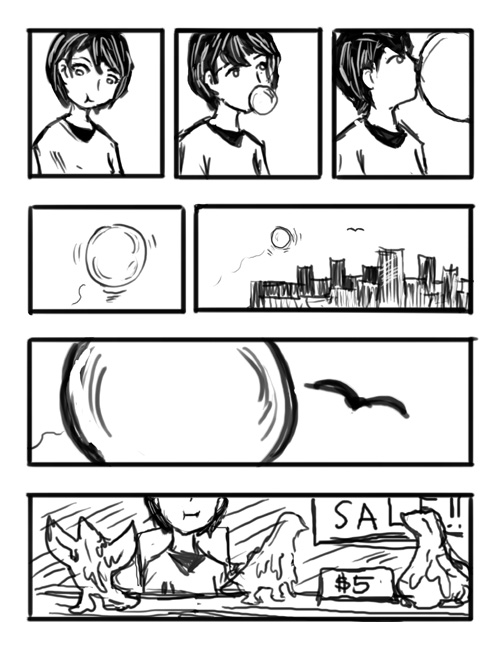
“Bubble Economy”

Driver Alien

AnimeNEXT 2009 Tomorrow!

This is the last reminder to everyone that I and the entire staff of Ogiue Maniax (i.e. just me) will be at AnimeNEXT in New Jersey from June 12-14. It’ll be my first time at this convention, but I’m sure I’ll find ways to have lots of fun.

I will be on two panels at AnimeNEXT:

“I Can’t Believe You Haven’t Seen This!” with the Reverse Thieves on Saturday 9am-10am in Panel Room 2. This panel is all about shows we think more people should see as it’ll really broaden your horizons when it comes to this thing we call Japanese Animation.

“Anime Blogging Basics” with a gang of others on Sunday 2pm-3pm in Panel Room 1. See what various bloggers have to say about what makes blogging so great and just why the hell we do this in the first place.

The following are panels I will probably attend but this list is subject to be incorrect with the slightest breeze or whenever I feel really hungry.

Friday
-Anime Through the Generations, 5pm, Workshop 1

Saturday
-Vertical Books: Industry Panel, 1pm, Panel 2
-Power Hour with Michele Knots (Ogiue’s dub voice actor) & Bill Rogers! 2pm, Panel 2
-Restricted Rock, Paper, Scissors, 6pm, Panel 2

Sunday
-Otaku Perceptions & Misconceptions, 12pm, Panel 3