Mizuhashi Kaori is Constantly Amazing

More often than not, whenever voice actress Mizuhashi Kaori appears in an anime I am amazed by her talent. Not only is she a very good actress capable of playing a variety of roles and personalities, but despite her being the seiyuu of Ogiue Chika it often takes me quite a while to realize that it’s Mizuhashi behind the role.


Ogiue Chika (Genshiken), Miyako (Hidamari Sketch), Rosetta Passel (Kaleido Star), Shimada Minami (Baka to Test to Shoukanjuu)

It’s usually when her voice deepens just slightly that I’m able to recognize her. Then when I go back and listen to the character again, I’m astonished that I wasn’t able to catch on. Mizuhashi’s like the best of both worlds when it comes to voice acting; her voice has distinct features to be sure, but she also has a capacity for variation between roles.

In short, she’s a pleasant surprise whenever she appears.

Now I don’t have the vocabulary or familiarity with voice acting to actually explain to you what I think makes her a good voice actor, so I recommend you check out any of her roles, or listen to her voice acting sample on her official profile.

Conceptual Gattai: Mecha and Slice of Life

I’ve been talking a good deal about both giant robots and slice of life anime as of late, and in doing so it was perhaps inevitable that the notion of combining both would start to percolate in my head.

At first, mecha and slice of life would appear to contradict each other. Mecha is generally about some kind of story and conflict, be it good vs evil, big vs small, one team vs another, whereas slice of life has its focus in the non-events of life. Is it possible to reconcile the two? I say yes, and all you have to do is start with Patlabor.

Now for those unfamiliar with Patlabor, the basic premise is that in the near future giant robots are used in labor jobs such as construction and demolition, and have essentially become a part of everyday life. Some unscrupulous people get the bright idea to start using these mecha to commit crimes, and so a robot-based police force called “Patlabor” is formed.

So envision the Patlabor scenario in your mind. Now, get rid of the robot crime and by extension get rid of the robot police force. There’s your slice of life mecha show. Instead of focusing on capturing criminals, the story becomes about the daily hijinks of working a normal job as a robot pilot. If you want, have the characters younger and center the story around the training process, like Gunbuster‘s early episodes minus the competitiveness. On that note, make the characters all cute girls if you want, though honestly speaking I don’t think such a thing is necessary for slice of life.

So basically, giant robots without the fighting. I know, pretty exciting, right?

I Was Right About the Megaman 10 Robot Masters

A few days ago I made a post about how the eight primary bosses of Megaman 10 looked quite different from their predecessors, most of which were in-story creations of either Dr. Light or Dr. Wily, and thus felt that these new robots were the work of neither. What I did not know was that the magazine which announced the eight robot masters, Coro Coro, also included basic information about them, and it turns out that all of them are robots who had normal jobs who were then affected by a virus which made them go berserk. In other words, none of the Robot Masters were designed by Wily or Light, and  my suspicions based on their designs turned out to be true.

“Congratulations,” I said to myself as my right arm patted my left shoulder, “You figured out a plot point in a game meant to evoke the nonsense plots of the NES-era.”

I Took This Screenshot So That I Could Have It On Hand and Also It’s Funny

This is from episode 22 of Ouran High School Host Club. It’s a moment I refer to sometimes when talking with friends about anime, and I was kind of annoyed that I just could not find it on google image search. So here it is. It’s Kasanoda the mean-looking son of a gangster’s dad making a reference to Yokoyama Mitsuteru’s manga series Giant Robo.

Use it, spread it, maybe use it to trick Ouran fans into watching Giant Robo OVA. On that note, maybe you can use Renge-chan to convince someone to watch RahXephon.

The Uncompromising Mecha Melancholy

Whether I was consciously aware of what  anime “was” or not, for about as long as I’ve liked Japanese cartoons I’ve been a fan of giant robots. On a more intellectual level they can be used to represent so many things and tell so many stories, but on a simpler level they’re just big and awesome and I am never against that. But when I look at giant robot fans as a whole, my perception of the fandom is this uncompromising group which laments the fact that the shows today are not the shows of yesterday. Of course not all robot fans are like this, and it could very well just be a loud minority, but there is this persistent message that for them, mecha will never satisfy them again unless it does a complete 180 and goes back to the 80s or the 90s or whenever they think mecha shows achieved their pinnacle.

Out of those loud, complaint-prone fans, I feel that the prime example is hardcore fans of the Universal Century timeline from the Gundam series, i.e. the timeline that comprises the original Amuro Ray vs Char Aznable series from 1979 and all of its true sequels. If you’ve ever attended a “History of Gundam” panel at an anime convention or gone on mecha forums or even /m/ on 4chan you’re bound to see these guys, who will express their strong opinion that Gundam Wing or Gundam SEED as inferior to their beloved UC shows. And it’s perfectly okay to like UC more than alternate timelines, but the point at which it gets unreasonable, and the point where I start to get annoyed by the hardcore UC contingency is when they start to villainize the non-UC series and assign traits to them that they don’t really have, or that are so unfair that not even their preferred series could hold up under that kind of scrutiny. One of my favorites is the idea that Gundam was ruined when it began to pander to fangirls, but Gundam has always held a certain appeal for females, just not in the way mecha fans might prefer.

While I don’t think it’s wrong to have standards or even extremely high standards, I feel like it gets to a point where these really hardcore giant robot fans will never be satisfied, first because the industry will never be at the point it was when it produced these shows that mecha fans loved, and second because even it it did, a lot of fans don’t actually know what they like or why, and will try to find these scapegoats. Or if a mecha show manages to do well, it won’t be for the reasons they’d like.

Does anyone else feel this way about giant robot fans? Is this merely an image I’ve built up because I focus on mecha a lot and see these fans a lot more? Please tell me if you disagree, or at least what your view of the giant robot fandom is like.

Megaman 10 Robot Master Analysis

These are the 8 Robot Masters of the recently announced Megaman 10. If you haven’t seen their sprites yet, you can consult my post from yesterday. As promised, I will be talking about their designs more today, laying out what I feel are key aspects of the latest set of eight.

When I look at the bosses of Megaman 10 I can sense a difference between them and their predecessors. While the game’s designs are still in-line with the overall classic Megaman aesthetic of cute and simple anime-style characters, there’s a consistent theme throughout their designs which only occurred sparingly in previous Megaman games.

The most prominent one is that the descriptor in their name dictates a lot more of their design in general than in previous games. Strikeman’s torso is designed to look like a baseball. Commandoman is a tank on legs. Sheepman needs no explanation. The properties that define them are more explicitly incorporated into their designs. The closest we get to more orthodox designs are Solarman and Chillman, and even they have somewhat unusual bodies.

While you have a few Robot Masters from previous games which do follow this trend seen in Megaman 10, such as Heatman having a Zippo Lighter for a body, they’re more the exception than the rule. When you compare Metalman to Blademan, Metalman is merely adorned with sharp spinning blades, whereas Blademan has swords for arms and a sword for a head.

Overall, these robots do not look quite like any bosses from the past. They do not resemble any of Dr. Light’s designs, nor Dr. Wily’s or Dr. Cossack’s. I think this is intentional. My suspicion is that, in actuality, none of these Robot Masters are Dr. Wily’s, and that they’re coming from another source entirely or from multiple different sources. In a way, they remind me of Megaman 6 because that game also had Robot Masters who didn’t seem all that Wily-esque, which made sense seeing as all of them were supposed to have come from different countries.

So I’m throwing it out there: I don’t think Dr. Wily is responsible for the Robot Masters in Megaman 10, and in fact I bet he was planning to attack with his own set of 8, but his minions also got affected by the “Roboenza” virus. That doesn’t mean he won’t be the villain, but I think it’ll be more him taking advantage of a bad situation. Or maybe once you figure out the cause of Roboenza and find the cure, then he’ll make his move.

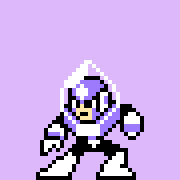
Megaman 10 Robot Master Pixelization

The 8 Bosses of Megaman 10 were announced recently, and IGN had the courtesy to showcase both the character art and the sprites. The only problem is that they saved the sprites as jpg’s, and in doing so reduced some of the quality of the sprites. Wanting to see how they “really” look, I decided to reverse-engineer the sprites based on those screenshots and such, and in doing so I developed a greater appreciation for them than I had previously.

As a disclaimer, while I used an NES palette to determine colors, I was not able to 100% figure out the colors for the sprites based on the source jpg’s. If anyone knows the proper colors, please tell me so I can fix them.


Blademan


Solarman


Sheepman


Commandoman


Pumpman


Strikeman


Nitroman


Chillman

Upon closer look, I’d say there’s something very interesting and different about these designs compared to previous Megaman games. I’ll go in-depth into my thoughts about these new Robot Masters tomorrow, so for now just enjoy the pixeled goodness.

The Precarious Position of “Seinen Cute”

I am a man who likes cute things. This is sometimes a problem.

As a general rule in societies around the world, cute often falls into the realm of the feminine and the girly, especially when the ones being cute are girls. This is something I experienced when I was really getting into anime in high school, and people who knew about my interest in anime would sometimes say, “Cardcaptor Sakura? Really?

During that period, the shock that fanfiction of Gundam Wing existed that paired men with other men was still fresh, so the idea that Cardcaptor Sakura was capable of appealing to a lolicon crowd didn’t even factor into the equation. It was more a matter of me, a guy (almost an adult at that point!), enjoying something that was made for little girls. It’s a battle I had to fight, and it’s a battle I’m sure many of you out there are familiar with and may even continue to go through. How do you break through societal standards of what is considered “umanly?” It’s a little easier when we’re all nerds and we suck at throwing objects, but even in the realm of geekdom you will find that masculinity plays some sort of role.

So when I see people bothered by how often seinen manga have this girlish, cute, sometimes moe aesthetic, I think back to whenever I’ve run into the problem of being told that I’m not supposed to be enjoying cute things made for girls.

Consider the fact that guys are guys, and while some of us like cute things we all have a tendency to like sexy things, though personal preference affects what “sexy” is. There is cute, there is sexy, and there is cute and sexy. And sometimes they all exist in the same comic, sometimes in the same character, and it can be off-putting for a lot of people while being just as enticing for others. Ask yourself, is it all right that a comic can have both sexualized characters and non-sexualized characters interacting with each other on an equal level? Does having sexualized elements in a character sexualize the entirety of their character?

If I had to take a stab at how Azumanga Daioh creator Azuma Kiyohiko felt about these questions, I think his response would be found in the character of Kimura.

Kimura appears to be a pretty creepy guy. He’s a high school teacher with a thing for high school girls to the point that, for him, age is irrelevant because “high school is high school.” But then you see how the guys in his classes react to him. They consider him a “role model” of sorts because he’s honest with his feelings. Further exploration of Kimura’s character shows that he is both a loving husband and a good father, and that he strongly believes in charity, donating a significant part of his paycheck on a regular basis. At the end of the day, taking all that into account, is he still creepy? Probably, but that doesn’t mean he isn’t a lot of other things too.

Those of you who are creeped out by the state of seinen manga’s more questionable practices have every right to be creeped out, and those of you who enjoy it have every right to enjoy it, and everyone has the right to disagree with each other. To me however, no matter how much questionable material is released and sold, the very fact that cute comics aimed towards adult men are published and manage to be successful is a great triumph that can never be taken away.

Robotech: More Like Anime Than You Think

Robotech over the years has gotten about equal amounts support and derision from anime fans. It introduced viewers to permanent character deaths and a dramatic serial space opera, but also obscured parts of the message of the original Macross and had a few edits here and there, though not nearly as much as what had come before it.

One of the bigger criticisms of the whole franchise is that in order for it to remain cohesive it requires a “god of the gaps,” or something to explain why these disparate parts of the story and universe actually fit together. I’ve made fun of Robotech for that reason before as well. But then I thought about this idea of just filling in blank after blank with whatever you could find, and it reminded me a whole lot of another giant robot franchise: Gundam.

Question: Have you ever heard of Johnny Ridden?

If your answer is “no,” that is perfectly normal. But if your answer is “yes,” then you are a fairly hardcore Gundam fan, or you’ve just seen the name appear on Gundam models and scratched your head wondering just who this person is.

To make a long story short, Johnny Ridden is a character who, like Char Aznable, was a Zeon ace in the original Mobile Suit Gundam. He got his own custom colors, his own nickname (Crimson Lightning), and he fought at many crucial points in the war. The only thing is, he never appears on-screen in any of the episodes or movies. You are just supposed to assume he’s around. Also, he loves Kycilia Zabi. I don’t think even her own father can say that!

Basically Johnny Ridden was designed after the series was over to help promote the line of Mobile Suit Variations, or robot designs which take existing models and recolor them in order to sell them off as “new.” If you’re into video games, it’s pretty much the same thing as a “palette swap.”  It’s just like how a Wizard is stronger than a Magician in Dragon Warrior because it’s yellow. And the big thing is, Mobile Suit Variations worked. They sold, they made Bandai money. And now? Johnny Ridden makes appearances in games and has comics in which he actually appears, and it all has to do with how much people want to explore the gaps in the world of Gundam and how easy it was for Bandai to make this all possible.

When you look at what Robotech did, it almost pales in comparison.

Hidamari Sketch ×☆☆☆ is Informed by SHAFT’s Recent Experiences

Warning: Images in this post may not be safe for work. As such, I’ve included a cut with this post.

Watching the first episode of Hidamari Sketch ×☆☆☆ (pronounced Hoshi Mittsu, or “three stars”), my immediate reaction was that something was different. It still carried much of what makes the show so entertaining to me, such as the creative visual aesthetics and the overall sense of humor, but there in this first episode of the new season there was a certain vibrancy to the animation and overall style of the show, and it’s not like the sudden improvement in animation quality that occured in episode 1 (and only episode 1) of Hidamari Sketch x365.

If I had to pinpoint the change that has occurred with Hidamari Sketch ×☆☆☆, it would be that SHAFT has accumulated a number of shows under its belt since x365. The plastic toy-like nature of the CG in ×☆☆☆ that manages to fit in with the show harkens back to Maria Holic. The visuals and timings of conversations contain flairs of Bakemonogatari.

One moment which sticks out in particular is that of Yuno’s daily bath ritual in this first episode. Here, Yuno’s naked body is drawn different than it has been in the past, and seems a little closer to scenes involving Senjougahara Hitagi or Sengoku Nadeko (but at the same time not outright sexual like in those instances).

Continue reading