The Ambiguously Vague Gestures: Genshiken II, Chapter 81

After the intensity and emotion of the last chapter, this month’s winds down with a post-confession Madarame. In order to try and cheer him up, the old Genshiken girls (+ Hato and Kohsaka) cosplay for him, and for a brief moment the old impassioned expository Madarame makes a triumphant return. As Tanaka and Kugayama leave with Madarame for some male bonding, Saki encourages Madarame to not let go entirely of his past with Genshiken. There also seems to be some bad blood between Keiko and Hato, though the reasons are unclear.

As is the case with recent previous chapters, this one also referenced an old anime, in this case the title of Akuma-kun‘s final episode. Appropriate, because whether you want to call it the denouement of dramatic structure or the ketsu of kishoutenketsu, Chapter 81 feels like a wrap-up of the crazy developments that have happened over the past few months with Madarame, at least when it comes to his feelings for Kasukabe. As such, this chapter feels a lot less overt with its significance and its presentation of information compared to last time, but there are still plenty of moments which radiate with potential. As always, this isn’t an end (well obviously because the manga isn’t finished but you know what I mean), but a continuation.

There’s one scene in particular this chapter that I’ve read over and over because I’m not sure how to interpret it. As the girls (and guys) cosplay for Madarame from the gender-bender game that Kohsaka worked on, Kasukabe herself joins in as well. Before we see Saki in un-drag though, we see her having a conversation with Kohsaka about her character, who’s supposed to be “boyish,” to which Saki retorts that it’s actually a boy. Then, we see two characters off-panel speaking to each other (their words are visible but they aren’t), who I’m pretty sure are Kohsaka and Kasukabe. One of them asks if they accidentally “let it slip” and the other says that it’s not about that. I believe we’re supposed to read it as Kohsaka having hid the details of his game from Saki and her response being that the content of his game is besides the point. However, because of the way she says “it’s a boy,” and the follow-up conversation about a secret being out, and the fact that we see Saki go from what others have charitably referred to as “maternity clothes” to an outfit with a corset such that we can never get a clear idea of her figure, and the fact that even with the corset she looks bigger than she used to (notably in the chest area), I feel as if this chapter is lending credence to the theory that Saki is indeed pregnant.

I might just very well be overanalyzing, and things like Saki’s slightly larger figure and larger breasts might just be either a stylistic change by Kio or a sign that she’s growing older, but it just has me wondering. If my speculation turns out to be unfounded, I’m of course fine with that.

This chapter we get to see the “old” Madarame make a return as he muses on the very concept of “trap” characters and how there are different things to consider when translating them to 3D, a rant which Saki quickly reminds everyone is reminiscent of the Madarame she first met and despised. Is this scene a sign of Madarame getting his otaku groove back? Is it the case that the last few years have been a continuous trial and now that it’s over with he can go back to being himself, or is it that Madarame is trying to force it? Is it a regression to a past identity, or is it a progression, a nerd phoenix rising from the ashes of rejection and anxiety? I’d like to believe that the old Madarame is a new Madarame, and I’m definitely looking forward to where his character will go from here.

As a side note, if you’ve ever wondered what I meant by density of information looking unusual in manga, just look at the page above where Madarame is ranting. If you’re used to manga at all, just the whole page seems to stray from how Genshiken usually flows, though that’s what also gives this page its impact.

An interesting thing I’ve noticed about Madarame’s character is that Madarame seems to get paired with more characters than anyone else both inside Genshiken itself and among fans both English-speaking and Japanese. There’s of course the whole ordeal with Kasukabe, but there’s also Ogiue’s Sasa x Mada fantasies, Angela putting the moves on him hard, the ambiguity of Hato’s friendship, Kohsaka feigning (?) interest this very chapter, and then on top of that I’ve seen fanart and such going all the way back to 2005 that put him with Keiko and Sue, well before they interacted with him like they do now. It might just be that, as Hirano Kouta of Hellsing fame puts it, that “Madarame is the most moe character in Genshiken,” but I just find it interesting that so many, fictional or otherwise, seem to want Madarame to be happy (or at least less pathetic). It’s probably a testament to his enduring character and the fact that he is above all others the quintessential nerd/otaku.

In any case, it makes Saki’s comment that Madarame could very well make his own harem feel both tongue-in-cheek, yet somehow serious, though in the end I interpret it more as Saki telling Madarame that he is actually attractive in his own way. That said, I have to wonder how awkward it would be to have a girl who just rejected you also tell you that it’s okay for you to keep the sexy(ish coplay) photos you have of her. That’s the kind of scenario that so many nerds ae desperate to avoid (“What if she knows that I find her sexually attractive?”), but it’s a new world I guess. I wouldn’t be surprised if Madarame ends up throwing them out anyway, though I also wouldn’t be surprised if he keeps them.

I’ve used this comparison to describe multiple characters over the series, but Keiko is something of a Saki-type for Genshiken II. Yajima is a Saki in the sense that she’s a fish out of water and has the dry wit, but Keiko serves the role of being the character with the most “real world” experience, though as Sasahara remarks it’s more the result of making numerous mistakes. Still, it gives Keiko a type of perceptiveness that’s lacking in the current members of Genshiken, and it makes the moment where she just shows Madarame how his secret never really was one quite hilarious. Given how she didn’t even appear in the second TV series (though as far as I know that was just an unfortunate scheduling conflict, and she does make an appearance in one of the drama CDs), it almost feels like the series is making up for that by giving her more presence in the current manga.

As for the dirty look Keiko gives Hato, it’s yet another ambiguous moment in this chapter whose path will lead us who knows where. If we go by the harem view mentioned before, then this could be interpreted as Keiko exhibiting jealousy, but I think it’s something else. If I had to guess, I’d say that Keiko’s impatience towards Madarame dancing around and avoiding his own feelings for fear of confrontation is also showing itself with Hato and where he might stand with Madarame.

Even though she’s clearly not the focus, I do want to talk a bit about Ogiue’s part in this chapter. When Kohsaka grabs Madarame’s arms and tells him that they could’ve had a polygamous relationship with each other and Saki, I like how you can tell who is thinking what in that moment. For most of the guys, it’s just an awkward moment, but clearly Ogiue and Hato think more of it. Ohno seems much less affected, though it might make sense given her preference for significantly older, hairier, and balder guys. Keiko’s blushing on the following page is probably the most surprising, and another moment in this chapter open for interpretation. Could Keiko be a candidate for the Fujoshi Files after all?

The chapter ends with the reappearance of Katou, who we don’t know much about other than that she has Ohno-esque preferences, and that she’s been job-hunting as of late, but I wouldn’t mind seeing more of her at all. At this point Asada has more development than her, and she doesn’t even have a real face! I don’t have confidence we’ll see much of her, but one can always hope.

The Future of iDOLM@STER is Gyrozetter

I have a theory: Chousoku Henkei Gyrozetter actually takes place in the same world as The iDOLM@STER many years into the future. I’m going to lay out my ideas for how this transition comes about while also providing ironclad proof of their shared universe.

1) Inaba Rinne is a Futami Descendant

It’s not clear which of the Futami twins Rinne is descended from, but most likely it’s Mami. It’s not clear just how many generations into the future Rinne is removed from Ami and Mami, but Futami genetics are undeniably strong.

The resemblance is uncanny.

2) The Success of 765 Pro and the Start of the AI Car Boom

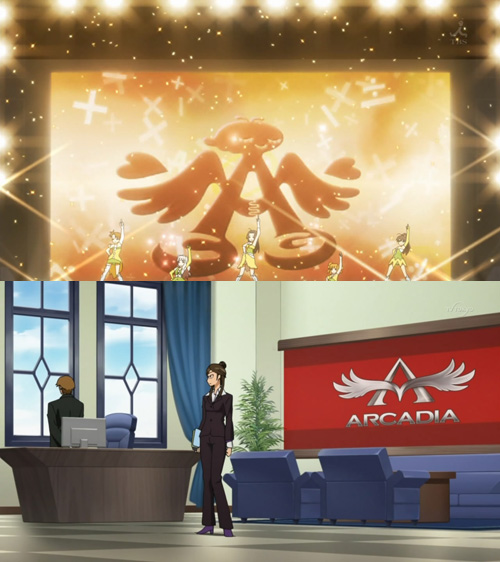
Thanks to a combination of talent, spirit, and camaraderie, 765 Productions becomes wildly successful. At first, they do only promotions for car companies, but thanks to rich girl Minase Iori’s connections and the advancement of technology 765 Pro manages to start their own automobile line. They name the car company offshoot “Arcadia,” modifying their logo along the way.


Assistants to the CEO continue to dress in black suits in honor of Akizuki Ritsuko.

3) Shijou Takane is Responsible for the Rosettagraphy

At first glance, the Rosettagraphy makes no sense. A mysterious stone tablet that tells humanity how to build advanced cars that turn into robots? It sounds like nonsense, until you remember that Takane is equally engimatic, and that she is capable of speaking in many tongues. As we can clearly tell now, it’s because she holds the secrets of not only technological growth but also of prophecy. If she had revealed it to humanity too soon, who knows what would’ve happened?

Takane was a Messenger in Many Ways.

4) Gyrozetter AIs are Actually Based on 765 Idols

How else would you explain this?

I rest my case.

My Donation to Kick-Heart Was Not an Obligation

I recently donated to Kick-Heart, and it was my very first Kickstarter donation.

For those who aren’t familiar with it, it’s an animation project by Japanese animator/director Yuasa Masaaki, a man whose style can best be described as “experimental and unorthodox.” As someone who not only enjoys variety in animation but also appreciates Yuasa’s work (particularly the brilliant Kaiba), I ended up pledging, but I want everyone to understand that this was my own conclusion, and not one I necessarily expect from others. 

As people have rallied for Kick-Heart there’s been good, but there’s also been this problematic message attached to it wherein Kick-Heart is seen as a potential savior of not just the anime industry but of creativity and imagination in anime itself. To some extent, they have a point: there are certain anime that are more commercially viable than others, and this is usually based on what’s trending at the time combined with the economic realities of the time. In that sense, funding this Kickstarter is useful for figuring out if there really is an audience for Yuasa’s brand of works, enough to justify at least a 10-minute animation piece. But then if you’re not part of the audience in the sense that you have little interest in Yuasa’s work, then you shouldn’t feel obligated to maintain a lie just because people are making you feel like you’re industry poison.

I said why I decided to join in, and if my or anyone else’s reasons for donating to Kick-Heart convinced you to donate, feel free to do so. What you shouldn’t feel, however, is pressured to donate out of the “greater good.” Kick-Heart isn’t an intimidation tactic, and it shouldn’t be talked about as such.

The Fujoshi Files 57: Sazanka Bianca

Name: Bianca, Sazanka (サザンカ・ビアンカ)
Alias: N/A
Relationship Status: Single
Origin: Aquarion EVOL

Information:
Sazanka Bianca is a teenage resident of the planet Vega and a student at Neo-DEAVA’s Holy Angel Academy, which trains pilots in order to fight against invaders from the planet Altair. As a fujoshi, Sazanka is particularly fond of her classmates, best friends Cayenne Suzushiro and Shrade Elan, the two of whom together are responsible for many of her fantasies.

As one of the many pilots capable of operating the mighty robot Aquarion, Sazanka possesses a superhuman “Element power.” Specifically, she has the ability to corrode physical materials through her “Fushokuryoku,” or “Humicane from Rotten Girl.” In addition, though not an Element power, Sazanka is extremely adept at taking photographs, seemingly able to photograph anyone in any situation, and sells her photos of both guys and girls to her fellow students.

Fujoshi Level:
At one point Sazanka and her fellow classmates were given armbands which shock the wearer whenever their heart rate rises above a certain amount. Placed in the same group with Cayenne and Shrade, the interactions between the two friends ended up electrocuting Sazanka many times over.

My Conversation with a Singapore Mahjong Expert

Because of mahjong anime, I gained an interest in Japanese mahjong. And because I played so much Japanese mahjong and continued to consume anime and manga based on it, I began to wonder what it would be like if there was a series based on having to play all of the different styles of mahjong which exist around the world. This has led me to do some research and even attempts to play other styles of mahjong, and in fact the first post I made on this blog about other styles of mahjong was about Singapore-style. At the time, the only way I could play it was a single player java program, so no matter what my speculations about strategy and gameplay were the result of a very limited experience.

Since then, I’ve been able to find a website which allows me to play some form of Singapore mahjong against human opponents, and through it I’ve been able to put to the test some of my musings on Singapore mahjong from that post. Looking back, the post turns out to have been decently accurate, but I am of course still very much a beginner at it, so I wanted to find someone with more perspective and experience. That’s how I came across Singapore Sparrows, site dedicated to mahjong in Singapore (primarily the MCR—more on that another time—and Singapore styles), and through it managed to have an interesting and enlightening conversation concerning the similarities and differences between Japanese and Singapore mahjong.

I recommend reading the entire post as well as my follow-up comment, but to summarize I asked the blog owner Edwin a series of questions about strategy in Singapore mahjong, especially because the Singapore style has far fewer hands than Japanese and therefore the hands felt comparatively less fluid. Edwin brought up the fact that not only does Singapore mahjong have things called bonus tiles which can net you points just for drawing them, but it has more bonus tiles than probably any other style of mahjong, and so in his opinion the bonus tiles function in a capacity similar to cheap hands in Japanese-style such as tanyao and iipeikou.

Thinking about the function of bonus tiles, I speculated that rather than fulfilling the role of those smaller value hands, they were more akin to calling riichi: ways to empower worthless hands and give them some teeth and a chance to win. The big difference is that with bonus tiles they are the catalyst to deviate your hand into something simpler, whereas calling riichi always exists as an optional goal, beginning vs. end, but both carry risks unique to each version of the game.

Now, when considering how this would impact a narrative about a game of Singapore mahjong, the flower tiles really are wild cards, and I could see some maverick of a hero taking a risk to get just the right bonus tiles he or she needs, a foolish move normally, but one that the hero recognizes is the only path to victory. Along with all of that animal tile imagery of cats eating mice and chickens eating bugs, panels could be filled with really elaborate nature imagery.

Another fascinating point brought by Edwin was the way in which pinfu (or ping hu) hands in Singapore mahjong really influence the way the game is played. If you play riichi mahjong you may think pinfu hands are important because of how quick and probable they are, but their potency is nothing compared to Singapore pinfu. Not only can it be played open, but it has a special stipulation which makes it either a weak, simple 1 han (tai in Singapore-style lingo) or a monstrous and deadly 4 han hand, controlled by the presence or absence of bonus tiles (no bonus tiles means 4 han). As such, many players will aim for “ping hu,” but because it’s so clearly a good option no matter what, players of Singapore mahjong are also especially wary of its dualistic lamb/lion status. If you have no bonus tiles and a couple of open straights in your hand, people will get mighty suspicious and the player to your left will try to figure out ways to avoid dealing out tiles you need for your straights. It’s a dimension of strategy that is in many ways different from Japanese-style mahjong, and it’s the sort of thing that encourages me to try more styles.

And of course, the variable strength of Singapore pinfu is also a perfect place for some dramatic storytelling. Can’t you imagine a Washizu-esque villain playing his masterful 4 tai ping hu, ready to destroy his opponent, when suddenly he draws a flower bonus tile and all of his beautiful machinations slip through his fingers like sand? Can’t you imagine his agony as the hero willingly deals into the significantly downgraded hand, giving poor Singaporean Washizu a rather pyrrhic victory?

Fun times. Fun, fun times. Incidentally, thanks to mahjong comrade Dave I learned that Mahjong Hime allows you to play both Singapore and Taiwanese styles. Most likely, my next post regarding the hypothetical International Mahjong Manga will be about Taiwanese mahjong.

Psycho-Pass, the Forbidden Word, My Thoughts

People have been making kind of a big deal about how the director of the new anime Psycho-Pass, Motohiro Katsuyuki, has mentioned banning usage of the word “moe” among the staff, in order to counter current trends in anime. I’ve seen some people take this as a psuedo-rallying point, a sort of “BOOYAH! In your face, MOE!” attitude. I’ve seen reactions taking it as an attack on moe, a “Why are you so unenlightened?” response. For me, when I first read about it, I laughed, not because I’m for moe or against it, but I immediately thought of how ambiguous a word like moe could be and how it can potentially impact the creative process by being so ambiguous.

Other than the information we already have, I don’t have any insight into the production of Psycho-Pass so everything from here is purely hypothetical and speculative.

When you think about actually having the word moe be a part of discussions when creating an anime, you inevitably have to deal with “moe” as a conscious effort, and I can imagine it impacting the direction of a work. This is not an inherently bad thing, but I feel that just by banning the word you might end up having to explain things more concretely, or at least in a way that doesn’t use such specialized language. In some ways, I can see how “make it more moe” as a way of describing how something should be can be about as helpful as asking someone to “make it 20% cooler,” as the My Little Pony saying goes.

To say a word is banned doesn’t meant that elements won’t slip back in. Let’s replace “moe” with “hardcore.” Imagine if the interview said, “We banned the word ‘hardcore’ from our staff meetings.” While you might not have direct references to pro wrestling or other similar material, there’s a fair chance some kind of physicality or extreme imagery might make it back in. I don’t know if it’ll really happen with Psycho-Pass, but moe does not need a specific directive for it to appear. Even without the intent behind it, it can still happen.

Don’t Play Tenhou on Firefox

This is just a little public service announcement warning people of a problem with the mahjong client Tenhou when used in Firefox. The problem is that sometimes no matter what tile you select for discard, the game will automatically discard the one you just picked. In other cases, sometimes if you try to call for a tile, the client won’t listen to you. This is a documented issue on Tenhou’s website, and if you can’t read Japanese you’ll at least notice that some sentence pertaining to Firefox is highlighted in bold.

For those who play mahjong, I’m sure you can imagine the frustration of drawing just the tile you need only for the client to not listen and throw away your chances of winning that round, or worse yet, throwing away a tile you know is clearly dangerous and that you yourself would not have discarded in a million years.

I’ve switched to using Chrome when I play on Tenhou and it works out fine, aside from some strange squeezing of the image that can occur when you go from window to full-screen. At the very least, it’s not the game actively disobeying your orders.

Roger Klotz Dubbing

There’s been a tendency in English anime dubs of children’s shows that I’ve noticed for a while now, which is this tendency to imbue characters with ATTITUDE where previously there was none, or at the very least not such an overt presence as such. Basically, what dubs do is turn Doug Funnie, nice average guy with some decent qualities, into a Roger Klotz, a snarkier sort who’s quick to deliver verbal jabs.

After I watched the first episode of toy commercial-as-anime Monsuno in Japanese, I got this feeling that the English dub (which actually premiered months before the Japanese version) would give to characters the voices their character stereotypes expected of them. Sure enough, the nerd was incredibly nasal, and the main character, who isn’t quite Doug Funnie but is the nice sort, is cracking wise at his friends, bits of sarcasm seeping through his dialogue.

A more interesting example comes from Yu-Gi-Oh!, not so much from Yugi himself but from Kaiba. Kaiba in the Japanese version is certainly no Doug Funnie. He’s ruthless and blunt and lives by his own agenda, but what happens is that his Roger Klotz dubbing just takes these qualities to the nth degree. Where he might say something in Japanese like, “Get out of my way. I have no time to waste on you,” in English it would become, “Get your worthless existence out of my way, you dweeb. I can’t have you breathing the same air as me or it might make me sick to my stomach.” Certainly it makes Kaiba memorable in an odd sort of way, but it also gives him an entirely different set of fangs.

Have you noticed this? Is my reference to Doug too old for people at this point? Do people still watch dubs?

The High School Setting

Sometimes anime and manga as a whole are criticized for having too many stories take place in high school or involve high school students, and indeed there are a lot of titles, both good and bad, which fall into that category. While explanations range from “that’s how old a lot of readers are,” “there is a certain ideal to high school, the moment before you become an adult,” and even “so they can sexualize teenagers,” I have to wonder if it has anything to do with high school as a point of commonality among Japanese people.

Most young people in Japan go to high school (if someone can argue otherwise, please do), but once they go beyond high school their lives start to branch out more. Some go to college, some enter the work force, some go to technical training schools, and so on. This is even a plot point in some manga which make the transition out of high school such as Initial D. What this means is that, as a writer, if your aim is to have a position in life that the majority of your readers can directly relate to, then that period becomes harder to manage because not everyone will have that roughly similar experience post-high school.

Obviously this doesn’t mean that people cannot relate to characters outside of their own experience, or that people will reject heroes in unfamiliar settings, but that you end up losing that simple and easy connection. Such a loss can be overcome and frequently is, but high school perhaps remains that time people can look back to and say “I lived in that.” They might not have the magic powers or have gone to the rich school where everyone eats diamonds, but there is the thematic shorthand nevertheless.

The Fujoshi Files 56: Gen’ei Ryou

Name: Gen’ei, Ryou (玄永遼)
Aliases: Tenmiko (てんみこ), Natiral Digital (天然デジタル)
Relationship Status: Single
Origin: Suzaku: Kabukicho Mahjong Legend

Information:
Gen’ei Ryou is a teenager living in Kabukicho, where she excels academically, is a member of the school’s public morals committee, and participates in her school’s archery club. Aside from her talents in those areas, Gen’ei is also a top-ranked online mahjong player, utilizing a primarily “digital” style of play. When she discovered that her friend/club mate/love interest Nanjou Suzaku quit archery to play mahjong, Gen’ei challenged her to a game, where her own victory would mean Suzaku would have to quit mahjong, but failed against Suzaku’s prowess. Since then, she has become somewhat more receptive to mahjong, though this is primarily motivated by her fondness for Suzaku.

Outside of school and mahjong, Gen’ei frequently attends doujin events, and is often seen in the company of the Hanaukyou family’s maid, Suzuki Ikuyo when at events. Her favorite series is Omakase Tentel, particularly the pairing Tentel x Mikoto, or “Tenmiko” for short.

Fujoshi Level:
Gen’ei does not create her own doujinshi, and is purely a consumer. According to certain metrics espoused by fujoshi and overall otaku expert Miyano Tamae, she has a fairly weak imagination but makes up for it with a lot of buying power.