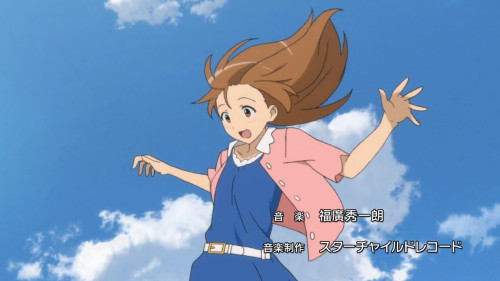
Genshiken Second Season Episode 4, Familiar (?) Old Friends

Genshiken Second Season Episode 4 features both cosplay antics and some Comic Festival drama. My overall thoughts can be found in my reviews of the equivalent manga chapters: 62 63 64

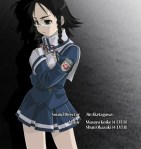
You can also see my thoughts on Ogiue cosplaying Azusa from K-On! The anime went and kind of made it more…fanservicey?

One of the differences between the anime and manga in this episode have to do with format pacing, as the arrival of Ogiue’s old hometown companions occurs at the end of Chapter 63 and acts as a cliffhanger, whereas the same event occurs in the middle of the second half of Episode 4 and resolves by the end. Some of the dramatic impact disappeared from the scene in my opinion, and I think that they could’ve done more, whether with timing or music choice or something else.

Also, I noticed that because some lines of dialogue were cut from the anime, the Crunchyroll subs didn’t quite accurately translate certain points. Yabusaki wasn’t saying that Genshiken president is a perfect job for Ogiue, the line was meant to convey that Yajima isn’t at all surprised that Ogiue would have such a past of making yaoi out of her boyfriend and the ensuing trauma which came out of it. The manga dialogue also has Yabusaki mention that it was her and the other Manga Society girls who pushed her to jump out of a window, a tinge of guilt in her expression.

That’s me nitpicking, though. The real purpose of this post is actually to ask a question.

I’m really into Genshiken, and while I don’t have the whole thing memorized, it’s something I’ve obviously thought about a lot. Thus, when Nakajima first shows up again, I had a strong reaction, somewhere between “oh snaaaappppp” and “holy crap.” It was a big deal for me, and I remember my body tensing up and me having to re-read that point just to let it all sink in. That’s because I recognized Nakajima and Shigeta instantly, and I’ve come to realize that simply not everyone has Genshiken on the brain to the point that they would have that instant reaction. Not only that, but for those who stuck with the anime exclusively, the series never delved heavily into Ogiue’s past, so this is the first time those viewers are learning about her suicide attempt and the events surrounding it.

So, what I want to ask is, what was your impression when Nakajima first arrives in Nidaime?

Did you recall her immediately? Did you need some of the dialogue to jog your memory? Did you totally forget who she was? For those who are anime-only, did you learn something significant? Could you remember Nakajima from that one episode from Genshiken 2?

Pacific Rim Podcast

I was recently on The Cockpit discussing the recent giant robots ‘n monster film Pacific Rim along with the host Patz, as well as the Reverse Thieves. The podcast is super spoileriffic so it’s recommended for people who’ve already seen it.

If you have any love for giant robots and/or giant monters, you might not necessarily love the movie, but you’ll at least like it a fair deal.

The Fujoshi Files 77: Konishi Nozomi

Name: Konishi, Nozomi (小西望)
Alias:
Nozomin (のぞみん)
Relationship Status:
Dating
Origin:
Fudanshism: Fudanshi Shugi na Seikatsu

Information:
Konishi Nozomi is a teenager who attends Kentei Academy and acts as the vice-president of the school’s manga club. A sincere girl who is quiet (but not necessarily shy), one year at Comic Manga Market she meets a gothic lolita girl named Amane. Over time, the two grow closer, though unbeknownst to Nozomi, Amane is actually her male classmate, Miyano Amata, the most popular boy in school. However, when Amata’s secret eventually comes out, Nozomi shows that she had already realized the truth at some point, and the two begin a relationship of sorts.

A versatile otaku, Nozomi is skilled in both drawing and cosplay, and is particularly a fan of the magical girl anime Omakase Tentel and the BL pairing of Tentel x Mikoto, the main character Yanami’s mascot companions. She also is the premiere shipper of manga club member Kiyokawa Atsumu with his best friend and manga club president Matsumoto Senri. Her favorite doujin circle is “Gojappe,” she prefers to cosplay as Yanami, and though she is strongly in favor of Ten x Miko, she also gets along with the Miko x Ten contingent of her club.

Fujoshi Level:
Nozomi can be absolutely overwhelmed by her intense fujoshi feelings. So powerful is this potential reaction that, once, after seeing a particularly erotic Ten x Miko drawing, Nozomi had to go to the nurse’s office at school the next day to see if something was wrong with her. In addition, according to Miyano Tamae’s rankings, she is a “Dreamy Maiden Fujoshi” with a Delusion Power level of 5000 and an Economic Power level of 800.

Genshiken Second Season Episode 3, Hato Kenjirou, and Naruto’s Haruno Sakura

Once again this is a review that isn’t. Relevant manga discussions are Chapter 59 and Chapter 61.

Before I get into it though, I want to point out an interesting comment I got recently on my previous episode “review” in response to the cut alcohol scenes. Natsuno, a Japanese person, replied that Japanese TV does in fact regulate depictions of alcohol consumption. Interesting thing to find out, I think.

In Episode 3 we’re introduced to the “other” Hato, the imaginary female version of Hato who makes fangirl comments in his head. No matter what you call it, a Stand, an 801-chan (not used in the anime though), or whatever, it’s meant to be an example of how Hato is able to have a distanced fujoshi view while still maintaining his own thoughts.

The anime’s portrayal of the other Hato came across to me as a bit different from the manga version, despite the scenes being pretty much the same. What I realized afterwards was that this has a lot to do with medium, that conversion from paper to television, and the different conceptions of time that come with it.

In the early chapters of Naruto, one of the gimmicks of the character Haruno Sakura is that she often has thoughts she isn’t willing to express openly, and this usually takes the form of an “Inner Sakura,” a more comically angry-looking version of her silently shouting her true feelings. In the manga, I thought this gag was pretty funny, but in the anime it didn’t work for me at all. This is because in the manga the presence of Inner Sakura appears to take place at the same time as the regular Sakura, a simultaneous existence, whereas to emphasize it for the anime they had to first show Sakura talking, and then Inner Sakura’s response, one and then the other. Although to a lesser extent, I find this to be pretty much the difference between the Nidaime manga and anime.

I think what it comes down to is that when you have that inner and outer self interaction as with Sakura or Hato and you depict it on the page, you can concentrate on one piece at a time while still seeing that they’re on the same page, or more specifically in the same panel. That one panel becomes a cohesive piece of information which can be approached and broken down, and doesn’t need to rely on the linear time of an animated sequence, nor the loss of attention that would occur if the anime did actually play both scenes simultaneously.

Only 4 Days Left to Support Classic Magical Girl Anime Creamy Mami’s Release

UPDATE: FUNDING FOR CREAMY MAMI EPISODES 1-13 WAS SUCCESSFUL! I DON’T KNOW IF I PLAYED ANY SIGNIFICANT PART BUT THANK FOR READING.

A company called Anime Sols has been trying to crowdfund a number of old anime, some classics, some rather obscure. Despite streaming all of their shows at least in part, none of the anime they’ve picked so far seem to be anywhere near their intended goals, and I think it’s a bit of a shame. Of their shows, the one that seems to have the best shot is Magical Angel Creamy Mami. At over $8000 currently of its $19,000 goal, it’s been much more “successful” than its fellow Anime Sols shows, and I’ve even pledged myself. With only four days left there isn’t a lot of time, but that also means it’s still possible to contribute.

A popular 80s magical girl show which is still well-loved, Creamy Mami is less Sailor Moon-style “magical girls as fighting force” and more Full Moon o Sagashite’s “magical girls using magic to turn into adults.” It’s from a different era and conception of magical girls, and thematically also very representative of what was around at the time, and the ability to have these shows brought over and sold to English speakers would be great for fans of anime, especially those interested in the mahou shoujo genre.

Now those who’ve read Ogiue Maniax may be aware that I’ve not exactly given Creamy Mami the best reviews. I don’t exactly find it to be a riveting show, so it may seem like I’m talking out of both sides of my mouth, but my support of Creamy Mami has less to do with the quality of the individual show and more about the potential opportunity it brings to have more classic magical girl anime available. I’m a fan of mahou shoujo for aesthetic, narrative, and emotional reasons, and so even if Creamy Mami isn’t fantastic, it may be the bridge to shows of a similar cloth which are. Keep in mind that I’m not asking people to support a magical girl show so that they can get more violent action shows or harem works, nor am I suggesting that failure to support this would mean the death of all anime crowdfunding. However, if mahou shoujo is your thing, then it might just be worthwhile.

And once again, I have to say that the second ending theme for Creamy Mami is really good.

Watamote’s Tomoko is Basically Butt-Head

Hear me out.

Tomoko, the main character of No Matter How I Look at It, It’s You Guys’ Fault I’m Not Popular! (aka Watamote) is a sad sack whose life gradually rolls downhill as her own delusions of greatness collide with the reality of her crippling social awkwardness. You can even see this in the fact that, contrary to original translations of the manga, the title emphasizes that she blames other people for her problems. Some of those problems are real, some imagined, but what’s generally true is that she makes things worse for herself.

A lot of characters are likened to Tomoko as a kind of shorthand to understand the humor, horror, and appeal of her character. I’ve seen Shinji from Evangelion, Wile E. Coyote (because of how everything she does backfires), and I was originally even fond of comparing Tomoko to Charlie Brown, but the more I think about it, the more that I realize that ol’ blockhead for all of his misfortune doesn’t quite cut it, and that there is only one true answer.

  • Obsessed with media and entertainment, but also thinks a lot of it is crap
  • Not entirely incompetent, but definitely overestimates his own intelligence
  • Awkward, stuttering laugh
  • Hears dirty words where there are none
  • Misguidedly misanthropic
  • Plans to make his life better backfire constantly
  • Sometimes believes he got “laid” just by being near a girl

Think about it. I guess the only thing is that Butt-head “wins” more often because he enrages his principal.

Scenes Cut from Genshiken Second Season Episode 2

I might be calling this an episodic review in the tags, but that’s kind of a misnomer. Instead, I’d like to talk about Genshiken Second Season episode 2, or rather, what’s missing from it.

The manga equivalents of this episode would be Chapters 58, 59, and 60, but if you look at Chapter 59 you’ll notice a rather important Madarame story being cut from it. Now, this might be them cutting it out entirely, or it might be a pacing issue or something where they’d prefer to explore the new characters before putting the spotlight on the old guard again. That’s why, for now, we’ll leave it aside and assume it might actually appear in the anime at a later date, and focus on another curious cut. For those who are sticking to the anime, be warned that Chapter 59 is potentially pretty spoilery for you.

In Episode 2, Yajima, Yoshitake, and Hato all go over to Yajima’s place to create their profiles for the club magazine, Mebaetame. Prior to this, they go to buy some drinks, during which Yoshitake talks about her fantastic metabolism. What the anime did not include, however, is the fact that Yoshitake was trying to buy alcohol to liven up the party. The scene was originally a way to show how Yoshitake is as free-spirited as Yajima is straight-laced (her objection is mainly that they’re below drinking age), especially when Yoshitake ends up getting the beers anyway. Curiously, whereas in the manga they pass out due to drunkenness, in the anime, they simply got tired.

Here’s what I’m wondering: Was this cut due to time constraints, or was it cut in order to avoid showing underage drinking?

I don’t know enough about Japanese television censorship or censorship laws to determine if this is the true cause, but I do know I’ve seen plenty of manga to anime adaptations play it safe in roughly similar ways. The Bokurano anime, for example, turned a rape and exploitation storyline from the manga into something much less extreme. Genshiken does not even begin to approach that territory, but maybe for this show it’s still something they’d like to avoid.

Another thing, though not exactly a cut, is a loss of context. The moment when Ogiue slams the door on Ohno is a visual reference to the time Ogiue invited Sasahara over alone. That part of Genshiken isn’t animated, so the connection is lost.

The opening is kind of interesting. It has quite a bit of information about what’s going to happen (including the appearance of a certain saucer-eyed character and her friend), but what I find most interesting about it is that it makes it very clear that Hato is the focus of the new series, something which wasn’t always immediately obvious in the manga. Also, Sue as Koujiro Frau from Robotics;Notes is about as perfect as it gets. That’s something that wasn’t in the manga but fits Sue’s character so amazingly well that I wish it had been. There is precedent for anime stuff to make it into the original manga, though, so hope is not lost.

The Relationship Between Classic Toei Heroines and Moe Characters

Not too long ago I half-jokingly suggested that the first moe character was Hilda (pictured above), the heroine from the 1968 animated film Hols: Prince of the Sun. The basis of this was that Hilda was the creation of a young Takahata and Miyazaki, who would later go on to form Studio Ghibli, and if you’ve ever read Miyazaki’s recollection of his first time watching Legend of the White Serpent, you’ll not only see similarities between Hilda and Pai-Nan, the heroine of Legend of the White Serpent, but also between his reaction and the way fans of Key games talk about their beloved works: Miyazaki actually cried the whole night, and fell in love with Pai-Nan. Of course, if Pai-Nan had such an impression, then it’s possible to argue that she’s the first moe character, but regardless of what character has the distinction, I suspect that the tragic element which defines both of these characters also has an influence on the development of female characters in anime and manga, and by extension the idea of moe.

In the trailer to Hols: Prince of the Sun, Hilda is introduced, accompanied by on-screen text saying, “Am I a demon, or a human being?” This highlights the inner conflict of her character, as Hilda is both the sister of the main villain as well as the love interest of the hero. She plays both a romantic and an antagonistic role, and the fact that she struggles over which is her “true self” is the inherent tragedy of the character. Star-crossed lovers are nothing new to media, of course, but according to The Pretty Character Chronicles: The History of Animation Heroines, 1958-1999, the early Toei animated films, of which both Hols and Legend of the White Serpent are included (though these titles are themselves about a decade apart), often feature heroines who begin the movies as antagonists.

Pai-Nan doesn’t quite fit this concept, as she’s more of a tragically cursed character, a princess in need of rescue in the vein of  a classic Disney Princess. This makes a degree of sense, given that Toei’s goal was to try to be the “Disney of the East,” but when you look at heroines in classic Disney films, none of them fulfill the role that Hilda or other similar Toei heroines play as partial antagonists. In fact, if you look at Disney animated films as a whole, there’s pretty much only one character who does fit this bill: Megara from Hercules, a film from 1997. In other words, “damsel-in-distress” is not quite the function of these Toei heroines.

What relevance does this have to current anime and the presence of moe, then? My argument is that the tragedy component of heroines such as Hilda has been reduced or compacted to varying degrees, so when you have a character who has traits commonly considered moe, such as a character who suffers from being short in a slice-of-life comedy, what you’re seeing is an on-going series of tiny tragedies, like with Yuno in Hidamari Sketch. The tsundere, especially the more contemporary tsundere type, is another example, as a character who struggles with being true to her feelings can be considered tragic in her own way. Hidamari Sketch also provides one such character in the form of Natsume, whose feelings for the character Sae remain unrequited due to Natsume’s own stubbornness.

While I think the criticism of moe characters as feeding off the desire of men to want to rescue the poor female victim is valid to a good extent, I think that the quality which has transmitted itself from those early Toei days all the way to the current age is not so much that of the “helpless girl” but that of “helplessness.” A girl tragically trapped in a situation can be moe, but what’s considered even more moe is the heroine who can’t be helped no matter what. In such a case, powerlesssness becomes not so much the half-way point in an elaborate power fantasy, but the end point in and of itself, with the potential for empathy between not just the viewer and the hero, but the viewer and the heroine. Of course, that’s somewhat of an extreme case, and the end result really depends on how individual works wish to resolve the inner conflict of the descendants of the tragic antagonistic heroines.

Genshiken Second Season Anime Initial Thoughts

The new Genshiken anime has begun airing, and with it comes not only a time skip over the conclusion to the original manga, but also a new cast of characters. Seeing as the anime is pretty much covering the manga panel-by-panel, and I’ve already reviewed the individual comic chapters along the way, there’s not much need for me to do a thorough analysis, but I do want to give some thoughts about the adaptation process at least. If you do want to see my thoughts on the events of episode 1 of Genshiken Second Season (or Genshiken Nidaime, or as I prefer to call it, Genshiken II), you can find them here and here.

By the way, the title of the first episode is a reference to the Japanese title for the Shinkai Makoto movie known in English as The Place Promised in Our Early Days.

While the anime is faithful to the manga so far, in watching the first episode I feel that the pacing of this newest anime is a good deal more frantic than what I’m used to seeing from Genshiken anime. While the series was never quite subdued moe comedy or Maria-sama ga Miteru levels of “slow,” there was always a kind of mellowness to them even in the sillier situations. Think of Saki talking to them about how Kohsaka (probably) watches anime while they’re having sex. The humor crescendoes, coming out gradually. With the new series, it feels like one gag after the other with little room to breathe in between.

The thing I’m not as sure about is to what degree this has to do with the adaptation itself by Production I.G. (and along with it the new voice actors), and to what degree this is because of the new cast of characters and their different personalities. Certainly as much as Madarame could get rather crazy in the old days, he’s no Yoshitake, whom Ogiue accurately describes as like Kuchiki, only with tact and sense. At the same time, I’ve re-read the manga recently and I didn’t get the impression that the pacing is different, even if some of the energy shown by its characters is.

If I had to pick out a major difference, I think it may have to do with the fact that the manga often presents varying pieces of information such as different dialogues and facial expressions at once, from panel to panel, while the anime presents the same stuff isolated from its connective moments. Of course, the fact that I’ve seen all of this already may also mean I’m more sensitive to this, and someone entirely unfamiliar with the new Genshiken might be taking in the crazy world of a girl-dominant Society for the Study of Modern Visual Culture first and foremost.

I do also want to say just a couple of things about the voice actors. First, although they’re fine (but will take some getting used to), I experience cognitive dissonance when hearing Yukana as Ohno. No matter what, I can’t shake Cure White from my head. The other thing is that, in addition to finding Yamamoto Nozomi’s Ogiue performance to be somewhat similar to Mizuhashi Kaori’s other non-Ogiue roles, her Ogiue is actually closer to how I first imagined the character’s voice back when she appeared in the manga. At the time, I heard her voice as just the tiniest bit high-pitched with an equally small amount of nasalness, which Yamamoto has.

Speaking of Ogiue, one thing that didn’t occur to me while watching but I realize may be an issue with the animated Nidaime is that, for someone who had stuck only to the anime adaptations previously, Ogiue’s character might come across as way different from what they remembered. Whereas the last time we left Ogiue she had a tendency to stare daggers into everyone she met, now she’s kind of good-natured and filled with a good deal more joy, and without the Karuizawa arc from the manga showing both what her traumas were and how she eventually overcame then, this contrast in her old and new personalities is potentially jarring.

Anyway, to end things off, here’s a fun comparison for Ogiue fans everywhere.

The Fujoshi Files 76: Masana

Name: Masana (雅奈)
Alias: Masa-nee (雅姐)
Relationship Status: Dating
Origin: Fujoshi Kanojo.

Information:
Office lady, writes BL novels. Has obscure tastes and doesn’t like when things go mainstream. She particularly has a thing for yaoi stories about businessmen. Has an eye doctor boyfriend who is really into audio equipment, and is not very understanding of her fujoshi hobbies, creating a good deal of tension in their relationship. Good friends with Yuiko and Sacchin.

An older office lady, Masana (“Masa-nee” to her friends Yuiko and Sachi) is an author of BL novels. Interested especially in stories concerning businessmen, she has obscure tastes and does not enjoy genres as much when they become too mainstream. Masana dates an eye doctor who is not very understanding of her fujoshi hobbies, which creates a good deal of tension in their relationship, especially because he seems unable to see that his obsession with audio equipment is just as strong as Masana’s passion for yaoi.

Fujoshi Level:
In a fit of anger, Masana once wrote fanfiction of her boyfriend being the uke to the wires and cables of his own audio equipment.