Adulthood in Tribe Cool Crew

Screen Shot 2015-10-29 at 12.00.31 PM

Tribe Cool Crew is the kind of kids’ show I really enjoy, one that combines a surprising amount of maturity and actual consideration for children with an overall fun and vibrant spirit. Rather than just moralized preaching, it tries to understand where kids are coming from. It’s why I’ve already written two separate reviews for this hip hop dancing anime, one towards the beginning of its broadcast, and the other right in the middle. Now that the anime has finished, it brings me to consider how important the idea of “maturity” (and all that it entails) is in Tribe Cool Crew. By the end, there are a number of developments that are rather surprising and even arguably out of place for a kids’ show, but also create a varied image of what it means to be an “adult.”

Note that this post will be especially spoiler heavy compared to the other two reviews.

Throughout Tribe Cool Crew, there is a general sense of development and progression in the characters, or at least a few episodes dedicated to each character. For the main duo Haneru and Kanon, it comes across as learning how to dance better by overcoming psychological barriers. However, when it comes to the adults, there are three prominent versions of maturity that are presented.

Screen Shot 2015-10-29 at 12.09.34 PM

For Kumo, Mizuki, and Yuzuru, the adults that team with Haneru and Kanon to become Tribe Cool Crew, their worries tend to be about managing expectations. The character Mizuki, for example,  at one point has to learn that her tendency to overwork herself through multiple jobs, favors, and a lack of appreciation for sleep should be reined in a bit lest it wear her down to a nub. What’s interesting is that this all originally came from a good place: she worked hard as a kid to go from overweight, shy girl to a cool and curvaceous dancer. Rather than the lesson being “DO YOUR BEST!” or “NEVER GIVE UP!”, it’s a more tempered outlook that is valuable to both children and adults.
Screen Shot 2015-10-29 at 12.13.02 PM

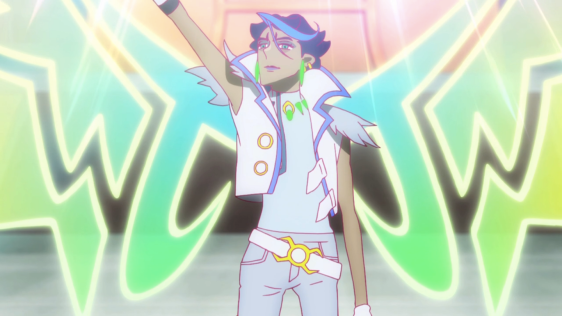
A different kind of maturity appears with the character Jey El, who focuses on ideals. Essentially a highly idealized Michael Jackson figure with all of the controversy stripped out, Jey El is a peace ambassador whose dancing is beloved throughout the world. He came from the slums and has dedicated his life to stopping war and violence. Because of this, Jey El is revealed to have numerous enemies in both arms-dealing and the military-industrial complex, with attempts on his life being not that uncommon.

Of course, just the fact that I typed “military-industrial complex” in reference to a show about kids dancing seems kind of weird. Sure enough, the reveal that the ever-important “Dance Road” tournament that defines the series is sponsored in part by warmongers is quite ham-fisted, reflecting a tendency in a lot of kids’ series in general (anime or otherwise) to slip in something more serious towards the end of their lives. Nevertheless, Jey El’s maturity is rooted in a kind of uncompromising vision that is optimistic even as he’s fully aware of the horrors of the world.

Screen Shot 2015-10-29 at 12.07.28 PM

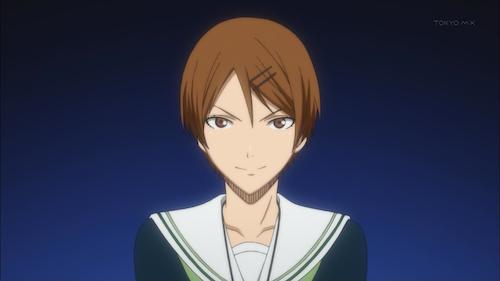
Then there’s the idea of adulthood and maturity from Jey El’s head of security Gallagher, which is grounded in cynicism and the need to compromise even when it goes against one’s values.

In the second half of the anime, the biggest problem facing Tribe Cool Crew, aside from their progression through the underground dance tournament “Dance Road,” is an unusual dance called “Crowd High.”  With dynamic movements and easy to learn moves, Crowd High has gone viral on a global scale, but the characters discover that the dance is actually quite dangerous to perform as stories of injuries begin to pile up (keeping safe while dancing is a recurring message in the series). As Tribe Cool Crew reaches its climax, it’s revealed that the Jey El they’ve seen encouraging them on is in fact a robot, and the real Jey El is in a coma as a result of a bombing by a small child in a war-torn region.

Gallagher explains that he is behind the popularity of Crowd High, seeking to spread dance just as Jey El wished but utilizing a style that has no need for soul, talent, or inspiration so that anyone can learn it, even if it comes at the occasional risk of injury. He also happens to be working with the very military/weapons moguls that Jey El was fighting against. Gallagher’s idea of maturity is one where success is tempered by a view of reality as harsh and unforgiving, and that achieving one’s goals may require a deal with the devil if the ends justify the means. Underlining all of this is the fact that Gallagher was also emotionally affected by the bombing, questioning if Jey El’s methods are even feasible if they can’t reach that one small child.

Children are thus introduced to these varying perceptions of what it means to be an adult, and I think that on some level it allows young viewers to decide who to follow. That said, I think it’s not surprising that in the end Haneru and Kanon do not follow Gallagher’s example, and that Jey El’s revival (brought back thanks to the soulful dancing of our heroes) also inspires a change in Gallagher. Nevertheless, what I find especially notable is how Gallagher is in the end portrayed not as a true villain or even someone with malicious or self-serving intentions. On some level he still believes in their mission, and it is the tragedy of losing Jey El that prompts him to adjust his way of thinking.

If you liked this post, consider becoming a sponsor of Ogiue Maniax through Patreon. You can get rewards for higher pledges, including a chance to request topics for the blog.

Hey Dandy: Genshiken II, Chapter 117

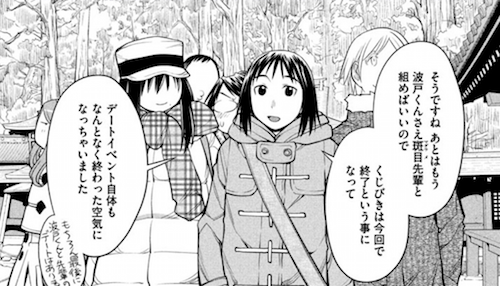
As Hato becomes aware of Yajima’s feelings for him, a heartfelt discussion between the two ensues, where they share their doubts and beliefs about what it means to live with oneself. Though ostensibly a prelude to the last “date” of their trip to Nikkou, the moment between Hato and Yajima might well end up being one of the highlights of Genshiken Nidaime.

Over and over, I think one of the questions asked of Nidaime has been, why a harem arc? Why go for the most stereotypical anime trope that potentially damages Genshiken as this realistic depiction of otaku and fujoshi? Given how Genshiken has turned out in its exploration of Madarame’s awkward love life, one answer has been that it’s commenting on the disconnect between the fantasy of the anime harem and the reality of interpersonal relationships. This has been supported by the characters themselves sometimes even saying as such. However, there’s a second possible answer that’s arguably much simpler, and perhaps even extends out from the original series, which is a desire to portray greater diversity in the otaku population, and that includes a greater number of girls and women.

While I cannot attribute any proof of intent to creator Kio Shimoku’s goals with the second Genshiken manga, there are a few factors that have me considering this. First, there’s the higher female to male ratio. Second, there’s Hato himself, who is, suffice it to say, rather complex when it comes to ideas of gender, sex, and sexuality. Third, there is the greater emphasis on the idea of body image in Nidaime. I think this is perhaps where the “harem,” one of the most upfront formulas for having a heavy amount of female characters in a series, becomes integrated into this idea of diverse representation.

In this chapter, the discussion between Hato and Yajima essentially falls on what it means to “look” or “behave” like a woman. Yajima tells Hato that his crossdressing affects her deeply because it reminds her that she is not beautiful, that she’s overweight and lacking in anything that would attract men. Hato responds that he’s jealous of Yajima because he has to constantly put on this ideal act of being a woman in order to keep from getting found out, whereas Yajima naturally exudes femininity even when she does not fit societal standards.

Moreover, Hato remarks that he totally believes a relationship between him and Yajima would be possible, and fondly imagines the idea of being able to share a love of BL with a fujoshi girlfriend, while also specifically mentioning that not just any fujoshi would do (Yoshitake’s personality he considers possibly incompatible). The very things that make Yajima hate the way she looks, the tension of being a woman but not “acting the part,” are what Hato finds appealing about Yajima. And yet, Hato resists starting a relationship because he came to Genshiken to make friends, fujoshi friends, and doesn’t want to taint that desire and pervert it into a pursuit of a relationship.

There’s a lot to unpack there! We have a clear indication that Hato is bisexual, or somewhere deep in that middle area of the Kinsey scale. We have Yajima, who’s not even part of the Madarame harem, sharing these everyday questions that can haunt the mind and subtly cripple one’s self esteem. Basically, there are these two embodiments of so much inner and outer pressure, and they are opening up to each other in a way that, while it technically fails the Bechdel Test in multiple ways (one of them is sexually a man after all, let alone Madarame being a major topic of conversation), it speaks to something deeper about how people view themselves relative to societal standards. For example, why is there sometimes the assumption that an attractive woman can fall in love with an unattractive man for his inner qualities, but that an unattractive woman has no chance with a beautiful man?

On top of all of this, Yajima shows something that I think is truly impressive: she isn’t fully comfortable with homosexuality still, despite being a fujoshi. At one point, Yajima thinks to herself that she should tell Hato, who has said that a relationship with Yajima isn’t out of the question, that he should make the “right” choice and go with a girl. In her mind, she sees that as the proper way things should go. However, and this is key, she holds back because she realizes how much Hato has gone through when it comes to his relationship with Madarame and the soul searching that he’s had to do. Here is a character who is in her own way affected by the standards society puts on women, yet is vulnerable to assumptions of what is normal and what is not as seen in how she opposes Hato’s crossdressing for so long, and over time is learning and changing her mind at a pace that is her own. In the end, Yajima encourages Hato to try his best in his pursuit of Madarame, and it means so much given what Yajima is thinking and what kind of person she is. It’s a real struggle that is rarely talked about.

Diversity and representation are two of the biggest topics when it comes to current American comics and cartoons. Japan’s history in this regard is different, with things such as shoujo, BL, yuri interacting with a traditional and contemporary sexist society. In Genshiken Nidaime there’s something powerful, almost as if there isn’t an overtly political motivation to improve representation of other sexes, genders, and sexualities, but a simpler desire to show more of the world in all of its complexities using the tools of manga. I’ve had a feeling along these lines the entire time I’ve been reading Nidaime, but this is perhaps the chapter where it stands out more than any other up to this point.

(Obligatory Ogiue sighting)

If you liked this post, consider becoming a sponsor of Ogiue Maniax through Patreon. You can get rewards for higher pledges, including a chance to request topics for the blog.

The Fujoshi Files 148: Kazabune

Name: Kazabune (風船)
Alias: N/A
Relationship Status: Single
Origin: Moehime

Information:
A member of the group of Heian-period youkai known as “Kachou Fugetsu,” Kazabune has a far wider knowledge of yaoi due to her ability to time travel. By creating an ark in the shape of a die, she can go into the future, a talent she uses to exploit the modern era’s photocopying technology. Kazabune also has an older brother with whom she used to share her books. Together, they created a secret code to communicate using sexual positions to signify Japanese letters. In terms of genre she prefers anything, as long as it’s hardcore.

Fujoshi Level:
In addition to exceeding the boundaries of time and space in order to maintain her record of yaoi fiction, Kazabune is able to determine whether a book has erotic content just based on the cover; an impressive feat when considering that BL from the Heian period only has written text.

How the Gorgeous Food Manga Mogusa-san Does Side Characters

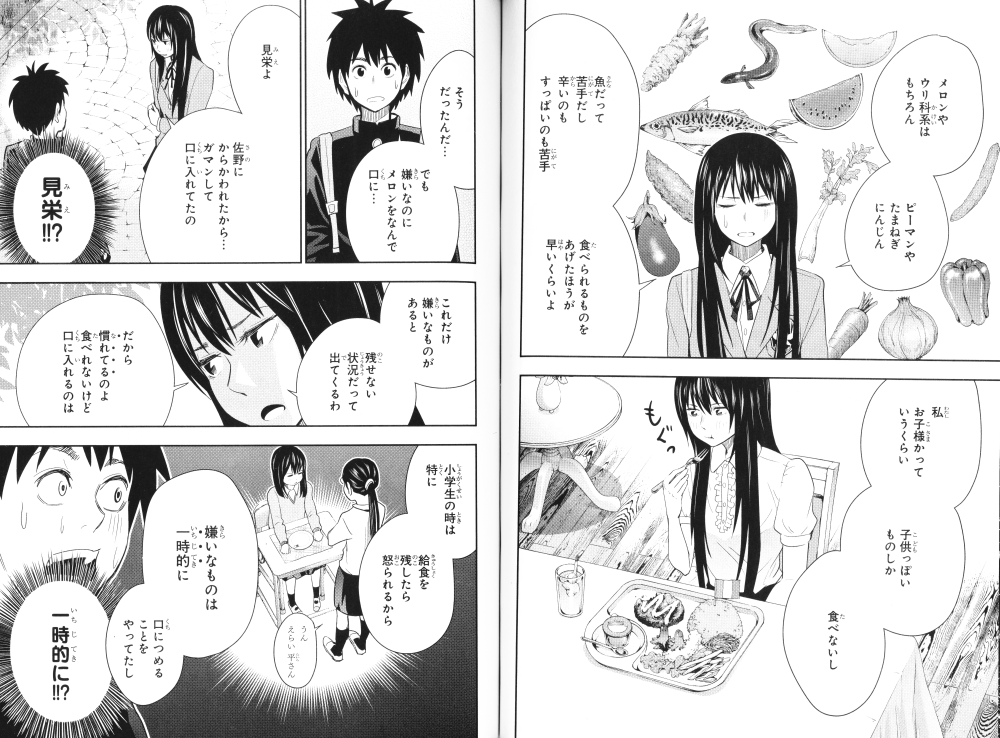
I recently picked up Volumes 2 through 5 of one of my favorite manga in recent years, Mogusa-san. Featuring a girl who eats anything and everything and has developed seemingly superhuman skills in order to get as much food in herself as possible without anyone noticing, it’s basically a series made just for me. One question that arises from reading Mogusa-san is, how do you keep this premise going? What kinds of characters do you introduce as complements or foils to Mogusa herself? The answer is, a closet picky eater who has some of the qualities of a tsundere without necessarily falling squarely into that archetype.

mogusasanvol3-chigumi-small

Taira Chigumi is the president of Mogusa’s class, and a seemingly strait-laced, no-nonsense individual. However, she harbors a deep, dark secret: she has the palate of a 10 year old. That means hamburg steaks and gummy candies are in, tomatoes and fish are out. Of course, she has an image to uphold, so she’s learned to basically keep gross foods in her mouth without swallowing them, and then force them down with a helping of coffee milk.

It makes sense in a way: opposite a girl who eats anything is a girl who eats almost nothing, and the added twist of giving her the taste buds of a child makes her rather endearing. When Koguchi (the male POV character) discovers her secret, she responds by violently attacking him. On the surface, this appears to be the stereotypical tsundere reaction, but it’s a little too active and conscious for that to be the case. Tsundere characters are usually based around having an almost involuntary reaction to embarrassment and having their true selves revealed (as parodied in the manga Mozuya-san Gyakujousuru, about a girl with tsundere as a form of clinical disease). Also, rather than having her priorities be love or the denial thereof, Chigumi simply wants to be friends with Mogusa because she sees how Mogusa just seems to love food more than anything else, and maybe, just maybe, if she spends enough time with her, that this quality will rub off on Chigumi as well.

mogusasanvol3-corn-small

Chigumi isn’t the only character who adds to the world of Mogusa-san, as it also features a little sister who eats character-shaped foods as if she were a Titan from Attack on Titan, and even an eating rival. Suffice it to say, I recommend this series 110/10. No, that’s not a typo.

If you liked this post, consider becoming a sponsor of Ogiue Maniax through Patreon. You can get rewards for higher pledges, including a chance to request topics for the blog.
The Comfort of Tech Skill in Competitive Games

The question of how much technical skill or physical prowess should play a factor in competitive games is an on-going debate that really puts at the forefront the tension between “games” and “sports.” I’ve discussed this divide previously in reference to Super Smash Bros. with the intent to understand both sides, but a recent comment by Starcraft and Hearthstone community leader Day[9] has me thinking about the extent to which technical refinement can contribute to the competitive viability of a game outside of the environment of competition itself.

While explaining why he believes that Counter Strike: Global Offensive is the best-designed competitive multiplayer game (emphasis on the word “design”), he organizes his argument into four key points that a lot of the best games tend to share: an engine that encourages interaction, room for strategy, variety of content, and some sort of execution skill with clear reward. In elaborating upon the idea of execution skill, Day[9] explains that it can often be difficult for players to feel a sense of improvement if the goal or evidence of improvement is too abstract. In contrast to the difficulty of tracking your decision-making, getting a basketball into a hoop has a clear goal, and the actions you take towards achieving that goal are immediately noticeable (did this help me shoot more hoops successfully or not?).

The reason why I want to focus on this idea of a high technical or execution skill is, first, that I can totally understand what he means from my own experience playing competitive games, and second, that it really opens up the idea of competitive gaming as being about so much more than just “winners and losers.”

In my time playing Japanese mahjong, I’ve run into a number of hurdles that made it difficult to truly gauge whether or not I’d improved. As much as mahjong takes skill, it’s still a game where luck is a significant factor, and when playing opponents who are equal or better than you, it’s not uncommon to go on a serious losing streak that makes you question if your previous wins were due to luck of the draw or if you’ve indeed progressed as a player. It’s only over the course of many games, as well as by facing players of lesser skill, that it becomes more obvious if your skills have improved. You begin to see the mistakes that you made in the past in the actions of other players, and you understand on a more fundamental level what made those decisions mistakes in the first place.

The big issue is that this is a painful way to go about improvement, and it would not surprise me if most people were not this masochistic about finding out whether or not they have become better players. One has to claw in the dark, finding bits and pieces of light wherever they might appear, and eventually find out if they’re now standing on something stable or a worn-out rope bridge.

Abstract thinking and decision-making are difficult to quantify, which is why something like a Training Mode in a fighting game is so appealing to players. As Day[9] mentions, even if you fall behind in terms of strategy, a game with a “high-variance execution skill band” can give players something to aim for (no Counter Strike pun intended) with very clear rights and wrongs. Compare trying to learn a high-damage combo to trying to understand intrinsically the concept of a “neutral game.” Some players are better at technical execution and others are better at grasping deep concepts, but I think both players would agree that the combo, the headshot, the waveshine are all much more tangible than what David Sirlin calls “yomi,” or reading the mind of the opponent.

This can be a problem, as explained by James Chen when he refers to fighting game players who try to master the art of complex attack patterns (mixups) that cause the opponent’s defense to falter (“opening up the opponent”) without actually understanding the fundamental goal is that you’re trying to psychologically intimidate the opponent into not blocking. James makes an important statement, which is that, while many people believe that the “neutral” (the game state where both players are fully in control and have equal dominance on the field) is all about the mixup, in fact the mixup is the reward you get out of winning the neutral. After all, what use is your amazing mixup and combo game if you never actually get to land it? It’s complex, I know, and it’s amazing that James is able to explain it so well.

Back to Day[9]’s point, what I find to be the major significance of this idea of high execution skill is that improvement becomes almost like a salve, a way of reassuring yourself that you’re not that bad, or that you see a clear path towards getting better. Unlike blaming your teammates (common to DOTA 2 and League of Legends), this isn’t merely a placebo; you’ve still gotten better at your game on some level, and the best players marry brains with brawn. When looking at discussions of competitive games, certain communities such as Super Smash Bros. Melee and Starcraft will tout their games’ “high skill ceilings” with respect to technical skill as signs of their superiority as competitive games and as esports, but the presence of a high skill ceiling also becomes a comforting warm blanket. Even if you falter in terms of strategy and abstract thinking, you have the option to continually improve without needing it because you can advance your execution skill.

When I say that this idea seems to bring competitive gaming away from the competitive environment itself, what I mean is that, even though the improvement of skills (be they mental or physical) are generally supposed to accompany you to the moment of competition (whether it’s a tournament or a ladder), the ability to look back at your progress and declare yourself better than you once were is just as important. “I am not what I was yesterday.” Unlike strategy where the personal rewards can be distant and obscure, execution skill is both a short and long-term confidence booster, bringing the competitive game to be just as much about constructing pride as it is about victory or defeat.

If you liked this post, consider becoming a sponsor of Ogiue Maniax through Patreon. You can get rewards for higher pledges, including a chance to request topics for the blog.

Hikigaya Hachiman Changes, Whether He Likes It or Not

snafutoo-hachiman

My Teen Romantic Comedy SNAFU was a pleasant surprise I had originally written off. In spite of its excessively light novel title and its school romance setting, the series exhibited a great deal of maturity. I recently finished the second series, and while I won’t go too into detail about it (my first review still applies in a lot of ways), I did want to talk about what I find to be the most notable aspect of My Teen Romantic Comedy SNAFU TOO!, which is the willingness to let its main character, Hikigaya Hachiman, grow.

You might be thinking, “What’s so special about character development? That’s what stories typically do.” In a way, there is indeed nothing impressive about how Hachiman changes. However, given his personality, that of the cynic and outcast who observes human interaction in order to point out all of the unnecessary niceties that people throw out in their daily lives, I would have assumed that he would forever remain in that capacity. However, the second series really shows Hachiman being affected by the different people he helps out and interacts with, to the point that he begins to question how he approaches solutions and how he categorizes people, allowing bits of optimism and consideration for others to seep into his way of thinking.

The most fascinating to me about this change in Hachiman is how he processes these small changes in his values through his hyper-logical, hyper-pessimistic outlook, and has to struggle with where it seems to contradict his preconceived notions. What really hits home is the way he realizes that his actions potentially hurt not only others but himself as he increasingly values his friendship with Yuigahama Yui and Yukinoshita Yukino, the other central characters of the series.

The fact that there’s no clear favorite in the love triangle is also really notable. How often does that happen?

The Fujoshi Files 147: Izayoi

Name: Izayoi (十六夜)
Alias: N/A
Relationship Status: Single
Origin: Moehime

Information:
One of the “Kachou Fugetsu,” a group of youkai in the Heian period, Izayoi is a strong-minded individual who will say whatever’s on her mind and will work hard towards her objectives. She has an eye for men, and often finds herself having the opposite tastes of her fellow Kachou Fugetsu member Kazabune. Upon meeting the writer Tomoe, she learns that Tomoe is the author of one of her favorite books, The Bamboo Prince.

Fujoshi Level:
Izayoi prefers works with strong “seme” characters, and appeears to be quite into BL overall.

A Mission for Myself: New York Comic Con

General Thoughts

As New York Comic Con has come to rival San Diego Comic Con and become its east coast counterpart, the scope and demand of NYCC are constant points of consideration for any potential attendee. While the convention pretty much improves every year and little can be faulted for how it’s run, the guests they bring, and just the amount of stuff there is to do (aside from perhaps the inevitable over-emphasis on professional and industry panels), I find that there’s a certain evaluative process I notice my friends and me going through every year, which all boils down to the simple question: should I attend next year?

First and foremost, as an anime and manga fan I have to say that NYCC delivered, and in ways I hadn’t expected to affect me so deeply. This year, they most notably brought Naruto creator Kishimoto Masashi and Uzumaki Naruto voice actress Takeuchi Junko and premiered Boruto: Naruto the Movie for the first time outside of Japan (see my review here). Aside from some hiccups in terms of the Hammerstein Ballroom venue—the overly strict no food policy went so far as to ban bottled water, and the concert-oriented seating obscured the screen for significant portions of the viewers—it was the most memorable part of the convention for me, and it brought me back to 13 years ago when I was at the height of my own Naruto fandom.

On top of that, the announcement of a Tiger & Bunny film helmed by Ron Howard was the biggest surprise by far of NYCC, and the opportunity to get a personal drawing from Attack on Titan animator Asano Kyouji was a rare treat. While I was unable to get Asano to draw Holon from Real Drive like I hoped (to be fair that show is 10 years old), this image of Sasha from Attack on Titan is the coolest thing I brought home from New York Comic Con:

However, my experience with NYCC made me realize just how disconnected I am from a lot of current fandoms. This isn’t to say that I disliked New York Comic Con, or what it does. I’ve always enjoyed the mix that New York Comic Con brought, between the opportunity to meet professional artists, the focus on entertainment media that has extended out from the superhero movie boom, and just the general celebration of nerd culture. However, partly because I was out of the country for four years, and partly because of my own general taste for things, I haven’t been as deep into certain popular works in recent years as I might have been in the past.

What really brought this point home to me was how much I enjoyed the Justice League Reunion panel. Seeing Carl Lumbly talk about bringing his cultural heritage to the role of the Martian Manhunter as an immigrant with a traumatic past, finding out that Justice League Unlimited was a clever and creative compromise with a soulless marketing engine that wished to use the cartoon purely as an action figure commercial, and hearing Kevin Conroy sing “Am I Blue?” flooded me with so many fond memories of what made that series great. It made me recall the character of A.M.A.Z.O. and how incredibly deep and interesting his story was, and the “Ask the Justice League” portion was downright hilarious, especially Martian Manhunter’s greatest enemy being “a villain made of flaming Oreos.” It made me want to find this feeling again within more non-Japanese works.

This is certainly not a criticism of the current state of animation; many fantastic works have been and are still being created. Rather, it has made me aware of just how much a connection to the “nerd mainstream,” as it were, fuels New York Comic Con. NYCC is a for-profit convention backed by the entertainment industry, and it will aim for the works that hit the widest audience, or at least the widest audience within a niche. This is what fuels the decision for a Firefly panel, or indeed inviting a manga megastar like Kishimoto. Rather it fuels my desire to expand my interests further than where they are currently, to get a better sense of the zeitgeist of current American (and non-American!) fandoms.

Exhibitor Hall, Artist Alley, and Panels

Again, when it comes to the actual con, there was much to enjoy. In the Exhibitor Hall, I got the chance
to try Street Fighter V, say, “Domo” to Ninja Slayer, and get that cool Sasha drawing from Asano.

The Artist Alley, as always, was a great place to meet artists, find out about new works, and see the trends that fuel the creators. Superheroes are a no-brainer, anime is less prominent but if it is it’ll be something that captured the imaginations of American fans, such as Dragon Ball Z or Sailor Moon. Stylistically, I made just one purchase at Artist Alley this year, issue 1 of a comic called Henchgirl by Kristen Gudsnuk, the premise of which is exactly what it sounds like. The Artist Alley filled with everything from amateurs to industry veterans, with talent abound. However, I tasked myself with a challenge, which was to find something that spoke to me, that didn’t rely on name recognition, and that wasn’t too tempered by my own preferences for specific types of characters or heroes. Gudsnuk’s drawings resonated with me the most because of the humor and soft, cartoony style. If you’re curious, you can read the comic online for free.

The other highlight of the Artist Alley might have been seeing a small kid, probably no older than 6 or 7, hand a copy of Days of Future Past to Chris Claremont.

As for panels, it’s no secret that a for-profit con like NYCC will have a different flavor from a fan-oriented endeavor such as Otakon. I generally enjoy the latter kind more when it comes to programming, but NYCC has a pretty consistent track record of quality, possibly because it’s such a big deal now and encourages industry hosts to bring their A-Game, as seen with the Justice League Reunion.

The Kishimoto panel was a rare opportunity to get into the mind of one of manga’s most successful creators. While the questions were curated, the host did a great job of opening up Kishimoto, and I’m sure that him no longer having to keep deadlines or worry about how his answers might influence sales of Naruto allowed him to give responses that were a bit more candid than what is usually seen from Japanese guests. Probably the best thing I found out from the panel was the friendly rivalry shared by him and One Piece‘s Oda as Shounen Jump‘s two frontrunners, as well as the titles that influenced him most. That said, I hope the audience that was mostly silent after hearing Kishimoto mention Tezuka Osamu’s Phoenix get the chance to find out more.

“Push Boundaries Forward: Gender, Diversity and Representation in Comic Books,” featuring Marjorie Liu, Darryl Ayo, David Brothers, Amber Garza, Jeremy Whitley, Joey Stern, and Shannon Waters was one of many panels over the weekend that focused on addressing the changing dynamics of comics creators and readers. Both the audience questions and panelist answers showed a strong desire to move forward, to learn, and to understand that greater diversity in comics is a multifaceted challenge that never ends, and is ultimately beneficial to comics as a whole.

The Felicia Day panel was pure Q&A, and that’s exactly what the audience wanted out of it. Incredibly charismatic in that awkward way that appeals to geeks most, Felicia Day genuinely engaged her audience with an attitude that was both deeply caring and kind of flippant, bringing a realness to her answers. The best moment was when she complained that you couldn’t have sex with her character in Dragon Age 2, which her manager had ordered the studio against.

The Sunrise panel showed once again that they’re one of the direct-from-Japan studios to really get what it means to throw a panel. In addition to the surprising news about Tiger & Bunny, their announcements were varied and spoke to different portions of their audience. By the way, if you heard a couple of loud guys cheering for Giant Gorg, that was me and Patz from the Space Opera Satellite Podcast. We were serious, too. Giant Gorg is a rare series directed by the character designer of the original Gundam, and had been in licensing hell for years.

GORG!!!

Yo-kai Watch is also a thing.

Finally, I decided to attend a screening of a Love Live! concert, partly to satisfy my curiosity about this particular aspect of Love Live!‘s media mix, and to see the fan reaction. What I got out of it is exactly something I mentioned in my review of The School Idol Movie: the series is extremely malleable by fans, going from a warm, inspiring story full of interesting characters to a mountain of instant memes at the drop of a hat. As people shouted at the character Ayase Eli, “DON’T LET YOUR DREAMS BE DREAMS,” I wondered if that could somehow be parlayed into the slogan of Love Live!: “Make our dreams alive!”

Cosplay

As with most con reports at Ogiue Maniax, I’d like to leave off with some cosplay. Truth be told, I wasn’t digging a lot what I saw, but Sunday really turned it around.

Rediscovering the Ninja Spirit – Boruto: Naruto the Movie

This review is part of Ogiue Maniax’s New York Comic Con 2015 coverage. Major spoilers for the Naruto anime/manga and minor spoilers for Boruto: Naruto the Movie are included.

Once upon a time, I was a huge fan of Naruto. Having both read the manga and seen the anime from the very beginning, I can still remember what got me hooked onto the series in the first place. The rich world of competing ninja villages provided the space for elaborate and creative battles. The fact that every character, hero or villain or somewhere in between, had their own stories and their own pasts that shaped who they are made it so that Naruto could be so many things to so many people. I wanted explore their society, to imagine what powers and characters would appear next. I have many fond memories of Naruto that can be best summed up by the fact that, even if he was never among my favorite characters, Uzumaki Naruto himself embodied not only a sense of tragedy but also the drive and empathy to move forward and help those who are similarly lost.

At some point, however, I fell off the Naruto fan wagon. Sure, I still enjoyed it to an extent, and I more or less kept track of what was going on, but I found that the continuously escalating power creep of shounen manga and the ever-growing and unwieldy cast just made Naruto feel as if it had lost focus. I don’t mean that it didn’t know where it was going, but rather that when the series became chapter after chapter of gigantic, virtually city-sized attacks, those humble beginnings of Naruto and his companions trying to navigate their world got lost in the shuffle.

This is why I actually enjoyed Boruto: Naruto the Movie so much. It felt like a return to the foundations of what made Naruto great, yet also does not deny all of the artistic and narrative development that happened since then, power levels and all. It encapsulates Naruto and eternal friend/enemy/rival Uchiha Sasuke’s growth by showing how they pass their experience on to the next generation.

At the start of the Boruto, it’s been many years since Naruto saved the world. Naruto’s son is Boruto, whose mother is Hyuuga Hinata (who is my favorite Naruto character). Unlike Naruto, who was an orphan and shunned by his community due to housing the fox spirit, Boruto must deal with the fact that his father is the world’s greatest celebrity. Naruto, who has since fulfilled his dream of being Hokage, is so busy that this leaves little time for Naruto to be a father, and Boruto lashes out against that. Understanding between father and son, as well as the value of hard work, are ultimately the main themes of the film.

When I say that Boruto feels like a return to the Naruto of old without shunning what it became, what I mean is that it really captures a sense of the inner struggles of its characters within their elaborate world of ninja fantasy, while also communicating the passage of time perhaps better than the manga itself ever did. For the younger generation, it gives a strong sense of what motivates each and every character, while remaining sharp and complete as a story. For the older generation, one can feel the developments, through their interactions and especially through the fighting, that brought these familiar faces to where they are now. Rather than being in the haze of hundreds of chapters or episodes, the movie conveys just how much these characters have grown over the years, both within their universe and as characters in a work of fiction. When Naruto harnesses his ultimate powers, what jumps out is the sense of hard work, pain, and joy that led him to this point.

While Naruto has always been a story of generations, particularly the young both surpassing and learning from the old, a story dedicated to exploring the relationship between father and son is something new to the series. Sure, there was the arc where Naruto finally meets his father, among other examples, but for the most part Naruto is generally a manga and anime where parents’ legacies are more important than the parents themselves, who are either dead or in the background. Naruto was an orphan, Sasuke’s parents were murdered by his own brother, Sakura’s folks were still alive but hardly relevant. Now, not only is it Naruto and Hinata with children of their own, but most of the rest of the characters as well, and it’s a joy to see the direct connection between generations play out in greater detail.

I watched Boruto as part of the 2015 New York Comic Con, which, much to the delight of Naruto fans, invited Naruto creator Kishimoto Masashi and Naruto voice actress Takeuchi Junko as guests. During his first interview of two, Kishimoto mentioned that he had remained true to his vision for the ending (which he came up with back in 2009), one where Naruto ultimately saves Sasuke from himself. Looking back, it made me realize just what Kishimoto had been going for at a point when Naruto as a story seemed to be getting crushed by the perils of long serialization (Naruto ran for 18 years). There was a point in the manga when it seemed to transform into the Sasuke Show, that it was it turn doomed to a fate of meandering and directional changes. Now, I realize that it was meant to show Sasuke’s descent into darkness so that Naruto could be the light that guides him out of it, but again, within that long weekly shounen struggle it’s all too easy to lose sight of the overall context.

In contrast, Boruto suffers no such issues, and that helps it stand out in a significant way. The movie keeps at a fine pace in spite of the gigantic cast of characters. It would be all too easy to falter by showing too many characters doing too many things, but this is really Boruto’s story in the end, and it’s a satisfying and heartfelt one.

The last thing I want to say is that, at certain points in the movie, I was on the verge of tears. Thinking back, I recall the same thing happening upon seeing the tragic story of Zabuza and Haku, Naruto’s first real antagonists, play out beautifully. It was at that point all those years ago when I realized that Naruto was something special, and Boruto feels very similar. A part of me, the part that remembers what it was like to first discover Naruto and to be fascinated by its world, would like the story of Uzumaki Boruto to go on, but overall I would be fine if this ends up being Naruto‘s swan song.

If you liked this post, consider becoming a sponsor of Ogiue Maniax through Patreon. You can get rewards for higher pledges, including a chance to request topics for the blog.
To Be the Hero

aidariko-blue

I’m a fan of characters who support. Whether it’s Dominic Sorel in Eureka Seven, who stands by the long-suffering Anemone or Aida Riko in Kuroko’s Basketball, who coaches and manages the Seirin High School Basketball Team, often times my favorite characters are those who care less for being the “hero,” and who try to make a difference in their own way. Generally speaking, I’m of the belief that there are many ways to make a difference, and that you don’t need to be the one chopping the monster’s head off, nor should we fault others for not aspiring to be that mighty warrior. Indeed, even more recent main characters like Kuroko Tetsuya in Kuroko’s Basketball and Onoda Sakamichi in Yowamushi Pedal are protagonists whose powers are primarily based on “support.”

However, I find that, as much as I enjoy that character type, they potentially are a source of complacency, and one might even argue that they teach people to settle for less. Case in point, while I think Riko does a lot for her team and is just a great character in general, she derives from an archetype that is basically a sideline cheerleader. They’ll either be the newbie who needs things to be explained, or the informative expert who does the explaining, but when the chips are down their purpose in the story is to stare longingly as the hero goes into action. There’s some sexism historically at work here, with female characters being created to serve the male leads, but I don’t want to make the issue purely about sex and gender, especially given all of the work that’s been done to play with and expose those tropes, like how Witch Craft Works essentially genderswaps the typical shoujo heroine and shoujo ideal love interest. I also don’t want to deny the ability for a “sideline cheerleader” to be an interesting character in their own right. Rather, it’s more about the idea that “everyone is the hero of their own story,” and how there are positives and negatives to it.

On the one hand, the notion that everyone is the main character in their own lives, be it reality or fiction, can be a self-fulfilling prophecy of confidence, where one imbues oneself with agency and ambition, and accomplishes their goals. At the same time, it might cause people to seek out “glory” without necessarily finding their own definition for the word, instead conforming to what their society (or what readers supposedly think) are parameters for success.

On the other hand, if one believes in supporting others, this might afford them a point of view that could go unnoticed otherwise. Glory for oneself is unimportant, because what really matters is doing what one can. However, this same mindset carries the risk of encouraging passivity to the point that people might inadvertently lose opportunities to better themselves. Perhaps it even becomes an excuse for why they remain in their rut.

Obviously these are in a way two extremes, and that there is a full spectrum between light and shadow, to borrow a phrase from Kuroko’s Basketball. Characters like Riko and Dominic essentially work in opposite directions towards a center, with Riko coming from the manager character and Dominic defying what it means to “rescue the girl.” There’s a lot of interplay and room for interpretation, and it opens up paths for artists, be they professional, amateur, and/or fan, to explore and defy what they’re told is “normal.” I just find myself thinking about how simply saying that I prefer support characters can carry a lot of implicit meaning.

The last thing I want to leave off with is a scene from Game of Thrones, when Tywin Lannister, the patriarch of the powerful House Lannister, asks his grandson what makes a good king. When the grandson replies correctly with “wisdom,” Tywin is ecstatic and explains that wisdom comes in part from knowing what you don’t know, and heeding your advisers who are experts in their fields. In this case, though the king is supposed to be the one with all of the glory, is it the case that being a king is perhaps the biggest support position of all?