On my winter 2023 trip to Japan, I happened to do a good deal involving trains and train accessories. This is Part 1 of my experience, focused on the Railway Museum in Omiya, Saitama.
The Railway Museum
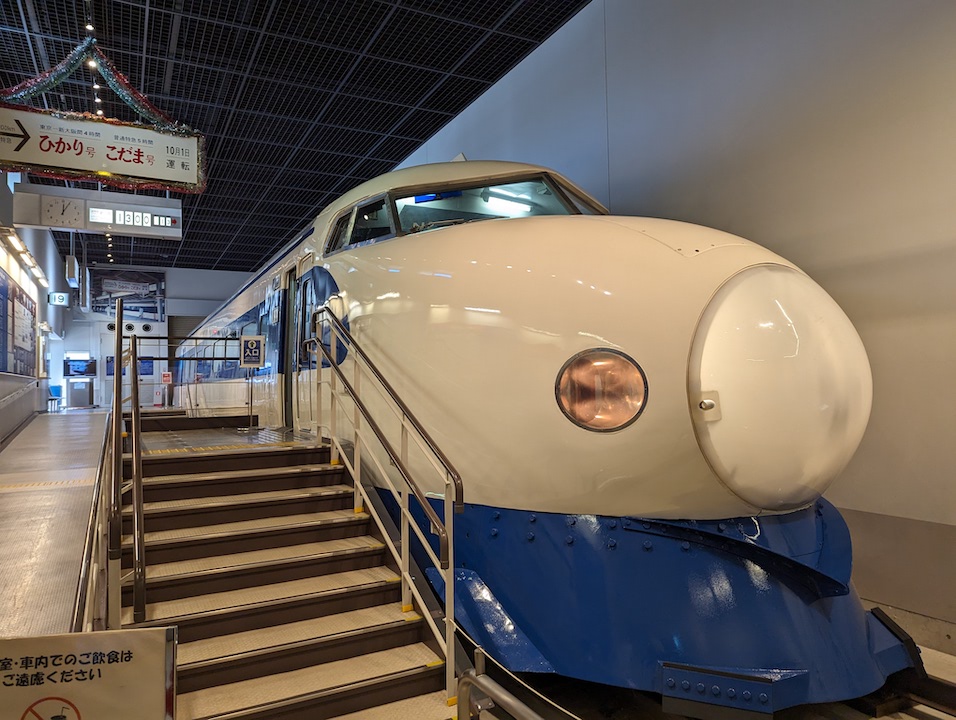
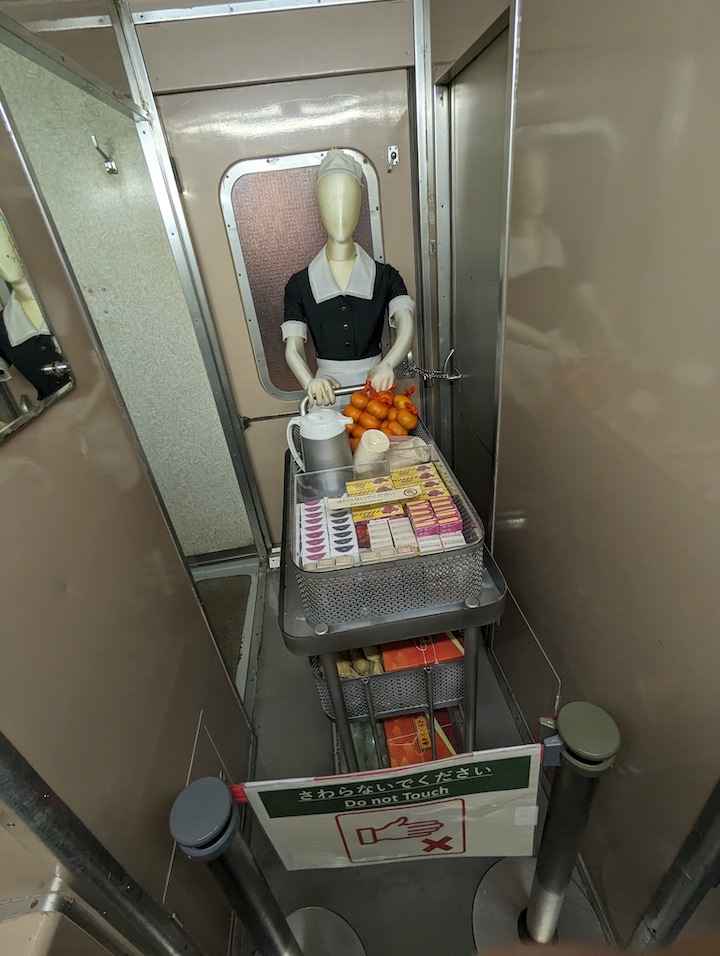
Owned and operated by Japan Railway, the museum features exhibits about the country’s trains, as well as actual decommissioned train cars. Getting to see and even sometimes walk through trains from throughout the history of Japanese rail is a blast that scratches two itches: a fondness for exploring cultural development and a love for large machines. Whether it was going inside the very first bullet train, seeing a train meant exclusively for the emperor, or learning about manually powered carts that utilized laid tracks, I got a lot out of simply being there.
There was also a restaurant that served authentic train cafeteria foods from the olden days, but unfortunately, I already had lunch plans that prevented me from eating there. I did snag some microwaveable train curry to try at a later date, though (more on that in the future).
One highlight was seeing the kids who loved being there. Whereas some museums typically have adults dragging bored children there, this was not the case at all. These young train fans were captivated by everything they saw, and some even dressed up as conductors. It made me realize that the train otaku of Japan start young—a recurring theme that I saw throughout my trip.
Shinkalion Shorts
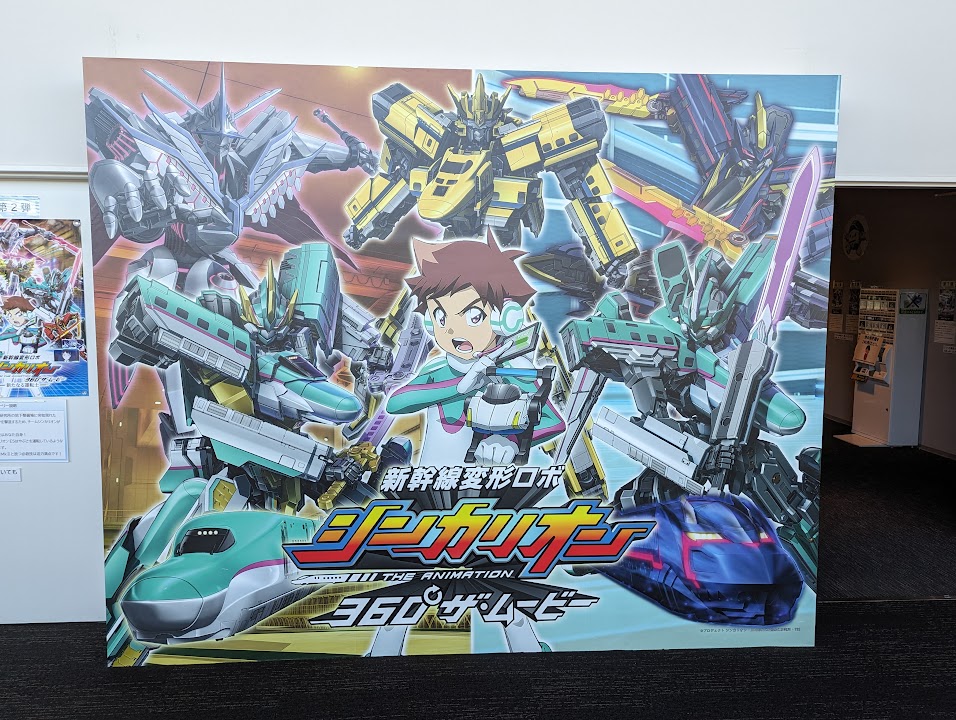
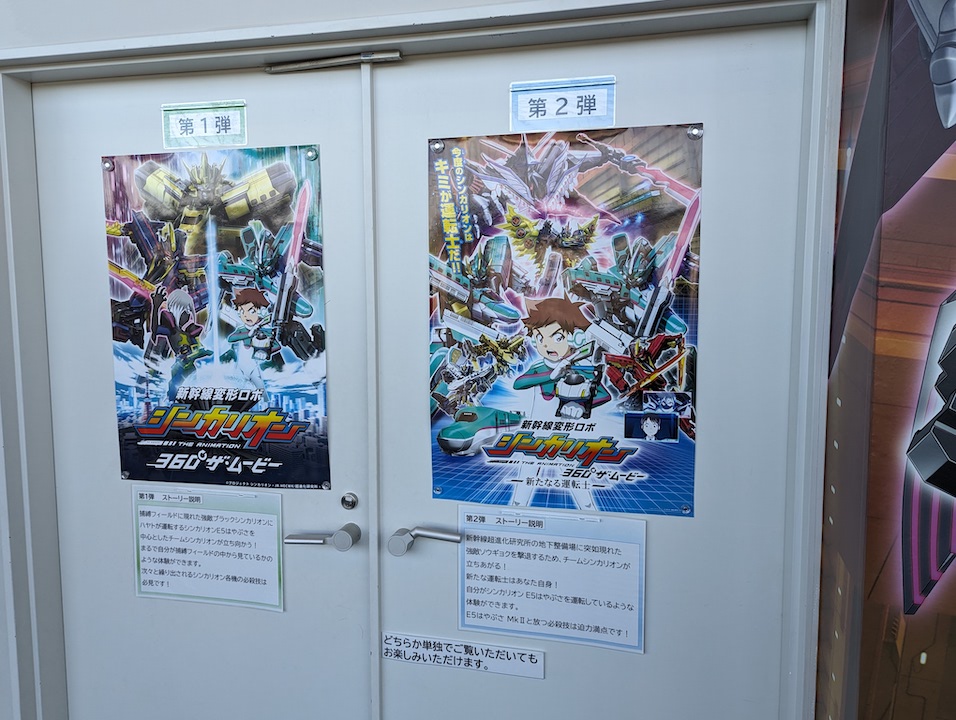
Speaking of kids stuff, I was delighted to find out that the Railway Museum has showings of two shorts from Shinkansen Henkei Robo Shinkalion: The Animation, the mecha anime about transforming bullet trains. Specifically, they’re Shinkalion: The Animation—360° The Movie and Shinkalion: The Animation—360° The Movie: The New Driver. Both cost a little extra—around 700 yen each—with each around five to eight minutes. The seating capacity was quite small (around 20 seats), but I did see some kids and parents watching as well. They also had showings throughout the day, so anyone curious could dip in at their own convenience.
Both shorts take place in the world of the anime, with the second taking place later in the story than the other and including the audience as the titular “new driver.” The main gimmick for these shorts is they’re shot in 3D and (as implied) in 360 degrees. When laser beams go flying, you can look over your shoulders to see it disappear in the distance. They’re fun little things that I’m glad to have experienced.
Coincidentally, the makers of the series actually announced a new anime on Christmas called Shinkalion: Change the World. The characters look a bit more mature than in previous series, and I wonder if they’re aiming for a slightly older audience.
With only a few exceptions, Precure has always been resistant to portraying its heroines when they’re older. If they’re middle schoolers, that’s all you’ll ever see them as; if they’re high schoolers, same deal. That’s why one of the 20th anniversary projects, which portrays some of them as adults, came as such a surprise.
Power of Hope: Precure Full Bloom is a series that brings back the cast of 2007’s Yes! Pretty Cure 5and 2006’s Futari wa Pretty Cure Splash Star in their 20s, clearly aimed at the original audience of young girls who have themselves grown up. Known as Kibou no Chikara: Adult Precure ’23 in Japan, the story centers on the eight former Precures as working adults. When mysterious shadow monsters start appearing all across town, they discover that they can age backwards to their old middle school selves and transform once again into combat-ready magical girls.
Thematically, one of the biggest things about Power of Hope is the way it portrays a messier and more complicated world than the actual main series of the franchise. In contrast to the generally rose-colored optimism of their youth, the girls are all running into challenges that can’t be solved by sunny dispositions alone. Even those who have basically achieved their childhood dreams see that joy crashing into reality. What’s worse, they are well aware of how little other adults care about their fellow human beings. Rather than concerning itself with girls who are trying to find themselves and what they want to do in life, the anime is more about confronting the cynicism of the “real world,” both locally in Japanese society and on a global scale. Among the topics brought up are overly conservative and sexist workplace bosses, climate change, fear that you peaked too early and that your life is all downhill now, unethical mining in Africa, rampant capitalism, and so on.
It’s funny to me that this series would come out in the same season as Bullbuster, an anime also about working adults connected to a domain usually seen as kiddy (magical girls, mecha). Like Bullbuster, Power of Hope refuses to say that things will work out in the end—it just hopes we can reach that better outcome.
The creators of the show clearly put a lot of thought and effort into aging up the girls. Where many series might just make them taller, change their hair a bit, and call it a day, Power of Hope really gives each of them a mature quality that is uniquely their own. In fact, I consider these adult designs to be some of the best I’ve ever seen. The only shame is that they decided not to give them grown-up versions of their magical girl forms. I suspect it was as much a time saver as anything else—it allows the anime to reuse stock footage from the original series they came from. Splash Star kind of gets shafted here just because it’s a digital-paint anime from before the transition to HD broadcasts in Japan, so it really shows its age.
A number of characters make cameo appearances, and fans of those earliest Precure series are likely to get a kick out of their presence. Of particular interest are the hosts of the online video channel “Dark Night Light,” in which two familiar voices make for surprisingly hilarious comedians. My only real gripe about the guest characters is the fact that Masuko Mika—the old intrepid school journalist—is nowhere to be found.
While the mainline Precure titles touch on some serious topics, they also are not in the business of crushing children’s aspirations. The presence of adversity usually carries a message to not give up because things will look brighter on the other side. But now that those same kids are older, it wants to speak to them as adults. In Power of Hope, it’s more like “some people just suck, but you still gotta work for a better future for yourself and the world.”
I originally wanted to take my time writing about why I like Selen Tatsuki, but circumstances have dictated a change of plans.
(Content Warning: Brief discussion of attempted suicide)
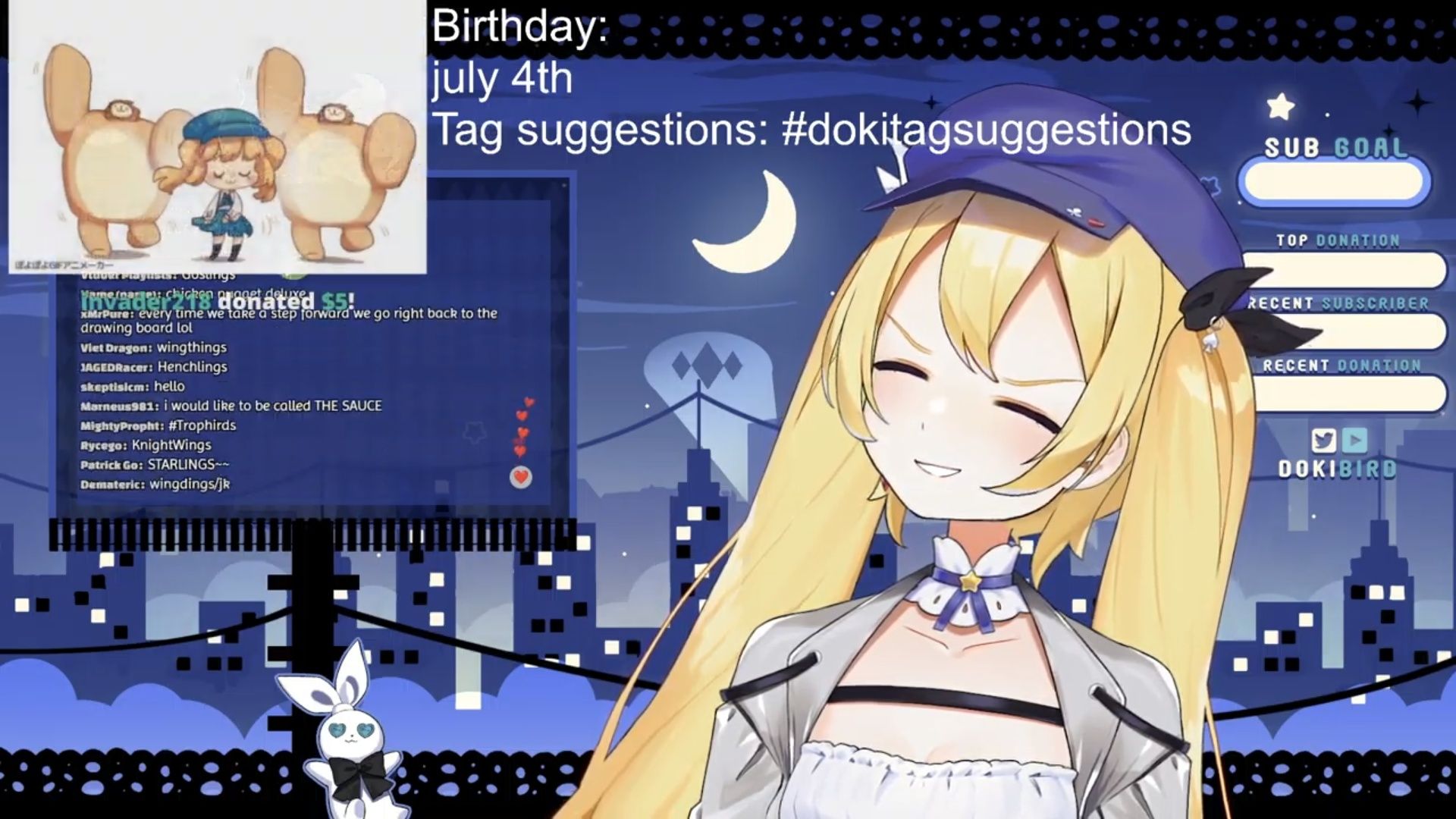
In what is possibly the most notorious Virtual Youtuber firing ever, the purple dragon with the infectious cackle and 800,000+ subscribers is no more, her channel now devoid of all the videos that made her famous. In Selen’s place has risen a new—or rather old—alter-ego from the woman behind the digital mask: Dokibird.
I’m a fan of Doki/Selen. And with this being the Lunar New Year season (a time she has mentioned being culturally important to her), I thought it more important than ever to explain what makes her one of my favorite VTubers.
Discovering the Dragon
I actually don’t quite remember how I discovered Selen. I might have watched her debut stream, but I can’t even check because the VOD is gone. Whatever the case, I think what made me really take notice (after her iconic laugh) is when she revealed herself to be Cantonese. She is one of the two biggest known Canto VTubers along with hololive’s Hakos Baelz, but while the latter took time getting comfortable sharing about her heritage, Selen embraced talking about it pretty immediately. That’s why I included a clip of her for my Otakon 2022 panel, Hong Kong in Anime and Manga. Her Cantonese (and sometimes Mandarin) streams were downright hilarious, and I think relatable for anyone who grew up in an immigrant household.
From there, I quickly grew to appreciate Selen’s antics. For one, she is incredibly entertaining while teasing others, but also just as much so when she’s on the receiving end. During sessions of Apex Legends, Selen would use a combination of skill, cunning, and entertaining obnoxiousness to take heads and win games. At the same time, this combination would also sometimes land her in hot water, and the consequences were equally hilarious. The quick switch from her characteristic laugh to a loud “OH SHIT!” is delightful. She’d bring this attitude to everything she plays (even Pineapple on Pizza and Peppa Pig), but I focus on Apex not only because she’s famously strong at the game, but because I usually never watch first-person shooters. Selen actually made them fun for me.
On the topic of Apex Legends, it would be remiss of me to not mention the story of Team Snake Bite.
A Friend in Need
Team Snake Bite, the trio of Selen and holostars EN members Axel Syrios and Regis Altare, almost didn’t happen. Axel had been invited to a big VTuber-only Apex tournament, and he really wanted to bring Selen on board. The only problem: the tournament organizer, Shibuya Hal, thought Selen was too good. Unlike many other competitions, V-Saikyo is about bringing together veterans and newbies alike, and Selen potentially could make any team unstoppable: She had once reached Predator, a rank that positioned her as one of the 500 best players in the world. But Axel managed to convince Hal to let her in, with the caveat that she would be worth more points than anyone else. Regis would round out the team, arguably being underrated due to the fact that his experience with FPS balanced out his lack thereof in Apex specifically.
Part of the fun of team competitions such as this is getting to see the players practice while shooting the breeze, and in one fateful stream, Selen asked a pivotal question to her squad: If a poisonous snake bit your friend on the dick, would you be a homie and suck the venom out? This offhand bit of trolling would quickly evolve into a running gag, an official team name, and a slogan: Do not wallow, TSB is here to swallow.
Watching Team Snake Bite is probably the most fun I’ve ever had following an FPS, and it’s all thanks to their collective antics. For example, during scrims, they just couldn’t seem to win any games—until their coach, pro player Nocturnal, offered to buy them all pizza. Suddenly, a switch flipped, and they took not just one, but two victories. The banter, the teamwork, the chaos, and of course, Selen’s chuckles made things memorable.
Unfortunately for them, TSB underperformed in the actual event. They were possible favorites to win, but ended up in the bottom half of the results. Afterwards, Selen would describe herself as someone who gets really anxious in competition, and the skills she’s known for don’t come out as easily in a less casual setting. But this only made her more endearing: To know that Selen has an issue with nerves makes her a person of delightful contrasts. And even during the tournament, Nocturnal praised Selen for her situational awareness.
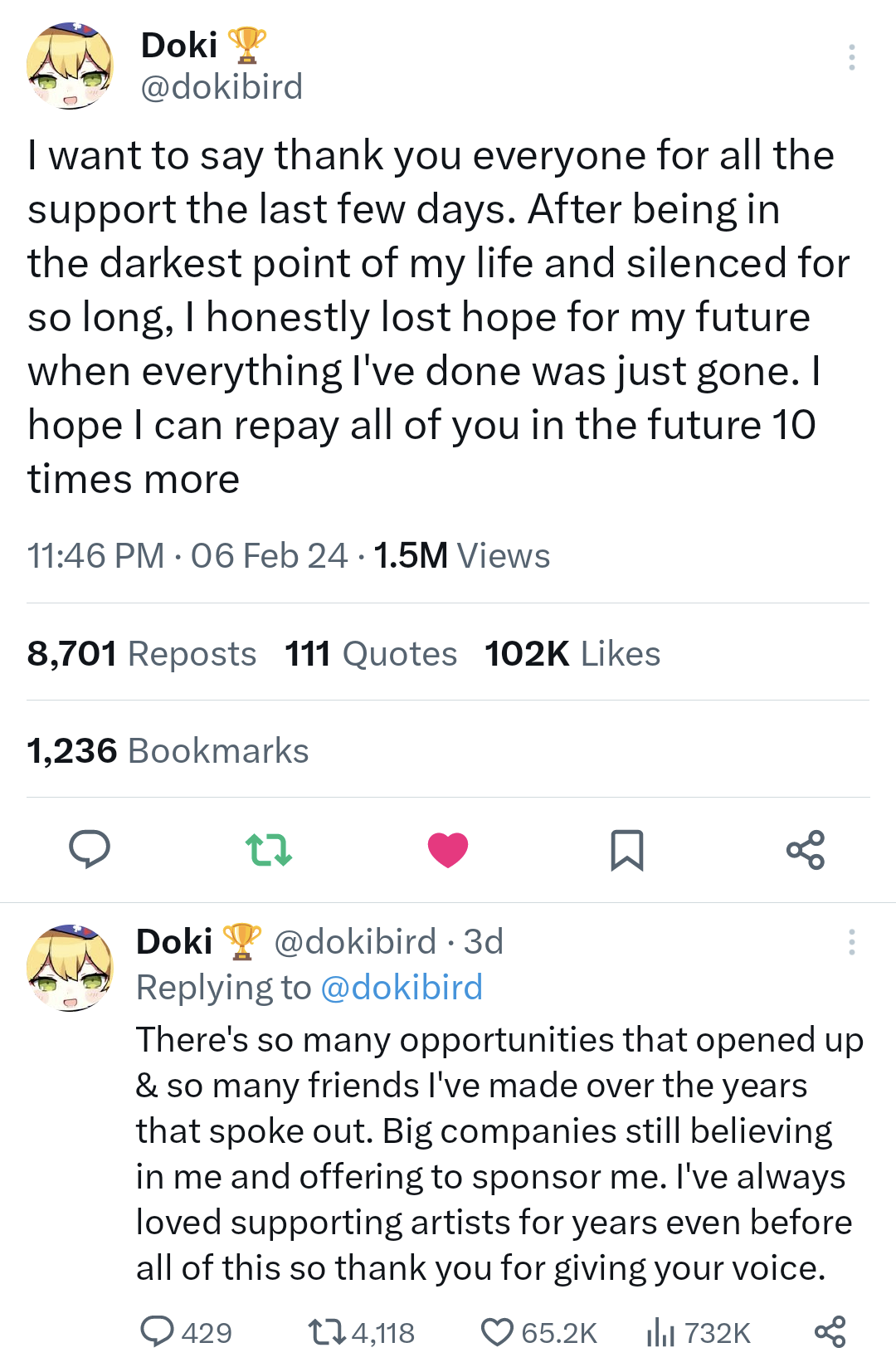
A few days after Selen’s termination and reemergence as Dokibird, Axel made a tweet:
Take My Money
As fond as I’ve grown of the VTubing scene as a whole, I’m pretty judicious with where I spend my money. I might think the world of someone, but I always want to be cognizant of where my cash is going. That’s why it took me a while to support Selen monetarily, but it did happen eventually.
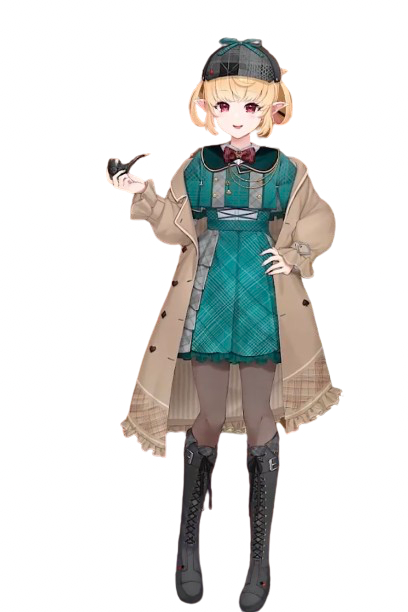
First, I bought a voice pack or two; I wanted to show my support in small ways. Then came a very special costume reveal: a Moriarty/Arsene Lupin–inspired design to rival “Sherlock Poms,” a detective motif for fellow (now-former) Nijisanji member Pomu Rainpuff.
Not only did “Moritsuki” look amazing, but she even commissioned a video game based on that detective theme to go along with the costume!
Selen had already been known for being ambitious with projects. She was one of three to help bring about the VRChat mascots designed by Priichu, which are some of the best chibis I’ve ever seen: adorable, full of personality, and successful at capturing the spirit of their designs while consistent with one another. She helped expand the VRChat worlds, holding 3D concerts in lieu of actual official 3D models. Then there was WrestleSanji, basically a VTuber version of my old love, VGCW. Seeing how she went above and beyond with both the Moritsuki outfit and game, I knew I had to join her membership.
I just didn’t expect it to last a mere six months.
One thing I regret is never getting any official physical Selen merch, especially of the Moritsuki look or her 2nd outfit (see above). Now that she’s returned to her original indie persona of Dokibird, I don’t plan on making this mistake again.
Final Thoughts
I often talk about the similarities between VTubing and pro wrestling, and in Dokibird’s situation I find another commonality: These worlds are the only two where you can have a dominant public identity, switch to a new one, and then revert back to your old self. In the case of wrestling, it literally happened just a few weeks ago. Unusual as it may be, though, I’m glad we have these opportunities to see the same person again, whatever form they take. No matter what her outer shell looks like, Doki’s charisma shines through.
Although she has plenty of strengths as a streamer, I think Dokibird’s appeal ultimately comes down to the fact that she’s just fun to be around. I have no delusions about seeing her as anything beyond an entertainer with a career that involves interacting heavily with fans, but she often comes across as just a really enthusiastic friend whose caring, yet sardonic attitude adds to her charm. Whether she’s playing her favorite games or ones that make her suffer, whether she’s just talking idly or giving insight into her own life behind the scenes, Doki is great.
That’s why it still horrifies me that we almost lost her forever in the worst way possible. It would have been an absolute tragedy, and I’m grateful that she was able to come back from the brink. With her triumphant return to streaming (where she got over 120,000 concurrent viewers and over a million VOD views), I’m glad that her fans have a new opportunity to show their support.
I don’t know if she’ll ever read this post, but that’s not the point. I hope that these words I’ve written can contribute to the collective love for her, and that they can help foster a positive environment where she can thrive.
My initial impression of the anime Gene of AI was that it reminded me of Urasawa Naoki, manga author of Pluto, 20th Century Boys, and more. Urasawa has a distinct way of drawing characters, and Gene of AI author Yamada Kyuri seems to follow many of his stylistic quirks. But it’s not just the aesthetics that are reminiscent— the robust examinations of humanity and culture are also of a similar vein.
All this might sound like I’m accusing Yamada of being a pale imitation, but I’m not. Gene of AI stands on its own two legs as an interesting piece of science fiction that speculates about a world where artificially intelligent beings called humanoids live alongside humans. Humanoids have their own unique medical challenges, as well as moral and ethical quandaries. In the thick of it all is the main character, a fully human doctor of humanoids named Sudo Hikaru who also secretly performs extralegal treatments for those who can’t go through normal channels.
More than merely asking what it means to be human, Gene of AI examines the complexities that come from a world where equal human rights for sentient AI has long been the norm. The series presents a variety of intriguing problems, like how the artificial limits of humanoid capability and the unknown/volatile nature of human capability can create mutual envy, of how the distinction between humanoid and robot is blurry and imposed from the top down. In this way, Gene of AI bears some resemblance to Urasawa’s Pluto. However, while Pluto is a reimagining of a Tetsuwan Atom story by Tezuka Osamu, Yamada’s series is more like a futuristic Black Jack, all while maintaining its identity as a work of speculative fiction.
There’s more manga than what the anime covers, so I’m hoping we get the next part of the Gene of AI series. In an industry where science fiction is often just window dressing, this is one that challenges viewers to consider more about their world and the future that lies ahead.
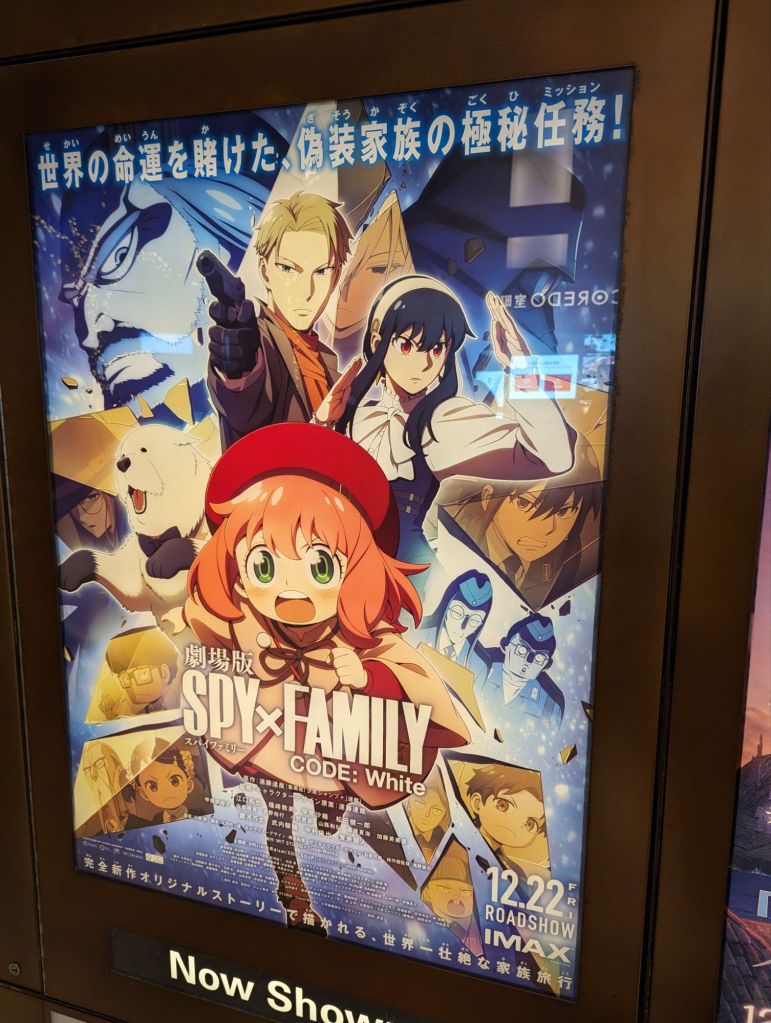
My winter trip to Japan last year gave me the opportunity to see Spy x Family Code: White, the very first Spy x Family movie. As a fan who has kept up with both the manga and the anime, I was curious to see how they would approach a theatrical release. I sat down with my buttered-potato-topped hot dog and my sour-cream-and-onion popcorn, ready to find out.
Spy x Family is the story of Twilight, an unrivaled master of espionage whose latest mission is to create a false family so that he can get close to a former prime minister, all with the goal of preventing another war from breaking out. To this end, he marries an office worker named Yor and adopts a girl named Anya. Unbeknownst to him, Yor is really one of the deadliest assassins alive. And while neither husband nor wife know the truth about the other, Anya certainly does because she’s actually a psychic. Despite all the secrets, though, the three manage to form a family that on the surface is the envy of all, yet also increasingly seems to be motivated by genuine love and affection.
The recent trend with some Jump series (such as Demon Slayer and Jujutsu Kaisen) has been to adapt an arc or major plot point into a feature-length work, and I wondered if Spy x Family would do the same. However, it turns out that the makers went with a different tack. Rather than going for something canonical, they created an original story. It’s the common choice for mega franchises, e.g. One Piece, Precure, Doraemon, Detective Conan.
In fact, Code: White is pretty much a Detective Conan movie with way less mystery solving and way more action. The story is all right, but spectacle is the name of the game: gorgeously animated chase scenes and fights, a story that takes the trio to ridiculous(ly cool) places, wild stunts, and plenty of explosions. The actual plot developments stretch the limits of what would plausibly keep Twilight and Yor from suspecting each other and wouldn’t be feasible if the movie wasn’t standalone. But given what it is, the makers are allowed to go ham, and they have enough for ten Christmas dinners. It’s a short but sweet popcorn flick.
I think the fact that Spy x Family Code: White is a non-canon entry says a lot about how the franchise is regarded in Japan. Basically, it’s a pop culture hit, almost on par with the heavy hitters. That much was clear even when discounting all the merch available in chains and other big stores to promote the movie. At one point, I stopped in a stationery store that barely sold five manga, and one of those titles just happened to be Spy x Family.
It doesn’t look like the hype will be dying down anytime soon.
It’s February, which means the day everyone with romance in their hearts looks forward to.
That’s right: It’s new Precure anime time. And with Precure Full Bloom and Soarin’ Sky Precure finished, I’m hoping to have reviews of both series done this month.
Of course, the must-watch show for me this season is Bang Brave Bang Bravern. The culture clash between a very super robot and a gritty realistic world is hilarious, and I want to see where it all goes.
This month is also a momentous time for two of my favorite VTubers. La+ Darknesss, fresh off a new outfit reveal, will be having her first solo concert. It’s sponsored by Nissin UFO yakisoba, of all things. Meanwhile, Hakos Baelz will be celebrating her February 29 birthday with streams every day (and hopefully won’t collapse from overwork). After the string of unfortunate VTuber events recently, I am looking forward to some fun times.
Kio discovers late that there was a Sayonara Zetsubou Sensei talk event and exhibition featuring the anime’s voice actors as well as the author Kumeta Kouji. Tsuchiyan, a person involved with Sayonara Zetsubou Sensei’s manuscripts replies to Kio and thanks him. Apparently they’ve met before, back when stuff was original airing.
Kio enjoys a Sayonara Zetsubou Sensei afternoon movie, and plans to watch the evening one as well. (I think this has to do with the SZS exhibit mentioned above?)
A person who is staff for anime radio shows realizes Kio follows her, and gets excited. They’re a big fan of Genshiken. Kio replies that he followed her on Twitter to make sure he doesn’t miss another event like the SZS stuff.
Kio’s ideas for most of the Genshiken LINE stickers, with him asking for suggestions. I asked him if he was planning on having them available internationally, but he said he didn’t even know that was possible.
Kio drew the belly band art for Volume 2 of the manga Oshibana. He’s a fan and retweets the author Shima Tokio’s work quite often. Shima thanks Kio, and Kio mentions really liking the main heroine and wanting to draw her.
Kio got the new Panpanya manga collection, titled Yuriika. He wasn’t able to read the comics in it when they were first being published, but he still take his time and get through them now.
I love me some mecha, and that’s why I want to give my thoughts on the recent giant robot anime that’s been the talk of the internet. I’m referring, of course, to Bullbuster.
Was there something else?
Joking aside (Go watch Bang Brave Bang Bravern!), I think 2023’s Bullbuster unfortunately went under the radar in a season and year full of great anime. It’s a mature show, but not in the mocking or edgy sense. Rather, it’s more akin to a salaryman anime with mecha included that, along the way, makes an argument for ethical companies in contrast to greedy corporations and their craven, plundering capitalism.
The plot: Okino Tetsurou is a mecha designer who is assigned to work with a small company called Namidome Industries. He’s a big fan of giant robot anime, and his latest work, the Bullbuster, was created to embody that aesthetic while also being useful for pest control. However, he soon finds out that “pest control” is a euphemism for large monsters roaming, and he learns that Namidome Industries was actually set up to eliminate these creatures so that the displaced residents can return home. However, there are many more hurdles than simply blasting the monsters away—like actually keeping a business running.
Bullbuster is cut from a cloth similar to that of Patlabor and Dai-Guard. While itdoesn’t get into the heady philosophy of the Patlabor movies, Bullbuster has that environment of regular people working regular jobs that just happen to involve giant robots. In fact, the mecha are less glamorous than either of those aforementioned series, and they typically come across as more vehicles with robot aesthetics grafted on. That has a charm of its own.
There’s actually an even older work also springs to mind: The Unchallengeable Trider G7, a series about a boy who owns his own company and his own super robot. In its opening, the singer (Taira Isao) asks: “Do we fight to protect our company funds?” He then immediately answers his own question: “NO! We fight to protect the Earth!” Bullbuster is presented with a similar situation, only the heroes are not an ultra-rich kid with nigh-unlimited money like in Trider G7, but rather adults who have to deal with issues like budgets, gaining local support, and other unsexy things. In the process, it becomes a David vs. Goliath story that pits Namidome Industries against the major corporation, whose threat comes not merely from their size but also their prioritization of profit at the expense of all else. One thing I find notable is that while there are moments where the big corporation comes across as possibly just suffering from a few bad apples, it becomes increasingly clear that the rot is actually deep in the roots.
The main fault of Bullbuster is that it doesn’t look particularly good. Nothing about the visuals whether in stills or in motion is anything to write home about, and the CG used for the monsters looks outdated by a decade or more. Even for someone like me who doesn’t put too much stock into “animation quality,” I think it holds the show back.
Ultimately, what tells me that Bullbuster has an adult perspective is not just the business setting or the lack of teen tropes. Rather, it’s because whatever hopeful message the anime conveys is inevitably tinged with a bit of cynicism that can only come from being worn down by entering “the real world.” Even when problems are solved and people are held accountable, often the ones truly responsible for the harm caused remain protected by power and privilege. Nevertheless, I respect Bullbuster for telling us to not give up.
PS: The singer of the opening is NORISTRY, and he’s actually an utaite, or amateur/semi-pro online singer. If you like the song, he streams and releases covers pretty regularly.
On my recent trip to Japan, I watched an anime movie as in-flight entertainment: Doraemon: Nobita’s Little Star Wars 2021. This film is actually a remake of 1985’s Doraemon: Nobita’s Little Star Wars. While I have not seen the original, I have heard that it’s a beloved work in Japan.
Doraemon is one of those Japanese mega franchises that was never part of my childhood, so I hold no particular nostalgia for it. Even so, I do know that the annual movies for enduring mega franchises are big deals (see: One Piece, Detective Conan), both in terms of box office sales and getting major industry names to work on them. For example, in this case, the screenplay is actually by one of my favorite creators, Sato Dai (Eureka Seven, Battle Spirits: Shounen Toppa Bashin).
The basic premise of Doraemon is that a hapless boy named Nobita meets a robot cat from the future named Doraemon, whose main feature is the ability to pull out all sorts of fantastical gadgets: a door that can lead to anywhere, a block of gelatinous konjac that when consumed works as a universal translator, and so on. Nobita, Doraemon, and friends thus get into all sorts of hijinks in general, but in this instance, the adventure comes to them. A diminutive alien named Papi has escaped to Earth because of a coup that threatens his world’s democratic government, and the gang ends up helping out when the coup’s militaristic leader, Gilmore, comes to pursue them.
I definitely did not expect Doraemon to turn into Voltes V, but the flavor is similar in that both stories turn into the struggle between an oppressor and people who seek to be represented by their government rather than ruled by it. I don’t know if this pro-democracy message is the reason the old film got remade, but given the current state of the world and the rise of authoritarianism, I have to wonder.
Another thing I noticed is just how much love and care was put into animating Nobita’s friend and crush, Shizuka. I’ve read many times over the years that she is a common first love among kids in Japan, and it feels like the movie really leans into this.
I came in with few expectations, and got out of it a kid’s movie with a surprisingly important message relevant to this time and all times. Hope it’ll work!
In November of 2023, Virtual Youtuber Natsuiro Matsuri celebrated her 5th anniversary by holding a concert themed after the premier Japanese video streaming site of the 2000s, Nico Nico Douga. The homages came in every form, from covers of Vocaloid songs popular in Nico Nico’s heyday (“Senbonzakura,” “Miku Miku ni Shite Ageru”), to jingles and error messages, and of course, the flurry of on-screen viewer comments that was and still is its signature feature. It wouldn’t be a real Nico Nico parody without that.
For those familiar with Nico Nico, it was most surely a nostalgia trip, but I did see some confusion from the uninitiated. They wondered how people could enjoy a chat that obscures the actual video. I mean, isn’t it distracting?
In short: yes, it certainly is, but there are benefits as well. While not everyone likes the flying commentary (I know people who turn it off whenever possible), it also adds something to the viewing experience while also being a product of an older era of online video.
There are two important aspects of Nico Nico’s unique comment section that make it a boon more than a detriment. The first one is that because the text is on top of the video, it means you don’t have to constantly look away to see what people are saying. The second (and more crucial) one is that it fosters a pseudo-real-time communal experience without having to watch something live.
Similar to many other video platforms, Nico Nico allows for live streaming currently, but that wasn’t always the case. Like Youtube, it used to be purely pre-recorded material. While comment sections were nothing new even then, what Nico Nico allowed was the ability to have a user’s comment come up at a specific time in a video, so it’s clear what that person was reacting to. On top of that, anyone could post a message in this manner whether they saw a video the day it was uploaded or five years later, and they would show up all the same. This means you can feel like you’re watching with a group of people and quipping about what’s transpired despite not actually being together spatially or temporally.
In other words, Nico Nico created an asynchronous form of fostering community through its chat, and this extends even to the present day when live streams are plentiful. In contrast, Twitch and Youtube constantly make viewers feel like they’re missing out if they don’t watch live. Twitch’s VOD service is an empty husk now, while Youtube only lets you participate in the chat if you watched something live or at least right when it premiered. There is a comment section, and it even lets you put timestamps, but it is considered its own separate space. On Nico Nico, however, chat and comments are one and the same. This approach, I believe, helps to prevent anxiety about FOMO to some degree.
That‘s not to say Nico Nico doesn’t have its flaws. Non-potato video quality, the ability to watch stream recordings after the fact, and even priority for who can even view something at all can be locked behind a premium membership. Youtube is also just more intuitive to browse and use in any language. But Nico Nico found a solution to the problem of not being able to provide a true simultaneous viewing experience, and I think an approach along those lines still has plenty of merit.
I’m grateful to Matsuri for the reminder. Nico Nico is such a large piece of Japanese internet history, and for good reason. Maybe we can also be at a point where the flexibility displayed by Nico Nico can help people not be as beholden to rigid schedules and fear of missing out.









 OGIUE MANIAX