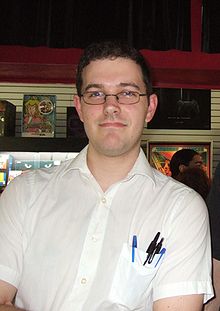
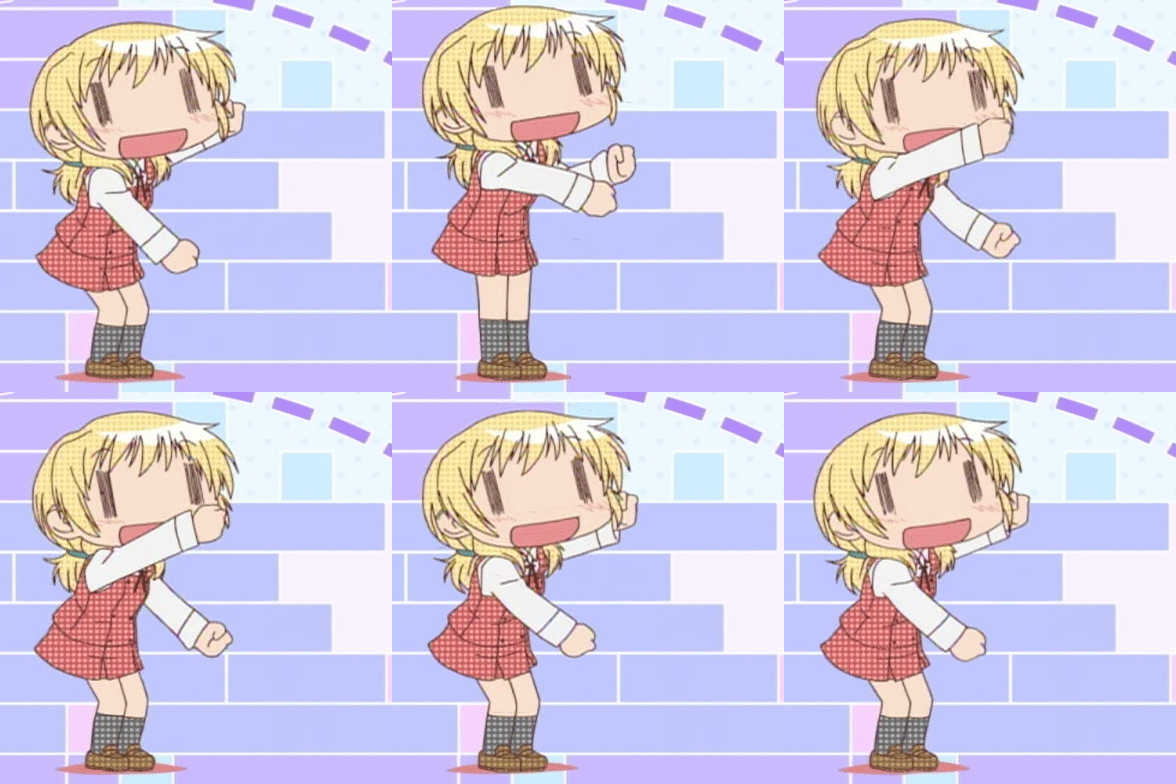
The Nostalgia Critic AND the Angry Video Game Nerd in Zettai Karen Children: The Unlimited

UPDATE: The Angry Video Game Nerd made a cameo too! Thanks, VF5SS!

I tweeted about this as well, but I also want to leave a more permanent record of this rare occurrence.

theunlimited-criticandnerd
The Unlimited Episode 5

critic_7168The Nostalgia Critic

220px-James_D._RolfeThe Angry Video Game Nerd

Coincidence?

Edit: Actually with the way he’s wearing that tie, there’s no way that’s mere coincidence.

Sketch in Celebration of the New Genshiken Anime + More

The Current Genshiken Club Members

The Hokuto Brothers (I think Toki turned out the best)

Yoshimori and Tokine from Kekkaishi

Nonowa etc.

The Comedic Stylings of Five Legendary Warriors: Yes! Pretty Cure 5

I was originally going to make my next Precure review about the recently-concluded Smile Precure!, but because of its many similarities to Yes! Pretty Cure 5 I thought it would be better to talk about that one first so that when I do get around to Smile you’ll know where I’m coming from. Do keep in mind that I haven’t seen the sequel, Yes! Pretty Cure 5 Go Go, all the way through yet, so this review is “incomplete” in that sense.

Yes! Pretty Cure 5 comes from the time when the official English still demanded that you refer to it as “Pretty Cure” in spite of the Japanese pronunciation, and it’s the first series in the franchise to step away from a pair oriented cast of main characters and do a full-on Sentai/Sailor Moon-style five-man team. As the story goes, one day an energetic girl named Yumehara Nozomi encounters a small mascot creature named Coco, a prince who asks her to become a legendary warrior and help restore his kingdom, which had been destroyed by an evil organization called “Nightmare.” Nozomi agrees and becomes Cure Dream, and is later joined by the athletic Natsuki Rin (Cure Rouge), the idol Kasugano Urara (Cure Lemonade), the gentle Akimoto Komachi (Cure Mint), and the intelligent Minazuki Karen (Cure Aqua), as well as Coco’s best friend and fellow prince, Nuts.

Out of all the Precure shows, Yes! Pretty Cure 5 ranks as one of the least visually impressive. Its animation is frequently awkward and off-model, and the transformed costume designs are awkward and unmemorable, but Yes! 5 is able to make up for those issues through really, really genuinely fun character interactions and antics. The five Cures all have dynamic characterizations, and seeing their personalities bounce off of each other is simply a joy. This even extends to the side characters, especially the school newspaper’s reporter, Masuko Mika (above), and her infectious Lois Lane/April O’Neil-like desire to get the scoop on the Cures.

Because of how entertaining the lunch-time and after-school banter can be, I sometimes refer to Yes! Pretty Cure 5 as the “Real K-ons, ” a comparison all the more appropriate because they girls are shown eating all the time. Four out of the five Cures have huge appetites and/or are obsessed with sweets, and the only one left out, Komachi, is the daughter of traditional Japanese candy maker. It makes for a show where just seeing the five girls hanging out at school is in many cases far more engaging than the action scenes, something which is often the opposite case when it comes to Precure.

That said, when the two halves of talky comedy and action come together, the result can be some incredibly solid episodes. My favorite example is when you find out that Rin (“the red flame of passion”) and Karen (“the blue spring spring of wisdom”) don’t get along quite as well as the others, but when a villain tries to use their lack of cooperation against them, it actually backfires: their rivalry ends up egging each of them on to perform even better, ironically improving their overall teamwork. Smile Precure! has a similar episode but the conclusion isn’t nearly as hilarious. Also, Cure Aqua takes a lot of her attacks from pro wrestling.

Speaking of the villains, Nightmare may be my favorite antagonist group in all of Precure because it actually runs itself like a corporation, albeit one inhabited by otherworldly monsters. You have the CEO, who can only be contacted through an intermediary. You have board meetings where the bad guys discuss their latest plans, end-of-year staff performance reviews, and of course promotions and demotions. For the most part the individual antagonists aren’t much to speak of, but there are a couple of notable exceptions, the aforementioned intermediary, Kawarino (think of him as the equivalent of Smile‘s Joker), and Bloody, a wizened veteran who attacks the Pretty Cures less through brute force and more through psychological manipulation.

Also of note is the fact that the mascots in the show, Coco (right) and Nuts, are the first in the franchise to be able to take human form, and in this case the two turn into handsome fellows. There’s a not-so-subtle undertone of Coco and Nozomi having feelings for each other, as well as Komachi and Nuts, but it remains just ambiguous enough that it needs to be inferred. Somewhat predictably, Pretty Cure 5 is the Precure most popular with fujoshi; if you ever wondered where Sayonara Zetsubou Sensei character Fujiyoshi Harumi’s favored pairing of “Pine x Napple” comes from, it’s a parody of Coco x Nuts.

Yes! Pretty Cure 5 is most certainly a show with its fair share of flaws, but also really noticeable strengths which make the show great to watch one episode at a time or in semi-large batches. The show’s antagonists make for a decent enough threat to motivate the story along, but the real fun is in seeing the antics of the five Cures, as the series does an excellent job of showing the main cast as friends who trust and love each other. Even more fortunate is that the direct sequel, Yes! Pretty Cure 5 Go Go seems to make up for a lot of the problems of its predecessor.

PS: Cure Rouge is one of my favorite Cures. Yes, more than Sunny. No, not nearly as much as Marine.

THAT’S RIGHT, NEW GENSHIKEN NIDAIME(?) ANIME

The newest issue of Monthly Afternoon has revealed that a new Genshiken anime is in the works. This calls for a celebration:

I’ll be honest: even with the serialization of Genshiken II (aka Nidaime aka Second Season), I never expected it to get another anime adaptation. I wished for it, of course, given that the anime never even resolved Ogiue’s arc, but I thought its time had passed, and the reception to the manga sequel has been mixed, with a number of fans both inside and outside of Japan feeling alienated by the new setting.

Of course, this development begs quite a few questions. First and foremost, will the new anime actually cover the remaining parts of the original Genshiken, or is it actually just an adaptation of the second series? Would it be half and half? Would they speed through the remaining parts of the first series in order to get to the new characters? How many episode will it be? For that matter, will it even be a TV series?

Second, who is going to animate this new version? The first Genshiken anime was by the now-defunct studio Palm, while the OVAs and Genshiken 2 were done by Studio ARMS. Responsible for Queen’s Blade and currently Maoyu: Maou Yuusha, ARMS brought a bit of a perverted slant to Genshiken, and given the presence of not only Hato but also a very aggressive Angela I could imagine them going hog wild, for better or worse. I don’t exactly have a dream studio I’d like to see work on it, but the resulting product could definitely be a tad unexpected depending on who gets it.

Third, what about voice actors? We have all of these new characters, with Hato especially presenting a challenge. Do you go the route of having one of the “masculine” female voice actors vary her voice, or do you find one of rare male voice actors who can successfully do a female voice? I would actually suggest Ishida Akira as Hato, if he weren’t already playing Kuchiki. As for the other characters, maybe they’ll go for a curveball, like Kugimiya Rie as Yajima. In any case, it’ll be good to hear Mizuhashi Kaori’s Ogiue again. Over the course of the anime, Mizuhashi’s conveyance of Ogiue’s blunt and awkward personality improved tremendously, and I’m wondering how it might have changed in the 4-5 years since she last played this blog’s favorite fujoshi.

There’s plenty to think about and anticipate, and I’m sure I’ll do even more when the next bit of info is out, so I’ll just conclude with the following words.

BANZAI!

OGIUE BANZAI!

OGIUE-KAICHOU BANZAI!!!

Why Nyaruko’s Design Stands Out

I’m not much of a fan of Haiyore! Nyaruko-san, the moe-fied Cthulhu mythos-themed comedy anime, but I find that the main character Nyaruko has a really appealing character design. While she doesn’t look that different from other cute anime girls, Nyaruko draws the eye and leaves a memorable impression to the extent that it makes me want to maybe, just maybe, give her show a second chance. In looking at her more closely, the element that visually differentiates her from other similar character designs, the lynchpin which transformers her into something more distinct and complete, is her checker-patterned dress.

My reasoning has relatively little to do with personal preference (at least as far as I can tell about myself), but is based on the amount of contrast that the checkered pattern provides on Nyaruko’s overall design. Nyaruko does wear other outfits in her series, namely her school uniform, and if you compare the two outfits the checkered dress simply stands out more. There’s the inherent contrast of dark and light that a checkered pattern already has, but there’s also the fact that the pattern stands out against the broad swathes of flat color that make up Nyaruko’s hair, skin, and the rest of her clothing.

You could get a similar effect with stripes, but a checker pattern is like a stripe pattern taken to the next level, and I think that the way the checker pattern is only a small part of her dress instead of the dominant pattern as you might imagine a striped dress to be keeps it from overpowering the rest of Nyaruko’s design. It’s also somewhat of an uncommon clothing pattern among anime characters, which makes it easier to associate the checker pattern with her character before others. What you’re left with then is a visual design which not only pops out but causes others (including other characters in Nyaruko-san) to recede.

Didn’t Quite Go the Distance: Eureka Seven AO

It’s fairly common knowledge that sequels aren’t the easiest thing to successfully pull off in entertainment. Even if the sequel ends up being okay, it may not live up to its predecessor because of how iconic moments and innovations can start to become formula (having to fit “Yippee-ki-yay, motherfucker” into every Die Hard for example), or plot points from the first in the series have to be modified in order to cater to the new version. Whenever I watch a sequel, I’m aware of how daunting this mountain can be, and try to take into account those problems even if they ultimate are my criticisms. This is the approach I took when I heard that Eureka Seven, one of my favorite anime ever, was getting a sequel, but even with an open mind I felt that Eureka Seven AO not only paled in comparison to the original but was in certain ways a regression of what Eureka Seven had done.

Eureka Seven AO is billed as a direct sequel, as opposed to an alternate universe/retelling like the movie or the manga. The story centers around a young boy named Fukai Ao, who lives in the independent nation of Okinawa, and for whom life is difficult because of the way the community tries to ostracize him. In this world, the skub (or scab however they want to spell it this time), are considered a problematic natural disaster, especially because they bring with them mysterious monsters known as “Secrets,” which Ao ends up having to fight. For anyone who’s seen the original, the fact that the world of AO consists of real-world countries and continents is meant to imply that something is very strange or different about its setting, and trying to figure out just what in the world happened becomes part of the initial intrigue of the series.

When I say “regression,” I’m not referring to retcons or weird developments in AO‘s plot which cast a different light on the original’s events, but a regression of what mecha anime is capable of. Eureka Seven took an approach which let viewers explore its world through a cast of engaging, fleshed-out characters and a central love story developed gradually over the course of many episodes, and which anchored the narrative in such a way that the emotional excitement of the series builds up continuously throughout. It’s not altogether unique to Eureka Seven, and you can probably trace this style of show all the way back to Macross.  Eureka Seven AO, on the other hand, feels more like a mediocre 80s mecha anime, more keen to develop its story as a set of vague mysteries and tensions but never entirely delivering on any of them. It’s not just that the plot is worse, but that it ends up resembling the way a staunch non-fan might look at and describe their idea of a Gundam anime.

What Eureka Seven AO does have, at least initially, is a strong cast of characters with plenty of potential as to how they’ll develop, but much of it never comes to fruition (though the brief glimpses at Ivica’s character and past were things I enjoyed in particular), or if there is a development the lack of impact from the rest of the series lessens the overall effect. In particular, AO never manages to have its story properly focused by something like Eureka and Renton’s romance,  and though it didn’t have to necessarily be “another romance” (which might have well turned it into just a rehash of the original), there was nothing that could properly fill that void. It seems like the closest thing was just the mystery of what happened to Eureka and Renton, the intrigue of which the show feeds into fairly well, but the explanation we’re left with at the end is less than satisfying. And there is the potential for romance at the beginning, as the dynamic between Ao and his friend Haru is cute and gives a good sense of their relationship, but it ends up getting pushed aside. In the end, probably the most interesting point brought up in the show has to do with how the Secrets are treated by humanity, and how it reflects in some ways the way the Skub were regarded in the original Eureka Seven.

If the movie Eureka Seven: Good night, sleep tight, young lovers suffered from having a weak and confusing beginning but then a fairly strong finish as all of its disparate ideas came together, then Eureka Seven AO is the opposite: It starts off strong and with many of the pieces in place to tell something both grand and personal, but its plot and character development are so discombobulated that when the ending finally comes it hits like a drizzle instead of the torrent of emotions that the original provided.

Ebiten’s Unique Look at the Harem Genre

Ebiten is an anime so chock full of references that it relies on them too much. Though not a show I would recommend, there is one point in its favor I’d like to talk about that I imagine a lot of people didn’t take note of because of the overall lack of interest in the show.

From the very first episode we are introduced to a character named Noya Itsuki, a cute girl who turns out be a crossdressing boy. For most of the series, he factors in only somewhat into each episode’s story, but when the final “arc” comes around (if you can say that for a 10-episode anime), Itsuki gains a more prominent role. In reality, Itsuki is not the effeminate side character first presented, but a man with so much raw chemistry that he can literally control any women who come in range of his pheromones (and who’s also a lolicon on top of that). Up until that point, we learn, some of the girls had been suppressing his dangerous abilities by feminizing him through not only making him crossdress but through drugs specifically designed to counter his natural machismo.

In other words, the “real” Noya Itsuki is actually a harem lead, the guy who mysteriously attracts all of the ladies, and the female characters in the show had been actively trying to prevent the anime from becoming another Love Hina. Much like School Days and its own unique take on the harem (i.e. the amount of emotional manipulation needed to actually sleep with the entire cast of girls), I can’t say the show is worth watching just for this fact, but it’s quite a meta-level plot twist for a show that’s basically yet another “girls having fun in their own club,” even if it only exists as a brief blip in its own series. It also brings to the forefront an idea I’ve seen thrown around here and there, which is that the all-girls moe/comedy titles that exist grew out from harem-type shows once enough male viewers no longer needed a Y-chromosome character to “relate with” or to act as a stand-in.

Gamification of Drama

There’s a scene in the old Nintendo Power comic based on The Legend of Zelda: A Link to the Past, where Link and Zelda are finally facing off against Ganon himself, the primary antagonist of the Zelda series. As Ganon has Link and Zelda nearly beaten, Zelda says a prayer and desperately fires a seemingly plain wooden arrow at Ganon, only for the arrow to transform into the legendary Silver Arrow mid-flight and slay the pig demon. The whole notion of the Silver Arrow as Ganon’s one weakness is taken from the video games, but as anyone who has played Link to the Past knows, you don’t need one Silver Arrow to defeat Ganon, but four. Essentially, while there are a number of approaches that could have been taken, in this case the comic dramatizes the impact of the Silver Arrow by having its singular appearance act as the climax of the story in order for it to function better as a narrative.

If the Link to the Past comic is a case of taking a gameplay element and transforming it into a plot point, then the Super Robot Wars games, especially the recent ones, are a strong example of the opposite. Based on the idea of taking robots from actual anime and having them fight together, the SRW franchise is all about the conversion of story elements into gameplay, but the early games were limited by an emphasis on statistics. The result was that certain characters and robots became less useful because they lacked effectiveness in the game itself. There have been attempts to mitigate it, such as creating an original upgrade for one of the robots, such as the relatively weak Mazinger Z into the mighty Mazinkaiser, but recent SRW games, particular the series, have sought to remedy this discrepancy by completely prioritizing dramatic impact over a sense of logic. Thus, not only are the most powerful weapons transformed into attack options, but the most powerful moments in the original anime are given a gameplay function.

Thus, what you see is not simply the robot Godmars’ strongest technique, but a recreation of the moment when Godmars and its pilot Takeru draw upon the last of their energy to deliver a final blow to the main antagonist of their story. The “Super Final Godmars” technique is meant to carry the same weight as Zelda’s Silver Arrow in the comic, only it’s made repeatable throughout the game so it also functions as the Silver Arrow from the video game.

This approach even transcends specific moments in a series, as is shown when looking at how the characters in those robot series are themselves given unique properties to show off their individuality. Lelouch, protagonist of Code Geass, is meant to be a strategic mastermind in his story, and so the game gives him the ability to boost allied units in specific ways which make him best suited for staying out of the front lines and for issuing commands.

What I find interesting about this transformation of plot point into gameplay elements is that the actual end goal of such a function is to invoke intangible qualities by way of tangible mechanics of intangible moments. In other words, in order to give players the feeling of re-enacting those climaxes from anime, the SRW games look at those dramatic moments, figure out how it should impact the game in terms of requirements/damage/etc., but then has to arrange those numbers to best replicate the feelings created by those original scenes. This is probably what makes the original robots which appear in SRW games to have such over-the-top animations compared to the robots with actual source material; they have to add another step to try and convince players that they should be just as into their (at the time) ahistorical designs as they are the robots straight from anime.

Best Anime Characters of 2012

BEST MALE CHARACTER

Nishimi Kaoru (Sakamichi no Apollon: Kids on the Slope)

When it comes to Kids on the Slope characters, an excellent series, I get the feeling that the rugged-yet-sensitive Sentarou would be the most popular one. Indeed he is a great character, but there’s something about Kaoru which impresses me more. More plain-looking and less-outgoing than Sentarou, the ups and downs of Kaoru’s life and the process by which he gradually opens himself up to others gives Kaoru what I find to be a real sense of humanity, warts and all. What’s especially important is that the story doesn’t portray Kaoru as a purely passive figure who just benefits by association, but as someone who becomes a best friend and perfect foil to Sentarou. That scene at the school where the two make amends by playing a duet of piano and drums is one of the best moments in anime I’ve ever seen.

If anything, whether you pick Kaoru or Sentarou as a favorite, it’s difficult, perhaps nigh-impossible to talk about one without the other. Overall, it’s that friendship through the good times and the bad which makes Kids on the Slope and its characters so memorable.

BEST FEMALE CHARACTER

Yanagin (Daily Lives of High School Boys)

To explain my pick this year, I would like to take a quote from an episode of The Simpsons titled “A Star is Burns”:

Homer Simpson: Barney’s movie had heart, but Football In The Groin had a football in the groin.

2012 was actually full of excellent female characters in contention for the title. There was Mine Fujiko, whose own spinoff series explored not only her history but also the question of what it means to be “Fujiko.” There was also Urabe Mikoto, the Mysterious Girlfriend X, who comes from one of my favorite manga and whose eccentric personality I always enjoy. Takakura Naoko, the vice principal from Tari Tari, had adult charms and adult struggles which won me over. Cure Sunny (Smile Precure!), Senomiya Akiho (Robotics;Notes), Aria (Saint Seiya Omega), I could rattle off a dozen names, and yet, I just couldn’t forget Yanagin, whose shrill, trauma-inducing cry kept cutting through the competition like a football in the groin.

There isn’t much to Yanagin. No inspiration, moe, attraction, character development, depth, nothing like that. All it boils down to, is that she makes me laugh like no other character could in 2012.

Final Thoughts

It really wasn’t easy pickings this year in either category, and that has a lot to do with an overall strong year of anime. 2012 brought us strange and experimental shows in the form of things like gdgd Fairies and The Woman Called Mine Fujiko, and it delivered shows which both reinforced and defied their supposed lineages such as AKB0048. Along the way there have been many approaches to characterization, stemming from various beliefs as to what the role of characters are, from rough templates which activate creative imagination to ones meant to reflect a sense of reality or realism whether physical or emotional. Even though this contrast is nothing new, I think this year is especially good at showing how there isn’t a dichotomy at work, that these areas are not so rigid that one precludes the other, and that notions of character (as well as Ito Go-style kyara) are much more fluid. In other words, anime continues to show its potential.

Vocaloids and Vegetables @ Go Go Curry

20121005_gumiWhen I think of Christmas, I think of food, and vocaloids (I guess).

While this is all old news by now, it’s new to me, and I figure that there are people like me out there still. Visiting Go Go Curry for the first time in a long while, I saw that there’s actually been some kind of Go Go Curry/Vocaloid collaboration, notably in the form of a Go Go Curry theme song titled “Can’t Stop! Go Go Curry.” The Vocaloid used for the song is actually “Gumi,” the synthesized version of Nakajima “Ranka Lee” Megumi, and the song is by Satsuki ga Tenkomori and Nijihara Peperon, though I don’t know anything about the Vocaloid scene so I can’t tell you anything about them. The girl on the poster’s design is reminiscent of Oreimo, though not by the original character designer. You can see the music video below.

In addition, at the West Village location in New York City, Go Go Curry has been serving a full-on vegetarian curry sauce for the past few months, which I was able to try out. It was clearly a necessary move given the amount of vegans and vegetarians in that area, but I also think it’s a positive change. Early in the Midtown Go Go Curry location’s life, I had seen multiple instances of Muslims and others unable to eat pork enter into the Midtown Go Go Curry location, only to find out that pork is inherent to Go Go’s curry roux, so I think it’s the best way to expand their customer base.

As for the Vegetable Curry itself (which I got with pork sausages), the sauce is definitely different from the pork-based original, being thinner and not having quite as deep and robust a flavor, but it’s still good and mixes well with the rice. Coming in either mild or spicy, if you can eat pork then I wouldn’t recommend it over the original normally, unless you eat there often enough that you’d like a slight change of pace. And of course, for those who can’t, now’s your chance to try out Go Go Curry.