Even Mewtwo Understands the Principles of Good T-Shirt Design

Nintendo has announced plans to release Pokemon t-shirts for adults under its “Pokemon 151” line. This means not only larger sizes, but also designs catering to older audiences as well. And I for one welcome this desire to match actual aesthetics with anime/video game t-shirts.

Anime t-shirts and wearable merchandise in general tend to suffer from the recurring dilemma of simply Not Looking Good. This is especially a problem with any sort of non-Japanese t-shirt release, as the design usually just ends up being a stock image pasted onto the front of the shirt with no regards for the overall look. It’s like delivering a punchline with no setup.

This is why I was so pleased with the Eureka Seven t-shirts that came with the DVDs. It’s like someone understood the importance of subtlety (and in some cases when NOT to be suble) when designing them.

So yes, anime t-shirt makers, please learn from Pokemon 151.

Except for COSPA and Uniqlo. You guys are swell. Most of the time at least.

Are the releases we want going to be the releases we get?

One complaint always leveled at anime companies is that they charge too much for anime. It’s something I’ve criticized in the past myself. Well, companies are finally listening and we’re seeing a variety of attempts to lower the cost of watching anime.

Gonzo plans on continuing its free online subtitled broadcasts with a continuation of Strike Witches.

Gainax and Bandai Entertainment have made it possible to watch the smash hit Gurren-Lagann on network cable via the Sci-Fi Network. Not only that, Bandai is planning a blitzkrieg release with 9 episodes per disc with a release of 1 disc per month. That’s 3 months for ALL of Gurren-Lagann.

Maria-sama ga Miteru, officially titled now as Maria is Watching Over Us, has an upcoming release of the entire first season at once. That’s 13 episodes from the get-go. No waiting, no nothing.

Media Blasters is releasing the second half of Gaogaigar all at once for practically nothing as well. This has less to do with plans and more to do with the fact that GGG did not do so well in the US, but it’s there.

And finally, Toei Animation has given the courtesy of releasing episodes of Hokuto no Ken and Slam Dunk online at $2 per episode. Granted, there’s some Digital Rights Management crap that we have to deal with, but they at least figured out that this is a better way of giving exposure to older series such as these.

So the anime industry has finally stepped up their game, and made it easier than ever to obtain anime from legitimate sources for affordable prices. It is now up to us as fans to support them, to tell these companies that, yes, we are willing to give you money directly provided you make it possible for us without sacrificing an arm and a leg when we do not have the fortune of being Edward Elric.

I don’t expect people to buy every single example I list here, and of course people’s income situations vary greatly, but I think it’s important that the anime fandom show that we are supportive of new attempts to get anime in our hands.

Hokuto no Ken Event for 7/7

Seven artists are going to be making redesigns for the four Hokuto Brothers (Kenshiro, Raoh, Jagi, Toki), as part of the Hokuto no Ken 25th Anniversary Celebration.

The event will be held on July 7th, 2008 at a Tower Records in Tokyo.

As for the “redesigns” themselves, it’ll be…interesting…as let’s just say the artists selected do not exactly have Hara Tetsuo-esque styles.

The 7 Chosen Ones

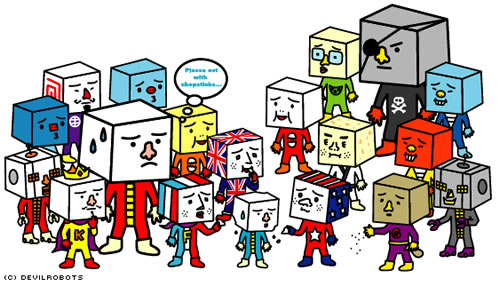
Kitai Shinichirou (DEVILROBOTS)

Mad Barbarians

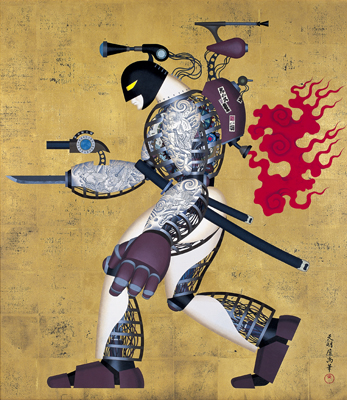
Tenmyouya Hisashi

Inoue Takaho

Urata Spancall

Hirose Soushi

Matsushima Satoshi

Source: Anime! Anime!

OP/ED OP/ED

The opening credits, or intro, of a staple of TV and animation. it’s a combination of sound and image designed to inform the viewer and pull them in. it is basically a commercial for the show you are about to watch with the secondary effect of giving credit to the people who are responsible for the show. The ending credits continue to list names of all the people who work on a show, and though it is not always the case, especially on American TV, it can be used to leave the viewer with a certain feeling. Japanese animation is of course no exception, but somehow anime has become what I think is the standard for openings and endings. There’s something special and different about the openings of Japanese animation compared to the animation of the rest of the world, and I’d like to know what it is.

I don’t think it would be too farfetched to say that a significant portion of anime fans love, welcome, and even expect the shows they watch to have good opening and ending credits. It’s the reason why fansubbers try so hard with their ridiculous karaoke effects. It’s the reason why I’m going to Otakon to see JAM Project. And I believe that it is a common factor in turning people into anime fans in the first place.

Anime openings can cause budding otaku to go, “Wow, this is different and good!” It’s not like non-Japanese cartoons are without good or memorable openings. I bet you there’s plenty of people out there who at least have a cursory knowledge of the old Teenage Mutant Ninja Turtles theme, or children (and adults) who could sing the Kim Possible opening as well. And while one can argue that anime openings have “better” music, it’s not like anime is without its repeated-title-shouting-style intros (see above concerning JAM Project, or should I say, its individual members).

Perhaps it’s simply a matter of professionalism. Not only is there an industry trying to make money off of it, but musicians, at the very least on a surface level, appear to approach these songs as if they were any other pieces they’ve performed. Directors are hired on specifically to direct the openings and endings. People’s livelihoods can depend on whether or not the opening credits are a hit with the audience.

I’d like to think that the root cause of the culture of successful openings and endings is passion and respect, but it’s an overly optimistic view of things. I just know that there’s something which makes the openings and endings of anime different and better.

PS: I haven’t even begun to think about dub openings and how they factor into all of this, though I’m sure that shouting, “It’s time to D-D-D-D-D-D-D-D-DUEL!” will get a reaction out of people

PPS: I lied, this isn’t really an opinion or an editorial.

Oh, why here are the fat chicks!

I had once asked where all the fat chicks are in anime, and it turns out that someone has answered my inquiry. It turns out they’re all in a show created by Shirow Masamune, Real Drive.

*Ahem*

Their waists are still a bit tapered, but their faces, waists, and thighs are all greater than average for anime characters, so all that’s left to say is…

Good work, Shirow. Good work, Japan.

Oh, and I’ll actually review this show at some point.

Let Sleeping Dogs Lie: The End of Inuyasha

I’m not a fan of Inuyasha, so I really haven’t kept up with it this whole time. I do recall buying a single issue from a store back when manga was still being sold like monthly comic books, and I did watch Inuyasha at my college’s anime club. When the heads of the anime club decided to stop showing Inuyasha, I wondered why. One of the last episodes we watched had Inuyasha and Sesshoumaru working together to defeat a common enemy while using their respective blades as intended (Inuyasha for destruction, Sesshoumaru for healing), so I thought that it was finally getting somewhere good and would conclude soon after.

Ha.

Many jokes have been made concerning the “never-ending” nature of Inuyasha, but finally we can stop cracking wise about it and switch to humor based on the fact that as of this week, Inuyasha finishes with 558 chapters.

Inuyasha ends with a final battle with the demon Naraku, after which Kagome makes a decision to choose what’s right over her heart’s desire. The battle itself is pretty nice and conclusive, but it’s the kind of final battle you know that Takahashi could have pulled out at any moment and it would have still made sense. Sesshoumaru wielding his Nendou Bakusai Ken Bakusaiga with its endless destructive capabilities, it could have been a cheese wedge forged by destiny instead.

Inuyasha thankfully concludes with an ending and all that, as opposed to the abrupt stop that occurred with its anime counterpart. It’s not the best ending I’ve seen, but I doubt it’ll displease too many people or get accused of being a cop-out/Gainax Ending/any other conclusion-themed perjorative.

Really, Inuyasha will ultimately not be remembered for its plot, so having an actual ending doesn’t hurt or help too much, though I think it leans towards the latter. I’m not a fan of Inuyasha like I said, but I think its fans will continue to have adventures with Inuyasha and friends for a long time.

Inuyasha is finished, but it’s still endless.

In conclusion, I just want to point out that I was the first person to say that Inuyasha is “Dragon Ball Z for girls.” If anyone says otherwise, they’re wrong.

Various Thoughts Concerning American Cartoons in Japan

I recall at some point someone (possibly me) asking my high school Japanese teacher what animation she watched as a child. I think everyone was expecting an answer like Tetsuwan Atom or Candy Candy or something, but her answer was “Tom and Jerry.” She was apparently quite fond of it as a child growing up in Japan.

American cartoons have a long history in Japan, what with Tezuka idolizing Walt Disney, but today we’re at an interesting point in this cartoon exchange. Rather than American cartoons inspiring Japanese ones, or Japanese people being “secretly” responsible for American cartoons, both countries are well aware of the other’s creative exports, with anime becoming a fairly common word in English (is it that Pokeyman stuff?!), and American cartoons making their way to Japanese cable.

According to Craig McCracken, Spongebob Squarepants is a huge success in Japan, doing much better than his own Powerpuff Girls, which necessitated the creation of Powerpuff Girls Z to try and appeal to the Japanese market better. South Park has also found some popularity, and it makes me wonder if the appeal of South Park and Spongebob in Japan is the absurdity of their characters and situations.

I used to joke that I would start subbing “The Boondocks” into Japanese at some point. A lot of the humor of Boondocks, like South Park in its later seasons, is very political, using the (relative) innocence of children to illustrate a point about society, so I thought it’d be amusing to try and translate this aspect for a culture that is not intimately familiar with race relations in a country with so much history and diversity in this regard.  Suffice it to say, I was shocked when I found out that Boondocks had in fact been dubbed into Japanese. Still later, the second season of Boondocks was moved from a Korean studio to Studio Madhouse, one of the most famous animation studios in Japan. To what extent were the people watching on Japanese cable able to understand the deeper meanings involved in Boondocks? While I don’t really have an answer, I can’t help but wonder about this every time I hear Riley say, “Niigaa.”

Cartoon Network has its own station in Japan, and through it many old classics are brought to Japanese viewers, as well as newer shows such as Teen Titans and Samurai Jack, two shows which are inspired by anime to varying degrees. A more recent show to come out in America and to hit the shores of Japan is Ben 10, the cartoon by Man of Action about a 10 year old boy with the power to turn into different aliens who fights menacing aliens with the help of his grandpa Max and his cousin Gwen (pictured above). As far as I can tell, Ben 10 is not widely popular but it does have its fans, and some have even drawn fanart. Not surprisingly, it seems as if most of them are primarily fans of Gwen before anything else. I get the feeling it’s because she is surprisingly moe for a western cartoon character. Some call her “tsundere,” though something about that description doesn’t quite line up. Maybe a new term is needed.

“American Tsundere?”

In Control: Understanding Akira

Whenever I think of Akira, the first thing that comes to mind is my sophomore year of high school. There was an anime festival going on in the city, and I was waiting in line to watch Galaxy Express 999 at a small theater. Behind me on the line was a guy, probably somewhere between 16 and 24, discussing anime, talking about how he found Akira to be incredible and the “best movie ever.” This man’s life was changed by Akira. Later that evening, my life would be changed by Galaxy Express 999. Still, I had seen Akira before, and I wondered just what was it that blew this guy’s mind.

Today, years later, I rewatched Akira, and I finally understand it. More importantly, I understand that Akira is actually not that difficult to understand.

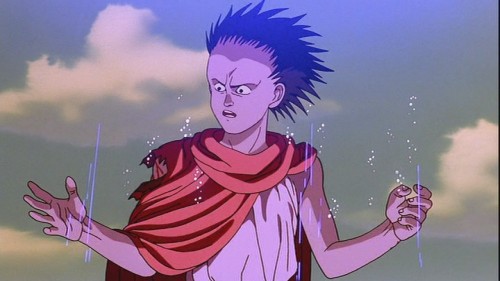
Akira takes place 21 years after the end of World War III in the city of Neo-Tokyo, a city with strong police presence, assigned curfews, and the youthful delinquents who constantly ignore that authority. The story focuses on Kaneda, the confident leader of a biker gang (bousouzoku, literally berserkers), and his timid childhood friend Tetsuo, also a member of his gang. Beyond this, describing the plot of Akira is difficult in that ultimately a cohesive story progression where characters get what they deserve and plot threads tie together is not the aim of Akira.

Neo-Tokyo is an advanced city, portrayed as having large, high-tech skyscrapers looming overhead and bright neon colors all around, but it is through this portrayal that Neo-Tokyo is revealed to be a city liable to fall apart any moment. People in Neo-Tokyo live for the moment, unsure of the future. Neo-Tokyo is a city out of control.

“Control” is the theme of Akira. Wanting it, gaining it, and losing it, one leads to the the next. Tetsuo has always been looked after by Kaneda since they were children, which causes Tetsuo to become resentful towards his own inability and gives him the desire to want to surpass Kaneda. Another character, a scientist with good intentions, strives to control a primal force beyond human comprehension. The politicians believe they control everything, but their pointless bickering and lack of understanding as to what is happening in the real world show that the only things they control are their own wallets. It is the illusion of control that ultimately results in one losing it.

Akira is very famous for its visual style and excellent animation. Everything, from explosions to vehicles to environments (as mentioned above) are rendered beautifully with fluid movement, and it is in this hyper-realism that the fragility of the world in which they live becomes most noticeable. The world of Akira is almost so tangible that it may crumble if touched.

Most of the people who I have met who have a fondness for Akira saw it in their teeange years, like the guy waiting behind me on line. It is in our teenage years that our minds and bodies develop most rapidly, and we begin to think that we control of our lives, or perhaps that our lives are out of control. Tetsuo and Kaneda themselves are teeangers. In a sense, Akira is a visualization of the conflict of being a teenager, where the more you learn about the world, the more frightening it can become. Given the theme of Akira, I realize that while it was not a mind-blowing experience for me individually, it is no surprise that it has been one for so many people.

Despite all that I wrote, I still believe Akira is easy to understand. If you’re struggling with trying to make sense of the narrative, it may just be that you’re trying too hard to control it.

The Target of My Obsession Reflects Back Onto Me

I’m usually okay with it, but there are times when I wonder how to explain my fascination with Ogiue to people who are not otaku, or not familiar with anime and manga. There is perhaps a latent fear that it’s not something easily understood, or that I’ve taken my interest in Ogiue a step too far such that I’d prioritize her over a significant other if I were in a relationship.

…Then I realize that I’m worried about my obsession and sexualization of a manga character who constantly worries about what others think of her obsession and sexualization of manga characters.

Hmm.

Waiting in line, drawing the Ogi

This is something I did while occupying time yesterday.