The Fujoshi Files 111: Kaminaga

Name: Kaminaga (神永)
Alias: N/A
Relationship Status: Engaged
Origin: Genshiken: The Society for the Study of Modern Visual Culture II

Information:
The former de facto leader of her high school art club’s fujoshi contingent, Kaminaga is a skilled artist and consistently “rotten”-minded woman. She shares an unusual relationship with Genshiken member Hato Kenjirou, as she is not only engaged to Hato’s brother Yuuichirou, but Hato now crossdresses in a manner where he becomes nearly the spitting image of Kaminaga. Hailing from Niigata prefecture, her fiancee is extremely “normal” while still being aware of Kaminaga’s fujoshi side. Kaminaga insists that Hato call her “big sister,” and tries to dispense advice albeit from her BL-loving perspective.

Fujoshi Level:
Kaminaga may be the most powerful fujoshi in all of Genshiken. Not only does she pair her fiancee with his own younger brother, but she was able to immediately spot who reacted at “appropriate” levels (Ogiue and Hato) upon hinting at this concept. In addition, she was more than willing to spend an evening drinking with Yuuichirou and his former judo teammates just so she could watch a group of burly men wrestle around.

Mix It Up, Make Something New: Aldnoah.Zero

One of the anime I looked forward to most this past season was Aldnoah.Zero. Although from the beginning it feels heavily derived from many other popular and classic mecha anime, it increasingly reveals itself as a series that can stand on its own merits. Akin to a patchwork quilt, Aldnoah.Zero takes all of these influences and merges them into something that is also remarkably fresh and new.

The story in Aldnoah.Zero focuses on the effects of a lopsided war between the Earth and the extremely powerful space empire known as Vers. Having been resoundingly outgunned in their previous conflict due to the power of the Vers’ giant robots, the Earth has seen an uneasy peace for many years. However, an attempt to bridge the two sides ends in disaster, which leads the planet back into a battle it likely cannot win.

At first glance, Aldnoah.Zero looks like it comes from the Code Geass school of cool teens fighting political battles, yet it also has clear influence from Gundam. Which Gundam though? Its basic Earth vs. Space Colonies plot and its “ship on the run” ongoing storyline resemble the original Mobile Suit Gundam. The way each of the factions in the enemy Vers forces treat the Earth like a battlefield to assert the pride of their respective clans is more reminiscent of Mobile Fighter G Gundam and the literal use of the Earth as a ring for different nations to battle it out. Then there’s the princess-in-disguise plot thread, which evokes the events of Turn A Gundam. On top of all of this, while he looks less muscular, the character Inaho’s logical nature, reticent personality, calm under pressure and his decision to consistently use what amounts to a generic no-frills mecha calls to mind Chirico Cuvie, the hero from Armored Trooper Votoms. In certain ways, it’s a strange mishmash that typically only works in something like the Super Robot Wars games where the “rules” of cohesiveness can be bent liberally, but Aldnoah.Zero manages to pull it off gracefully.

This is probably most apparent in how Aldnoah.Zero handles mecha battles. Given an opponent with vastly superior technology, the rag-tag Earth forces that we follow have to rely on wit and ingenuity, while also taking advantage of the fact that the Vers soldiers tend to be a little too overconfident in their weaponry. The battles are one of the highlights of the series, and what makes them interesting and consistently both fun to watch and intellectually stimulating is the fact that the gap is so large that it more or less feels like the “real robots” of the Earth vs. the “super robots” of Vers, and seeing just how Inaho dissects the opponents’ mecha. Usually sides are either individual robot vs. monster (Mazinger Z), military vs military (Mobile Suit Gundam), dominant real robot mowing down enemy forces until the enemy comes up with something equal (Gundam W), or super-powered equals, which makes what Aldnoah.Zero does remarkably rare, if not outright unheard of.

The series even goes out of its way to make sure this technological and aesthetic contrast is there for the viewer to see in every battle. The mecha designs of the Orbital Knights look fanciful and tend to incorporate more fantastic weaponry such as rocket punches, beam swords, and powerful energy barriers, while the Earth forces use mostly ammunition. Even the one moment when the series could have given Inaho his own protagonist-level prototype weapon gets subverted, as he decides to remain in his mass-produced grunt machine.

Of course, not everyone will care about the quality of the robot action, but the story itself looks to be holding up well. Aldnoah.Zero has a lot of narrative elements that, again, feel as if they’re hitting notes from past anime, but for the most part they drew me deeper into their world rather than making me question how everything fits together. Of particular note is the character Slaine, a Terran on the side of the Vers forces who is caught in the middle, and who may be the real main character rather than Inaho. That said, the first season just finished recently, and we are left at what is clearly a turning point. It’s difficult to judge how the story will turn out in the end, as these kinds of series can often crash and burn from the changes they decide to make the second time around, but for now I’m looking forward to what comes next.

BONES in Its Bones: Captain Earth

Captain Earth centers around an alien force attacking humanity known as the Planetary Gears, who see humans and their “libidos” as a food source. The main character is Manatsu Daichi, who, as a child, befriends a boy and a girl and is thus set on a strange path that ends with him becoming the pilot of a giant space defense robot known as the “Earth Engine.” At the same time that he defends the Earth with his friends, he must deal with the fact that there is another faction on Earth that believes that the only way to save humanity is to create an Ark to save the best of the best, and who are willing to get in “Captain Earth’s” way to do so.

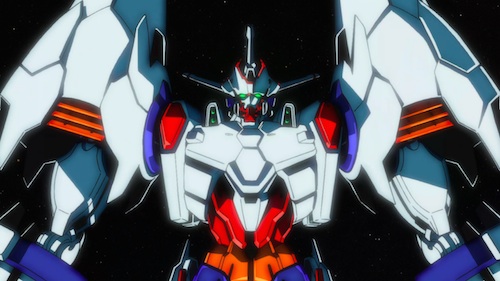
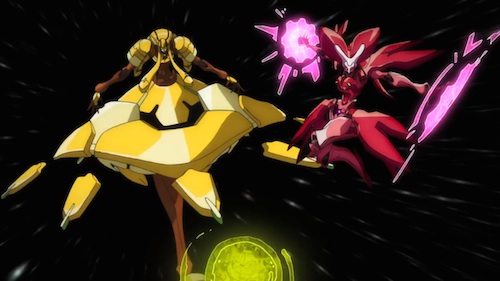
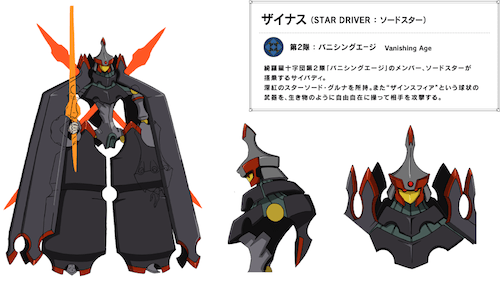
When I watched the first episode of Captain Earth, I felt that the show had to be somehow related to the anime Star Driver, a previous work from the same studio, BONES. Like Star Driver, “libido” is presented as some kind of important power or energy source. The enemy mecha, known as Kiltgangs, bring to mind many  of the “Cybodies” from Star Driver as well, not only in terms of design but also in their pilots’ very “spirited” (read: erotic) reactions. Mysterious songs herald the arrival of an enemy. In the end, it turns out that these allusions remain only as such and that there were no direct narrative connections between these two works, but I do still find it valuable to compare them because Captain Earth more or less feels like a more conventional, less wild re-telling of Star Driver.

Above: Enemy mecha from Captain Earth, Below: Enemy mecha from Star Driver

Whereas Star Driver has a main character whose sense of justice has him appear out of a rift in space like some kind of giant interdimensional Zorro, Daichi in Captain Earth is mainly inspired to do good by the example of his deceased father, and undergoes an elaborate combination sequence that has him launching into multiple space stations. While quiet scenes in Star Driver are set on a mysterious island and battles take place in an enigmatic pocket outside of time and space, fights in Captain Earth uses Tanegashima (home of JAXA in reality), and its most signature fights take place in orbit around the Earth. One thrives on symbols and mystery and is akin to being a giant metal Utena, while the other plays out more closely to a typical super robot anime, yet they share many of the same strengths and flaws as shows. Both shows have vibrant and expressive characters, a consistent sense of mystery about the enemy that gradually reveals itself, and beautiful animation especially focused around dynamic action sequences. However, they also share unusual plot reveals that are strangely abrupt, as well as changes of heart in characters that basically make sense but could be better if they were focused on more. Both stories feel liable to fall apart in a structural sense, but are held together by the dynamism and energy of their characters, for better or for worse.

How does this manifest in Captain Earth in particular? There are two points that stick out to me. The first is the fact that the Planetary Gears have an intriguing inverse relationship with their robots, in the sense that they are basically giant robots who take on the guise of their “human” pilots rather than the other way around. This is quite a unique idea, but it never gets explored as much as I would have preferred. The second point comes in the last episode, when Daichi is back to basics, fighting the enemy with just the Earth Engine and no additional weapons or frills. It’s something that happens at the end in a lot of giant robot anime such as Gurren-Lagann or Gaogaigar, but when Daichi calls out the Earth Engine’s attacks, I realized I didn’t actually remember any of them, because the story couldn’t quite ever focus on the main robot as this symbol of good and make its attacks memorable. What makes the scene a partial success instead is the fact that we are there with Daichi as he grows into the role of “Captain Earth,” and his romantic relationship with the character Hana.

Actually, when I think about it further, Captain Earth doesn’t feel like simply a different, less surreal version of Star Driver, but more the lovechild of Star Driver and another BONES work, Heroman. The Earth Engine basically looks like an upgraded version of Heroman with its red, white, and blue color scheme and its overall “physique,” while Daichi’s personality is right in between Takuto from Star Driver and Joey Jones from Heroman. What’s even more notable, however, is the fact that many of the other high and low points of Captain Earth that it does not share with Star Driver can be found in Heroman. In particular, when Captain Earth is focused on its main story, it has a sense of urgency and excitement, but often it ends up meandering in a way that is less irritating and more puzzling: “Why put this diversion here of all places? It’s not even humor to break up a serious moment?” With Heroman it’s the long number of episodes they spend dealing with that mad scientist villain, and with Captain Earth it’s the time they spend on Earth chasing down unawakened Planetary Gears. While the latter makes more sense, it just feels as if it comes at an unusual point in the overall story.

While its aesthetics don’t have quite the flash and razzmatazz of anime like Utena or Kill la Kill or indeed Star Driver, the show’s more by-the-books approach to looking good enhances the series and its viewability by giving care to both its characters and its mechanical designs. At the same time, I can easily see why someone looking for a cohesive narrative above all else would find Captain Earth infuriating, even if I did consistently enjoy and look forward to the series. I wouldn’t say it’s a show that you shouldn’t think about too much, but that you should think about it while well aware of where the characters and their emotions fill in the gaps that might not otherwise make much sense.

The Fujoshi Files 110: Konno

Name: Konno (今野)
Alias: Kon (コン)
Relationship Status: Single
Origin: Genshiken: The Society for the Study of Modern Visual Culture II

Information:
A former classmate of Hato Kenjirou, Konno is a fujoshi who discovered that Hato likes yaoi and is inadvertently responsible for spreading the rumor that Hato was gay. A resident of Niigata Prefecture, Konno was a member of the high school art club along with Hato, Kaminaga, and her friend Fuji. Somewhat high-strung, Konno has feelings for Hato but has difficulty making them known, and feels a good amount of guilt over the incident with him in high school.

Fujoshi Level:
Unknown, other than that she always looked forward to Kaminaga’s BL work back in their art club days.

The Entirety of Initial D Takes Place Over Two Years

I recently finished Initial D: Final Stage, which brings the story of teenager Fujiwara Takumi and his inhuman drifting skills to a satisfying conclusion. I had been keeping up with Initial D on and off for almost 15 years now, which is kind of crazy to think about, but what was even bigger shock for me was realizing (thanks to the show’s ever-present exposition) that all of Initial D, whether that’s over 700 manga chapters or its anime equivalent, takes place in the narrative over a span of two years.

It’s nothing to get worked up over, and there are series with even more drastic disparities between publication and in-story time frames (see Akagi and Megatokyo), but there’s something about Initial D which feels different. It’s almost as if there were indeed 15 years’ worth of racing action crammed into two.

Other facts I wasn’t even aware of are that the manga itself ran for about 18 years, and that the author Shigeno Shuuichi was born in 1958. Somehow he was able to maintain the racing manga for almost two decades, rendering his work about as timeless as the very Eight-Six Trueno that’s at the center of Initial D.

Perhaps “Explaining the Joke” in Anime Isn’t Really Explaining the Joke

I sometimes see people ask why so often characters in a comedy anime will explain a joke after it’s happened, as the idea of doing so is, at least in English, considered a sure-fire way to kill any and all humor (I call it the Jay Leno Effect). I’ve been doing a bit of reading about Japanese humor recently though, and based on it I think I have a better understanding of why this happens.

Japanese social interactions are loosely governed by two concepts: “honne,” or one’s true feelings, and “tatemae,” what one displays outwards to the public. While I think it’s a mistake to put too much stock into this distinction (believing Japanese people cannot express themselves is sort of ridiculous), the explanation I’ve read is that honne and tatemae are central to certain types of Japanese humor, particularly manzai comedy. In manzai, the idea of having the boke (fool) and the tsukkomi (straight-man) is that the boke does something or says something ridiculous, and the tsukkomi responds with a sharp retort and/or a wack in order to correct the boke.

When it comes to anime, I think that actually when another character “explains the joke,” it’s not to tell the audience in case they didn’t understand. The idea is that something so unbelievable just happened that, rather than letting it slide and preserving the situation (tatemae), the person feels compelled to express his or her true feelings about it (honne). Essentially, the act of explaining the joke is part of the humor itself, as it essentially shows how the event was so jarring or absurd that the character had no choice but to tell it like it is. Sometimes you see characters in anime do this silently, taking advantage of the fact that the format allows us to be privy to their inner thoughts.

Of course, not all jokes can be explained by this, and in fact I’ve also read that some Japanese humor is about being able to create laughter on the inside without it spilling outside, which might explain certain slice of life humor like Hidamari Sketch and Yotsuba&! and the like. That said, I find myself laughing out loud at both of those titles pretty often, so who knows.

The Fujoshi Files 109: Oakwood Editor

Name: N/A
Alias: Silkwood Editor (くぬぎの編集者)
Relationship Status: N/A
Origin: Humanity Has Declined

Information:
The Oakwood Editor leads one of the most popular amateur groups to be part of the BL “douruishi” craze. Living in a time when fairies have supplanted humans as the dominant species, her circle sells 5000 books at the world’s first douruishi event.

Fujoshi Level:
Nothing is known, other than that she heads a very successful douruishi group.

The Fujoshi Files 108: Silkwood Editor

Name: N/A
Alias: Silkwood Editor (合歓の木の編集者)
Relationship Status: N/A
Origin: Humanity Has Declined

Information:
The Silkwood Editor is one of the women who took to the BL “douruishi” craze started by Y the Camphorwood Editor in the era when humans have been replaced by fairies as the Earth’s dominant species. Her circle manages to sell 4500 copies at the world’s first douruishi event.

Fujoshi Level:
Nothing is known, other than that she commands one of the more successful BL douruishi groups.

Witch Craft Works as a Vehicle for Feminist Criticism

If you search online for Witch Craft Works, one of the first things you’re likely to see is the promotional art for the anime, pictured above. It’s an attention grabber for sure, as the image of a tall, voluptuous woman cradling a smaller, frailer man in her arms sends a whole array of messages that can be interpreted in a variety of ways. Of these possibilities, one question that arises asks, is Witch Craft Works feminist? I would argue that it is in certain respects, but not necessarily in the way that one might expect. While one may very well approach the gendered role reversal in terms of whether or not it’s a form of empowerment, I find that it’s better to consider it in terms of how it highlights how we view those roles in the first place.

Witch Craft Works is an anime and manga about a meek-looking teenage boy named Takemiya Honoka and his love interest/protector, the practically-perfect-in-every-way Kagari Ayaka, who is also a witch able to command flames. Weak protagonists are nothing new for anime at this point, but whereas a typical story would have the guy “man up” and defend the woman (see Fate/Stay Night, for example), Ayaka is clearly stronger than he is at all times. This is what creates the spark of potential for Ayaka to be a symbol of female empowerment, though people who read into her this way may potentially be disappointed, especially because her clear male-oriented attractiveness (wide hips, very large breasts, long raven-black hair) and moments of obvious fanservice can detract from such a portrayal.

While those unfamiliar with shoujo manga might see the series as more of a role reversal in general, in fact Witch Craft Works is more specifically a genderswap of a stereotypical shoujo manga. Instead of the girl being perpetually late for school and bumping into Mr. Tall, Dark, and Mysterious, it’s Honoka playing the part instead. All of the lines that the male love interest would make about protecting the female protagonist while holding her gently have instead gone to Ayaka. What makes it clearly shoujo as well is the trope of having Ayaka followed by a squad of fangirls who keep all potential partners at bay through bullying and trickery. The main difference, aside from the change in genders, is that the art style is more geared towards a male audience, which opens it up for the criticisms seen in the previous paragraph.

When I say that Witch Craft Works can be interpreted as a feminist work, however, my intent is not to argue that people should just get over the clear idealized appeal of Ayaka for heterosexual male viewers. Instead, the point I want to make is that this role reversal brings to the surface many assumptions we make about how characters behave. Imagine that, instead of Witch Craft Works acting as a reverse shoujo series, we instead made a genderswap version of James Bond, or better yet Golgo 13? In this version, a stoic woman would sleep with guys left and right, who would be so amazed at her instinctual command of the carnal arts that they would beg at her feet for more as she leaves without saying a word. Sometimes, they might get caught in the middle of a gunfight or perhaps themselves be assassins, which would result in them being violently murdered by “Golga 13.” As she goes about putting bullets in the heads of her targets, men and women would sing her praises and talk about how amazingly powerful she is.

Would this be empowering? Perhaps. Would this emphasize equality between male and female characters? Not really, as it’s more just flipping the issue. However, by turning the tables in that way, it would increase awareness of how these tropes are affected by how we perceive characters’ behaviors according to their genders. Witch Craft Works does something similar, only instead of using the typical narrative aspects of a guy-oriented series like Golgo 13, it uses the cultural markers of girl-oriented anime and manga to start with, and then pushes things a few steps further.

One of the arguments by fans of yaoi and yuri as to why they prefer those stories over ones about heterosexual relationships is that there’s less of a power imbalance between male and female. At the same time, categories like “seme” (top) and “uke” (bottom) complicate this issue because they can often be used to express a relationship of domination and submission. Witch Craft Works, through the interactions of its weak male and strong female leads and its mix of guy-oriented and girl-oriented aesthetics, calls to mind all of these different portrayals of romances. Kagari and Ayaka simultaneously behave like a shoujo romance, but also a bit of a shounen one as well, and even embody aspects of yaoi and yuri. Apparently the manga was originally supposed to be yuri itself but was changed to its current form.

For guys, this is a rare opportunity to see what it feels like for a male character to be made a damsel-in-distress, though the conclusion for them won’t necessarily be that this is a problem, and that the role is diminishing men as a whole. It’s possible that this can even be viewed as something desirable, that men rarely get the chance to feel the desire to be rescued, to have their troubles eliminated by someone more powerful than themselves, even less so when the rescuer is a woman (usually it’s a father or something along those lines). Instead of manifesting an empathy for weakness through moe girl character, it can be achieved through a boy, and there isn’t even a need to berate him for not being “man enough.” At the same time, male viewers can see the boy damsel, take comfort, and then return to endless images of macho heroes. Women, on the other hand, leave Witch Craft Works and go back to a sea of women being captured and waiting for their saviors. As a result, Witch Craft Works ends up emphasizing the fact that the “damsel-in-distress” issue is not that the trope is inherently dangerous or detrimental, but that it has been historically reinforced repeatedly as something “for women.”

By playing with the standard rules of its storytelling style but flipping the script, Witch Craft Works serves to make us aware of those storytelling tendencies, especially those found in anime and manga. and to look at them more critically. In that respect, Witch Craft Works is capable of contributing to feminist criticism.

Aldnoah.Zero Arrogance

Most of the fights in the mecha anime Aldnoah.Zero follow a roughly similar pattern: In a reversal of the typical structure of giant robot combat, a technologically superior and seemingly invincible enemy is overcome by the tactics and ingenuity of the protagonist Inaho and his allies without the need of secret prototype weapons or trump cards. What I think makes these battles and the opponents’ eventual defeats work really well both narratively and thematically is that their downfall is usually based on them being blinded by arrogance.

One might argue that this is unrealistic, or more specifically that an opponent with such an edge in terms of firepower would likely not have overlooked some of the weaknesses that end up being exploited by Inaho. However, given the culture of the Vers Empire, the feudalistic space culture that attacks the Earth, I find that it makes a lot of sense. The subjects of the Vers Empire, especially their “Orbital Knights,” have been raised to believe that they are inherently better than people from Earth, and that this superiority derives from their discovery and use of a powerful technology called the “Aldnoah Drive.” While from our perspective it’s easy to point out that the “inherent” superiority of the Vers is anything but because it derives from an outside source in the Aldnoah Drive, actually history has shown that similar reasoning, as strangely illogical as it can seem, has often been used to justify similar mindsets or even forms of racism.

Consider the hypothetical example of a nation of people who believe they are simply better than their neighbors because they were born on land that was more arable. Although one could easily say that this is just a matter of luck or probability to an extent, it wouldn’t seem that strange for them to believe that they were somehow blessed by God or some other great power, and that they deserve this blessing on some fundamental level. It’s circular reasoning to be sure, but that doesn’t necessarily stop anyone from believing it.

Thus, the Orbital Knights believe that they are inherently superior in every way over the Terrans, therefore they receive the more powerful technology, therefore they are inherently superior in every way over the Terrans. They buy so much into not only the idea that the people of Earth are too stupid to figure anything out, but that they actually have no Achilles’ heels to exploit in the first place. With nothing to challenge them and without even acknowledging that they may have overlooked something in their robots (or “Kataphrakts” as Aldnoah.Zero calls them), potentially preventable defeats are addressed too late.