Survival Game Club! Anime vs. Manga

When it comes to the anime Sabagebu! Survival Game Club!, a show about girls in a high school airsoft club, one of the more surprising aspects of the show is that it is in fact a shoujo manga. The anime even acknowledges this, pointing out how it runs in Nakayoshi, the same magazine that has featured series such as Cardcaptor Sakura.

As true as this may be, it is still easy to get the impression that the show still doesn’t quite look or feel particularly shoujo even when putting aside the whole survival game aspect of its premise. As it turns out, this is because while the show is indeed adapted from a girls’ comic, there are actually a number of differences between the manga and anime that result in a fairly different product in certain ways. This is not an argument for which is better or worse, merely a laying out of just how these two iterations are set apart from each other.

I find that there are three elements in particular, at least when looking at the early chapters and episodes, where the Survival Game Club! anime and manga differ significantly.

1) The Anime and Manga Simply Look Different
sabagebu-momoka-firstshot-sequence

sabagebu-samplepage

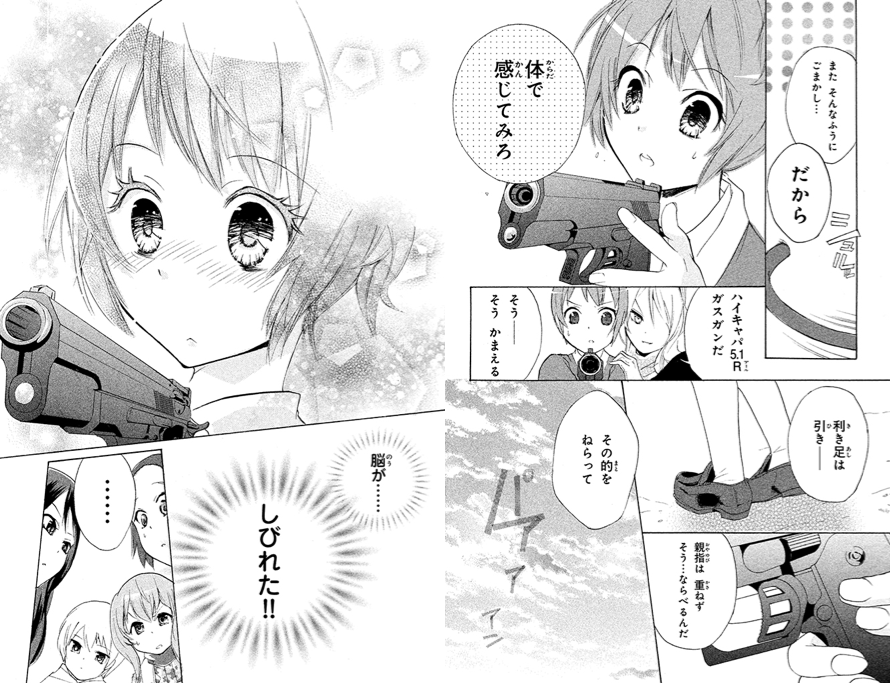
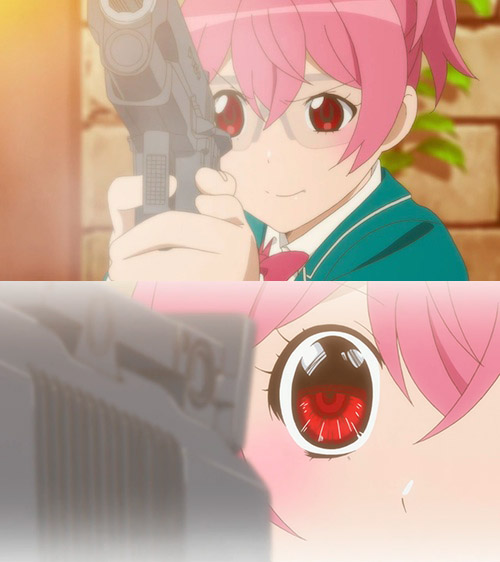
Both versions of Sabagebu! depict cute girls using fake guns, but they each take unique approaches. With the characters, the anime designs appear closer to something from a more male otaku-oriented work. The manga, on the other hand, utilizes character designs that appear flatter and more in line with the flowery aesthetic of a typical shoujo manga.
sabagebu-mayacomparison

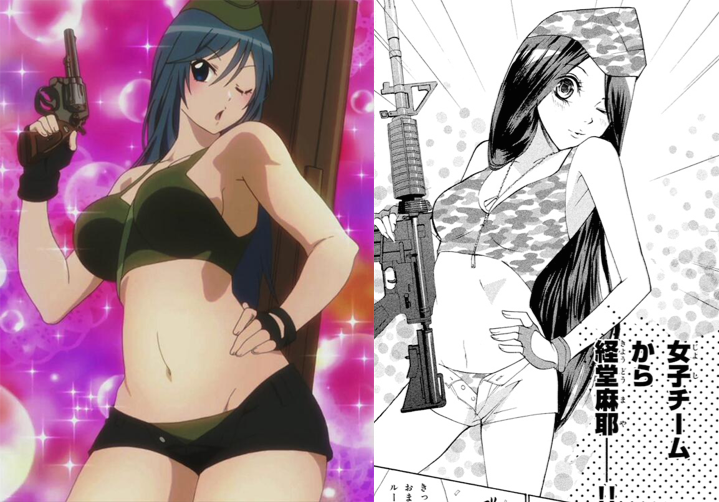
This contrast is also evident in how the anime portrays the girls that are meant to be more attractive, giving them a kind of round, three-dimensional curvaceousness that is not present in the manga. In the comparison image above, the anime version of the character Maya has a gravure idol-like quality to her, whereas Maya in the manga has a look more akin to a fashion model, or perhaps even a fashion drawing.
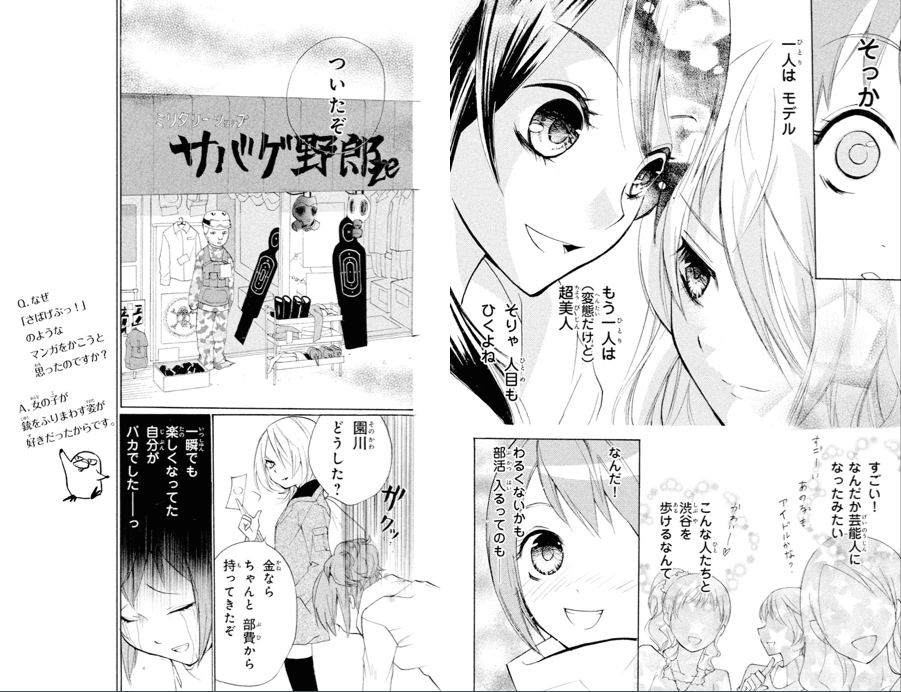
sabagebu-shoujofeel

To be fair, most shoujo manga adapted into anime try to go for a more “neutral” look compared to the particular and well-known stylizations of shoujo manga. One need only look at the original Sailor Moon anime and compare it to its manga (or the designs of the recent Sailor Moon Crystal anime). Sabagebu! is no exception in this respect.

2) The Anime Pads Out Scenes from the Manga

In their review of the first episode, the Reverse Thieves mention that the anime feels like it’s adapted from a 4-koma (panel) manga even though the original Survival Game Club! comic does not utilize that format at all. While one could argue that this is just a matter of having so many 4-koma manga adapted into anime, I find that the real culprit is the fact that many of the scenes in the manga are extended in the anime. The result is that the connective tissue that carries one moment into the next in the manga is obscured by the added animation.

So far, this is often done by creating elaborate gun fight scenes where the manga ends up either showing less (or nothing at all), but this padding also comes from increasing the amount of mean-spirited behavior or by adding more cultural references. For example, here is a scene where the character Urara is acting upon her jealousy over the club president’s fondness for the protagonist Momoka by using a stretching exercise as an excuse to place Momoka in some painful wrestling holds. The manga and anime, however, approach things somewhat differently.

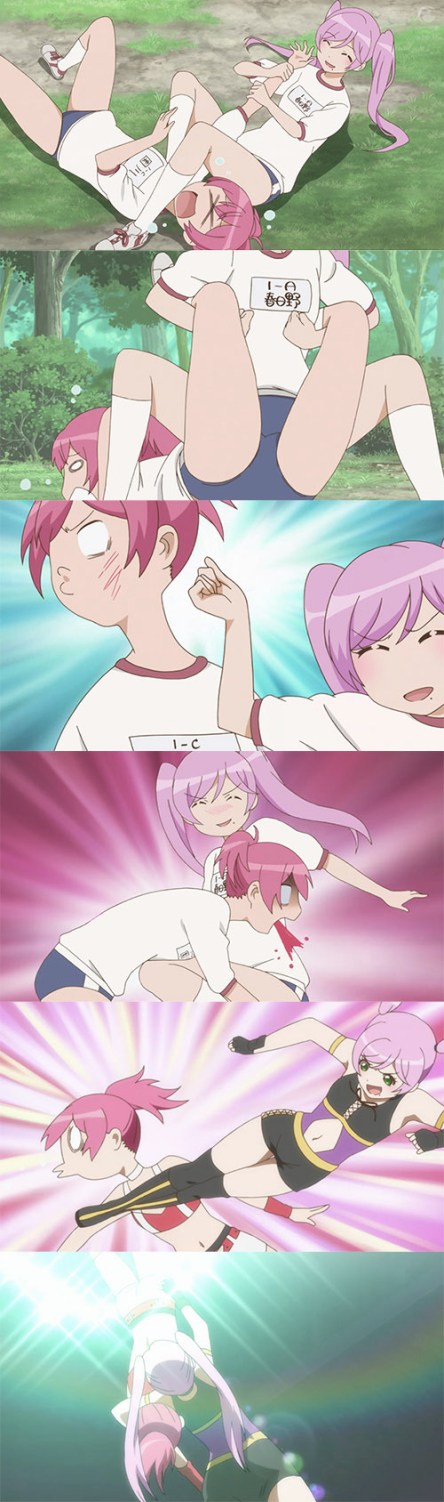
sabagebu-uraraholds-manga

sabagebu-uraraholds-anime

While in the manga the joke is supported through the characters’ dialogue (Urara falsely claims that she “doesn’t know anything about armlocks!”), the anime just piles on further wrestling techniques. The two gags are similar, of course, but the expansion seen in the anime is more akin to how shows like Azumanga Daioh have been adapted in the past.

The venomous behavior of the characters in the anime also ties in nicely to the next point.

3) The Protagonist’s Personality is Nastier in the Anime

In the anime, after Urara fails to separate Momoka from the club president, she goes off to cry by herself. Momoka follows her and offers her hand, only to do this:

sabagebu-momokapunchesurara

This causes Urara to fall in love with Momoka instead, becoming a masochist for Momka’s sharp jabs, both literal and metaphorical. While in the manga Urara also ends up with a strange crush on her, Momoka does not engage in any sort of physical retaliation at all. In fact, whereas Momoka in the anime has a general philosophy of “payback” that heavily defines her character, in the chapters of the manga I’ve read this is not prevalent at all. Perhaps it’s a change that came over time, and was retroactively added back to earlier portrayals of Momoka when it came time to adapt the manga into anime.

sabagebu-makeupThis is not to say that Momoka is entirely a fair and meek shoujo heroine, but her personality in the manga is somewhat closer to what one might expect out of a girls’ romance comic… only without any real romance and with lots of guns.

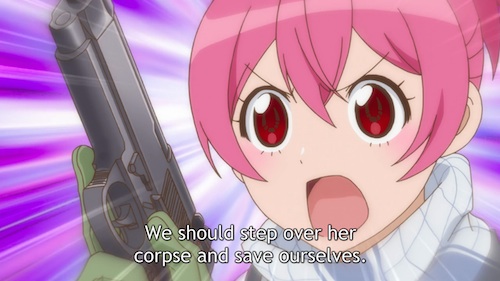
sabagebu-mendokusai-small

sabagebu-momoka-small

Overall

Whether animated or on paper, the basic appeal of Survival Game Club! is how it brings a type of crass humor that is rare in the demographic/genre of shoujo, and does so through subject matter that is rather unusual. The key difference between the two is that whereas the manga juxtaposes its shoujo visual style with the content and its characters’ behavior, the anime takes the roughness of the cast to the extreme and changes the designs to be more in tune with other cute-girls-doing-things shows. Personally speaking, I think I prefer the manga’s approach more because of how bizarre it looks within that shoujo aesthetic, but I do have to say that there is some appeal in Momoka’s vindictive behavior in the anime.


Weak Mecha

While at this point we have an understanding of the concept of a “weak” protagonists in giant robot anime thanks to characters like Ikari Shinji from Evangelion, rarely are main robots allowed to exude an image of weakness and vulnerability as well. If we even look at Shinji himself, while he’s known for being passive and lacking in will, the actual EVA-01 looks monstrous and acts even more terrifyingly.

In most cases when there is a “weak mecha,” it ends up being a joke character’s ride, whether that’s Boss Borot from Mazinger Z or Kerot from Combattler V. In terms of actual main-focus giant robots, the closest this concept gets its maybe Dai-Guard the almost-literal “budget robot,” or perhaps the perpetually incomplete Guntsuku-1 from Robotics;Notes. Maybe the Scope Dog from VOTOMS counts because it’s so disposable, but like Dai-Guard it still at least looks strong.

Of course it only makes sense that mecha tend to be on the powerful side; they’re giant mechanical humanoids after all. It’s just something I’m starting to consider a potential limitation of the genre and an interesting space to explore.

To Her, the Fight is Everything: Selector Infected Wixoss

Selector Infected Wixoss (pronounced “Wicross, not “Weak Sauce”) is Highlander meets Yu-Gi-Oh! meets Puella Magi Madoka Magica. Girls are chosen to become special battlers in a card game, with the goal of becoming the mugen shoujo, or “eternal girl,” and having their wishes granted. However, if a girl loses three times, she loses that opportunity. Of course, as one might expect given the constantly foreboding atmosphere of the show and even its opening, there’s a twist or three.

It’s actually really hard to avoid the comparison with Madoka Magica, not simply because it makes for a convenient point of reference, but because the strengths of Wixoss—its exploration of its characters’ wishes, and the way it incorporates the “Wixoss” card game into its narrativeare best explained relative to the popular magical girl anime. The main character Kominato Ruuko is, like Kaname Madoka, an innocent and cheerful girl with no particular wish of her own despite being thrown into this scenario where one’s heart’s desire is the most important thing, but as the series explores Ruuko’s character and her lack of “motivation,” she also reveals herself to be clearly different from Madoka.

Whereas Madoka’s hesitation is more because she keeps seeing the horrors and consequences of being a magical girl, Ruuko realizes that deep down she needs no reason to play the cruel game that is Wixoss other than that she simply enjoys it. Ruuko thus ends up exhibiting shades of Ryu from the Street Fighter video games, someone who lives for the thrill of the fight. However, because people potentially sacrifice their happiness when playing “Wixoss” as a means to an end, Ruuko feels immense guilt from the fact that she derives such pleasure from the game itself. Just the fact that the pure joy of playing is put into question, albeit not in an especially deep manner, gives Wixoss an interesting platform to think about this whole wishing business. Additionally, the show is a bit less concerned with the aftermath of wishes gone wrong and looks more at the pain of trying to fulfill one’s wishes.

The scriptwriter Okada Mari (Aquarion Evol, The Woman Called Mine Fujiko) can often be a divisive figure as her tendency to challenge social and sexual taboos in her work (in this case incest) while showing a penchant for the melodramatic can come across as heavy-handed. In this respect there’s a clear similarity to Madoka Magica, where writer Urobuchi Gen regularly has his characters announce their feelings and the despair associated with them. One noticeable difference between the two, however, is that Okada clearly has a better understanding of how girls behave and interact with each other. I’m not a girl so I can’t speak from firsthand experience, but in talking to girls about their experiences, the sort of underhanded and subtle tactics of exclusion are closer to how girl bullies operate. This alone gives Wixoss a sense that it treats its characters less as vessels for ideas or specific personality types as Madoka Magica does (which is not to say that the characters in Madoka are bad, just that they serve different purposes), and more as different manifestations of worries.

I believe this is the first show to specifically mix the TCG anime genre with a primarily female cast, and what I find especially surprising is the fact that “Wixoss” is actually a real card game, which makes me wonder if its marketing is successful or not. Most accompanying media for collectible card games in Japan present their TCGs into the most exciting and wonderful experiences ever, something that will help you make friends and cherish competition, and while Wixoss does this to an extent, the decidedly dark bent of the anime highlights the fact that players tend to suffer tragically when playing. It’s clear that the actual mechanics of the card game play second fiddle to the characters and their narratives, especially because the show doesn’t do much to explain how the game works, but in the end the actual real-life game is still there, and while it would be unreasonable to call players of the official TCG masochistic or anything like that, I’m sure the concept of the show is something quite a few keep in mind as they play.

There’s a strong sense of a yin-yang relationship in Selector Infected Wixoss between pleasure and pain, joy and tragedy, gain and loss. Strangely enough, however, though the anime definitely pushes itself as a “dark” series, I find that enjoyment of it doesn’t necessarily require a fondness for heavy works or an interest in deconstruction or subversion. The experience of watching Wixoss is not so much about horror as it is introspection, and the light that exists within the series is worth paying attention to as well.

Autistic Anime

In discussion of anime online, it is not entirely uncommon for someone to say that a certain anime is “made for autistics” or that “autistics dislike this show because they’re unable to pick up on the subtleties of human expression.” While there is a clear problem in terms of turning the term “autistic” into this general sort of insult, I would like to set that somewhat aside and to honestly consider what the following idea: what if anime (or other forms of media) were intentionally made for autistic people?

This post has actually been in the back of my mind for a few years now but I’ve always felt uncomfortable enough with the idea of writing it. My worry has been that, in bringing up a serious topic such as autism that I know very little about, I wouldn’t be able to do it proper justice even within the very limited scope of what I want to explore. However, after recently reading a post by Alain from Reverse Thieves about how the desire for “good” narrative pacing in anime among different people is more of a “horizontal” structure of preference than a “vertical” hierarchy of superior vs. inferior taste, it prompted me to move forward. In part, this is due to the fact that Alain launches his argument from a video of a talk given by Malcolm Gladwell, and in watching more videos of him, I came across this video where Malcolm talks about the strengths and weaknesses of making snap judgments, where he explains that everyone has periods of what he calls “momentary autism,” or points at which people are incapable of “reading minds,” something most non-autistic people take for granted.

As far as my personal experience, while I am not autistic myself (though I’ve of course been accused of it as some point in my internet life), I did have a roommate who was diagnosed with Asperger syndrome, and he made me aware of what this concept of being unable to pick up on emotional cues really means, and how difficult it can be to deal with it in everyday life. While he explained that he himself had high-functioning autism/Asperger’s, which meant that he could participate relatively well in society, he also was unable to participate in the humorous banter common among our group of friends at the time. This was partly because of the difficulty in picking up social cues, but it was also because surprise and moments of improvisation can be downright frightening. Instead, he would read up on jokes and prepare them in advance, so that he could contribute to the laughter.

This idea has stuck with me for years, and over time it’s transformed into the question I asked at the beginning. Imagine what a true “autistic anime” would be, something that does not assume the ability to infer people’s intentions as a default, but says, “this anime/cartoon/movie assumes its main audience to have autism and attempts to be as fulfilling for them as what is expected of the majority of entertainment for non-autistic people.” Here, the horizontal structure of different preferences as equal would include those with the inability to pick up on others’ emotions easily. Or, perhaps to take it further, what if the majority of the people in the world were autistic and as a result most of our entertainment had to cater to such an audience if it wanted to be successful on a larger scale?

Of course, this is the point at which I should be presenting various conceptions of what such anime would possibly look like, but I’m at somewhat of a loss. I don’t remember if I actually read this somewhere or if I’m making it up in my head, but I recall seeing somewhere the idea that anime as it currently exists can often be appealing to autistic people because of the fact that in so many works characters announce their emotions very directly. I think the idea is that, when Naruto shouts that he won’t forgive Sasuke and his cartoonish face has all of its features exaggerated for instance, there’s little ambiguity. Perhaps there could also be something more structural in terms of narrative, so as to foreground surprises or even be designed to encourage multiple viewings such that the content becomes increasingly familiar but also has more to explore each time. I do not meant to encourage the stereotype, but I have to wonder if the way works such as Star Trek, Doctor Who, Gundam, indeed even Naruto have created fanbases that work off of re-watching these shows and delving into their tiniest details (often regardless of the context of character motivation) results in a similar appeal.

I think it’s easy to tell that my own ideas in this regard are kind of rudimentary and lack extensive research and familiarity with the subject of autism, but I wanted to express my own simple ideas in the hopes that someone more well-versed in the subject either personally or professionally might be able to tackle this subject better.


Newtype Magazine’s Very First Cover Girl

Just as Marilyn Monroe graced the first issue of Playboy, it’s often somewhat telling who a magazine gets to be their first cover girl. For the anime magazine Newtype which debuted in 1985, it turns out to be Cham, the fairy girl from Aura Battle Dunbine, and I have to wonder what message that sent at the time.

Honestly when I found this out I was pretty surprised. Perhaps I shouldn’t have been given the Newtype -> Gundam -> Sunrise -> Dunbine connection. And yet, of all of the female characters to be the visual centerpiece for a debut, Newtype went for the cute fairy girl as opposed to even, for example, other girls from Dunbine like Marvel Frozen (a prediction of Disney’s eventual purchase of Marvel nearly 30 years later?!). What could it mean, especially because she would be back only a few issues later?

I may not be the best person to speak on this. I never finished Dunbine, and I don’t have any real idea as to how popular Cham was at the time among anime fans. However, whether they were trying to appeal to a fanbase of Cham lovers or trying to push her as the next big thing (though at this point Dunbine had been over for a while), I feel as if Cham’s status as the inaugural spokesmodel of Newtype says something about where anime fandom was in Japan at the time and where it’s gone since.

You often hear about how anime’s changed and the advent of “kawaii” and “moe,” but where did it truly begin if it began in anime at all? Then you look and see that at the very start of this magazine for anime fans from 1985 and see a cute little pixie.

The Fujoshi Files 102: Student from Warm Watch Group

Name: N/A
Alias:
Student from Warm Watch Group (見守る会の生徒)
Relationship Status: 
N/A
Origin:
Mayo Chiki

Information:
This girl is a student of Roran Academy and a member of the “Subaru-sama Warm Watch Group,” a fan club for the butler of the Suzutsuki household and Roran student Konoe Subaru. Their group, comprised mostly of fujoshi, are in favor of Subaru’s friendship with a male classmate named Sakamichi Kinjirou, which puts them constantly and secretly at war with a rival group opposed to that relationship, “Shooting Star Subaru Sama,” aka S4. This member is one of the few in the Warm Watch Group other than their leader Narumi Nakuru to interact directly with Kinjirou.

Fujoshi Level:
After rescuing Kinjirou from an S4 member’s attack, she asks him if he is the “seme” (top) or the “uke” (bottom).

Gattai Girls 5: Juusou Kikou Dancouga Nova and Hidaka Aoi

Introduction: “Gattai Girls” is a series of posts dedicated to looking at giant robot anime featuring prominent female characters due to their relative rarity within that genre.

Here, “prominent” is primarily defined by two traits. First, the female character has to be either a main character (as opposed to a sidekick or support character), or she has to be in a role which distinguishes her. Second, the female character has to actually pilot a giant robot, preferrably the main giant robot of the series she’s in.

For example, Aim for the Top! would qualify because of Noriko (main character, pilots the most important mecha of her show), while Vision of Escaflowne would not, because Hitomi does not engage in any combat despite being a main character, nor would Full Metal Panic! because the most prominent robot pilot, Melissa Mao, is not prominent enough.


Juusou Kikou Dancouga Nova, the 2007 sequel to the 1980s anime series Choujuu Jishin Dancouga, can be considered in some ways the epitome of an “average” anime. A more accurate description, however, would be that it’s a show that is overall somehow fun and satisfying despite not living up to a lot of the ideas it presents, which is evident in not only its narrative but also its sense of characterization.

The basic premise of the anime is that four unrelated people in Japanese society are summoned to pilot the mighty super robot Dancouga Nova, which intervenes in battlefields around the world in order to aid the losing side. However, rather than simply aiding the weak, this mission of Dancouga Nova’s is quite literal, as it will defend a military force one day and attack it the next, depending on that force’s relative strength in any given scenario. It’s an interesting idea to be sure, and Dancouga Nova even takes some steps to explore its consequences (a journalist character actively questions whether or not Dancouga Nova’s actions are merely creating stalemates that perpetuate war, for instance), but given the obvious question of what this will all possibly lead to, the series responds by more or less dropping the issue like a hot potato and shouting, “aliens!!!” Then they fight the aliens and it’s fairly exciting, but it leaves one wondering where the rest of the story went. As an aside, for some reason I find this less disappointing than how Gundam 00 transitioned between similar plot points despite being a stronger work overall.

Given these issues, it would be reasonable to expect the show’s treatment of its characters to be equally inconsistent. This is indeed the case to a fair extent, as the members of the Dancouga Nova team are all defined by sets of traits that seem destined to lead jokes about their personalities that fall pretty flat, (though they don’t come across as unbearable). Dancouga Nova gunner Tachibana Kurara for instance does the Golgo-13-esque “Never approach me from behind” thing, but the fact that she says it every time the situation calls for it turns it from an interesting character trait to a catch phrase that wears out its welcome (like most of the quips in the series). Main character and team leader Hidaka Aoi has the fewest of these qualities, which makes her lead position more enjoyable than if anyone else had as much of a spotlight.

However, whatever weakness in plot and characterization that exists in the show, it’s worth nothing that its portrayal of the female pilots is for the most part neither putting them on a pedestal above men nor subordinating them to supportive roles. A number of series that focus on groups of female characters both inside and outside of the mecha genre have a tendency to be about how beautiful and wonderful the girls are, a setup which has its place, but here the team of four is divided between two men and two women, all of whom contribute in battle evenly.

(It’s also interesting that all of the pilots are adults, rather than teenagers).

An additional female character is added later, but is shown to be just as effective as the others (and for a while is even their rival). Aoi herself is more or less a solid if underdeveloped character in terms of her portrayal, and while one possible criticism might be that she lacks agency in that she’s thrown right into the thick of things with little say in the matter, that’s more a problem for all of the characters in the show regardless of gender. In fact, the only point of “inequality” might be that the female characters (Kurara is a narcotics officer, Aoi is a professional racer and model) are more glamorous than the guys’ (salaryman and hobo). However, beyond this, neither male or female characters are rendered useless, and even the sole situation that might be considered a “damsel-in-distress” situation is more a matter of a female character staying to fight knowing that she’s at a clear disadvantage due to a number of factors wholly unrelated to her gender.

This is not to say that this series is aiming for a strong sense of feminism. On some level, all of the girls in Dancouga Nova are clearly supposed to be attractive feminine ideals, albeit in different ways. Fanservice, or more broadly the overt sexualization of its female characters, is certainly present in the series in quite a noticeable way. However, while creatively positioned camera angles and bouncing breasts appear throughout the anime, at the same time they are also not so prominent that fanservice becomes raison d’être for Dancouga Nova unlike a number of other similar series. For the most part, the anime keeps the “cheesecake” separate from the fighting, so battles do not consistent of prominent T&A shots while the female characters are being tossed around in their cockpits. Some revealing shots do occur in the action scenes, but they’re usually brief and fairly mild, and instead the summoning of weapons and the destruction of enemy mecha comes across as powerful and mostly gender-neutral.

When it comes to Aoi in particular, I do find it notable that while she is a fairly hot-blooded type as befits a super robot protagonist, she still comes across as relatively subdued as far as passionate yelling pilots are concerned, especially when compared to the hero of the original Dancouga, Fujiwara Shinbou. In contrast, there is a similar character in Dancouga Nova, Kamon Sakuya (the homeless one), but his attempts at playing the role of the 70s super robot hero are, like Kouji from Godannar, mostly a source of comic relief. A part of me wonders if this is making some kind of statement, that the old school nekketsu inevitably makes way for a newer type to fit modern times. I must admit that my impression of Dancouga comes mainly from its appearance in Super Robot Wars and just a little bit of the actual show, but even from this partial view Dancouga is famous for its passionate yelling and a dynamic visual style that makes even standing still an exciting assault of flashing lights and colors and crazy exaggerated proportions courtesy of Obari Masami (animator on Dancouga, director of Dancouga Nova).  Perhaps in light of this, the look of Dancouga Nova is not as exaggerated either. I would have chalked this up to “digital animation,” except Choujuushin Gravion, also directed by Obari, proves otherwise.

Dancouga Nova is a simple show that presents a female mecha lead who, while not exactly at the forefront of feminism, is strong, confident, narratively significant, and passionate enough that it’s easy to wonder why more characters aren’t like Aoi. It’s not so much that she’s a shining example of a great protagonist, but rather that she (or a character like her) should be the base line of what is minimally required for a heroine in this type of show. Aoi can be a bit simplistic, but in that way that defines a generation of male heroes in giant robot anime. Of course, as Dancouga Nova shows, being able to portray a female character well doesn’t necessarily mean a show itself is going to be amazing or that it won’t have its fair share of problems, but all the same Dancouga Nova is made better for having a lead like Aoi.

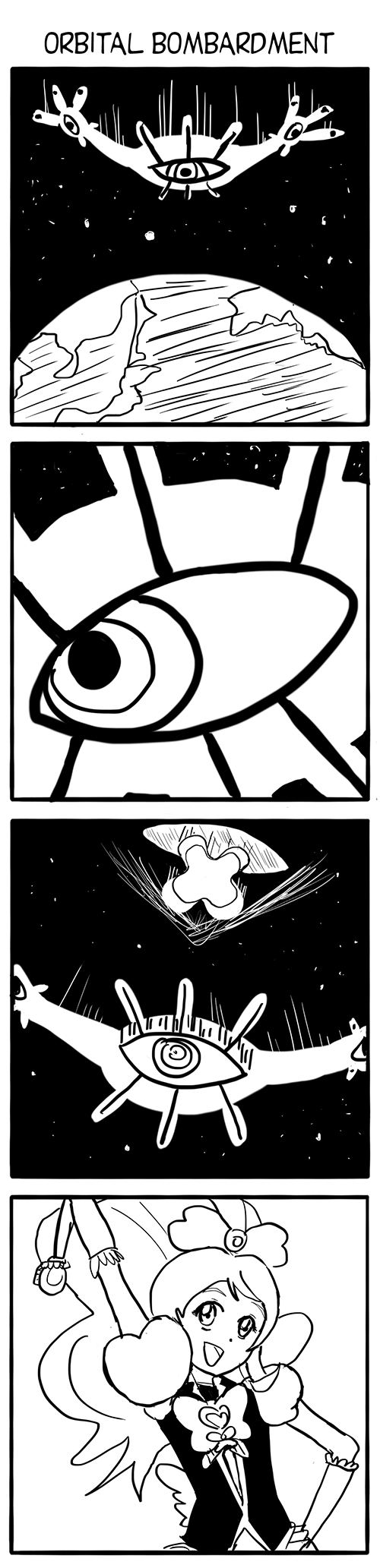
I’ve Been Wanting to Draw this Comic for a While

orbitalbombardment-small

Where the American Anime Fandom Goes

I’ve been living outside of the United States for the past few years, though funnily enough I’ve spent every 4th of July in the US. This year is an exception, but at the same time I will also be heading back home soon. So at least for the foreseeable future, this is my first and last Independence Day in Europe. What better time then to talk about America? I haven’t done that in a few years either.

Specifically, there are a bunch of thoughts related to Americans and anime fandom that have been whirling around in my head as of late, and I’m using this opportunity to try and organize them into some cohesive ideas. Not sure if I’ll succeed or not but that’s part of the entrepreneurial spirit or somesuch. AMERICA.

Two pieces of news that caught my eye over the past few weeks have been the announcement of a sequel and animated television series for Pacific Rim, and the fact that the recently revived Toonami block on Cartoon Network is doing better and better. In the case of Pacific Rim, one of the biggest talking points concerning the first movie’s release was that it didn’t do well in the United States, but in contrast found some success nternationally, especially in China. The idea permeating Pacific Rim and its “failure” was that it needed to do well domestically for it to have any real hope of continuing, but this news has shown otherwise. Scott Mendelson over at Forbes argues that this is the first movie that has received a sequel despite of its lack of success at the American box office, and may hint at the increasing importance of that overseas market. Various arguments have been made for why Pacific Rim didn’t click with American audiences, from idea that “mecha” isn’t a popular genre in either the US mainstream or among its anime fandom, to the opinion that it was just a bad movie, but there’s something intriguing about the idea the US is not the epicenter of this property’s future.

In contrast, it looks like anime is in a certain sense “rediscovering” its American fandom through Toonami. For a long while anime looked like it was on its way out of the American geek culture, as the presence of Japanese cartoons on Cartoon Network faded from their heyday in the early to mid 2000s. The “Toonami” concept itself, a block dedicated to anime and anime-like cartoons, even went away in 2008. And yet, whether it was because the folks in charge smelled profit in the air from anime once more or there was just some personal desire somewhere to bring anime back to the fore of Cartoon Network, Toonami has returned and is doing quite well.

Historically, anime has not needed its American fanbase. Sure, there have been a lot of viewers, but anime’s domestic market is Japan, and it also finds success around the world, in Europe, South America, and Asia. The US certainly has an online presence when it comes to anime discussion and enthusiasm, but over the years it’s been easy to get the impression that this fandom is a paper tiger, especially when it comes to popular shows among the internet fandom not translating to home video sales. Of course, this also has something to do with how expensive anime was for a long time (and still kind of is relative to other forms of media), but overall it wouldn’t be surprising if people perceived American audiences of anime as just somehow lacking. Now, however, not only are American viewers tuning in to catch Toonami and its latest anime, but the shows people are most interested in are also the ones that have developed large fanbases online as well.

It would be remiss of me to minimize the importance of the actual shows themselves, as I think regardless of anyone’s opinions of these anime, it’s fairly easy to see why series such as Sword Art Online (MMORPG plus swords and sorcery), Attack on Titan (violent post-apocalyptic world with large cast of interesting characters), and Black Lagoon (guns and action) would do well with an American audience even if all three are significantly different from each other. One thing that I find interesting, however, is that at least for the first two their Japanese fanbases are also quite substantial. In this situation, you have the support of a hardcore Japanese fanbase, a mainstream Japanese audience (especially for Attack on Titan), a hardcore international and American fanbase, and a relatively mainstream presence in the US as well. It’s as if the division between fan and casual has been collapsed, and interests that are often viewed as mutually exclusive now overlap.

So on the one hand, you have a property in Pacific Rim where the American audience turns out to not be as important as originally thought, and on the other hand you have in Toonami the rediscovery of an American audience that is, while arguably not significant, still good to have. I feel like there’s some connection or relationship here but I’m not exactly certain of what it is. One thing that might help is that I recently read an academic article from 1998 on Sailor Moon, which was written during the time that Sailor Moon was already a runaway hit in Japan and was beginning to air in the US. Though Mary Grigsby’s “Sailormoon: Manga (Comics) and Anime (Cartoon) Superheroine Meets Barbie: Global Entertainment Commodity Comes to the United States” is more about arguing how the series is influenced by cultural hegemony (essentially the continuous and subconscious reinforcement of how things are in society) yet somehow defies it, what caught my attention is the fact that a note at the end mentions how by the time this article was published Sailor Moon had already been a commercial failure in the US.

Sailor Moon was not the profit machine that the various companies supporting its US distribution had hoped, but in light of a new  Sailor Moon anime in celebration of its 20th anniversary and the clear continued significance it has to American anime fandom, it’s clear that the show has had an impact, and possibly that what was seen as a failure of the show at the time may have been more a failure of marketing. To some extent, this may have had to do with the cultural landscape of the US in the 90s. After all, in contrast to the revising of Sailor Uranus and Sailor Neptune from lesbian lovers to cousins back then, currently more and more people in the US are accepting or at least tolerant of same-sex relationships. However, there’s another important point to consider. In the Pacific Rim article, Mendelson also writes that “The deciding factor separating Pacific Rim 2 from Robocop 2 may be the passionate fan base of the former. It’s easier to talk financial parties into a sequel to a somewhat under-performing original if paying audiences actually liked said original.” Sailor Moon grew a powerful fanbase that the models for success at the time couldn’t properly account for. As the American anime fandom grows once more, now may be the time for both old and new fans to find some common ground.


The Fujoshi Files 101: Narumi Nakuru

Name: Narumi, Nakuru (鳴海ナクル)
Alias:
Narunaru
Relationship Status:
Single
Origin:
Mayo Chiki

Information:
The cat-eared high school student at Roran Academy with an extreme fondness for glasses, Narumi will go as far as to dive out windows to save a pair. She, like many of the girl at her school, is a big fan of fellow student and butler Konoe Subaru, and is even the president of the “Subaru-sama Warm Watch Group,” one of two major Subaru fan factions in her school. The Warm Watch Group is constantly at odds with their rival group, S4 (Shooting Star Subaru Sama), though neither is aware that Subaru is actually a girl.

Narumi and the rest of the Warm Watch Group are mostly fujoshi, and thus support the friendship between Subaru and “his” male friend, Sakamachi Kinjirou. Narumi herself goes as far as to write BL novels starring thinly-veiled analogues of the two which are so lengthy that they require someone with superhuman strength to staple the pages together, and then acts out the scripts. Owing to the popularity of her doujinshi, she has a loyal fan club of her own.

Fujoshi Level:
Narumi once turned down a boy who had confessed to her, for the reason that she has dedicated her entire high school life to creating BL.