Random Thoughts on Twitch Plays Pokemon

aiiiiiirrr-small

I made this just for this post

Twitch Plays Pokemon is a fascinating social experiment. Through the magic of streaming video and live chat, tens of thousands of users try to collectively play a single game of the original Pokemon Red by inputting simple commands such as up, down, and a. The result is inevitably chaos as our hero Red looks to be religiously checking his items, pacing back and forth, throwing away valuable items, and never ever being able to walk in a straight line. Fans have lovingly crafted a lore around the whole endeavor, taking the idea of active participation to arguably another level.

If you’re reading this, you probably don’t need me to tell you about it, because Twitch Plays Pokemon has absolutely exploded in popularity, getting coverage on a number of major sites. Given this, I do have to wonder to what extent the popularity has to do with Pokemon itself? Pokemon is one of the best-selling video game franchises of all times, and inevitably many people have experienced Pokemon in one form or another, even if they haven’t played the original game. This is why you can get anywhere between 40,000 to 100,000 people on the stream simultaneously 24 hours a day, because much like the British Empire the sun never sets on Pokemon fandom.

I’m no exception as I’ve inputted a few commands myself. I’ve watched in horror as the convulsing young Pokemon Trainer threw away two of his most valuable Pokemon, and witnessed the serendipity of Digrat, the Rattata who keeps resetting the progress of the game by digging back to the beginning of caves and secret hideouts. What I’ve also learned is that Pokemon Red is still really fun in and of itself. While the latest games in the series, Pokemon X/Y, are by far the best Pokemon games ever in terms of level of refinement, things to do, and even ease of finally creating that competitive team to beat down your friends/people on the internet, the enjoyment that the first-generation games brought was not simply a matter of nostalgia. Nostalgia is a huge factor for me personally, as the familiar tunes are ingrained deep into my psyche and I realized I could recognize that a Drowzee was sent out just from hearing it cry, but the elaborate yet ultimately forgiving sense of exploration you get in Pokemon Red/Blue just feels right.

This isn’t to say that the collaborative aspect of Twitch Plays Pokemon is subordinate to the game itself, as it’s being part of a greater crowd that is (for the most part) trying to aim towards success but often unintentionally stifling it that gives the whole experience much of its charm. With the Pokemon games, you’ve always had an environment where success feel great, but with Twitch Plays Pokemon failure often feels just as satisfying. Either way, it makes for great stories to share.

The Perfect Nickname for Saki’s Anetai Toyone

The new season of the Saki anime is here, and with it comes a whole slew of new characters. I’m quite fond of a number of them, but perhaps none more than Anetai Toyone. At 197 cm tall (over 6’5″) she’s not just “anime girl” tall, but actually a dark and imposing figure (at least physically).

I mentally refer to her as “the Undertaker” because on her resemblance to the WWE wrestler, particularly his early-to-mid 90s look, and I’m encouraging everyone else to do the same. It’ll make the actual experience of watching the show that much richer, and I want you to think of that signature gong every time you see Toyone.

Perhaps Kakura Kurumi (the small one) could be her Paul Bearer.

Watamote’s Tomoko is Basically Butt-Head

Hear me out.

Tomoko, the main character of No Matter How I Look at It, It’s You Guys’ Fault I’m Not Popular! (aka Watamote) is a sad sack whose life gradually rolls downhill as her own delusions of greatness collide with the reality of her crippling social awkwardness. You can even see this in the fact that, contrary to original translations of the manga, the title emphasizes that she blames other people for her problems. Some of those problems are real, some imagined, but what’s generally true is that she makes things worse for herself.

A lot of characters are likened to Tomoko as a kind of shorthand to understand the humor, horror, and appeal of her character. I’ve seen Shinji from Evangelion, Wile E. Coyote (because of how everything she does backfires), and I was originally even fond of comparing Tomoko to Charlie Brown, but the more I think about it, the more that I realize that ol’ blockhead for all of his misfortune doesn’t quite cut it, and that there is only one true answer.

  • Obsessed with media and entertainment, but also thinks a lot of it is crap
  • Not entirely incompetent, but definitely overestimates his own intelligence
  • Awkward, stuttering laugh
  • Hears dirty words where there are none
  • Misguidedly misanthropic
  • Plans to make his life better backfire constantly
  • Sometimes believes he got “laid” just by being near a girl

Think about it. I guess the only thing is that Butt-head “wins” more often because he enrages his principal.

Sasha Blause in Potato Confront

I thought it to be the most appropriate music for the occasion.

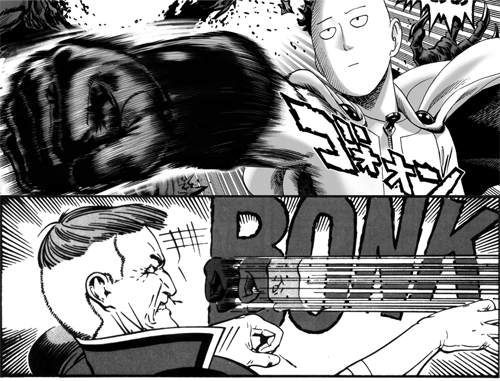
I Seriously Can’t Believe No One’s Made This: One Punch

onepunchman-guygardner-small

Straight Title Robot Anime, or, MIKUBAIN: LET’S GET SILLY

In a previous post, I had likened the bizarre 3dcg anime gdgd Fairies to an Adult Swim cartoon. I still think it’s an apt comparison, and with the new season currently running this only renews my confidence in that description, but what I hadn’t expected was for there to be another anime like gdgd Fairies, especially not one that’s themed around a giant robot future. This isn’t so surprising once you learn that it’s from the same creator as gdgd Fairies, but what’s impressive is that in some ways this new show’s humor is even more absurd.

Straight Title Robot Anime (yes, that’s the title) takes place in a time when humanity has gone extinct and only giant robots are left to fight an eternal war. Living on this Earth are three human-sized female robots who are trying to stop the war by re-discovering mankind’s great invention: humor. In order to accomplish this, they try to figure out what it means to tell a joke and induce laughter, but the concept is so foreign to them that they’re unable to make any headway.

In other words, this anime is actually all about trying to explain jokes, which is classically regarded as humor’s own kryptonite, but amazingly this just makes the whole premise funnier. It’s also animated entirely in the free program Miku Miku Dance, which was created for just the purpose its name implies (animating Hatsune Miku).

If it wasn’t obvious that this show is from the same mind as gdgd Fairies from, the fact that there’s an “improv” section similar to the fairies’ own “Magical Spring Dubbing Lake” should be more than sufficient evidence. In it, the three robots visit simulations of “ancient human locations,” such as a hardware store, and try to figure out uses for the objects found. I’m not sure how they accomplish these scenes, but I imagine it actually involves them gathering materials from those real-world places and then having the voice actors engage in prop comedy. Here, not only are the voice actors unable to keep up their acted roles and break down into their normal voices, but one character goes from having a very artificial BEEP BOOP I AM A ROBOT voice to having a natural cadence which not even an electronic voice distortion can fully hide.

Most telling of all is the fact that, despite the show being premised around the idea that the robots do not understand what it means to laugh, the robots in this sequence are giggling constantly. The narrator nonchalantly explains this as “interference,” invoking that old Mystery Science Theater 3000 mantra, “It’s just a show; I should really just relax.”

So that’s Straight Title Robot Anime. In my opinion, the humor isn’t quite to the level of gdgd Fairies yet, but its appeal is such that if you liked gdgd Fairies you’ll probably enjoy this too. However, if your only response to the fairies was revulsion then this show won’t help either. These really are both love it or hate it shows, as is evident from the comments both anime received. You can experience Straight Title Robot Animegdgd Fairies 2, and the angry comments these shows tend to get, on Crunchyroll.

One Piece’s Nico Robin Reviews Vividred Operation

American Mahjong Manga

As a follow-up of sorts to my previous post about American Mahjong, I drew this (read left to right):

Delicious Rate 300%

Sagimori Arata and the Pinnacle of Powerful Puns

I love good (bad) puns. I’m also quite fond of mahjong and its representations in manga and anime. So when the two combine in an interesting way, why it’s just a wonderful day for me.

Saki and its spinoff Saki: Episode of Side A (aka Achiga-hen) both feature a lot of characters with weird mahjong powers based on elements of the game, but Achiga especially has this tendency throughout its run to obscure the abilities of its characters. One such case is the character Sagimori Arata.

Here’s the joke: Arata, it turns out, also has a special affinity for the circle or dot tiles, which are known in Japanese as “pinzu.” In addition, Arata’s family owns a bowling alley, she wears a bowling glove, and she even got a bowling-related winning sequence in the anime that didn’t exist in the manga.  Arata, the bowler, is good with pins.

Did you groan? Did you cheer? Both is the right reaction.

Those who’ve talked to me about Saki know that I totally called this. I just wish I said something on here earlier for proof. What I didn’t predict, though, was how complex the bowling analogy is. Essentially, Arata is not like Kuro or Yuu in that her ability dominates her hand, but rather means that she’s really good at tricky, complex waits using pin tiles, things that increase the probability of her winning with pins.

You can even see it in the screenshot from the anime above. Generally, most hands that you see in mahjong have maybe two possible tiles they can win on, sometimes three. Arata’s pin tiles above are 2, 3, 3, 3, 4, 5, 6, which means she has four winning tiles: 1, 2, 4, 7, twice as many possibilities as normal.

As the character FunaQ explains further, the waits Arata usually goes for have some vague relation to splits in bowling, the most famous of which being the oft-mentioned “7-10 split.” I don’t know enough about bowling to say more than that.

So, seeing as Arata is my favorite character in Episode of Side A, the fact that she has become the delivery system for the ultimate case of punnery means she strikes all the right chords for me.