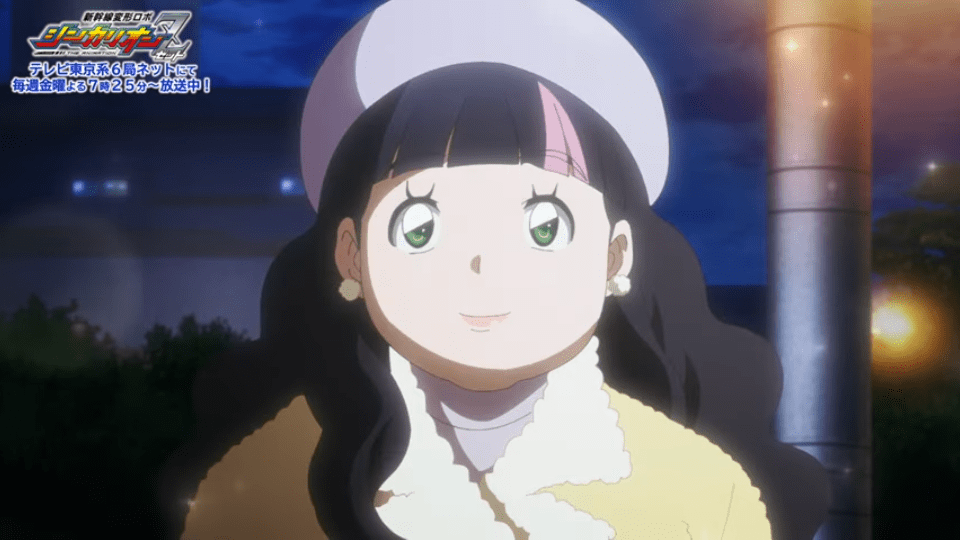
Super Robot Wars 30, Shinkalion, and Pioneering DLC

The developers of Super Robot Wars 30 have announced a final expansion pack that brings many surprises, the biggest of which are new DLC units.

  • Scopedog, Scopedog TC LRS (Armored Trooper Votoms)
  • Ultimate Dancouga (Super Beast Machine God Dancouga)
  • Red 5+ (Majestic Prince: Genetic Awakening)
  • Getter 1, Getter 2, Getter 3 (Getter Robo Devolution: The Last 3 Minutes of the Universe)
  • Shinkalion E5 Hayabusa Mk. II, Shinkalion E5 Mk. II Over Cross ALFA-X (Shinkansen Henkei Robo Shinkalion the Movie)
  • Dygenguar with Aussenseiter (Super Robot Wars Alpha 3)

Gan Gan Zudandan

The big news on this list in my opinion is Shinkalion, not because it’s one of my long-desired franchises for SRW or anything, but because it has ties to a major company like Japan Railway. In hindsight, however, it was ridiculous to think that could be a barrier: Shinkalion did already appear in the mobile game Super Robot Wars X-Ω, and the series itself is crossover central. Seeing the series debut is nice, and I enjoy how the originally-3DCG units in this game have a different look and feel to them (see also ULTRAMAN). I’ll also be hoping for DLC missions where train otaku Hayato gets to geek out with all other mega nerds in the cast. Too bad Evangelion isn’t in SRW30 for some truly fun references.

I’m Seeing Double: Four Ryomas!

The other new main-series debut is Getter Robo Devolution, and I’m surprised at its inclusion. While other SRW have taken references from multiple Getter Robo series at the same time (mostly in terms of how Shin Getter Robo presents itself), this is the first time we’re seeing variations of the same characters crossing over—and no, I’m not counting Sanger and evil Sanger in Alpha Garden. Interestingly, they announced voice actors for these characters (and big ones too!), which makes the decision to omit a lot of the Gaogaigar vs. Betterman mecha all the more mysterious.

Incidentally, the manga is actually out in English from Seven Seas, so I plan on picking it up to see what this one’s all about. It’s also from the creators of Linebarrels of Iron.

30th Anniversary Versions

The Scopedog TC LRS and Ultimate Dancouga stand out because the idea of making special versions of robots specifically for SRW is very rare, with Mazinkaiser being the #1 example. Sometimes there are units taken from unused production materials (like Final Dancouga), but this is a step beyond. Moreover, both anniversary robots are from their original mechanical designers—Ookawara Kunio and Obari Masami, respectively—contributing to the epic feel of this collaboration. I’ll be curious to see what animations the Scopedog has, as I do miss Chirico’s amazing final attack from the SRWZ games.

When Will I Use Them?

I’m in a strange position where I’m pretty much at the final stages of SRW30, and I’m trying to figure out if I should just get all the DLC units before proceeding or if I should focus on them in a possible New Game+. Either way, I can’t wait to try them out.

Super Robot Wars 30, Gaogaigar, and J-Decker: The Compromises of a Composite Narrative

Brave Police J-Decker has made its debut appearance in Super Robot Wars, joining its fellow Brave franchise series King of Braves Gaogaigar. However, J-Decker effectively replaces in Super Robot Wars 30 a huge portion of the Gaogaigar cast of characters—specifically the Brave Robots introduced in the novel sequel King of Kings: Gaogaigar vs. Betterman—and in doing so merges their two plotlines together in a way that defies SRW precedent. It’s something I can appreciate, but I also feel that it comes at the expense of the “everything and the kitchen sink” approach the game franchise is famous for.

While J-Decker precedes Gaogaigar in terms of their air dates (1994 vs. 1997), Super Robot Wars 30 flips things around. The story specifically has the events of the latter take place first, and makes the Brave Police the first Brave Robots since the events of Gaogaigar Final. I find this to be a pretty clever way to tie the two plots together, especially in order to reconcile having an adult Mamoru (the kid character in Gaogaigar) with a young Yuuta from J-Decker

However, the idea that the Brave Police are the latest generation of units doesn’t square with what takes place in the Gaogaigar vs. Betterman novels where a new Brave Robot Corps is formed with the likes of NichiRyu, GetsuRyu, ShoRyu, and Porc-Auto. Those robots aren’t even included in Super Robot Wars 30, meaning that their role in the story has been supplanted by the robots of J-Decker. This is highly unusual, if only because SRW games are often about “more is better.” While the franchise over the past decade-and-change has been trying to streamline a lot of the bloat inherent to it (so no excessively redundant attacks, for example), it’s rare to have them omit entire groups of potentially playable units that are an important factor in the source material.

I suspect that there are a number of extenuating circumstances that resulted in this compromise. It wasn’t that long after the conclusion of Gaogaigar vs. Betterman that SRW30 was announced. There are elements of the story, regardless of the mecha, that are skipped over. In addition, most of the new robots introduced in the novels don’t already have voice actors, so it’s not like calling up Hiyama Nobuyuki and telling him to reprise his role as Guy. While there have been cases of SRW assigning voices where there weren’t any before (see the Virtual On units in Alpha 3), that was also over 15 years ago. 

Incidentally, that’s also a case where only a handful of reps are included (as opposed to every Virtuaroid).

So while having Gaogaigar vs. Betterman is one of my favorite parts of SRW30, the changes made mean we still don’t have the might of the full cast of characters from it. Maybe we’ll see it happen in the future. 

And maybe what could make it easier is having an actual anime version…

Kio Shimoku Twitter Highlights March 2022

This month was the release of the 8th and final volume o f Hashikko Ensemble!

Kio saw the anime film Goodbye, Don Glees! and enjoyed it. He’s particularly fond of the last scene, which he likens to a large mosaic.

The man can’t find his copic markers, but eventually does.

Kio made his first trip to Akihabara, but took a different route this time. The last visit, he went to Melon Books, ZIN, K Books, etc. This time, it was Yodobashi, Volks, Yellow Submarine.

When asked if his interests are going from books to 3-dimensional things, Kio says that his interest in ero is growing weaker, while his desire to build gunpla is growing stronger.

Another reply shows Kio that the old Genshiken capsule figures still exist, to which he expresses surprise. He’s also amazed at how the swimsuit figures of Saki and Ohno managed to happen. The original replier says he likes this Ohno figure, but likes the bouncing boobs Ohno bust that came with an issue of Monthly Afternoon.

(Ogiue Manaix note: I have this one too, but I never managed to get the Ogiue counterpart because it was Japanese mail-order only…)

Countdown to the release of Hashikko Ensemble, Volume 8—the finale!

Kio mentions that the Hashikko Ensemble characters feel like they could keep going. (I agree.)

Kio was exhausted, so he ended up just drinking beer and falling asleep.

Kio’s pet tortoise isn’t going to have the garden space it used to, so Kio is trying to set up a habitat for it on his balcony. 

The Kimura Jin super fan known as “b” talks about how pure and innocent Jin looks, and asks Kio if Jin is saying “ni” (two) in the countdown image above. Kio gives an affirmative.

A close-up of the back cover from Volume 8.

I had to ask if there’d be any limited store exclusives for Volume 8. Kio answered “no,” which helps me a lot because it determines how I order the book.


Kio thanks b for giving him courage.

Technically not Kio tweets, but manga artist Shigisawa Kaya drew some Hashikko Ensemble fanart! In the first image, they mention loving Kozue’s fat fingers.

More drinking.

Artist Ikuhana Niro mentions wanting to get a new back and shoulders sometimes, and Kio agrees with the sentiment.

The artificial rendition of “Kanade” by Sukima Switch, as performed by the main characters of Hashikko Ensemble, goes away April 25th, 2022! Make sure to listen.

Kio wonders who the heck “Nagayama Koharu-chan” is. (Note: It’s actually a weird troll account by the author of Chainsaw Man where he pretends to be a third grader into Chainsaw Man).

Epoch Epoxy: Mobile Suit Gundam Narrative

Every so often, I’ll come across a specific type of retcon in a long-running series that essentially says a certain important character or thing was unseen in the background all along, and that the audience just wasn’t aware of this. It’s a kind of shortcut to make new information not feel shoehorned in, and it’s not necessarily a bad thing—just evidence that things weren’t planned from the outset, for better or for worse.

The Gundam franchise has sort of always been this way, whether it’s the Mobile Suit Variations line that talked about all the other aces fighting in the One Year War offscreen or anime such as 08th MS Team showing events from a different perspective. But the film Gundam Narrative takes it to a whole other level, being what is essentially spackle for a specific period in the Universal Century timeline.

Early Gundam series were not made to overly adhere to a finely tuned canon, as they were usually set years apart chronologically to emphasize the idea that “things have changed.” But as the timeline has become more dense with sequels, prequels, sidequels, and spin-offs, there developed a certain unexplained plot element that had no real answers: why did the crowning technology from the film Char’s Counterattack, the Psycho-Frame, stop being used in later UC works like Gundam F-91 and Victory Gundam? It’s the kind of thing that can be explained by simply saying, “Stuff happened,” but the space-opera minutiae fairly present in Gundam potentially makes that an unsatisfying answer.

The result is a movie about three kids—Jona Basta, Michele Luio, and Rita Bernal—whose lives are tied to major events throughout the Universal Century series. They were there when a space colony fell on Australia before the start of First Gundam, but burgeoning Newtype powers resulted in them being able to evacuate their town to safety. They were involved in the Cyber-Newtype experiments that were a major element in Zeta Gundam. And now their story takes them to being directly involved with the aftermath of the events of Gundam Unicorn and the hunt for the third Unicorn-class mobile suit, known as Phenex. 

Gundam Narrative basically tries to act as a bridge between two eras, and while the story is decent on its own, the focus with reconciling that incongruity results in an unusually jargon-heavy work (even by Gundam standards!), and a bit of weakness when it comes to the social and political themes that usually come part and parcel with the franchise as a whole. I’m not sure if it’ll end up being anyone’s favorite Gundam, but it’s also not a hot mess. Gundam Narrative serves a function, and it’s fairly entertaining while doing so, but I tend to prefer something with more meat on its bones.

What Drives Them—Gundam Reconguista in G Part III: Legacy from Space

The third Gundam: Reconguista in G film continues the trend of breathing new life into a less beloved Gundam series. The edits make it noticeably easier to follow than the TV series, although I do acknowledge that the story is rarely ever straightforward or presented plainly, and this is a sticking point and the reason G-Reco is fairly divisive.

But as I watched Gundam Reconguista in G Part III: Legacy of Space, I had an epiphany of sorts that I think helps explain this split opinion. Namely, the key to understanding G-Reco is to get into the minds of individual characters. I understand how this sounds a little obvious (plenty of stories are about achieving personal goals), but what I mean is that character actions can seem inscrutable until you actively try to get into their heads.

The story as of Part III: As alliances and allegiances have shifted since Part I and Part II, Earth’s great continent-states now send forces into space to meet with Towasanga, a nation on the other side of the moon, created by the descendants of the humans who settled in space colonies in the Universal Century era. Not only do Towasangans have access to technology unobtainable by those on Earth, but the Towasangans see themselves as arbitrators between the Earth and the far-off colonies of Venus Globe, which provide to the Earth the photon batteries needed for it’s civilization to function, and thus see the need to equip themselves for conflict amidst the increasing tensions on Earth. Bellri Zenam, still thinking about the deaths he’s seen and caused, tries to figure out what he should do and where he fits into the big picture.

One of the big differences between G-Reco and other Gundam series is that there aren’t two major sides, like Federation vs. Zeon or Earth Alliance vs. ZAFT. Rather, there are multiple governments and factions: Ameria, Gondwana, Towasanga, Capital Tower (which is then further divided into the Capital Guard and the Capital Army). These groups are then comprised of singular people who think independently and have their own ideas of right and wrong, which results in G-Reco being more confusing when you think primarily in terms of who is on what side and which side is winning, because these positions are always in flux. Rather, the important thing is actually to understand what motivates each character and how it affects their decision-making.

Bellri, for example, is initially driven by his opposition to the Capital Army and its inherent militarization of what is supposed to be a neutral defensive force. Upon meeting Aida Surugan, he’s also moved by his own horniness. By the third movie, he’s also filled with regret—both from having accidentally killed his own teacher in mobile suit combat and learning why having a thing for Aida is a bad idea—and his actions reflect this. Bellri constantly tries to avoid dealing lethal damage, but also isn’t so naive that he thinks he shouldn’t do anything. When he loudly shouts that he’s about to fire and does a purposely bad job of aiming, one gets the sense that he’s trying to deliver warning shots that are nevertheless real and dangerous.

The Char Aznable of the series, Captain Mask, is motivated by something very different: improving the standing of his people. As a descendant of that Kuntala, people raised to be human livestock when food was abysmally scarce on Earth, Mask’s kind are still discriminated against. It’s little wonder why he’d be so willing to ally himself with the powerful and influential. To Mask, it’s all a means to a noble end.

So when the forces of Towasanga show up, and many seem to have pursuit of glory in mind, it highlights their hypocrisy and elitism. Particular attention is paid to the female commander Mashner Hume and her boytoy, Rockpie Geti, who are overly eager to mix business with pleasure. It’s as if the film is trying to say that the only thing that’s worse than ignoramuses perpetuating war on Earth is ignoramuses who live in space who are supposed to know better and perpetuate war anyway. Still worse is the man who consciously exacerbates all this: Cumpa Rusita, the leader of the Capital Army.

I will admit that I remember little of this section from the TV series, but the slightly condensed nature of the film brings with it better pacing that makes certain events feel less abrupt. The restoration of Raraiya’s memories now comes across as strange yet reasonable, like it takes going into space to jog her memories. Bellri learning why he shouldn’t be hot for Aida also has a realness to it, as he’s shortly after shown to be struggling with some serious emotional turmoil (and his insistence on calling her Big Sis from then on feels a bit like a self-reminder).

The next parts of G-Reco are originally where the series went from okay to great for me, but I’ve also read that Tomino plans on doing some heavy changes to the end. As Bellri and Aida reach Venus Globe in Part IV, I’d like to see how it might reshape my experience. For now, it’s still a fun and contemplative ride.

Super Robot Wars 30 and the Two Chizurus

I love the way the Super Robot Wars series combines plots together, and one example is the “connection” between the two Chizurus featured in Super Robot Wars 30.

One of the anime series in Super Robot Wars 30 is the 2000s-era anime Gun x Sword, and among the cast is a veteran robot crew called El Dora Team, who are portrayed as old-fashioned relics of a bygone era who find the spirit to fight again instead of sitting on the sidelines and waxing nostalgic. They’re essentially meant to be 1970s robot anime characters (with a bit of Mexican and spaghetti-Western flair) thrust into a modern context.

One of those 70s elements is they once had a female teammate named Chizuru, possibly as a nod to Nanbara Chizuru, the girl member from Super Electromagnetic Robo Combattler V. However, both Gun x Sword and Combattler V are in Super Robot Wars 30, and the setting is such that El Dora Team are still the old timers and the Battle Team are the upstarts. As a result, they flipped the script and made the Combattler V Chizuru the younger one who reminds the grandpas about their dearly departed friend.

This swapping of ages and influences is a clever maneuver to allow both sets of characters to retain their identities and physical ages within the story. But it also reminds me of someone: Elvis Presley.

Elvis famously wore flashy jumpsuits with collars and sometimes capes, and there’s speculation that he didn’t do it out of the blue. Growing up, he was a big fan of the Fawcett superhero Captain Marvel Jr., and the similarities between the character and Elvis has led to fans of both wondering if Elvis took elements of his famous aesthetic from the comic character. The story doesn’t end there, though.

Over the years, DC had acquired the license to the Captain Marvel (aka Shazam) characters. In one of their many later reboots, they placed Captain Marvel Jr. into their setting as a modern teenager, so rather than being a child of the 1930s, he was now a product of the 1990s. But in a similar twist to how the two Chizurus are connected in SRW30, it was now Captain Marvel Jr. who was the Elvis fan.

It’s a funny kind of geekery that I appreciate, and it reminds me why it’s fun to be a fan.

Kio Shimoku Twitter Highlights February 2022

This month was pretty light when it came to Kio Shimoku tweeting.

Kio stumbles on a new technique while doing art for the final volume of Hashikko Ensemble.

B the Hashikko superfan asks if it’s due the cover, and Kio says it’s for the back cover because the front is going to be crowded.

B also mentions going to a choir concert thanks to Hashikko Ensemble, to which Kio expresses excitement that there was such an event.

Kio and Ikuhana Niro swap stories about buying alcohol on Ikuhana’s birthday.

Gathering the components for the release of Hashikko Ensemble Volume 8.

He slacked off on working out for three months, but got back into it recently. The post-workout aches from being away for so long are pretty bad.

Kio is about to private his Hashikko Ensemble YouTube video soon! Listen while you still can!

Another Five Star Stories model kit.

The pet tortoise returns! Kio apologizes for only having lettuce.

Next month is after the release of the latest chapter of Spotted Flower, and when the final volume of Hashikko Ensemble goes on sale. I expect a lot more tweets in March.

Power and Truth: Mobile Suit Gundam Unicorn

The Universal Century’s fight between the forces of the Earth Federation and the space-dwelling Zeon is both the foundation of Gundam and also, at times, the albatross around its neck. After 1988’s Char’s Counterattack closed the book on the central rivalry between Amuro Ray and Char Aznable, future Gundam anime would for decades do everything but provide a direct sequel. Gundam F91 and Victory Gundam set their stories decades after the events of Char’s Counterattack, other works like 0080: War in the Pocket and Gundam: 08th MS Team are side stories adjacent to Amuro’s story, and G Gundam launched the concept of alternative-universe Gundam—titles that take the name and basic aesthetics but are worlds unto themselves. This all changed with 2010’s Gundam Unicorn, also known as Gundam UC.

As a sequel to Char’s Counterattack,  can get pretty deep into the weeds. For example, to understand the power of the Unicorn Gundam and its heavy incorporation of Psycho Frames and its NT-D system (short for Newtype Destroyer) is to be invested in the lore of the Universal Century timeline. Newtypes are people who have gained extrasensory abilities in response to humankind’s expansion into space, and their subsequent weaponization of leads to the development of both aforementioned technologies; the former is a way to fully utilize their mental and emotional power (and which was once the key to saving the Earth), while the latter is a counter to such abilities. However, while these world-building elements can get complicated, they also provide a rich backdrop for Banagher and Audrey’s stories of confronting the crimes of their forefathers.

SPOILERS BEGIN HERE

Much like the later Mobile Suit Gundam: Hathaway, Gundam Unicorn is based on a novel, but it’s also the first franchise novel to be adapted into a part of the main canon. Taking place shortly after the Earth narrowly avoided having the Luna II asteroid base dropped on it, Gundam Unicorn tells the story of Banagher Links, a student living in a space colony who gets wrapped up in a strange conspiracy after encountering a girl calling herself Audrey Burne. The head of Banagher’s school and head of the Vist Foundation, Cardeas Vist, is the most powerful man in Banagher’s colony, and his immense influence over the Federation has to do with the latter’s fear of something known as “Laplace’s Box.” When a mobile suit battle breaks out in the colony, Banagher’s psychic desire to protect Audrey leads him directly to Vist and the mysterious Unicorn Gundam, a weapon that serves as the “key” to Laplace’s Box. Why the box has such a hold on the Federation and how characters reconcile with their family histories and ties to the history of the founding of the Universal Century are central to the story of Gundam Unicorn.

By the end of the first episode, Banagher discovers that he’s actually the estranged son of Cardeas Vist, and shortly after sees his dad die before Vist gives him exclusive access to the Unicorn Gundam—and with it, a bridge to a secret that terrifies the Federation top brass. In the next episode, Audrey reveals her true identity: She is Mineva Lao Zabi, the last surviving member of Zeon’s original royal family whose leaders steered a fight for independence into a militaristic fascist regime. These central characters, both with deep roots in the two respective warring sides, are continuously challenged to look long and hard at the privileges they’ve received on the backs of the fallen. Their situations are contrasted with another character, Riddhe Marcenas (the son of a Federation politician), who desperately tries to maintain the status quo in order to avoid disrupting the familiar world he’s known.

Banagher is the protagonist, but Mineva is the stand-out character in so many ways. For those already familiar with the history, Mineva is familiar as the innocent baby daughter of Dozle Zabi, who perished fighting the original Gundam in the first anime. The monstrous-looking Dozle was ironically the most righteous and pure-hearted of the Zabis (albeit while still being guilty by association of Zeon’s atrocities), and his selflessness and loyalty are what allowed Mineva to escape with her mother. As the last Zabi, she is revered by the remnant Zeon forces, and she has a regal bearing that speaks to her status. Now on the verge of adulthood, however, Mineva sees her mission as atoning for the sins of the Zabis.

The ultimate direction taken by Banagher, Mineva, and eventually even Riddhe is what I would summarize as “Do good with the advantages you have.” None of the power they possess, whether physical or political, is bloodless, but they decide to reveal the truth that lies behind Laplace’s Box despite the fact that its contents could potentially flip everything upside down. Laplace’s Box turns out to be a monument containing the very first Universal Century charter, previously thought to be lost in a terrorist attack. While something so ceremonial should not be so revelatory, it turns out that this original charter contains a clause surreptitiously removed in later versions: 

“In the future, should the emergence of a new space-adapted human race be confirmed, the Earth Federation shall give priority to involving them in the administration of the government.”

In other words, the Federation government was supposed to have enshrined the equal treatment and political representation of the space-born, but purposely revoked it in secret in order to rule over the Spacenoids. This action is revealed by Mineva to all as a  successful move to consolidate power, its obfuscation of the truth arguably being the first catalyst that would lead to the One Year War and the continued bloodshed between Federation and Zeon. I have to wonder if this is also meant to be the catalyst that leads to the decline of the Federation that we see in later sequels like F91 and Victory.

The series does not absolve Zeon of their crimes through this, and Mineva outright states that her family is guilty of much tragedy, but that this is about spreading the real history of what transpired and to open the path for a better future. I can’t help but think of the current situation in the US and the attempts to ban the teaching of its racist past and present in an attempt to indoctrinate children into a blind patriotism. I understand that both the novel and anime predate this current unfortunate phenomenon, but nevertheless it feels more relevant than ever. Perhaps it ties into Japan’s own ongoing struggle with rewriting its history books to hide the things its wartime government inflated on its own people and those throughout Asia.

There’s a lot of meat I didn’t even touch upon, and all of it has a lot to say about war, peace, society, and justice. While Gundam Unicorn is really dedicated to trying to fit neatly in the canon of Gundam, it’s also a solid and compelling science fiction anime in its own right. Somehow, its lessons feel more relevant than ever.

Is Loving a Genre Like Supporting a Local Sports Team?

I’ve been mulling over something lately: Is it safe to define a genre or trope preference in fiction as a case where you’re more accepting of less-than-stellar results? Much like supporting a local sports team through thick and thin, is being a genre fan about enjoying even the mediocre?

I’m ready to admit that the analogy falls apart under close scrutiny for a whole host of reasons. There’s no clear metric for winning vs. losing with something subjective like fiction. Supporting a player or a team, something made up of real people, is very different from being into a particular fiction genre—a more fitting comparison might be a favorite animation studio or book imprint.

But when I think about a genre I enjoy—giant robot anime for instance—there’s something about my appreciation that feels like it goes well beyond considerations of quality. When Good Smile Company announced a ton of new model kits for their Moderoid line, the sheer variety and obscurity of the line stood out to me. Some of the excitement came from the representation of series I consider personal favorites: Godannar!!, Reideen, Granbelm, Rayearth, The BIg O, and more. But it also came from seeing new or relatively obscure things get the spotlight, like Daitei-oh (the Eldoran series that never officially got an anime), Zeorymer, Promare, and iDOLM@STER: Xenoglossia. Not all of these series are genre-defining heavy hitters, but that they exist as merchandise fills me with warmth.

In contrast, I’ve watched a good amount of idol anime at this point, but I still don’t see myself as a fan of the genre. I appreciate the titles that stand out, though.

Perhaps, however, supporting your local fiction genre also comes with being able to recognize that you have a bias towards the tropes and expectations that come with it, because sometimes having a truly disappointing instance stings extra hard. But I also wonder if, like how you have sports fans of consistent winners and those of perennial underdogs, there’s a difference between the fans of a genre that’s seeing the limelight and one whose star has faded a bit—or, for that matter, a genre that may have once been big versus one that has never really ascended in the first place.

Kio Shimoku Twitter Highlights January 2022

This month’s tweet highlights for Kio Shimoku are a little different: I’m doing them in chronological order rather than grouping them by subject. Tell me what you think!

January is also the month that Hashikko Ensemble ended. Check out my review!

Kio decides to drink and bathe at the same time, then watch some DVDs. He can’t drink the next day, so he hopes he can indulge in the moment.

Various model kits he built.

Kio talks about what a big personal step it was for him to start a Twitter, and that he’s gradually learning how to use it. He thought he had to do it at some point, and thinks it was good timing in more than one sense.

A compilation thread of all the various drawings he posted on Twitter over the past year.

Kio compliments a follower’s Kurotaki Mai fanart.

Kio wishes everyone a Happy New Year.

The man loves Dennou Coil, (like everyone of great taste).

Kio draws Kousei as a tiger man to celebrate the Year of the Tiger. B, the “I love Jin” superfan  for the Hashikko Ensemble character asks if Kousei’s always been that buff (while also stating how Kousei’s cat-like qualities make the image work), to which Kio says he added a bit of fantasy to the drawing.

(Just as a warning, that Jin fan’s Twitter account is very NSFW. Their love of the character is serious business—as the Ogiue Maniax, I should know.)

Kio mentions finishing the manuscript for the final chapter of Hashikko Ensemble. When the Jin fan asks if the series got canceled, Kio says “more or less.” Elaborating a bit, he says he got the call to start wrapping it up in summer of 2020, but was given the opportunity to go past the School Festival arc and end on eight volumes total. For reference, the original Genshiken was nine.

Unbuilt model kits, including Girls und Panzer.

And Five Star Stories kits, of course. He actually got the first one as a gift from a reader!

Feeling some nostalgia from when he got this at Wonder Festival. A fan shows a similar arm from a model kit of theirs, and Kio replies that he was never able to get that one (the Mighty Beta).

Kio found an old L-Gaim Mk.II model kit he built 25 years ago. He loves the look of the mecha, and finds that it has a real “Showa” feel to it.

Kio got a new scarf, and decided to draw what it looks like with Madarame as the model. He saw it being called an ascot scarf, but found that it didn’t match his Google searches. “New York scarf” seems to fit the bill better.

In light of the death of famed baseball manga artist Mizushima Shinji (Dokaben), Kio reminisces about growing up with Mizushima’s manga. In his home, there would always be assorted volumes of Dokaben around, and he would read them voraciously. In his estimation, a lot of baseball know-how for kids his generation came from reading Mizushima manga, and he especially enjoyed the series Dai Koshien. Kio offers a prayer at the end.

Also, at some point, the Dai Koshien character Kyuudou looks like a Scope Dog from VOTOMS (I don’t understand the context to this).

Kio wanted to reference an old chapter of Spotted Flower for his manuscript, and opened his old file, only to remember that he did it in the program Comic Studio. He’s switched over to Clip Studio Paint now, and seeing Comic Studio start up took him by surprise. He also notes that Asaka-sensei had a different hairstyle in this earlier chapter.

B the Jin fan has a question for Kio, asking how Kio managed to get a music note generator version of Sukima Switch’s “Kanade” because it doesn’t seem to be for sale. Kio responds that he uses a program called Score Maker Zero by KAWAI, which can also sing using a synthesized voice. Kio can’t read sheet music, so it’s very helpful for him.

Kio says that he generated these notes for “Kanade” himself, and asks if B lives nearby. B thanks him and doesn’t say anything about location, but he does mention going to the high school that Hashimoto Technical High School is based on. Kio is impressed.

As Kio was rearranging his desk in his room, his pet tortoise awoke (after barely moving during these winter months), and then stepped out of its box, ate some food, went outside, and then peed and pooped.

Kio made a Hashikko Ensemble Youtube channel, and uploaded a video of his tone generator version of “Kanade” by Sukima Switch for two male voices. It’s supposed to evoke the image of Akira and Jin singing together.

Kio made a Hashikko Ensemble Youtube channel, and uploaded a video of his tone generator version of “Kanade” by Sukima Switch for two male voices. It’s supposed to evoke the image of Akira and Jin singing together.


Some old NEO-GEO games from his college days that he found in a cardboard box. They include a bunch of Fatal Fury games, Samurai Sho-down, and even Far East of Eden.