We’re at November already?! I really can’t believe it’s this close to the end of the year when the summer months felt like forever. New York Comic Con is in the rear-view mirror, Anime NYC is up ahead, and I’m still struggling to keep up with the anime that’s out this season—including the long-anticipated Pluto (aka one of the best manga ever).
Due to a combination of a busy schedule and my silly brain, I’ve actually been struggling more than usual to write about anime and manga. I can’t seem to read manga fast enough to satisfactorily write about series I’ve been reading, but maybe I should just deal with it and write even after reading just a single volume.
It might also be because I’ve been diversifying my media choices (and watching a bunch of VTubers), but I feel it important to keep Ogiue Maniax as primarily an anime and manga blog.
Thanks so much to my Patreon subscribers for November:
Not much to speak of this month, but I did post this right before Halloween, so there might be something interesting in the next few days (that I’ll be posting in November).
Kio defeated a Gargoyle outside the Bestial Sanctum in Elden Ring, and also is 33% through the story after beating Radahn. At first, he thought it’d be too strong, but managed to pull it off using the Watchdog’s Staff.
Kio wanted to re-read the vale tudo arc of the karate manga Shura no Mon (Asura’s Gate), which made him want to re-read the Showa arc of the similarly named but unrelated manga Shura no Toki (Time of Asura).
When asked if his next manga’s going to be fighting-based, Kio denies it.
Kio saw the movie Undercurrent, and thought it was a really good adaptation of the original.
Kio plans to watch the “Jungle Revenge” special for How Do You Like Wednesdays, but only got four hours of sleep, and is thinking he might doze off partway. Seems like this special is a follow-up to a DVD that was released six years ago.
There is an archetype in anime and manga that I’ve begun calling the “Emergency Heteronormative Character.”
In the beginning, many manga creators do not know where their comics will end up. Rose of Versailles was supposed to focus a lot more on Marie Antoinette than Oscar. Kinnikuman famously began as a superhero parody before it turned into a full-on wrestling manga—and all because its authors, Yudetamago, really got into the latter. A single storyline in Yu-Gi-Oh! about a trading card game permanently altered its entire trajectory. I think the same thing happens with series where character relationships are important.
Some love triangles know exactly who the end girl will be, whereas others might not arrive at an answer immediately (or ever). But I have also seen series where a particular character, usually a minor one, seems to exist just in case, as if above them is a message that reads “Break Glass if Heternormative Romance is Necessary.”
I have never read Slam Dunk, but I’ve heard about Akagi Haruko: the female love interest of the protagonist, Sakuragi Hanamichi. She is a fairly important character at the start (being the one to spark Hanamichi’s entry into basketball), and she’s even the focus of the anime’s extremely beloved first ending sequence. But over time, she recedes into the distance because the dynamics between the players themselves are what really draw people in.
The appeal of shounen sports series for shippers plays right into this pattern. Whether it’s Prince of Tennis or Yowamushi Pedal, there often seems to be a girl character who is like an anchor on the port of heteronormativity, allowing a manga creator to double back if need be. Even Saki has some of this energy in the earliest volumes. The character of Koutarou began as the sole male member of the mahjong club, acting as a potential male audience stand-in to witness the girls in their nonchalantly risque glory.
BL and yuri potential often drive a good deal of the relationship interest in series like the ones mentioned. However, the Emergency Heteronormative Character can even exist in series that are pretty heterosexual too. In Rokudo’s Bad Girls, you have Tsuyukusa Mizue, the only non-delinquent girl in the series. She’s meek and cute, and always worried about how the main character Rokudo seems to be turning to the dark side. And while the anime is on an accelerated timeline, the early part of the manga makes it pretty clear that she could have been Rokudo’s “saving grace” if the series had gone a little differently.
Emergency Heteronormative Characters aren’t automatically bland, and they can be fun and charming in their own right. That said, they often feel like the product of an author hedging their bets, and they typically shine less brightly because they are simply not meant to be in the spotlight as much. I also have to wonder if these characters exist on some level for in case a title needs a quick romantic conclusion should things need to wrap up quickly. However, as we further leave the era where nice and neat heterosexual relationships are seen as necessary, maybe the archetype will have to evolve into something else entirely.
The author of One Piece, Oda Eiichiro, once stated that he always wanted to make amanga series where the ending is the most exciting part. Right now, it looks like his flagship series could very well be heading in that direction. However, when I thought about whether this is possible, I couldn’t help but think about the fact that the graveyard of shounen manga is strewn with series that failed to hit that goal—if they even had a chance at all.
So many shounen manga, particularly popular battle manga, usually peak well before the end. While taste is subjective, I think it’s a common opinion across various titles. In Kinnikuman, the tournament to determine the king of Planet Kinniku is actually pretty good, but it kind of pales compared to the Akuma Daishogun arc. Fist of the North Star peters out after Kenshiro’s climactic clash with Raoh. Naruto and Bleach have many possibilities as to the best arc, but it’s definitely not their finales. L in Death Note is remembered far more fondly than other rivals. Even with Oda’s beloved Dragon Ball, Majin Buu is not usually the villain people would regard as the best or most memorable.
That’s not to say it’s impossible. Two answers I received when I asked on Twitter were anything by Fujita Kazuhiro (Ushio & Tora, Karakuri Circus) and Yu-Gi-Oh! Funnily enough, these two examples also came up in a private conversation I had on the same subject. Nevertheless, the odds are not in One Piece’s favor.
The reason for this hurdle is pretty simple, I think: Most successful shounen series end up getting somewhat zombified, as they’re expected to keep going for as long as they’re popular in the hopes of bringing in more readers. No matter how creative manga authors might be, or how well they can plan, it just gets increasingly difficult to run on all cylinders. On top of that, even if an author has a brilliant ending in mind, they might still get canceled early, or their attempts to force a finale are ignored. Toriyama, for example, clearly tried to finish Dragon Ball in the Freeza and then the Cell arcs, only for the manga to keep going.
One big X-Factor is that Oda is on another level in terms of long-term planning. His signature series is basically an armory full of Chekhov’s guns situated next to a clothing store dedicated to alternating shoe drops. If anyone can pull it off, it’s surely him, but when your manga has been going on for almost 30 years (!!!), that is a whole lot of anticipation to live up to. Good luck, man.
So…Can you think of any shounen battle manga that was at its best and most exciting by the end?
In August 2022, the online anime and manga store Right Stuf was sold to the massive anime streaming and licensing company Crunchyroll. Now, Right Stuf has announced that it will cease to exist and its contents will be integrated into the Crunchyroll Store as of October 10. With that comes what I (and apparently many others) believe is the end of an era. I haven’t felt quite this way since Geocities closed.
I first learned about Right Stuf Anime around 2005 or 2006, and have been a frequent customer ever since my first order: Eureka Seven DVD Volume 1. At a time when I didn’t have much disposable income, the sales they had on the regular were a great way to get more for less. Those sales were often based around a single anime or manga publisher, so it also became a practical method for familiarizing oneself with what a particular company had to offer. Although my memory is hazy, they might very well have been the first site I bought anime online from (It was either them or Deep Discount DVD).
Right Stuf didn’t always necessarily offer the absolute best deals. For example, in the time it existed, Amazon grew into an even bigger juggernaut of online retail. It wasn’t uncommon for items on Amazon to be better priced, but I stuck almost entirely to purchasing on Right Stuf because the company showed a lot of care for its products in so many ways. You almost never had to worry about damaged packaging, and they even went out of their way to eliminate the use of plastic and make it more environmentally sustainable. If you bought an item the day before it was part of a sale, you could email them and request the order be revised. And at the end of the day, the sales were still really good.
Not everything was rainbows, of course. I once had a package go missing and had to jump through a ton of hoops—including filing a police report—but the positives outstripped the negatives by a country mile.
Another strength was that the company always maintained something of an old school feel. A lot of the American anime culture over the past 15 years or so has been to incorporate more and more aspects of general geek fandom/media, and while those things are great, they can often overshadow the anime and manga aspects. The fact that Right Stuf was still dedicated primarily to Japanese pop culture after all these years (while still incorporating that more general fandom) was something I really appreciated.
I’m definitely concerned that without the Right Stuf brand and the weight of the customer expectations its fans expected, the savings just won’t be the same. I’ve looked at the Crunchyroll Store, and while I won’t knock them for providing merch in an easily accessible fashion, I never once thought of buying from there as long as Right Stuf existed. And even though I’m in a far different place in life compared to 2006, I know that’s not the case for everyone—especially younger anime fans (at least those who care about physical media) who’ve had to deal with things like a terrible economy wrought by a once-in-a-generation life-changing pandemic. And I just don’t expect the Crunchyroll Store to provide that more personal touch Right Stuf had.
Crunchyroll could surprise me. They could maintain a lot of what Right Stuf did, well, right. But the fact that they’re even shelving the Right Stuf name does not bode well in my view. I might give them a chance, but a chance is all they get. With Right Stuf, what I had was trust and faith.
The start of October means a new anime season, and there’s a lot of new shows I’m looking forward to. My main concern is having enough time for all of them. We’ve got manga adaptations I’m looking forward to like Shy, MF Ghost, Under Ninja, Migi and Dali, and Firefighter Daigo: Rescuer in Orange. Then there’s not one but two rap/hip hop battle shows in Hypnosis Mic season 2 and Paradox Live. And then Otona no Precure, the first sequel to feature past Precures as adults! For those who might be feeling tired of isekai, I think this season is gonna be one to remember—and even if you love isekai a ton, there’s still plenty to go around.
Thank you to my October Patreon subscribers below!
Kio kind of wings it with the color, but thinks that the work wouldn’t be that different even in B&W. Kio likes the color palette in Star Wars in general.
Kio mentions that this Jedi is not to be confused with this girl from Kio’s 18+ doujinshi. However, he realizes that he might have certain preferences when the characters he came up with in 2010 and 2022 are so similar.
Ogiue and Ohno might technically fall under this category too. Kio includes an old drawing of Ohno cosplaying Leina from Queen’s Blade and asking Ogiue to cosplay as Leina’s little sister Elina. This is a voice actor joke because the original Ohno (Kawasumi Ayako) voiced Leina and the original Ogiue (Mizuhashi Kaori) voiced Elina.
After seeing a weather report that the temperature is going to be 35 degrees C (95 degrees F) after a typhoon, Kio is reminded of a line about becoming accustomed to torture.
Kio got through 70 pages of his eromanga manuscript, but then wasn’t sure of a certain part and ultimately decided to put in twice as much effort and drew the whole thing.
In response to the passing of Terasawa Buichi (author of Space Adventure Cobra), Kio describes Cobra as an accumulated mass of sense. (That sense seems to mean like an artistic/aesthetic/creative sense.)
Kio took a lot at the author Shima Tokio’s 18+ doujinshi, and was not only surprised at a development that happens in the middle, but that Shima would have the time to draw this on top of working on a serialized manga.
Kio read a comic drawn by Nagata Reiji, a person who left being a surgeon to become a manga artist, about that very experience. Nagata was apparently also serialized in Afternoon, and Kio decided to buy one of his manga.
9月22日(金)からTSUTAYAにて『げんしけん』POP UP SHOPの開催が決定いたしました! 新作グッズの販売や記念ノベルティなど盛り沢山!!
Kio has been meaning to tweet about the Genshiken pop-up shop at all TSUTAYA stores (that began on September 22nd) but kept forgetting to do so. (Check out the replies as well for lots of Kio thanking very excited fans.)
A tweet about the start of the Genshiken pop-up shop event, with Kio retweeting and responding to various photos taken by fans of the displays, including those lamenting items being sold out.
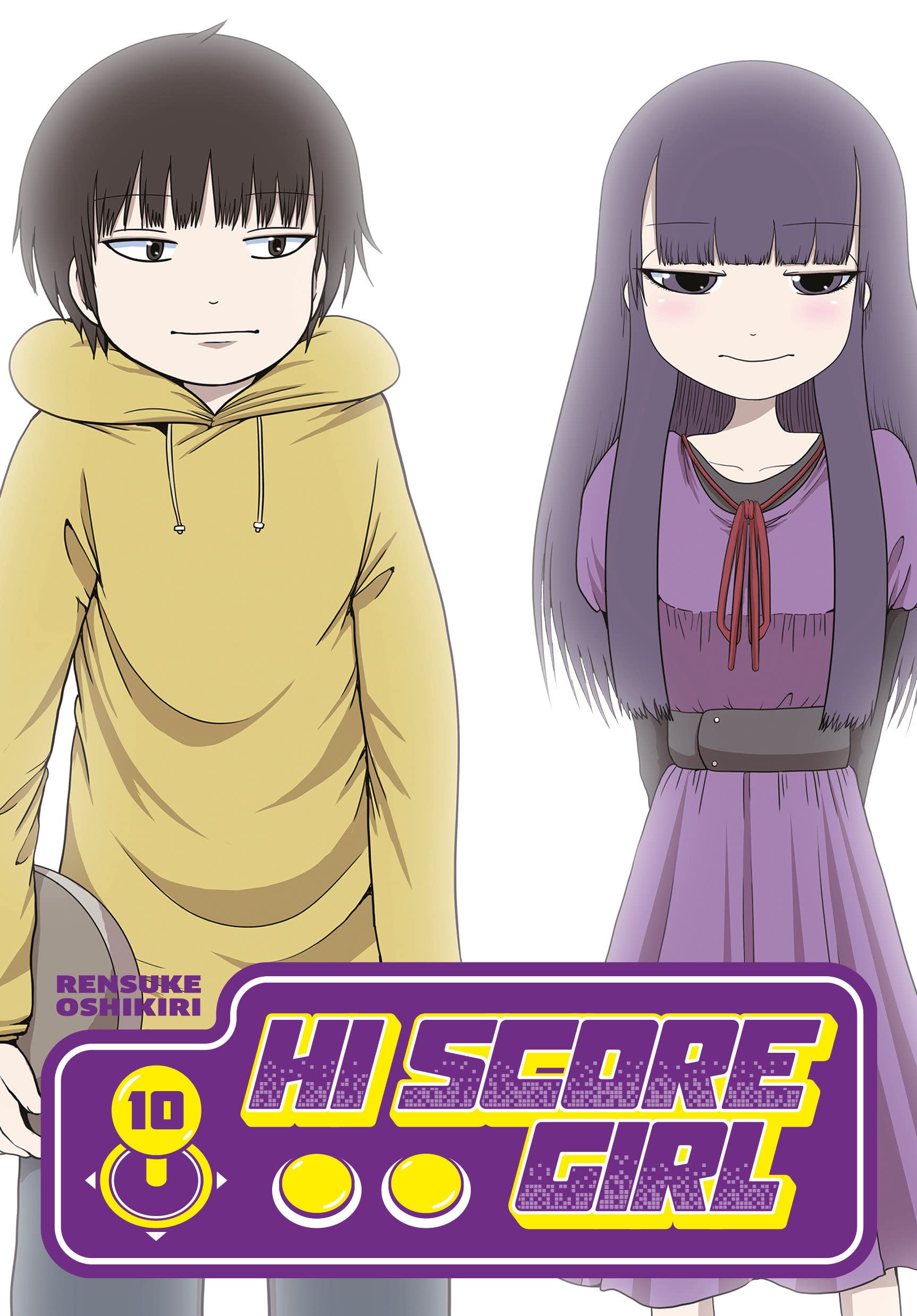
I’m happy and grateful that the full Hi Score Girl manga series by Otoi Rekomaru is out in English. It’s one of those manga where, once upon a time, a US release would have been a pipe dream. A nostalgic nerd love story premised around Street Fighter II and the 90s Japan arcade scene? As significant as that era was in Japanese gaming history, it’s a niche among niches. And yet, here we are.
I first discovered the series eight years ago, and was immediately won over by two things. First, there was the eccentric nature of its main duo: the obnoxiously loud gamer kid Haruo and his friend/rival/love interest, the reticent and rampaging Akira. They initially meet at an arcade and feud over a Guile vs. Zangief matchup, and though they never stop butting heads, it’s silly and sweet how they essentially communicate through gaming. That’s not metaphorical either; Akira pretty much never talks. Second, the portrayal of the 90s games and the way Haruo based his very outlook on life on them could have only come from a genuine place. Otherwise, jokes like “messing up the secret select code for Akuma” and “Akira having sympathy for big grappler characters because she feels bad about how little they get chosen” wouldn’t land so well.
The characters age over the course of the 11 volumes, going from elementary to high school and growing alongside the rapid developments in gaming technology. Their transition into adulthood is concurrent with continuous upgrades to Street Fighter II, the advent of 3D fighting games like Virtua Fighter, and so on. A nice narrative device to be sure, but it’s actually surprising seeing how much Haruo actually matures as he comes to understand responsibility in his own way. He’s not the sharpest tool in the shed, but his convictions are real.
Hi Score Girl reminds me a lot of one of my all-time favorites, 81 Diver. The art is similarly rough, and the core relationship is as much a rivalry as it is a love story (if not moreso). That’s actually pretty rare in manga focused on het romance, and is usually the domain of fujoshi-adjacent works. But it’s convincing here because of how Otoi portrays the genuine desire for connection, and the way that gap is bridged through gaming. Sure, the premise of a boy meeting an ultra rich mega gamer girl is unrealistic in many ways, but the portrayal makes me want to believe in their love.
In addition to the authenticity of the passion for fighting games, I think what ultimately makes Hi Score Girl work is that while Haruo kind of exists primarily in his gaming-obsessed mental space, the life lessons he draws from games are ultimately his own. He’s a guy with an imaginary friend who gives him pep talks and acts as his conscience, and that friend is often just Guile. Haruo and Akira imbue greater meaning into games, and the games reciprocate by providing them the thrill of victory, the agony of defeat, the comfort of friendship, and the joy of love.
I don’t know if it’s the record heat waves or just the sheer amount of things going in life, but the summer has felt incredibly long. But now that it’s the final stretch, I’m sure I’ll be missing it soon enough.
During this time, I also managed to watch both Shin Ultraman and Shin Kamen Rider, so expect some reviews of those sooner than later. In the meantime, I’d also like to mourn the loss of gfycat, which provided many a useful moving record for both mirth and study. I didn’t use the site much for Ogiue Maniax, but I have been updating a few posts here and there.
September Patreon subscribers! Thank you to the following—
A post about the new Hololive dog twins and their preferred name pronunciations.
Kio Shimoku
Kio mostly talks about Elden Ring, but also, check out that high-resolution Ogiue art!
Closing
I watched the Hololive Summer 2023 concert, and it was a blast. There were some issues with the viewing platform that ended up with the entire Day 1 concert being streamed for free on Youtube for the next month, and I’m thankful for that because it meant being able to easily watch Holotori strut their stuff over and over. The fact that Day 2 has holoX’s performance of their new song, “Labyrinthine Labyrinth,” as part of the free preview makes me feel like I won a small lottery again. I also highly recommend checking out the last song in the Day 2 preview, especially those who love 80s anime.
And now Hololive Myth 3rd Anniversary is coming up! It’s amazing to reflect on how much time has passed, and how directly it’s tied to the COVID-19 pandemic. No, I will never forget about that.
This month, Kio mostly talks about Elden Ring. But we also get to see a high-quality version of one of the best covers he ever drew (no bias from me, clearly).
Even after 100 hours, Kio is having trouble in Elden Ring. In many places, he feels that he would never have been able to figure things out without strategy guides. (Forgive me for not translating this in greater detail.)
Kio keeps seeing figures and illustrations from Elden Ring but for the most part has no idea who anyone is, seeing as he’s only played 16% of the game.
Reflecting on his time with a much older FromSoftware game, King’s Field II, Kio recalls his experience. Despite the fact that it wasn’t really “open world,” finding out how one area of the game connects to another was very exciting.
There was a remix of AKIRA music playing at the gallery, and Kio wondered where it came from. Turns out that it was new arrangements done for the gallery. Kio wants a CD of it.
High-quality version of the cover to Genshiken Volume 6, as well as just the art of Ogiue. Needless to say, I love this cover and volume to death. Also check the thread to see lots of people posting their copies (and variations).




 OGIUE MANIAX