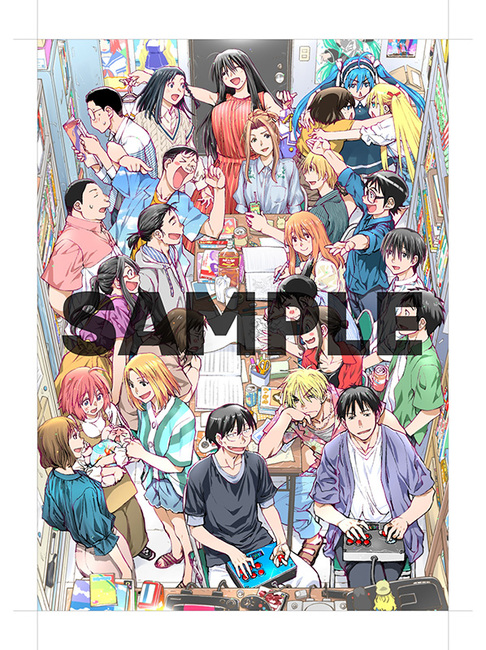
Otakon 2024 is this weekend! There are a few guests I’m looking forward to seeing (and hopefully interviewing), like Kakazu Yumi (Shizuru in Godannar, Renais in Gaogaigar FINAL) and Uchida Aya (Minami in Love Live!).
I don’t have any panels this year, but good luck to all presenters! I might be in attendance at yours.
Kio retweeted a t-shirt of the Fantasista mascot Sistan, which has art by Koume Keito (who worked on the Kujibiki Unbalance manga. Sistan thanks Kio, who responds that this makes him happy.
The electricity and water were out in Kio’s apartment, so he went to a super sentou (large bathhouse) and had a good time. Kusada and him talk about how losing power and plumbing should be a bad thing, but the bathhouse makes for a great way to relax.
Kio contributed art to a special Rakuen: Le Paradis 15th anniversary exhibition (and you can buy a replica if you’re in Japan!). He also realizes that he’s been a manga artist for 30 years, and half of that was with Rakuen doing Spotted Flower.
I’ve been catching up on the English releases of the Blue Periodmanga, and I’ve come to a few realizations.
I Really Like Miki Kinemi
Miki first appears while Yatora is taking the Tokyo University of the Arts entrance exam, and her design stood out to me. Her stocky frame and soft features left a lasting impression on me, and I hoped she would become a recurring character. I’m glad my wish turned out to be true.
Miki’s positive personality and enthusiasm for painting, the way she wears her heart on her sleeve, and the way she tries to take on others’ burdens (sometimes to her own detriment) make for an endearing character. Her body type is also a rarity in manga, and I’m very impressed by the author, Yamaguchi Tsubasa, and her ability to draw Miki so well. I’m a real fan—of both Yamaguchi and Miki.
Actually, They’re All Really Attractive
The more I thought about it, the more I realized that pretty much all the characters in Blue Period are charming in their own way. Girls, guys, gender nonconforming, they all exhibit a real spark of life that is facilitated by their respective visual designs but also goes beyond their appearance. They’re not attractive simply because they have XYZ physical and personality features but because they feel very human—beautiful and ugly and trying to navigate the world with the tools they have. Some of those tools are the result of their own work, but some have been forced upon them.
When I see a character show up again, I can get a tingle in my spine.
When you get them to bounce off one another, it’s like magic. Or art. One of my favorite things in manga is seeing really deep and dynamic character interaction, and Blue Period has this in spades. The subject matter probably helps, as these artists (from veterans to beginners) are look within while also peering into the souls of others for the sake of their work, or they try to run away and inadvertently do so anyway.
Is Blue Period Now One of My Favorite Manga?
I’ve thought highly of it for a long time, but now I like it even more. So yes, probably.
Things are looking dire in the United States because of the recent Supreme Court decision that grants presidents broad powers with few if any checks. I will admit that I’m very concerned about this, but all I will say is that those who think they’ll be safe from abuse of power are fooling themselves. Independence and freedom don’t just mean “I can do whatever the hell I want, even if others suffer for it.”
I hope that talking about anime will provide some comfort as I think about what to do next.
The summer anime season is officially upon us, and there’s lots of anime being remade and revived right now. The one I’m looking forward to most is Kinnikuman: Perfect Origin Arc, which is based on the 2011 continuation of the original Kinnikuman manga. Based on the promotional materials, I feel like it actually has a chance of getting some real traction with a modern audience. Might Kinnikuman be the next JoJo in the English-speaking market?
I hope so.
Thank you to the following Patreon supporters for the month:
This hololive VTuber has now been published in Hana to Yume magazine!
Kio Shimoku
He has an artbook coming out soon! He talks about this and more in his tweets.
Closing
A lot of hololive birthdays and concerts happened in June, but I think the ones I want to point out most are the Japanese 1st Generation’s 6th anniversary concert (featuring Haachama) and the Gawr Gura 2024 city-pop-themed birthday concert. Not only did La+ show up as a guest, but Gura actually threw in a reference to Legend of the Galactic Heroes!
Kio is going to have an artbook! (I wonder if this is why he’s been posting high-quality images of his old art over the past year or so.) More details here.
He wondered when would be the right time to release the book, and reflects on the fact that it’s been 30 years since he started his manga career.
Kio has a color illustration job deadline coming up, so he’s been plugging away at it little by little. He thinks he can finish in time. That said, he has a lot of other work due the week after. It also means he can’t work on his ero manga.
Terry and Mai from Fatal Fury will be in Street Fighter 6. Kio is surprised at the news. One commenter says they’re looking forward to seeing Sue in SF in 15 years, to which Kio says maybe in 30.
It turns out this drawing from last month is for the cover to the artbook! It’s one of his characters from an older work (I think the Yonensei/Gonensei series?).
Kio bought all of the original Oblivion Battery manga out, only to find out that it doesn’t progress as quickly as the anime. Now, he wishes he stuck with just the anime.
There’s a Yasuhiko Yoshikazu and Koizumi Yuu exhibit titled “Modern Japan and Russia/Soviet.” Kio couldn’t go the previous day but has decided to check it out.
While waiting for a Pre-DLC Elden Ring update to download, Kio works on his ero manga and gets a page done. He’s also wondering how the hell he’s listening to an audio book of Buddha’s Teachings while working on said 18+ comic,
Otomo Katushiro is releasing an album called Akira Remix. The Otomo recent cel exhibition was playing music from it, and Kio remembers going to the exhibition and hearing the music the whole time.
hololive’s La+ Darknesss is now a published manga author! As an anime blogger and a Plusmate, I had to write about it.
Shoujo manga magazine Hana to Yume is celebrating its 50th anniversary. As part of the festivities, they published an interview with La+ in their 14th issue of 2024, wherein the holoX leader talks about a variety of topics related to shoujo manga. On top of that, she also got the chance to script a manga, with art by Chitose Shiki. We’ve seen manga about hololive talents, but never an officially published work by one.
The one-shot work is titled The Knight-themed Streamer Who’s My Oshi Is Actually My Male Glasses-Wearing Coworker!? As is implied, it’s about a girl who discovers that her meek coworker is her favorite online personality. It’s a funny and all too fitting topic for a VTuber to be writing about. La+ in many ways has the tastes of both an old man and a young girl, and it manifests in this cute story.
As for the interview, here are some highlights:
La+ is a voracious reader. She typically reads 40 volumes of manga and other books every month. Even when she has a busy month, she’ll still read about 20.
Despite seeming like someone who would be more into shounen, half of her reading is shoujo manga. She thinks Hana to Yume can appeal to guys and girls alike.
What she’s into can change, but recently, she’s been into more conventional shoujo romances.
Yazawa Ai is how she got into manga—Nana and Paradise Kiss, especially. Yazawa’s work made her want to become a fashion designer, which she has studied. La+ actually still does fashion design. (In her casual outfit reveal stream, she mentioned designing the entire outfit from head to toe. Previously, she had also mentioned that she’d probably be a designer if she hadn’t joined hololive.)
The title that got her reading Hana to Yume was Ouran High School Host Club. Kyouya (who she refers to as “Kyouya-sama”) is what kickstarted her love of glasses. (Generally, La+ describes herself as being into glasses rather than glasses characters.)
After Ouran, the big Hana to Yume titles that drew her in further were Yona of the Dawn and Snow White with the Red Hair.
What she looks for in major female characters differs between shounen and shoujo. In the former, she wants girls who are super-talented and extremely cute. In contrast, she prefers very normal and average shoujo heroines.
Kio Shimoku, author of Genshiken, recently announced that he’s going to be releasing an artbook collecting his work from across his 30-year career! It will also include an interview with him.
The book is titled Kio Shimoku Gashuu: Mata Ashita, Bushitsu de—Kio Shimoku Art Collection: See You Tomorrow in the Clubroom. It’s being released by Fukkan, a Japanese publisher that specializes in niche specialty books and reviving out-of-print titles.
While the book is available for pre-order on other Japanese sites, pre-ordering on Fukkan’s site will get you a set of A4-sized replica illustrations of Kio’s work. And if you do it by July 16 (JST), then you can enter to win an autograph from the man himself!
Unfortunately, Fukkan will only ship domestically, so if you live outside of Japan, you’ll need to use a third party. Just keep in mind that with the pre-order bonus, shipping might be pretty killer!
As we inch closer to summer (and all the fun and horror that entails), I find myself a little spend-happy. What can I do when the Soul of Chogokin line announced a ton of new releases for their 50th anniversary?! There’s the DX Showa Mechagodzilla, Shinkalion, Tryon 3 (aka the very first Gundam entry in the SoC line), and it doesn’t even stop there. It’s impossible for me to buy all of them, but I am ever so tempted to do so.
I also started playing Elden Ring this month. I don’t know if I’ll do a full review or anything, but it’s inspiring me to at least write one or two posts somewhat related to it.
This past month also saw the birthday of hololive’ La+ Darknesss! I decided to celebrate by pulling out the old ink and brush and drawing a quick portrait. I used to post more art to Ogiue Maniax, but that mostly fell by the wayside a long time ago. I keep trying to convince myself to do more again, but we’ll see.
Thank you to the following Patreon supporters for the month:
I keep on thinking about upping my foreign language learning, but I have yet to fully commit. I’m considering trying one of those language partner/tutor sites, but I don’t know where to even begin.
Kio laments that Spotted Flower (a series that was once supposed to be simple and easy to draw) now has a huge cast, places he’s never drawn before, things that require photo references, and an increased page count.
It’s been 10 years since Kio last watched The Piano, a movie that apparently shook him with the level of NTR it features. In hindsight, he realizes this might be why he likes the movie so much.
The first time I learned that some anime and manga fans dislike Tanjiro from Demon Slayer, I was genuinely surprised. To me, he’s one of the best shounen protagonists in a long time: a gentle soul whose greatest qualities are love and empathy, and who is fueled by those emotions to get stronger. And in terms of the battles Tanjjro fights, I really enjoy how every victory feels like it came at great cost to him, emotionally and physically.
“How could anyone not like Tanjiro?” I wondered. Even knowing that this was probably a minority of viewers, I decided to just look at online comments both off the cuff and more detailed, and saw a few recurring criticisms. Namely, the goodness of Tanjiro can make him come across as preachy or self-righteous. He’s too good, lacking any darkness whatsoever, and this can be difficult to relate to.
I understand not being into goody two-shoes, but what confused me at first is that it’s not like Tanjiro is a perfect unstoppable hero. He’s often unable to defeat demons on his own, and it means that battles are more of a collective effort. However, I eventually realized that this too can be seen as an unappealing trait precisely because he didn’t win on his own.
Things changed when I began approaching the matter in pro wrestling terms. Essentially, I think a lot of people who aren’t fond of Tanjiro—or other similar characters like Deku from My Hero Academia—want heroes more akin to wrestling greats like Stone Cold Steve Austin, The Rock, and post-1980s Sting. Back in the 1990s, antiheroes became much more prominent in entertainment as a whole, and while they were often underdogs against an oppressive greater force, they were also rowdy ass kickers. In contrast, Tanjiro is what wrestling fans call a “white meat babyface,” or an unabashed good guy. In wrestling, this is often “solved” by having the good guy turn bad, become edgier, and then become good again so that they carry at least a bit of a dark side with them. This literally happened with The Rock, and even Deku has a similar phase—one that certain fans had wanted Deku to reach the entire time. Some folks are just looking for badasses.
All this reminds me of a post I wrote back when Kill la Kill was the big thing. At that time, some fans saw Ryuko as a one-dimensional protagonist because she’s a perpetually angry ass kicker who doesn’t have a grand arc full of character development. She doesn’t change on a fundamental level, and this was viewed incorrectly as “poor writing.” I think a similar thing happens with Demon Slayer, only with a different type of main character. That’s not to say preferences aren’t allowed to exist, but that they are not to be confused with neutral objectivity.
For Tanjiro and other “good boy” characters, the purity of their compassion is a beacon of hope that kindness and love can be enduring sources of strength. The fact that Tanjiro never changes at his core reinforces that power. At least, that’s my interpretation. What I’ve since learned is that others might see that aspect as something bland and in need of “development.” To this, I would say that being able to maintain one’s empathy even as the world grows more cruel is a fine character arc because it is in itself a true challenge that requires adapting and honing oneself to overcome the temptation to do otherwise.