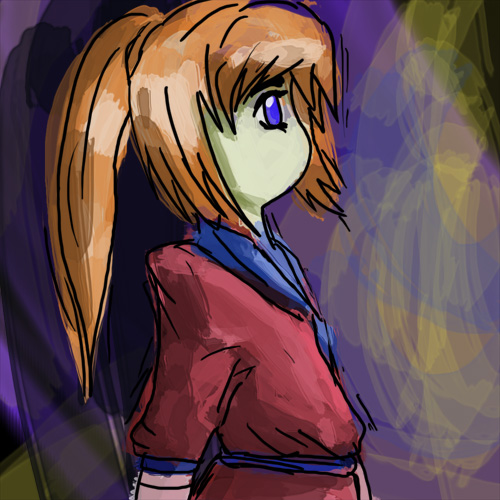
My Attention Leans Towards Ogiue’s Sweet Voice

It is not unlike spicy butter.

I’ve spoken previously about the fact that the Japanese special edition Genshiken manga Volume 9 came with a drama CD. What I haven’t spoken about is how it differs from the two drama CDs which followed it.

The two drama CDs released with Genshiken 2 seem to take place more firmly in the “anime,” while the first drama CD, having been packaged with the manga, seems to be more manga-esque. There’s a complete lack of background music unlike the later drama CDs.

The big difference though is the sound. While the later two drama CDs seem to have a very straightforward approach, the first one plays with stereo sound a lot. When one character walks across the room, you can hear his or her footsteps going from one speaker to the next. At one point the conversation splits off, with the guys talking in one part of the room, and the girls talking in the other. It’s pretty much impossible to listen to both conversations at once, so you begin to favor one over the other. Naturally, I pay more attention to Ogiue’s conversation, but what this also means is that you can benefit from listening to it at least twice to really get into each side’s conversation.

This was also clearly Mizuhashi Kaori’s first recording as Ogiue as she sounds a little softer than she does in Genshiken 2, not quite yet fully adapting to the bluntness of Ogiue.

“WHAT THE FUCK IS ANIME?”

I was on the bus, and on it was a group of kids probably no older than 13, discussing plans to make some kind of successful manga and anime. I couldn’t hear them too well, but some interesting things came up.

The conversation had clearly been going for a while. Then one of the kids starts talking about how “there’ll be a manga,” which gets another kid whose been part of the conversation to ask, “What’s manga?”

A third kid sitting across said, “Manga is like anime,” which then prompted the response, “WHAT THE FUCK IS ANIME?” The kid who knew nothing about anime was clearly annoyed that they’d been discussing the topic for a while and not teaching the uninformed what these unusual words meant. The third kid tries to explain, by having him compare the words anime and animation to see if the point gets across, and then going into some details, describing the difference as only kids in junior high can. It appeared to be unsuccessful overall, though in the end the non-anime kid had one thing to say:

“Manga? IT’S A COMIC!”

Clark Kenshiro

Listen to Some Super Fani Thoughts and Opinions on Winter 2009

Super Fanicom’s Voice Module has a new episode and once again I’m on there along with the fine folks at Super Fanicom and TheBigN. You’ll get some nice discussions on anime of today, anime of yesterday, and other various topics.

Also anime afros.

Book Off 20% Off Sale

For those of you who like manga at extra-affordable prices and live near a Book Off, you should know that Book Off is having a sale now until the end of February. They’re taking 20% off anything that doesn’t already cost $1.00, and this is on top of the already low prices that Book off gets due to having primarily used merchandise.

I myself picked up two volumes of La Sommelière and two volumes of Nazo no Kanojo X. Don’t worry though, Book Off also has English-translated manga for sale too.

The New York store is selling the third Gloizer-X box set for only $162. If that doesn’t get you out of your seat, I don’t know what will!

Less than 1 Week Until New York Comic Con

Let’s see what fun surprises are in store for us.

Not really much in the way of anime-relevant guests but for comics in general the guest list is astounding. You have Geoff Johns, Grant Morrison, Brian Michael Bendis, ART SPIEGELMAN, Gabe and Tycho, and Marv Wolfman and George Perez, among many others. And I hear the Ravedactyl artist’s alley table is gonna be back this year. Let’s hope the man himself also makes an appearance!

Panels and screenings are a bit more anime/manga-relevant but still kind of hilarious. “Turning A Bestselling Series into Manga: A Dark-Hunter Journey.” Well, I’ll give it the benefit of the doubt for now.

There’s the Live Action Yatterman movie which I feel needs some watching.

The Fujoshi Files 8: Nidou Kaneru

Name: Nidou, Kaneru (二道かねる)
Alias:
Kaneru (かねる)
Relationship Status: Single
Origin: Doujin Work

Information:
Nidou Kaneru is a young office assistant who draws doujinshi on the side and dreams of entering the world of professional manga. What Nidou lacks in talent, she makes up for with enthusiasm. Nidou Kaneru is very enthusiastic.

Originally not a fan of male/male relationships, she is convinced to start drawing yaoi by fellow doujin artist Tsuyuri aka Pantsuko. Although she is unable to sell even a single copy at first, Nidou does gain a degree over success over time. However, whenever she entertains the notion of quitting her dayjob to draw full time, her friends are quick to remind her of the merits of steady employment.

Nidou tends to act in a manner not quite befitting her age, and is patronized by everyone from higher-ups at work to elementary school students. Her main rival is the money-loving doujin artist Osana Najimi, and her best friend is her peace-loving teddy bear Aeolus.

Fujoshi Level:
Although Nidou Kaneru starts off drawing guy-on-guy doujinshi at the recommendation of another, it does not make her any less authentic as a fujoshi. After her artistic transformation, Nidou is unable to see two men together without thinking of the possibilities, whether it be two men who actually hate each other or even brothers.

Wine Is in Her Blood: La Sommelière Volume 3

The central theme of La Sommelière is that wines are capable of carrying special meanings for people from all walks of life, with very different levels of experience with wine. Volume 3 exemplifies this theme even more than in previous volumes. In this volume, the wine-tasting men are separated from the boys, L’espoir gets a new chef, old men get a new lease on life, and apprentice Sommelière Itsuki Cana learns that her father Itsuki Kouchi, whom she’s never met, was once infamously known among Japanese wine enthusiasts as the “Swindler.”

When the assistant of Japan’s #1 wine critic Minoshima Ryouichi visits L’espoir with revenge in mind, he instead is tricked into believing a bottle of Lieu-Dit Clos de Mont-Rachet is a real Montrachet. Shocked that he could fail despite all his time spent with Minoshima, Minoshima explains that the key to the deception was that the wine was served late. Chardonnay, more than even other white wines, is influenced heavily by small changes in temperature, and the increased dryness that resulted from a slightly warmer bottle of Clos de Mont-Rachet was able to fool his inexperienced taste buds. Minoshima then fires the assistant and kicks him out of the car. For Minoshima, fine wine is like fine art, and to be strung into a petty squabble over wine diminishes everyone involved.

In one instance, Cana comes across a self-proclaimed “genius chef” named Mizushima Kazuki who laments that not only is all wine terrible but that the people of Japan are unable to appreciate his cooking. Cana reprimands him, and gives him a glass of vintage 2000 Domaine Carneros Le Rêve, a California wine which won the title of “Best Sparkling Wine in America.” The flavor of apples, lychee, and carneros, a unique combination indicative of the diversity of America, shows Mizushima that perhaps the fault lie not with his patrons being unable to appreciate his cuisine, but rather with Mizushima being unable to understand the tastes of his customers. Grateful, Mizushima ends up being L’espoir’s new chef when their old one quits.

In another instance, Cana serves two decades-long business partners a 2004 Müller-Thurgau, a Japanese white wine from Hokkaido. The two men are shocked that a Japanese wine could be so delicious. Cana goes on to explain that the history of the wine was similar to their history as business partners.  The Müller-Thurgau vineyard began in 1975 with the goal of creating a respectable Japanese white wine. However, Hokkaido’s climate is unsuitable for making wine, and a general trend at the time towards red wine and away from white made it even more difficult. Despite these disadvantages, the Müller-Thurgau persevered and found success, much like them.

Finally, in the case of Cana’s father, an old friend of his named Saeki (a rich, wide-eyed, elderly man introduced in Volume 1) explains  to Cana that the reason he was known as the “Swindler” was because Kouichi was notorious for passing off cheap wines as valuable ones. To reinforce his point, Saeki shows Cana the wines that her father left behind as a legacy,  all of them inexpensive French wines such as Chateau Tour Des Gendres Bergerac Rouge. However, Cana immediately realizes that her father wasn’t trying to deceive people, he was trying leave behind the message that all wines have their place in the world. This point is made stronger by the fact that despite Saeki’s own extensive collection, these simple wines are nowhere present except in Kouichi’s box.

Wine plays a very significant role in La Sommelière. It dictates the pacing of the narrative, and educates while simultaneously enhancing the story and drama. The story now has two underlying plots: Cana’s pursuit of the mysterious benefactor John Smith, and the history of her father Itsuki Kouichi. The artwork continues to be very appropriate given the subject matter, and the conventional panel layouts lead the viewer’s eyes well. Everything works together to just make it a pleasant reading experience. Whether you read just one chapter or all of them, La Sommelière is the kind of story that lets you take in as much as you want.

Fear, Hesitation, and the Creative Process

I was recently overcome with the desire to start drawing a multi-page comic, something I haven’t really done in three years. It’s a little too early to talk about what the comic is about specifically, especially because the concepts and characters are still swimming around in my head and anything and everything is subject to change.

What I want to talk about is fear. It’s a specific kind of fear, and I don’t know to what extent it applies to others. At the beginning of the creative process, I get an idea, and occasionally it turns out to be a good one. But then fear sets in. What this fear says is, “I’m not good enough to do this. I shouldn’t be doing this at all. I should improve my basic skills before I even consider doing something.” Improving one’s skills separate from the project at hand is not something I believe as necessary, but it’s in that moment of fear and hesitation that it seems to resonate and overwhelm other thoughts.

Ultimately, it comes down to the (unreasonable) idea that the mistakes might tarnish the eternal soul of the creative work. If I release it to the wild that consists of the eyes of others, calling it a final product, and it’s not good enough, then there won’t be a second chance. That’s the sort of thinking that is so threatening to the life of a project. It really is dangerous thinking, too. This poison concocted from the fear of consequence, fear of failure, and fear of the unknown can paralyze body and spirit, and make any goal seem unattainable. Again, it’s not something that holds up when I’m able to distance myself, but when caught up in the middle it can take a toll on my confidence if only for the briefest of moments.

I tend to eventually overcome these mental roadblocks, though the more I think about it, the more I see that this doesn’t only apply to the creative process. There are many aspects of life where fear is the ball and hesitation is the chain, and I’ve yet to unshackle. Maybe if I can think of it this way, I can move forward.

Otacrates

Based on a number of factors, from columns in anime magazines to forum posts, from knowing people both online to talking offline, I realize that when it comes to understand the larger trends at work in something we might call “anime fandom,” all I know is that I know nothing.

There may have been a time when those willing to discuss anime are the ones driving the industry, but I don’t think that’s the case anymore. That’s just how it is: the casual will always outnumber the hardcore, and there’s nothing wrong with this. I have a relative who reads manga and watches anime with some frequency, but I doubt I would ever see him discuss it on a forum or go to an anime chatroom. When you go to a con, what you’re seeing are those who are dedicated enough to make the trip, and it’s not even necessarily a dedication to anime so much as it is to the trip and the event itself.

To understand what anime fandom as a whole is like is probably the key to success for anime companies in the US, so I’m not going to even pretend to answer when many others with more information have probably tried. This is more a personal reminder that as much as I study and discuss and enjoy anime and its fandom in one or two or even a thousand directions, there’s still infinite angles.