Mahjong Deals and Magical Contracts: Otakon 2012

Otakon is an event I look forward to every year, and to give you an idea of just how much, I actually plan my time in the US to coincide with it. I went in with the intent of getting some autographs (but not too many as I felt a bit autographed-out from my Anime Expo experience), but ironically I pretty much got everyone but the three I was looking to get the most: Hirano Aya, Nanri Yuuka, and Kakihara Tetsuya. Though a bit disappointed as a result, I realized that this is Otakon and it’s always impossible to accomplish everything you want to do. The scheduling is so jam-packed with events that time is always against you, but then you look back and see all of the fun you had.

This year, as seems to be the case over the past few Otakons, Baltimore was hot. Given that most of it is spent inside an air-conditioned space this isn’t so bad, but there always came a time where people had to brave the heat. Taking Megabus to Baltimore, for example, requires one to walk quite a distance to catch the local city bus. It’s a trek I’m accustomed to at this point, but still one I have to brace for. As for the people in elaborate cosplay, you have my pity to an extent, but seriously you guys must have been dying, especially the full-on fur suit wearers.

Industry Panels

Urobuchi Gen

When it comes to industry guests, my main priority is generally the Q&A sessions followed by autographs, and the reason is that I love to see people pick their brains, especially the creators. I always try to think of a good, solid question or two to ask them, and over time I think I’ve become pretty good at it, because the responses I receive are generally great, though actual credit for the answers of course goes to the guests themselves.

The first industry panel I attended was that of Urobuchi Gen, writer of Fate/Zero and Puella Magi Madoka Magica, two shows which are the new hotness, and by extension make the man himself the new hotness as well. Surprisingly, there was only one question nitpicking continuity, and the rest were about his work, and even some “what if” questions. From it, we learned that Urobuchi is inherently suspicious and so would never sign a magical girl contract, considers Itano Ichirou (of Itano Circus fame) to be his mentor, that he would never pick Gilgamesh as his servant, that the main reason Kajiura Yuki did the music was because of SHAFT Producer Iwakami’s magic, and that working with both UFO Table and Shaft is like being aboard the USS Enterprise and meeting different alien species. In addition, it turns out that Madoka Magica wasn’t influenced by any magical girl series in particular, and the closest lineage it has is with Magical Girl Lyrical Nanoha (atypical magical girl show with striking and violent imagery) and Le Portrait de Petit Cossette (a gothic-style show by Shinbo). Given my recent post about this topic, I have a few words in response to that, but I’ll save it for another post.

As for my question, I asked Urobuchi how he felt about influencing such an enormous industry veteran in Koike Kazuo (who is in the middle of creating his own magical girl series), to which he answered that he considers it something he’s most proud of. Though the two have not talked since that interview, he still follows Koike on Twitter. Later, I would get a Madoka poster signed by him.

Satelight

I also attended the Satelight (Aquarion, Macross Frontier) panel, attended by Tenjin Hidetaka (who technically isn’t a Satelight employee), which was just a fun introduction to their studio. They explored their history, from making the first full-CG television anime (Bit the Cupid), the creation of some of their less-regarded shows (KissDum, Basquash!), and into the modern age. Given the small attendance it actually felt a bit personal, and in this time we had some pretty interesting facts dropped on us. A studio which prefers to do original animation instead of adapations, we learned that they sometimes just like to animate things because they can. Case in point, they showed us Basquash! footage they animated just because they liked the characters and world so much, with no additional TV series planned for it. About director and mecha designer Kawamori Shouji, we learned that he likes to work on 3-5 projects simultaneously despite his somewhat old age (52), that Kawamori is devoted to making anime look good, sometimes at the expense of his budget.

They also showed us some CG-animated clips of concerts by Ranka Lee and Sheryl Nome from Macross Frontier, which were really nice and elaborate. Originally they were meant to be used in commercials for a Macross Frontier pachinko machine, but the 3/11 earthquake prevented the commercial from going on air. Another Satelight anime they showed was the anime AKB0048, which actually looks amazing, and from all reports by even the most cynical of reviewers, actually is. Kawamori even graced us with his recorded presence, giving an interview where he briefly discussed topics such as attending Otakon years ago and making the second season of AKB0048.

Given the flow of conversation, when it came to the Q&A portion there was one question I just had to ask: Why did Kawamori end up directing a show like Anyamaru Detectives Kiruminzoo, a show about girls who turn into animal mascot characters and solve mysteries, an anime seemingly far-removed from his usual mecha and idol work? The Satelight representative’s response was, Kawamori is known for working on anime with transforming robots, and when you think about it, transforming animals are not that different from transforming robots. Hearing this, I actually had to hold back my laughter.

One last thing to mention about the Satelight panel was that the laptop they were using was on battery power, and when it started to run out of steam, rather than finding an AC adapter to plug into a wall, they actually just gave the industry speaker another laptop entirely, also on battery power. An amusing hiccup in an otherwise great panel.

Maruyama Masao

Maruyama Masao is a frequent guest of Otakon. One of the founders of Studio Madhouse, he’s been to Baltimore for many, many Otakons, and it had gotten to the point where I began to feel that I could skip his panels to see other guests. This year was different, though. First, with the unfortunate death of Ishiguro Noboru, the director of Macross and Legend of the Galactic Heroes who had died just this past year, it made me realize that the 70+ Maruyama won’t be around forever. Second, this year Maruyama actually left Madhouse to form a new studio, MAPPA, an unthinkable move for someone in as good a position as he was. The studio was created in order to obtain funding for Kon Satoshi’s final project, The Dream Machine, but in the mean-time it also released its first television anime, Kids on the Slope. Even if Hirano Aya’s autograph session was originally scheduled for that time (it got moved), I felt I had to attend Maruyama’s Q&A. In fact, if you are ever at Otakon, I highly suggest anyone, even people who think they might not be interested in the creative side of anime, to attend one of his panels. His answers are always so rich with detail and history given his 40-year experience that you’re bound to learn something and then thirst for more knowledge.

Some of the highlights include the fact that he’d very much like to make an anime based on Urasawa Naoki’s Pluto but thinks the right format, eight hour-long episodes, would be difficult to fund (the manga itself is eight volumes), that half of the animation budget of Kids on the Slope went to animating the music performances, and that he is looking to try and get funding for Kon’s film in the next five years. I find it personally amazing that he would think of the format best-suited for Pluto first, instead of thinking how the series would fit the typical half-hour TV format. In addition, Maruyama pointed out that a lot of work was done in Kids on the Slope to blend and hide the CG, and I think it shows.

In any case, while I would normally be content to just give a summary of the panel, I’m going to link to a transcript just so that you can read the entire thing. The question I asked is as follows:

How did director Watanabe Shinichirou (director of Cowboy Bebop and Samurai Champloo) become involved with Kids on the Slope?

“I was working with Watanabe from back in the MADHOUSE days. Unfortunately there were about three years where nobody got to see his work — his projects always got stopped at the planning stages. So when I got Kids on the Slope, I handed him the manga and said, ‘here. You’re doing this.’ At MADHOUSE we had developed a feature — it was already scripted and ready to go, but then I left the company and the project fell through, so I gave him this as something to do. I really think he’s one of the top directors in Japan, one of the top 5. That’s why I wanted to create a theatrical animation with him. Up until this project, he’d only worked on original projects, so this was his first adaptation from a manga, and as a result, he didn’t really know how faithful he had to be, or if he had room to adapt, so he put up a lot of resistance at first.

“Mr. Watanabe loves music, and has a lot of deep thoughts on the music. So I told him that it was a jazz anime, and that he was likely the only director that could pull it off. That convinced him. Then Yoko Kanno said, ‘if Watanabe is working on this, I’d like to work on it too,’ and so that’s how that show came to be.”

Also note that in the photo above, Maruyama is wearing a shirt drawn by CLAMP to celebrate his 70th birthday, showing him to be a wise hermit.

Hirano Aya Concert

Partly because of scheduling conflicts, I attended the Hirano Aya concert knowing that it would be my only experience getting to see her. As expected, it was quite a good concert, and I had to get up despite my con fatigue for “God Knows,” but there wasn’t quite this process where I felt won over like I had with LiSA at Anime Expo. Thinking about it, it’s probably because I’m already familiar with Hirano Aya’s work.

I did wonder if her cute outfit was designed to kind of draw some of the controversy away from her, the large bow tie on her head possibly trying to restore her image in the eyes of certain fans. At the same time, given her songs and given her vocal range, I had to wonder if she would benefit from being presented as less of an “idol” and more of a “singer.”

Getting to the concert 15 minutes late on account of 1) the Baltimore Convention Center not being entirely clear as to what can lead to where, and 2) my own forgetfulness from not having done this for a year, I sadly missed the announcement that she would be signing autographs at the end, and ducked out after the encore was over. Alas, I’ll have to wait a while before I get the chance to have my volume of Zettai Karen Children signed.

Other

Apparently Opening ceremonies was ushered in by the Ice Cold Water Guy. Unfortunately I wasn’t there, but I heard it got quite a reaction.

I also attended (the last half of) the Vertical Inc. panel, whose big, big license is Gundam: The Origin. Honestly, I’d never expected to actually see it released in the US, seeing as Gundam is practically seen as poisonous in the States, and I doubly didn’t expect it from Vertical. In addition, though I didn’t attend, some friends went to the Kodansha Comics panel and got me a Genshiken poster! Would you believe that I’ve never owned a Genshiken poster? This one even has Ogiue on it! Granted, I can’t put it up just yet, but it’s basically a copy of the English cover to Volume 10.

Also, while I didn’t attend some of the guest Q&As, I did conduct personal interviews with some of them.

Hidetaka Tenjin

Nonaka Ai

Tetsuya Kakihara

Fan Panels

New Anime for Older Fans

A panel run by the Reverse Thieves, I was happy to see that the room was so packed that people were starting to get turned away at the door. The goal of the panel is exactly in the name: the two panelists pointed out anime that have come out within the past five years that they felt older anime watchers, even the kind who have children of their own, could enjoy. By far the most popular show was The Daily Lives of High School Boys, which just got endless laughs. What I found to be really interesting though is that I could tell the panel was working because I heard more than one baby crying throughout the whole thing. Assuming that the babies did not magically crawl in on there own, I could only assume one or more parent was there with them, also learning about New Anime. I even had a couple of old college friends attending Otakon tell me how much they wanted to watch some of these shows.
Genshiken: The Next Generation

If anyone thought this was my panel, my apologies! It was actually run by my old Ogiue co-panelist, Viga, and offered an introduction for existing fans of Genshiken to its sequel, Genshiken Nidaime aka Genshiken: Second Season. Overall, I thought it was a fine panel, though at points I felt like Viga couldn’t quite decide who the panel should be for, explaining some things while omitting other details entirely. Should it assume that people had read the current chapters or not? If the panel could have a tighter focus with a clearer idea of where it wants to go, I think it would be much better.

Fandom & Criticism

This panel was dedicated to introducing and exploring the concept of “active viewing” to a convention audience, which is to say the idea of distancing oneself from one’s own emotions while watching something in order to more accurately gauge what the work is saying. Hosted by Clarissa from Anime World Order, as well as Evan and Andrew from Ani-Gamers, I took interest in the panel partly because I know the panelists, but also because as an academic myself the concept comes into play with my own studies. The discussion was quite fruitful I think, though one thing I do want to say is that I feel the concept of distancing and dividing between the rational mind and how one’s emotions operate while consuming media can make it difficult to see how other people might view a certain show, and that it is important, I feel, to consider emotions and “passive feelings” while watching a show, as they can shape one’s experience in a way that “active viewing” may tend to break down like a puzzle.

Anime’s Craziest Deaths

It was my second time seeing Daryl Surat’s violence smorgasboard of a panel, and probably what impressed me the most wasn’t any single clip, but the fact that the footage was (as far as I remember) 100% new compared to last year’s Otakon, and that a lot of it came from newer shows. The panel is a treat to watch, and that the craziness of a death doesn’t necessarily have to do with its violence level, but it certainly helps. The panel was a full two hours, so the middle felt like it started to drag, but I think it has to do with the basic idea that people’s attentions will slowly fade over time, so it’s somewhat necessary to up the ante as it goes along. I’ll finish this part by letting Daryl himself offer some sage advice.

The Art of Fanservice

The last fan panel I attended was hosted by the third host of Anime World Order, Gerald, and it was a brief look through the history of fanservice, as well as some of the general differences between fanservice for men and fanservice for women. Defining the art of fanservice as titillation which is not just outright pornography, Gerald’s theory, which seemed confirmed by the audience’s reaction, was that fanservice for guys is typically very visual, very isolated, while women usually require some kind of context. A pair of bare breasts, no matter what situation the woman is in, can be enough for a guy, but a girl usually wants some backstory. Possibly for this reason, the clips of women’s fanservice tended to be a little longer. Also of interest was the Cutie Honey Flash opening, which was a Cutie Honey show targeted towards girls, and though Honey is still leggy and busty, I noted that the way the shots are framed is a far cry from its most immediate predecessor, New Cutie Honey.

I think the idea of “context” does definitely ring true to an extent, but I have to wonder about the degree to which people, especially otaku, defy those gendered conventions. For example, there is definitely “context-less” fanservice in Saki, but there are also moments which are meant to thrill based on the exact circumstances of the characters’ relationships, like when Yumi tries to recruit Stealth Momo for the mahjong club and shouts, “I need you!

Speaking of Saki, why I had a panel to present this year as well.

Mahjong

It was likely thanks to Saki: Episode of Side A that Dave and I got the chance to once again present”Riichi! Mahjong, Anime, and You.” The format was essentially the same as our panel from 2010, where we try to help the attendees learn not so much how to play mahjong (an endeavor which requires hours and hours of workshop time), but how to watch mahjong anime. New to 2012 though were the fact that we had two years of additional playing experience, which meant we knew what we were talking about a bit more, as well as a number of new video clips to thrill the audience, including one that Dave was so excited about he was almost willing to skip the order of presentation just to reveal it).

It was held in a larger room than last time, and though there were still some empty seats, the fact that we were able to mostly fill a room at 10 in the morning on Friday pleased me so.

After the panel, I was waiting on line for the Urobuchi panel, when the people in front of me not only recognized me from the panel, but also let me join in a game of card-based mahjong, where instead of tiles playing cards with the images of tiles are used. From this I learned that mahjong cards don’t work terribly well because it becomes extremely difficult to see your entire hand, but I have to thank those folks anyway for giving me the chance to play, and though the cards are less than ideal, they’re still handy in a pinch, especially because carrying tiles takes so much more effort.

Thanks to Dave’s effort, however, we actually brought tiles with us to play, and on Friday and Saturday, Dave and I managed to find time to sit down and play for a few hours against not only opponents we already knew but also  people we’d never seen before. The tables at the conference weren’t particularly suited for this, and we had to find a table edge and play the game with the mahjong mat angled diagonally. I ended up doing pretty well overall, including an amazing game where I never won or lost a hand and maintained a default score of 25,000, but what really stood out to me is the realization that we had all improved since we started playing mahjong. I know I said it before in discussing the panel part, but playing live against other people made it so that even my mistakes were the mistakes of a more experienced person who could learn from them.

Apparently we weren’t the only ones doing this, as we saw a second mahjong group as well. I couldn’t stay long enough to assess their ability, but as long as they were having fun it’s all good.

Other Photos (mostly cosplay)

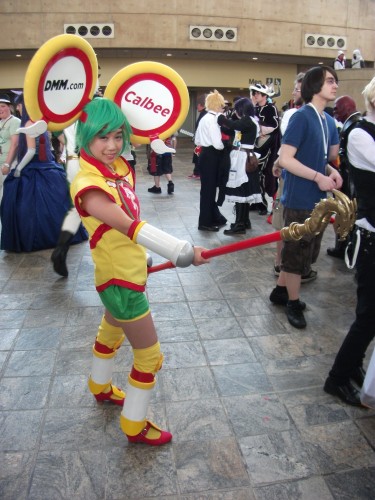
Despite a number of good costumes out there, I actually didn’t take too many photos this year. I blame the amount of times I had to hurry to get to the next thing on the schedule. Also, I saw absolutely no Eureka Seven AO cosplay. Promise me for next year!

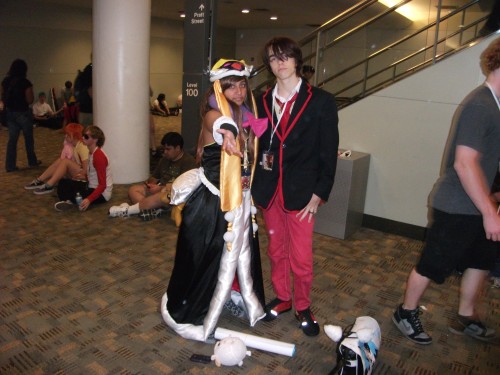
This was actually the first Fuura Kafuka cosplayer I had ever seen, and I’m amazed (and grateful) that someone would remember her. A funny story came out of this, as the cosplayer had not been aware that Nonaka Ai (Kafuka’s voice actor) was at the event. I told her about the autograph-signing on Sunday, and I hoped she was able to make it. Now, onto the next.

Overall

While at the convention I would notice little things here and there that I thought could use some improvement, the sheer amount of content at Otakon means that with even a few days of post-con recovery the bad mostly recedes away and all that I’m left with is fond memories. One complaint I do have, however, is that because the convention is set up to have some entrances and pathways usable and some off-limits, it is extremely difficult to tell just based on the map given in the con guide how to get from location to location. As an Otakon veteran at this point, I mostly have no issue with it, but even I ran into problems while trying to find the Hirano Aya concert. A combination of better signage to point people to the right locations alongside a clearer map would do wonders.

Even though Otakon had a “cooking” theme this year, I didn’t really feel it, pretty much because I didn’t attend any of those related events. At this point, every Otakon is starting to feel similar, but I can never hold that against it. After all, with a convention this big and with this much to do, I feel that we as fans of anime and manga make of the convention what we want. This isn’t to say that the way the convention is run doesn’t matter, of course, but that it is run smoothly enough that it becomes almost unnoticeable.

Truth be told, I used to take the sheer variety of panel programming and activities at Otakon for granted, but when I attended AX for the first time this year, I realized how limited that event is by comparison. Not only are there a good amount of industry panels with all of the guests they’ve flown over from Japan (or elsewhere), but the fan panels are a nice combination of workshops, introductions, and even philosophical explorations of topics concerning fans. Seeing Otakon once more in person, I knew this was indeed the con I waited for all year.

It Doesn’t Take a Madoka Magica

I was recently asked about why I don’t seem to like Puella Magi Madoka Magica nearly as much as other anime fans, bearing in mind the degree to which the show seems to garner an extremely devoted, I might even say evangelical fanbase. “Have you not seen Madoka Magica?” they ask.

While I think it’s quite a good show, even excellent in a number of respects, my opinion is that unlike so many others Madoka Magica did not open the world to me. It is not the greatest magical girl anime I’ve ever seen, let alone the greatest anime, and rather than showing me that it’s possible for such a genre to be full of rich depth and interesting ideas it just reinforced my already existing beliefs in that regard. So, yes, an excellent show and a fascinating twist, but something I always knew was possible (in a good way).

What I’ve kind of noticed is that the people who seem to be the most awestruck by Madoka Magica are the fans with little experience actually watching magical girl anime, and so when they discuss what makes the darkness of the series so special, it always feels less like people are talking from actual experience with the genre and more with just their idea of the genre from watching some Sailor Moon. Or if not Sailor Moon, their experience is comprised primarily of watching the genre exceptions, such as Revolutionary Girl Utena and Magical Girl Lyrical Nanoha.

This is not to deny the legitimacy of other people’s watching experiences, as telling someone that they don’t have the right to enjoy a show without x or y prerequisites is pretty ridiculous. However, I feel as if many people who think the world of that show and have an opinion on how it’s done so much with the magical girl genre, while in some ways right, have only experienced the “darkness” of mahou shoujo without being familiar with the “light,” in other words the shows which manage to achieve genre highs without falling into themes like subversion or dark parody. Even in the past decade or so you’ve had shows like Heartcatch Precure!, Ojamajo Doremi, and Cosmic Baton Girl Comet-san which are able to achieve a lot without flipping conventions all the way upside down.

It doesn’t take a Madoka Magica to realize the potential of the magical girl genre, which is something I hope more and more people come to learn.

Telling Someone to Grow Up is a Bad Argument

I recently read this post by Fast Karate’s Dave where he takes a game journalist to task for some blanket statements the guy made in regards to ideas like political correctness and freedom of speech. Dave makes good points about how these terms are abused to try and create the image of some noodle-armed over-sensitive people who can’t handle the truth. However, I find he also does something which can spoil the effectiveness of his arguments tremendously, which is that his conclusion simply amounts to telling the journalist (and others) to essentially “grow up.”

That article is not the first time I’ve seen this approach, and nor will it probably be the last, but I have to say that there is something problematic about structuring  well-reasoned arguments with a lot of good points to consider, particularly regarding topics such as the portrayal of sex and gender in media, and then just ending it with a simple demand to grow up, man up, get some common sense, or any other number of variations.

Certainly, as people mature they generally become wiser and may realize some of the arguments they made in the past were built on narrow perspectives or naive assumptions. However, the demand to grow up pushes the debate away from having points of discussion where people explain their sides and why they think it’s important that the other be convinced of their points, and into this vague space where certain intangibles are tacitly understood, as if to say that the point being made is so obvious if only you would catch up to the social norms which govern these interactions. Again, that’s not to say that the arguments preceding that jump couldn’t be perfectly cogent and even just outright correct, but if the idea at hand is so obvious that all it takes is for a person to “grow up” then the debate probably wouldn’t be happening in the first place.

I feel like if we can avoid narrowing the discussion to an argument against the other side’s immaturity then there wouldn’t be quite as much backlash.

“Government-approved” “Cool” “Japan”

I was thinking a little about the concept of “Cool Japan,” and why the idea has lost traction among various levels of fans and critics. One argument I hear occasionally is how, at the end of the day, people cosplaying and running around at conventions doesn’t give an image of “cool” or “cutting edge” but an image of regression or perhaps even immaturity. Essentially, people overestimated how “cool” Japan actually is. I don’t know how much this is really the case.

Another side is the way that Cool Japan was essentially government-backed. The idea of it was to use the media/fashion/image of Japan as “soft power” to influence the world. The problem, as far as I see it (and I think I’ve read similar arguments elsewhere), is that one of manga’s oft-touted strengths is its variety in terms of genres, ideas, philosophies, demographics, and even art styles. However, when it is being used by the Japanese government as one of its public faces, the manga and anime pushed out by the government becomes tacitly “government-approved.” If something is government-approved to be an image of the nation, then there is little chance that any government would willingly let their country’s image be tarnished by specific titles.

Essentially, what I’m thinking is that Cool Japan as a government-backed endeavor to some extent has to necessarily work against manga and anime as mediums of variety. I think the difference is between having something “government-approved” and “government-allowed.”

But I’m sure this topic has been talked to death. Probably at Neojaponisme.

Taking Small Steps and Huddling Over Scraps

When I originally wrote about Tropes vs. Women in Video Games, a video series which plans to explore the treatment of women in the medium, I expressed my concern that the creator Anita Sarkeesian might potentially cast aside more subtly positive portrayals of women in video games because they might still be significantly flawed. “If a medium is sexist in certain ways,” I thought, “then progress has to come in not only big steps but also small ones.” However, after reading this article about the Pixar movie Brave (warning: spoilers, though I do recommend reading it) in which the author Lili Loufbourow describes growing up with film and essentially forcing herself to deeply cherish even the most remotely positive portrayals of women in a medium which often forces them into a very limited number of character types, I find myself somewhat re-evaluating my thoughts on these matters.

Critical theorist Theodor Adorno writes about how mass culture, that is to say popular culture created by modern industry and capitalism, has a tendency to take any sort of radical idea or value and simply transform it into something palatable for the masses until its progressive value is swallowed up. I deeply disagree with Adorno in this regard for a number of reasons, namely his disregard for small steps within the area of mass culture. I still believe that it is important to look at examples of mixed results, cases where movement forward might come with a couple of steps back, and to just pay attention to places where progress is not measured solely by overall success. This is the reason why, when I write about the portrayal of women in anime and manga, I think it’s important to not just label things as “sexist” and call it a day.

His view brings some important questions to mind, however. Enlarging the sphere of discussion from sexism/feminism to the greater topic of progress itself, I have to ask myself, what is the difference between “taking a small step forward”and “huddling over scraps?” Is there a difference? Does one turn into the other when filtered through the lens of personal imagination and the changing values of a society?

My immediate feeling is that there must be a difference between taking a small step and huddling over scraps, and that the boundaries between the two are not so rigidly defined given history and context, but just the idea that the two can be conflated makes it somewhat dangerous. For that reason I now recognize that Sarkeesian and Loufbourow are essentially fighting against the same opponent, the “good enoughs” of female portrayal that pay only lipservice at best and are actually subtly regressive at worst, and that for Sarkeesian this dictates her tendency towards hard, powerful language in her videos. When subtlety is utilized, there is always the risk that it will be overlooked to such an extent that any messages given will be overwhelmed by the greater whole, or at least be perceived as such. While I prefer to try and work with the nuances myself, I have to recognize the potential pitfalls of that approach as well.

Reviving the Mahjong Panel

Otakon 2012 marks the return of the Japanese Mahjong panel, run by myself and Kawaiikochans creator Dave. It was a surprise hit back in 2010, and we’re so looking forward to bringing it back. What I’m about to talk about is related to some of the challenges we’ve faced in updating the panel.

Mahjong is a rather complicated (some might even say convoluted) game, and when we originally set out to do the mahjong panel we tried to make it as simple as we could while still covering just what makes mahjong (and by extension mahjong anime) fun. Naturally feeling a bit rusty with the material, we devoted some time to practicing the panel only to realize that there was a significant problem we did not have to deal with two years ago: we have both gotten significantly better at mahjong.

Mahjong is a game where subtle changes to the rules and even to the character and level of your opponents can impact the game tremendously. Playing multiple games to improve ladder ranking is a different beast from playing one or two significant games. When I attended the United States Professional Mahjong League in June, I had not played against flesh-and-blood opponents in over a year. Not only did I have to get used to the tiles again, but while I had definitely improved through playing online on Tenhou continuously (a process which forced me to constantly re-evaluate my play), I had become accustomed to that ruleset. So, for example, when I went into a game expecting it to last a full 8 round and began playing for the long term) I was sidelined by the fact that the UPSML games had a (necessary) time limit such that any round you were playing could be your last.

Though I was certainly thrown off by these unfamiliar rules, I was able to adapt reasonably well. It is the ability to recognize how those changes can potentially affect strategy that, at least for me, is an indicator of personal improvement.  However, it is that very same ability which can trip up an introductory mahjong panel.

When we were relatively inexperienced, we could deliver ideas with simplicity because the exceptions did not immediately spring to mind. Now, the danger was that our heads were too full of minutia. We knew where our statements fell short, and in an effort to correct them we continued to give explanations, but much like how the USPML’s time limit necessitates a different strategy, so too does the hour time limit for the panel.

The pursuit and refinement of knowledge in a given topic is actually what trips up so many intellectual presentations, whether the audience consists of professors or anime fans. The presenter has spent so much time exploring the limits of ideas and where their exceptions lie that it becomes difficult to “lie” to your audience, especially when improvement in your area (such as mahjong) is your main focus.

I think that the lesson to take away here is that we were so caught up in trying to teach strategy we’d learned that we had forgotten that before you learn how to play well, you have to teach how to play, period. And because our panel isn’t even about learning how to play, per se, we have to take that one notch down.

The Fandom of Plenty, the Fandom of Scarcity

In a previous post, I discussed what I believed to be one of the properties of moe as an industry to garner a fanbase: constant output of purchasable material to reinforce those feelings of devotion obsession. In this sense, moe can be thought of as a kind of “fandom of plenty,” a fandom whose existence is actively supported by an abundance of material easily obtained. Anime fandom in the United States over the past ten years has been characterized as such, where it’s so incredibly easy to watch a show and to move on to the next one without looking back that it becomes somewhat difficult to find something not to watch.

In contrast to the “fandom of plenty,” then, might be the  “fandom of scarcity.” The image of the anime fandom of yesteryear, from the tape-trading era and back, is one where each episode, each scrap of merchandise was so precious that being a fan was not only about watching as much as you can, but also about the lengths you’d go to in order to obtain that material, as well as the degree to which those small bits of treasure could be explored and scrutinized.

When I compare my experiences in both the former and the latter, I have to wonder to what extent it changes my own experiences as a fan. I am both the person who found Spring 2012 season to have so many worthwhile shows that I had to place some on the backburner in the hopes that I could reach them later, as well as the person who watched his VHS tape of some episodes of the middle of Nadesico over and over again just because there was nothing else quite like it for me. Are these ideas of abundance and rarity simply in the mind of the beholder? Certain the level of access I had in that Nadesico era was much greater than many, but it still felt like every tape was precious.

I also have to wonder to what extent these environments shape fandom itself. Just how much does scarcity shape an unofficial canonical list of works among fans? Is it possible for another Voltron, that is to say a show which was largely unremarkable in Japan which is considered seminal abroad, to exist? What shows would’ve been more popular and beloved had they not been shoved by the torrential downpour of a season of anime? How do these different environments influence what we value and why?

Explaining Compression in Comics

Last year I wrote a post titled “Explaining Decompression in Comics” in response to what I felt to be persistent misconceptions concerning decompression in comics storytelling. “Decompression” is characterized in these instances as using multiple panels to do what can be done in just one panel, and the gist of my argument was that decompression is less about total page count or delaying the rate at which a story is told and more about how information unfolds. It was quite a popular post, and it seems to have helped people get a better understanding of some of the particulars of decompression, especially in terms of manga paneling. However, even before I wrote that post, I was well aware that the opposite problem exists, where some readers of comics, particularly manga readers, can have trouble with the way “compression” works, especially in superhero comics of the Jack Kirby tradition. That is why I am writing this followup, to point out different ways as to how content can be conveyed.

Before I begin, I want to make something of a correction to my previous post that also applies to this one. In using titles like “Explaining Decompression” and “Explaining Compression,” I may give the impression that decompression and compression are simply things which comics “do.” This is not exactly true. Rather, decompression and compression are best thought of as descriptions of a variety of elements and how they interact within a comic, words which help to summarize an overall effect achieved by the relationships of many constituent parts such as panel layout, density of information, and the arrangement of elements within a panel. Also, I’m associating “decompression” with manga and “compression” with American comics due to their respective histories, but I’m well aware that the line has never been rigidly defined.


Suppli

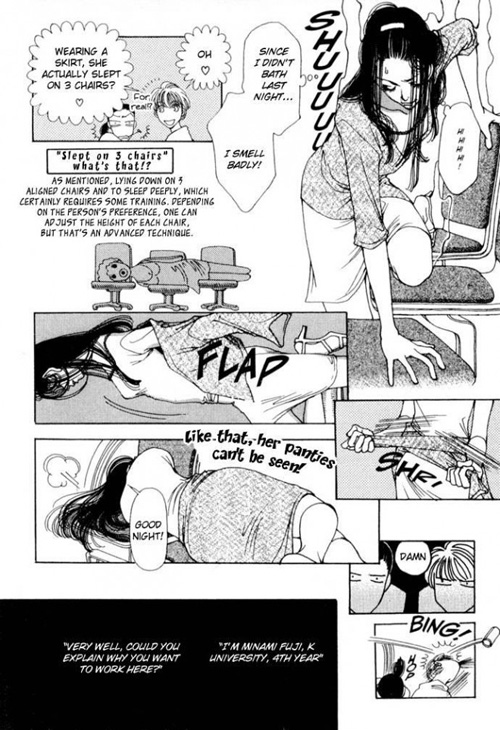
In a recent article comparing the manga Suppli and 2011’s Batman #7, Forrest Helvie criticized Suppli for being overly compressed while praising  Batman for avoiding this problem, an odd opinion given manga’s notoriousness for being “too decompressed.” While this usage is somewhat erroneous, the nature of that mistake brings up some important points about the meaning of “compression.” Essentially, he associates visual conciseness with decompression and visual complexity with compression, when such distinctions are non-existent. A comic can be concise and compressed, just as one can be elaborate and decompressed, and in fact those two ideas better summarize the visuals of Batman #7 and Suppli respectively.

Even the seemingly easy-to-understand compression turns out to not be so simple, so it should come as no surprise that American comics and their tradition of compression can be a tough read for those unfamiliar with it, notably readers of manga. While the stereotype is that manga fans’ dissatisfaction has to do with the content itself, characterized by caped musclemen and good vs. evil dichotomies, I would say that it also has a lot to do with how those comics work visually.  More specifically, the problem is that a highly compressed comic can make a reader more accustomed to the decompressed nature of manga feel as if the story is dragging along, creating a sense of impatience.

This can seem rather peculiar, given that decompression is stereotyped as taking forever to get to anything significant, but the word impatience takes on a different meaning depending on whether we’re talking about decompression or compression. For decompression, a sense of impatience has to do with the feeling that a comic is taking forever to get to where it needs to be. Impatience towards compression, on the other hand, derives from a sense that the story being told is not moving as quickly as your eyes want to, and this can be a significant hurdle which the inexperienced must overcome if they are to derive greater enjoyment from such comics.

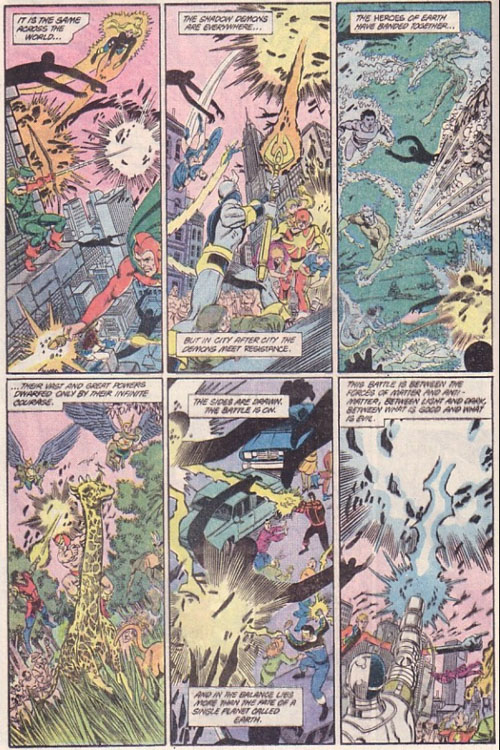
The above page, taken from a scene in Crisis on Infinite Earths, DC Comics’ first mega-crossover, called the “Battle Around the World,” is a classic example of complex compression, a big fight scene with simply a lot of figures acting and participating, with the text boxes very thoroughly explaining the context in which the battle is occurring. Though there is a cohesiveness to the page as a whole, this comic places incredible importance on each individual panel, where even the smaller elements within each panel encapsulate some distinct meaning. Each panel tells its own dense, rich story, a glimpse at events in every corner of the planet, and each character is posed to show them performing an action which defines their character to some degree. In the first panel for instance, the Green Arrow shoots from his bow and Starman is firing a blast from his signature weapon, the Star Rod. The image composition of each individual panel is vivid, each of them related to each other through similarities in both form and content.

For someone more used to manga, the way in which this information is organized together can be overwhelming. Whereas a character may be placed and posed to influence the reading direction of the page in manga, here the characters and panels are more self-contained. As a result, the manga reader may start to feel as if the story comes in fits and starts, almost as if someone were slamming the breaks every time there was something interesting to see. Manga and other comics which are more decompressed present panels as fragments of a whole, but here, panels are whole ideas unto themselves.


Batman #7

If we look at Batman #7, we can see that the word bubbles are fairly precise. There is no deluge of visual information requiring the reader’s attention. However, each panel is still being presented as a whole nugget of information, communicating a clear and specific point in every instance. That is not to deny the overall relationship the panels have with each other or the page on which they sit, but if you then look at Suppli, while it has some panels which present information as dense exposition, each panel (as well as each visual element within the panel), appears to cascade into the next, with the reader collecting bits of information along the way. Keep in mind, however, that compression and decompression, though essentially operating on opposite philosophies, can co-exist in a story, and the dividing line between them is not absolute, though one is often more present than the other.

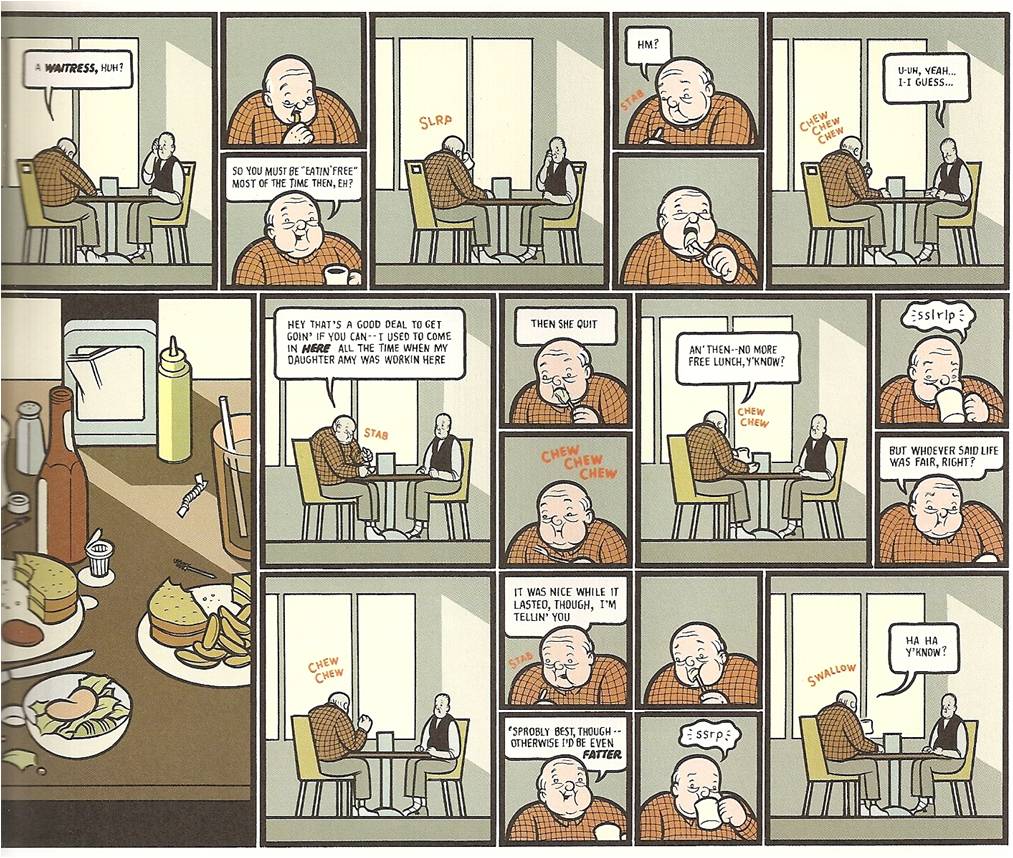
Decompression is increasingly a part of American comics, but the long-standing history of compression in American comics can be seen even in the ways a lot of more current comics have incorporated decompression. Marvel writer Brian Michael Bendis, for instance, is known for his snappy, natural-sounding dialogues which occur over multiple panels and pages, and which lend his comics a sense of decompression, but different artists have use different ways to portray those extended conversations, some of which are more compressed than others. Similarly, Chris Ware’s work (something decidedly non-superhero) can be both sparse and minimalist or extremely detailed and elaborate, but the paneling used in his comics also shows signs of an American comics tradition, albeit transformed heavily. The panels are somewhere between existing for complete information while also trying to hold back and let themselves strongly present their relationships to the panels around them.

So in the end, what can be done to help the reader for whom compression is a problem? In my opinion, the key is mainly awareness of how the panels operate. If you find yourself being weighed down by the comic, then just try to approach it one panel at a time. Think of the panel in a compressed comic as a lake or a pond. You dive in to examine its breadth and explore its depths, and then surface before moving on to the next one. Over time, your experiences will accumulate, but it’s important to let them build up.

Thoughts on Fandom Structure: Facilitating the Moe “Lifestyle”

In a recent conversation, I was presented an interesting question: why is that moe seems to engender the type of fandom which seems on some level staunchly devoted to it and has fans who can take attacks on moe personally? After some consideration, I thought of two reasons.

The first reason is that on some level, whether it be deep or shallow, I think moe fosters a very individual, perhaps even private connection. Regardless of the specifics and any sort of moral/aesthetic tastes, the idea (nebulous as it may be) begins to resonate with concepts such as catharsis, fantasy, sexual desire and identity, self-reflection, stress, and so on.

The second reason, and the one I’m more interested in for this post, has to do with the ease by which one can become a fan of moe. In a recent interview concerning Starcraft 2 fandom, commentator and personality Sean “Day[9]” Plott was asked why so many SC2 fans have a tendency to identify themselves as “Starcraft fans” and to put down other games as inferior products, to which he responded:

There’s a lot of people who are into Starcraft and it’s just become their identity because, honestly, there’s so much Starcraft content that you can watch it all day, every day, just like you can be into football or baseball. And so, rather than just say, “I like this,” they look down on other things.

I think these words can apply to moe as well, in the sense that not only is there so much of it currently available that you can watch and read nothing but moe genre titles and have your entire day filled, but that the system behind it actively promotes and encourages this sort of obsession. On the fiction-production side, you have this tendency towards characters who each possess easily expressed individuality, and so make it easy to define a favorite, and it’s a process that can be renewed with the next show and the show after that. On the merchandise side, you have figures, posters, limited edition DVD boxes, fan clubs, official events, and so on. If you’re into some show, there’s a good chance you can buy something related to it, and though there’s a lot of talk these days about how fandom is moving beyond expressing itself through simple consumption, it can’t be denied that it is still in its own way an expression of one’s self.

Obviously this model doesn’t only apply to moe or even just anime/manga, nor does every single fan of moe do this (and I want to make the point clear that I’m not characterizing an entire fanbase as having a singular mindset). However, when combined with that very personal connection which moe fosters, I think it creates a particular kind of devotion, which, while not entirely unique, more easily manifests itself as something just that personal.

My Hopes for “Tropes vs. Women in Video Games”

There was a big to-do recently when Anita Sarkeesian over at Feminist Frequency received a barrage of nasty comments over her Kickstarter to fund a project to analyze common tropes concerning female characters in video games. A lot of the commentary was as you might (unfortunately) expect, citing her supposed jealousy of better looking women, her “hypocrisy” over wearing makeup, as well as threatening her with rape. Even if most of this turns out to just be purposeful button-pressing in order to get a rise out of her, it’s still pretty sad that it came down to this.

I do not think people should have to agree with her just “because” she’s feminist, but at the same time I do wish people would come up with better arguments against her ideas and her points than simply things like “sexualization happens to men too” (the nature of the sexualization is nowhere near the same).

Tropes vs. Women in Video Games is already more than well-funded as of this post, but having watched her previous videos in the Tropes vs. Women series, I still want to say something about my hopes and worries about the project.

While Sarkeesian makes overall good points in her videos pertaining to the types of tropes which can reinforce images of women as passive beings in service to more fully developed men, I find that her videos tend to take something of a sledgehammer approach to addressing problems. Tackling big problems with big answers is a valid method, and it does result in points which are more readily and sharply conveyed, but there is a loss of nuance in discussing specific tropes she addresses as a result, possibly due to the brevity required in making short videos.

The consequences of this loss of subtlety is that the presentation of the tropes themselves seem to center around the idea of the trope itself being sexist more than its overuse (though both are considered culprits). For the Women in Refrigerators trope, the idea of a side or major supporting character dying in order to drive the hero to action is a recurring theme throughout fiction, be it with men or women, and the use of a girl as the “sacrifice” is not so much the problem as it is the degree to which it happens in superhero comic books, a genre which is all about power and inspiration.

Similarly, in her discussion of the Manic Pixie Dream Girl, she criticizes the character type for being something of a vague supernova of inspiration for the leading male character, lacking in qualities to make her fully realistic. To that I have to ask, since when does more realistic automatically equal a better character? While I certainly see the advantages and have argued for the strength of such characterization before, there is something to be said for characters who are their concepts distilled to an extreme. Furthermore, it risks leaving no room for the trope to be turned into something which can be positive for women without having to completely subvert it.

When it comes to Tropes vs. Women in Video Games, my hope is that Sarkeesian will not come at the female characters of video games with a “one strike” policy. While there are plenty of girls to be rescued and recurring roles for girls that can be explored and criticized extensively, I hope that she does not view individual characteristics isolated from each other, but rather sees the characters as a whole. In the end, any judgment she makes is hers, and characters can and will end up being considered problematically sexist (because let’s not kid ourselves, video games do have them), but if a character has positive traits in addition to negative or even harmful ones, they should be acknowledged in order to show where games have managed to make smaller progressive steps in addition to bigger ones.