The Interaction of Mecha Fandom and Code Geass as Mecha/Not-Mecha

I was listening to the most recent episode of the Veef Show, where the argument that Code Geass is not a “robot” show came up by way of another podcaster, Anime World Order‘s Daryl Surat. It’s an argument that I’ve heard before from Daryl, whether it was through AWO itself or just talking with him online, and it all hinges on a simple statement: A show which does not focus primarily on robots cannot be called a “robot anime.” The direction the fanbase of Code Geass takes, one that emphasizes the characters in a variety of ways such that arguments about attractiveness and character motivations occur side by side, is used as supporting evidence. Seeing that I just appeared on the Speakeasy Podcast and endorsed Code Geass as a solid mecha show for people who feel a little put off by mecha though, I figured that it would be a good idea for me to say something. Also because I enjoy both the Veef Show and AWO and they’re cool dudes.

While I’m on the side that says Code Geass is a mecha show, I’m not writing this to argue in its favor.  Where one person draws the line between genres (or whether they choose to draw them at all) is predicated to a certain extent on their own preferences (the reason I put the qualifier of “a certain extent” is that obviously a show with zero robots and zero mentions or implications of robots would have a hard time justifying itself as one), and that argument can just go back and forth with no signs of budging. It happens to all sorts of genres, particularly science fiction, which may be appropriate given the subject at hand, but I’ll leave that alone for now. What I really want to do is look at some of the deeper layers of meaning behind the above argument about why Code Geass isn’t a mecha show, as I think it says some things about the anxiety that exists in a fanbase for a genre which perhaps fears irrelevancy. I do not think Daryl necessarily feels this way, but underlying questions still exist within.

The notion that Code Geass does not fall into the genre of “giant robots” is based on the level of presence that mecha possesses within that series. While they appear in virtually every episode in some way or another, they are not integrated into the main thrust of the story, thus the show does not attract fans through its robots, at least not in comparatively great numbers. Given this view, the first underlying element of this argument is a question, “Why isn’t Code Geass emphasizing the mecha?”

The answer can be presented with varying degrees of cynicism, and I will show two here on somewhat opposing ends. The first version is that their goal is to pander to a larger anime fanbase by placing importance on those character traits previously mentioned. Mecha are thrown in for flavor but not much else. The second version is that giant robots for the sake of giant robots do not capture the attention of a wide enough audience. Whether you’re more inclined to express this same idea as the former or as the latter, the commonality between them is the fact that giant robots as a genre, be they super or real or some kind of hybrid, just aren’t that popular anymore. So then the next question that comes up is, “Why aren’t robots popular?”

I don’t have the answer to that. All I can say is, for fans who got into anime because of giant robots, or those who lived in a period where mecha shows made up such a huge part of industry output that it became one of the genres inextricably linked to anime, the idea that robots do not capture the general viewing population’s imagination can be a bitter pill to swallow. The properties of anime that are bringing in fans now may not be what brought people to the table in previous eras. As soon as what you thought was popular no longer is, and you can’t quite figure out why things have changed, it can be baffling. How you reason through this change can depend on how you feel towards what has supplanted your old favorites, and it can be conveyed with different degrees of discontent.

At this point, it’s important to remember that giant robot shows that place enormous amounts of emphasis on the robots themselves and their influence on the story as a whole still do exist and are still being made. The problem with them, however, is that they are few in number, and that as a niche genre it appeals to a dwindling hardcore fanbase. I know that Daryl is also aware of this issue, as must be a great number of mecha fans whether they consciously realize it or not, and embodied in that feeling is the uncomfortableness of having gone from riches to rags, from being one of the premiere fanbases to a minority. I find that in actuality, the negative reaction towards categorizing Code Geass as a “robot anime” comes not from simply definition semantics and pedantry, but from what I think is perhaps the most central question underlying everything: “Why aren’t Code Geass and other shows doing more to convince people to like giant robots?” With that, giant robot shows must thus not only appeal to fans who already like the genre but also act as ambassadors to people who are less receptive.

For that, I point once again to that Speakeasy episode, because the whole purpose of that podcast was to talk about mecha shows that are capable of appealing not to simply those who are unfamiliar with the genre and just need to be exposed to it, but to people who have been burned by giant robots in the past. With some shows, the mere presence of robots can be enough for people to say “no thanks,” but if Code Geass attracts this large fanbase that is willing to stay even with robots continuously present within the show, then it must be doing something to not have them outright rejected. Perhaps all that is happening is that the robots are being conveniently ignored, but before people can even carry the potential to love giant robots, they should be able to tolerate them first.

Have you seen the “V8 VFusion?” It’s a drink whose purpose is to mask its vegetable content with fruity flavor. It’s even advertised by showing people who don’t like veggies drinking and enjoying it. You can make an argument that it’s not really a vegetable juice and you could even probably make a convincing case of it, but then I have to wonder about how much that distinction really matters.

A Response to Geordie Tait, from an Otaku

In a recent article on Star City Games, Tait wrote an article to his future daughter explaining to her the prevalence of misogyny in the gamer community. He cites the recent buzz over Gizmodo intern Alyssa Bereznak and her own article detailing a failed date with Magic: The Gathering world champion Jon Finkel. In contrast to the cries of “shallow” and “whore,” Tait steps back to examine not just the disturbing ubiquity of such comments, but the combinations of elements that would result in such an environment, and points out that Bereznak’s main problem was that she should have known her tone in her article would have set off the primarily male geek community of Gizmodo.

Tait continues his article, talking about the self-delusion that is the “Nice Guy,” and even his own past where he himself was once one of the pack, decrying women for not looking past the gruff, hairy, overweight exterior of Magic players. There is a good deal of nuance in the article and I think it’s worth your time to read. That said, I have a minor problem with something Tait says.

Oh, Japan. Nearly every female character we encountered was designed by men, for men. Ridiculously proportioned, child-like in voice and temperament, they were calculated to attract the subway-groping attentions of the otaku.

My problem with the above statement has nothing to do with his accusation that female JRPG characters are infantile and designed for men. Despite my closesness to anime, manga, and Japanese video games, I simply haven’t played enough Japanese RPGs over the years to give a fair assessment of the overall picture. The source of my disagreement instead comes from his use of the phrase “subway-groping attentions of the otaku.”

At first when I read it, it seemed like Tait was trying to say that all otaku are the perverts on the train who victimize women by touching them on the train. “But,” you might say, “He doesn’t mean that all otaku are molesters, he’s just referring to the ones who are.”  That is still problematic however, as that qualifier treats “groper” as a subsection of “otaku,” when in reality the “otaku groper” is more the cross-section of a venn diagram. To imply that the primary reason that such things happen on Japanese mass transit is because they’re really into anime, manga, and video games with excessively cute girls is an unfair judgment.

Yes, there are plenty of examples of female characters who are explicitly sexualized in Japanese entertainment idea. Yes, there are characters who are designed to pander to an otaku market. Yes, you can go on the internet and find a whole world of fanart expressing the desire to see these characters as fetishized sex objects. And yes, this can be off-putting for women who see only examples of the “male gaze” where they would prefer personal identification, but all of the above elements do not say that otaku are going out there and waiting to violate women. It’s not a matter of whether or not such otaku are a minority. It’s not even about pointing out the number of female otaku or the amount of works in the “otaku mediums” like anime and manga that have managed to reach and strengthen women over the decades. After all, if a problem exists, it still exists, even in small numbers. But while Tait’s unkind descriptions of nerds are not limited to the otaku, they do not carry anywhere near the same (perhaps unintended) vitriol.

“Caucasian malcontent.”

“Warm, hairy male privilege.”

“Nice Guy™ Gamer.”

Only for the otaku does he define that category of nerd as not just sexually deviant, which is still fairly harmless if insulting, or simply as passive-aggressive misogynists, which is the Nice Guy in spades, but as purveyors of sexual violence. To have that stigma propagated by someone who should very well know better because he just spent an entire article reflecting intelligently on some of the problems among nerds and gamers is really a shame.

An important thing to note: While this is a flaw in Tait’s article, it does not invalidate the rest of the letter. I certainly did not just kick the corner of a house of cards, as his overall points and even many of his examples are still valid, including the realization that there was a good deal of discomfort showing those Japanese games to his girlfriend/now-wife. I think it just goes to show that developing understanding is a continuous path, and this is another area where Tait can continue to grow, just as we all should.

A Look at Fanservice Through Redline and Kanokon

The Reverse Thieves recently made a post about the level of acceptance that anime fans have for fanservice (meant here as sexual fanservice and not intricate weapon details, for instance) in their shows, where they discuss how the view towards cheesecake seems to get increasingly polarized the more extreme and perhaps fetishistic broadcast anime becomes. Having just written my own thoughts on a similar subject, I feel like the question of how fanservice is both executed and perceived, and I think the film Redline provides some good insight into the matter, especially when compared to a representative otaku fanservice show such as Kanokon.

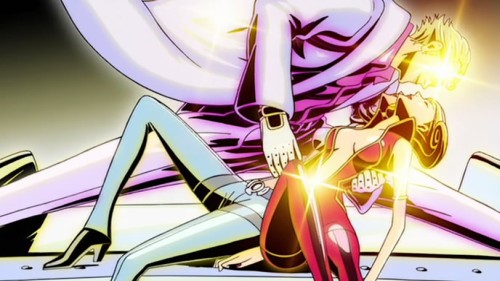
Redline is an anime very different from the norm, and especially different from what is popular with the current generation of otaku. Featuring a wild aesthetic somewhat similar to that of Dead Leaves, Gerald and Tim Maughan on Anime World Order referred to it as the anime they’d been waiting for since Akira. What that means is that Redline is a film capable of drawing in both anime fans that had left the scene long ago, as well as attract an audience similar to those people. It has a manic edge that’s got a certain dangerous appeal to it, and that extends to its fanservice as well.

The women in Redline are definitely overtly sexualized. Between two chesty music idols named the “Superboins” and the most important female character Sonoshee getting an extended topless scene, there is no argument that the film wants you to think of those characters as extraordinarily attractive. They are, to a certain extent, designed for fanservice, but compared to the fanservice from a series like Kanokon, it feels very different.

It would be easy to say that there is a “right” kind of fanservice, and to make the argument that “Kanokon’s fanservice is creepy and Redline’s isn’t. That’s not quite right, though. It’s too simple, and based on too many assumptions, like the idea that just because Kanokon is designed to sell through its harem and Redline‘s appeal lies primarily in its visual design that there is something inherently wrong with the former. Personally speaking, I vastly prefer Redline over Kanokon, but I’ll save that for a possible review in the near future. The real difference, I think, lies not in simply how the girls look (lolicon is not even a topic of discussion or possible misunderstanding with Redline), but with how they present to the viewer, particularly male viewers, what kind of qualities a man should have in order to obtain the idealized women in each respective series.

With Kouta, the main in Kanokon, the defining traits of his character and by extension the things that get the women flocking to him are his quietness, his sensitivity, and his decency. In Redline on the other hand, the portrayal of the women emphasizes “he-men, men of action,” as the old Charles Bronson Mandom commercial goes. Protagonist JP sticks up for his beliefs even if it gets him beat down, and the man he idolized in his youth can be seen in a flashback kissing two bikini babes simultaneously. Both are versions of male fantasy, the nice guy who is appreciated by all of the women and the daredevil who sets girls’ hearts aflutter, but they have a decidedly different appeal to them that doesn’t just have to do with how much Kanokon toes the line between fanservice and outright porn. They exist on somewhat opposite ends of a spectrum of male behavior, and the manner in which the women are sexualized, not just visually but also in their actions within the story, runs accordingly. With that in mind, I think it can be easy to see why there would be conflict between the two sides.

This is not an indictment on either type of male character or the series which they come from, especially with JP in Redline who is shown to be sensitive in his own way. Neither portrayal is inherently worse than the other, but problems can arise. Indeed, while both the “nice guy” and the “man of action” can be portrayed well as men of character and strength, they can also be pushed to unpleasant extremes, though the nature of that negativity can itself be different. The nice guy can be so passive as to absolve him of any mistakes he should be responsible for, and the man of action can often times be seen as a man who treats women purely as playthings to be manipulated. It is also not an indictment on the fans who identify with either character type, as the meaning of terms such as “wish fulfillment” and “role model” can get complicated. Is it better for a quiet nerd to prefer the quiet nerd character he is, or the active warrior that might wish he wants to be? I think that question lies at the heart of the difference in how fanservice is executed.

Objectification of the Vaunted…or Something? (NSFW)

When I look at certain cheesecake-oriented American comics such as Lady Death, Vampirella, and Taboo, I find that they bother me in a way that fanservicey manga, anime, etc. do not. It’s something I haven’t entirely figured out why, but there’s an inkling somewhere in my mind that tells me to head a certain direction. This post is the exploration of that feeling.

Before I start though, I’m going to have to point out that the images used in this post may be considered not work-safe. Careful!

Continue reading

Super-Expressive Faces

I’ve been reading the manga Coppelion lately, about three teenage girls who are genetically engineered to be immune to radiation in a post-nuclear apocalyptic Tokyo. One of those girls is Fukasaku Aoi, whose most prominent feature is that she has an incredibly expressive face compared to the other characters around her. It kind of makes her an endearing character even when she complains (which she does often), and I feel like she can really liven up scenes as a result. She shares this trait with Kurumi Erika from Heartcatch Precure!, and as is evident from previous posts, I like Erika quite a bit as well.

I find myself wondering about the candidness of such characters and why they can be so appealing, particularly when they’re grouped with characters who, while not necessarily reticent, still don’t have quite the range of expressions that someone like Aoi or Erika does. In thinking this through, possibly the best explanation I can find is not from manga or anime but from bande dessinée, Franco-Belgian comics. Though all sorts of things have been written about the expressive nature of eyes in manga, I think I might be best served by The Adventures of Tintin.

At the Belgian Comic Strip Center museum in Brussels, there is a Tintin exhibit which features profiles on all of the major characters. Among them is Haddock, a ship captain and friend of Tintin. Like Erika and Aoi, one of his most distinguishing features is his capacity for making wild facial gestures, and a display in the museum talks about the relationship between Captain Haddock and Tintin, who is usually much more calm in his demeanor. I don’t quite remember everything it said, but it mentioned something about how the visual contrast between the two makes for an ideal scenario where both characters complement each other with their respective approaches and make the comic better as a result.

If that’s the case, then taking that idea and applying it to the three-character structure of Coppelion‘s central cast, I have to ask myself what purpose does that middle character serve, the one who is less expressive than the Haddock but more expressive than the Tintin. My initial thoughts towards this is that the middle character, who in the case of Coppelion is its protagonist Naruse Ibara, is that if you think of the three characters as a spectrum to gauge the direness or excitement of a situation, the point at which Ibara starts to get facial reactions close to par with Aoi’s is when you know things are really getting serious. If it gets to the point where the third girl Taeko is freaking out, then it’s doubly so. Proper use of characters with different capacities for strong facial expressions can potentially control the level of excitement in a comic while also distinguishing the characters for variety.

I get the feeling that much of what I said was pretty obvious, but I still wanted to write it all down.

Lack of Variation, or Lack Thereof

I think it’s common when discussing anime and manga with people who are perhaps only barely acquainted with those subjects to hear from them that “anime all looks the same.” You can point to plenty of titles with variation in theme, art style, writing, you name it, but there is still that sense that all anime has a similar feel. Usually I’m the one trying to explain how diverse those comics can be, but in a recent visit to a comic shop, I found myself somewhat on the receiving end.

In this case, it wasn’t manga but rather American comics that gave me pause to consider. Not really keeping up with those comics as I had in the past, I was looking at the rack where they have the weekly 32-page (or so) issues, your Avengers and Batman and what-not mixed with titles from smaller publishers, seeing what might be interesting. Then it hit me. Everything kind of looked the same. I could obviously see that there were many different artists working on each comic, but there were just certain shared elements that made it feel like one big monolith of a wall.

I’m not sure exactly what it is, but I feel like it might just be the sheer emphasis on Olympian physiques which exists in not only superhero comics but other action-type works as well. Be it male characters or female ones, what I can mainly remember from those covers is just how prominent the toned bodies on them are. It could also be something about the characters’ facial expressions.

I know better, and I can point to this or that indie title or graphic novel to show that’s why it isn’t the case, but I think that my reaction might not be that far from the person, let’s say an anime fan, who takes one look at the American comics section and finds little variety in it. At the same time, I’m also aware of how easily something like manga can be perhaps unfairly summarized by just a glance.

Legitimately Enjoying Things Ironically

At some point after the term “hipster” became a popular put-down among nerds, the phrase “I enjoyed this…ironically” became a running gag designed to emphasize everything that is perceived to be wrong with hipsters, highlighting that, at least for the stereotypical image of the hipster, that the enjoyment of kitsch is all an act. Because of this, I now sometimes see nerds who are afraid to enjoy things ironically for fear of being associated with that crowd.

To you, I want to say, it is okay to enjoy things “ironically.” The idea that something is “so bad it’s good” is a valid one, and being entertained on that level does not necessarily have anything to do with being “hipster.” There is a caveat though.

The key to enjoying something in an ironic fashion and not having it make you seem like less pleasant of an individual is that enjoyment of the product at hand, t-shirts, beer, anime, should be top priority or close to it. If the “ironic” products are consumed in service of enhancing or giving flourish to your image in the eyes of others, that’s when it starts to cross over into “hipster” territory. It is pretty unappealing when someone looks like they’re doing something just to make themselves seem better than others.

Certainly, some things will inevitably be part of personal presentation, such as clothes. Wearing clothes that make you look good is not a “hipster” thing. If you’re not sure about the distinction, here’s a simple test: If no one was around to see you, would you still be enjoying things ironically?

The Skill Mezzanine

Over the past few years, there has been an upswing in video games geared for competition (or at least modified to be competitive). Starcraft 2, Street Fighter IV, the new Mortal Kombat, the concept of “eSports” is managing to achieve more success around the world than had been seen previously, with the notable exception of South Korea where Starcraft competition already managed to achieve a good deal of competitive success.

Many of these new games are sequels, and they emerge in a gaming environment far different from their predecessors. In some cases, as with Starcraft and Marvel vs. Capcom, it’s been over a decade since their most immediate ancestors. Online play has filled the long void that was left by the death of arcades. Facebook games and other bits of entertainment which fall under the heading of “casual” have made video games a common part of many people’s lives. There are now more people playing video games than in previous decades, but many of them do not devote themselves to games, particularly ones that foster competition. One of the results of this has been a move towards easier controls, reducing the number of things to do, simplifying actions, increasing the influence of random chance, and just making games where people can more easily feel like they’re accomplishing something.

In doing so however, there is a backlash created among those communities, because what this means is that, compared to those older games, they seem a little…softer. More forgiving. This in turn can be interpreted as an affront to the competitive spirit, especially for those games which dare to call themselves competitive, because it is giving a break to the weaker players. Many times, criticism will come in the form of questioning a game’s “skill ceiling.” The argument goes that if a game is less demanding on a fundamental level, it will result in a game where the best of the best will be unable to distinguish themselves from the masses more commonly known as “the rest.” Certainly this scenario is not out of the question, but what I’d argue is that those critical of these games’ skill ceilings often misuse the term and that they’re arguing against something quite different. For if the “skill ceiling” is the absolute limits of competitive skill, and the “skill floor” is the bare minimum to even understanding the game, then what those people are really arguing against is the lowering of a kind of “skill mezzanine,” the first space up from the skill floor and the minimum amount of skill needed to compete and win matches against others who are also trying to do the same.

“One guy was clearly making more mistakes than the other but he still won. This game is awful.” Putting aside the fact that weaker competitors are often capable of beating stronger ones simply because of how “skill” is nebulous and but one of many factors in competition (mental state being an arguably more important one), such an argument can be summarized by the idea that the game is too forgiving of mistakes, and that because a weaker player is more prone to errors, it rewards them unfairly. But a game that punishes mistakes less is not the sign of a lowered skill ceiling so much as it is evidence of a lowered skill mezzanine, and this is because even if the best players are the ones who are closest to touching the ceiling, the players worse than them do not have to aim for that ceiling as well. Their goal could simply be to touch the feet of those better players, and a more forgiving game means that they can accomplish such a task more easily, no matter how high the ceiling may be.

The higher the skill mezzanine however, the tougher it is for people to reach basic competitive competency, which has the effect of weeding out less devoted players. What remains, if numbers are sufficient (and there is always the danger of that not happening for a game), is that the only people left are the ones who have been able to overcome some very unforgiving limitations.

One of the consequences of mistaking the skill mezzanine for the skill ceiling is that people conflate the concept of game limitations that were overcome through skill with the idea that game limitations necessarily generate skill. Veteran Starcraft competitor and commentator Sean “Day 9” Plott often emphasizes that imposing restrictions can be a useful method for improving one’s gameplay. In that sense, the rules of a particular game can be seen as a forced limitation rather than a self-imposed one. But it is also a mistake to believe that those specific limitations should be the standard by which all other games are judged, to confuse the concept of limitation with the particulars of execution. Soccer is the most popular sport in the world, and is praised for the amount of mental and physical skill required to play it at a high level. One of the most basic rules, the one that gives soccer its internationally more popular name of “football,” is that a player is normally not allowed to touch the ball with their hands. This simple yet profound limitation (hands being vitally important to the survival of humankind) encouraged people to find ways to move the ball with the rest of their body, and as the game has developed over the course of generations, soccer players discover new methods and refine them. But one cannot say that, because soccer developed into “the beautiful game” in part due to the limitations on hands, that all other ball sports should also ban the use of hands.

There is nothing inherently wrong with criticizing a game’s capacity for competition, because there are games that are objectively more competitive than others. Chess is far more complex than tic-tac-toe. One game can indeed have a lower skill ceiling than the other. But I think it is important for people critical of a game’s skill ceiling to be able to distinguish between it and the skill mezzanine in order to discuss a game’s competitiveness.

Time and Genshiken

When I originally read Tamagomago’s post on the Genshiken generation gap, I realized something: time has moved differently for the characters of Genshiken compared to the real world.

The gap between Genshiken and Genshiken II has changed how I relate to Genshiken. Genshiken II starts off only a few months after the end of the first series, but in the real world, nearly five years had passed. One result of this is that the references used in the new series are a little anachronistic (a Zan Sayonara Zetsubou-sensei reference when the show shouldn’t have been out at that point, for example), but the one I find to be more personally important is that I went from being around Sasahara’s age to actually being closer to Madarame’s. I am no longer the college senior who could read about Sasahara’s graduation around the same time as my own. Had the manga progressed steadily from Volume 9, had there not been the long wait to herald in Genshiken II, I wonder if I would’ve also been reading the manga a little differently?

One criticism of the new Genshiken that I see from not just English-speaking fans but also Japanese ones is that it’s been difficult to relate to the new, primarily female cast. The feeling I often get from that response is that the readers who are of the opinion that Genshiken has changed for the worse feel that this world of college-aged otaku is not the one they had originally left. I even talked about it when the new series was beginning, remarking that Genshiken has always been about change, and that it should be possible to relate to these new characters, even if they do come from a different generation otaku. I realize now though that it’s not so much a matter of these readers not being able to relate to characters unlike themselves, but more that they feel the philosophy of Genshiken has changed, that the core essence is something different and perhaps frightening.

Obviously, the experience of shifting age groups as the result of the gap between Genshiken series is not something everyone can experience, especially if they’re not reading the comic as it comes out. Even if that weren’t the case, given time I would’ve reached Madarame’s age anyway. And even if others are around the same age as me, it’s not like people experience the passage of time in the exact same or even similar ways. More importantly, it’s not like my own personal experiences over the past five years are particularly better than others’. Even so, when I think about it a little more, it seems like one of the themes that comes out of Genshiken for the readers as well as the characters is the influence of personal history and how self-perception of time changes accordingly.

Ogiue originally defined herself by the trauma of her time in junior high. It dominated her life before she was eventually able to move on with the help of her friends. Madarame clings to the recent past by leaving his situation with Kasukabe comfortably ambiguous. Kugayama put his half-hearted ambitions aside and decided to just be normal. The first chairman, well, I’m not sure if he existed within time.

For the fans who feel alienated by Genshiken II, their personal definition of what it means to be otaku, and by extension, what it means to be part of a group otaku, has not changed in the five year Genshiken gap. I emphasize once again that there’s nothing wrong with this, and in fact it’s also pretty much where Yajima is at in terms of her own otaku-existential conflict. As for me, I know fully well how much I’ve related to Genshiken and continue to do so, but I also know that a lot has happened in my life since I finished the original series. I’ve defined myself many times on this blog according to how Genshiken has changed my life, but in the face of this new iteration, I find that it doesn’t change me so much as change alongside me.

Doctor Who Anime Fan-Trailer: Good Skills, But…

Translator Paul “Otaking” Johnson, probably most famous on the internet for his criticism of fansubbers (not the illegal part but that they draw too much attention to themselves) and his particular views on how anime should look (five-tone shading), recently released a finished preview of his Doctor Who anime treatment. Taking the iconic British science fiction hero and putting him in Japan, the whole thing lasts 12 minutes. While Johnson has since taken the Doctor Who video down, I still want to give my impression of it, and you can still find previous versions around.

I’ve been critical of Johnson in the past over his adherence to “five-tone shading.”  There was never anything inherently wrong with the concept of “five-tone shading,” and my criticisms were primarily that there are a variety of ways for anime to look good, that budget inevitably plays a factor, and that if you disregard all shows that don’t use that shading style, you look down on not just current anime but also anime from before the 1980s. But it being a few years and all, I had to wonder what he’d learned since then.

Now I am not a fan of Doctor Who as much as I have never actually watched it, so I cannot judge this preview animation based on how well it captures the Doctor Who spirit. Anything I know about it is from reading the internet. I also understand that it’s more a proof of concept, not a trailer or anything that requires a storyline, so I won’t say anything about plot coherency. Having done a bit of animation in the past myself, I can tell that Johnson has talent and put a lot of work into this project.

But it still doesn’t look good, and while that doesn’t preclude an animation project from being all right overall, it is a problem for Johnson who prides himself on understanding what makes anime look good, especially because the preview is meant to be a visual showcase.

There are certainly elements of it which look impressive, bits and pieces that stand out and grab your attention, but taken as a whole, it is less than the sum of its parts. I do not mean that the characters sometimes look off or that the animation goes sour at times, because that sort of thing happens. The real issue stems not from a lack of technical skill or any minor flubs, but from an inherent flaw in Johnson’s aesthetic philosophy.

Five-tone shading is not the entirety of the problematic philosophy, but its effects are very clear in the work itself and so a good place to start. Again, there is nothing wrong with thinking five-tone animation looks better, but just about very single character and object in the animation has this in spades, to the point that it becomes overwhelming. Everything is so specifically made to have that elaborate shading scheme that it is difficult to look at. Characters are frequently as prominent as their surroundings, the foreground is often times difficult to differentiate from the background, and it just ends up as a garish mess. It’s just too much. There are plenty of anime out there which use that shading method, but they don’t overwork it into every single thing all the time to the degree that everyone and everything fights for your attention.

Another problem is that when you’re animating with five-tone shading constantly, it becomes difficult to maintain the shadows while in motion. One need only look at the original, pre-release animation from Super Street Fighter II Turbo: HD Remix to see this problem. They originally went for a similar shading style there, but it causes shadows to be inconsistent and to “pop” unnaturally unless a lot of care is taken. There are limitations to five-tone shading, among then simply time and manpower. When five-tone shading is used as an absolute rule, those limitations become even more apparent.

It’s not just shading which can create this problem, but also character design, which is why a show like Turn A Gundam has relatively simplistic ones. This is also another area where the Doctor Who anime preview runs into problems, because much like with the shading, the character designs have too many aesthetic bells and whistles as the result of a particular desire for 80s anime-level “intensity.” All of the characters look dated as a result.

I can potentially see why someone would think that I’m criticizing 80s/90s character designs as a whole for not being “new” enough, I should clarify my point. Everyone, with possibly the exception of the Doctor himself, looks like they were inspired by a 1980s version of a “How to Draw Anime” book in the sense that the characters all look like they were made with the idea that this is how anime characters are supposed to look, down to the hairstyles and the little details. This is most prominent with the character of “The Master,” whose eyes make him look like a 17 year old wearing a fake beard. Certainly there are actual anime out there which are also guilty of this, but it’s still something to be aware of.

I could touch on more aspects, but I’m not trying to nitpick little flaws as much as I’m using them as examples of how the basic approach to this project has problems. Again, the whole project is impressively made, but the overall flaw with Johnson’s animation style is that he sticks too closely to his beliefs about how anime “should” look. Because the aesthetic philosophy upon which that’s founded is underdeveloped and incomplete, it results in a work where certain elements, such as shading detail and particular character traits, have been rendered extensively but at the expense of fundamental aspects like visual clarity and not forcing characters into overt visual tropes just because that’s how things were done. There is nothing inherently wrong with the desire for elaborate visuals in everything, but it alone cannot act as a visual foundation.