Otakon 2010: I Don’t Believe It. That’s Unbelievable.

At this point, having gone to Otakon for the past four years, I feel it safe to call myself an Otakon veteran to some degree. In terms of what to expect, this year didn’t feel that different from all the previous times I went, but a lot of things have happened to me over the past year or so, makes me think I’ll reflect back on Otakon 2010 particularly fondly.

Ogiue Maniax’s Panelist Debut

Otakon 2010, from July 30th to August 1st, was the first time that I came to the convention as a panelist. And I had two to boot!  It may have been obvious from all the posts I made about panel preparations, but I really wanted to do a good job and I really wanted people to come to the panels, so up until I finished both of them, I had been very nervous.

The mahjong panel, titled “Riichi: Japanese Mahjong, Anime, and You” was a collaboration between me and Sub over at Subatomic Brainfreeze. With a 9:30am Friday timeslot when a good portion of the con hadn’t even been registered, and a fairly obscure topic like mahjong, we were both worried that our panel attendance would amount to our friends and acquaintances, and while we would have been glad to teach them about mahjong, our real goal was to reach those people who were only barely familiar with mahjong anime. Fortunately, the turnout was better than we had ever expected, and while I am to understand that our panel room was the smallest of the bunch, we still managed to pretty much fill the whole room, getting approximately 160 people to listen to us talk about an old Chinese tile game and the way it works in Japanese cartoons.

The Riichi panel itself also went far better than we expected. Knowing how much information there was to convey despite the fact that we had already decided to cut large amounts of information, we had practiced the panel on multiple occasions, barely finishing on time. But while our practice sessions felt kind of strange and awkward, the actual panel itself had an amazing energy to it. Both Sub and I were playing to our strengths, playing off of each other, and we managed to give all of the information we wanted to while also keeping the audience entertained. We even finished early and had a good amount of time for questions! From this experience, I have learned that Sub and I make a good paneling team and I look forward to the next opportunity we have to do a panel together.

By the way, for those of you who were at the mahjong panel but were unable to copy down the URL for the additional mahjong resources, here it is.

My second panel was also on Friday, but at the opposite end of the day at 11pm. Entitled “Portrait of a Fujoshi: The Psychology of Ogiue Chika,” this joint effort between myself and Viga the Otagal was in many ways a culmination of what I had been doing on this blog. Last year, Viga challenged me to do a panel all about Ogiue, and that’s how we ended up on stage.

I understoood well that even if a good portion of the convention was into yaoi and Hetalia and the like that they would not be interested in deep character analysis, so while the panel attendance wasn’t as high as it was for the mahjong panel, it was still quite impressive, and once again we managed to play off the energy of the audience and each other and give a good presentation, with me giving a more subdued approach. Also, once again, where practice netted us a panel that had about 10 minutes worth of Q&A, the actual thing gave us three times the amount. While I wish we had prepared more, I think we did a good job of expressing what makes Ogiue such a great character and why we connect so well to her (and why you should too!).

When I think about it, doing a panel on a single character is unusually rare at an anime con. You have panels about Evangelion, but never is it a panel specifically about Ayanami Rei. I hope we can start a trend at anime cons, as I think it’s a worthwhile way of running things.

I don’t know if any video recordings are available so I apologize for those of you who were unable to attend but wanted to see them. I also want to say thank you, thank you from the bottom of my heart, to all of you who attended my panels. I hope you enjoyed them.

Now having panels at both extremes of the day has its drawbacks, but it also had the great benefit of avoiding conflict with the majority of events, thus freeing up the rest of the con for me. As is the case with every year, my primary mode of entertainment at Otakon is the panels, both industry and fan. Fortunately or unfortunately however, I found that there was still too many entertaining things crammed into a single weekend and I still had to sacrifice one panel for another.

Industry Panels

In terms of guests, I was not looking forward particularly to any of them this year, but I’m glad I attended the Q&A’s that I did as all of them provided incredible insight into the industry, with Mitsuya Yuji’s panel perhaps being the most informative of all. Attending his Friday panel, the voice acting veteran told us how voice acting became a “profession” rather than a side job for dramatic actors and how voice acting should come from the entire body and not just the voice. He also talked about how in the old days, if you flubbed a line, rewinding the film reel and readjusting everything was a huge pain, so mistakes were a big deal.

Throughout the panel, Mitsuya showed us what it was to truly be a voice actor, from passionate yells (he delivered a passionate “CHOUDENJI SPIIIIIIN” on more than one occasion) to voice changes to even the change in jobs given to you as you age and can no longer be the handsome male lead. Also, seeing as his debut voice acting role was as Hyouma, the main character of Combattler V, I asked him the question I had asked of Macross director Ishiguro and Gundam creator Tomino: What were your experiences with legendary anime director Nagahama Tadao?

Mitsuya gave us the impression that Nagahama was an incredibly passionate man. Gentle and understanding, he took his role as director very seriously and pushed Mitsuya to improve his performance. Mitsuya had originally tried out for both the lead Hyouma and the rival Garuda, and Nagahama made him redo his Garuda takes ten times. When asked if this was typical of a mere audition, everyone said that this was highly unusual. Mitsuya would later find out that all of this, from the audition to the strict voice sessions, were all signs of the fact that Nagahama had seen the amazing potential Mitsuya had and wished to nurture it into something greater.

Maruyama Masao was back again this year. The head producer over at Studio Madhouse, in my opinion the best anime studio there is, Maruyama is a staple of Otakon, but despite the fact that he comes pretty much every year, I look forward to it every time. This year we finally learned that Redline, the series he had been working on for six years which he also mentioned at numerous past Otakons, is finally getting a theatrical release in October, though its director also passed away before it could debut. Redline is  high-intensity anime, resembling the most elaborate portrayal of F-Zero ever, and Maruyama claims it will be the last truly hand-drawn anime ever.

Otakon was also the American debut of Welcome to THE SPACE SHOW, a feature-length film from the animation team which brought us Read or Die and Kamichu. As such, the creators were also there at Otakon, and managed to have an informative Q&A session. I gave a question targeting mainly Ishihama, the character designer, asking if he felt there is a trend in anime films to move towards simpler character designs which lend themselves towards looser and more whimsical animation. Ishihama responded that he believed there is indeed such a trend, but that there is also a counter-trend present, where more detailed, less fluid animations are also becoming popular.

As for Welcome to THE SPACE SHOW itself, the movie is quite fun but is too unfocused. The story of kids who travel into outer space in a way reminiscent of Galaxy Express 999, the film had opened up many good directions the story could have gone but ended not taking very many of them and losing a good deal of its potential. The film also dragged on after a while in a way where even the expertly animated sequences and wonderful set of aliens felt less exciting overall. At the Q&A session, we learned that this was the team’s first feature-length work, and in hindsight it really showed.

The only American industry panel I ended up attending was the Vertical Inc. panel with Ed Chavez and Peepo Choo author Felipe Smith. Ed, responsible for all of those Vertical Vednesdays I keep talking about on the blog, is about the most personable marketing guy in manga. While giving hints at interesting new titles coming in the future (including another Tezuka title), he also showed that he has some strong opinions on manga, stating that Vertical would not license Yokohama Kaidashi Kikou because “I don’t like it.”

Fan Panels

I had a lot of fun with the fan panels I attended, which mainly focused on exploring elements of anime and manga but I also attended some fun ones too. In the “elements” category there were three panels:  “You Don’t Like Moe and Here’s Why,” “The Changing Faces of Anime,” and “The Life and Times of Akiyuki Shinbo.” In the “fun” category, there was Anime World Order‘s “10 11 Anime You’ve Never Heard of But Must See,” the “Mecha Fan Panel,” and Megaman in Anime and Manga.”

The moe panel focused on the concept as a phenomenon and the meanings it gains as it has become a part of the industry itelf. It took a while to get off the ground but eventually found its footing, and the best advice I can give to the panelists is that more can be done to bridge the gap between what they are talking about and what the audience understands.

The Changing Faces of Anime panel, run by Evan Minto of Ani-Gamers, was a literal look at faces in anime, discussing changes in character designs over the years. It was a good panel which generated even better discussion, and it’s a difficult topic to tackle in only an hour.

The Shinbo panel, presented by wildarmsheero, showed that he had clearly done his research on the eccentric director and took a look at all the stylistic elements Shinbo loves to employ in his works. It ran a big long, forcing the Q&A session to be cut.

The “Must-See Anime” panel was very entertaining, though it was focused less on recommending good shows to anime fans and more about showing amazingly obscure anime that were difficult to obtain and had a lot of excitement value (but could still be good shows). I know that I’m going to track down Natsuki Crisis and other titles. Also, while obviously the clips themselves say a lot, it also doesn’t always convey some of the more overarching positives of a title, so more talking might be a good idea.

The Mecha Fan and Megaman panels meanwhile were fairly similar, giving the history of mecha and Megaman in Japanese graphic fiction. I won an old issue of Nintendo Power at the Megaman panel, and enjoyed the liveliness of the mecha panel, but I think that both could benefit greatly from delving even more into their topics. The Megaman panel also suffered from everyone reading from their scripts too much. It was very obvious that everyone at the panel was an expert in the field of Megamen, and I think removing the script would have made it more personable. On the other hand, it also showed the best Rockman.exe opening, so it’s all good.

Entertainment

While neither was truly the start or the end of the convention, I find that the opening ceremony and the Home Made Kazoku concert act as nice bookends to the con proper, mainly because of the positive impression Home Made Kazoku made on the audience at the former, which led to great anticipation about their performance for the latter. A hip hop-oriented Japanese group, their music and live performance was really infectious, and I think that music-wise it was a great success for Otakon this year, especially when I found out that the shamisen-playing Yoshida brothers managed to fill the concert area so tightly as to nearly be a fire hazard.

Speaking of fire hazards, the talk of the town was clearly the fire alarm Saturday Afternoon which forced all of the nearly 30,000 attendees to evacuate the Baltimore Convention Center. Given the general immaturity of the con crowd (including whoever actually pulled the fire alarm), I was pleasantly surprised to see people doing the right thing in the even of the fire: leave in a calm and orderly manner. Even the most rambunctious anime teen knows not to mess with this sort of thing, which brings a smile to my face.

Food and Friends

But going to a con isn’t just about the anime or the guests, it’s about meeting people and having a great time doing so. The con begins on Friday, but the con experience truly begins the Thursday before, from the point the bus arrives, and only really ends when we get back home. This year’s Otakon featured the return of glorious Brazilian Buffet, being amazed at the evergreen awfulness of G-Saviour while watching it in the hotel room, large gatherings with people relaxing and joking about, and amazingly deep discussions about everything anime and manga.

As I rode the bus home with my travel companions, we discussed for about four hours straight the very nature of enjoying anime and manga, as well as their qualities as creative forms of expression, and it made me realize just how much better conventions are when you add the human element to it.

I love it, and love makes Otakon better, I can guarantee you that.

Easily Misconstrued Title: Taekwon V Invades Japan

On August 7th, Robot Taekwon V makes its Japanese theatrical debut.

A Korean animated film from the 1970s about a super robot utilizing the power of Taekwondo, Taekwon V was thought to be “lost” for many years, in the sense that no good copy of the film could be found. This all changed in 2007 when an excellent-quality print was discovered.

Though Korean in origin, Taekwon V is clearly based off of the Japanese Mazinger Z, a similarity that its creator Kim Cheong-gi acknowledges, stating that he wanted to create a Korean hero for Korean children and simply assuming that this was the way robots were supposed to look.

While the bad blood extends well past animation and into the irredeemable treatment the people of Korea faced at the hands of the Japanese occupation before and during World War II, in this narrow scope the issue has always been the idea that “Korea just copies Japanese animation.” My previous post about this topic generated quite a bit of controversy and discussion, so take a look if you feel so inclined. By the way, I still maintain my stance, even if the movie features animation ripped straight of Bambi.

This is why it’s all the more amazing that Taekwon V is actually getting shown in Japan, even if it’s at only a single theater. No doubt it’s going to generate more racial slurs on the internet, but in a way I feel like it’s a big step forward. Also, I don’t think anyone can really blame a 30+ year old cartoon from an era with an almost non-existent animation industry for having taken some shortcuts. Well actually, you can, but I think looking at it in terms of copying/not copying is only seeing one side of a much more complex shape. There’s plain old “making stuff people enjoy regardless of how it’s made,” also plain old “making profit,” and other aspects as well.

By the way, the movie will be in Korean with Japanese subtitles, so sorry English speakers living in Japan who might be able to actually see it.

The trailer for all of you cool cats:

As well as an incendiary video from a while back:

Sho Nuff Himself Would Be Scared

When I think of western anime fanart, the first thing that pops into my mind is something I call the “Deviantart style.” Characters are usually drawn fairly realistically, their bodies becoming canvases for a psuedo-airbrushed look, every shadow and every highlight blended so softly that characters can probably be best described as “glowing.”


Artist: Yanimator

Artist: Ramy


Artist: REIQ (NSFW)

Now I am fully aware that Deviantart is home to an incredible variety of artists, and that even among the anime-style artists this is not anywhere close to the sole artistic style present. Nor am I even saying that this style is bad. However, as far as I can tell, this glowing style tends to be the most popular and ubiquitous, especially at anime conventions.

So my questions are: Why is this style so popular, and how did people learn it?

When I look at the most popular manga artists, none of them actually color their images in this manner, not Kishimoto (Naruto) nor Kubo (Bleach), and especially not Oda (One Piece). Branching out, I can only think of a handful of artists who get anywhere close to that Deviantart style, and most of them cut their teeth in the world of adult doujinshi, such as Satou (High School of the Dead), so their styles end up being closer to visual novel CG than anything else.


Artist: Satou Shouji (aka Inazuma)

One major difference is that the aforementioned Shounen Jump artists all color using real tools, and when I think about it, the Deviantart style seems born out of an almost purely digital environment, where textures can be finely tuned to almost microscopic levels, and stroke lines can be edited down with the utmost precision. It is, perhaps, a style resulting from the ability to hit ctrl-z in Photoshop and Illustrator. Of course, I’m not saying that it’s an impossible thing to overcome, but that perhaps artists who have experience with traditional media may be better at transcending limitations and making that style their own.

When it comes to anime artwork among western fans, I feel like there is an obsession with “realism.” In OEL manga for instance, a great amount of attention is put on screentones for smooth shading and for perspective in building backgrounds. With fan artists, perhaps this manifests itself into a hyper-realism where vibrant gradients rule the land. Not to pick on him again or anything, but it feels like the “five-tone shading” concept taken to the extreme, where the number of tones approaches infinity and the whole thing turns into a calculus metaphor. In a way, it reminds me of superhero comics, where musculature is emphasized greatly because they similarly harken to reality through exaggeration.

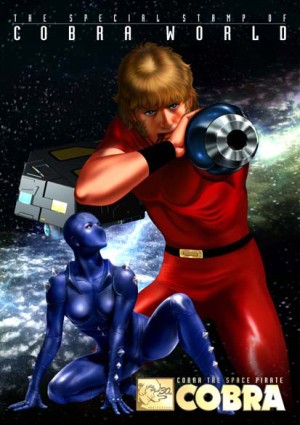
The closest artist I can think of which combines all of these elements is probably Terasawa (Space Adventure Cobra), but I get the impression that not very many artists on Deviantart take their inspiration from Terasawa.

Artist: Terasawa Buichi

But this is all speculation on my part. What do you think of the Deviantart style? Like it? Hate it? Do you use it? If so, what are you influences?

I just want to figure out how it came to be.

Enter Animefan

A couple of days ago I made a post discussing the way in which the purchase of anime-related goods often transcends the purchase of anime itself. I didn’t concentrate much on the act of buying anime, and was planning a follow-up post, but Omo over at Omonomono beat me to the punch. He brings up some good points that I want to touch upon while also elaborating on this whole idea of what it means to “buy anime.”

First, a story.

I once told someone that I pretty much only buy DVDs of things with which I’m already familiar, to which he simply responded, “Why would you buy something you’ve already seen?”

Whereas I saw my ownership of DVDs as a testament of sorts to the shows I felt were good and enjoyable enough for me to have them in my collection, the other person saw DVDs simply as a way to try new things out. In the end, we agreed to disagree.

While this person was not what you’d call a hardcore fan of any kind of media, I think his philosophy applies to a lot of how anime fandom sees anime: Why spend money to see something that isn’t new to you?

Omo hit upon a simple, yet profound idea: the act of purchasing DVDs is “meta.” Anime fans generally love anime because it presents a world to them with a story and characters to whom they can relate or from which they can derive some kind of enjoyment or escapism. They become fans of the anime, but not necessarily fans of the anime as a creative work. If most anime fans find some way of watching their favorite anime for free, and they subscribe to the idea of not paying for shows already viewed, then it is difficult to see why they would purchase a DVD of it, as that would require them seeing their favorite show not necessarily as a window into another world, but as an endeavor born out of the thoughts and efforts of its creators. In other words, on some level, they would have to appreciate their favorite anime as a work of art, which I have to ask, how often does that happen with entertainment in general, let alone anime?

Are anime fans actually less likely to appreciate their favorite shows as works of art? I believe so, and I use anime conventions as an example. When it comes to anime convention guests, the people who get by far the biggest crowds are the voice actors. On the one hand this tells us that a lot of fans can at least see past the character the actor portrays to the individual performer, but on the other hand the voice of a character is directly a part of the show itself. The influence a producer or a director or even a writer has upon a work is less readily noticeable by someone viewing a show, and as such these guests tend to get fewer sheer numbers. Is this any more or less than the audiences who see actors over directors for live-action movies? I don’t think so, but I wanted to show that as far as anime is concerned, this is the kind of thing that happens.

My words bring up another potential conflict: is there something bad about being one of those fans who sees anime purely as a window into another world? My answer is that I do not find anything necessarily wrong with not engaging one’s favorite shows on that “meta” level. Nor is seeing the strings necessarily a good thing; it’s pretty much all subjective in the end. Actually, if you want to see a good example of a fandom which balances the meta with the immersive, then look no further than professional wrestling.

In pro wrestling, there traditionally have been two terms used to describe people who enjoy it: marks and smarts. Marks are people who believe wrestling is 100% real, that the Hulk Hogan in the ring is actually who he’s supposed to be. They see pro wrestling as a venue for good to defeat evil, or at least for bad-good to defeat namby-pamby-evil. Smarts on the other hand are fans who know that wrestling is all staged. They know that there are writers and scripts and politics behind the facade of Nothern Light Suplexes and Shining Wizards, and having a keen understanding of the backstage actions is where they derive their enjoyment.

But those are the two extremes, and in this age where the cat is completely out of the bag about wrestling being “sports entertainment,” there arises a new category of fan: the “smart mark,” otherwise known as the “smark.” Like smarts, they seek the truth of what goes on with the wrestlers as actors, but are also eager to suspend their disbelief just long enough for them to cheer for the good guys and boo the bad guys.

So who is the “better” fan? Is it the mark for his genuine immersion, or is it the smart who appreciates the performance?  Or is it the smark who tries to combine both worlds, arguably at the expense of either side?

And how do you get all of them to buy your stuff to keep you afloat?

The Soul of Doujinshi: Why I Like the Comic Party Anime

As more and more dating sims and visual novels have gotten adapted into anime, the question of what makes a good adaptation frequently comes up. When I’m asked this, the title I most often mention is Comic Party.

I’m going to get into specific story details to express the strengths of Comic Party, so I’m going to be spoiling a good deal. Also, I have never played the original game, so while I am aware that a number of differences between the source and the adaptation exist, I do not know to what extent, aside from the very fact that the main characters seem to have been de-aged from college to high school.

Based on the dating sim by To Heart creators Leaf/Aqua Plus, the first Comic Party anime is not that different from a number of similar titles. A single guy finds himself surrounded by a variety of girls, including one childhood friend, one bespectacled jokester, one quiet girl, and so on, only this time the guy is a fledgling doujin creator and the girls are fellow doujin artists, cosplayers, and otaku. But what sets apart Comic Party from other dating sim adaptations is its approach to that single guy, that protagonist around whom the story revolves.

Kazuki, amateur artist, is introduced to the world of doujinshi by his enthusiastic otaku friend, Taichi. Although a rocky start, Kazuki ends up being inspired by a number of other doujin artists and eventually creates his very first doujinshi. A square-jawed violent tale of gangs and guns called “Not Hundred,” Kazuki’s isn’t exactly a crowd pleaser, but still manages to sell a few.

The joy of having his own artistic work purchased and read by others gives Kazuki a new determination. For his second attempt, he would do some serious research, learning what people wanted in doujinshi and how he could best incorporate all of it into a single work. Full color, twice the size (and price) of his first doujinshi, and featuring a big-breasted giant robot pilot as its main character, Kazuki was confident that his follow-up would be a smash hit, but failed to realize that in his attempt to make a big seller, his work lost its soul in a way that was recognizable to anyone who picked it up.

Feeling dejected, Kazuki abandons the world of doujinshi. However, with the help of the friends he made along the way, Kazuki is able to regain inspiration and draw again. Though his third work is rougher than the last two, even being made by xeroxing copies at the local convenience store, it is clear that his enthusiasm and spirit are stronger than ever. Kazuki learns what it means to be an artist of doujinshi.

Kazuki’s character is remarkable, particularly when you compare him to other dating sim heroes, where most protagonists of these adaptations are primarily viewer surrogates who act as guardian angels of sorts to help solve the problems of the girls around them. While this exists to some extent in Kazuki, what’s more important is that Kazuki has a significant character arc. He finds a goal, grows, falters, and recovers, and comes out of it a better person. I know that dating sim anime are not exactly where people look for anything more than wish fulfillment, but I was glad to have gotten an actual story and a much more active main character. This is also exactly the reason why I dislike Comic Party Revolution, as the anime went from being a tale of artists to just a nudge and a wink to the existing fans and an excuse to see all of the characters together.

Comic Party was also the first anime which introduced me to the concept of doujinshi (incidentally, also the concept of moe). It told me that doujinshi were comics created by fans for fans to celebrate the joy and love that comes with being a creator who sees himself not above his readers but as a peer. It wasn’t about money, it was about loving anime. And while I know that there are many doujin artists out there who do manage to work for profit, that doesn’t tarnish the ideal Comic Party presents.

Left-Handed Basis for Purchase of Anime Goods

For many anime companies in the US, the million dollar question is, “Why are so many fans willing to spend so much money on anime-related merchandise but not anime itself?”

One avenue of thought says that because a lot of people download these shows or obtain them for free and do so for so long, a lot of them simply take having free shows for granted. Figures and posters and such, however, cannot be obtained for no money. But I think this is looking at things on too narrow a level. I believe there’s something that manifests itself in different ways according to different types of fans, from moe fans to Naruto devotees to mech heads.

I think there’s a strong desire to get closer to the characters and the world of the anime, beyond what an anime shows. Even if it’s not real, we want to get as close to real as possible. By buying that left-handed bass, a person can feel like they have a bond with Akiyama Mio. By buying that Temari fanart at a convention, a person can affirm their fondness for the sand kunoichi, and in a much more direct and efficient way than simply buying the Naruto anime (which as a whole has like, 2% Temari content tops). By buying that Master Grade Qubeley MK II, a person can bring the fantastic realism of a mobile suit into the actual reality of their home, with the tactile nature of model kit building also contributing.

For the most part, anime fans definitely enjoy the anime they watch, but the anime itself remains in its own world behind the TV screen or computer monitor. Fans want to pull that world past the 4th wall and engage it more directly. But it’s impossible to make the world of anime our own, so the best we can do is buy tangible products that let us get as close as possible.

Otakumonogatari

Today it occurred to me that there is more to Bakemonogatari than what’s on the surface. No, I’m not talking about the occult subject matter or the Nisio Isin writing which can give even Japanese people pause, or even that Shinbo touch that the director puts into most of his works. Instead, what I’m referring to is the way Bakemonogatari treats otaku, or more broadly, anime and manga fans.

Now I want to ask, who in Bakemonogatari is an anime fan? The answer is no one and everyone. In this story, everyone is able to just mention obscure manga titles and make equally esoteric references with the assumption that somebody else out there will get them, almost like how everyone in Beyblade knows about tops.

Within the confines of its own story, Bakemonogatari normalizes the otaku, something that is exceedingly rare. In titles about otaku such as Genshiken and Mousou Shoujo Otakukei, the otaku is still seen as something special or at least different. Other works take aspects of reality and soften them through layers of otaku filters. Bakemonogatari on the other hand assumes otaku to be the starting point and moves the story forward from there, adding in all of those supernatural elements.

It’s kind of like how superhero comics are traditionally a power fantasy, taking the real world and making it a little more fantastic, but titles like Watchmen take the fantasy and inject reality back in. Not that I’m comparing Alan Moore to Nisio Isin, mind you.

How Diabolical!

I think there’s more to the manga and anime series Zettai Karen Children than meets the eye, possibly some kind of elaborate conspiracy taking place over a period of years.

The series is about 3 young psychic girls defending the world alongside their adult caretaker (not pictured) Looking at the character designs, I think it’s undeniable that there is at least some lolicon appeal to these characters and that the creators are well aware of this element.

However, Zettai Karen Children does not run in some otaku-pandering magazine. It’s not like it’s from Comic High or Champion Red Ichigo or even Dengeki Daioh. ZKC runs in Shounen Sunday, the home of Detective Conan, Kekkaishi, Touch!, and Inuyasha. It’s meant to appeal to young boys first and foremost, though in a way different from Shounen Jump‘s more well-known approach of commercialized battling and the like.

Shounen Sunday has a well-established track record of introducing female characters who are on equal footing with their male counterparts with the goal of introducing the concept of males and females being equal to one another to children at an early age. There’s Ran in Detective Conan, Tokine in Kekkaishi, Minami in Touch!, and Kagome in Inuyasha. Having the main characters be the girls in ZKC means that the strength of females is readily apparent.

I have trouble thinking that Shounen Sunday would just let a series with lolicon elements run in its pages without some kind of ulterior motive to change or influence people, to just let it run to attract that older otaku audience.

As Zettai Karen Children has continued, the titular girls have aged. As of now, they are junior high age and their bodies have clearly matured. First, this implies that the progression of time is desired in the series, and second, that the girls are gradually moving away from being designed to have that very, very youthful appeal.

What I think they’re actually doing is an attempt to slowly create an  attraction to adult women in a group that might normally reject it otherwise. It’s using the power of the 2D complex to seize the hearts of otaku early on and then gradually wean them off of lolicon.

That’s Shounen Sunday, thinking long-term.

What Do You Mean Not All Anime Involve Philosophical Discussions?

When it comes to anime and manga academia, I commonly see two mistakes.

First is when an unusual work that is elevated by critics and scholars as being artistically significant is considered indicative of other works in anime and manga. Oshii Mamoru’s Ghost in the Shell movies are the most frequently misused in this respect, and while I do like Oshii’s work (including his recent film The Sky Crawlers), he’s pretty much considered an anomaly. And even though he’s much more celebrated and popular, I think Miyazaki is the same way; his works are almost a universe unto themselves when it comes to the Japanese animation industry. If you’re going to analyze the nature and life of the Japanese animation industry, do you look at the rare exception or do you look at the more common works, the middle-of-the-road stuff? I’m not saying you should enjoy crap, of course. However, I think that while the former can give you a good idea of what anime can do, the latter gives you a far clearer image of where anime is.

The second is sort of a mirror image of the first problem. Here, run-of-the-mill works with little to say creatively are considered shining examples of artistic brilliance. Shows that served little purpose outside of making some money and are quickly forgotten due to mediocrity are carted about and displayed as if they were seminal works in the history of anime. For example, Seitokai no Ichizon might be presented as a brilliant portrayal of the difficulties in gender relations in education among students in Japan, when it’s more just a show designed to appeal to otaku and has some entertainment value.

But wait, you might be thinking, “How dare you tell us what’s significant and what’s not! You’re not the boss of us!” But I’m not saying that at all. Ghost in the Shell can say a lot of things about the anime industry. The only thing is that because GitS is an exception, you should probably study it as an exception. And I do think Seitokai no Ichizon‘s story is worth analysis to some extent, but you have to be aware of its origins as a light novel, as well as the otaku subculture it’s trying to appeal to, before you really try to present its ideas as indicative of anything at all.

While I do believe in personal interpretations quite a bit, postmodernism can be a terribly dangerous weapon.

Box vs Sphere: What is a Well-Developed Character?

What is a one-dimensional character? What is a well-developed character? And how is it that two people viewing the same exact anime can reach entirely different judgments on whether or not its characters feel “real” or not? Those are the questions that have most recently been on my mind.

It makes me ponder the differences in the way people perceive the world and the people around them, as well as how those perceptions are then translated into the world of fiction. What do some people prioritize in their concept and understanding of a “three-dimensional personality” that runs so counter to the opinions and values of others?

Personally speaking, I find characters to be particularly well-developed in personality when I can sense that there is something more to them than what they are saying. It’s not like I want characters who are saying one thing and thinking another, however. It’s more about showing or at least hinting at a thought process behind those words. Genshiken, Eureka Seven, and Toradora! for example are particularly good at this, in that you can see the transmission from personal desire to choice of words getting filtered through the characters’ own personalities and values. But then I know there are plenty of people out there who dislike these series while accusing the shows of the very opposite of why I praise them. So again, what causes this conflict?

Many times when a character is seen as “artificially deep,” the accusation leveled at them is that they are simply there to fulfill a checklist. This isn’t necessarily wrong or unwarranted, and even I’ve used the “checklist” criticism before and have no real regrets doing so, but the question then becomes, how did these checklists form and who is responsible for them? To what extent are those negative checklists generated by one’s own standards of realism and authenticity?

What is more important for a well-developed character, that they start off with an almost palpable personality that reveals a heart and mind in them, or that they grow their hearts and minds over the long term?

What is more important, what you let the audience see, or what you let the audience infer for themselves? If you keep on revealing more and more angles, is the purpose to imply a sphere, or simply a many-sided polygon?

And how much of it is tapping into the familiar vs the unfamiliar?

It’s food for thought I haven’t really digested myself yet.