Exploring Thoughts in “Lupin the Third: The Woman Called Mine Fujiko”

This post contains spoilers from Lupin the Third: The Woman Called Mine Fujiko

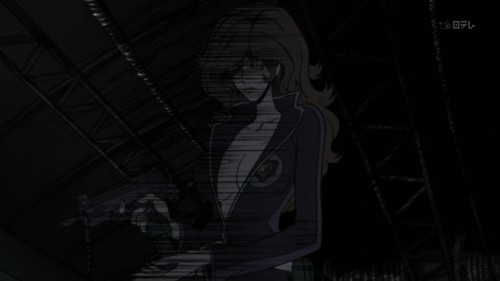
Lupin the Third: The Woman Called Mine Fujiko came and went, and I think it brought with it an intriguing sort of depth and character study that differentiates it from most anime out there.

The way in which the series explores the psychology of the character Fujiko really felt like women were in charge of this show, which they were. It had not only a female writer in Okada Mari, but also a female director in Yamamoto Sayo. I think I get this impression because while Fujiko is an unpredictable character of many mysteries, the way it’s portrayed doesn’t invoke “mysterious woman” as some kind of unsolvable rubik’s cube or distant creature like I think often happens when men write about exploring a female character’s psyche. There is less peeling back the layers and more starting from the assumption that the way thinking happens on the part of Fujiko is normal.

There’s an interesting twist which happens at the end of the series where up until that final episode we think we’re learning about Fujiko’s past and that finally we get to know what makes her tick, but it turns out that all of those memories have been falsely implanted in her. That false past shown is one of rape and sexual abuse, and it created this sense that Fujiko’s life of crime and hypersexual activity is in response to that. As I was watching, I wondered how this would transform the identity of the character of Fujiko, and even whether this extreme past would make it incompatible with the rest of the Lupin the Third franchise before it’s revealed to be false information.

If the circumstances were different, the fact that we were basically fed lies perhaps might have felt like a cop-out, but I don’t see it that way at all. By subverting it at the very end I feel like that whole train of thought, the very act of considering the consequences, became a meaningful thought exercise.

Not the X-Games: Anime Expo 2012

Anime Expo 2012 was my first Anime Expo and my first west coast convention. While I’m not one of those really thorough con veterans, I still found some interesting differences between it and the conventions I’ve been to before, both when compared to the bigger cons as well as the smaller ones. Located in Los Angeles, it uses its position to its fullest.

Industry

In a change of pace of sorts, I  somewhat foolishly attended fewer industry panels than I normally would at a convention. I say somewhat only because of the fact that, for so many of them, they largely amount to announcements (which appear within a minute on Twitter) and they have Q&A sessions which lack teeth. Sometimes you can get a good one, and I try hard to ask good questions when I can, but the more “official” it is, the less chance you’ll get a decent answer. The foolish part is the fact that I was accustomed to Otakon, where one must generally choose between autographs and panels, an only later found out that AX works on a system of giving people “skip the line” tickets for attending guest panels. Lesson learned for (hopefully) next time.

Despite those limitations, AX2012 was by far my most autograph-heavy convention experience I’ve ever had, which is a reflection of one of Anime Expo’s greatest strengths: the sheer amount of guests, particularly Japanese ones. I managed to get stuff signed by the staff from Madhouse, Animetal USA, Kajiura Yuki + FictionJunction, a limited autographed image from manga artist Toume Kei (who wasn’t attending but offered the images as part of a gallery), and probably the biggest one for me: an OVA of Legend of the Galactic Heroes signed by Horikawa Ryo, voice of Reinhard von Lohengramm. I happened to take a fantastic picture of him.

I did manage to go to a few panels as well. I went to the Animetal USA Q&A just to see that bit of spectacle (it was calmer than I had expected), and attended the panel for GoFA, or Gallery of Fantastic Art. GoFA can be described as an organization dedicated to taking anime and manga and giving it a sense of realism by creating products and opening galleries based on those works. The panelists showed off actual products such as glasses and watches based on the designs of anime and manga creators, and mentioned that artists such as Hoshino Lily (Mawaru Penguindrum character designer) and Fukumoto Nobuyuki (Kaiji, Akagi manga creator) have or will have gallery exhibitions in Japan. Apparently they’ve been a part of AX for a long time now, but this was their first time running a panel, a privilege they received because they’re actually producing a stop motion animation based on the artwork of Toume Kei (Sing Yesterday for Me). We got to see a very short preview, about which not much can be said because it lasted less than two minutes.

Another panel of interest was a manga workshop run by an actual manga artist whose name I sadly did not catch (though Peepo Choo’s Felipe Smith was helping to translate). I was unable to stay for the entire thing, but what I saw focused a good deal on anatomy, working from the idea that a solid foundation in realism is needed in order to deviate from it. While I don’t entirely agree with that assessment, I think it is nevertheless an excellent skill to foster and definitely a legitimate way to begin to create art and comics. I do wish that manga workshop panels and the like could move more towards paneling and page layout, but I get the feeling that character design is much more immediate has much more impact for the vast majority of people.

Concerts

I went to all three of the concerts—Animetal USA, FictionJunction, and LiSA—in some capacity, though could only stay for a small portion of the FictionJunction concert due to some scheduling conflicts (more on that later). Animetal USA had by far the smallest crowd, but an enthusiastic one nonetheless, and it was great to hear their take on classic anime songs from shows like Gatchaman, Mazinger Z, and Saint Seiya. I’ll admit, I’m not a fan of heavy metal (though that’s not to say I don’t enjoy it), but I’m glad I went. Later at their signing, the most impressive thing was that there was a real Animetal USA cosplayer, a girl dressed as guitarist “Speed-King” (aka Chris Impellitteri). What little I heard of FictionJunction was definitely excellent. I definitely wish I could’ve seen it all.

The LiSA concert is one of the highlights of AX2012 for me, because I went in only knowing her as the singer of the Fate/Zero opening but not particularly interested, and came out of it as a fan. Not only were all of her songs really good, but her practically-headbanging enthusiasm just filled the concert venue. Impressively, she managed to do the emceeing for her own concert almost entirely in English. I’m not sure how much of it was from actual fluency and how much was practiced and scripted, but she pulled it off regardless. She gave us the benefit of singing the opening to a new summer anime (that wasn’t even out yet), Sword Art Online, and the concert actually made me want to check it out despite only having a passing interest in it prior.

Non-Industry Panels

If AX’s main strength is its industry presence, its main weakness is a lack of interesting fan panels. While fan panels can always vary in quality, they tend to follow along the same basic goals of bringing fans together in order to share in a topic or to convey new ways of seeing the things we love, hat’s not to say that the fan panels at AX weren’t or couldn’t be interesting, but that the sheer amount of “official” panels somewhat limited the overall presence of fan panels. On top of that, many were workshops or something similar, but personally speaking I generally don’t go to conventions for workshops.

I attended the Bloggers and Podcasters Town Hall, not knowing quite what to expect, especially given the use of the term “Town Hall,” but it ended up actually being fairly accurate. Moderated by the Benjamin “Benu” Lopez of the long-running Anime Genesis podcast, the audience (including myself) discussed various topics, including the move to include blogging into a podcast and vice versa, as well as ways to break up the factionalism and cliques which often appear around groups of bloggers/podcasters. It was a fruitful discussion, and I got to meet a number of people I’d only read/heard previously, though I do kind of wish that we didn’t just talk about reaching out but also ways to refine and improve our existing work. As I said at the panel, I do believe that content is king.

Given that I’ve been a part of academia for a while now, I went with the purpose of attending as many of the academic panels as I could. At times, this caused conflict as I had to sacrifice seeing a certain guest in order to see what other researchers were working on, but I think it was well worth it. Even though other events clearly overshadowed the attendance of the academic track, there was something distinctly different about having it as part of a general convention instead of simply being a stand-alone academic conference. Mainly, I felt like presenters had prepared for a mix of academic and non-academic audiences, and it made the presentations a little more fun than what would normally happen.

The highlights of the academic track were the keynote address, where Professor Jeffrey Dym of UC Sacramento discussed his “History of Manga” class, and the “We Make Manga” panel run by Northrop Davis of the University of South Carolina. In both cases, the speakers really knew what they were talking about, and described the challenges they faced in creating their classes, how they designed their curricula, and what sources they used as the foundations for their classes. For Dym’s panel, the things that stood out to me the most were his lament that Ishinomori Shoutarou did not have more work out in English despite his legendary status and the fact that he hesitated on including sports manga in his class because of how little of the really groundbreaking series (Star of the Giants for instance) exist in English. For Davis’s panel, it was definitely the fact that he mentioned his class as being designed to somewhat mimic the editor system used by manga publishers in Japan, especially given the degree to which endeavors such as Tokyopop’s old OEL material lacked in that very area.

I think the attendance could have been stronger if the academic panels hadn’t been added so late. The large color guide didn’t even have those panels, and it was clear that despite the giant screens showing the updated schedules that many attendees ignored it. When I presented at my own panel (which ended up overlapping with the FictionJunction concert due to a 40 minute delay, thus eliminating my chance of doing both), it was to a rather sparsely populated room, which I honestly think could have been made more lively if only people knew about it (and if the concert didn’t start and end when it did). Overall, I think I did an all right job (I did a visual analysis of the manga 7 Billion Needles), I just wish more of you could’ve attended it!

Cosplay

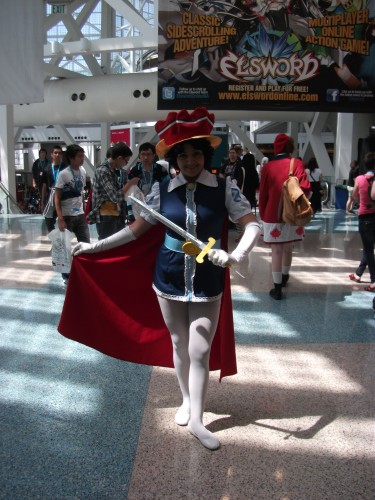
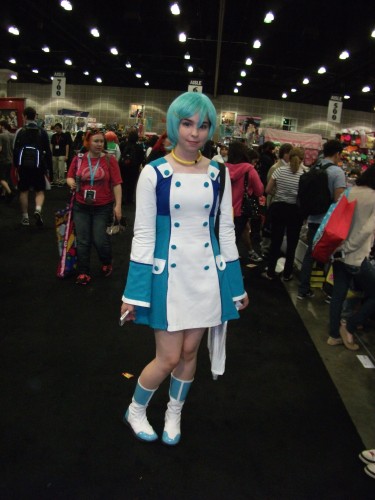
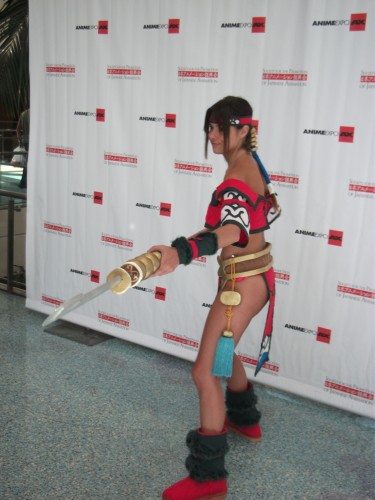
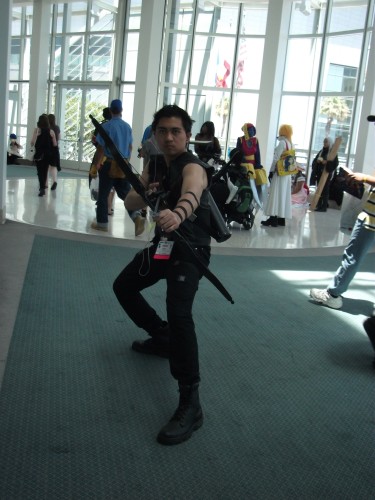
I think I’ll say it: AX2012 was possibly the best convention I’ve ever attended in terms of cosplay. Not only were many of the costumes excellent, but I don’t think I’ve ever seen so much variety. Popular cosplay topics such as Homestuck and Hetalia!, while still very present, didn’t even come close to dominating the visual landscape of the con, and cosplays I had resigned myself to possibly never seeing appeared in numbers. Whereas previously I had seen zero Dragon Kid cosplays from Tiger & Bunny, this time I saw five.

I remember being the only person to clap for Dragon Kid at Otakon 2011’s Sunrise panel, so this was a pleasant change.

In addition, I thought I’d never see a Precure cosplay at an American con, but I was gladly proven wrong. Have you watched Heartcatch yet? It’s really good.

Anyway, I’ll let the rest of the cosplay speak for itself, though keep in mind that this certainly isn’t an accurate representation of all of the cosplay at AX2012, merely what I photographed.

Final Thoughts

So there went my first Anime Expo. If I had to do it over again, I probably would’ve found a better medium between panels and autographs, and I would’ve definitely tried to see more faces. Also, the Kinokuniya in LA is definitely better than the one in NYC.

GET NiGHTS iNTO DREAMS HD

If you ask me what my favorite video game ever is, my answer is unwavering and undeniable: NiGHTS into dreams… An absolute classic of the Sega Saturn, I poured countless hours into the game just enjoying everything, from the environments to the clever boss fights, from the excellent music to the crisp and ultra-smooth gameplay. No game that I’ve played, including its Wii sequel, NiGHTS: Journey of Dreams, has quite captured the movement of acrobatic flight that the original endowed upon players. I can wax nostalgic on this game until the end of the time, but I’ll cut it short by just saying that no game feels quite like it.

Now, NiGHTS is getting a downloadable HD remix. When I first saw the character models used for the kids, I immediately thought of the old blockier gameplay models. I have to wonder if they somehow took the models from the old cut scenes and used those instead, or if they’re built from scratch.

Are you part of the new generation that’s never seen a Saturn? Are you part of the old generation but just never got a chance to play it because you chose the Playstation over the Saturn (like most people ended up doing?) I think it is only in your favor to try it out. And if the HD version is somehow messed up, the game actually includes the original Saturn version as well, so no worries there.

Actually, one thing I am concerned with is the controllers themselves, as while playing the Wii NiGHTS I found the octagonal gate of the Nintendo analog sticks to compromise the smoothness of the flight needed to play a NiGHTS game properly, and it is probably because of the controller that it could not capture that feeling of acrobatic flight I mentioned at the beginning. The Saturn 3D controller’s analog control was so incredibly smooth and nice to use (though the controller itself was kind of clunky) that it makes every analog stick or equivalent since then pale in comparison.

I will have faith that the current consoles will be able to deal with it adequately for now, though I am concerned with the Windows edition. Does anyone know of a Saturn-to-USB converter for controllers?

The Incredible Kaminaga: Genshiken II, Chapter 77

In Chapter 77 of Genshiken II, we learn that while many fujoshi are strong, but Kaminaga may be Strongest of All.

The cat’s out of the bag as Kaminaga learns that Hato occasionally dresses up as her doppelganger, but as much as Ogiue downplays it as coincidence, and as much as Hato’s old classmate Konno mentions that it’s because of Hato’s crush, Kaminaga has other ideas entirely. Presented with an older brother and a younger brother who dresses up like the elder’s girlfriend (and now fiancee), Kaminaga creates the pairing of Yuu x Ken, or Hato’s older brother and himself. This is made all the more outrageous by the fact that she herself is the girlfriend.

Kaminaga throws out the tough questions pertaining to Hato’s sexuality. She brings up the possibility that he might be bisexual, and also the fact that his stance of “I’m not gay but I like yaoi” is similar to the BL trope of “I’m not gay, I just love you in particular.” As Kaminaga presses the question and asks if there’s a guy Hato knows who fits that situation, Madarame shows up, though Hato’s feelings about him are still left ambiguous. Instead, Hato mentions that everything’s fine, because he has plenty of friends, male and female, who know and accept him.

I’ve previously written about how the new Genshiken members in a way resemble Kohsaka in terms of the way they’re able to combine style with their very otaku mindsets, but I feel that, more than any other, including the attractive Angela and Ohno, that Kaminaga comes closest to the idea of a “female Kohsaka.” The ways in which she so unashamedly displays her delusions, especially to a guy she just met (Hato’s brother in the previous chapter’s flashback) and eventually turned him into a lover stands in stark contrast to the complexes that the other girls have about mixing fujoshi lifestyles with significant others. Ohno has Tanaka, but Kaminaga was able to get a decidedly non-otaku boyfriend for the long-term. When you think about Kaminaga that way, her sheer confidence and simultaneous ability to not compromise her compromised mindset is a kind of inspiration.

As we learn more and more about Hato’s past and set up his potential future, I feel that part of his purpose in the story is to “challenge.” Somewhat like how Ogiue flipped the story of Genshiken upside down, Hato really pushes the envelope in terms of assumptions about the club and how otaku behave and the like. The amount of Hato x Mada material in this chapter brings up certain questions about the nature of Genshiken II, and it reminds me of the fact that the new series is more than different enough from the original to seem somewhat alien to those who may have enjoyed the previous iteration.

I’m not referring just to Madarame’s rather confused feelings, but also the way the series has given him what in another work would have been some kind of “awesome harem” but in this case is an exercise in confusion and mixed emotions. While pining for Saki (still), he’s been growing a friendship with a very convincing crossdresser, gets kissed on the cheek by one American girl, and almost gets a full on boob grab on the other American girl.

Speaking of Sue’s “attack,” it’s a reference to Rei from Fist of the North Star.

Have I ever mentioned before how nicely Kio draws the blondes’ eyelashes in the new Genshiken? He out of his way to show only their outline instead of simply using black like he did previously, and it gives them a kind of mysterious quality. Aesthetically it’s quite pleasing, though perhaps it emphasizes their foreignness a little too much? I’m not exactly sure how I feel about it other than that I like the way it ends up looking.

Actually, when you think about Kuchiki and his accidental swipe at Risa’s chest in a previous chapter, which he did while totally unconscious from being choked out by Hato and thus unable to remember, or even the way the older Yoshitake was denied the privilege of seeing Hato come out of the shower, it seems like the series likes to mess with which characters get to have things happen on-panel. The rest of the actual sexual interaction, as we know, happens, it’s just that it’s never really shown. It’s that kind of manga.

As for Ogiue, this isn’t one of her chapters, but the mere fact that she refers to using one’s own boyfriend for yaoi source material as “normal” is rather amusing, and in its own way another sign of significant change within her. Could you have imagined the old Ogi half-admitting that she’s doing the very same thing on a regular basis, and on top of that is calling it normal?

Anyway, next time is Saki time. Watch out.

Dutch-Japanese Foods Part 1: Japanmarkt 2012

The city of Leiden has an annual outdoor market called the “Japanmarkt” (Japan Market), where people and booths gather along one of the canals of the city in order to celebrate all things Japanese. I actually went last year but forgot to bring my camera, so I made sure this year not to forget and to also actually report on the danged thing because it’s pretty cool overall.

Held this year on May 25th, Japanmarkt is not terribly different from any of the Japan-themed festivals I’ve attended back in the US, but what is very clear is that the festival reflects to some degree the unique history the Netherlands has with Japan. Back when foreigners were for the most part not allowed in Japan, it was the Dutch merchants who were the rare exception. Moreover, the first Japanologist, Philipp Franz Balthasar von Siebold, was a German living in Leiden, and his old house is now a Japanese museum on the same street as Japanmarkt. And of course, there are a good amount of Dutch anime fans mixed in there, creating this convergence of Japan-loving generations that’s different from an anime convention. That said, there were actually anime con booths there as well.

Food was a popular item, and for my part I tried two things in particular. The first was a curry (for charity!). The second was something that could only have come out of a Dutch-based celebration of Japanese culture.

If you don’t know takoyaki, they’re essentially fried chewy balls of batter stuffed with bits of octopus and covered in savory sauces, a kind of convenient comfort food (and quite delicious if I do say so myself). There was a takoyaki stand at Japanmarkt, but it had a twist, mixing the concept of takoyaki with that of “poffertjes,” tiny pancake-like snacks typically served with powdered sugar.

These “takoyaki poffertjes” were something I felt I could never get elsewhere, their uniqueness compelling me to try them out. I can’t complain.

At one of the tables which was selling manga, I overheard a girl helping her friend out by finding volumes of My Girlfriend is a Geek (Fujoshi Kanojo). I don’t often see people interested in those otaku/fujoshi romance manga, especially ones giving lists to their friends to hunt down those books wherever possible, so that put a bit of a smile on my face.

Gattai Girls 1: Gowapper 5 Godam and Misaki Youko

Introduction: “Gattai Girls” is a series of posts dedicated to looking at giant robot anime featuring prominent female characters due to their relative rarity within that genre.

Here, “prominent” is primarily defined by two traits. First, the female character has to be either a main character (as opposed to a sidekick or support character), or she has to be in a role which distinguishes her. Second, the female character has to actually pilot a giant robot, preferrably the main giant robot of the series she’s in.

For example, Aim for the Top! would qualify because of Noriko (main character, pilots the most important mecha of her show), while Vision of Escaflowne would not, because Hitomi does not engage in any combat despite being a main character, nor would Full Metal Panic! because the most prominent robot pilot, Melissa Mao, is not prominent enough.

Between its generic Monster of the Week stories, basic “defend the world from evil” plot, and its overtly toy-oriented design, the 1976 anime Gowapper 5 Godam by Tatsunoko Pro is a largely bland and mediocre giant robot series. Following the “Gowapper 5,” a team of five kids whose purpose is to “go on adventures” (really) and who discover a giant robot, even the normal saving grace of such a show, the giant robot itself, is lacking.

Though one can ignore the Rudolph nose, the titular robot is so blocky and aesthetically awkward that even the animators for the show who are otherwise skilled at producing action scenes cannot make Godam look impressive. Despite a handful of fairly impressive episodes which manage some good bits of characterization or interesting moral dilemmas, overall Gowapper 5 Godam would be even more forgotten than it already is if not for two reasons.

First, the character designs were by Amano Yoshitaka of Final Fantasy fame, who worked on many other Tatsunoko anime as well.

Second, it is the first ever giant robot anime to feature a prominent female character in a leadership position.

Misaki Youko transcends the “token female character” position in a number of ways. In addition to being the unmistakable leader of the Gowapper 5 (she wears the red uniform and her teammates consistently refer to her as such), she is clever, courageous, cool under pressure, a highly-skilled fighter (possibly the most skilled of the five), always dresses sensibly, and, perhaps most amazingly of all, never actually gets kidnapped or put in damsel-in-distress situations. She shows strong leadership even in moments of weakness, at one point willing to relinquish her position for what she feels is her own error in judgment, and is able to pilot Godam effectively and deal the finishing blow on multiple occasions to the enemy. Even today, such a character is a rare exception in the mecha genre (especially when you exclude those shows where all of the pilots are female), let alone in 1976.

However, while Youko as a character remains extremely capable, she is hurt by the fact that the show itself can never actually decide if Youko is its main character or not. Even the opening flip flops between emphasizing her as the most important character and focusing on the blue second-in-command, Gou.

Looking at who is most prominent when piloting Godam itself, a method which would work with just about any other giant robot show, doesn’t really apply here. While Godam is the centerpiece of the series, usually the Gowapper 5 go out and fight hand to hand or in their personal vehicles, leaving whoever is left behind to pilot the robot, whether that’s Youko or Gou or one of their three comically misshapen teammates. Much later in the series when they start to regularly pilot it all at once, Gou sits in the center chair, but then other times Youko acts like the main character, even being the one to directly defeat a major villain.

Because of the way that Youko receives fewer and fewer episodes devoted to her as the show goes on, I get the feeling that the makers of Gowapper 5 Godam originally wanted her to be the undisputed protagonist (with Gou as deuteragonist), but something had to make them backpedal, possibly as early as when they were making the opening. The fact that Gou, the character who has more of the look you’d expect from a giant robot hero, overall gets the most episodes dedicated to him (followed by the youngest character, Norisuke) makes me think that they determined that a female as the central character of the show was hurting their sales and that they had to do something about it. Moreover, the odd 36-episode length of Gowapper 5 Godam and the number of sudden introductions of new merchandise into the series in the last 1/3 of the show hints at a possibly troubled production or low toy sales which they would have to try and overturn. At the same time, the fact that Youko continues to be prominent even at the very end might imply that this was an on-going conflict throughout the show’s production.

As the first true female leader in a giant robot anime, Misaki Youko is in many ways a pioneering character. She is well ahead of her time to the extent that she may have been too much for the very anime she comes from. In that respect, she perhaps not only the patron saint of female protagonists in mecha, but also the patron saint of characters who transcend the quality of their own anime.

Amazing Fantasy: Genshiken II, Chapter 76

If last chapter was crazy, this one is downright mental.Genshiken II, Chapter 76 is the origin of one Hato Kenjirou, and what an origin it turns out to be.

After the truth of Hato’s identity is revealed by his former senpai and doppelganger Kaminaga, Hato tells everyone the story of his high school trauma. As has been previously revealed, Hato was in his high school’s art club, which was populated by fujoshi. Though a fan of BL himself at that point he denied any interest, until one day he found himself alone in the art club with Kaminaga’s doujinshi lying there.

Taking it to the bathroom so as to avoid anyone walking in on him reading, his classmate Konno found out about it and completely misinterprets the “reading it in the bathroom” aspect in a way that probably most people would. Konno told her fellow club members, who spread the rumor through the school and Hato became “that homo.” To rub more salt in, upon graduation Kaminaga, who Hato seem to have had a crush on, ends up dating Hato’s older brother, Yuuichirou.

And it looks like there’s going to be more next chapter! Not quite a flashback perhaps, but something.

Honestly, I am completely surprised they revealed Hato’s background so soon into the run of the new Genshiken. While it probably makes sense given that it’s been something like 19 chapters at this point, I always thought they would save something like that for a much later period. Thankfully the origin of Hato is a solid one. It’s the degree of trauma that would most certainly make life miserable for Hato, but not so miserable that he would end up like Ogiue, who had to deal with suicide and deep self-loathing.

Hato’s backstory is also fortunately supported by some really interesting characters. Truth be told, I was just a tiny bit concerned as to how Hato’s old classmates might turn out story-wise, but I’ve turned out pretty impressed. Kaminaga for one seems like a character with many layers to her. If there’s one word I would use to describe her, it’s perceptive.

Throughout this chapter, whether it’s pulling off Hato’s wig as he tries to throw off the girls by pretending to be someone else, or when she brings up the fact that Kuchiki mistook her for Hato “for some reason,” or even in the extended flashback, Kaminaga shows herself to be really smart and observant in a way that might even exceed Kasukabe. Probably the character most similar to her in Genshiken would be Yabusaki’s friend Katou. On top of the fact that she could talk so candidly with Hato’s brother about yaoi (in spite of the fact that Yuuichirou had zero knowledge about it) and then start dating him on top of that shows a new kind of fearlessness.

As great as Kaminaga turns out to be, however, I think Konno might actually be my favorite character of the new cast, and not just for her saucer eyes, though I find them to be hilarious. It’s quite clear that Konno had a crush on Hato all through high school and did not truly mean to make Hato’s life more difficult by spreading rumors. I think that Konno just had to confide in someone in order to deal with this problem, and I can imagine that Konno felt inferior to Kaminaga in both looks and talent, and to have the boy she likes have only eyes for her must have felt bittersweet. Moreover, the scene at the very end of the chapter where Konno now believes that she’s responsible for turning Hato into a full-on crossdressing homosexual makes you want to tell her everything will be okay.

Poor girl.

The biggest mystery that still remains is just why Hato dresses like Kaminaga most of the time, and while a less savory answer would have something to do with how she started going out out with his brother, I’m more inclined to believe that it’s because Hato, in transforming himself into the perfect fujoshi, saw Kaminaga as the ideal basis. With all of the positive attributes mentioned above, which includes physical appearance as well, it makes sense. The fact that Hato probably had feelings for her really puts an additional twist on the whole matter, but I’m inclined to believe that it still all relates to Kaminaga as the ideal girl (of sorts).

Another thing to consider is the fact that this chapter reveals that Hato can draw well, like when he copies from a still life. Perhaps Hato, who believes he can only imitate Kaminaga’s drawing style, might have more of an issue with trusting his own imagination?

So, not a ton of analysis compared to what I normally do this time around, but I am definitely looking forward to seeing what happens.

By the way, Genshiken Volume 12 goes on sale in Japan on June 22nd. There don’t seem to be any special editions, so I’m grateful I won’t be spending as much on it as I have the last two volumes.

Blaaaazin’: Anime 2012

This past weekend was my second time attending the unambiguously named “Anime Con” over in Almelo, the Netherlands, only unlike last year I managed to go for more than one day. Truth be told, I had originally planned on skipping out this year for various reasons, but when I saw the guest list it seemed like a must. Not only was anime and manga scholar with a particular fondness for Tezuka Helen McCarthy attending, but there was Initial D opening/ending band m.o.v.e. as well. Another prominent guest was Dutch comics artist Martin Lodewijk, but I was not able to see him because he was only able to attend on Friday (which I skipped out on).

Located near the German border, the train ride to Almelo for me altogether took about two and a half hours, something I felt I should have remembered from the last time I did it, but somehow seemed strangely new. I was unable to procure a hotel at or near the venue, but taking the train back and forth ended up costing less money (and even less than a similar trip by Amtrak back in the US), and it gave me a lot of time back and forth to read manga and even to draw, which I hadn’t done in a long time. So, even aside from the actual convention itself, fun was had. Also quite fortunate was that the weather in Almelo was excellent, and if I hadn’t had to pass through wind and rain to get there I would’ve thought it to have been a waste to wear a jacket.

Before I get into the con itself, I do want to note that there are some interesting parts of the event which didn’t change too much from last year like the game room and the maid cafe, so I’ll refer you again to last year’s report.

Panels

Now I am the type of con-goer who loves to attend panels, and it was very clear to me that Anime Con this year had made a concerted effort to insert more panels into its programming. There were humorous panels, quiz shows, and a number of informative ones, including a Vocaloid panel. Not being terribly interested in Vocaloid myself normally, I walked in on it half an hour after it had begun in order to be around for the next panel, only to realize that in my ignorance I had missed out on what may have been the best Vocaloid panel ever.

Normally, Vocaloid panels seem to be more celebrations of Hatsune Miku and friends, but this panel was actually run by motsu, the rapper from m.o.v.e. Known for such sage wisdom as “I got no impression/ This town made by the imitation/ Wanting your sensation/ In this silly simulation/ I wanna rage my dream,” from the little I caught of it, the whole hour was a little bit of history about Vocaloid and a lot about how it works as a music-making program and its limitations, like how Vocaloids are bad at that double-consonant often found in Japanese, the “kk” in Tekkaman for instance. The band has somewhat close ties to the program, as not only was his fellow bandmate yuri was made into the celebrity Vocaloid “Lily,” but the guy as an active musician uses the program himself, even posting on Nico Nico Douga under the name “Nicormy.”

We learned that motsu likes to use the Gackt-based Vocaloid “Gackpoid,” and that there was originally some trouble with Vocaloid Lily because of yuri’s relatively deeper voice and how the program is better-suited for high-pitched tones a la Hatsune Miku. He also gave some tips for working around the program’s limits, like using the hi-hat (the cymbal?) from a drum machine in order to simulate a “ssst” sound, another weakpoint for Vocaloids, or using a “bend down” to improve the sound of Vocaloid rapping. Even though I don’t know music and had to look up some of these terms after, I really regret not being in there earlier.

Right after the Vocaloid panel was Helen McCarthy’s talk on “kawaii” and its origins, tracing it back more generally to a biological human tendency to want to protect doe-eyed creatures be they babies or kittens, as well as more directly how the styles we associate with Japanese cuteness were the result of an intermingling between Japanese and Western cultures. For instance, Helen pointed towards Betty Boop as an influence on kawaii, a mix of cute and sexy and facial proportions which resemble a traditional idea of attractveness in Japan, and talked about the French artist Peynet, whose romantic drawings of Parisian life still persist today.

Of particular note for me was her brief discussion of the artist Macoto Takahashi, whose “Makoto Eyes” (see above) would clearly become an influence on 60s and 70s shoujo manga. In fact, I had to ask Helen about the clear lineage into shoujo, and what might have caused a decline in those types of sparkling eyes, to which she replied that it likely has to do with how the painstaking detail of Makoto Eyes, which can take hours to draw precisely, conflicts with the hectic work schedule of a manga artist.

The last panel I attended was “The Future of Comics is Manga.” Held on the last day of the convention, it drew what I felt was a surprisingly large crowd based on my experience with American conventions, and I have to wonder if there are actually proportionately more anime con attendees interested in industry and creator discussions compared in Dutch conventions. On the panel were Helen McCarthy, Japanese manga and video game pixel artist curently living in the Netherlands Aoki Noriko, writer for the Dutch anime magazine Aniway Rik Spanjers, and Dutch comics writer Sytse Algera. The discussion went to various places, from how it’s faulty to say that comics never appealed to adults around the world and that it’s more an issue of the comics industry not being able to hold onto those readers to the comparatively low salary that most manga artists make, which has to be tempered by an actual passion and enthusiasm for creating comics.

Somewhat unfortunately, the Q&A session turned into primarily a discussion of piracy and copyright, from downloads to doujinshi to everything in between. While I felt that it was in certain ways a fruitful discussion, and everyone agreed that creators cooperating with fans had definite benefits, it also pushed aside all other potential questions. Moreover, a lot of the discussion had to do with artists feeling that they’re being slighted by downloads, and I feel that when you have a panel comprised of mostly artists and creators it skews the discussion in a certain direction, just as a panel of mostly editors might, or a panel of mostly fanfiction writers. All in all, though, it was quite informative.

The Concert

While I’m aware of the fact that m.o.v.e. has performed at at least one anime convention in the US, given my current living situation and the sheer size of the United States it was actually easier for me to go to Anime 2012 to see them than if I were still back in the US and they had visited another state.

Last year I had attended a portion of the Aural Vampire concert, but had to leave early. This year I decided to stay for the full thing, which almost didn’t happen because the concert started 45 minutes late. In spite of not getting home until 1am as a result, it was still really great, with m.o.v.e. playing up the crowd and throwing in their Initial D songs alongside some of their non-anime-related work.

I am no regular concert attendee, so I can’t say if this is anything truly special or not, but I was pretty amazed that the singer yuri actually sounds better live than she does in official recordings. I don’t have the proper musical vocabulary to describe what I mean, but she actually comes off as more powerful on-stage than in music videos. motsu meanwhile rapped up a storm, and in some ways it’s even more special to hear live than yuri’s strong vocals.

There were also some technical difficulties with the microphones during the concert, but m.o.v.e. handled it very well with the help of a supportive crowd. When mics would stop working, the two would share one, and at one point the DJ Remo-con (who also deserves respect) passed over his personal headset to motsu so he could continue.

As might be expected, motsu actually has excellent English (he was even occasionally switching to English in the vocaloid panel prior), and was definitely not working from a script when talking to the audience. My favorite moment was probably when motsu asked if we wanted “A CAT FIGHT” or “ANOTHER KIND OF FIGHT.” Remo-con responded with a cat paw gesture. At another point, motsu also asked what kind of beat we want, giving “flamin'” as one option. Naturally, there was only one choice.

Artist’s Alley

Unlike many of the Dutch cons I’ve attended the artist’s alley this time around was somewhat separate from the dealer’s room. I’ve spoken about this many times before, but I’m still interested in the fact that most of the artists in the alley seem to prioritize making full books, either by themselves or in collaboration with others, as opposed to buttons and other trinkets (though those were still around). I have to wonder if it has anything to do with the Netherlands’ own strong tradition when it comes to publishing (it was known for having very good freedom of publishing centuries back), though that connection may be too tenuous.

An interesting element of this convention’s artist’s alley was that there was this peculiar collectible card game available, where you actually buy cards based on the amount of things you buy in the artist’s alley, which you could use to create an actual deck. I didn’t buy too much from the alley, so I couldn’t experience the game firsthand, but it was apparently the idea of the people running the Manga Kissa (manga cafe) at this convention and many others, and who actually currently have a permanent location in Utrecht.

I also got a chance to talk Aoki Noriko, the Dutch-resident Japanese artist, who is also apparently a huge fan of Saint Seiya given her personal portfolio. As we talked, she mentioned some of the difficulty going from traditional media to digital, which is a topic I’m always interested in. In the end, I bought the comic above and left with a thank you, though looking back I regret not asking her more about her work in video games, as she did sprite graphics in the 8-bit and 16-bit era.

Speaking of art, ever since Nishicon 2011 I’ve been really enjoying the idea of a drawing room at conventions, a place which provides free paper and drawing tools so that people can go nuts. Like at Nishicon, the room was run by “Mangaschool,” the group which also ran various drawing tutorials and workshops throughout the convention. I feel like sometimes the best thing to do to get away from the hustle of a con while still being a part of it is to just sit down and draw, to let the mind wander through the hand. Also robots are cool.

I don’t have a proper scanner on me at the moment so while I’d like to share the drawings I made at the convention, I’m going to save it for a separate post in about a month. Look forward to it!

Storyboards

Also on display at the convention were various anime design work and storyboard pages from a wide variety of shows. I’ve included some below for your enjoyment:


Sakura contemplates revenge

Cosplay


Sadly she was not singing the Panty & Stocking opening

Overall

While I may not be the best judge of the long-term progress of “Anime Con,” I noticed many improvements compared to last year, especially in terms of varying the kinds of things that are available to do. Theaterhotel Almelo may only be able to hold 3000 people, but I certainly felt their energy as fans.

Saki 08th Mahjong Team

As a promoter of mahjong anime alongside my comrade-in-tiles Sub, it was inevitable that I would follow the new series, Saki: Episode of Side A (aka Achiga-hen). Taking place in the same setting as the original Saki anime and manga, the series follows another set of girls working together to take down their fellow tile slingers with yuri subtext so heavy that it might as well be called yuri supertext. Despite its origins and the many similarities between the two Saki series, however, they end up feeling quite different.

I know that this has very much to do with the fact that the manga for Episode of Side A is not drawn by the original artist, Kobayashi Ritz, but by Igurashi Aguri of Bamboo Blade. The girls in Achiga aren’t quite as exaggerated in terms of their personal attributes, which lends them more of a well-roundedness to their characters. In a certain sense, this can be seen as quite a good thing, as Achiga does come across as simply a more tasteful, somewhat more subtle form of Saki (though the yuri is decidedly less subtle), but at the same time I’ve noticed that it becomes more difficult to pick and choose favorites compared to the original series, to think of the characters as iconic extremes. As a quick and informal experiment I asked people on Twitter who their favorite Achiga characters are, and while I received a few responses here and there, it seemed like people thought they were merely okay and much preferred that original cast, and I think that says something.

If you look at the differences between the characters of Saki and Achiga just merely in terms of how they show their mahjong, the original cast of Saki just has way more characters with specific gimmicks and powers. If you look at the main crew of Saki, every single girl in Kiyosumi hassomething. Saki has her tendency towards kans. Nodoka is the pinnacle of the “digital-style” player. Yuuki has tacos and an affinity for the East Wind. Mako can access her memories of mahjong matches like a data bank. Even Hisa, who is the most normal of the bunch, still has her easy-to-summarize gimmick of “intentionally making bad waits.”

In contrast, three out of the five Achiga girls have no identifiable gimmicks. The main character Shizuno appears to just have “tenacity,” and even the Matsumi sisters’ abilities aren’t as wild as Koromo’s ability to always win off of the last tile. Taking this into consideration, I have to wonder if Achiga was set up to intentionally show the “common man,” the more down-to-Earth players.

One of the side effects of having less bombastic characters is that, because Saki primarily conveys its mahjong matches through the use of mahjong super powers, and Achiga‘s characters with their softer abilities can’t be utilized as much in that sense, it becomes harder to clearly identify the attributes that will make a character your favorite. It’s not impossible to pick one of course (Sagimori Arata the bowling girl here), but there’s not much to instantly catch your attention. This isn’t necessarily a bad thing, as I think it’s more than possible to make up for a lack of thrilling game-breaking magic, and in fact I’d probably prefer a series which places the game more in the characters’ psychological states than their special abilities (see the obvious example of Akagi), but Achiga doesn’t really add anything to make up for it in terms of the mahjong, and in fact just blazes through the games, making the yuri aspect seem that much more prominent.

I know there’s this idea that Saki is really just all about yuri, but while I think that it’s certainly a prominent aspect of the series I also think that the mahjong itself as a vehicle for simplified character expression played quite a role in attracting people to Saki as well. I don’t expect people to actually learn the rules of mahjong, and there’s nothing that says tenacity has to be less amazing as a character attribute than using a mahjong Sharingan (and probably shouldn’t be), but the degree to which the mahjong gets skipped over or rushed through in Saki: Episode of Side A sure makes it seem that way.

(But don’t get me wrong, I’m still enjoying the whole thing.)

Why I Bought a JManga Subscription

JManga, a 100% legal digital manga distribution site, is an interesting phenomenon. Good intentions mixed with a hodgepodge of titles and a bizarre pricing structure, which I can basically describe as paying the site to give you an allowance, have made it questionable as to whether or not anyone should try it out. Ultimately I decided to subscribe myself (the $10/month deal), and there are two major reasons for my decision.

The first reason is that it is now available in Europe. Up to only a few months ago, JManga as a service was restricted to the US and Canada, and so I wouldn’t have been able to use it anyway. With their roll-out into Europe, however, I wanted to at the very least support that decision. Even if I don’t get terribly many manga on there, I wanted to encourage the idea that regional restrictions for books in digital form is nonsense. Though I know that I’m only one subscriber, I also want other similar services in the future to follow suit.

The second reason is that JManga actually has a feature that I have not seen on any other manga site, legitimate or otherwise. Sure, tons of scanlation sites exist and they provide easy access to thousands of titles, but JManga actually gives you the option to switch back and forth between Japanese and English. One click of a button and the page you’re on changes into the other language. For someone like me who wants to read more manga in Japanese but might have trouble with particularly difficult phrasings or unknown vocabulary, it’s a far simpler solution than constantly running to consult good ol’ Jim Breen. It’s even more convenient than owning the physical books in two languages in certain ways, though the load time between versions can be a bit long, and the interface itself still needs some work.

I’m well aware that this utility really only helps readers with strong (but not perfect) Japanese literacy skills, people who can read a manga in Japanese for the most part, people with a good grasp of kanji, who have a firm enough understanding of the grammatical structure of the language to know what specific part of the sentence in a potentially quite liberal translation corresponds to the original, and who can spot when a joke has been localized for the English version. For beginners, it may be too much of a chore to consult the Japanese versions, and for someone who’s fully fluent or even a native speaker, there’s simply no need to switch to English at all, unless perhaps that person wants to learn English. I happen to fall in that “sweet spot” though, and in that respect I’ve found it quite useful. If you do too, then maybe it’s something worth considering.

By the way, it seems like the most popular manga on JManga are yaoi titles, yuri titles, and Soredemo Machi wa Mawatteiru. Makes sense to me.