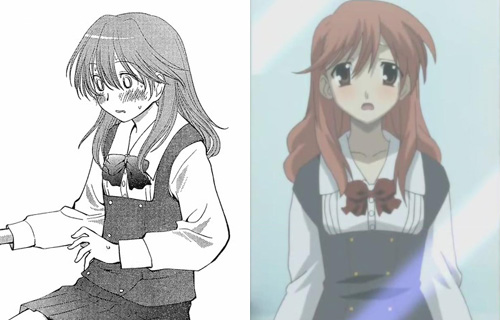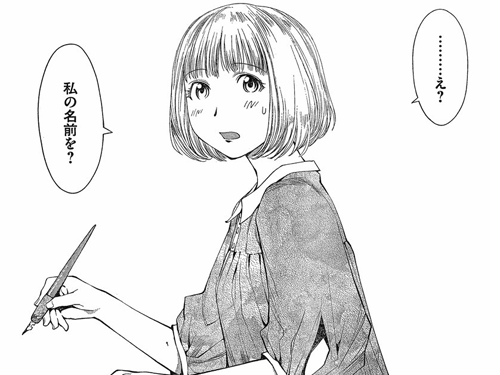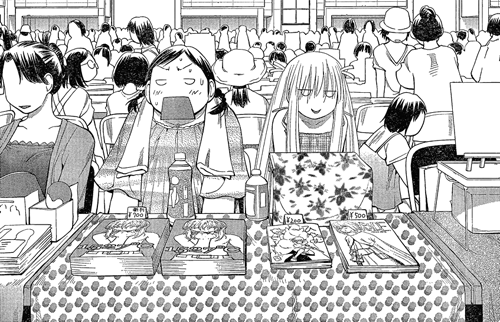
Cross Fight, Cross Fight: Genshiken II, Chapter 62

What was once fated to shine brightly for a few moments in the grand scheme of the universe now has been given new life, as Genshiken II has shed its limited-time status and has revived itself as a fully serialized title. That’s right, Genshiken is back in full force and I can only be pleased by the news. Almost as if to symbolize this new beginning for Genshiken, Chapter 62 feels almost like another introduction to the series and the madness contained therein. Let’s take a look.

As Angela returns for her third trip to Japan and Yabusaki puts the finishing touches on her Fullmetal Alchemist doujinshi, Ogiue is working frantically to complete the second half of her debut as a legit manga artist. Luckily she has the help of the current Genshiken freshman as well as Sue, but the whole situation begins to derail when Hato becomes self-conscious of the fact that his facial hair is growing in. Yajima suggests that Hato wouldn’t have this problem if he dressed like a guy, given that guys aren’t embarrassed by facial hair, but Hato has no men’s clothing with him. Fortunately(?), Ohno left everyone some cosplay outfits, but things get quickly out of hand and everyone ends up working on Ogiue’s manga while cosplaying.  Even Ogiue decides to join the “party” in an effort to take responsibility. The chapter ends with Yabusaki coming in to help Ogiue, only to lecture them for goofing off. Naturally, Ohno deeply regrets not being around for this rare occasion of cosplay goodwill.

So, this heavy chapter obviously has a ton of references, and it’s not exactly big on character development, so I think it’s a good idea to find out just who they all are. Some of them I got, some of them I needed to do some internet detective work. Here’s a list of the costumes worn by each Genshiken member.

Yajima: Yagyuu Juubee Mitsuyoshi, the rather large and voluptuous heroine of Sekiganjuu Mitsuyoshi.

Hato: Ashikaga Yuuki, the cross-dressing main character of the School Days sequel, Cross Days.

Yoshitake: Kurashita Tsukimi, the Jellyfish-obsessed protagonist of Kuragehime.

Sue: The titular character of Comic Master J, a super manga assistant.

Ogiue: Nakano Azusa, underclassman guitarist from K-ON!

The entirety of Ohno’s selection for Hato consists of crossdressing characters. Though I can’t recognize all of them, at least one of them is Maria from Mariaholic. Yajima’s outfit is arguably the most embarrassing, coming from a manga series by the character designer of badonkadonk resource Real Drive, but given Yajima’s personality that must have been the most conservative outfit of the bunch. It’s interesting that Ohno would see “overweight girl” and interpret that as “cosplay as thick ladies,” though it makes sense in retrospect. Yajima’s outfit this chapter shows that she’s actually quite busty, and much like when Ogiue first cosplayed way back when though, it kind of makes you aware of the fact that Yajima’s baggy clothes are partially the result of shame. How appropriate it is then that Yoshitake is dressed as a character with a similar dilemma.

Ogiue as Azusa of course makes it own kind of sense, especially when you factor in the fact that the girls of the light music club pushed Azusa towards the Azunyan cat motif somewhat resembles Ohno’s own constant persuasion of Ogiue into cosplay. In fact, Ohno can draw a number of parallels to K-ON!‘s Yamanaka Sawako.

Interestingly, everyone except Ogiue is dressed as a main character, despite the fact that Ogiue was pretty much the central focus of the second half of the original Genshiken. If I were to be somewhat liberal with my interpretation, I’d say that this is symbolic of the direction of Genshiken II, where the new girls are starting to establish themselves as the main stars of the new series. As I’ve said before though, I’m quite okay with this, despite my fondness for Ogiue, as it feeds into one of the themes of Genshiken, that of the continuous renewal of the club.

Looking forward, with Angela around, the chances of a Sue-centric chapter rise greatly. And in the spirit of Sue, we’ll end with a fourth-wall-breaking image.

Distance to Travel: The Borrower Arrietty

Thanks to a twitter tip by the fine folks at Tsunacon, I found out that there was a showing last week of the latest Ghibli movie, The Borrower Arrietty, at the Melkweg theater in Amsterdam. Luck would also have it that I’d come down with a cold during the same period, but I managed to power through and experience my first theatrical anime in the Netherlands, and second time in a Dutch theater overall.

The first time, I had gone to see Harry Potter and the Deathly Hallows, Part 1, and it carried the unique challenge of having the audio in a language I understand (English) with subtitles in a language I don’t know but is fairly close (Dutch). Perhaps due to my experience as an anime fan, I found my eyes gravitating towards the Dutch subtitles, and because written Dutch is so closely related to English it would occasionally interfere with my ability to understand what characters were saying, almost as if the subtitles were in English but accidentally taken from the script of Harry Potter and the Half-Blood Prince. For The Borrower Arrietty, the movie was presented with Japanese audio and Dutch subtitles, and I found it a lot easier this time to ignore the Dutch. I think it had to do with both the fact that Japanese and Dutch are quite far apart as languages, and that I had gained the experience of Deathly Hallows. Which is to say, I was able to avoid one potential distraction, and even my cold seemed to play nice. Either that, or the movie drew me in enough that I could comfortably ignore it.

The Borrower Arrietty follows a small family of Borrowers, a race of small people no taller than a ballpoint pen. Living underneath a house inhabited by normal humans, they “borrow” the tiniest amount of materials from the human world in order to fulfill their own needs. The humans meanwhile are oblivious to their existence, and the Borrowers in turn avoid all contact with humans. Arrietty is the family’s only child, a 14-year-old girl who is set to go on her very first “borrowing” with her father, but who is already quite adventurous and often wanders outside to explore. Living above them is a new resident named Sho, a young boy with a heart condition.

The world of the Borrowers is a patch-work world of human products appropriated for use by tiny people, and it is in the portrayal of this world that the movie really shines. Whereas a lesser film would constantly make obvious references to scale, Arrietty does this through a mixture of subtle visual effects and through the characters’ natural interaction with their environment, and it is the first thing that really pulled me into the movie. A hand cloth becomes a blanket, a clothespin becomes a hair clip, staples become the rungs of a ladder. When the family of Borrowers is gathering at the dinner table, they have tea which they pour out of a tiny teapot, but while the teapot is scaled down for their usage, the tea comes out not as a steady flow but as droplets which swell at the tip of the spout due to the small opening and the natural cohesiveness of water. Backpacks are held together by velcro; when viewed from the perspective of a Borrower, the fastening and unfastening feels quite alien. The world is a whimsical and dangerous frontier.

Without giving away too much, The Borrower Arrietty is about physical, social, and conceptual divides. There is the sheer size difference between human and Borrower, the purposeful separation of the two species, and even the way a length of distance for a person can seem mercilessly long to a creature 1/20 our size, or for that matter, for a boy with a weak heart. The film is also about working to bridge those divides, and the degree to which it succeeds actually depends on your own outlook on life. Arietty is as optimistic as you make it out to be.

The Borrower Arrietty is not directed by Takahata or Miyazaki or even Miyazaki’s son Goro, but by Yonebayashi Hiromasa, who has worked on Ghibli films before but is in the director’s chair for the first time. When the movie began, I wondered as to what extent Miyazaki would influence future Ghibli films of which he is no longer apart. Granted, Miyazaki still has a big hand in Arrietty, being responsible for planning and screenplay, but I still had to ask myself how much “Miyazaki-style” and “Ghibli-style” would go hand in hand as time passes. Fortunately (or not), The Borrower Arrietty made me quickly forget my own inquiry with its engrossing visuals and storytelling, and by the time it was finished I felt myself not worrying about it so much.

Vistas: Final Fantasy Advent Children & Character Camera

I’ve written a post concerning Final Fantasy: Advent Children as part of our “multi-vistas” category at the Vistas blog, where everyone on the blog takes a look at the same work and writes a response. Mine is about the character-centric visuals of Advent Children as well as some personal elements, while my colleagues have written about Advent Children as Fantasy vs. Science Fiction and the lack of discrete visibility in its action scenes and its possibilities.

Creamy Mami, All Alone

I’m a little less than halfway through 80s magical girl anime Mahou no Tenshi Creamy Mami, and though it’s fairly entertaining I haven’t really been feeling it. I’ll watch a couple episodes and then have no motivation to keep watching, unlike when I watch, say, Ojamajo Doremi where I almost have to stop myself from watching more. It’s not particularly boring or offensive or anything like that, so for a while I just wasn’t sure why Creamy Mami wasn’t quite gelling for me, but I’ve finally figured it out.

Morisawa Yuu, the girl who transforms into Creamy Mami, has no female friends around her own age.

Instead, you mostly see her interact with adults (some of whom she primarily talks to as Creamy Mami), a couple of male friends, and only rarely do you get a one-off female character the same age as Yuu. This isn’t a problem in and of itself, especially given that it is very possible for a girl to be friends with guys her own age, but in the show Yuu likes one of them, the other one likes her, and that one is the comic-relief fat kid. We never get to see Yuu interact with someone who can truly be considered her peer and equal, and I think it can be a problem, even if the show was intentionally designed that way. (Cardcaptor) Sakura has Tomoyo, Nagisa (Cure Black) has Honoka (Cure White) and her lacrosse team, and even Mitsuki (Full Moon o Sagashite), who also transforms into an older girl, can be seen interacting with her female classmates. All of them are better characters for it.

Without a female friend of the same age, Yuu kind of feels that she’s only there to transform into Creamy Mami, which she very well might be, but I think that she would have been fleshed out much better in a way that doesn’t run contrary to the overall feel of the anime if she had such a friend. I could possibly say that the show works as a somewhat minimalist anime, where only the bare essentials are needed to drive it forward, but even that could have benefited from a female friend for Yuu.

I’m a Dreamer, Moeru Power: Genshiken II, Chapter 61

The newest chapter of Genshiken II hints at the most glorious team-up in otaku manga history. However, the antics of Battlehopkins and Double Asada are only for a few panels, and the real focus is split this time around between Ogiue’s precarious deadline juggling and Hato engaging in a Hato x Mada-themed thought exercise. This month’s theme is friendship!

Before we jump into the chapter though, I want to point out the next-chapter anime references that are at the end of each chapter. We’ve seen Occult Academy, K-ON!, and Heartcatch Precure, among others. This time it’s Jewelpet Tinkle. I didn’t even know that series had an otaku following.

Ogiue discusses her professional debut with Yabusaki, who is equal parts jealous and proud of her former enemy and current doujinshi collaborator. Ogiue’s challenge, as established a few chapters back, is to finish both the manuscript for her first published manga and the doujinshi she’s planning for Comic Festival (which we now know is Fullmetal Alchemist-themed), and though she has an insanely prolific work-rate (see her previous 80-page draft which she drew in about one night), it can be a double-edged sword; as we can see at the very end of the chapter, Ogiue can get so engrossed in her imagination that it can be difficult to put her professional responsibilities above her passions. I get the feeling Sasahara knows this better than anyone, which is why their unofficial editor-artist relationship can be so volatile.

During their discussion, Ogiue and Yabusaki speak in their respective Tohoku and Kansai dialects, which is nothing short of amazing. While Yabusaki does this all of the time, it is an incredibly rare case that we get to see Ogiue use Tohoku-ben out loud instead of just thinking in it, and I believe that this is the very first instance of Ogiue speaking in her native dialect for an extended conversation outside of flashbacks. I think this is a very important indication of not only how much more comfortable Ogiue has become with herself, but the extent to which Ogiue and Yabusaki get along now, even if their faces don’t show it. Ogiue doesn’t even use her Tohoku dialect in private with Sasahara! Her Tohoku talk, combined with her newer hairstyle, in a way reminds me of Heartcatch Precure, where we get to see girls change while discovering their true selves.

At the same time as Ogiue, Sue, Yabusaki, and Asada are talking art, Hato is taking respite from the heat in Madarame’s empty and air-conditioned apartment. Here, we get to see Hato’s gender-divided fantasy in action, as Hato the guy’s thoughts run practically parallel with Hato’s thoughts as a “fujoshi,” represented by an imaginary(?), naked, and decidedly feminine Hato floating nearby. Alternately called a Stand and an 801-chan among other things, Hato’s mind inhabits this unusual territory where he scrutinizes his own natural actions and provides a field day for psychologists of fictional characters. Hato turns out to be so tired that he ends up dozing off, and by the time he wakes up Madarame is already home. A potentially awkward situation to say the least, especially given Hato’s out-of-body musings.

Just as we were able to see a current Ogiue talking in her own dialect for an extended period for the first time in Genshiken, this is also the first time that Madarame gets to see Hato sans drag, but rather than making things more uncomfortable, Madarame just treats him as one of the guys. While sharing dinner, Hato brings up the fact that he does not consider himself to be homosexual, even though he likes BL as much as he does. Anticipating Madarame to react somehow, Madarame still doesn’t seem particularly fazed by this “revelation.”

Speculating as to why Madarame is able to take such a declaration in stride, I can only think that it’s because Madarame, as an otaku, knows the significant disparity that can exist between 2-D and 3-D. Ogiue is into yaoi, but she doesn’t expect Sasahara to be into other guys even when she uses him as “inspiration” for her own doujinshi. An even better example might be Madarame himself, whose taste in the erotic can skew a little young, and yet he finds himself in love with the very mature Kasukabe Saki. For that matter, Sasahara and Ogiue sometimes skew young in their preferences as well (young Ritsuko Kubel Kettengrad and Edward Elric, respectively), so I think the whole of Genshiken understands the divide well. Still, gender and sexuality is not the easiest of topics to talk about, and you might be surprised at how the complex lines of tolerance and understanding can fall within people’s own values.

Seeing how relaxed Madarame is being around Hato despite the possibility that an outsider observer (i.e. “herself”) could interpret all of this as fertile soil for romance, Hato can’t help but see Madarame as a weak bottom because of how open he leaves himself to “attack.” For some reason though, I feel like Hato’s logic behind the “hetare uke” Madarame “character” is different from Ogiue’s. I think Ogiue’s variant has more to do with how passive he is despite his passionate otaku outbursts and the like.

Speaking of Saki, Hato accidentally becomes aware of Madarame’s unrequited love, though Madarame himself is unaware that Hato knows. Maybe Hellsing creator Hirano Kouta is right after all and Madarame really is the most moe character in the series.

Wig Party: Genshiken II, Chapter 60

In my last chapter review, I predicted an Ogiue-centric chapter while also pointing out how Hato hasn’t gotten a chapter focused on himself yet but rather seemed to get a bit of focus and characterization every chapter.  Contrary to my expectations however, this latest chapter, despite taking place mainly in Ogiue’s apartment, is actually centered around Hato. Specifically, it reveals the truth as to why he cross-dresses, peeling away some of the enigma that is Hato Kenjirou.

Ogiue has a professional manga debut coming up and in order to meet her deadline she’s recruited Yajima, Yoshitake, and Hato. Yajima, who we know likes to draw, finds herself paling in comparison to Hato not just in looks but also in artistic talent. It also turns out that Hato has been gaining a reputation outside of the club as a mysterious brown-haired knockout who only seems to show up in the afternoon, and given the potential trouble that would-be suitors of Hato could bring, Yajima has to ask Hato once more: why the dresses?

Hato explains that he had kept his fondness for yaoi a secret all through high school, because if and when he revealed his status as a fudanshi, the “rotten boy” opposite the “fujoshi,” he surely would’ve been was persecuted by his peers. So upon entering college, he began cross-dressing mainly so that he could enter a club much like Genshiken and finally be able to talk with people who share his interests.

“Persecution.” The word lingers in Yajima’s head, and it makes her feel absolutely terrible for confronting Hato. While she can’t relate to Hato in terms of choice of attire, as an otaku it’s very likely that she knows the pain of being ridiculed or tormented by one’s peers all too well. Yajima decides to not press the issue at first, but then realizes that Hato’s response was only half an answer. Everyone there now knows why Hato started to cross-dress, but given that everyone in Genshiken knows his secret and his okay with the fact that he’s a fudanshi, it’s no longer necessary. So why does Hato continue to cross-dress?

He enjoys it.

He knows he looks good in it, and it helps to fuel his own fantasies, not necessarily in the sense that the cross-dressing itself is the kink, but that donning women’s clothing can give him the right frame of mind. Through it, Hato can see the possibilities, including pairing himself with Madarame, which also puts the last scene of the previous chapter in a whole new light: were Hato’s signals real or imagined by Madarame?

One significant reveal for me in this chapter is the fact that Hato self-identifies as a man. In planning future entries for the Fujoshi Files, Hato presented a bit of a problem, namely, how much of gender is biological and how much of it is social? Gender studies is not my specialty, and even among the Genshiken characters, you could see that different characters take different approaches: Yajima talks of Hato as if he were a man, while Ohno mainly refers to Hato in the feminine. As you can see as well, I’ve mainly gone with male pronouns when referring to Hato, but I ultimately decided that it would be based on his own personal preference.

So Hato’s crossdressing isn’t entirely the product of a tormented gender identity conflict, but it’s important to avoid thinking that Hato’s crossdressing is somehow less legitimate or even wrong just because it’s a little self-indulgent. Hato has a perfectly good reason to crossdress, and the way in which Genshiken presents his situation, with both serious and more lighthearted aspects, does not and should not lessen either side. Nor should Hato and Genshiken in turn make gender portrayals that are focused more in one direction (such as Wandering Son) necessarily less poignant or entertaining.

We also learn a little bit more about another character whose life rarely gets explored, as we discover that Kuchiki is that guy in more ways than one. He’s not only the guy so lacking in social skills that they became actively antagonistic, but that he’s also able to coast by in life because of nepotism. I wonder what his parents think of him?

I think that Genshiken II has been getting better and better at establishing the New Class as characters in their own right, and I don’t really mind seeing the club veterans step aside so that they can take center stage. It takes a theme already present in the original manga, that of people entering the club and leaving when they graduate to make room for new blood, and realizes it in a much bigger way. It makes me wonder how they would fare if this was the first Genshiken series ever, and we only knew the previous characters somewhat in passing.

Next chapter looks to be again about Hato, but I’ve been deceived in the past, so I’ll hold off making any big predictions until then. Sue didn’t talk too much in this chapter, so I wonder if Kio’s saving her up for something big. The last thing I want to talk about though is Ogiue (of course), and the way that Kio Shimoku has been inserting some some nostalgic references to Ogiue past. Ogiue’s inner thoughts entertain the proposal of Hato x Mada in Ogiue’s native Tohoku dialect, and when Ohno tries to start a cosplay party at Ogiue’s place we’re greeted with a familiar sight. Perhaps we could call this “Ogiue Abridged?”

Trekked to Sliedrecht, Did the Anime Thing: Tsunacon 2011

It’s been quite a few years since I was able to attend any sort of anime-related event outside of the United States, so when I found out that right here in the Netherlands are not one, not two, but three anime cons, why I had to check at least some of them out. This report is about the first of them, Tsunacon, located in the town of Sliedrecht. I’m not sure why it’s called Tsunacon, though I suspect it’s a play off of “Tsunami.”

Held in De Lockhorst, a complex devoted to athletic activities and just having spaces and rooms available for just this very kind of thing, Tsunacon is a one-day event. I’ve attended one-day events before, namely the PAS Spring Fest in New York City and Tekkoshocon‘s Tekko 1/2 held at the Carnegie Library, and if I had to compare Tsunacon to those two mini-cons, I’d say that Tsunacon feels the most like an actual anime convention. This might have to do with the fact that Tsunacon is not a free event (although the ticket price is more than fair) whereas the other two are, but it’s more the atmosphere of it.

Before I go into the con itself though, I have to point out the train to Sliedrecht. Moving between the cities of Dordrecht (not to be confused with Dordray) and Geldermalsen and about 4 cars long, I think it’s kind of adorable and also anime-related if you stretch your logic a bit. You can do it, Spurt-tan!

De Lockhorst is only a short walk from the Sliedrecht train station. On my way there, I saw two couples holding hands and possibly cosplaying as well. Ah, nerd love.

When you get inside the first thing you’ll notice is the concession area. While the collection of Japanese snacks (Yan Yan, Ramune) are likely a familiar sight to the American con attendee, there are a number of uniquely Dutch snacks, such as poffertjes, tiny pancakes in powdered sugar, and frikandel, a kind of minced meat sausage. They also had a cotton candy machine, which I’ve never seen at any US anime con.

The big culinary hit here was Cup Noodles, at €3 a cup. Now you might be asking, “3 Euros?! Isn’t that a bit overpriced?” It most certainly is, but the attendees could not get enough off Momofuku Ando’s glorious creation. I couldn’t tell you why it was so popular, but I wonder if the more traditionally Dutch foods don’t carry the same novelty. Maybe it’s just the sheer joy of eating noodles from a cup alongside your friends.

When I think about it though, the Broodje Kroket (croquet breads) ares kind of like the Croquet Pan you’d find in Japanese bakeries. Even when you’re eating “normal foods,” you’re not too far off, Dutch anime fans!

The real kicker though would probably be that they sell beer alongside everything else. And not just any beer…

That’s right, Japanese beer for the Japanese anime fans.

Given that the average age at Tsunacon was decidedly “teenager,” this might set off some alarms, but I must point out that the drinking age here is actually 16, excluding hard liquors. In fact, despite the relatively low median age of the attendees here, everyone seemed quite well-behaved. Even the “hug me” signs seemed more subdued compared to their US peers.

Tsunacon obviously isn’t devoted solely to food though, and close by were the manga library, a game room, a workshop room, and the dealer’s room.

The Manga Library had a fairly sizable collection of titles in both English and Dutch, as well as a few in Japanese. It grew more and more popular throughout the day, and as if to anticipate the creative spark that reading manga would inspire, they left pencil and paper around so that people could draw. I myself decided to revisit an old friend and read the Sai vs Touya Meijin chapters of Hikaru no Go.

The Game Room, which meant specifically video games (sorry card and board game fans, though I did see a number of Yu-Gi-Oh! players dueling it out), had systems ranging from the classic NES to the X-Box 360 and Wii, as well as popular convention games like Dance Dance Revolution. I have no idea what version it might have been.

One thing that stood out to me was the European SNES, pictured above, which resembles the Japanese Super Famicom a lot more than it does its American counterpart. If you’re wondering what game that is, it’s Battletoads vs. Double Dragon. It is a terrible game, but the thought is appreciated. And yes, 4chan memes are popular here too.

I originally planned on participating in a Super Smash Bros. Brawl tournament, but the slots filled up extremely quickly, and by the time I got there it was too late. However, it turned out that the Super Street Fighter IV tournament was short on competitors, so I decided to throw my hat into the ring. I picked Sagat, my favorite character from the Street Fighter series, and defeated my first opponent only to lose to the very next one 1:2. You might not think that to be terribly impressive, but I was quite proud of myself given that-

  1. I’ve never played Super Street Fighter IV
  2. I’ve only played vanilla Street Fighter IV once

But Sagat is Sagat, and I just threw fireballs and delivered uppercuts on my way to victory, at least for a short while.

The workshop room had workshops on cosplay and drawing manga, all in Dutch so even if I felt particularly motivated to start cosplaying I wouldn’t be able to reap its benefits.

The Dealer’s Room also doubled as the bag check room, and was mandatory if you were planning on doing any shopping, or even playing  in the game room. The main activities of the Dealer’s Room, aside from shopping of course, were the “Manga School” workshop and the goldfish-catching game straight out of your favorite festival episode. The winner who caught the most “goldfish” (they had to use rubber balls here) would win some Haruhi pins and a poster of a J-Pop singer whose name I’ve unfortunately forgotten. My goldfish endeavors came out to a big fat zero, but that’s okay.

Another interesting element of the Dealer’s Room at Tsunacon was that, perhaps due to space limitations, the Dealer’s Room also doubled somewhat as an Artist’s Alley. But while American cons’ Artist Alleys seem primarily focused with individual images, Tsunacon’s anime fan artists were big on self-publishing, often times with their very own original characters, though publications based on existing series were also present. In this regard, one table in particular caught my eye.

A Genshiken-themed doujinshi of all things! Of course I had to get it. It’s not 18+, in case you were wondering.

You know what I like? Ogiue. And you know what else I like? Pokemon. This book manages to combine both, and that is quite all right with me. I was also flattered to find out that they actually knew about Ogiue Maniax, and I was proud to have them do the doujin event thing and get some sketches. Thanks a lot to all of you! I wish you had a website URL in the book so I could direct people.

A short walk from the entrance where the concessions and around the corner landed me in the anime karaoke lounge. Now I’ve done karaoke at dedicated locations, and I’ve done convention karaoke, but what was nice about this place was that it was more or less a small bar/restaurant. In addition to the snacks you could get from before, helpful staffers worked as waiters, taking orders for food and drink while everyone sat around enjoying the fan-powered renditions of God Knows, Hatsune Miku, various Final Fantasy themes, the Chobits opening, and more. They actually had it set up so that the lyrics would pop up in romaji which the singer could follow, much like a real karaoke place. This is quite different from Otakon where they hand you the lyrics on a sheet and you have to do your best given the circumstances. Not knocking Otakon or anything, but this system was way more useful for people who felt like they kind of knew their songs but still needed some help.

I partook of a macaroon from a helpful staffer/waiter before exercising my own lungs. My song of choice: the Mazinger Z opening, which I performed a little better than I thought I would. (Fortunately) I do not have any record of the event, as while I love to karaoke, I am not what you might be calling “talented.” It might be better to say that I can display a degree of courage when it comes to on-stage performances. Despite the relative youthfulness of the crowd, they actually got quite into my performance, and by the time I was done I received a full applause from the room. Thank you all.

If you weren’t paying attention to the singing though, you might have noticed the interesting decorative choice in the form of various Disney statues placed throughout the bar/lounge.


The two “main events” of Tsunacon would have to be the competitions, both AMV and cosplay. Unfortunately, despite knowing this beforehand it somehow slipped my mind while there, and I didn’t go to either. My apologies! While I’m normally not much of an AMV or cosplay sort of person, I still wish that I’d managed to check them out. According to the schedule, the same room also housed video showings and some quiz-based panels, so it was ostensibly the video and competition/events room. Next year!

While I did not attend any actual cosplay events, I did see quite a few excellent cosplayers, which you can see below. There was a really good Crocodile from One Piece cosplayer, but I wasn’t able to catch him.

Overall, Tsunacon was a fun little one-day excursion where there the focus was primarily on letting the attendees do their thing. Rather than going from event to event or even spending the entire day in one location, the con seemed more conducive to just hanging out with your otaku comrades. In that regard, I do wish I had brought others with me, because as cool as it was a one-man trip to a con can only get you so much. It’d also be cool if they had more informational panels in addition to their workshops and games, not for me as my Dutch is abysmal, but to foster learning that doesn’t necessarily have direct utility. The space was also a tad crowded, but nowhere near as insane as some of the bigger cons I’ve attended, and if anything this is a good sign that Tsunacon is getting increasingly popular.

I’ll leave off with these collaborative drawing boards. I drew a couple of things myself. See if you can spot them!

You’re Magical: Ojamajo Doremi

On the surface, Ojamajo Doremi is a relatively simple series. Its plot isn’t particularly complex, and it can hardly be called a controversial series that creates divisive opinions. However, I also find it remarkably difficult to review because it is really, really good. Its strengths are many while its faults are few, and it represents some of the best that not just the magical girl genre but anime in general has to offer.

Ojamajo Doremi centers around a trio of 3rd-graders and their path from witch apprentices to their ultimate goal of becoming full witches with mastery of magic. The titular heroine Harukaze Doremi is an energetic motormouth, easily lovestruck, who calls herself “the world’s unluckiest pretty girl.” Fujiwara Hazuki, shy, intelligent, and a connoisseur of bad puns, is the only daughter of a wealthy family and Doremi’s best friend. Rounding out the core group is Aiko, a tomboy from Osaka with a penchant for takoyaki and money who lives with her single father. Along the way, they use their magic to help out friends, family, and various others around town, though their magic often backfires in a humorous fashion.

The show is mostly episodic, with a few ongoing plot elements, most significantly the periodic “witch exams” the girls have to take in order to move up in rank and gain more powerful magical abilities, and on a basic level Ojamajo Doremi feels very comfortably like any other magical girl show with its cute mascots and brightly colored wands and transformation sequences. However, it uses those trappings to great effect, telling genuinely heartfelt stories with strong and enriching messages without going out of its way to diverge from convention. This desire to motivate, combined with the show’s incredibly rich characterization, gives a strong sense of not just how well-developed the characters’ personalities are, but that they’re inspirations to those watching.

The first really solid example of the show’s approach to characterization—and the first instance where Ojamajo Doremi begins to exhibit its full strength—is the portrayal of Aiko’s relationship with her father. When the girls’ elementary school has its “Take Your Parents to School Day,” everyone is excited. Aiko, though, purposely chooses not to tell her father about it. The reason? Having only recently moved from Osaka, Aiko’s father is a new face at his current job, and she doesn’t want to harm his reputation at his taxi company for what she considers a selfish purpose by having him take the day off so soon after starting.

When I first saw this, I was just so impressed by how this little bit of information addresses and reveals so much. It establishes Aiko as a strong, mature, and practical girl who really loves and supports her father, all without explicitly bringing up any of those attributes. It also shows the difficulties that go along with being a single parent working a job with long hours and presents a real situation which father and daughter have had to face together.

The show’s excellent treatment of its characters does not end with Aiko, and while Aiko might have the best introduction, it is perhaps Hazuki who grows the most. When Hazuki is first seen, she is a wallflower whose kind, soft-spoken nature complements the louder Doremi well. Over the course of the series, while Hazuki never stops being an overall quiet girl, she slowly learns how to be more assertive, sometimes even being the first to act. However, I must point out that Hazuki does not “gain” any strength of character, as it’s clear from the very start that her best qualities were with her all along, and that she merely needed the confidence to express herself more readily.

Doremi herself is not to be outdone in terms of characterization, either. Not only does she have about as much development as Aiko and Hazuki, but her infectious personality alone would be capable of carrying the show without the rest of the series being so good. Doremi is a clumsy girl who frequently gets outsmarted by her much younger sister, but she’s also very unorthodox and her straightforward personality is endearing. In a magical girl series aimed primarily at young girls, she is an exemplary heroine with whom they can learn and grow themselves.

As a series aimed towards kids, Ojamajo Doremi has the added concern of not only being entertaining but also delivering a good message to the children watching. Fortunately, this is where the series really excels, most notably through its tempered optimism and its approach to magic.

Ojamajo Doremi‘s is a message of positivity, but it is not so afraid to expose its viewers to some of the sadder, potentially more hurtful aspects of life to the point that it would pretend they do not exist. The problems that the girls help out with can range from rescuing a boy who fell into a hole to helping a girl come to terms with her own guilt over killing a pet. This also extends to the main characters themselves, such as the fact that Aiko’s mother walked out on their family. It’s quite a sensitive topic for Aiko, but Aiko doesn’t let it get her down, and it’s this emphasis on enjoying life, bumps and all, that also contributes to Ojamajo Doremi‘s success as a children’s show that has much more substance than other anime like it.

As for magic, Ojamajo Doremi places great importance on how it is utilized. As is the premise of the show, Doremi, Hazuki, and Aiko regularly use their spells to aid others, but the more you watch it the more you realize that the magic does not solve anyone’s problems for them. As a hypothetical example, if two friends are fighting, rather than making them less angry, the three girls’ magic will place them in the same room so that those friends can talk it out and clear up any misunderstandings. Thus, instead of eliminating the problem outright, the magic in Ojamajo Doremi acts as a guide, nudging people in the right direction so that they can find the answers for themselves. It’s a message that a lot of kids’ shows in general fail to deliver, let alone magical girl anime, and it’s really the kind of thing that can get a child (or an adult!) to think, even if they don’t realize it at first.

Now if the show has any real flaw, it’s that the show is by necessity designed to sell toys. It isn’t a big problem at first, but about halfway through the series it becomes clear that the toys weren’t selling quite enough, and the new animations for the girls’ magic spells really place the merchandise dead center for the kids at home to see. But as I said, it’s necessary for this sort of program, and the show manages to overcome this limitation in spades. Another lesser flaw is that the English dub for it is really, really bad, changing dialogue and stripping away much of the charm of the series.

Overall, Ojamajo Doremi is an amazing series. It is an almost perfect case of how to execute a proper magical girl anime that creates strong emotional connections with the characters that has you looking forward to more of their adventures. It leaves you not only satisfied with the quality of the work itself, but happy that the show was able to relay its messages of personal growth, positivity, and friendship to children and adults of all ages. Whether you’re 10 years old or somebody’s parent or just someone who appreciates good anime, Ojamajo Doremi is simply worth watching.

Kine-Sis: Ore no Imouto ga Konna ni Kawaii Wake ga Nai

Back when I wrote my initial thoughts on Ore no Imouto ga Konna ni Kawaii Wake ga Nai (My Little Sister Can’t Be This Cute), I felt unsure of just how the show would turn out. While definitely an otaku-pandering show, it seemed to be capable of much more, and so I refrained from posting about it again until I finished the series right and proper. Now that the series is over I feel I can lay down a firmer opinion.

So, did Oreimo live up to its potential? And would it indeed have been better off if it wasn’t so focused on the “little sister” thing?

The answer to the first question is “not quite.”

Whenever I was asked what I thought of Oreimo as it was airing, I could only summarize my opinion by saying that for every good thing the show did, it also did something bad, and this didn’t really change too much as I kept watching. That doesn’t mean that the show didn’t improve some over time, but that every improvement was met by an equal and opposite reaction. Originally, the reason the show caught my attention was that underneath all of the basic little sister stuff, it seemed to address a deeper issue that concerns the otaku that are inevitably its own fanbase, that of self-confidence and self-image in otaku. It’s one of the themes that made me love Genshiken so much, so perhaps I was somewhat biased in seeing that, but little sister Kirino and the show at large brings forth the question, “Can I show my otaku self to others?”

In one episode, Kirino tries to make friends with fellow anime fans she’s met on the internet, but her initial attempt is stymied by the fact that her stylish clothes and lack of interest in bishounen and pairings creates an incompatibility with those with whom she was trying to speak. “We’re otaku, but we have nothing in common.” In another episode, Kirino has to face her best friend Ayase discovering Kirino’s obsession with little sisters and the pressure of having someone close to you, someone who genuinely wants the best for you, try to help but come across as attacking the very core of your being with very hurtful words. Her dad also discovers her collection, and will have no part of it. I know these problems. I’ve felt them myself and I’ve seen others struggle with them, and when Oreimo is on, it can really hit home for the anxious geek, at least in bringing those sore spots into the light.

Unfortunately, the resolution left something to be desired fairly often. While Kirino’s plight with making otaku friends turns out well with her eventually befriending Kuroneko and Saori Bajeena and showing that incompatible anime tastes doesn’t mean you can’t be friends, the solutions for the non-otaku finding out about her hobby essentially came out to going around them. In both the case of Ayase and her father, the problem was resolved by older brother Kyousuke purposely taking the blame for everything. This was noble of him and all, but the issue is that the problem itself is not confronted. I worried about this for a while, wondering what would come of it, if anything. In a later episode you see Ayase trying (and failing) to understand Kirino’s obsession and overcome some of her own prejudices so it didn’t completely disappear, but overall moments like those made the show feel like while it could bring the big guns to the party, it couldn’t actually fire them.

I know I might get criticized for expecting too much, and that I should have just treated it as an otaku-pandering fanservice anime, but it was not I who brought up the aforementioned otaku problems, but the show itself. If it had ignored those points or not have presented them as well as it did, I wouldn’t be basing on my opinion on that aspect, but it did. At its best, the show seemed genuinely heartfelt. Seeing Kuroneko “out of character” and just interacting with her younger siblings showed a very human side of her. It provided a contrast with the title of the show nicely, Kuroneko herself being the older sister and not in the “onee-san” character type kind of way, which complements Kirino’s own status as a not-quite “imouto character-type” little sister. At its depths however, Oreimo was like a show that talked realistically about cancer and the financial burden it can cause on the family around a cancer victim, only to magic the cancer away at the end or fall back on the same old stereotypes and tropes.

I don’t really regret watching Oreimo, as I feel that even though it didn’t do as much as it could have, it still accomplished something, and I can only hope that the otaku that could be helped by its message, however distorted, can benefit from it even a little. If it can do that, then I might just recommend it. As for the second question of whether the “little sister” aspect helped or hurt the show, I think it would have been a little better off if the show encouraged us more to see her as a girl first and a little sister second.

I also thought it could be pretty funny.

Mysterious Madarame X: Genshiken II, Chapter 59

This month’s Genshiken II focuses on club alumnus Madarame. If you’re the kind of person who likes to pair anime characters up, then this chapter has a lot for you to chew on. Romance! Sort of.

Madarame has always been a fan-favorite, due in part to the fact that he seems the “Truest Nerd 4 Life” and thus the one closest to us. This is especially evident in his unrequited love for Kasukabe; sinking back into the recesses for fear of not ruining your friendship is the hallmark of the nerd with heartache, that “noble nerd” mindset with which many deceive themselves. I don’t know about you, but I’ve definitely felt that before, even if it wasn’t directed at any girl in particular.  So when Sasahara’s sister Keiko confronts Madarame about his feelings towards Saki in the tactless way that only Keiko can (as opposed to the tactless way only Sue can), Madarame gets taken for a psychological ride and we’re taken along with them.

Keiko, who has herself shown affections for the other half of the Kohsaka-Kasukabe Combination, makes it very clear that not only is she well aware of Madarame’s crush on Kasukabe, but that just about everyone else is too, possibly even including Saki herself. Of course, this comes as a complete shock to Madarame, who failed to realize that in his concerted efforts to minimize his longing gazes at Saki actually made his feelings completely obvious. Though this has very much to do with the fact that Madarame is such a huge dork, believing you’re subtle when you’re really not is a problem many guys have, and I can really empathize with him. Madarame has a track record of doing this, too. I mean, let’s not forget the “nose hair” incident.

By the way, I’m unsure of how popular it is among English-speaking fandom, but I know there’s a decent amount of Japanese Genshiken fans who are way into Madarame x Keiko (or Keiko x Madarame). I wonder if Kio Shimoku is aware of that?

Madarame and Keiko’s conversation never quite resolves. Sue walks in at an (in-) opportune moment, suggesting that not only do Sasahara and Keiko have more in common than expected, but that perhaps Sue is actually a cosmic being who takes strength from the meta-fabric of Genshiken itself, particularly in channeling Ogiue references. I hope that Sue gets her own dedicated chapter at some point in this run. Shifting character focus from chapter to chapter seems to be the direction of Genshiken II, so I think there’s a fair chance of it happening. Maybe Angela will make a brief return.

In any case, despite Sue’s interruption, Keiko leaves Madarame with a profound message: the only reason he can continue to spin in place is because he’s never had his heart broken. And again, if we look at Genshiken history, right there on-panel in the beach chapter was Keiko confronting an old boyfriend. Whether that bad outcome was the result of “heartbreak” or not is unclear, as is whether Keiko has truly given up on Kohsaka, but the comparison between then and now shows the kind of maturity that Keiko’s developed since we first saw her trying to wrangle money from her brother, incomplete as that maturity may be.

So while the chapter was Madarame-centric, Keiko also got a lot of development, or at least we see that she’s developed some since her last appearance.

Book-ending the chapter is Madarame’s interactions with Hato, who has been using Madarame’s apartment to change in and out of his feminine clothing. The impossibly attractive Hato is messing up Madarame’s wiring a bit, and even he can’t tell whether his friendliness with Hato is more of the male companionship he clearly misses from his club days or if it’s something else entirely (or possibly both). Again, for you shippers out there, I’m sure this chapter pleases Caesar. Interestingly, Hato himself seems to be getting the most consistent amounts of page time. I wonder if it just has to do with the fact that he is the biggest mystery of Genshiken.

Ogiue meanwhile is poised to make her published manga debut, and I am continually fascinated by her relationship with Sasahara, notably in the way they butt heads due to their respective professions of artist and editor, and how it ultimately results in better work. Ogiue’s experience with Sashara-as-editor, which we’ve seen ever since the last volume of Genshiken, is itself likely influenced by Kio Shimoku’s own time at Kodansha’s Monthly Afternoon, and seems to confirm Peepo Choo artist Felipe Smith’s own account of creating manga for sister Kodansha publication Morning Two. I’m also curious as to whether or not Sue stays over at Ogiue’s place often and interferes with Sasahara and Ogiue’s alone time, as the chapter seems to imply.

But the real story is that Ogiue’s manga schedule is conflicting with her Comic Festival schedule, and that seems to be the focus for the next chapter.  As you might expect, I’m looking forward to it quite a bit.