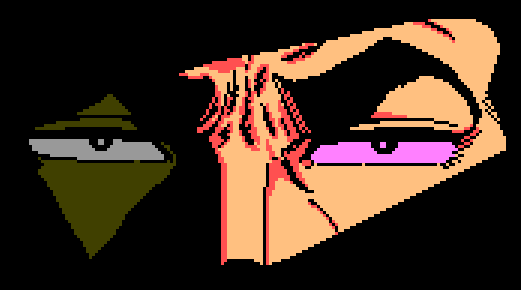
Too Good for Its Own Good: Psalms of Planets Eureka Seven (Anime)

With the Eureka Seven movie out, I figured it was high time for me to start talking more about Eureka Seven. I already reviewed Gravity boys & Lifting girl, but now I’ll be reviewing the original for this post, and then working my way towards the new movie.

Psalms of Planets Eureka Seven is an anime I hold very near and dear to my heart. I’ve watched it in almost every way possible: On Japanese TV, using downloaded raws, using downloaded fansubs, on DVD, and dubbed on American TV. It is not the first anime I watched, far from it in fact, but it has impacted my fandom and my life tremendously in positive ways. When asked to present a series of high quality with excellent characters, art, story, and pacing, Eureka Seven is the one I mention.

Eureka Seven centers around the concept of sky surfing, or being able to ride your board through the air, carried on mysterious green waves called Trapar. Sky surfing, known as lifting, is a popular sport in the world of Eureka Seven and influences culture tremendously, much in the same way skateboarding or surfing can attract people. Lifting is so well-known that they’ve become a common feature on giant military robots (called KLFs) to help them fight more freely in the sky. Perhaps the most famous lifter is a man named Holland, whose skills on a lif-board and in a KLF are all but unmatched and is also the leader of a band of anti-government rebels called Gekkostate.

With all that said, Eureka Seven is mainly the story of two people. The first character is Renton Thurston, a 14 year old boy and amateur lifter who idolizes Holland and is the son of a man regarded as the greatest hero the world has ever known. Renton dreams of escaping his dreary town and the shadow cast by his father, a dream which he is granted when he meets the second character and namesake of the series, a beautiful and mysterious girl named Eureka. Eureka has a personality you could almost call cold and distanced if not for the hints of humanity that reveal themselves occasionally. Enamored by Eureka’s calm beauty, Renton decides to follow her, only to find out that she is part of Gekkostate, the same rebel group led by Holland, and is given an invitation to join.

In the beginning, it’s fairly episodic, with the events of each episode pretty much resolving themselves by the end, but always dropping hints that there is more to the series than one might expect. The initial hook, as it were, is that you get to see the adventures of a stylish gang of rebels fighting against their world and its injustices while also having some fun. You also get to see the partnership between Renton and Eureka develop slowly but surely. If the series stayed like this forever I would have been happy with it, happy to keep watching, but fortunately for all of us the creators decided to do more. From here, the story continually ramps up, becoming stronger and grander until you are swept up by the raw emotion in the story. I know many people disagree with me, but I truly feel that Eureka Seven is one of the best-paced series ever. It is 50 episodes long and really knows how to use that number, with only a few hiccups along the way. Other than that, though, if you like a show which builds up gradually and never falters, Eureka Seven is it.

The characters in Eureka Seven are fantastic on pretty much every level. Design-wise, they’re all very unique and stylish, no doubt due to the contributions of character designer Yoshida Ken’ichi, a man who is possibly my favorite character designer ever. What really pushes Eureka Seven though is the incredible amount of character development. Very few characters in the show are the same person they were in the beginning and at the end. Renton struggles with growing up, Eureka has to deal with her strong and unfamiliar emotions, and Holland must come to terms with the contradictions in his real personality and the one he presents to the world.

Then you have other rich and well-developed characters. Talho Yuuki, girlfriend of Holland, is the ship’s pilot for Gekkostate. Having known Holland for a long time, she is able to reach past his facade and talk to the real him in a way no others can. On the government side is a man named Dominic Soleil, a young and intelligent communications officer who is also the caretaker of an unstable pilot named Anemone. Dominic is the main window into the government side of the story, and his presence does a good job of humanizing it, though there are others who add to the portrayal.

I can pretty much keep talking about the characters. It is they who really push the series and get it to stick in the minds of fans. However, there are other reasons for its artistic success, such as the aesthetic presentation that is on par with the characters. The animation ranges from decent to gorgeous, and the music is varied and strong, from the background music to the main themes. In fact, music is connected deeply with Eureka Seven, with musical references throughout. For example, you should know that Renton’s father is named Adrock Thurston.

The only flaw that Eureka Seven has isn’t really a flaw at all. You may be feeling it yourself as I expound praises on Eureka Seven. What I’m referring to is something called “overhype.” Eureka Seven fans have the hindsight of being able to see the entire series as a whole and knowing just how far it goes, so they, myself included, approach telling others about it by explaining how great it becomes. They have the entire image in their heads and their hearts. However, what happens is that this hypes the show up so much that when some new viewers watch the initial episodes, they don’t see the grandiose and life-changing anime known as Eureka Seven. The show is still good at the start, but it takes time to build up, and because of this overhype they ask, “Why isn’t it as good as people said?” You can see a similar thing happening with Gurren-Lagann or Legend of the Galactic Heroes. This is why I’ve tried to write this review in a way which explains the growth that happens in the series, but I know that even I fall victim to overhyping it.

That is Psalms of Planets Eureka Seven, a series which is, as the title of this review puts it, too good for its own good.

Mandle in the Wind: Be a Man!! Samurai School

Last weekend at the New York Asian Film Festival, I got the opportunity to see the live action film adaptation of the 1980s Shounen Jump manga known as Sakigake!! Otokojuku. The title translates into something along the lines of Charge!! Mancademy, but the official English title is Be a Man!! Samurai School, which while not a literal translation gets the point across just fine. The director and star of the movie, Sakaguchi Taku aka Tak Sakaguchi, as well as his head stuntman, was there watching the movie along with us, and would stay around for a Q&A session afterwards.

You see, Otokojuku is a school for MEN in every respect. Led by its principal, Edajima Heihachi, a man who can take out hundreds of opponents just by mentioning his name and his title, Otokojuku is an all-male school, and the only remaining school in all of Japan that trains men to be MANLY MEN. The story begins as Tsurugi Momotarou, an impossibly calm and cool Samurai-esque man who carries a sword with him everywhere and wears a headband that barely misses the ground, is entering Otokojuku as a freshman shortly after beating up a gaggle of thugs using the power of Punching Fast. He makes some friends, endures some hardships, and then has a Shounen Fight Finale. I don’t really think that’s a spoiler because what can you expect from a movie based on an 80s Shounen Jump property?

There are many things you might look for in a movie, such as plot coherence, solid character development, subtle themes and undertones, and a straight and sure path from start to finish. Otokojuku has none of these, and is instead just a bunch of scenes from the manga faithfully adapted and strung together. Now, don’t hold it against the movie that it doesn’t seem to flow too well, as it is literally a faithful adaptation of the manga, a series which tended to flop back and forth between comedy and serious action more than most Shounen Fight Manga. It’s almost treated as isolated vignettes of the various ways in which the primary characters of the movie turn into manlier men than they were previously. The movie is fun and nonsensical, and if you really want to know an equivalent, it feels somewhat similar in pacing to the live action Cromartie High School movie. Basically, it doesn’t really watch like a movie. If this bothers you, then I would not recommend it, and whatever you do don’t be an ass about it.

The highpoint of this movie in my opinion is the narration, done by the masterful Chiba Shigeru, better known as the narrator for the Hokuto no Ken anime and an expert at making anything he says sound serious and dangerous. Any time anything at all needed to be explained or any time there was a special move to announce, sure enough Chiba would be there to tell us with power and fervor about it. It left such an impression on me that during the after-movie Q&A session, I had to ask Sakaguchi about what it took to get Chiba to do the movie. Sakaguchi said that he personally went and asked Chiba to do it, feeling that he was necessary for the movie to succeed and reach its true form.

Sub over at Subatomic Brainfreeze informs me that the entire movie was filmed in only two weeks with a budget of $400,000. Based on what I saw, I believe him. Don’t let that hold you back though, as it is one of the truest adaptations of an anime or manga I’ve ever seen. More than Casshern, more than Devilman, and especially more than Dragonball Evolution, Be a Man!! Samurai School is the movie to watch  if you want to see a manga brought to life.

Somerset Somersault: AnimeNEXT 2009

This past weekend I attended AnimeNEXT in New Jersey. While held this year in Somerset at the Garden State Exhibit Center and conjoined Somerset Doubletree Hotel, in years prior the convention was held at the Meadowlands Arena in Secaucus. However, seeing as this was my first ever AnimeNEXT this did not have much of an effect on me beyond the fact that I was basically required to stay at a hotel, an experience which turned it from a commuter convention to a hotel convention, and perhaps turned out better because of it.

AnimeNEXT is a fairly small con whose guest list is comprised mostly of locals. There are no big name Japanese guests at AnimeNEXT but the convention doesn’t really pretend to be an Anime Expo or an Otakon. It’s in this environment that I was able to do my first two official con panels ever (I was a last-minute panelist on the Comic Market panel at Otakon 2006), and I managed to learn a lot despite attending relatively few panels myself. At a convention like this, fan-run panels really are the order of the day so that was the majority of my activity at AnimeNEXT.

Friday, June 12

Friday I arrived in Somerset accompanied by kransom from welcome datacomp and the Reverse Thieves. After finding out that my site was apparenty called “Ugiue Maniax” I went to the panels. Getting there too late to see the mecha panel or others that might have been of interest to me, I ended up going to the “Anime Through the Generations” panel, curious as to who would be giving such a panel with such a name. It turned out to be a group of girls who were fairly young but also fairly diverse in their approach to the fandom, and with the help of Rob Fenelon and other (seriously) old school fans it turned into an interesting discussion about how otaku relate to each other across age gaps.

Next was a panel about Anime Pirates, whose name was fairly confusing because I was unsure of whether or not it was a panel about Pirates in Anime or about Anime Piracy. It turned out to be the former…sort of. Apparently Gurren-Lagann totally counts as pirate anime because it makes Captain Harlock references.

Probably the highlight panel of Friday was Anime Princesses, or as the full title goes, “Anime Princesses Rule, Disney Princesses Drool,” run by the aforementioned Old Guard Anime Fans, which talked about female royalty in recent anime and how their portrayals as figures essential to the governance of their respective kingdoms contrasts heavily with the traditional portrayal of the damsel-in-distress Disney Princess. I noticed a lot of girls leaving once they realized that the panel was essentially about politics in anime rather than talking about princesses per se, but for those who stayed it was an informative hour. My only complaint with the panel really was that too much time was spent on too few princesses and there was a glut of video clips. Points that could have been illustrated with one or two videos were expanded to four or five.  Still, a fun panel.

At this point I’d like to talk about the game rooms set up for AnimeNEXT and how pleasant it turned out to be. They had six separate rooms dedicated to different genres with the most popular ones getting their own rooms out of consideration for said popularity. Most importantly, they never really smelled too badly. It was a well-run game room overall.

Saturday, June 13

Saturday began with the panel run by the Reverse Thieves and I, titled “I Can’t Believe You Haven’t Seen This!” Though it was among the first panels of the day, running from 9am-10am, we still managed to get a fairly large crowd and for that I am thankful to you our panel attendees, whoever and wherever you are. It’s our hope that we could expand your selection of possible anime to watch and to go beyond what you know already, and people came away ready to look at the titles we recommended, among them being Kaiba, Rose of Versailles, and Kekkaishi. Again, thank you to everyone there.

Vertical Press also had their panel Saturday, led by Marketing Director Ed Chavez. In it, he tried to clear up misconceptions about Vertical Press, which is often touted as a provider of manga classics but should more accurately be seen as a provider of the widest range of material indicative of Japanese popular culture. Ranging from cook books to light novels to non-fiction memoirs and of course manga, no topic is taboo for Vertical Press. Having spoken to Ed on multiple occasions now, I have to recommend anyone who has an interest in manga or Japanese pop culture who has the opportunity to listen to Ed speak should take that opportunity. While a Marketing Director, he does not speak like a stereotypical spin doctor, and will fast convince you that Vertical Press is trying to sell you something worth your time. I know I felt that way at least.

The panel immediately following the Vertical Press one was a dub voice actor panel featuring Michele Knotz and Bill Rogers. The crowd was significantly larger than the Vertical Panel, which came as no surprise once it was revealed that both Knotz and Rogers are voice actors for Pokemon. Both are talented individuals, though the main reason I was there is because Knotz is the English voice actor for Ogiue. So naturally I had to ask Knotz for her opinion on Ogiue. Michele called Ogiue a “very interesting” character, and a type whom she had never played prior to landing the role of Ogiue. Recalling difficulty in achieving the right voice for Ogiue, Michele mentioned that the voice director told her to do a voice akin to “Wednesday Addams.” While I don’t think Ogiue is quite like Wednesday Addams (a more accurate description would be to imitate a girl imitating Wednesday Addams), it was interesting to see how she approached this most important and defining of roles in anime. Both of them also talked about how much they’re looking forward to Genshiken 2’s US release. There were other questions but as far as Ogiue-related topics were concerned this was it.

One of the panels that caught my eye on the programming schedule was “Restricted Rock Paper Scissors.” Anyone who’s seen Kaiji should be familiar with this concept, though interestingly only half of the people at the panel had even seen Kaiji. After a few hiccups and the panelists warning the half who didn’t see Kaiji to say away from the half who did, the game was afoot. I managed to be a finalist in both of the games I played, remembering that there’s no such thing as Honor in the ultimate gamble and to avoid the mental trap of “balance.” My prizes were candy and a tiny deck of Uno cards. Truly I was at the very least a Penultimate Survivor.

The highlight of Saturday by far was dinner, as I and other bloggers converged on the local Ruby Tuesday and chatted it up. Many of the bloggers were ones I met for the first time at AnimeNEXT and it’s always enjoyable to see new faces. Among them were the Reverse Thieves and kransom, my fellow Sunday panelists Omo, Super Rats, and Moy, as well as Anime Almanac’s Scott and Japanator’s Brad. I got the dry-rub Memphis ribs with mashed potatos and steamed broccoli, and followed it up with a decked-out baked potato.

After dinner I arrived just in time for the “Bad Anime, Bad!” panel, where we watched select clips from an old Toei animation called “Dracula: Sovereign of the Damned,” an entertaining movie which plays fast and loose with the story of Vlad Tepes and whose plot involves Dracula pretending to be Satan so he can trick Satan’s bride into marrying him. The movie managed to continually top itself in ways that few could imagine. It was also apparently based on a comic by Marv Wolfman, writer of the most famous Teen Titans run as well as many other comics.

Hisui from Reverse Thieves joined us halfway through Dracula, the other half having been spent at the “As the Otaku Grows” panel, which he informed us was a very misleading title as it turned out just to be a guy with a serious hard-on for 90s anime. He would declare that everything made before and after the 90s was worse by comparison, and would apparently give inane evidence to support his claims. I guess if we have so many people calling the 80s the greatest anime decade it’s inevitable we’d get one for the following decade. I look forward in 15 years when someone declares this decade of Zaizen Jotaro and Slap-Up Party Arad Senki to be the greatest period of anime ever.

Sunday, June 14

Due to rearrangements in the AnimeNEXT schedule, I essentially had my entire Sunday convention experience in the same room. Starting off with the History of Manga in the US panel, I learned a lot about not only manga translations in the US, but also the many attempts to either take existing manga properties and get American artists to draw comics based on them, or to draw a comic in a deliberately “manga-esque” style. It’s a side of the manga industry that isn’t really explored much and I learned a good deal, particularly in regards to how the companies constantly try to adapt to the shifting environment. My only regret was that I had to leave the panel a little early so I was unable to ask him about anything he knew in regards to Marvel’s Shogun Warriors comics. For those who don’t know, Shogun Warriors was a toy and comic line where popular Japanese super robots were brought to America with their stories entirely changed so they could fit in the same universe, somewhat similar to Super Robot Wars but not at all like Super Robot Wars.

US Manga History was followed up immediately by “Otaku Perceptions & Misconceptions,” and it turned out to be a panel by the same people who ran the Friday Anime Through the Generations panel. The conversation revolved around how not only others see otaku but also how otaku see themselves, and it eventually boiled down to how otaku could and should work to fight misconceptions, a topic I contributed to based on my own beliefs.

And then after that was the moment of truth, the “Anime Blogging Basics” panel. As expected from a 1:30pm panel on the last day of a con, barely anyone we did not know showed up, but again that was hardly a surprise. We talked mainly about the “Why” of anime blogging, which turned out to be quite interesting because of the level of variation between our blogs and our styles. Omo enjoys focusing on the fandom (he mentions that his feed contains over 400 anime blogs), Super Rats concerns himself primarily with anime figures and photographs of, Moy’s blog has gone through many variations until it settled into something more personal, and my own blog is defined by the description you see at the very top of Ogiue Maniax. Omo described my blog as the evolution of those old character shrines from 90s online fandom, a description I can’t quite disagree with. In the end, I think we managed to lay down some solid thoughts and opinions on blogging and perhaps helped the two or three guys we didn’t know to engage in their own blogging adventures.

With the con over, I and the others had lunch at Marita’s Cantina, which turned out to be a surprisingly good Mexican restaurant, and one that I would recommend if you are ever in New Brunswick. After eating to our content, we took the train back to New York.

Final Thoughts

AnimeNEXT as mentioned in the beginning is not a widely attended convention, but it still managed to attract a lot of dedicated anime fans. While I did not focus much on cosplay, I did notice a lot of dedicated cosplayers, and to those of you who dressed as Eureka Seven characters I salute you. I do not know if I will attend again based on circumstances beyond my control, but I would recommend it if you live in the area. It’s not the most exciting convention but it’s certainly not a nightmare. AnimeNEXT is the type of convention where being around good people and great friends can magnify your enjoyment of the con tremendously.

Oh, and if you’re taking the train to New Brunswick to get to the con, watch out for bums. Just a warning.

Once Upon a Time, a Girl Finished Her Grape Soda: Up

Up once again shows that when it comes to mainstream 3D animation, there’s Pixar and then there’s everybody else. Or to put it differently, the only studio not trying to be Pixar is Pixar itself.

People sometimes ask me why I like anime so much, and though I’ve mentioned in the past that to an extent it is a very personal thing independent of average level of quality in anime, there are still certain recurring traits that keep me coming back: emotional sincerity, respect towards the viewer, respect towards the medium itself, the ability to take simple premises and elevate them. Up manages to fulfill all of these and more. That is of course not to say that the reason Up is good is because it’s “like anime,” because it really isn’t, but its approach and understanding that even for a kids’ movie (or perhaps especially for a kids’ movie) not everything has to fall neatly into place remind me very much of the reasons why I got into and continue to enjoy animation. You can do so much when you’re not limited by reality, and to understand that is to understand that what I just said applies well beyond the visual aspect of animation.

Like Wall-E, Up is a very emotional movie which dares to use a hero that is not just unusual because of the way they look, but because of how the entertainment industry has restricted the roles of certain character types. In the case of Up it is Carl Fredricksen, an old man who used to sell balloons who decides to use his remaining stock to float his house to South America to fulfill a lifelong promise. He inadvertently brings along a young boy scout analogue named Russell, an eager but physically inept boy.

Carl’s curmudgeonly demeanor masks the fact that he was once a wide-eyed but shy boy dreaming of fun and adventure (somewhat similar to young Russell), as well as a man who was very much in love. It’s a mask that we are allowed to peer behind throughout the movie, giving Carl a very strong presence in every scene he’s in. We can see in his current attitude and actions the life he has led up to that point. His interactions with Russell show how easy it is to perceive the elderly as distanced from the rest of society, as well as how incorrect that notion often can be. Carl is an interesting and deep character, and I do not use the word “deep” lightly. He moved me, moved me to tears and smiles and left a deep impression.

Placing an elderly man in the main role of a movie animated or otherwise is a bold move in an entertainment industry which tends to devalue the elderly. Even when they are featured prominently in movies, they are usually placed in teacher roles, or meant to be comically cranky old men. While there’s been a recent trend for older main stars in movies as Hollywood’s big names realize their years are catching up on them (e.g. Sylvester Stallone in Rocky Balboa), most often the message these movies send is “check us out, we can still hang with the young guys.” Up however is different. Carl Fredricksen is not an old man trying to play a young man’s game. He is doing what he feels is necessary precisely because he’s old. There is no denial, there is no shame.

While I said that the movie’s strengths go well beyond the visual, there is no denying that the movie also looks good. Its style is something that I think registers with everyone no matter your age. It’s bright and colorful without bombarding the viewer and overwhelming the retinas. Character designs and backgrounds, are soft without seeming entirely innocuous. The overall three-dimensional design is of course excellent, as expected of Pixar, and if you decide to watch it with 3-D glasses, Up never overwhelms you with shots designed to tell you JUST HOW 3-D THIS MOVIE IS, unlike many other 3-D movies. The use of recurring symbols in Up is also excellent in a way that I rarely see from movies. This is not abstract symbolism, but rather the movie establishing the significance of small but emotionally precious objects, and whenever these objects are referred to or used in any way you know how much weight is put behind them, much like anything Carl says or does.

Up is exactly what a family movie should be, in the sense that it is not just a family movie. Go by yourself, go with your friends, go with your kids or your parents. It’s an intelligent movie which respects the intelligence, both mental and emotional, of its audience, and engages them with such sincerity and power that anyone who sees the movie will feel like they’ve come away from the movie well-rewarded. It will be a reward well-earned because it is almost impossible to feel like an idle observer with Up.

Catch Me Talking About Giant Robots on the Anime 3000 Podcast

I was a guest on the Anime 3000 podcast on a topic very near and dear to my heart: giant, monster-punching, war-fighting robots.

I was on there along with Gerald from Anime World Order, John-Paul from Fight Bait, and Mike Dent from R5 Central.

Sadly, due to personal obligations I was not around for the whole podcast, and came in starting at the section about Nagai and Ishikawa. If you want to hear me talk you can skip to that part of the podcast, but I highly recommend that you DO NOT, as the discussions concerning Imagawa and Tomino are also important.

Looking back at my picks for recommend giant robot anime for beginners, I realize my list has many flaws, such as Shows that are Too Long, Old-Looking Animation, and No Super Robots. I’m not sure how I would solve any of these though, so you’re stuck with what I gave you.

Download is available here.

Kick, Attack, Contemplate Your Existence: Casshern SINS

Casshern SINS is the story of an amnesiac robot named Casshern who lives in a post-apocalyptic world where even robots, once known for their ability to live forever, are now faced with the spectre of death as their bodies rot away due to a “disease” known as the Ruin. The only immortal left is Casshern himself, whose desire for pacifism runs contrary to his incredible, at times uncontrollable abilities as a literal killing machine. When Casshern discovers that he is somehow responsible for the Ruin, he sets off to find the truth, his journey taking him around the wasted planet, seeing for himself how others cope with life and death.

Casshern SINS is a remake and re-envisioning of Neo-Human Casshern, a 1970s anime about a man who is permanently transformed into a robot to fight a robot rebellion led by the evil Braiking Boss. As you might have noticed from the basic plot summary above, the two series are nothing alike, and the 1990s remake and 2000s live-action movie do not fare any better. There are very few shows, especially popular ones, that are comparable to Casshern SINS, and it leaves an important question that I’m going to try to answer: How should one approach Casshern SINS?

Casshern SINS is an intellectual anime. That is not to say that the anime requires a high level of intelligence to watch or that it’s somehow better than anime that aren’t intellectual, but the storytelling in Casshern SINS is highly unusual. Unlike most other anime, it is less about telling the emotional stories and more about conveying metaphors and allegories.

Characters in Casshern SINS are not fleshed out individuals with wide ranges of emotions who are made to feel in some sense “realistic.” Instead, the characters act as set-pieces in a greater story, like pieces of a puzzle, like the characters in a biblical parable or an old fable. While the two are nothing alike, Casshern SINS and its approach to characters is similar to that of Sayonara Zetsubou Sensei in the way it boils down characters to their basic essence and then moves them forward to see where they will go. Casshern is a conflicted berserker. Ringo is an innocent young girl. Braiking Boss is an Ex-King Former Boss. Friender is a ferocious canine companion, albeit a robotic one. They do not go much beyond their basic identities in order to tell their versions of the Prodigal Son or the Tortoise and the Hare. Characters highlighted in each episode also follow a similar pattern. You have the parable of the Singer, the parable of the Painter, the parable of the Sentry. And of course, there’s a lesson included in each one, a lesson which Casshern takes to heart, similar to Tetsurou in Galaxy Express 999 or Kino in Kino’s Journey.

And also similar to 999 or Kino, Casshern SINS slowly constructs a world of its own in which to tell its stories. There’s no clear indication that the planet is even Earth, and so all you can do is follow Casshern himself along and learn about the world in which the story takes place at the same pace he does.

The visual style of Casshern SINS lends itself tremendously to the way the story is constructed, or perhaps I should say that the story and visuals go hand in hand. The artwork and character designs are very expressive and wild, but somehow it all comes together in a very subdued manner, even when Casshern is chopping some poor robot’s head clean off. In terms of animation, the show basically has two modes: talking heads and beautifully animated and choreographed fight scenes, and while it’s clear that monetary limitations necessitated this format, the animators and directors did a very good job working with it. For this reason, backgrounds and general scene design in Casshern SINS are incredible, to say the least. Almost every background can be taken by itself as a work of art, often abstract, often expressionistic, but always lending a unique flavor to the world it is meant to portray. If the characters are going to stand still and ask each other questions, they’re going to do so with plenty of visual information to go around.

Casshern SINS is clearly an ambitious work, and in being so ambitious it also may have some trouble finding its target audience. It barely resembles its source material, and while it can be very abstract it is not entirely so, which may leave those who would prefer it to be even more ambitious and daring disappointed, while those who do not take well to its fine-art approach may also reject it. Still, I feel that the way in which Casshern SINS tries to incorporate so many aspects of art and storytelling is also what makes it stand out from much of the crowd.

Sprkng! Early Observation of Dragon Ball Kai

I don’t plan on making it a habit of blogging about Dragon Ball Kai, but seeing as I reviewed a very “special” remake yesterday, I felt I should talk a little about how the other, inarguably better remake is doing.

For those of you who don’t know, Dragon Ball Kai is an HD re-mastering of the original Dragon Ball Z with new audio recorded (both music and voices) and, most importantly, all fat trimmed to make the show more streamlined and in-pace with the original Toriyama manga. Three episodes are out so far, and it should give a good indicator as to how the show will fare later on.

Dragon Ball Kai accomplishes in three episodes what took the original anime five, and early Dragon Ball Z wasn’t even that filler-laden! At the pace they’re going, the show may end up feeling it’s never dragging. That is, unless perhaps the manga dragged in certain areas as well. It’s an interesting conflict, being “true to the manga,” because should you be true to it, bad parts and all? Probably the main difference in pacing that will be seen is that in the manga powering up hardly takes any time. It’s the classic cliche of Dragon Ball Z that entire episodes are spent “powering up,” and it’ll be funny to see that stereotype smashed. It’ll be even funnier when the Namek saga takes significantly less time, and the inevitable jokes will occur which go, “Are they still on Nam- oh…I guess not. Carry on!”

Unlike that other thing, there’s really no point to discussing whether or not Dragon Ball Kai is true to the spirit of Dragon Ball. While this is clearly going to make them massive piles of money to roll around (and to sleep on top of with lots and lots of beautiful women), it’s still, I feel, a labor of love to a certain extent, even if it’s simply a repackaging of old material to seem new and fresh. I’m cool with that.

I just have to wonder if this mean that for all the young kids who are watching Kai before Z, will they be unable to ever watch the Z anime when a superior alternative exists?

The Best Argument for Creationism: Dragonball Evolution

Dragonball Evolution, what can be said about it? Well,  I can certainly call it a “movie.” It is a series of scenes placed one after the other on a film strip and shown in a sequential order. Dragonball Evolution: People involved in a production to put a form of entertainment in theaters.

Upon first hearing that a live-action Dragon Ball movie was being made, I had an image in my head full of cheesy lines and attempts to bring stories full circle, revisions to existing aspects of Dragon Ball designed to make it seem “cooler” and less “cartoony,” unfaithfulness to the source material’s characters and their personality, and awkward special effects. When the first trailer was released, and then the second, this prediction still appeared to hold true. Now, after having seen the whole thing, I can say that the movie was exactly what I expected it to be.

Where to start with this, “Evolution” of Dragon Ball as it wishes to be known? Well, how about the way in which it relates to Charles Darwin’s theory, or rather the attack on it by certain religious groups?

Proponents of Intelligent Design commonly state that there is evidence in the bedrock that shows that the Earth’s history is not a continuous chain of events, and that there are mass extinctions and sudden increases of certain types of animals, as if the history of the Earth and its wildlife are a series of islands connected by a higher power. This is in fact how Dragonball Evolution feels. You know it’s a story mainly because you’ve been told that it’s one, but while the events of the movie follow a chronological order, there is almost nothing which smoothly connects one scene to the next. Master Roshi will claim that going to the tournament is vital to their quest to defeat Piccolo. Then no one will participate in the tournament and then we never find out what going to the tournament actually accomplished. Yamcha and Bulma hate each other in one scene and in the very next they’re already falling in love. There isn’t even at the least a generic scene where Yamcha catches Bulma while she’s falling or something. Goku is in high school for some reason, and he gets picked on by jocks. He meets Chi Chi there. Then high school is never ever mentioned again. Master Roshi, the narrator, and Piccolo will all mention that Piccolo was responsible for nearly destroying the Earth until he was sealed 2000 years ago, but now he’s free and looking to enact revenge on humanity. How exactly did he break free from his confinement? Apparently NOBODY KNOWS OR CARES, at least not enough to tell the audience.

That’s not to say EVERYTHING is bad about this movie. Characters are occasionally true to their manga portrayals in certain ways. Goku is always naive, gets one or two nice lines to show how dumb he is. Master Roshi’s introduction feels very much like Master Roshi except in every scene after that he turns into generic old master. Also, sometimes the action scenes make it feel like a generic action movie, which is to say not super awful. Also my friends and I burst out laughing practically every minute at one bad line after another until we lost count.

An interview with the people who made Dragonball Evolution has members of the cast and crew defending the production, saying that the director succeeded in keeping the spirit of Dragon Ball alive and adapting it just enough to appeal to a wider audience. The problem is that they’re totally wrong and Dragonball Evolution is not faithful to the spirit of Dragon Ball at all. I can go into the many reasons why this is the case, but I’ll just give one: the core of Dragon Ball is represented by its main character Son Goku and his personality: goofy, often very dumb, loves to fight, and has a strong sense of justice when it comes down to it. There’s a certain kind of whimsy and humor that never leaves the series even when planets are being destroyed and limbs are being chopped off. That is to say, Dragon Ball is all about having serious fights never be too serious because it’s always been about the comedy as well. Dragonball Evolution throws all of this out and decides to be an action movie and coming-of-age story like so many others out there. Even if it succeeded in being a well-constructed story with brilliant direction, it would still not be Dragon Ball.

The Exciting World of Ron Sharks: Akagi

When you first look at an anime like Akagi, there might not be much to grab you especially if you’re an anime fan. The art style is very unusual, some would even say “awful.” You’re not even entirely sure what the show is about, and all you’ve seen of it are screenshots of a guy with a chin so pointy he could use it to assassinate people. But that’s when you look at the full title and realize that’s all you need: It’s not just Akagi, no it’s Mahjong Legend Akagi: The Genius Who Descended Into the Darkness.

Akagi is based on a manga about mahjong by Fukumoto Nobuyuki. This might be an unusual topic for you. “Who would make a comic about mahjong?!” However, unlike most cases where this might be shocking (“Who would make a comic about breadmaking?!”), what you have to know here is that mahjong manga are actually quite common in Japan. There are entire magazines devoted to the subject, like if you took Shounen Jump or Shounen Magazine and instead devoted all of the content to how-to-play mahjong guides and mahjong comics. This is the world Akagi comes from.

The titular character is Akagi Shigeru, who when we first see him is a boy in his early teens, who the narrator (voiced by Furuya Tohru i.e. AMURO RAY) tells us will “some day” be a legend in the underworld. Akagi is a lad with a penchant for deadly games which push his body and will to their limits. At this point, Akagi has never played mahjong in his life, but his intelligence, fearlessness, and incredible capacity for gambling with all of his soul without succumbing to pressure make him a perfect match for a game like mahjong, a game where your entire psyche is mapped out in the actions you take. Needless to say, the entire show revolves around Akagi playing Mahjong with a) Yakuza b) people known by the Yakuza c) Yakuza-esque people, and every moment at the mahjong table is filled with the kind of intensity you can only get when your life can be decided by a single, seemingly insignificant action.

You might think that with all this talk of mahjong, you would need to know how to play the game in order to properly understand Akagi. This is not the case at all, and I will attest that I watched the whole show before ever learning anything about mahjong. There’s a lot of strategy involved, but it has little to do with the actual rules of the game and everything to do with human psychology. The way the show is presented makes every moment as tense as possible, as the characters’ minds are assaulted by doubts and fears that come from trying to read another player’s moves.

The art style for Akagi is pretty unusual, but my only complaint about it is that the anime doesn’t quite match up to the art style of the manga. Neither one is very conventional, but when you look at the manga, you’ll see that it has a vibrancy and “ugliness of the world” that is lessened due to the consistency of the animation in the anime adaptation.

The Akagi manga practically looks like a gag manga, but it only makes the comic better, especially when combined with the game of mahjong. One advantage of the anime though is that they were able to create a CG set of mahjong tiles to use throughout the show, and are able to do some pretty creative things with it.

It does seem like the animators got a little bored with the show after a while and began to do more creative things. In the early episodes, Amuro Ray would describe a metaphor for how a character was feeling at the time and that was it. Towards the end however, it ends up being a situation where the narrator will describe a metaphor, and then the anime will shift to a visual scene to accompany the metaphor. So if the narrator says, “AKAGI’S SITUATION IS SIMILAR TO BEING A COBRA IN A DESERT WITH ONLY A CAN OF PICKLES AT ITS SIDE,” you will be sure to see a scene with a cobra, in the desert, with a can of pickles. Some might call it stalling for time, I think it’s the animators wanting to do something special. This would continue into the next anime adaptation of a Fukumoto work, Kaiji.

Ultimately, Akagi might be about mahjong but what they’re playing matters less than how they’re playing it. Again, if you’re worried about not understanding it, do not let that stop you. This is Initial D with mahjong tiles instead of cars. This is Yu-Gi-Oh! for 40 year olds (especially the early chapters of Yu-Gi-Oh!). If either of those descriptions make you hesitant, don’t let them stop you either. Watch this show.

Sakura-con (was) Live on Nico Nico

Sakura-con this year decided to broadcast a stream LIVE directly to Nico Nico Douga, giving Japanese viewers perhaps their first REAL glimpse at American otaku. I jumped on the stream, eager to see not only what the con itself had in store for us, but also what everyone REALLY goes on Nicovideo for: the comments.

The camera was at the con karaoke bar, and it’s amazing just how much the song selection was indicative of the American fanbase. I jumped on a little late, but highlights include the first Naruto ending theme, the first Inuyasha ending theme (TWICE!), BOTH “Simple and Clean” and “Hikari” (English and Japanese versions of the Kingdom Hearts opening respectively), the Sakura Taisen opening and the dub Pokemon 1st opening sung by almost everybody. The show stealer though was a 10 year old girl who sang the entire 1st Japanese Pokemon opening, Mezase Pokemon Master. Showing more showmanship and honest love of anime than any of the other singers, the Japanese crowd cheered her on, knowing that this was truly a fan, a fan of anime.

Of course, not all of the comments were nice, as they referred to an overweight girl as “Totoro” and “Pizza.” But they were also enamored by some of the more attractive cosplayers. And there was also a bit of a clash between Japanese viewers and non-Japanese ones such as myself, as the latter tended to send comments in English and the Japanese did not appreciate this. Still, things managed to cool down and karaoke continued.

After karaoke was over, the camera hovered over some people organizing their figure collection, which was an unusual mishmash of Warhammer, moe PVC figures and shounen action. At this point I had to stop watching, but I began to wonder if the Japanese people would want a convention like this in Japan. I asked on Nico, and at least one person said he would definitely want to see something like this. The American fanbase’s lack of shame is both its greatest weakness and its greatest strength.