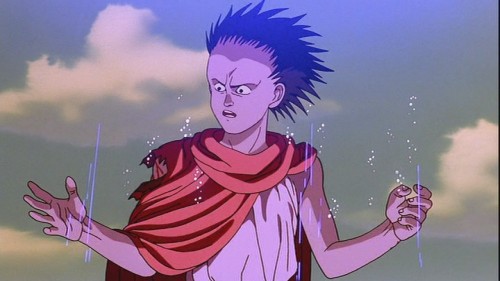
In Control: Understanding Akira

Whenever I think of Akira, the first thing that comes to mind is my sophomore year of high school. There was an anime festival going on in the city, and I was waiting in line to watch Galaxy Express 999 at a small theater. Behind me on the line was a guy, probably somewhere between 16 and 24, discussing anime, talking about how he found Akira to be incredible and the “best movie ever.” This man’s life was changed by Akira. Later that evening, my life would be changed by Galaxy Express 999. Still, I had seen Akira before, and I wondered just what was it that blew this guy’s mind.

Today, years later, I rewatched Akira, and I finally understand it. More importantly, I understand that Akira is actually not that difficult to understand.

Akira takes place 21 years after the end of World War III in the city of Neo-Tokyo, a city with strong police presence, assigned curfews, and the youthful delinquents who constantly ignore that authority. The story focuses on Kaneda, the confident leader of a biker gang (bousouzoku, literally berserkers), and his timid childhood friend Tetsuo, also a member of his gang. Beyond this, describing the plot of Akira is difficult in that ultimately a cohesive story progression where characters get what they deserve and plot threads tie together is not the aim of Akira.

Neo-Tokyo is an advanced city, portrayed as having large, high-tech skyscrapers looming overhead and bright neon colors all around, but it is through this portrayal that Neo-Tokyo is revealed to be a city liable to fall apart any moment. People in Neo-Tokyo live for the moment, unsure of the future. Neo-Tokyo is a city out of control.

“Control” is the theme of Akira. Wanting it, gaining it, and losing it, one leads to the the next. Tetsuo has always been looked after by Kaneda since they were children, which causes Tetsuo to become resentful towards his own inability and gives him the desire to want to surpass Kaneda. Another character, a scientist with good intentions, strives to control a primal force beyond human comprehension. The politicians believe they control everything, but their pointless bickering and lack of understanding as to what is happening in the real world show that the only things they control are their own wallets. It is the illusion of control that ultimately results in one losing it.

Akira is very famous for its visual style and excellent animation. Everything, from explosions to vehicles to environments (as mentioned above) are rendered beautifully with fluid movement, and it is in this hyper-realism that the fragility of the world in which they live becomes most noticeable. The world of Akira is almost so tangible that it may crumble if touched.

Most of the people who I have met who have a fondness for Akira saw it in their teeange years, like the guy waiting behind me on line. It is in our teenage years that our minds and bodies develop most rapidly, and we begin to think that we control of our lives, or perhaps that our lives are out of control. Tetsuo and Kaneda themselves are teeangers. In a sense, Akira is a visualization of the conflict of being a teenager, where the more you learn about the world, the more frightening it can become. Given the theme of Akira, I realize that while it was not a mind-blowing experience for me individually, it is no surprise that it has been one for so many people.

Despite all that I wrote, I still believe Akira is easy to understand. If you’re struggling with trying to make sense of the narrative, it may just be that you’re trying too hard to control it.

OEL Manga, what is up with it

A few years back Tokyopop started advertising and promoting its own line of “Original English Language” or OEL Manga, and no one I know reads them. I’ve checked out a few here and there, but I feel something holding me back when I see a title in the stores. On the few occasions where I have picked one up to read, well, sometimes I’m pleasantly surprised and other times I’m not.

I liked Bizenghast overall, but the fluctuation in quality from page to page was very distracting. A well-done drawing would lead into a rush job into another nicely detailed drawing, and it seems like the product of someone with not enough time to really hone each panel.

Dramacon is another one I decided to take a look at, simply because Anime Jump and others had lauded it for being one of the better titles. I found myself unable to finish it, as it felt less like a heart-felt examination of the convention scene and the drama in it and more like wish-fulfillment on a level below Comic Party. What’s a mysterious love interest with a scarred face doing in a story where the focus seems to be Normal Anime Fans Doing Their Normal Anime Things? Maybe I’ll come back to it at some point, but it was like the pieces of the puzzle did not fit together properly.

I’m probably giving them a harder time than I should, but at the same time I’m really not, as it was Tokyopop’s desire to showcase these talents on a level on par with work from Japan. If there’s any OEL titles of merit that I’m overlooking, I’d like to know about them.

Your Doujin Work Sucks

Hiroyuki, author and creator of Doujin Work, is not exactly a common name among anime fans. In some cases, I’d suspect that mentioning it would get more people thinking about To Heart than anything else. No, Hiryoyuki is probably better known around the internet for his comic involving a bespectacled teenager with a troubled past trying to get it on with a feline familiar. In other words, “A Cat is Fine Too.”

So here we have a man firmly rooted in the doujinshi “industry” making a comic about creating doujinshi. The story centers around a girl named Osana Najimi and her quest to create doujinshi. However, unlike Kazuki of Comic Party, who draws because he finds it incredibly fun, or Ogiue of Genshiken, who draws because she can’t help it, Najimi dives into the world of doujinshi for one reason and one reason only: profit. Her friends Justice and Tsuyuri are able to sell well at doujinshi events, so with a little practice the money-loving Najimi feels that she too can rake it in.

The only problem is that she sucks at drawing. Najimi has no natural talent, and effort does not seem to reward her much either. The work she creates sells mainly for the so-bad-it’s-good factor.

Hiroyuki’s style, born out of drawing doujinshi, makes much sense for a comic revolving around doujinshi. Overall, the manga (which is presented in 4-panel-style) is well-drawn and entertaining. The same cannot be said of the anime.

The anime adaptation of Doujin Work suffers from poor animation, though much of it is forgiven when taking into account the (presumably) low budget and fairly simple designs of the characters. There were also rumors floating around 2ch and the internet in general that working on the animation with Hiroyuki was a bit of a nightmare, and not in the good way. Even if this is just a rumor, the result is still a show that could have looked better and been better.

But that’s what makes it so interesting.

Here you have someone drawing a comic about a person who tries to get into the world of doujinshi with lackluster results. This comic is then adapted into an anime…with lackluster results. In a sense, the mediocre showing of the Doujin Work anime adaptation is the best possible outcome for it.

“Oh, but that wasn’t intended by the creator!” you might be saying. Well, not everything intended by the creator defines a work. Kind of like when an anime becomes a cult classic in spite of its quality and not because of it.

PS: I know the anime adaptation has a section which shows the voice actors of the anime trying to make and sell doujinshi, but for some reason no one ever bothered to include those parts in the available episodes. A sad loss.

Fireball: Disney did WHAT now?

Fireball is a 3-D animation airing in Japan, produced in part by Disney.

Yes, that Disney.

Each episode is less than two minutes long, and it seems to be a concerted effort by Disney to make newer in-roads into Japan’s animation-watching audience. I say newer because Japan IS actually fond of Mickey Mouse and friends, not to mention the fact that Tezuka idolized Walt Disney.

The use of 3D Animation is interesting, as it’s something that Japanese animation hasn’t really been great at, so in a sense it’s using Disney’s power to its advantage, though I don’t actually know to what degree they actually help.

The main character, Drossel, appears to be at least partially designed to appeal to otaku, with her long twintails and slender robotic figure and large “eyes,” so I also get the feeling that they are trying to tap into this audience as well.

I suspect this has something to do with seeing the success of Powerpuff Girls Z in Japan.

My Eyes, I Can’t See

She can melt her own sword with her hotness

That is my reaction to catching up on over 100 chapters of Bleach.

You see, because when you get that much Bleach in your eyes it

Anyway, I actually started reading Bleach about 2 years ago and kept up with it pretty well, but the day my first external hard drive died was the same day I downloaded a ton of Bleach manga, and it left me with sort of a sour taste. I basically abandoned the series shortly after the Soul Society Arc.

So here I am, all caught up, and the series seems to be gearing up again after a fairly nice, if shaky conclusion. The only problem, I realize, is that much of the comic for the past 100 chapters or so has felt very meandering. When you read in big chunks, time passes pretty quickly, but then I realized just how long it would have been had I been doing this every week. It’s kind of daunting when you step back and think about it.

Maybe it’s the fact that the humor more recently hasn’t been as strong as some of the earlier chapters (BOHAHAHAHA), or that because Ichigo and Rukia weren’t together for most of it that I didn’t get to see the strong interplay between the two that attracted me to the series in the first place. Actually, those two are kind of related, aren’t they?

Speaking of Rukia, she’s one of those unusual characters who always looks hotter in official art than she does in any fanart be it Japanese or American (see above). I don’t know what it is, but a lot of people who draw her don’t seem to “get” what makes her attractive, though they will work fine with Orihime, Yoruichi, Rangiku, Nemu, and practically the entire cast, but not Rukia. Rukia’s appeal lies in her eccentricity combined with her knowledge and naivety. She’s aggressive, but not as if she’s trying to compensate for being small, and there’s always a sense that she follows her own unique internal logic. Not to mention the nice eyes, and you know I’m a fan of nice eyes (see primary character theme of this blog).

Will I keep up with Bleach now that I’m all caught up? I don’t know. It is kind of fun to just wait a bit.

Hokuto Hyakuryuusei Ora Ora Ora Ora: Playing Jump Ultimate Stars

A friend of mine kindly obtained for me a copy of the game Jump Ultimate Stars. I imagine a lot of you already know what the game is and have probably played it far more than I have. For those of you who don’t, Jump Ultimate Stars is a Shounen Jump crossover fighting game for the Nintendo DS spanning Shounen Jump’s approximately 30-year history. Think of it as Smash Bros, but with Naruto, One Piece, Otokojuku, Jojo’s Bizarre Adventure, Hokuto no Ken, Dragon Ball, and so on.

This review isn’t really a “game review” as I’m not planning on telling anyone to buy it or not. The controls are similar to Smash Bros in many ways, though it doesn’t feel quite as fluid and the lack of the “third jump” can be annoying at times. That’s just nitpicking though.

Jump uses the dual-screen in a rather unique way. On the upper screen is the action, while on the lower screen is what resembles a comic panel. You the player must construct your own “comic page” out of various characters’ famous panels, and these characters are the ones who will be available for you to use in battle. There are Battle Koma (usable characters), Support Koma (Marvel vs Capcom 2-style assists), and Help Koma (stat boosts).

I love seeing the many references, and while a bit tedious I like the logic in many of the unlocks. For example, at one point you get Kenshiro, and through points you can upgrade Kenshiro to more and more powerful versions. It’s only when you unlock the Yuria’s Help Koma that you can bring Kenshiro to full power, giving him access to Musou Tensei, the ultimate technique of Hokuto Shinken. Similarly, you need Yuria to fully power Raoh, but Raoh only has two battle koma types total: six and eight. Or, to put it more simply, strong and VERY strong. Very fitting for Raoh.

The only really sad thing is that while Jump Ultimate Star has some of my favorite Jump characters, such as Kuchiki Rukia (Bleach) and Kobayakawa Sena (Eyeshield 21), it doesn’t have my absolute favorites, particularly Hyuuga Hinata (Naruto) and Souther (Hokuto no Ken). Maybe next game.

PS: The Emperor has no need for PSPs.

PPS: Not really, as Super Robot Wars A Portable looks sweet.

To Be, or Not to Be Cool and Spicy: Shugo Chara, episode 27 and on

Hinamori Amu is now in the 6th grade (her sister Ami just starting kindergarten), and she has to face the new school year while dealing with the departure of two of her closest friends, Nadeshiko the queen and Kuukai the jack. Hinamori Amu receives her 4th guardian egg, while we find out that Utau has a second Shugo Chara, an angel named Eru.

Get it? A devil named iru and an Angel named Eru. DebIRU, EnjERU.

Ha ha. Ha.

Ha.

Much like Miyazawa in Kare Kano, Amu’s cool and spicy persona has begun to break down, and it turns out that the other kids are noticing. Amu, who was used to thinking of her outer person as her “character” hiding her true self, is now unsure of what part actually is the real her, or hontou no jibun as the 1st Ending theme is called.

I feel for you, cool and spicy one, though the very fact that you question both the coolness and level of spice shows signs of actual maturity.

I’ve spoken at length multiple times about how highly I regard Shugo Chara, and it looks like for this second part of the anime they’ve decided to ramp up the plot immediately. Episode 27 immediately throws down the gauntlet with a few surprising twists, and while it’s probably quickly resolved by episode 28 (as these things tend to go), they’ve made sure that 27 and on won’t be quite the same as the previous episodes.

Oh, and no new opening (yet). We get a new ending theme, though.

No one told me about the other side of Kurenai.

People have been telling me that Kurenai is an amazing show, and prior to watching the first two episodes I fully intended on checking it out based on the visual style alone.

However, most of the comments I’ve seen in regards to Kurenai have focuses on the young 7-year-old Murasaki and her realistic and charming innocence. I thought it would be a fairly slice of life show.

No one told me that those moments of innocence are there to contrast with the ugliness of the rest of the main character Kurenai’s world. It’s a world of corrupt and emotionally crippled adults who are forced to play a game of life without knowing all of the rules. The show’s mood carries a sense of stark pathos in the same vein as the tales of the rogue surgeon Black Jack.

So yes, people were right, Kurenai is an amazing show. I just wish I had a better sense of what truly makes Kurenai good beforehand.

Or maybe I don’t. It’s fun to be surprised, after all.

Dai Gurren Dango Dai Kazoku: Kyoto Animation’s Clannad

Oh, Furukawa

More than any other company in the world, Key associated with the concept of moe. It is responsible for revolutionizing the visual novel with its heavy emphasis on tragedy and empathy. The heroines of Key games are deeply flawed (some might say too flawed), and to care for them is to feel the pain of your own existence. Their fantasies come with a price.

Kanon and Air, two of Key’s most famous works, were adapted into animated series by Kyoto Animation with great success. They remained faithful to their original source material while adapting them to fit the needs of the television series format. In 2008 they took on the third of the “Seasons” tetralogy (each major Key game takes place in a different season of the year), Clannad.

Clannad is the story of Okazaki Tomoya, a young man in his senior year of high school, whose aspirations in life have been rapidly fading away ever since he had a falling out with his father a few years ago. A chance meeting with Furukawa Nagisa, a shy, soft-spoken high school girl with a love of anthropomorphic snacks, and her desire to re-establish the defunct Drama Club puts Tomoya on the path to rediscovering what it’s like to have hopes and dreams.

The gentle Furukawa Nagisa, the starfish-obsessed Ibuki Fuuko, the introverted genius Ichinose Kotomi, the athletic and aggressive Fujibayashi Kyou, and the dangerously powerful Sakagami Tomoyo comprise the main heroines of Clannad with significant story time devoted to all of them. Behind them is an even larger cast of secondary and minor characters, chief among them being Sunohara Youhei (Tomoya’s best friend), Fujibayashi Ryou (Kyou’s twin sister), and Nagisa’s parents. However, don’t take my brief descriptors as evidence of the characters being shallow or underdeveloped. They are all given time and room to express the many facets of their characters, even the minor ones.

Delving into the characters’ pasts can at times become overly reliant on exposition, and though I am a fan of exposition in general I’ve found the best moments in the show come from when Clannad does not present you with all of the facts. The most notable example that comes to mind is a moment where Youhei, in an angry outburst, hints at the reasons why he and Tomoya became best friends. No more explanation is necessary to understand Youhei’s character at that point in the story.

Clannad is Key improved through years of experience. It doesn’t break any genre conventions, as it is still, at its heart, an anime based on a relationship-heavy visual novel, and it has its cast of cute, moe female characters, but it and the people at Kyoto Animation did try some new things to set it apart from the other Key adaptations.

Clannad, while still very much a conventional Key-style moe drama, does do a few things different from its predecessors. Aside from a few exceptions, there is less emphasis on the supernatural. Also, Kyoto Animation structured it differently compared to Kanon and Air. While there is a strong focus on each of the main heroines and the series can be divided into chapters, the girls do not suddenly stop mattering when their story arcs finish. Nagisa’s story is the most notable, as it is developed throughout the series, from episode 1 on. It clearly puts her in the position of the Clannad heroine, though based on any remote amount of information or even the events of the first episode this should not be a surprise or a spoiler to anyone.

The character designs in Clannad are much like the ones used in Kanon and Air, and they are the most prominent aspect associated with Key, even more than their penchant for supernatural tragedy. There are no surprises in this regard, though the school uniforms are much better designed compared to the ones worn in the previous two major Key works, and the spring-time setting of Clannad results in a more subtle atmosphere for backgrounds and overall artwork. The series also has a surprising amount of animation for a show so heavily based on words, but at this point it’s par for the course with Kyoto Animation.

Clannad is not entirely based in sorrow and anguish, and in many respects it is lighter on the tragedy than the previous Key series. It has more than its fair share of comedic moments, most notably with Fuuko, and it blends the lighter and heavier sides of its story with a sort of deftness that’s not easy to achieve. More than likely, this is the result of both Key and Kyoto Animation gaining experience working with these types of narratives.

If you’re not a fan of the Key-style moe, then Clannad is probably no exception. Clannad is the flavor of Key distilled and refined, and those who treasure its taste will be pleased.

Introducing the Bratender: La Sommelière Volume 1

Forgive my misogynistic title. I just couldn’t resist.

Araki Joe is a man who Knows Alcohol. Readers may know Araki from the anime adaptation of his manga Bartender, which tells the story about a man whose mixed drinks brighten the lives of his patrons. He’s also responsible for Sommelier, which tells the story about a man whose wine-serving abilities bri- well you get the idea. Don’t confuse Sommelier with La Sommelière, though, as there’s a world of difference between the two.

And by world of difference I mean the fact that the main character is a woman.

Itsuki Kana is a young woman with a passion for wine. Having studied the art of winery in college, Kana lives on a vineyard with a kind old lady and a group of orphans and spends her days growing grapes and making wine. When a slick city folk kind of hombre (omubure) appears with a message from a mysterious benefactor, “John Smith,” Kana sets off to Tokyo to find Mr. Smith, her only souvenir from home being a bottle of white wine produced by Kana and the orphans, a wine which she proudly labels as the “World’s Best.” Kana begins work at an upscale restaurant as a Sommelière, or Wine Waitress. Her love and comprehensive knowledge concerning wine allows Kana to (say it with me) brighten the lives of her patrons, but also learns a thing or two about wine herself.

The artwork in La Sommelière is incredibly clean, with sophisticated character designs, elegant if traditional panel layouts, and an emphasis on the beauty and versatility of wine. The most detailed drawings are always wine-related, and when it comes to tasting the wine, the characters are drawn with facial expressions that can be summed up as “a very sophisticated and high-class Yakitate Japan.” As for Kana herself, her devotion to wine, enthusiasm, and pleasant demeanor make for an incredibly endearing and attractive heroine.

At the end of every story is a detailed explanation on a wine featured in that chapter. I personally have very little experience with wine (or most alcoholic beverages for that matter), so I cannot verify the accuracy of the information given. It really doesn’t matter, though.

Going into this manga, I was worried that the emphasis on wine would be reliant on certain universal factors dictating which wines are better than others, but I’m glad to say that isn’t the case. There’s one universal truth in the world of La Sommelière, the truth that context is queen. The context in which the wine is made, the context in which the wine is served, the frame of mind of the drinker, everything contributes to the idea that any wine can potentially be the “best ever,” even a white wine produced by an intrepid Sommelière and a group of orphans.

La Sommelière is not out in English, and as a seinen title it’s not the easiest read for people beginning their Japanese studies. Even if you are fluent, French words are being thrown around constantly and it can become daunting to decipher the mysterious world of wine. Still, even though I hardly know the first thing about wine, I can recommend La Sommelière simply for its pleasant atmosphere and strong, elegant art style.