“Is it more important to me for a group song to sound good or have distinct voices?”
This is something that’s been on my mind lately as I’ve been exploring my own feelings about music- and idol-adjacent worlds.
I have an odd relationship with K-Pop. I think it can be good, but it’s also definitely not my preference generally, and as someone who seeks to be open-minded, I keep resisting the urge to write off huge swathes of it. The last thing I want to be is dismissive, so I listen and listen, but it just never seems to fully click. Even with songs that I enjoy, something bothers me in the back of my head. Also confusing is that I seem to end up enjoying songs inspired by K-Pop more than K-Pop itself. Case in point: “Dark Breath” by hololive VTuber La+ Darknesss. That includes both the song itself and the accompanying dance (which I know is part of the appeal of K-Pop).
Speaking of, La+ has been crossing over in all sorts of places: notably performing with non-hololive VTubers, doing covers of songs by the League of Legends K-Pop-style group K/DA (alongside her fellow hololive members) for Riot Games One, and being one of two VTuber ambassadors for the very first The iDOLM@STER/Love Live joint concert.
And here, despite the hololive performances of “POP/STARS” and “Baddest” being less polished, I also enjoy them more than the originals. I don’t think it’s merely because I know the VTubers, so I’ve been doing a good deal of listening to K/DA for the first time, and revisiting Love Live! in between VTuber songs.
Different franchises and media projects have their own priorities. Love Live! and The iDOLM@STER are both just as much about voice acting as they are music, and being able to easily distinguish between individuals based on how they sound is a big part of helping each character/performer to garner their own fandoms.
For example, I don’t think you need to have any familiarity with Love Live! to notice that “Cutie Panther” features three very distinct voices. The differences can be exaggerated, but they’re present nevertheless.
Similarly, the start of ReGLOSS’s “Shunkan Heartbeat” has each of the five hololive members singing a part of the beginning by themselves, and it’s because the song is as much an introduction of them as five distinct entities (each with their own Youtube channel). That’s part of the VTuber business model.
This is not to say that songs need distinct voices to be good, and there’s plenty of music with easily differentiated voices that is lacking in other ways, including within those voice-acting/VTuber/idol domain. But when I listen to Blackpink, for instance, I find it is nowhere near as easy to tell the singers apart. It might just be a lack of familiarity on my part, but I also feel that it might not even be the fault of the singers themselves. After all, if you picked three random people out of a room and told them to all sing, there’s a good chance they’d all sound different from one another, even if they weren’t good.
The culprit, I believe, could be how K-Pop is produced. That industry seems to be built on projecting images of perfection, and the result is that everyone sounds flawless. However, this has the drawback of also removing the quirks in people’s voices and by extension their individuality. And even with K/DA, I feel that their songs do a relatively better job of keeping these qualities, perhaps because the source material was a game with over 150 unique playable characters.
Which is to say: 1) While I don’t think distinct voices can be the only thing a song has, nor a lack of such a quality to be a deal breaker, I think it can add a lot to a song. 2) I think part of the reason K-Pop feels so overproduced to me is because of the way it seems to hone and chisel the music to such an extent as to wipe out those interestingly unique qualities that singers possess.
And all this leads me down another rabbit hole, which is thinking about the different roles a singer can have when it comes to music. Does the song serve them, or do they serve the song? Are they the centerpiece, or part of a greater sound? With idols, is it that the quality of music is less important than its ability to emotionally connect the fans to the idols? I feel like there are endless possibilities, and perhaps that how much we as listeners and audiences prioritize certain elements is what shapes our tastes.
I watched the first episode of The Apothecary Diaries, and the opening is very reminiscent of a different and much older anime: The 1984 Glass Mask TV series.
Here is that intro:
And here is Glass Mask:
Between the heavy focus on the main heroines, the black background, and even the head movements, I can’t help but see similarities between protagonists Maomao and Kitajima Maya, respectively.
It might just be a coincidence that they’re similar, but I’d love to know if any inspiration was taken.
The past few months of Hololive have been one major event after the next, and among the biggest were the debut of not one, but two new Virtual Youtuber groups. First was Holo Advent at the end of July, the newest English generation in two long years. Then in September came ReGLOSS, who seem to be the vanguards of an entirely new division. Both groups have now had a bit of time to establish themselves, and they seem to reflect two very different approaches: refinement based on past experience vs. taking an experimental direction that’s a mix of old and new.
Holo Advent
While “lore” and “backstory” matter less and less over time, they are part of the initial impression a VTuber makes and can help to solidify their image in the eyes of fans. And when it comes to the English branch of Hololive, their parent company COVER Corp. chose to make things elaborate. Unlike the relatively simple princesses, idols, and devils of the Japanese branch, the first generation (known as Holo Myth) debuted with an ancient Atlantean shark, a grim reaper, a warrior phoenix, an Eldritch priestess, and a time traveling detective.
Due to circumstances of timing (a global pandemic) and their own abilities, Myth are the most successful generation of Hololive—and possibly any VTuber group—ever. Their follow-ups, Project Hope and Holo Council, went even bigger by being the representatives and embodiments of abstract concepts: hope, of course, but then also a celestial governing body of space, time, nature, civilization, and chaos. While all of them have turned out to be popular and entertaining individuals, I think the grandiose nature of their lore can be a burden on the girls themselves. It can weigh the VTubers down just as much as it can elevate them, and often the streamers give this facet of their characters only basic lip service.
I believe that knowing how to avoid that awkwardness is the lesson taken from the past two English generations, and I see this in how Advent strikes a middle ground between them. Like Council, they have a group concept unifying them: The members of Advent are all runaway prisoners who were locked away due to their forbidden powers but staged an escape together. However, their individual backstories are all more detailed than Myth yet less so than Council. Shiori Novella is an archiver whose pursuit of knowledge gave her access to the forbidden. Koseki Bijou is a sentient jewel who inadvertently drives avarice. Nerissa Ravencroft is a demon not unlike a siren. Fuwawa and Mococo Abyssgard are twin demon guard dogs locked away for being huge pains.
In practice, this specific level of lore allows them to play into their core characters without having to devote too much of themselves to keep up an act. Shiori encourages creative works and accumulation of interesting stories. Bijou makes rock jokes on the regular. Nerissa sings beautifully. FuwaMoco talk in cute dog voices and bark on occasion. They don’t have to, for example, express primordial chaos. In pro wrestling terms, Advent’s gimmicks are starting points that they can choose to learn into or not without feeling like they’re overdoing or underdoing it.
ReGLOSS
If Advent is a product of calibration and finding a nice lore sweet spot that is neither too sparse or too burdensome, then ReGLOSS takes a far different angle. Like Advent they number five in total, but all of them are supposed to be just regular human girls—not reincarnations or half-wombat people or anything—albeit eccentric in their own ways. Hiodoshi Ao is a handsome manga artist who is now a VTuber to help with new story ideas. Otonose Kanade is an aspiring musician with a penchant for bad puns. Ichijou Ririka is a young gal CEO who loves survival puzzles. Juufuutei Raden is a saucy rakugo performer with a fondness for drinking and smoking. Todoroki Hajime is a short-statured, pastel banchou (delinquent boss) who loves dance and fashion.
These five have joined together to make music, but what’s funny about this is that most of them are not practiced musicians. A couple have confessed that singing is still awkward to them, and they don’t have the trained vocals of many of their senpai. While there have been Hololive members who start off lacking in this department, there is typically the expectation that they’ll grow at their own pace and fans will love their ability or evenlack thereof. In contrast, ReGLOSS debuted with their own generational song from the get-go.
However, this plays very much into a familiar aspect of Japanese idol culture. Unlike K-Pop, which prefers to unleash its stars when they’re already fantastic, part of the enduring appeal of idol culture is seeing the performers grow. That quality permeates Hololive both naturally and by intent, but it’s never been this concentrated. That said, it’s notable how, while they’re mostly not singers by default, they have other skills and interests they can fall back on. For example, Raden does fine art history talks and Ao did an entire stream about the bullet journal system.
The most unusual thing about ReGLOSS is arguably that they are also the first to be part of a division called holoDEV_IS (pronounced “Holo-dev-ice”), whose true purpose is still unclear. Is it an attempted inroad to other areas of entertainment? Not much is known.
Room to Explore
With any sort of new iteration, there will be those who want something comfortably familiar. Likewise, there will also be those who want something new and exciting. What I think has helped make Hololive such a big player in the world of VTubing is their willingness to provide both while understanding that there is more than one type of success—big numbers alone don’t tell the whole story. Advent and ReGLOSS are indicative of this philosophy, and as they continue forward, I will enjoy seeing all their members carve out their own fanbases and finding people who appreciate them.
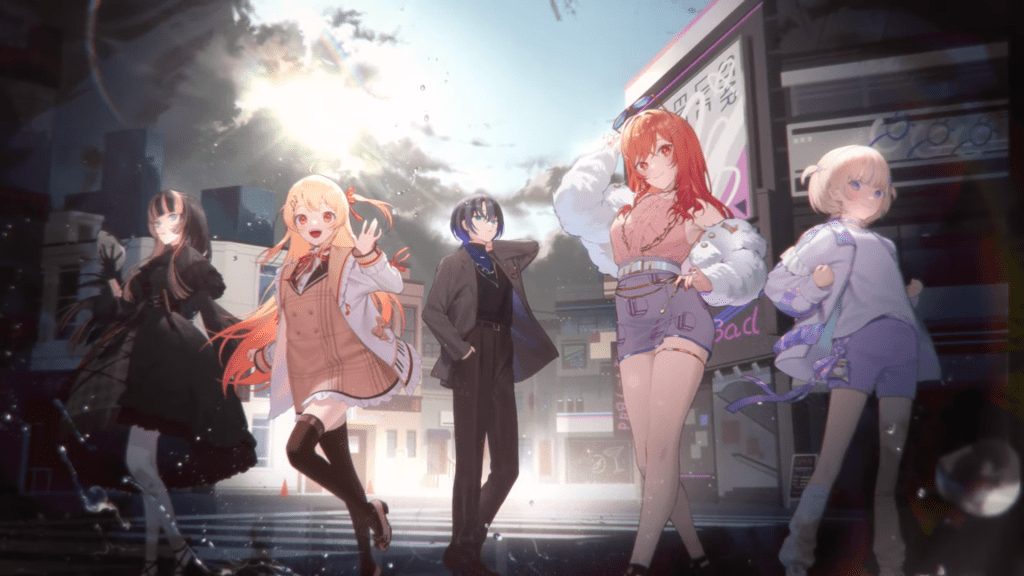
Hololive just announced a new group of Virtual Youtubers, collectively called ReGLOSS. Ever since the Hololive Splash Party concert at the end of August, there have been numerous teasers for something called “hololive DEV_IS,” and these new members seem to be the first project under that banner. Now we have both their appearances and a debut music video, one thing that stands out to me: The girls of ReGLOSS have surprisingly clean character designs.
Most VTuber designs take what I’ve referred to as a “maximalist” approach. Typically, a Virtual Youtuber wants their essence to be easily identifiable at a glance, and so most will have things like wild hairdos, horns, animal ears, and complex outfits on display. The most recent Hololive English generation, Advent, features all these attributes and more. While there are exceptions, this is the general trend.
In comparison, the ReGLOSS designs are actually quite subdued. Sure, they’re still pretty flashy, but they’re somewhat less elaborate than even typical IRL human idol or Kpop fare. The fact that all five members’ outfits are coordinated with one another is new and different—rarely have generations looked this cohesive. (And if anything, they kinda look like they stepped out of the anime RahXephon.)
As for why Hololive has decided to go this angle, I wonder if it’s because they seem poised to be a music group first and foremost, and there isn’t as much of a need to go big with the designs. Perhaps it’s no coincidence that another major Hololive singer, AZKi, has herself gotten more elegant redesigns over time. That said, I’d be shocked if they didn’t stream at least a decent amount, as that connection with the fans has been a boon to the followings of all the various musicians in Hololive.
For now, I’m pleasantly surprised. While I appreciate plenty of VTubers with maximalist designs (including Advent), I have wondered if that “arms race” has gone a bit overboard. If ReGLOSS finds success, maybe we’ll see a turn back to simpler and more refined aesthetics (if we ever really had them at all).
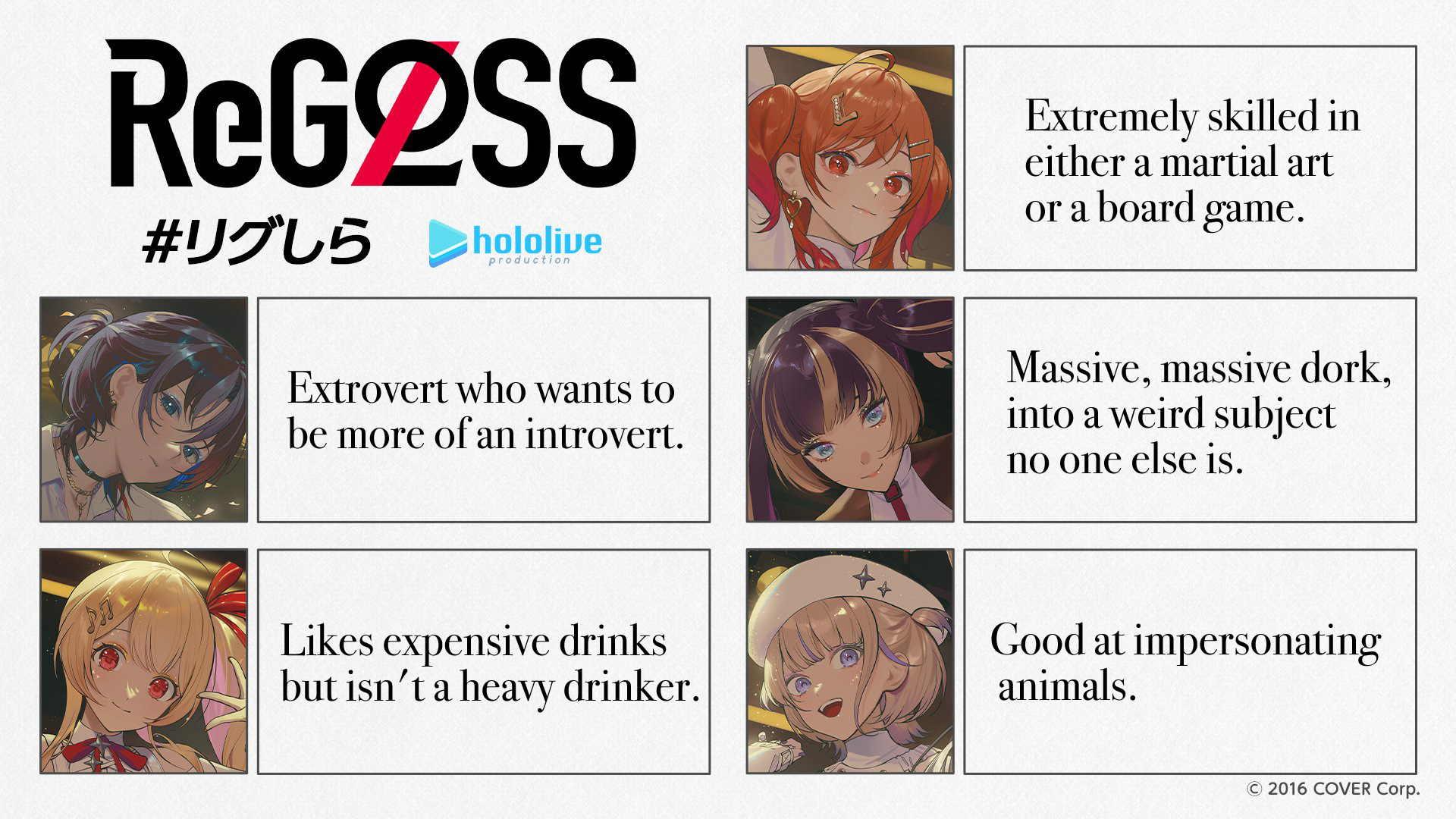
PS: While it’s somewhat futile to speculate about what they’re really like, Hololive seems to be very aware of this, and has created an image and hashtag for fans to predict what they’re like. So I figured, why not join in on the fun?
PPS: Hololive has also revealed their casual outfits. Though they no longer match, I think everything I said about their designs still stands—even Raden’s.
I don’t know if it’s the record heat waves or just the sheer amount of things going in life, but the summer has felt incredibly long. But now that it’s the final stretch, I’m sure I’ll be missing it soon enough.
During this time, I also managed to watch both Shin Ultraman and Shin Kamen Rider, so expect some reviews of those sooner than later. In the meantime, I’d also like to mourn the loss of gfycat, which provided many a useful moving record for both mirth and study. I didn’t use the site much for Ogiue Maniax, but I have been updating a few posts here and there.
September Patreon subscribers! Thank you to the following—
A post about the new Hololive dog twins and their preferred name pronunciations.
Kio Shimoku
Kio mostly talks about Elden Ring, but also, check out that high-resolution Ogiue art!
Closing
I watched the Hololive Summer 2023 concert, and it was a blast. There were some issues with the viewing platform that ended up with the entire Day 1 concert being streamed for free on Youtube for the next month, and I’m thankful for that because it meant being able to easily watch Holotori strut their stuff over and over. The fact that Day 2 has holoX’s performance of their new song, “Labyrinthine Labyrinth,” as part of the free preview makes me feel like I won a small lottery again. I also highly recommend checking out the last song in the Day 2 preview, especially those who love 80s anime.
And now Hololive Myth 3rd Anniversary is coming up! It’s amazing to reflect on how much time has passed, and how directly it’s tied to the COVID-19 pandemic. No, I will never forget about that.
The first Virtual YouTuber to really pull me into Hololive was none other than Akai Haato, aka Haachama. She’s currently on an indefinite break for health reasons, so I wanted to support her even when she’s not streaming by writing about why she’s still an all-time favorite of mine.
As Hololive continues to grow, it pulls in more and more ridiculously creative people. Whether it’s through singing and dancing, language skills, gaming ability, comedic chops, charisma, or more, they prove time and again to be a collection of extremely talented individuals.
Haachama is not exceptionally strong in most categories—more a Jack of All Trades. However, there are a couple areas where she outshines just about everyone else: experimentation and adaptation.
To VTuber fans, the roller coaster that is the Haachama experience is well known at this point. Originally joining Hololive to play a tsundere high school girl, she began to take on an increasingly unhinged character personality as she spent four years abroad in Australia, including during the height of COVID. Her experimentation during this time with videos and editing was in part her making the best of a bad situation, i.e. notoriously terrible Australian internet, but it nevertheless laid the foundation for much of Haachama’s fame. The Haachama Cooking videos, where she would confidently and genuinely demonstrate some of the biggest culinary crimes, are just one example of the lengths she’s willing to go.
Fans began to joke that Akai Haato the tsundere and Haachama the unbridled horror were actually two different personalities, with the latter overpowering the former. They even created fanart about it. But then one day, Haachama began to stream as Haato again, using her old catchphrases that she had long since rejected. This culminated in what’s known as the #Coexist Arc, where Haachama seemed to imply that Haato and Haachama were actually sisters who went through some kind of unspeakable tragedy, and that both personalities now inhabit the same body while battling for supremacy. In practical terms, the result is that she now sometimes streams Haato-style (more mellow and relaxed) and sometimes Haachama-style (manic and intense).
In other words, Haachama took a joke from the fans, added her own spin on it to create a kind of semi-interactive lore, and then parlayed it into a way to expand her repertoire and not get boxed into one way of being. Very few Hololive members or even VTubers in general are willing to take such risks with their branding and image, yet Haachama seems to experiment endlessly with what she can be.
It’s important to note, though, that Haachama is also fairly shrewd. She has mentioned that the reason she started changing her character was in order to fill a hole in what Hololive lacked at the time, and her decision was to be a little more “Nijisanji.” The two companies are somewhat defined by their inaugural VTubers—Hololive with Tokino Sora as ideal idol and Nijisanji with the elegantly crass Tsukino Mito—and Haachama as unpredictable idol carries shades of both. This is her adaptability in action.
I previously compared Haachama to the late pro wrestler Brian Pillman because of how his drastic change from white-meat babyface to loose cannon was similar to hers. Since then, it’s clear to me that she’s more of a Matt Hardy—being performers who repeatedly reinvent themselves to either keep up or defy the times. “Haachama the Eldritch entity” is not that far off from the bizarre and imaginative transformation of “Broken” Matt Hardy and the way Matt would play with history and expectations. Neither seem to be satisfied settling into one mode of performance.
I don’t necessarily love everything Haachama does. There are times when she swings big and misses. But even when one stream or project flops, I enjoy seeing Haachama continue to try new things. One prominent example is how she no longer releases Haachama Cooking videos where she eats weird ingredients (like tarantulas) and approaches food with zero practical kitchen skills. Instead, she has moved towards making real progress in actual meal preparation. I miss the absurdity but love her adventurousness.
Haachama pushes boundaries, always seemingly looking for avenues of change. It can be rough for her when things don’t turn out as she intended, but her ability to entertain and renew herself is hard to match. It might make her branding a bit inconsistent, but that plays into her presence all the more. Sometimes, she’s so unpredictable that she does the most predictable thing. I hope that whenever she makes a full recovery, she can come back and still be proud of what she’s accomplished.
The new Hololive English generation, HoloAdvent, has made their debut after more than two years of waiting. Among the five Virtual Youtubers are actually a pair of twins—the Abyssgard sisters Fuwawa and Mococo, collectively known as FuwaMoco. And while there is a lot to potentially talk about (including the fact that Fuwawa is a Genshiken fan!!!), I want to focus on one thing: The pronunciation of their names.
During their inaugural stream, Fuwawa and Mococo made some requests to viewers about their names. First, their last name isn’t pronounced “a-BYSS-gard” but rather A-byss-gard.” Second, their first names are “FU-wa-wa” and “MO-co-co,” and notfu-WA-wa” and “mo-CO-co.” With those specifics, FuwaMoco has brought overseas Hololive fans back into the realm of “pitch accent,” a prevalent element of the Japanese language.
The Pitch Accent Rabbit Hole
Much has been said about Japanese and pitch accent already. Multiple language-learning Youtubers, such Dougen and Yuta, have dedicated videos to the topic. Use of pitch accent can differentiate meanings of words, but more often, hitting the correct pitches can make your Japanese sound more natural and easier to understand for native speakers.
In the realm of Hololive, it’s one of the things that makes Inugami Korone’s regional accent so distinct. As heard in the above video, her pitch accents are very different from those of the more standard Japanese spoken by Murasaki Shion.
It’s even to the point that native Japanese speakers can have trouble with Korone. However, because pitch accent is hard to teach from a textbook and not as prominent in English, it can be a challenge for those going from English to Japanese to even pick up on the differences. Even in those Korone videos, there are comments from people saying that they can’t really hear the difference.
Nailing FuwaMoco’s Names
Incorrect pitch accent isn’t necessarily a deal breaker when it comes to learning Japanese, and how much you want to devote to it is a matter of personal priority. Is sounding closer to native speech more important than learning a wider vocabulary or memorizing kanji, for example? But if your goal is to pronounce FuwaMoco’s names correctly, then you can start from there.
Let’s first look at their family name, Abyssgard. While technically it’d be “Abisugaado” in Japanese, for our purposes, we can ignore those particulars (and in fact, FuwaMoco do the same.)
When focusing on the “Abyss” part of it, the incorrect pronunciation is “a-BYSS” and the correct one is A-byss.” When wrong, it sounds more like the English word “amiss,” while the right one is closer to how you’d say “pumice.”
“Pumice Guard.”
“Abyssgard.”
You can then carry that distinction to their given names, Fuwawa and Mococo, because those follow a similar pattern: FU-wa-wa and MO-co-co.
Going Forward
Keep in mind that the above guide is not a universal rule or anything. If you continue to study Japanese pronunciation, you’ll definitely find plenty of words that don’t follow those specific pitch accents. Also, regardless of whether you can say their names perfectly without effort or you find it to be a struggle, it doesn’t make you less of a fan.
Concerts are normally not my thing. I’ll attend them at anime cons as an extension of my greater fandom, but I typically don’t travel specifically for music events.
That all changed with Hololive English’s inaugural live concert, Connect the World. Well, sort of. Attending a Virtual Youtuber concert can be viewed as a natural consequence of being an otaku, but it’s also akin to seeing a KPop and J-Idol group. Either way, my fondness for the stars’ antics outside of musical performance was just as much a motivation to see them as the concert stuff. And as the very first Hololive concert to be held in the US, I felt that I had to at least try to go. I might never have such an opportunity again, because as much as I’d love to attend the Holo Fes events in Japan, it’s just not realistic for me.
So with a bit of luck and perseverance (and lots of angry cursing at Ticketmaster), I managed to secure myself a ticket and a pretty decent seat. Fast forward a few months later, and there I was with penlight in hand, cheering alongside 5,999 other Holo fans. It was a fantastic overall experience, and I’m grateful to have been a part of this moment in VTuber history.
Summary
Connect the World began with a message in English from A-chan, whose role in Hololive can be described as the ultimate behind-the-scenes pillar. A central figure in the development of Hololive from its humble beginnings, she has garnered a fandom of her own that made itself known through enthusiastic cheers. The concert then went into full swing with a full-roster performance of the Hololive signature theme “Shiny Smily Story,” followed by ten individual performances from the EN girls, two guest numbers by reps from Hololive Japan and Hololive Indonesia, three generational songs, the titular “Connect the World,” and then an encore with “Kirameki Rider.”
Unlike later Hatsune Miku concerts with full-on 3D holograms, this was done with a flat projection screen and additional monitors on the side—similar to what is done even in the Japan events. So it wasn’t the fully immersive experience one might expect, but I think part of the “live” feel actually comes from being shoulder to shoulder with one’s fellow fans. In other words, we help make it “real” just as much as the VTubers.
The Opening Acts Were Made for Me
I feel incredibly blessed that the first couple of solos were by two of my favorites in EN. The first, Hakos Baelz, is nearly undisputed as the best dancer in Hololive EN (as well as being one of the strongest in Hololive as a whole), and I couldn’t help but be drawn to her as she killed the dance floor. Even basic movements, like swaying left and right during “Shiny Smily Story,” carried a sense of poise and confidence when executed by Bae, and she continued that same spirit into her original song “Psycho.” Almost as impressive was her singing, which possessed a powerful throatiness that I enjoyed a lot and fit the song well. Someday, I’d love to see her more energetic movements alongside the amazing rhythm and fluidity of fellow dancer extraordinaire La+ Darknesss.
I’ve read people’s complaints about how the camera work didn’t do Bae’s self-designed choreography justice, and I can sympathize. Seeing it live really drove home how beautifully she moves, and I feel fortunate to be among those who could witness it straight on and uninterrupted. That being said, I feel like the criticism of the camera can be overly harsh, not only because I think it has its moments but also because the approach taken is meant to play it safe. In other words, it’s better at hiding flaws than accentuating strengths—sometimes it works, and sometimes it doesn’t.
The second star on stage, Amelia Watson, went with her first and only original song, “Chiku Taku.” For Amelia, neither singing nor dancing have ever been her strong suits, but part of the joy of witnessing Amelia on stage is in experiencing her energy and seeing the strides she has made with respect to the “idol” aspects of being a Hololive VTuber. The highlight for me was the kicking motions in her dance—what I’ve since learned is ska dancing, or “skanking.”
Having both of the above performances be in the free YouTube preview works out in my favor, as it means I get to revisit them as much as I want. The fact that Bae was also part of the free preview at the Holo 4th Fes Deco*27 stage makes me think that they know full well what a draw she is.
Other Favorites
One stand-out moment was IRyS’s “Gravity,” which is my favorite of her originals, as well as one of the Hololive songs I love most. I was happy to hear IRyS herself say that she’s partial to “Gravity” as well. The song just accentuates her talents as a vocalist, especially because it has that illusion of effortlessness that only comes when someone is immensely skilled at something. I feel like I achieved something just by hearing it live.
Later when the EN girls did their group songs, IRyS actually ended up with another solo performance just because she’s technically a generation unto herself. This has led to multiple jokes from fans and from IRyS alike—“Who do you like more, IRyS or IRyS?” Incidentally, prior to the start of the concert, I was chatting with a friend about her, where I mentioned wanting to hear “Gravity,” and in response, he said that he really wanted her to sing “Caesura of Despair.” That just so happened to be her second song, and while we had no actual say in the song list, it’s fun to pretend that we willed it into existence. Between both tunes, they really show off the crystal clarity of IRyS’s voice.
I expected that we’d get some surprises at Connect the World, but I didn’t expect the debut of two new original songs, one by Gawr Gura and the other by Ouro Kronii. Truth be told, I don’t listen to enough Hololive songs to always know what is a cover, what is an original, and what is brand new, but they both sounded unfamiliar to me at the time. Gura’s “Full Color” and Kronii’s “Souten ni Moyu” both fit their respective characters, personalities, and voices very well, and I think they’re each VTuber’s best songs to date. Neither has an official release yet, but I’m definitely looking forward to them.
The Teaser
After the encore was a mysterious teaser that had the audience clamoring. Featuring stills of fiery imagery and ending with a symbol that somewhat resembles a toothy grin, the natural assumption is that this is the long-awaited next generation of Hololive—the first since 2021. With no other info at this point, it’s anyone’s guess as to what it all means.
Given the dark tones of the teaser, my hope is that it’s some kind of heel faction. Obviously it wouldn’t work quite like pro wrestling—you don’t actually want the viewers to despise them—but I imagine them dropping in to interrupt songs as they begin and talking smack as they belt out some tunes. Hololive EN also has a tendency to start with elaborate lore that then falls by the wayside, so I don’t know if they could maintain that sort of gimmick for long.
Issues
There were a few hiccups at the event, and I don’t just mean Amelia’s at the end of “Chiku Taku.”
The first was that the monitors on each side were off-sync from the main screen, which made looking back and forth between them kind of awkward. The second was that the singing could sound a bit chimpunky at times. Was it the audio equipment at the venue or maybe something else, like use of pitch correction? I don’t have the knowledge to diagnose that sort of thing, so I’ll leave it to the experts.
Technical problems aside, I had also hoped to see more interactions between the different branches English, Indonesia, and Japan, but there wasn’t any mingling. I suspect that they wanted to just do the basics and save stuff for future concerts. I recall a similar situation with JAM Project’s first US appearance at Otakon 2008, where it was almost like an introduction to the American audience.
None of these things are deal breakers, particularly because I understand that the sheer complexity of trying to pull off a huge concert with 3D models means something might not work as intended. Take these as minor quibbles among an overall great experience.
Final Thoughts
I’m proud to have been part of this first Hololive concert in the US. I feel content knowing that I got to see some of my favorite entertainers shine on stage. I do hope we get a blu-ray soon, though, as I would like to have a permanent physical way to re-watch it. Then again, the 4th Fes blu-ray isn’t even out yet, so we might be waiting a good while longer.
I hope we get to see more international concerts in the future so that others have the opportunity to go in person, even if I end up being personally unable to attend them. Of course, depending on location and lineup (Haachama and La+ in particular), I might just have to find a way again.
And now that I’ve gone to a concert for virtual idols, who knows what’s next? Maybe I’ll attend some concerts by 100% flesh-and-blood musicians as well. Ironically, the VTuber rabbit hole might just lead me back to the real world.
How much should we do what we’re good at vs. to what extent should we try to work on our weaker areas? And to what end? I’ve been contemplating these questions because of the Virtual Youtuber Calliope Mori.
There used to be an ad campaign in the 2000s for the beer Dos Equis featuring a charismatic older gentleman described as “The Most Interesting Man in the World.” The commercials would boast about his accomplishments, and even occasionally have him wittily comment on various topics. In one case, his advice on careers was “Find out what it is in life that you don’t do well, and don’t do that thing.” It‘s a statement that can be taken as “know your strengths and play to them,” but this and similar sentiments have me contemplating the ways in which we as people navigate the notion of self-improvement.
That’s where Calliope Mori comes in. One of the most popular VTubers in the world, the central theme of her persona is that she is a “rapping reaper”—a death god who has bars for days while also presenting a very anime aesthetic. A lot of her early success was built on her rap skills, and it’s given her both fame and fortune, including a major deal with Universal Music Japan. Yet, rather than stick to the image of the “hip-hop anime girl,” Calli has more recently delved into two areas she feels less experienced in: cuteness and singing.
Among VTubers, being adorable and singing well are certainly not uncommon traits. Her genmate Gawr Gura (featured in the above collaboration, “Q”) is a prime example, and Calli going this route means being compared to the Guras of the world. But while Calli’s qualities (especially her rap skills) are much rarer and help her to stand out among the crowd, she’s also mentioned a desire to work on both cuteness and singing ability. For example, she originally asked if she could have a character model that was short and flat-chested, closer to her ideal image of cuteness. Calli has also been doing covers of cute songs like “Kawaikute Gomen” and “Idol,” the opening for Oshi no Ko. It’s a move that has gotten both positive and negative feedback, some of which has been on the extreme side.
The worst comments seem to stem from the idea that one shouldn’t be putting content like this out unless they match a very high and often gatekeeping standard, and I find it sad and awfully pathetic to attack someone who is trying to do what they want while aware that they’re not the best at it, rather than just be mature and ignore what you don’t like.
Certainly, Calli could only try to operate outside her wheelhouse because she’s had financial success through Hololive and the support of a fanbase that wants to see her do well. It’s a far cry from telling someone barely scraping by to just “do what you feel like, even if you’re not necessarily going to be great at it.” But while Calli has a fairly privileged position, the fact that she’s willing to learn and experiment in the public eye, all while doing things that don’t come as easily to her, is admirable. It would be a terrible thing if people are discouraged from trying unusual things because of the backlash Calli receives. My hope is that everyone, Calli included, does not lose heart.
I like my social media to be text-focused. I’m not camera shy, but I don’t like that to be my primary form of exposure to the world. TikTok isn’t for me, and fair disclaimer: I still have no experience with it. However, when I reflect on my preferences, I remember one significant difference between the internet experienced by Zoomers vs. previous generations: the sheer deluge of disinformation that proliferates in more recent times. In this respect, the desire for a social media platform that emphasizes personal-feeling videos might allow for a slightly better (but inevitably imperfect) defense against bad actors.
One of the challenges of appealing to younger people on TikTok is that they value authenticity. It’s a nebulous term to be sure, but sleek traditional marketing campaigns can fall short for people who feel distrust when things look a little too polished. This is not to say that TikTok is free from scam artists and propagandists—far from it—but when I began to think more about the nature of text-based online communication, I recall the sheer number of fake accounts that are created to spread false information.
A white supremacist can grab a stock photo of a black person and then engage in digital blackface to share harmful political and social messages. Bots use artificially generated profile pictures to create entirely fake personalities to amplify some poisonous ideology, and if people aren’t looking carefully, one can be fooled into thinking they’re authentic. In contrast, it takes a lot more work to pretend to be black on a video platform than it is on one where all you need is a stolen or fabricated headshot. Deepfakes are an issue, but they’re not at the point where they’re nigh-impossible to spot—at least not yet.
Of course, TikTok is not immune to disinformation. It just disseminates differently, and adjusts itself to an online culture that is not only more video-based but also focused on being “short and sweet”—little nuggets of “wisdom” and “knowledge” that are anything but. I have my concerns about the way TikTok’s algorithm might be even better at sucking people down rabbit holes. That said, I think the difference in this moment in time might be that the imposter who’s claiming to be someone they’re not has to at least put in more effort to pull the charade off.






 OGIUE MANIAX