The Real Meaning of djWHEAT’s “Growing eSports”

In a recent video interview by Marcus “djWHEAT” Graham about the world of eSports, djWHEAT espouses his beliefs on how eSports can grow, and that in defiance to the doom and gloom that surrounds declining numbers in games such as Starcraft II there is steady growth in both the idea of video games as sport as well as streaming. One of the frequent criticisms I see from people towards djWHEAT’s philosophy is that for most people, eSports as a whole doesn’t matter, and that if their game is the one that’s doing worse, then little else matters because they are not going to jump ship to another game just because. However, I feel that this view is something of a shortsighted misunderstanding on djWHEAT’s viewpoint, and one that limits itself not only to an unfortunate a favored game vs. an evil usurper context, but to an ephemeral present too narrow in scope.

When I hear djWHEAT talk about how the growth of one game can benefit eSports as a whole, and that people leaving Starcraft II for League of Legends or other games is not such a bad thing, I do not interpret it as this idea that the games don’t matter, that they’re just interchangeable within this structure of the competitive gaming scene. Rather, it has more to do with increasing the presence of eSports as a concept to the point that it gets as close to a commonly understood idea as possible, not just among gamers but among non-gamers as well. While one can argue that there will always be economic limitations to how much eSports can grow, this does not mean that there is a limit on growth in terms of exposure and acceptance. The more people know about competitive gaming, whether that’s through friends or family, or seeing matches online, or through playing the games themselves, or even just from a random guy on the street, the greater the opportunity for eSports to never truly fade away.

The scene might wane. It might become a fraction of what it was. However, establishing a cultural foothold by just having enough people positively experience eSports through games—whether it’s StarcraftStreet Fighter, DOTAPokemon, or something else—creates a mental and emotional connection more difficult to take away than money and eyeballs. If we look at Japanese anime, for example, there are certain titles (again, such as Pokemon) which, regardless of how you judge their quality, made the idea of anime simply better known and more acceptable to a wider range of people than just an existing hardcore fanbase.

I find that djWHEAT’s vision is one for the future beyond the myopic squabbling we see now, one where the ground is more fertile for the potential growth of new eSports-capable video games in a way which does indeed benefit everyone. Let’s say for the sake of argument that Starcraft II is fated to die out in a year, that it is on a downward and unrecoverable spiral. In light of this scenario, I want to give two alternate realities where this could be happening: one is where Starcraft II is the only game in town, the only game people consider competitive in any way, and the other is where Starcraft II is but a fraction of a complex milieu of a society in which eSports is known and accepted.

In the first, when Starcraft II goes, so too does the notion of competitive gaming, and if ever some game developer wanted to make their own Starcraft, they would have to start from scratch in more ways than one. People would see Starcraft as an anomaly, something which fell with no viable alternatives, and the creators of this new game would have to convince people all over again that this was a worthwhile notion, that people enjoy spectating games just as much as they enjoy playing them, and that there are positives to creating a competitive video game for the benefit of viewers.

In the second, on the other hand, when Starcraft II dies out, the notion that competitive gaming is viable would still be part of the public consciousness. It may not have ended up working for this particular title due to some combination of reasons, but future game developers could look at it and ask, “Where did it go right, and where did it go wrong?” When they go to try and get funding and support, they can point to other games which have been successful, games which companies might even already know about as eSports, and say, “We know what mistakes Starcraft II made and we can adjust accordingly. And, as you well know, there are plenty of examples of this model working.”

In both cases, there is a chance for a new and better spiritual successor to appear and grab all of the fans who once supported that game, but where in the first reality a single company would have to struggle just to introduce the idea of competitive gaming, in the second reality the notion of eSports would be accepted enough that there wouldn’t just be one company trying to create the next Starcraft (or any game of your choice), but five or maybe even ten companies, all eager to re-capture and even improve upon the things that made it so widely viewed and adored in the first place. The potential would not only always be there, but it would be so visible that it would continuously inspire game creators, as well as players, casters, everyone, to seize that opportunity.

Essentially, what djWHEAT is advocating when he says that the growth of one eSport is beneficial to all is not simply the product of a “let’s all get along” mentality. Instead, it is based on the idea that the more “eSports” becomes a solid concept in people’s minds through exposure, the better chance future games and gamers will have of fostering and being fostered by that positive environment, an environment which benefits all competitive games past, present, and future, whether a game’s life span is 50 days or 50 years.

Pokemon as eSport

As an avid watcher of professional Starcraft I constantly hear of all the strengths and weaknesses of various video games as spectator sports. Starcraft, for instance, has tons of strategic depth and is also visually clear in many ways, but often times the complexity of a given player’s battle plan requires a commentator to explain it in detail, and differentiations in individual army units can be confusing for someone who’s never had experience with similar games. Compare this with soccer, where “kick ball into goal” is clear as day, or even fighting games, where life bars and graphical depictions of punches and kicks tell the story. So with all eSports, one issue is always, how far removed is the game from reality? If it’s too abstracted then it becomes a game mainly for the devoted or hardcore, which is fine, but spectatorship is the question here.

This got me to thinking, what about Pokemon? While Pokemon is pretty far-removed both in terms of its menu-based gameplay and the sheer number of Pokemon and attacks and the complex rock-paper-scissors chart that makes up the 17 types, I wonder if Pokemon can get around all of this by just being so internationally famous that a possible majority of people under a certain age have had some experience with Pokemon, be it through the video games or the anime or their friends/relatives telling them about how Rock beats Flying. If it’s a common-enough experience, then maybe there’s not as much immediate need for realism or explanation.

On top of that, Pokemon has always been quite robust when it comes to strategy, to the extent that not only have there been multiple tournaments over the years (see the recent Pokemon Video Game Championships for example), but there have been a number of sites dedicated to exploring strategy and tactics in Pokemon, whether that’s Smogon or predecessors such as Azure Heights. These forums manage to bring together the very young up to people well into their adulthoods.

Granted, there are a number of drawbacks and setback that could stifle Pokemon as eSport despite its popularity and penetration. The first is that it’s likely Nintendo would never entirely support a competitive Pokemon scene which fuels people’s salaries, especially because part of the appeal and atmosphere in Pokemon has to do with empowering players to feel strong and special and to bond with the Pokemon they catch and train. Ideally, a competitive version would just allow you to customize your Pokemon (and there have been online simulators over the years which allow this), but I doubt Nintendo would ever approve of such a thing themselves. The second problem is that Pokemon’s strategy and difficulty is purely in the mind, whether that’s coming up with ideas on the fly or memorizing statistics, and while plenty of games have those elements the fact that Pokemon is turn-based means there is no physical rigor involved. No one will mention someone’s fabulous micromanagement. No one will be impressed by 400 APM (actions per minute) when the game really only takes 1 APM.

In any case, while I’m not terribly optimistic of Pokemon Battling becoming a career, I still would like to think that some day there may be a game that is so commonly known that it’s a matter of course for it to enter a competitive realm accepted by many. I mean, more than League of Legends even.

I guess the only thing to leave you is an actual competition video of Pokemon, to see what people think.

The Future of iDOLM@STER is Gyrozetter

I have a theory: Chousoku Henkei Gyrozetter actually takes place in the same world as The iDOLM@STER many years into the future. I’m going to lay out my ideas for how this transition comes about while also providing ironclad proof of their shared universe.

1) Inaba Rinne is a Futami Descendant

It’s not clear which of the Futami twins Rinne is descended from, but most likely it’s Mami. It’s not clear just how many generations into the future Rinne is removed from Ami and Mami, but Futami genetics are undeniably strong.

The resemblance is uncanny.

2) The Success of 765 Pro and the Start of the AI Car Boom

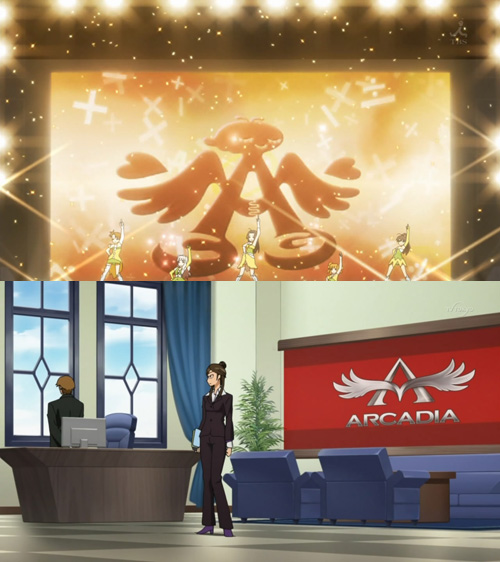
Thanks to a combination of talent, spirit, and camaraderie, 765 Productions becomes wildly successful. At first, they do only promotions for car companies, but thanks to rich girl Minase Iori’s connections and the advancement of technology 765 Pro manages to start their own automobile line. They name the car company offshoot “Arcadia,” modifying their logo along the way.


Assistants to the CEO continue to dress in black suits in honor of Akizuki Ritsuko.

3) Shijou Takane is Responsible for the Rosettagraphy

At first glance, the Rosettagraphy makes no sense. A mysterious stone tablet that tells humanity how to build advanced cars that turn into robots? It sounds like nonsense, until you remember that Takane is equally engimatic, and that she is capable of speaking in many tongues. As we can clearly tell now, it’s because she holds the secrets of not only technological growth but also of prophecy. If she had revealed it to humanity too soon, who knows what would’ve happened?

Takane was a Messenger in Many Ways.

4) Gyrozetter AIs are Actually Based on 765 Idols

How else would you explain this?

I rest my case.

My Conversation with a Singapore Mahjong Expert

Because of mahjong anime, I gained an interest in Japanese mahjong. And because I played so much Japanese mahjong and continued to consume anime and manga based on it, I began to wonder what it would be like if there was a series based on having to play all of the different styles of mahjong which exist around the world. This has led me to do some research and even attempts to play other styles of mahjong, and in fact the first post I made on this blog about other styles of mahjong was about Singapore-style. At the time, the only way I could play it was a single player java program, so no matter what my speculations about strategy and gameplay were the result of a very limited experience.

Since then, I’ve been able to find a website which allows me to play some form of Singapore mahjong against human opponents, and through it I’ve been able to put to the test some of my musings on Singapore mahjong from that post. Looking back, the post turns out to have been decently accurate, but I am of course still very much a beginner at it, so I wanted to find someone with more perspective and experience. That’s how I came across Singapore Sparrows, site dedicated to mahjong in Singapore (primarily the MCR—more on that another time—and Singapore styles), and through it managed to have an interesting and enlightening conversation concerning the similarities and differences between Japanese and Singapore mahjong.

I recommend reading the entire post as well as my follow-up comment, but to summarize I asked the blog owner Edwin a series of questions about strategy in Singapore mahjong, especially because the Singapore style has far fewer hands than Japanese and therefore the hands felt comparatively less fluid. Edwin brought up the fact that not only does Singapore mahjong have things called bonus tiles which can net you points just for drawing them, but it has more bonus tiles than probably any other style of mahjong, and so in his opinion the bonus tiles function in a capacity similar to cheap hands in Japanese-style such as tanyao and iipeikou.

Thinking about the function of bonus tiles, I speculated that rather than fulfilling the role of those smaller value hands, they were more akin to calling riichi: ways to empower worthless hands and give them some teeth and a chance to win. The big difference is that with bonus tiles they are the catalyst to deviate your hand into something simpler, whereas calling riichi always exists as an optional goal, beginning vs. end, but both carry risks unique to each version of the game.

Now, when considering how this would impact a narrative about a game of Singapore mahjong, the flower tiles really are wild cards, and I could see some maverick of a hero taking a risk to get just the right bonus tiles he or she needs, a foolish move normally, but one that the hero recognizes is the only path to victory. Along with all of that animal tile imagery of cats eating mice and chickens eating bugs, panels could be filled with really elaborate nature imagery.

Another fascinating point brought by Edwin was the way in which pinfu (or ping hu) hands in Singapore mahjong really influence the way the game is played. If you play riichi mahjong you may think pinfu hands are important because of how quick and probable they are, but their potency is nothing compared to Singapore pinfu. Not only can it be played open, but it has a special stipulation which makes it either a weak, simple 1 han (tai in Singapore-style lingo) or a monstrous and deadly 4 han hand, controlled by the presence or absence of bonus tiles (no bonus tiles means 4 han). As such, many players will aim for “ping hu,” but because it’s so clearly a good option no matter what, players of Singapore mahjong are also especially wary of its dualistic lamb/lion status. If you have no bonus tiles and a couple of open straights in your hand, people will get mighty suspicious and the player to your left will try to figure out ways to avoid dealing out tiles you need for your straights. It’s a dimension of strategy that is in many ways different from Japanese-style mahjong, and it’s the sort of thing that encourages me to try more styles.

And of course, the variable strength of Singapore pinfu is also a perfect place for some dramatic storytelling. Can’t you imagine a Washizu-esque villain playing his masterful 4 tai ping hu, ready to destroy his opponent, when suddenly he draws a flower bonus tile and all of his beautiful machinations slip through his fingers like sand? Can’t you imagine his agony as the hero willingly deals into the significantly downgraded hand, giving poor Singaporean Washizu a rather pyrrhic victory?

Fun times. Fun, fun times. Incidentally, thanks to mahjong comrade Dave I learned that Mahjong Hime allows you to play both Singapore and Taiwanese styles. Most likely, my next post regarding the hypothetical International Mahjong Manga will be about Taiwanese mahjong.

Psycho-Pass, the Forbidden Word, My Thoughts

People have been making kind of a big deal about how the director of the new anime Psycho-Pass, Motohiro Katsuyuki, has mentioned banning usage of the word “moe” among the staff, in order to counter current trends in anime. I’ve seen some people take this as a psuedo-rallying point, a sort of “BOOYAH! In your face, MOE!” attitude. I’ve seen reactions taking it as an attack on moe, a “Why are you so unenlightened?” response. For me, when I first read about it, I laughed, not because I’m for moe or against it, but I immediately thought of how ambiguous a word like moe could be and how it can potentially impact the creative process by being so ambiguous.

Other than the information we already have, I don’t have any insight into the production of Psycho-Pass so everything from here is purely hypothetical and speculative.

When you think about actually having the word moe be a part of discussions when creating an anime, you inevitably have to deal with “moe” as a conscious effort, and I can imagine it impacting the direction of a work. This is not an inherently bad thing, but I feel that just by banning the word you might end up having to explain things more concretely, or at least in a way that doesn’t use such specialized language. In some ways, I can see how “make it more moe” as a way of describing how something should be can be about as helpful as asking someone to “make it 20% cooler,” as the My Little Pony saying goes.

To say a word is banned doesn’t meant that elements won’t slip back in. Let’s replace “moe” with “hardcore.” Imagine if the interview said, “We banned the word ‘hardcore’ from our staff meetings.” While you might not have direct references to pro wrestling or other similar material, there’s a fair chance some kind of physicality or extreme imagery might make it back in. I don’t know if it’ll really happen with Psycho-Pass, but moe does not need a specific directive for it to appear. Even without the intent behind it, it can still happen.

Roger Klotz Dubbing

There’s been a tendency in English anime dubs of children’s shows that I’ve noticed for a while now, which is this tendency to imbue characters with ATTITUDE where previously there was none, or at the very least not such an overt presence as such. Basically, what dubs do is turn Doug Funnie, nice average guy with some decent qualities, into a Roger Klotz, a snarkier sort who’s quick to deliver verbal jabs.

After I watched the first episode of toy commercial-as-anime Monsuno in Japanese, I got this feeling that the English dub (which actually premiered months before the Japanese version) would give to characters the voices their character stereotypes expected of them. Sure enough, the nerd was incredibly nasal, and the main character, who isn’t quite Doug Funnie but is the nice sort, is cracking wise at his friends, bits of sarcasm seeping through his dialogue.

A more interesting example comes from Yu-Gi-Oh!, not so much from Yugi himself but from Kaiba. Kaiba in the Japanese version is certainly no Doug Funnie. He’s ruthless and blunt and lives by his own agenda, but what happens is that his Roger Klotz dubbing just takes these qualities to the nth degree. Where he might say something in Japanese like, “Get out of my way. I have no time to waste on you,” in English it would become, “Get your worthless existence out of my way, you dweeb. I can’t have you breathing the same air as me or it might make me sick to my stomach.” Certainly it makes Kaiba memorable in an odd sort of way, but it also gives him an entirely different set of fangs.

Have you noticed this? Is my reference to Doug too old for people at this point? Do people still watch dubs?

The High School Setting

Sometimes anime and manga as a whole are criticized for having too many stories take place in high school or involve high school students, and indeed there are a lot of titles, both good and bad, which fall into that category. While explanations range from “that’s how old a lot of readers are,” “there is a certain ideal to high school, the moment before you become an adult,” and even “so they can sexualize teenagers,” I have to wonder if it has anything to do with high school as a point of commonality among Japanese people.

Most young people in Japan go to high school (if someone can argue otherwise, please do), but once they go beyond high school their lives start to branch out more. Some go to college, some enter the work force, some go to technical training schools, and so on. This is even a plot point in some manga which make the transition out of high school such as Initial D. What this means is that, as a writer, if your aim is to have a position in life that the majority of your readers can directly relate to, then that period becomes harder to manage because not everyone will have that roughly similar experience post-high school.

Obviously this doesn’t mean that people cannot relate to characters outside of their own experience, or that people will reject heroes in unfamiliar settings, but that you end up losing that simple and easy connection. Such a loss can be overcome and frequently is, but high school perhaps remains that time people can look back to and say “I lived in that.” They might not have the magic powers or have gone to the rich school where everyone eats diamonds, but there is the thematic shorthand nevertheless.

What If Manga Had No Japan

When people in the past have argued about the definition of manga and anime, the grounds of contention have had to do with this idea of manga as “by Japan, for Japan, made in Japan,” and which pieces, if any at all, are relevant in categorizing. While I have my own ideas in this regard, I want to set that aside and ask, how would we define manga if Japan ceased to exist?

A lot of these debates occur because people bring their own values and their own priorities to “manga-ness,” such as personal desire to draw manga, or a desire to have clear-cut difference to make it easier to discuss, but generally they assume that there is a Japan, that as a nation-state, as a land mass, as a culture, it will never disappear. I do not wish this upon Japan or the Japanese, but with 3/11 and the Tohoku Earthquake and the subsequent fear of radiation, there is the possibility however small, or at least the notion implanted into our (my) thoughts, that someday there will be a great diaspora or maybe the government will have no one left to govern, and that included in this movement out of Japan would be the people who work in anime and manga.

If the vast majority of people move to the same location, is that where “manga” is located? If the artists spread around the world, and have to decide whether to draw for the scattered Japanese audience or for the country they’re now living in (with its potentially vastly different culture), are they considered manga artists either way or is there now a significant difference? What if we then fast-forwarded 100 years and now those artists had children if they didn’t have any, had maybe integrated more thoroughly into their adopted homes, and now a new generation takes over for them? If young people who grew up with the made-for-new-country comics of the now-deceased artists are drawing for that same audience but influenced by those artists’ styles which clearly derive from their days in Japan making manga, are they now manga artists too?

As it stands, I must admit that these questions don’t really impact the health or condition of manga or its fandom, but I thought about it and how it might alter the notion of Japanese-ness in anime and manga, and I thought it interesting to present, even in this half-formed state.

The Meaning of “Vanilla”

About a year ago I wrote a post wondering about the “NTR” (essentially cuckolding) genre of porn in anime and manga, and in it I had a small aside in the introduction where I mentioned the English-speaking anti-NTR fanbase that has developed in response, people who will proudly and adamantly proclaim their love of “vanilla.” At the time, I referred to these vanilla fans and their fervor as if they were an extreme response to the popularity of NTR because the intense championing of very conventional depictions of sex seemed odd (though understandable). Upon thinking about this subject again recently, however, I realized that I had overlooked something, and that one of the reasons there seems to be this contingent of vanilla supporters is that the definition of “vanilla porn,” at least according to certain fans of anime and manga, is quite a bit broader than how people would normally define it.

In general usage, vanilla (used for sex or otherwise) implies something that is ordinary and simple, and if one is being negative, bland and boring. In depictions of sex, this generally means something along the lines of missionary position between a couple. But when you look at the categories used in English to describe specific works of erotic anime and manga, you’ll sometimes get tag combinations such as “BDSM HAREM INCEST VANILLA.” I’m not making a value judgment on those other categories by any means, but I think that everyone can agree that, typically, those things don’t go hand in hand with “vanilla.”

What this has me realizing is that the ardent support for “vanilla” may be an even more direct response to NTR than I had first thought, because it ends up being defined by fans as essentially “not-NTR,” though to be more accurate it would probably be “anything that is not gay, rape, or NTR.” Given this definition-by-negation, it would seem that the most vital aspect of “vanilla” is loyalty. In this conception of vanilla, the relationships can be polygamous, they can be extreme in one way or another, but if there is a sense of betrayal or if feelings are hurt through sex, then it falls to the other side.

If you liked this post, consider becoming a sponsor of Ogiue Maniax through Patreon. You can get rewards for higher pledges, including a chance to request topics for the blog.

My First Exposure to 70s Robots

I can still remember my first exposure to pre-Gundam giant robot anime. I had a VHS fansub which at the very end had a number of retro openings on it, a preview of what was to come from that fansub group. That’s where I was first introduced to Zambot 3, which I thought looked pretty cool, and where I first got a glimpse of the 80s’ Aura Battler Dunbine, whose catchy theme song sticks with me even today. At the same time, though, I remember distinctly thinking that Koutetsu Jeeg looked like the dumbest thing ever.  I still think Jeeg is an ugly robot with its pickle legs, but it was more the overall style, fashion, choice of song, everything, that made it seem so foreign to me as an anime fan. I loved robots then as I do now, but obviously I needed some education, and I’m glad that I now know better.

I think what really sticks out in my mind in that video was the second Mazinger Z opening, mainly because of the way that Mazinger Z itself was shaded. It didn’t have the standard shine+shade of later giant robot anime, and instead had these large areas of pencil (or something like it) blocked in. When you watch the opening, you can literally see the grit of the drawing materials right there on the limbs and stomach. I hated it then, thought it made the show look old and tacky, but looking back, the way it stuck in my mind is part of why I started being able to look well past the aesthetics of 90s anime I had become so accustomed to, and to eventually realize how much the time that we’re in influences the look of everything around us, including the entertainment we watch.