How Much Does “Japanese-ness” Matter to Anime and Manga Fans?

The stereotypical image of the non-Japanese anime fan is someone who is in love with Japan. He goes by many names, mostly given by others but also self-referenced: otaku, wapanese, japanophile, weeaboo. This anime fan believes that at least part of what makes anime great is that it comes from Japan, and this imbues a certain degree of specialness or at least difference to it.

But I have to wonder, just how much is it even true that Japanese-ness is that vital component for so many anime and manga fans?

This is not to say that it definitely does not matter for people or that at the end of the day fans are better off judging things from some imagined objective stance of mighty neutrality, but rather is just me asking about where that desire for Japan may or may not exist.

Let’s talk about fans of dub voice actors, the kind who line up to get their autographs every time they appear at a convention and who vastly prefer them over their original Japanese counterparts. You can say something about how those are the voices they’re familiar with, and that they were exposed to those voices through a more accessible medium like television, but what I think is that, at the end of the day, even if Japanese-ness might be present in other areas of the anime they like, be it the character designs or the settings of the stories, “Japanese-ness of speech” itself is not as much of a factor. Having the comprehensibility and perhaps even understanding of nuance of English (or whatever language) is more important than having the characters speaking in Japanese.

Once I attended a cherry blossom festival in New York, where I saw a black girl dressed in a kimono. If it wasn’t clear that she was an anime fan, she was also surrounded by friends cosplaying Naruto characters. What was interesting about the way she wore her kimono though was that it clearly wasn’t the correct way to put one on nor the correct way to walk in one but it was obvious that she didn’t care. I got the impression that even if she knew, it wouldn’t really have mattered. While the coolness and I would even dare to say the Japanese-ness of the kimono itself was important, it was also important for her to assert her own attitude, to conform the kimono to herself rather than the other way around.

A simple hypothesis would be that a fan prefers just enough Japanese-ness for their anime and manga to seem special or different, but not so much that it becomes utterly alien or unapproachable. However, I think that would be a flawed statement for a number of reasons. First, an appeal of Japanese-ness might not necessarily equate to exoticism or Orientalism (though in many cases it probably would), and second, there is a dynamic of what people do and don’t want to be, how much they expect things to conform to their own values rather than the other way around, and so “alien” for some may be preferable. Maybe I’ll think of something better eventually.
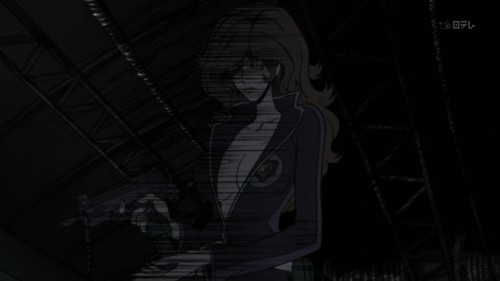
Exploring Thoughts in “Lupin the Third: The Woman Called Mine Fujiko”

This post contains spoilers from Lupin the Third: The Woman Called Mine Fujiko

Lupin the Third: The Woman Called Mine Fujiko came and went, and I think it brought with it an intriguing sort of depth and character study that differentiates it from most anime out there.

The way in which the series explores the psychology of the character Fujiko really felt like women were in charge of this show, which they were. It had not only a female writer in Okada Mari, but also a female director in Yamamoto Sayo. I think I get this impression because while Fujiko is an unpredictable character of many mysteries, the way it’s portrayed doesn’t invoke “mysterious woman” as some kind of unsolvable rubik’s cube or distant creature like I think often happens when men write about exploring a female character’s psyche. There is less peeling back the layers and more starting from the assumption that the way thinking happens on the part of Fujiko is normal.

There’s an interesting twist which happens at the end of the series where up until that final episode we think we’re learning about Fujiko’s past and that finally we get to know what makes her tick, but it turns out that all of those memories have been falsely implanted in her. That false past shown is one of rape and sexual abuse, and it created this sense that Fujiko’s life of crime and hypersexual activity is in response to that. As I was watching, I wondered how this would transform the identity of the character of Fujiko, and even whether this extreme past would make it incompatible with the rest of the Lupin the Third franchise before it’s revealed to be false information.

If the circumstances were different, the fact that we were basically fed lies perhaps might have felt like a cop-out, but I don’t see it that way at all. By subverting it at the very end I feel like that whole train of thought, the very act of considering the consequences, became a meaningful thought exercise.

Anime and Idealized Figures

When it comes to figure drawing in the western art tradition, the standard human is marked at about 7-7.5 heads tall. Increasing those proportions will result in a more idealized figure, to the point where if you want to make a figure look heroic you make him 9 heads tall. However, based on information I’ve learned from the manga drawing workshop at Anime Expo 2012 (and backed up by the Wikipedia entry on body proportions), it turns out that manga and anime much prefer a 6.5-head-tall character as its baseline, and in some cases as an ideal.

The Wiki entry gives moe as an example of where those proportions change, but even putting aside moe girls and going straight into masculine tough guy territory, what I find particularly interesting is that even some of the majestic figures in anime and manga are about 6.5 heads tall.

Reinhard von Lohengramm (right) is a genius tactician and a brilliant leader beloved by all who serve under him, someone who’s not just heroic but legendarilygalactic heroic, and yet he himself is only 6.5 heads tall, maybe 7 heads at best.

Kinnikuman is a super powered wrestler with muscles rivaling even the greatest of American comics superheroes, and yet he too ranks in at about 6.5 heads tall. The same even applies to that most recognizable of anime superheroes, Goku.

Obviously not all anime and manga characters are 6.5 heads tall, and there are plenty of tall, svelte characters who go into fashion model territory, but I have to wonder how this might affect people’s perceptions of characters both male and female. For example, are anime characters viewed as more child-like or less powerful when viewed by someone unaccustomed to manga for these reasons?

The Incredible Kaminaga: Genshiken II, Chapter 77

In Chapter 77 of Genshiken II, we learn that while many fujoshi are strong, but Kaminaga may be Strongest of All.

The cat’s out of the bag as Kaminaga learns that Hato occasionally dresses up as her doppelganger, but as much as Ogiue downplays it as coincidence, and as much as Hato’s old classmate Konno mentions that it’s because of Hato’s crush, Kaminaga has other ideas entirely. Presented with an older brother and a younger brother who dresses up like the elder’s girlfriend (and now fiancee), Kaminaga creates the pairing of Yuu x Ken, or Hato’s older brother and himself. This is made all the more outrageous by the fact that she herself is the girlfriend.

Kaminaga throws out the tough questions pertaining to Hato’s sexuality. She brings up the possibility that he might be bisexual, and also the fact that his stance of “I’m not gay but I like yaoi” is similar to the BL trope of “I’m not gay, I just love you in particular.” As Kaminaga presses the question and asks if there’s a guy Hato knows who fits that situation, Madarame shows up, though Hato’s feelings about him are still left ambiguous. Instead, Hato mentions that everything’s fine, because he has plenty of friends, male and female, who know and accept him.

I’ve previously written about how the new Genshiken members in a way resemble Kohsaka in terms of the way they’re able to combine style with their very otaku mindsets, but I feel that, more than any other, including the attractive Angela and Ohno, that Kaminaga comes closest to the idea of a “female Kohsaka.” The ways in which she so unashamedly displays her delusions, especially to a guy she just met (Hato’s brother in the previous chapter’s flashback) and eventually turned him into a lover stands in stark contrast to the complexes that the other girls have about mixing fujoshi lifestyles with significant others. Ohno has Tanaka, but Kaminaga was able to get a decidedly non-otaku boyfriend for the long-term. When you think about Kaminaga that way, her sheer confidence and simultaneous ability to not compromise her compromised mindset is a kind of inspiration.

As we learn more and more about Hato’s past and set up his potential future, I feel that part of his purpose in the story is to “challenge.” Somewhat like how Ogiue flipped the story of Genshiken upside down, Hato really pushes the envelope in terms of assumptions about the club and how otaku behave and the like. The amount of Hato x Mada material in this chapter brings up certain questions about the nature of Genshiken II, and it reminds me of the fact that the new series is more than different enough from the original to seem somewhat alien to those who may have enjoyed the previous iteration.

I’m not referring just to Madarame’s rather confused feelings, but also the way the series has given him what in another work would have been some kind of “awesome harem” but in this case is an exercise in confusion and mixed emotions. While pining for Saki (still), he’s been growing a friendship with a very convincing crossdresser, gets kissed on the cheek by one American girl, and almost gets a full on boob grab on the other American girl.

Speaking of Sue’s “attack,” it’s a reference to Rei from Fist of the North Star.

Have I ever mentioned before how nicely Kio draws the blondes’ eyelashes in the new Genshiken? He out of his way to show only their outline instead of simply using black like he did previously, and it gives them a kind of mysterious quality. Aesthetically it’s quite pleasing, though perhaps it emphasizes their foreignness a little too much? I’m not exactly sure how I feel about it other than that I like the way it ends up looking.

Actually, when you think about Kuchiki and his accidental swipe at Risa’s chest in a previous chapter, which he did while totally unconscious from being choked out by Hato and thus unable to remember, or even the way the older Yoshitake was denied the privilege of seeing Hato come out of the shower, it seems like the series likes to mess with which characters get to have things happen on-panel. The rest of the actual sexual interaction, as we know, happens, it’s just that it’s never really shown. It’s that kind of manga.

As for Ogiue, this isn’t one of her chapters, but the mere fact that she refers to using one’s own boyfriend for yaoi source material as “normal” is rather amusing, and in its own way another sign of significant change within her. Could you have imagined the old Ogi half-admitting that she’s doing the very same thing on a regular basis, and on top of that is calling it normal?

Anyway, next time is Saki time. Watch out.

Stand Aside, Book Smarts: The “Knowledgeable Girl”

While reading the Drops of God recently. I took notice of the supporting character Miyabi, a sommeliere-hopeful who assists the hero Shizuku, bolstering his seemingly supernatural sense of taste (literally tasting things with his mouth) with a larger knowledge of the wine world. In this setting, Shizuku’s genius, though achieved through years of work and forced training, comes across as of a deeper quality than Miyabi’s superior book smarts.

Miyabi falls into a character type I might refer to as the “Knowledgeable Girl,” a trope I see most often in shounen manga. This character is different from someone who’s simply smart or studious or is a bookworm. Instead, it is the character who seems to play two roles: the first is to have a solid foundation of knowledge so as to be useful when exposition is necessary, and the second is to have that knowledge contrasted with the hero’s more impressive abilities, as if to say that, while the hero lacks conventional knowledge, he is such a radical that he can overcome it, or that it’s only a matter of time before he picks up that knowledge as well. In a way, she is meant to be surpassed.

Probably the most prominent example I can think of is Sakura from Naruto, who, like Miyabi, criticizes the male hero for not knowing the basics, and whose book smarts are ultimately shown to be less powerful and important than the unique flavors Naruto himself provides. I bet you can think of many others as well.

I don’t think this is a character type doomed to mediocrity, as the key, I feel, is to actually give a true advantage to book smarts, something that just isn’t waiting to be trivialized. Female coach Riko from Kuroko’s Basketball (AKA THE BASKETBALL WHICH KUROKO PLAYS), for example, while very much in that supporting role, at least shows a strategic knack owing to her intense study lacking in the players. Tokine in Kekkaishi, more knowledgeable than her counterpart Yoshimori, is better at refining her abilities than at simply making things bigger and more powerful.

I wonder if it’s possible to argue that no character type is truly terrible and that it’s all in the execution? I’m sure I’ll be corrected rather immediately.

Thoughts on Fandom Structure: Facilitating the Moe “Lifestyle”

In a recent conversation, I was presented an interesting question: why is that moe seems to engender the type of fandom which seems on some level staunchly devoted to it and has fans who can take attacks on moe personally? After some consideration, I thought of two reasons.

The first reason is that on some level, whether it be deep or shallow, I think moe fosters a very individual, perhaps even private connection. Regardless of the specifics and any sort of moral/aesthetic tastes, the idea (nebulous as it may be) begins to resonate with concepts such as catharsis, fantasy, sexual desire and identity, self-reflection, stress, and so on.

The second reason, and the one I’m more interested in for this post, has to do with the ease by which one can become a fan of moe. In a recent interview concerning Starcraft 2 fandom, commentator and personality Sean “Day[9]” Plott was asked why so many SC2 fans have a tendency to identify themselves as “Starcraft fans” and to put down other games as inferior products, to which he responded:

There’s a lot of people who are into Starcraft and it’s just become their identity because, honestly, there’s so much Starcraft content that you can watch it all day, every day, just like you can be into football or baseball. And so, rather than just say, “I like this,” they look down on other things.

I think these words can apply to moe as well, in the sense that not only is there so much of it currently available that you can watch and read nothing but moe genre titles and have your entire day filled, but that the system behind it actively promotes and encourages this sort of obsession. On the fiction-production side, you have this tendency towards characters who each possess easily expressed individuality, and so make it easy to define a favorite, and it’s a process that can be renewed with the next show and the show after that. On the merchandise side, you have figures, posters, limited edition DVD boxes, fan clubs, official events, and so on. If you’re into some show, there’s a good chance you can buy something related to it, and though there’s a lot of talk these days about how fandom is moving beyond expressing itself through simple consumption, it can’t be denied that it is still in its own way an expression of one’s self.

Obviously this model doesn’t only apply to moe or even just anime/manga, nor does every single fan of moe do this (and I want to make the point clear that I’m not characterizing an entire fanbase as having a singular mindset). However, when combined with that very personal connection which moe fosters, I think it creates a particular kind of devotion, which, while not entirely unique, more easily manifests itself as something just that personal.

Thinkin’ Thoughts

Getting anime and manga merchnadise in the Netherlands is actually not that difficult I’ve learned, particularly when you live closer to the bigger cities. Though a lot of material is in Dutch, because a lot of people here know how to read in English already a lot of it is also imported from the US. I could be in worse situations.

That said, I’d be lying if I said I didn’t miss New York City and the amazing amount of access I can get with just a short train ride. When I think about how to spend a summer day in New York for me, it involves going to Kinokuniya first, followed by Bookoff (or vice versa), and then moving on to eat at Go Go Curry. They’re all around the same area so it also makes for an enjoyable walk. The sheer weight of my bookbag as it’s stuffed with manga is also a strangely pleasant and familiar feeling, and even reminds me of my high school days. It’s even more fun to relax on the train ride back, preferably with friends, just sharing everything we got while simultaneously peeling off layers of Bookoff price tags (those things tend to accumulate as the same book gets resold over and over).

Perhaps the New York routine is special mainly because it’s where home is. Probably if I gave myself more time here (and actually went to Amstelveen), I could build up a similar routine, but for now I’m content to wait for the moments I go back.

Definitions of Lolicon

If you’re into anime and aware of the concept of lolicon, then you probably have an idea of what the word means and the kinds of characters associated with it. Lolicon, after all, means the eroticization of very young characters, particularly female ones, right? It turns out to not be so simple, and I don’t mean in terms of “she looks 10 but is actually 500.”

I’ve been re-reading Sharon Kinsella’s Adult Manga lately (which is one of the best academic texts on manga and the manga industry), and in one chapter she writes about lolicon and doujinshi creators, as well as their relationships to professional manga In it, she gives the definition of “lolicon manga” as manga which “usually features a young girlish heroine with large eyes and a childish but voluptuous figure, neatly clad in a revealing outfit or set of armour.” It’s still pretty consistent with the current general conception of lolicon, but the “voluptuous” trait might seem a little strange.

Kinsella points out Gunsmith Cats as a lolicon title, but unlike the idea that it’s lolicon because of Minnie-May Hopkins and her child-like figure (see above), the example given is of the older-looking Rally Vincent.

Furthermore, she discusses the lolicon-esque qualities of Ah! My Goddess, but like Gunsmith Cats she isn’t just talking about the younger Skuld but also Belldandy and Urd, who, Urd especially, seem to go almost entirely against the current conception of lolicon used by people. Other titles from Monthly Afternoon (home of Genshiken!) mentioned as lolicon which seem to defy that definition further are Seraphic Feather and Assembler 0X.

Ah! My Goddess

This could be considered merely a rather broad definition of “lolicon,” but there are three things keep me from drawing that conclusion. First, according to Kinsella the influence of lolicon-style on the manga industry is somewhat acknowledged by professionals. Second, the character designs of Azuma Hideo, the “father of lolicon,” are very much in that blurry territory of the “child-like but voluptuous.” Third, is a conversation I’ve had with ex-manga editor and current Vertical Inc. editor and frontman, Ed Chavez.

According to Ed, one of the most significant lolicon characters ever is Lum from Urusei Yatsura, a character known for her sexy figure, and he also considers the origin of lolicon to actually be Maetel from Galaxy Express 999, a character notable for her mature and motherly qualities. I remember finding his categorization a little out of the ordinary, but when taking Kinsella’s words into account as well, it starts to make sense. It is that intersection of youthful but in certain ways adult, where for example the body is more developed but the face remains youthful, though neither is necessarily at any extreme.

Lum (left), Maetel (right)

Given this idea of lolicon, one of the most fascinating lines of thought to come out of this can be summarized with the following: if we go by this older definition of lolicon, even many of the fans who consider themselves vehemently against lolicon, who try to avoid it like the plague, would be categorized as lolicon fans themselves. Again, characters like Rally Vincent and Belldandy have been presented among fans for years and years now as the positive counterpoint to their respective series’ younger-looking characters, but they too now fall under the same umbrella.

Taking that into further consideration, the question becomes: given the anime of the last 20 years or so, what female characters wouldn’t be considered lolicon? It seems to encompass a large majority, where even characters defined by their mature, sexual bodies like Miura Azusa from THE iDOLM@STER and Fukiyose Seiri from A Certain Magical Index are grouped in, not to mention characters like Lina Inverse from Slayers.


Miura Azusa (left), Fukiyose Seiri (right)

I am not using this as a platform to invalidate people’s opinions, or to accuse anyone of being hypocrites. The term lolicon seems to have transformed over time, and the current generally accepted definition of it isn’t somehow less valid than its origins discussed above, though it may make for some inconsistencies in communicating, and at the end of the day Minnie May is still there. Rather, I think it shows a clear example of how words can change over time, that the boundaries by which we categorize things may not simply be about what traits are and aren’t present, but how those traits interact with each other (though that subtlety makes it susceptible to being more narrowly defined), and furthermore, how those traits are then perceived by those viewing.

In the end, Kinsella provides a quote from a senior editor of Monthly Afternoon:

The form of the manga is the same, but the themes have been changed to make them easier to read and understand for lots of people. Aah! My Godesss is a good example. It looks like otaku manga, but the content is different, the story has been changed so it can be read by a wider audience.

Could it be that, by taking the styles originally associated with lolicon, and putting them into contexts more relatable to a broader audience, this lolicon aesthetic no longer exists in that form? Where once the term referred to a broader range created by the interaction of certain traits, by having that larger readership claim one end of that spectrum, does the lolicon genre as we currently know it come into the forefront?

My Dream Spinoff: Boss Borot the Animation

On the most recent Speakeasy Podcast, the Reverse Thieves discussed spinoffs/re-imaginings/sequels of series we love, with the caveat that they had to have definite endings, and asked listeners to come up with their own examples. It was actually a difficult question for me at first because what would have been my top two choices, Genshiken and Eureka Seven, are now currently enjoying sequels themselves. Obviously fortunate for me, but still a monkey wrench into the question at hand.

Then I remembered another idea I had some years ago: an anime starring Boss, the bumbling side character from Mazinger Z and his eponymous mecha, the Boss Borot. Sure, we got Shin Mazinger with its more charitable portrayal of Boss wherein he showed some competence and a fair amount of courage, but he was still ultimately on the sidelines. What I would like instead is a show where Boss and his Borot are in the spotlight, and a villain appears that he has to deal with more or less all by himself.

The way I picture it, the villain would be this diabolical mastermind who would always envision the mysterious pilot of that “round menace” to be some genius tactician who can read five moves ahead, when in fact Boss probably defeated him accidentally. It would be a relationship similar to Inspector Gadget and Dr. Claw, or if we want to just stick to anime examples, Boss would be like Yurika from Nadesico or Captain Tylor (though I’ve never actually seen The Irresponsible Captain Tylor so I’m hesitant to make that comparison only on what I know from listening to others).

I’m not really sure if there should be a Penny to provide competent support, though. Maybe his henchmen Nuke and Mucha would be help enough.

In any case, I even thought of the main hook for the opening theme.

“BORO BORO BORO BORO BOROTTOOOO

-Kageyama Hironobu (in my imagination)

Gundam AGE as Healthy Failure?

I’ve been enjoying Gundam AGE quite a bit since it began airing, and I think it’s a solid show (thought not without its flaws) which successfully utilizes its main premise of a battle being fought over multiple generations. The second generation hero Asemu is a far cry from his dad Flit when they were similar ages, and through hindsight it ends up highlighting what made Flit unique in the first place. As it turns out, though, Gundam AGE isn’t doing so well in the ratings, and it apparently has failed to reach the kids demographic it was trying for in the first place. At this point, it’s pretty easy to just say that the mistake was marketing to kids, that they shouldn’t have repulsed the older fanbase through the kiddier designs and the like, and that the solution is more UC (or things similar to the Universal Century stories), but I think this would be a huge mistake.

Putting aside the fact that this is not the first time that a good Gundam series has disappointed in the ratings (see Gundam X and even the original Mobile Suit Gundam) and just assuming that nothing the show does now will turn it around, the kind of risk that Sunrise took in gearing Gundam AGE towards a younger demographic is, in my opinion, the healthiest kind of failure there is. Well, if you consider it in terms of profits lost I’m sure there would be some disagreements, but what I mean by healthy failure is that they didn’t have to do this, but saw that there is a potential market from a new generation far removed from the original 1979 anime, and made a concerted effort to appeal to it. It reminds me of Sunrise’s recent hit, Tiger & Bunny, because that show was a surprise hit to even Sunrise themselves, and I have to wonder if it encouraged them to take more risks. Obviously I don’t know if AGE was in planning before or after T&B, but there seems to be this general spirit of experimentation which I’d rather not see stifled because of this setback.

When Sunrise did research into why kids weren’t getting into AGE, they arrived at the conclusion that kids these days don’t understand or know about wars and space colonies. It seems like an odd result, but assuming that this is the problem (or perhaps more accurately that modern kids don’t care about space war by default), the thing I want to point out is that there are ways to work from this information without just abandoning it entirely. If the children of Japan today are ignorant of wars and space colonies, then perhaps one of the goals of a Gundam which targets them should be to introduce those concepts  as if they were entirely new. In other words, if it’s unfamiliar, make it familiar.

Perhaps an easier solution would be to just find out what the kids like and transform the premise to fit the current trends, but I don’t think the solution has to be an all-or-nothing endeavor, even if Gundam AGE may have toed the line too much. Heck, I think looking back at the previous alternate universe of G Gundam could provide some nice possibilities, not so much because of the martial arts aspect, but the premise of having Gundams from various nations each with their own special abilities, which isn’t that far off from the cast of a collectible card game/monster battle show.