
I’ve got a new post over at the Vistas blog, this time about the differences in paid services provided by two different streaming sites with two different ideas of what its users should pay for, Crunchyroll and GOMtv.net. Feel free to comment either there or right here on Ogiue Maniax.
Category Archives: thought exercise
Gotta Defeat M. Bison By Christmas

Ever since the Clannad side stories, there has been a small trend in dating sim and visual novel anime where, rather than trying to incorporate all of the vital elements from all of the characters into a single on-going story, adaptations would instead create smaller, alternate-path arcs. In this new model, as shown by last season’s Amagami SS and Yosuga no Sora, every few episodes would be devoted to one girl, and once her story was over, the next episode would act as if that story never existed, instead focusing on the idea of “what if the hero ended up with this girl instead?”
I’m not entirely supportive of this style of storytelling and I worry about its misuse to some extent and the way it can potentially trivialize not just the girls but the male protagonist himself, but the format has merit. In fact, I think it could be of great benefit to a genre of anime that had its heyday in the 90s but is almost non-existent today. I speak of the fighting game adaptation.

Now if you haven’t much experience with fighting game anime, it’s safe to summarize the genre by saying that most of it is very bad, to be somewhat kind. As to why the general quality of fighting game anime is so poor, the reasons are many, including budget, but much of it stems from the sheer numbers of characters that populated the source video games even as far back as Street Fighter II and its 12 warriors. Consider that fighting games have a large number of selectable characters, and that the player picks one and plays through the entire game with them. In time, every character gets their own fanbase. So if you’re making a fighting game anime you most likely want to appeal to the fans, and thus your adaptation has to include all of the characters. 12 is a lot, let alone the 16 when the actual Street Fighter II animated movie came out or the 30+ of the newest games, and inevitably what happens is that the characters don’t all get the same amount of love. Zangief fights Blanka in a ring just because. Lawrence Blood is made into a servant of Wolfgang Krauser just to fit him in.
Generally speaking, that’s fine. Characters should have different levels of focus in a story, that’s the difference between a main character and a side character after all. But while fighting games have official protagonists, your Ryus and Akira Yukis and Terry Bogards, in the context of being a video game the “main character” is whoever the player chose. So with fighting game anime having trouble with allotting enough time and attention to all of the characters, characters who are each important to someone out there, it begins to resemble the dilemma that dating sims, which are themselves video games where a variety of characters are “absolutely important” in their own paths.
That brings me to the big question. What if fighting games took a note from Amagami? What if, instead of trying to cram every character into one story, each episode or OVA was just, “what if this character won the tournament?” Each individual fighter can get their moment in the spotlight that they so rightfully deserve? Most likely this wouldn’t solve the budget issue, but it would showcase the characters in their proper glory.
Once an anime is made this way, call me. I have some very good ideas for the English voice cast.
The Mystery of Ivrogne

Of all the characters in Star Driver, Nichi Keito, alias Ivrogne, has intrigued me the most. With the revelations about her in episodes 17 and 18, I feel like my attention towards her is pretty justified. Before the next episode hits and we learn even more, I want to look at some of the elements to her that made her stand out as a character worth attention, even before the most recent episodes. Before I begin though, I want to state that I am not going to be scrutinizing every little detail about her character by combing through prior episodes. Nor I am trying to shed light on any obscure hints. This is more my observations from watching the show every week, and noticing her behavior somewhat in passing and how it piqued my interest. Naturally, there are spoilers in this post. Continue reading
Seeing the Darkness of Madoka Magica

Ever since episode 1 of Puella Magi Madoka Magica, many bloggers have been making confident statements about how the show looks to be a dark subversion of the magical girl anime. While that is certainly accurate on some level, it seems to be the case that a lot of people don’t quite understand how exactly Madoka Magica is a subversion, simply because they don’t understand the subject itself. In other words, a good number of people writing about Madoka Magica don’t actually know the magical girl genre, despite the broad statements being made. Thus, I am going to address at least a few misconceptions.
Misconception #1: Magical Girl Anime Are About Good vs. Evil
Correction: Magical girl anime are about “before” vs. “after.”
While there are some shows which pit our heroine(s) against a dark force, the vast majority of magical girl anime and manga do not even factor in the good/evil dichotomy. Instead, they will focus on how the magic changes their own lives or how it changes the lives of those around them. Those shows which do have a good deal of fighting often have it in service to something else; in those instances, it’s generally more about protecting others than it is vanquishing villains. So when someone says that Madoka Magica is different because it doesn’t have “Good vs Evil,” they are basically incorrect in the sense that magical girl shows were never really about good and evil in the first place.
Misconception #2: Magical Girl Anime Say, “You Don’t Have to Change a Thing!”
Correction: Magical girl anime say, “the magic isn’t as important as who you are!”
Yes, the “Be Yourself!” message is fairly common in magical girl shows, but there’s a distinct difference between this statement and the misconception. One implies a static existence, while the other points to an active one. The self-improvement thus happens with the help of magical powers, but it is usually the catalyst for change, with the real reason coming from within.
Misconception #3: Sailor Moon/Nanoha is a Typical Magical Girl Show
Correction: Sailor Moon is more of a typical fighting magical girl anime and Nanoha is an atypical fighting magical girl anime, while a typical magical girl anime is more along the lines of Ultra Maniac or Fushigiboshi no Futagohime.
This ties in directly with misconception number 1 and it’s fairly understandable why people make this mistake. Sailor Moon is a very significant show in the magical girl genre, and for many anime fans the very first mahou shoujo anime they ever watched (myself included), but it wasn’t really typical for its time. Certainly it has had its influence on later series, probably most notably Pretty Cure, but Sailor Moon combined the magical girl anime with the team dynamic popular in live action tokusatsu and to a lesser extent giant robot anime, and used that as a platform to deliver action-packed fights, but don’t confuse what Sailor Moon added to the genre with what the genre is fundamentally about.
Similarly, Nanoha is a show made for otaku, taking the magical girl formula and targeting it directly towards an older male audience–much like Madoka Magica itself–but it draws a lot from Sunrise action and mecha shows and adds a cup of moe. It’s also understandable why this might be an anime fan’s main exposure to magical girls, as fans who might have avoided the genre as a whole may have been pulled in by what Nanoha did differently, but that is the Nanoha formula, not the magical girl one.

“So what exactly is Madoka Magica subverting, then?”
To understand the answer to this question, we have to know the basic theme of the magical girl anime, which is how magic can make your wishes come true, or let you do things you couldn’t before. This can be portrayed by having a character, generally a normal girl, come across their magical abilities, or it can directly target the audience (which it generally assumes to be young girls) and have a girl who already has magical powers from the start. Either way, a magical girl show typically says, “Wouldn’t it be great to be a magical girl?” You can see this in pretty much every magical girl show aimed at girls, be it Cardcaptor Sakura, Majokko Megu-chan, Shugo Chara, Minky Momo, Ojamajo Doremi, and yes, even Sailor Moon. If the show is geared more towards male otaku, then the theme might turn into “Wouldn’t it be great to know a magical girl?” but the opportunity magic gives you to change/better your life is the crux of it all.
On some level magical girl anime are about the exploration wish fulfillment, and when you keep that in mind the true nature “dark” element of Madoka Magica becomes clearer. The dreary aesthetic of the witch realms, the violence, and the ambiguous morality in the characters play a role, but the most important point to consider is how the magical mascot Kyubey offers the chance to make your wish come true at the “price” of becoming a magical girl. The fact that the wish-granting comes with some sort of unknown, unquantified, and unqualified cost is where the direct subversion is strongest.
“How much are you willing to sacrifice to make your wish come true?”

The Decision of Kyon, The Disappearance of Suzumiya Haruhi

The Disappearance of Suzumiya Haruhi does a lot for the popular franchise, giving significant development to its characters, most notably narrator and central protagonist Kyon. The film gives a lot to think about on both intellectual and emotional levels, and I find both my thoughts and feelings on it to be surprisingly intense, so I want to organize them to see if I can give myself some clarity and perhaps insight to others.
Just as a warning, while I am calling this a review, it is going to be EXTREMELY SPOILER-HEAVY.
Mysterious Madarame X: Genshiken II, Chapter 59

This month’s Genshiken II focuses on club alumnus Madarame. If you’re the kind of person who likes to pair anime characters up, then this chapter has a lot for you to chew on. Romance! Sort of.
Madarame has always been a fan-favorite, due in part to the fact that he seems the “Truest Nerd 4 Life” and thus the one closest to us. This is especially evident in his unrequited love for Kasukabe; sinking back into the recesses for fear of not ruining your friendship is the hallmark of the nerd with heartache, that “noble nerd” mindset with which many deceive themselves. I don’t know about you, but I’ve definitely felt that before, even if it wasn’t directed at any girl in particular. So when Sasahara’s sister Keiko confronts Madarame about his feelings towards Saki in the tactless way that only Keiko can (as opposed to the tactless way only Sue can), Madarame gets taken for a psychological ride and we’re taken along with them.
Keiko, who has herself shown affections for the other half of the Kohsaka-Kasukabe Combination, makes it very clear that not only is she well aware of Madarame’s crush on Kasukabe, but that just about everyone else is too, possibly even including Saki herself. Of course, this comes as a complete shock to Madarame, who failed to realize that in his concerted efforts to minimize his longing gazes at Saki actually made his feelings completely obvious. Though this has very much to do with the fact that Madarame is such a huge dork, believing you’re subtle when you’re really not is a problem many guys have, and I can really empathize with him. Madarame has a track record of doing this, too. I mean, let’s not forget the “nose hair” incident.
By the way, I’m unsure of how popular it is among English-speaking fandom, but I know there’s a decent amount of Japanese Genshiken fans who are way into Madarame x Keiko (or Keiko x Madarame). I wonder if Kio Shimoku is aware of that?

Madarame and Keiko’s conversation never quite resolves. Sue walks in at an (in-) opportune moment, suggesting that not only do Sasahara and Keiko have more in common than expected, but that perhaps Sue is actually a cosmic being who takes strength from the meta-fabric of Genshiken itself, particularly in channeling Ogiue references. I hope that Sue gets her own dedicated chapter at some point in this run. Shifting character focus from chapter to chapter seems to be the direction of Genshiken II, so I think there’s a fair chance of it happening. Maybe Angela will make a brief return.
In any case, despite Sue’s interruption, Keiko leaves Madarame with a profound message: the only reason he can continue to spin in place is because he’s never had his heart broken. And again, if we look at Genshiken history, right there on-panel in the beach chapter was Keiko confronting an old boyfriend. Whether that bad outcome was the result of “heartbreak” or not is unclear, as is whether Keiko has truly given up on Kohsaka, but the comparison between then and now shows the kind of maturity that Keiko’s developed since we first saw her trying to wrangle money from her brother, incomplete as that maturity may be.
So while the chapter was Madarame-centric, Keiko also got a lot of development, or at least we see that she’s developed some since her last appearance.
Book-ending the chapter is Madarame’s interactions with Hato, who has been using Madarame’s apartment to change in and out of his feminine clothing. The impossibly attractive Hato is messing up Madarame’s wiring a bit, and even he can’t tell whether his friendliness with Hato is more of the male companionship he clearly misses from his club days or if it’s something else entirely (or possibly both). Again, for you shippers out there, I’m sure this chapter pleases Caesar. Interestingly, Hato himself seems to be getting the most consistent amounts of page time. I wonder if it just has to do with the fact that he is the biggest mystery of Genshiken.
Ogiue meanwhile is poised to make her published manga debut, and I am continually fascinated by her relationship with Sasahara, notably in the way they butt heads due to their respective professions of artist and editor, and how it ultimately results in better work. Ogiue’s experience with Sashara-as-editor, which we’ve seen ever since the last volume of Genshiken, is itself likely influenced by Kio Shimoku’s own time at Kodansha’s Monthly Afternoon, and seems to confirm Peepo Choo artist Felipe Smith’s own account of creating manga for sister Kodansha publication Morning Two. I’m also curious as to whether or not Sue stays over at Ogiue’s place often and interferes with Sasahara and Ogiue’s alone time, as the chapter seems to imply.
But the real story is that Ogiue’s manga schedule is conflicting with her Comic Festival schedule, and that seems to be the focus for the next chapter. As you might expect, I’m looking forward to it quite a bit.

Vistas: What Is That Funny S-Shape?
I’ve got another post up that the Vistas Asiascape blog. This time it’s about comics and literacy. Well, sort of.
The Destiny of Kicking Ass
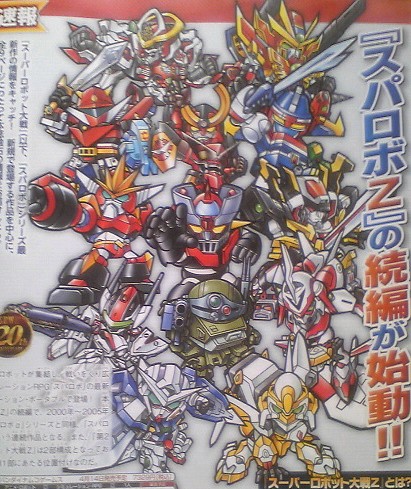
In very exciting news, Super Robot Wars Z 2 (Part 1) has been announced. Subtitled Break the World, the game has some surprising new entries into the world of SRW, from both recent and not-so-recent anime. Before I start elaborating on my thoughts concerning the lineup, I’m showing the complete series list uses for the game.
Italics means this anime has been in SRW before but was not in SRWZ.
Bold means this anime is brand new to the SRW franchise.
Muteki Choujin Zambot 3
Muteki Koujin Daitarn 3
Muteki Robo Trider G7
Space Emperor God Sigma
Space Warrior Baldios
Rokushin Gattai Godmars
Sentou Mecha Xabungle
Armored Trooper VOTOMS
Armored Trooper VOTOMS: The Last Red Shoulder
Armored Trooper VOTOMS: Red Shoulder Document – Roots of Treachery
Armored Trooper VOTOMS: Pailsen Files
Super Dimension Century Orguss
Mobile Suit Z Gundam
Mobile Suit Gundam: Char’s Counterattack
New Mobile Report Gundam W
After War Gundam X
Turn A Gundam
Mobile Suit Gundam SEED Destiny
Mobile Suit Gundam 00 1st Season
Choujuu Kishin Dancougar
Juusou Kikou Dancougar Nova
Shin (Change!!) Getter Robo: Armageddon
Shin Mazinger Shougeki! Z Saga
Earth Defense Corp. Dai-Guard
The Big O
Overman King Gainer
Choujuushin Gravion Zwei
Genesis of Aquarion
Code Geass: Lelouch of the Rebellion
Tengen Toppa Gurren-Lagann the Movie: Gurren Saga
Macross F
Macross F the Movie: The False Songstress
Psalms of Planets Eureka Seven: good night, sleep tight, young lovers
There’s a lot to talk about here, especially with shows like Code Geass, Gundam 00, and a major curveball in the form of Dai-Guard, but probably the two newest entrants which are the biggest deals are VOTOMS and Gurren-Lagann, though for somewhat different reasons.
VOTOMS hails from early 1980s and is considered among the “realest” of real robot anime. It has a grittiness to its robots and overall setting that is rarely seen in mecha, let alone anime in general, as can be seen from my reviews of the series (though I must apologize for never actually writing my final review). For years people thought it was a shoe-in for the SRW series, but when years and years went by and VOTOMS still wasn’t included, fans started coming up with excuses. Oh, maybe the robots would be too weak and bland, or Chirico would be too strong of a pilot, or it somehow wouldn’t fit in among the earth-shattering forces that populate the roster. But as if to lay those possibilities to rest, SRWZ2 puts it into the same game as Gurren-Lagann, one the biggest example of escalating power levels and over-the-top, universe-rending attacks in a robot anime ever (which is the “problem” with Gurren-Lagann), as if to say that while all of those possible reasons may have once been valid, they’re history. Sure this first part of SRWZ2 is going to avoid having to deal with the really crazy stuff, but it’s inevitably going to have to confront the big guns of Gurren-Lagann by the next game. And it’s the movie version on top of that!
I understand that the reason this lineup works is that the plot of the game is based heavily on Orguss, which involves going to different dimensions and universes, so they can even do things like have Shin Mazinger where they once had Mazinger, and the Eureka Seven movie to replace the TV series, but that’s all right. Plot was never exactly the strong suit of the SRW games, after all, as the latest anime proves.
So to conclude, various fanboyish notes:
-Can’t wait to see Zeus in action.
-Mazinger Z is going to get not one but two crazy powerful finishers. No need for the Kaiser here!
-I wonder if Zambot, Daitarn, and Trider are going to have a Final Muteki Special. Sun, Moon, and Phoenix?
-Re: Godmars – ポゥーン
-I wonder how much Dai-Guard will cost to replace if it blows up in battle?
-I’m looking forward to the VOTOMS BGM.
-I know I’m jumping the gun and putting expectations on the next game, but Amuro vs Ribbons? Hell yes.
-Setsuna F. Seiei gives the best (worst) pep talks.
-I think movie Eureka and Fyana from VOTOMS will get along swimmingly.
-I wonder if the geass will factor into gameplay in any way, shape, or form?
-Aquarion and Shin Getter better not accidentally deface the moon too much or they’re going to make Loran Cehack sad. They’ll also make Garrod upset but for a different reason.
My Anime Regions
Born and raised in the US, having studied in Japan about 5 years ago, and currently living in the Netherlands, I consider myself quite fortunate to have been on three different continents for long periods, enough to say that I wasn’t simply a tourist. The benefits have been many, but the one that is perhaps most important to me is that I’ve gained a bit of perspective on how things work differently from country to country. As an otaku, this of course applies to my pursuit of anime and manga as well, and so I want to just talk about my own firsthand experiences in this regard.
Before I go into detail though, I think it’s important to highlight a few points about myself:
First, my English is my native language, and I have studied Japanese for a number of years and am reasonably fluent in it. I cannot read any other languages to any decent extent, and I can only understand one other when spoken.
Second, my available “access points” varied from place to place, meaning television, internet, etc. Also, I was in Japan before streaming anime became a big deal, whereas currently I am living through the age of the official streaming simulcast alongside everyone else. Well, sort of, but I’ll get into that later.
United States
Now because I’m native to the United States, I’ve seen my fair share of how anime/manga and its surrounding fandom and industry have changed over time, but as I’m not looking to make this a history lesson I’m going to mainly focus on the state of obtaining anime from about 2005-2010. In that period, whether it was in college or back home, I had cable television and high-speed internet, as well as the fortune of living in a city with Japanese book stores (or at least a Japanese grocery when it came to college). I used the TV and internet to varying degrees to satiate my desire for anime, and as my Japanese improved I was encouraged to start buying manga in Japanese as they tended to be less expensive even with import mark-up, especially if they were used books.
Even ignoring the untranslated titles, anime and manga have been quite accessible, whether it’s through downloading, Cartoon Network’s (increasingly sparse) anime line-up, or just going to the Barnes & Noble to pick up a volume of something. Companies are currently trying to increase their internet presence, with more and more titles, including older ones that are no longer available otherwise, being streamed on sites such as Hulu and Crunchyroll. The genres available were and are surprisingly diverse, particularly when it comes to manga, though they don’t cover everything Japan has to offer, just because some things simply do not sell in the US (and some titles that were released certainly did not either).
It’s important to note that anime took quite a long time to get big, and it was only really with the advent of Pokemon that it became such a big deal. While it’s come quite a long way, it’s still considered quite a “niche” thing, and a lot of works which can survive in Japan based on overall higher readership there will most likely tank in the US. Anime as “anime” is still quite young compared to the rest of the world. Anime and manga are definitely accessible in the America, it just takes a bit of effort to really sink yourself in, and although it takes a while to feel the limitations in genre, you may eventually feel it. Also remember that the US is big, and that my experience can be quite different from someone living in, say, the Midwest.
Japan
In Japan I had television but no reliable internet, and while I hear that most otaku in Japan use a Tivo, I unfortunately did not own one, which meant that I had to follow the official schedule in order to keep up. While it could be trying at times, there was a certain thrill in planning my days around the TV broadcasts. The fact that Futari wa Pretty Cure Max Heart and Zoids: Genesis ran simultaneously on two different stations meant I had to choose, which is something that has never really been an issue with anime fandom in the US, at it was rare that two stations would be showing anime at the exact same time. I myself didn’t have to deal with this since the days when Pokemon would chase Digimon out of its time slots. If there was a show on late at night that I really wanted to catch, say, Glass Mask, I would go to sleep early so that I could wake up at 1 or 2am, watch it, and then go right back to sleep. I also remember getting home from a trip to Akihabara, pedaling hard as I could so that I wouldn’t miss the beginning of Gundam SEED Destiny. That also reminds me of when I had faith in Gundam SEED Destiny. Those were innocent times.
(By the way, I chose Pretty Cure).
Manga though, it’s hard to live in Japan and not see comics available for sale. In addition to larger bookstores and specialty shops, you could find the latest manga magazines in convenience stores, your Jumps and Sundays and such. While those stores didn’t carry everything, you could still find some surprising titles; it was through a convenience store that I found the Hulk Hogan manga. The ubiquity of manga was especially advantageous for just sheer exposure: by buying just a few magazines you could get a pretty wide range of works, from good to otherwise.
One unique advantage I had while in Japan was that I had access to the library of the school at which I was studying abroad, which meant access to their extensive collection of anime on DVD. Nowadays it’s not that hard to go online and find all these obscure titles, but back in 2005 this library’s DVD collection went well beyond what was fansubbed (and probably still does today), with series such as Zambot 3 and Tetsujin 28 in their entirety. I know I just picked two robot titles too, but trust me when I say there was more.
So when it came to anime or manga, despite my internet situation I probably had more titles available to me than I ever had before or since. The only trouble of course is that it’s all in Japanese, and while my Japanese is good I’m still not comfortable with it, let alone comfortable with it five or six years ago despite the rapid improvement that living in Japan itself caused. In any case, the main point to take away here is how easy it was to just be surrounded by the stuff.
The Netherlands
A few months ago, Irish anime podcaster Eeeper wrote this letter where he pointed out the difficulties in being a European anime fan, particularly in this current age where anime is officially streamed. Before I arrived in Europe, I could see his point and could agree, but it was only after I actually started living here that I could really feel it.
Having high-speed internet but no TV here, online is mainly how I watch things. When it comes to the streaming of anime, Europe seems to get left out pretty often. The entirety of Hulu is off-limits save for a single, terrible-looking show (not anime in case you’re wondering). Funimation’s video site automatically redirects to a generic company page. This is something I previously only really experienced when I couldn’t watch the official Japanese-only episodes of Bakemonogatari on their official site. It’s not all bad, as some shows on Crunchyroll work just fine. However, others do not, and you get these really odd situations, like how Naruto Shippuden is available for me to watch but the original Naruto is region-blocked. The fact that I just came from the US, where I recently watched all of Kekkaishi and Slayer Revolution (and Evolution-R) on Hulu, makes me very aware of this disparity. That said, internet here is quite fast and what I can watch I get in a flash.
Manga is a bit of a different situation. In terms of the internet, no official sites as far as I can tell have blocked their manga from European access. In terms of actual physical books, comic stores aren’t amazingly common in the Netherlands, but cities are generally small enough that you don’t need too many, and cities with more comic stores are only a short train ride away. Going to Amsterdam takes about half an hour, which is longer than it took me to get to Manhattan, and the selection of manga (as well as European comics) can be surprisingly extensive, usually taking the form of English-translated titles imported from the US or Dutch-language books. One interesting thing to note is that some titles get translated into Dutch before they are translated in English, possibly owing to the fact that manga and anime have had a strong presence in Europe way before the “anime boom” ever hit the United States. In fact, a friend told me that Urasawa’s works were available in Dutch way before they were in US bookstores. It might also have to do with the proximity to Belgium, which has its own rich comics history and influences the regions around.
On that note, one big difference with the Netherlands and Europe more generally is that everything is more packed together. While traveling by train in Japan is somewhat comparable to doing so in the Netherlands, Japan is still an island, while going from where I live to Belgium, an entirely different country, is a mere 3-hour train ride. Europe also gets a good deal of titles that the US does not, but they’re mainly for people who speak French and alas neither I nor Eeeper (I assume) are capable of this feat.
Final Thoughts
So there’s a bit of my anime experience across three countries. I of course cannot speak for every anime fan who has lived in the countries I have, let alone the countries where I have never set foot, but I hope that this post helps to bring a bit of understanding to fans around the world, to see the varying circumstances that affect our fellow fans. If you want to chime in with your own experiences for any country/area that I did not cover, feel free.
The Powder Keg That is Three-Player Mahjong
Looking to take a break from my typical online mahjong sessions without straying too far, I’ve begun dabbling in 3-Player Japanese Mahjong. It is arguably both more stressful and less stressful than 4-Player, and I wanted to just jot down my thoughts on the gameplay and dynamics of 3P mahjong.
Just to get my bias out of the way upfront, I find 3P mahjong to be inferior to 4P, and its primary strength is as a backup measure in case you can’t get a fourth player. Despite that, it is still very fun and captures much of the mahjong spirit, especially when you’re playing with some rad personages.
3P Mahjong is an incredibly volatile game, and this is primarily due to three reasons. First, is the revised role of the North (Pei) tiles. With no fourth player, North is considered a “neutral” wind, and now carries with it an additional property: if you have a Pei in your hand, you can exchange it for another tile. In doing so, you also gain an additional dora for every Pei you come across. Like all dora, these North dora cannot be the catalyst for a winning hand, but they can bolster one that’s already able to win. Incidentally, if you draw your winning tile due to exchanging a Pei, it counts as Rinshan Kaihou, only it’s better because you also have the inherent dora from the Pei itself. Rinshan Kaihou being her signature move and all, I’m sure Miyanaga Saki would have a blast with 3P.
Second, is that the game removes the Character (Man) tiles numbering 2 through 8. With only the 1-man and 9-man remaining, this makes players far more likely to draw tiles of the same suit, a high probability made even higher when you remember that there is 1 less player than normal. Honitsu (Half Flushes) are incredibly common, and the normally fairly difficult-to-achieve and more valuable Chinitsu (Full Flush) is often well within the range of possibilities. It’s also the only time I have ever seen anyone get a Honroutou (only 1’s, 9’s, and Honors) or a Chinroutou (only 1’s and 9’s), as the removal of 2-Man through 8-Man means they don’t get in the way of those hands from forming.
Third, is the fact that 3P mahjong indeed has one less player than normal, so useful tiles have a higher likelihood of reaching you. When combined with the comparative ease of forming high-value hands and the boost given by North dora, and you have the volatile scenario of which I spoke. The game almost always reaches a situation where everyone’s sitting there with an absurdly valuable hand and everyone has the tiles everyone else needs to win. Of course, that means that just as you poised and ready to declare your victory and watch your score skyrocket, so are your opponents, and greed can definitely be your undoing. Also, as everyone has a greater chance of achieving tenpai generally, if you happen to have a particularly worthless hand in a round it hurts a lot more than it does in 4P mahjong.
The game does have some factors to balance out the precariousness of 3P mahjong, namely the prohibition of stealing tiles to complete a straight (chii), and the fact that everyone starts off with 35,000 points instead of 25,000 points. The former keeps hands from being completed too easily, and the latter acts as somewhat of a buffer against the frequency at which powerful hands appear. Just to give you an idea, I actually got a yakuman (32,000 point) hand once, and I still ended up placing in 2nd by the end. Still, I feel like these countermeasures aren’t quite enough, and while I generally enjoy having luck be a factor in my games, 3P mahjong feels like it has just a little too much luck and not enough things to mitigate damage in a bad luck situation the way 4P mahjong does. It gets your blood pumping.
The last thing I want to mention is the modification to scoring, where you get more points for having someone deal into your hand than you do from drawing the tile yourself, which never happens in 4P mahjong (Ron haneman is worth 12,000 while Tsumo haneman is only 9,000). In addition to being an interesting contrast with Chinese mahjong styles where self-draw is way more powerful than winning off of someone else’s discard, it also enhances the high-pressure feeling of 3p mahjong.
 OGIUE MANIAX