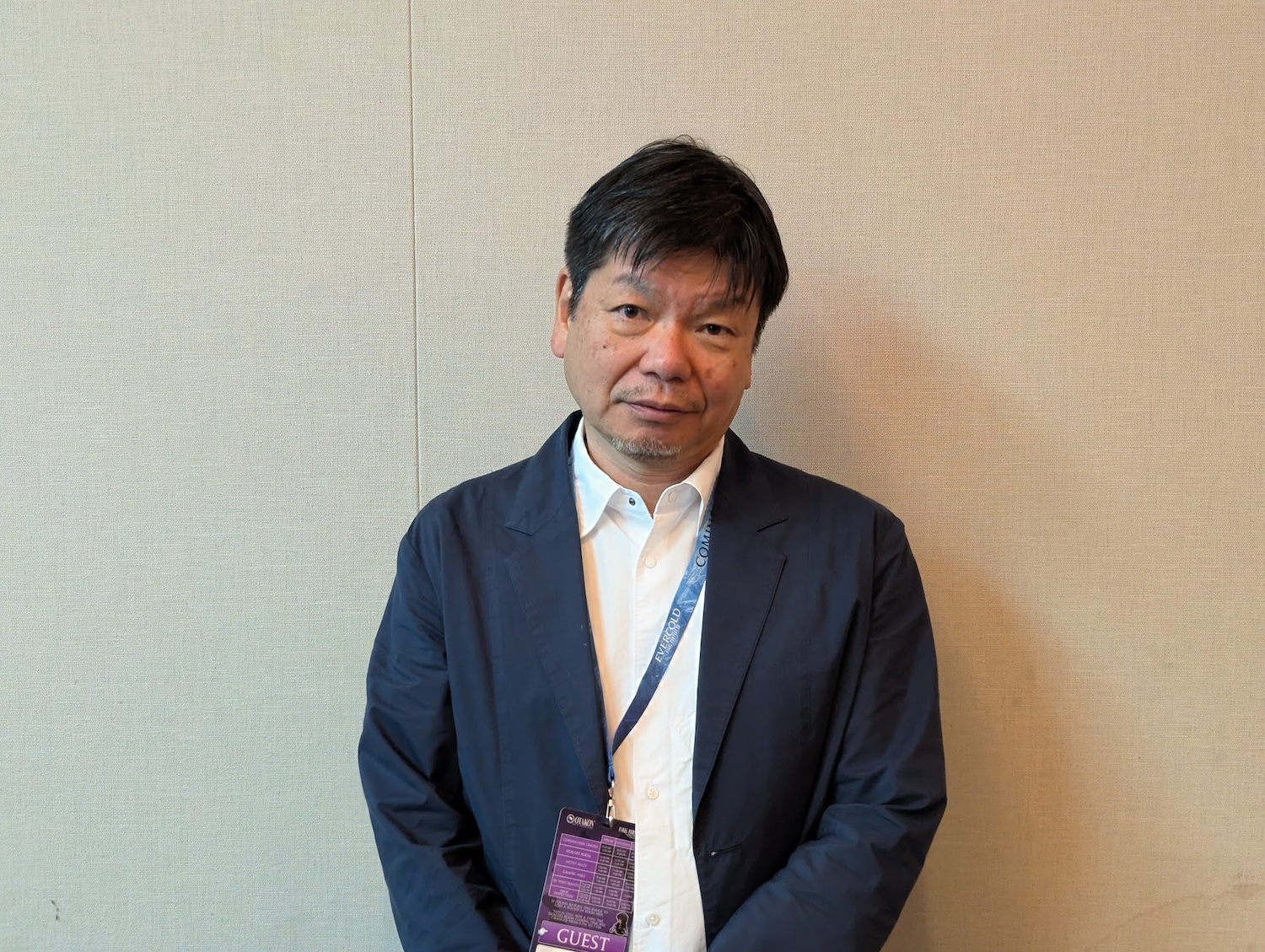
Otakon 2026 Interview: Studio BONES Co-Founder Minami Masahiko

Minami Masahiko is one of the founders of Studio BONES and was at Otakon to promote an upcoming 2027 Okinawa Animation Festival, scheduled for January 29–31. This interview was conducted on July 31, 2026.

Thank you for this interview. You are one of the founders of BONES, but you had a long career before that as well.

You—or rather, a version of you—appears in the drama Aoi Honoo. Have you seen it before, and what did you think of your depiction?

This is a live-action drama series based on a manga, and the author is Shimamoto Kazuhiko-sensei, a classmate of mine in my college years. I heard from him that I should treat it as fiction based on our time in college, and I think it should be viewed as fiction. Some parts are exaggerated.

The original Eureka Seven is one of my favorite anime, and I’ve had the opportunity to interview both Director Kyoda and Kawamori Shoji. But I wanted to hear your perspective as to what it was like to bring this project together.

I originally worked for Sunrise, which created a lot of original robot animation, and later on I worked as a producer on Mobile Fighter G Gundam. Building original robot animation myself is something I find very fulfilling, and when it comes to making a year-long series, I find it’s extremely important to collaborate with lots of different people.

Speaking of Sunrise, you worked as a producer on various titles, and I wanted to know what it was like for you working with Director Tomino, Director Imagawa, and Director Takahashi Ryousuke

First, when it comes to Director Tomino and Zeta Gundam, I only worked in production management for one episode. For G Gundam, I worked as producer, and for Layzner, I actually worked on production management but was also rotating that role with different teams.

To give a little bit more context, back during this period, the vital thing about original robot animation was the “plastic model/toy/merchandising” model So it was important to understand two pillars/aspects, as a toy product but also as an original work. What’s really memorable is that all three of these directors took this challenge very seriously.

It seems you worked the most with Director Imagawa. Would you be able to explain in detail how he dealt with this balance?

Back with G Gundam, this was the era of laser disc and DVDBlu-ray hadn’t come out yet. But while we had to think about the business of packaging the show for those formats, shows were produced fundamentally with the television broadcast in mind. G Gundam‘s big sponsor was Bandai, and when it came to a work with the “Gundam” name, it was a matter of when the next Gundam would come out. G Gundam is a Gundam with a lot of Gundams from all over the world, and the timing with which they appeared was tied up with when the merchandise would be available. Within that, Director Imagawa is a man with a lot of great ideas, and he was focused on how to insert originality and drama into the story’s setting.

I have one more question: From a producer standpoint, what is the advantage of doing an original work over an adaptation?

First off, when it comes to works based on something, originality is derived from the creators So when we work on animated adaptations of existing work we have to think about how we can maximize the appeal of the work in animation through artistic and creative expressions. That’s our top priority.

On the other hand, when it’s our wholly original work, the sense of originality lies with us as the creators. We think about how to incorporate the appeal of animation as we proceed with the project planning—how we can incorporate the themes and also how we as the project creators can more effectively convey the work through animation.

Thank you!

The Mystery of Ivrogne

Of all the characters in Star Driver, Nichi Keito, alias Ivrogne, has intrigued me the most. With the revelations about her in episodes 17 and 18, I feel like my attention towards her is pretty justified. Before the next episode hits and we learn even more, I want to look at some of the elements to her that made her stand out as a character worth attention, even before the most recent episodes. Before I begin though, I want to state that I am not going to be scrutinizing every little detail about her character by combing through prior episodes. Nor I am trying to shed light on any obscure hints. This is more my observations from watching the show every week, and noticing her behavior somewhat in passing and how it piqued my interest. Naturally, there are spoilers in this post. Continue reading

Xam’d: Lost Memories is More than a Title

Xam’d: Lost Memories is a very ambitious show by BONES, the studio behind Eureka Seven and Full Metal Alchemist. The story follows a teenage boy named Akiyuki who, caught in the middle of a war which spans both the technological and the mystical, gains the ability to transform into a mysterious creature known as a “Xam’d of the Lost Memories.”

Though the show was originally aired on the Sony Playstation Network around the world, it recently received a TV broadcast in Japan with entirely new opening and ending themes. Whether DVDs will be available in the US is uncertain.

Xam’d is a very divisive show and there are two reasons for this split in opinion from those who have seen Xam’d. First, world-building and plot development occur at the same pace. Second, you are never given a comprehensive view of that world or its characters.

Xam’d and Eureka Seven share much of the same staff and even the same character designer, Yoshida Ken’ichi. As such, I am going to be comparing the two in order to further illustrate my points. When Eureka Seven presents its story, it first sets up the world and its characters, giving you a rough sense of what is “normal” and how everything works before it begins to tell its grand narrative. Once the “real” story begins, you have a strong understanding of how and why the world works and what the character’s motivations are. A solid foundation is built so that its story can be that much bigger, and by the end the story encompasses the entirety of the world in which it takes place.

Xam’d on the other hand thrusts you right into the story with little to no set-up or understanding of what is supposed to be going on. Episode 1 puts the main character in the middle of a violent battle, but you the viewer are unable to make a distinction between which side is which as the show does not inform you of any possible identifiers to differentiate nations or armies. It is only episodes down the line that you are made aware of the distinguishing features and pasts of the nations at war, but it doesn’t flash back to the first episode to make it clearer to you, nor does it ever actually explicitly mention it. This is how story development works in Xam’d. Rather than setting up the world and telling a story through it as Eureka Seven would, Xam’d instead tells the viewer about the world only when it’s needed to understand what is going on in the main plot. To put it differently, any time you learn about the history of the world and characters in Xam’d, it directly correlates to something vital in the actual story. Past and present are revealed simultaneously.

Even then however, you as the person watching this show are never given a full understanding of anything that’s going on. Unlike E7, the characters always know much more about anything than you. As a result, many actions that occur in the show can come as a surprise, and many details have to be inferred. It is also very different from a mystery, where you know very little and gradually learn more until you understand everything. That feeling of confusion will remain with you throughout the show. While you are made aware that the world of Xam’d is complex, you are rarely shown any of its complexities, and though the world is vast, the story told in Xam’d concerns only a small part of it, and of that fragment you are only ever allowed to view it from a distance or through blinders.

Whether handing over the reins of imagination is a brilliant move or a hopelessly imbecilic one on the part of the show and its creators is the main contention between supports and detractors of Xam’d. “Lost Memories” is more than a part of the title, as it not only describes an important aspect of the story, but it also hints at the nature of the storytelling itself. Whether you will want to keep watching is heavily predicated on how much you enjoy the incomplete and fractured view that the series gives you from beginning to end, but I would recommend it anyway just so you can be exposed to a different sort of narrative style.

A Guide to the Characters of Xam’d: Lost Memories

Takehara Akiyuki

Nishimura Haru

Nakiami

Teraoka Furuichi

Nazuna

Kakisu Toujirou

Benikawa Ishuu